


 Travel guide
The overall investment depends on the kind of journey you want: how long you stay, where you stay, how comfortably you travel, how much privacy you prefer, and how deeply you want to explore.
A short, practical journey and a longer private exploration may both take you to the Sundarbans, but they can offer very different experiences.
So instead of asking only, “How much does a Sundarban trip cost?”, it is more useful to ask:
“What kind of Sundarban experience do I want?”
Once you understand the factors that shape a journey, it becomes much easier to choose the right balance of time, accommodation and comfort.
What Determines the Cost of a Sundarban Journey?
There are four main factors to consider:
- Duration
- Accommodation
- Level of comfort
- Privacy and how the journey is organised
Transfers, boat arrangements, meals, guiding and required permits also form part of a well-planned journey.
But among all these factors, duration deserves particular attention.
In the Sundarbans, more time does not simply mean more nights. It can mean more opportunities to understand a landscape that changes constantly with the tide.
How Many Days Do You Need in the Sundarbans?
- For a first-time traveller, 4 days is an ideal duration for an introduction to the Sundarbans.
- For travellers who want a deeper, slower exploration, 6–7 days can be far more rewarding.
Why 4 Days Is Better Than 3 Days for a First Visit
A three-day Sundarban trip can work for travellers with very limited time, but it can also feel rushed.
The journey itself involves travelling from Kolkata towards the Sundarbans, moving through the waterways, settling into your accommodation and spending meaningful time exploring the forest and surrounding landscape.
Trying to compress all of that into three days leaves little breathing space.
Four days gives a first-time traveller a better rhythm.
You have enough time to settle into the landscape, spend meaningful periods on the waterways, explore the mangrove environment, look for wildlife and birds, and experience the destination without constantly feeling that the return journey is approaching.
For a first introduction, four days provides a much better balance between time, exploration and comfort.
It is long enough to experience the character of the Sundarbans without making the trip unnecessarily long.
Why 6–7 Days Is Ideal for Deeper Exploration
See it for yourself
A private journey shaped around you — your group, your pace, your interests. Book a free consultation.
If four days introduces you to the Sundarbans, six to seven days allows you to slow down and explore it more deeply.
And slow travel is particularly important here.
The Sundarbans does not operate according to a tourist timetable.
The landscape changes with the tides. Water levels rise and fall. Wildlife may appear for only a few moments—or remain hidden all day. Birds become active at different times. A quiet creek can suddenly become interesting, while another stretch may offer nothing visible at all.
That unpredictability is part of the experience.
With six or seven days, you have more room to:
- Spend longer periods on the waterways
- Experience the landscape under different tidal conditions
- Explore at a less hurried pace
- Spend more time observing birds and wildlife
- Appreciate the smaller details of the mangrove ecosystem
- Experience the surrounding human landscape
- Allow unexpected wildlife encounters to happen naturally
You stop chasing a checklist and start experiencing the forest.
Why the Sundarbans Rewards Slow Travel
Travellers often associate extraordinary wildlife journeys with places such as the Galápagos, the Amazon or the great African wildernesses.
The Sundarbans deserves the same sense of curiosity.
It is the world’s largest mangrove forest and an exceptionally dynamic tidal ecosystem, where land, water and forest are continuously interacting. UNESCO describes the Indian Sundarbans as a landscape shaped by tidal processes, with an extraordinary diversity of terrestrial and aquatic life.
The tiger is only one part of that story.
A Sundarbans journey can reveal a Royal Bengal Tiger swimming across a tidal channel, an Osprey hunting over the water, a White-bellied Sea Eagle above the mangrove canopy, or one of the region’s remarkable kingfishers appearing briefly along a creek.
Recent Sundarban Bird Festival records documented seven kingfisher species, including Common, Brown-winged, Stork-billed, White-throated, Black-capped and Collared Kingfishers, among others.
The waterways can also hold the possibility of a Ganges River Dolphin surfacing briefly.
And then there is the smaller world.
Crabs, mudskippers, fish, frogs, snakes, snails and other creatures occupy an ecosystem where the normal boundaries between land and water seem to disappear.
The Sundarbans is also one of the few places where you can appreciate how completely a tiger has adapted to a watery environment. Sundarbans tigers are capable of swimming long distances and are known to prey on fish, crabs and water monitor lizards.
None of these encounters can be scheduled.
That is precisely why time matters.
The longer you stay, the more opportunities you create to notice what a hurried traveller may miss.
Accommodation: From Simple to Premium
Accommodation is another major factor in determining the overall investment.
The Sundarbans offers different levels of accommodation, allowing travellers to choose according to their expectations and priorities.
Simple and Practical
A simpler stay can suit travellers who care more about exploration than accommodation.
The focus is straightforward: a comfortable place to rest, essential facilities and an opportunity to remain close to the local environment.
For a traveller whose priority is wildlife and exploration, this can be a sensible choice.
Comfortable Nature Stays
Travellers who want a better balance between exploration and comfort can choose more comfortable nature-oriented accommodation.
This can be particularly suitable for:
- Couples
- Families
- First-time travellers
- Travellers who prefer a more relaxed stay after a day on the waterways
Eco-Village Experiences
An eco-village stay offers a different perspective.
Instead of treating accommodation simply as a room for the night, it can bring you closer to the local landscape and community.
For travellers interested in understanding the Sundarbans beyond wildlife, this can become an important part of the journey.
Premium Accommodation
For travellers who place greater importance on comfort, premium accommodation can be chosen where available.
But there is an important point to remember:
A more expensive room does not automatically create a better Sundarban experience.
If wildlife, birding and exploration are your priorities, additional time in the landscape may be more valuable than moving to a higher accommodation category.
The right choice depends on what matters most to you.
Comfort, Privacy and the Way You Travel
The cost of a Sundarban journey also changes according to how much convenience and privacy you want.
A shared arrangement can be practical for travellers who are comfortable following a common schedule.
A private journey offers greater control over the pace and structure of the experience.
That can be especially valuable for:
- Couples seeking privacy
- Families travelling together
- Groups of friends
- Wildlife enthusiasts
- Photographers
- Travellers who prefer not to rush
Private travel does not necessarily mean luxury.
It means the journey can be shaped around your group.
- For a photographer, that may mean greater patience.
- For a family, it may mean a more comfortable rhythm.
- For a couple, it may simply mean having the waterways and accommodation experience organised around them rather than around a larger group.
What Forms Part of a Well-Planned Sundarban Journey?
When comparing different journeys, look beyond the accommodation or headline price. A properly coordinated Sundarban journey may bring together:
Kolkata-to-Kolkata Transfers
Getting to and from the Sundarbans is part of the experience. A coordinated transfer removes unnecessary logistical complications.
Boat
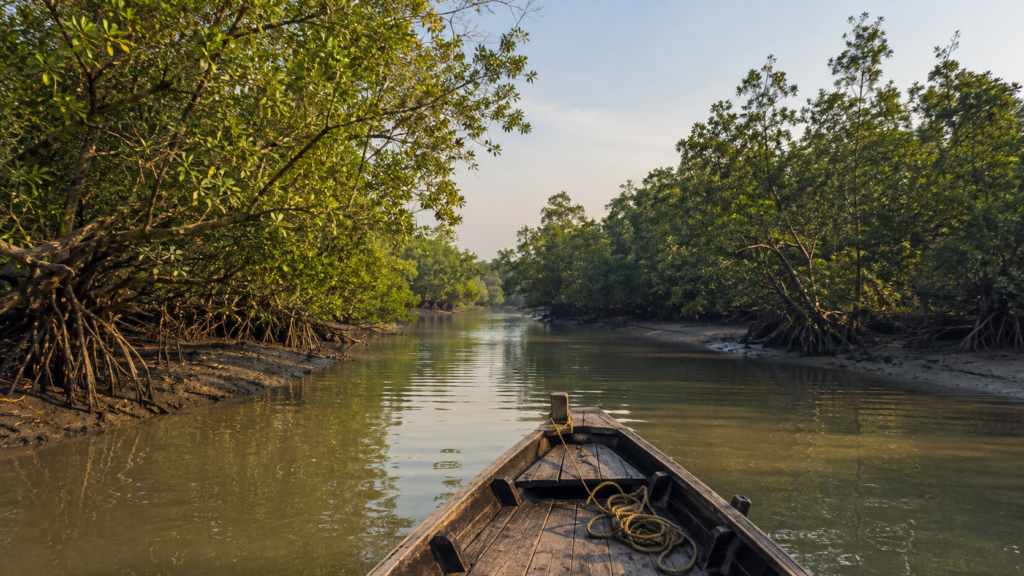
The waterways are central to experiencing the Sundarbans. The boat is not merely transportation—it is your window into the tidal landscape.
Accommodation
The choice can range from simpler stays to comfortable, premium and eco-village options, depending on what is available and appropriate for the journey.
Meals
Meals can be arranged as part of the journey so that travellers do not have to coordinate food around every day’s exploration.
Guide or Naturalist
Knowledgeable guiding can add considerably to the experience by helping travellers understand wildlife behaviour, birds, mangroves, tides and the wider ecosystem.
Permits and Required Formalities
The protected forest areas operate under specific regulations. Required permits and formalities should be properly handled as part of an organised journey.
The value of a well-planned journey is therefore not only in individual components.
It is in how those components work together.
How to Choose the Right Sundarban Journey
Instead of comparing journeys only by cost, compare the experience they provide.
Ask yourself how much time you have.
If this is your first visit, four days is our preferred duration for a well-paced introduction.
If you want to explore slowly and give yourself more opportunities for wildlife and bird observation, six to seven days is the stronger choice.
Consider where you want to spend your investment.
Would you rather have:
- Simpler accommodation and more time exploring?
- More comfortable accommodation and a balanced itinerary?
- Premium accommodation with greater comfort?
- A private journey designed around your group?
There is no universally correct answer.
Look at the boat experience.
The Sundarbans is experienced largely from its waterways. Time spent moving through creeks, rivers and forest edges is an essential part of the journey.
Consider privacy.
If you value flexibility and want the journey to move according to your group’s preferences, private travel can make a meaningful difference.
Look at the pace.
This may be the most important question of all.
Does the itinerary give the Sundarbans enough time to reveal itself?
The Wild Orbit Expert Advice
Don’t Start With the Price. Start With the Experience.
Our advice is simple: Decide what you want from the Sundarbans before deciding how much you want to spend.
For a first-time traveller, we recommend four days.
Three days can work, but the experience is more likely to feel compressed. Four days gives you enough breathing space to settle into the landscape, experience the waterways and explore without making every hour feel like a race against the clock.
If you already know that you want more than an introduction, consider six to seven days.
The longer duration allows you to slow down.
And the Sundarbans rewards patience.
A tiger may not appear. But while waiting, you may discover an Osprey hunting over a creek, a kingfisher sitting quietly on a branch, a dolphin surfacing in the distance, a sea eagle crossing the sky, or something as small as a crab moving through the mangrove roots.
That is the difference between visiting the Sundarbans and spending time in the Sundarbans.
- If wildlife is your priority, consider giving more value to duration and time on the waterways rather than simply upgrading your room.
- If comfort is important, choose accommodation that makes you feel relaxed after a day of exploration.
- If privacy matters, a private journey can be worth prioritising.
And if you want to understand the Sundarbans properly, allow time for its human landscape as well. This is not an uninhabited wilderness. Communities have developed their lives and livelihoods around a delta shaped by tides, rivers and forests. The relationship between people and this environment is part of what makes the Sundarbans distinctive.
Most importantly: Do not treat the Sundarbans as a checklist destination.
It is a place to observe, wait, listen and notice.
The reward is not always the biggest wildlife sighting.
Sometimes it is simply understanding the extraordinary ecosystem around you.
So, What Does a Sundarban Journey Really Cost?
There is no universal answer. The overall investment depends on the experience you choose.
- Duration determines how deeply you can explore.
- Accommodation determines where and how comfortably you rest.
- Comfort and privacy influence how the journey is organised.
- Boat time determines how much of the tidal landscape you experience.
- Guiding, meals, transfers and permits determine how much of the journey is coordinated for you.
For a first-time visitor, four days is an excellent introduction. For travellers looking for a slower and deeper exploration, six to seven days can be considerably more rewarding.
The right journey is not necessarily the most expensive one. It is the one where your time, comfort, curiosity and expectations are in balance.
Explore The Wild Orbit Private Journeys
The Wild Orbit organises private, all-inclusive Sundarban journeys from Kolkata to Kolkata, bringing together the essential elements of the expedition in one carefully coordinated experience.
Transfers, accommodation, meals, boat, expert guiding, permits and essential local logistics are organised as part of the journey, allowing you to focus on experiencing the Sundarbans rather than coordinating its moving parts.
Whether you want a well-paced four-day introduction or a longer six-to-seven-day exploration, your journey can be shaped around the experience you want from the Sundarbans.
Plan your private Sundarban expedition
A private journey shaped around you — your group, your pace, your interests. Book a free consultation.