

 Travel guide
There is a brief period every year when the Sundarbans become a forest of flowers, bees and boats.
As the mangroves bloom, wild giant honey bees move through the forest collecting nectar. On the waterways, traditional honey collectors known as Moulis prepare to enter the mangroves. Their destination is not a managed apiary but wild bee colonies hidden inside one of the world’s most challenging tidal forests.
This is the Sundarban honey collection season.
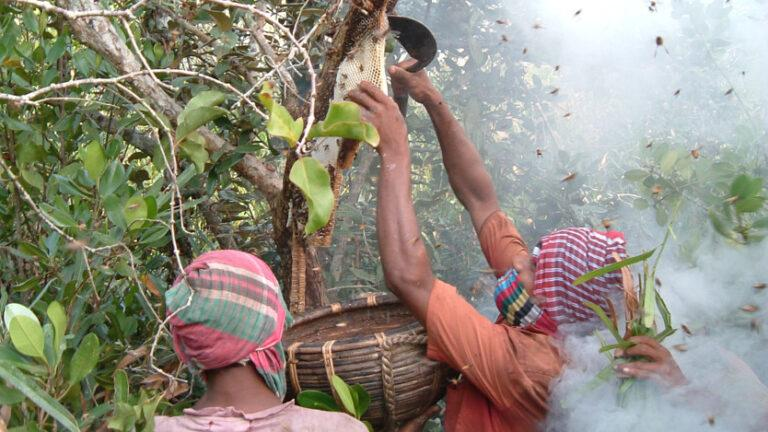
For the Indian Sundarbans, the Sundarban Tiger Reserve identifies April and May as the principal months for collecting honey and beeswax. The ecological honey-flow period begins earlier, with flowering starting around the end of March and continuing through the following months.
But the story of Sundarban honey is much bigger than a harvesting calendar.
It connects mangrove flowers, wild bees, traditional knowledge, local livelihoods, Forest Department regulation, Royal Bengal Tigers, tiger widows, GI heritage and conservation.
And that is what makes this honey unlike an ordinary jar on a supermarket shelf.
Sundarban Honey Collection Season at a Glance
| Question | Answer |
| When is Sundarban honey collected? | Primarily April and May in the Indian Sundarbans |
| When does flowering begin? | Khalsi begins flowering around the end of March |
| Which bee produces the wild honey? | Mainly Apis dorsata, the giant/rock honey bee |
| Which flower is especially prized? | Khalsi (Aegiceras corniculatum) |
| Who collects the honey? | Traditional honey collectors known as Moulis |
| Can one colony provide more than one harvest? | Potentially, if the colony is left sufficiently intact and conditions permit |
| Can anyone enter the forest to collect honey? | No. Collection in regulated forest areas requires Forest Department permission |
| Why is collection dangerous? | Moulis enter tiger habitat and face wildlife, tidal and environmental hazards |
| What are Bagh Bidhoba? | Women whose husbands have been killed by tigers are locally described as “tiger widows” |
| Does Sundarban Honey have GI registration? | Yes. It is a registered Geographical Indication product in India |
| What is Mouban? | A government-linked marketed honey associated with Sundarban honey |
When Is the Sundarban Honey Collection Season?
The official Sundarban honey collection season in the Indian Sundarbans is primarily April and May.
The timing follows the flowering cycle of the mangrove forest. According to the Sundarban Tiger Reserve’s conservation plan, flowering begins with Khalsi (Aegiceras corniculatum) around the end of March, followed by flowering in plants such as Acanthus ilicifolius, Avicennia, Sonneratia apetala and Rhizophora. The main flowering period continues through April and May.
This distinction is important.
The flowering season and the officially regulated collection season are not exactly the same thing.
The forest may begin offering nectar before the main collection period, while the Forest Department’s regulated honey and beeswax collection is identified by STR as taking place during April and May.
So if you are asking: “When is the best time to see the Sundarban honey season?”
The answer is generally April–May, when the mangrove flowering season and regulated honey collection overlap.
Why Does the Sundarban Produce So Much Honey During These Months?
The answer starts with flowers.
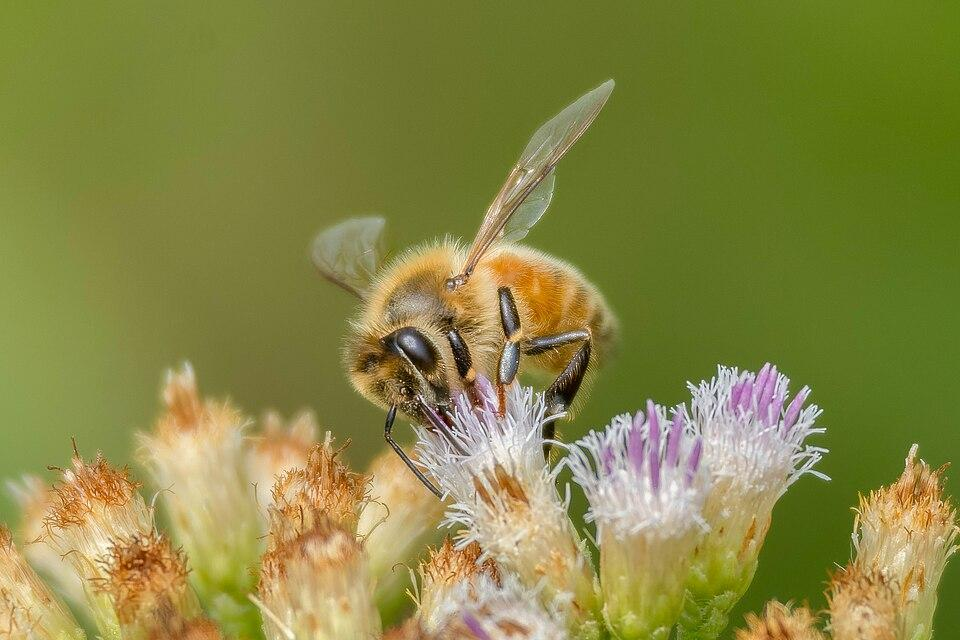
Mangroves are not simply trees growing beside salty water. During their flowering period, they become an enormous seasonal source of nectar and pollen.
The Sundarban Tiger Reserve identifies several important flowering plants associated with honey production, including Khalsi, Goran, Gewa, Keora, Baen, Kankra and Garjan.
The sequence creates a natural chain: Mangrove flowering → nectar availability → bee foraging → honey accumulation → seasonal harvest
This is why the Sundarban honey season is fundamentally an ecological event. It is not a date chosen simply because honey collectors traditionally prefer April and May.
The forest itself determines when the opportunity appears.
Which Flower Produces the Best Sundarban Honey?
If one flower deserves special recognition, it is Khalsi.
Khalsi, scientifically known as Aegiceras corniculatum, is one of the important nectar-producing mangrove plants of the Sundarbans.
The Sundarban Tiger Reserve specifically states that Khalsi gives the best honey and describes honey from Khalsi as one of the best-quality honeys found in West Bengal.
The STR conservation plan even notes a distinctive ecological feature of Khalsi: its salt-excretory glands are associated with nectar availability, and the document records a particularly high density of these glands.
But there is an important point to remember: Sundarban honey is not always Khalsi honey.
Wild bees forage across multiple mangrove species. The floral composition can therefore influence the aroma, flavour and characteristics of different honey collections.
So Khalsi is particularly prized, but the broader identity of Sundarban honey comes from the complex flowering landscape of the mangrove ecosystem.
The Bee Behind Sundarban Wild Honey
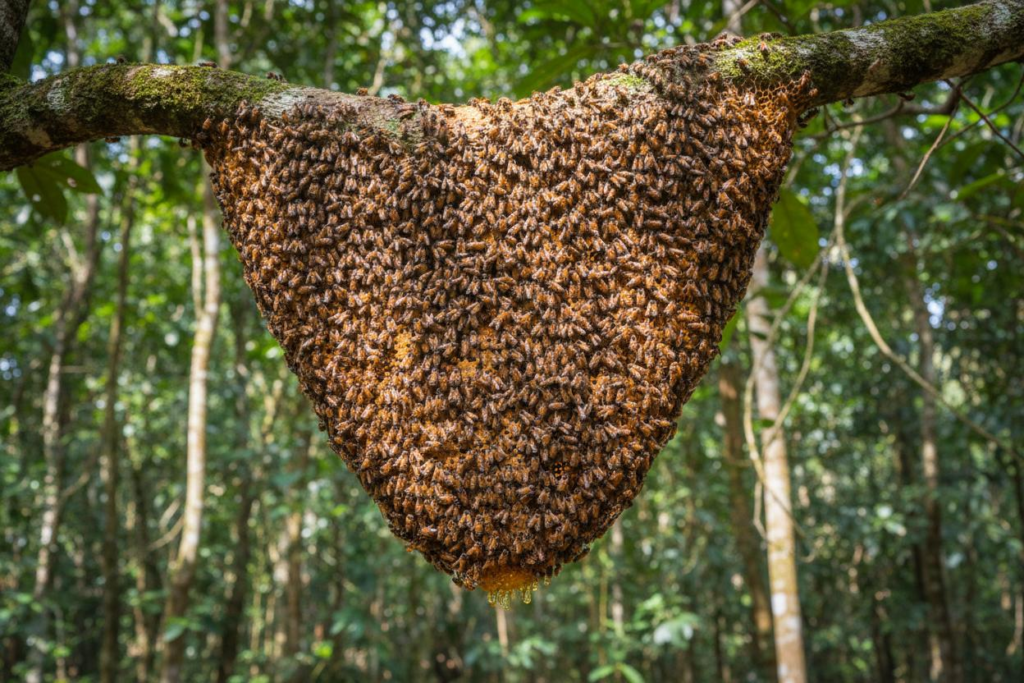
The main character on the other side of this story is the giant honey bee, Apis dorsata.
Often called the rock bee, Apis dorsata is a wild honey-producing bee associated with the Sundarbans.
The Sundarban Tiger Reserve describes rock bees visiting the forest during the flowering season.
Unlike honey production in a conventional commercial apiary, traditional Sundarban honey collection involves finding wild colonies in the forest.
The relationship is remarkable:
- The mangroves bloom.
- The bees arrive and forage.
- The colony stores honey.
- The Moulis search for productive colonies.
And then the forest becomes a workplace.
Who Are the Moulis of the Sundarbans?
The traditional honey collectors of the Sundarbans are known as Moulis, with variations including Moule and Moulay appearing in different sources.
Their knowledge is highly specialised.
A Mouli needs to understand the forest well enough to identify productive colonies, interpret the movement of bees and coordinate the collection team.
Historical ethnographic research describes Moulis as skilled in identifying good beehives by observing the direction in which bees fly and in cutting the honeycomb and collecting honey.
This is not simply honey harvesting.
It is traditional ecological knowledge.
The collector needs to know the bees, the trees, the tides and the forest.
And there is one more thing every Mouli must know: when it is time to leave.
How Is Honey Collected From the Sundarbans?
Traditional wild honey collection is a coordinated activity.
A simplified sequence looks like this:
Forest permission
↓
Boat journey into the forest
↓
Search for productive wild colonies
↓
Approach the hive
↓
Use traditional smoke-based techniques to manage the bees
↓
Harvest the honey-bearing portion of the comb
↓
Leave sufficient colony structure for the bees
↓
Return with honey and beeswax
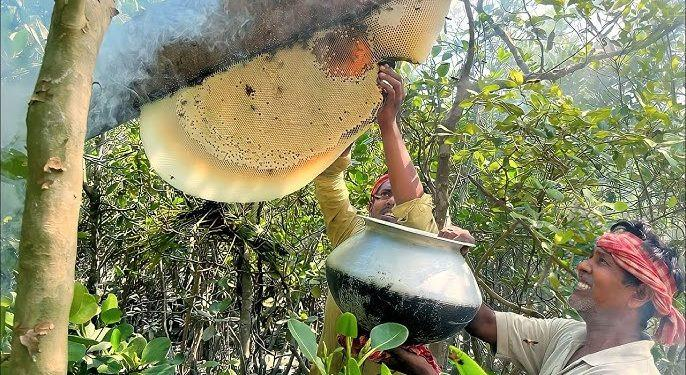
The Forest Department’s conservation documentation describes smoke being used to facilitate honey collection and explains that honey collection is an important seasonal activity carried out by Moulis.
The process is carried out within a difficult environment where even a few minutes around a wild colony can become dangerous.
Can One Sundarban Honeycomb Be Harvested Twice?
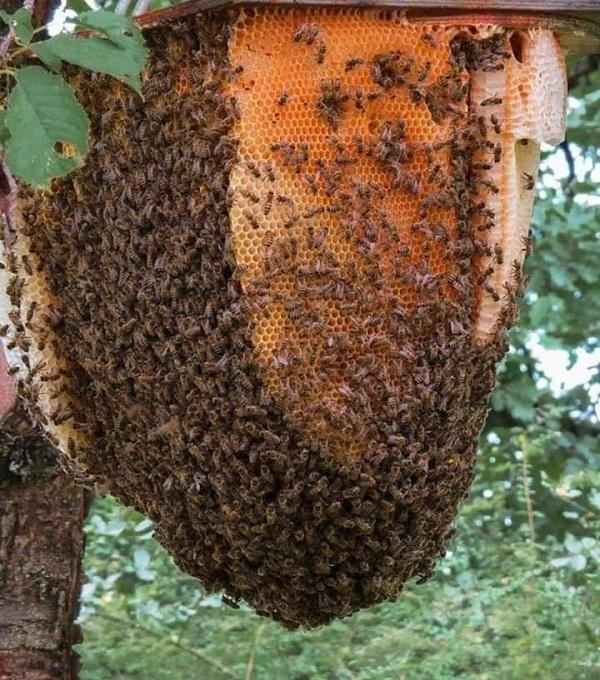
Here is one of the lesser-known facts about traditional honey collection.
A productive colony can potentially provide more than one harvest during a season.
The key is what happens during the first harvest.
If sufficient colony and brood structure is left intact, the bees can continue working and replenish honey stores.
Accounts of Sundarban honey collection describe repeat harvesting after an interval of roughly 10–20 days, although the exact timing depends on the colony, flowering conditions, weather and the collection method.
So it is better to think of this as: one colony, potentially multiple harvest opportunities rather than assuming that every hive can always be harvested twice after exactly 15 or 20 days.
This is also why harvesting technique matters. The objective is not simply to take as much honey as possible.
The bees must survive for the forest to produce another harvest.
Can Anyone Enter the Sundarbans to Collect Honey?
No.
Honey collection in regulated areas of the Indian Sundarbans is not an unrestricted activity.
The Sundarban Tiger Reserve officially identifies honey and beeswax as minor forest produce and states that it issues permits for honey collection every year. The collected honey is deposited at different STR godowns for storage and subsequent disposal through the West Bengal Forest Development Corporation Limited.
The STR conservation plan further describes a regulated system in which permits are issued after decisions concerning the minimum support price, with each permit allowing a specified group of collectors to enter the forest. It also describes Forest Department arrangements during the collection period, including floating camps, armed staff, radio communication and speedboats for monitoring and emergencies.
That means honey collection is simultaneously a traditional livelihood and a regulated forest activity.
Why Does the Government Regulate Honey Collection?
There are two obvious reasons.
Protecting the forest
The Sundarbans is a protected mangrove ecosystem. Forest resources cannot simply be harvested without management.
Protecting the collectors
Moulis are entering dangerous wildlife habitat.
The STR conservation plan describes Forest Department arrangements for emergencies such as tiger attacks and snake bites during the collection period.
This makes the permit system more than a bureaucratic formality. It is part of managing the relationship between people + wildlife + forest resources.
The Risks of Entering the Sundarban Forest
The phrase “honey collection season” can sound peaceful.
The reality can be anything but peaceful.
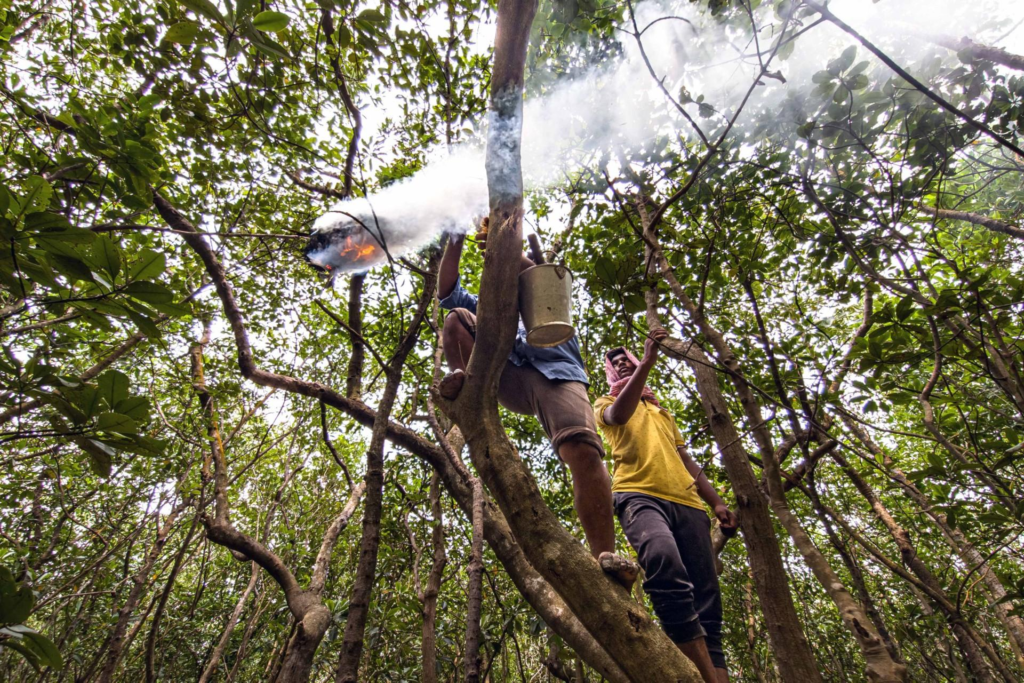
Traditional honey collectors enter an ecosystem containing:
- Royal Bengal Tigers
- Estuarine crocodiles
- venomous snakes
- defensive wild bees
- deep mud
- tidal creeks
- rapidly changing water levels
- heat and humidity
- storms and difficult weather
The most serious threat is the Royal Bengal Tiger.
Honey collection takes place inside tiger habitat, meaning Moulis are effectively entering the home territory of one of the world’s most formidable predators.
Research describes honey collection as a highly dangerous occupation because collectors face tiger attacks, snake bites and climatic hazards.
WWF-India has also described wild honey collection as a livelihood that exposes Moulis to serious human–tiger conflict.
This is why calling Sundarban honey simply “wild honey” doesn’t tell the whole story.
It is wild in origin and the people harvesting it enter a genuinely wild environment.
Bidhoba Gram: The Tiger Widows of the Sundarbans
There is a human cost behind the danger.

Some men who enter the Sundarbans for forest-based livelihoods do not return. Their wives may suddenly become the sole providers for their families. These women are known in local usage as Bagh Bidhoba, meaning “tiger widows.”
The term Bidhoba means widow, while Bidhoba Gram is used in some contexts to describe communities or villages associated with large numbers of widows.
The expression Bidhoba Gram should not be confused with an official administrative name unless a specific government source establishes that status.
The story is painful because honey collection is not merely an individual adventure.
- A forest journey can affect an entire household.
- A man leaves with a boat and a team.
- A family waits.
And sometimes, the boat returns without him.
Bonbibi: The Guardian Who Travels With the Moulis

The relationship between the people and the Sundarbans is not only economic.
It is cultural and spiritual.
Before entering the forest, traditional forest workers have long invoked Bonbibi, a revered protective figure associated with the Sundarbans.
For people whose livelihoods depend on entering tiger habitat, such traditions express something deeply practical:
The forest must be respected.
Bonbibi represents more than religious tradition in this context.
She is part of the cultural relationship between people and a forest that can simultaneously provide:
- honey
- fish
- livelihood
- shelter
and danger.
The Moulis therefore carry more than equipment into the forest. They carry generations of knowledge, belief and caution.
Why Is Sundarban Honey Famous?
Sundarban honey is famous because several unusual qualities come together in one product.
1. It comes from a unique mangrove ecosystem
See it for yourself
A private journey shaped around you — your group, your pace, your interests. Book a free consultation.
The bees forage among the flowering plants of a vast tidal mangrove forest.
2. It is associated with wild Apis dorsata
Traditional honey collection revolves around wild giant honey bee colonies rather than ordinary commercial hive production.
3. Khalsi honey is especially prized
The Sundarban Tiger Reserve specifically identifies Khalsi as producing some of the best honey.
4. The floral sources are diverse
Khalsi, Goran, Gewa, Keora, Baen and other mangrove plants contribute to the nectar landscape.
5. It has a distinctive mangrove character
The Sundarban Tiger Reserve describes its natural mangrove honey as having a strong aroma and flavour associated with mangrove flowers.
6. It has a powerful cultural story
Moulis, traditional knowledge, boats, Bonbibi and the dangers of the forest are all part of its heritage.
7. It has formal geographical recognition
Sundarban Honey is a registered Geographical Indication product in India.
The official GI record lists:
- GI Application: 769
- Product: Sundarban Honey
- Applicant: West Bengal Forest Development Corporation Limited
- Certificate: 540
- Certificate date: 2 January 2024
- Class: 30 — Foodstuffs
- Geographical area: West Bengal
This GI recognition gives Sundarban Honey an official geographical identity beyond its popular reputation.
From the Mangrove to the Market
The story doesn’t end when the Moulis return from the forest.
The Sundarban Tiger Reserve states that collected honey is deposited at designated STR godowns before being handed over to the West Bengal Forest Development Corporation Limited for subsequent disposal.
This creates a journey that can be traced all the way from the forest:
Mangrove flower
↓
Wild Apis dorsata colony
↓
Honeycomb
↓
Mouli
↓
Forest Department-regulated collection
↓
Storage and processing
↓
Market
The West Bengal Forest Development Corporation has also marketed refined Sundarban honey under the name Mouban.
So when people talk about Sundarban honey, they are talking about both a natural product and a wider social, governmental and economic system surrounding it.
How Much Honey Does the Sundarban Produce?
Official figures show that honey collection can vary dramatically between years.
Reported Sundarban Tiger Reserve figures include:
| Financial Year | Actual Honey Collection |
|---|---|
| 2020–21 | 389 kg |
| 2021–22 | 3,649.7 kg |
| 2022–23 | 12,000 kg |
| 2023–24 | 25,575 kg |
| 2024–25 | 19,900 kg |
The figures demonstrate an important ecological reality: There is no guaranteed annual honey harvest.
The quantity collected can change with flowering, bee activity, weather and other conditions.
In 2023–24, the reported STR collection reached 25,575 kg, exceeding the stated 25,000 kg target for that year.
The following year, collection fell to 19,900 kg.
The numbers themselves tell us that the Sundarban honey season is dynamic rather than predictable.
What Determines the Quality of Sundarban Honey?
“Wild” does not automatically mean “high quality.”
Honey quality can be measured using scientific parameters.
The Sundarban Tiger Reserve’s documented grading criteria identify moisture content as an important factor in determining the quality and value of crude honey.
The cited criteria classify:
- A Grade: up to 23% moisture
- B Grade: 23–26%
- Above 26%: rejected
This gives us a more meaningful way to discuss honey quality than making unsupported claims about purity or health benefits.
The character of Sundarban honey also reflects its floral origin and geographical environment.
Can Honey Collection Be Made Safer?
This is one of the most important questions for the future.
If honey collection provides an income but entering tiger habitat creates serious risk, is there another way?
Conservation organisations have explored apiary-based honey production as a safer alternative for communities that traditionally depend on wild honey collection.
WWF-India has documented initiatives aimed at reducing human–tiger conflict by supporting honey production in safer settings rather than requiring collectors to enter deep forest habitat for every harvest.
This does not mean traditional Moulis or their knowledge become irrelevant.
Instead, the future may involve combining: traditional ecological knowledge + modern beekeeping + community livelihood + conservation
The challenge is to ensure that people can benefit from the honey economy without paying for it with their lives.
The Hidden Connection Between Flowers, Bees, Tigers and People
The deeper story of Sundarban honey is an ecological chain.
- The mangroves flower.
- The bees arrive.
- The bees collect nectar.
- The honey accumulates.
- The Moulis enter the forest.
- The Forest Department regulates the harvest.
- Families depend on the income.
- The tiger occupies the same forest.
And sometimes, that final relationship has devastating consequences.
This is why Sundarban honey cannot be understood only as a food product. It is a story about the relationship between people and a living mangrove ecosystem.
The flower, the bee, the Mouli and the tiger all belong to the same landscape.
10 Fascinating Facts About Sundarban Honey
1. The official collection months are April and May.
The Sundarban Tiger Reserve identifies these as the months when honey and beeswax are collected.
2. The flowering begins before the main collection season.
Khalsi begins blooming around the end of March, followed by other mangrove species.
3. Khalsi is considered the best honey source.
The STR conservation plan specifically states that Khalsi gives the best honey.
4. The main wild honey bee is Apis dorsata.
This giant/rock bee forms wild colonies in the Sundarban ecosystem.
5. One productive colony can potentially provide multiple harvests.
When sufficient colony structure remains, bees can replenish honey, allowing another harvest after an appropriate interval.
6. Honey collection is regulated by permits.
STR issues annual permits for honey collection in the regulated forest.
7. Moulis enter tiger habitat to collect honey.
The occupation exposes them to serious human–tiger conflict and other forest hazards.
8. Some women are known as Bagh Bidhoba.
The term refers to women widowed by tiger attacks, including deaths connected with forest-based livelihoods.
9. Sundarban Honey has a GI registration.
It was registered in India under GI Application 769, with Certificate No. 540 issued in January 2024.
10. The annual harvest can change dramatically.
STR records range from just 389 kg in 2020–21 to 25,575 kg in 2023–24.
FAQs
When is the Sundarban honey collection season?
The principal regulated honey and beeswax collection period in the Indian Sundarbans is April and May. The flowering that supports the honey flow begins around the end of March.
Which flower produces the best Sundarban honey?
Khalsi (Aegiceras corniculatum) is considered one of the most important and prized honey-producing flowers. The Sundarban Tiger Reserve’s conservation plan states that Khalsi gives the best honey.
Which bee produces Sundarban honey?
The principal wild honey-producing bee associated with the Sundarbans is Apis dorsata, commonly called the giant or rock honey bee.
Who are the Moulis?
Moulis are traditional honey collectors who enter the Sundarban forest to collect honey from wild bee colonies.
Can one honeycomb be harvested twice?
A productive colony can potentially provide more than one harvest if sufficient colony structure is left intact and the bees have favourable conditions to replenish their stores.
Can anyone enter the forest to collect honey?
No. Honey collection in regulated forest areas requires Forest Department permission.
Why are honey collectors at risk from tigers?
Traditional honey collection takes place inside or around Royal Bengal Tiger habitat. Collectors must enter the forest and navigate its creeks, islands and mangrove vegetation while exposed to wildlife and environmental hazards.
What does Bagh Bidhoba mean?
Bagh Bidhoba means “tiger widow.” It refers to women whose husbands were killed by tigers, including men who entered the Sundarbans for forest-based livelihoods such as honey collection.
Does Sundarban Honey have a GI tag?
Yes. Sundarban Honey is a registered Geographical Indication product in India, under Application 769 and Certificate 540.
Why is Sundarban honey famous?
Its reputation comes from its mangrove origin, wild Apis dorsata colonies, diverse floral sources, prized Khalsi honey, traditional Mouli harvesting, distinctive mangrove character and GI recognition.
Why is honey collection dangerous?
Moulis enter tiger habitat and may also face crocodiles, snakes, wild bees, tides, mud and severe weather.
Planning a Journey Into the Sundarbans
The honey season reveals a side of the Sundarbans that cannot be understood from a standard sightseeing itinerary.
To experience the landscape meaningfully, you need to understand its tides, mangrove ecology, wildlife, islands, waterways and communities—not simply look for a tiger from a boat.
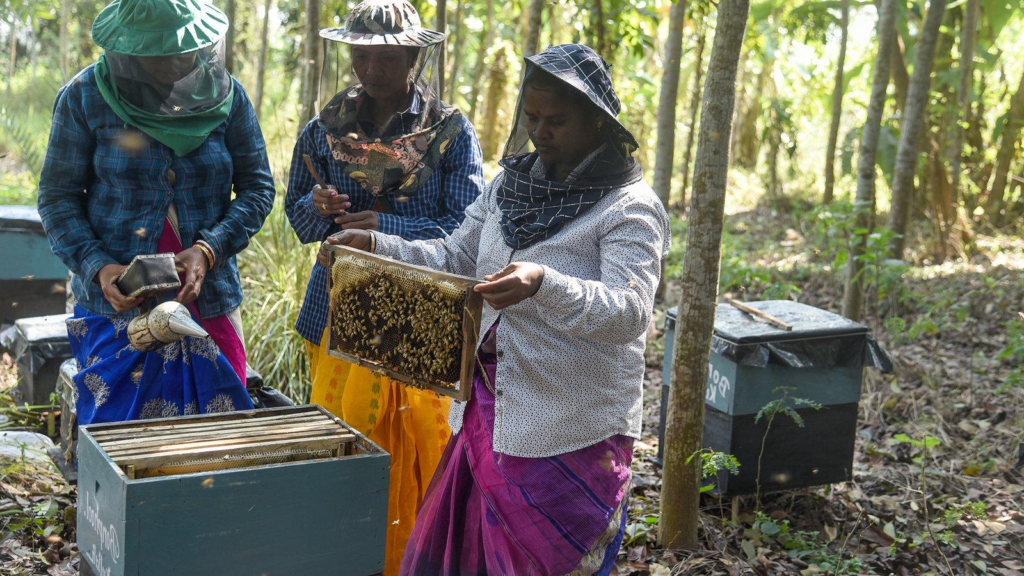
At The Wild Orbit, we approach the Sundarbans as an expedition rather than just a destination. Our Sundarban trips are planned around the character of the landscape, bringing together wildlife, mangrove ecosystems, waterways, island life and the stories that make the forest what it is.
If the story of the honey season has made you curious about the forest that produces it, explore our Sundarban trip and start planning your journey into the wild.
Plan your private Sundarban expedition
A private journey shaped around you — your group, your pace, your interests. Book a free consultation.