


 Travel guide
Before You Enter the Sundarbans your first Sundarbans travel guide should prepare you for more than a list of places to visit. The Sundarbans is not a place you simply arrive at and start sightseeing. It is a landscape you gradually enter.
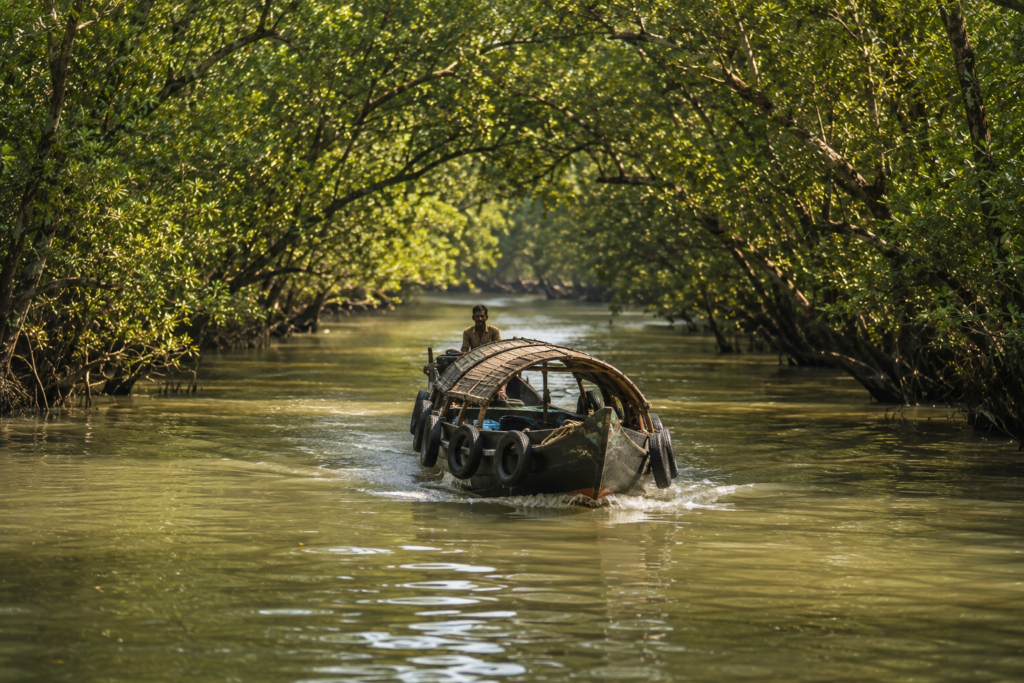
The journey moves from roads to waterways, from busy settlements to quiet riverbanks, and eventually into a world shaped by tides, mud, mangroves and shifting channels. Here, the forest does not sit neatly behind a gate or along a safari road. Much of it is experienced from a boat, where every bend in the river can reveal something different.
For a first-time visitor, that is part of the magic.
You may come hoping to see the Royal Bengal Tiger, but the Sundarbans offer far more than one animal. There are mangrove forests rising from tidal water, birds moving along creek edges, crocodiles resting on muddy banks, deer appearing between the trees, fishing boats crossing distant channels and villages whose lives remain closely connected to the surrounding landscape.
This guide is designed to help you understand that experience before you go – what the Sundarbans is, what makes it different, what you can see and do, and what you should realistically expect from your first visit.
What Are the Sundarbans?
The Sundarbans is a vast tidal mangrove landscape spread across the delta of the Ganges, Brahmaputra and Meghna river systems, extending across India and Bangladesh. The Indian Sundarbans lie in West Bengal and form one of the country’s most remarkable coastal ecosystems.
But calling it simply a “mangrove forest” doesn’t quite capture what makes the region special.
The Sundarbans is a living landscape shaped continuously by water. Rivers, tidal creeks, mudflats, islands and mangrove forests are interconnected, while the movement of the tide can change the character of the waterways within hours.
The forest is also home to an extraordinary range of wildlife. The Royal Bengal Tiger is its most famous resident, but the ecosystem supports spotted deer, wild boar, fishing cats, estuarine crocodiles, water monitors, dolphins and a remarkable variety of resident and migratory birds.
For visitors, several protected areas form part of the wider Indian Sundarbans landscape, including the Sundarbans National Park and Sundarbans Tiger Reserve. The region’s ecological importance has also earned international recognition as a UNESCO World Heritage Site.
Understanding this geography is important for a first-time traveller because the Sundarbans is not one single tourist attraction. It is a vast network of forest, waterways, islands and communities.
That is why exploring it feels so different from visiting a conventional wildlife park.
What Makes the Sundarbans Different?
Most wildlife destinations have a familiar rhythm. You enter the forest, follow a defined route and spend your time looking for animals.
The Sundarbans work differently.
Here, the waterways are the routes.
A boat becomes your way into the landscape, carrying you through tidal rivers and narrower creeks while the forest rises along the banks. The scenery can change from open water and mudflats to dense mangroves within a short distance.
And the wildlife does not follow a schedule.
- A tiger may remain completely hidden.
- A crocodile may be almost impossible to notice against the mud.
- A kingfisher can flash across the water and disappear before you have time to raise your camera.
- A herd of spotted deer might emerge unexpectedly from the forest edge.
This unpredictability is not a flaw in the Sundarbans experience. It is what makes the wilderness feel wild.
The destination also has another layer that first-time visitors often discover only after arriving: people are part of the story.
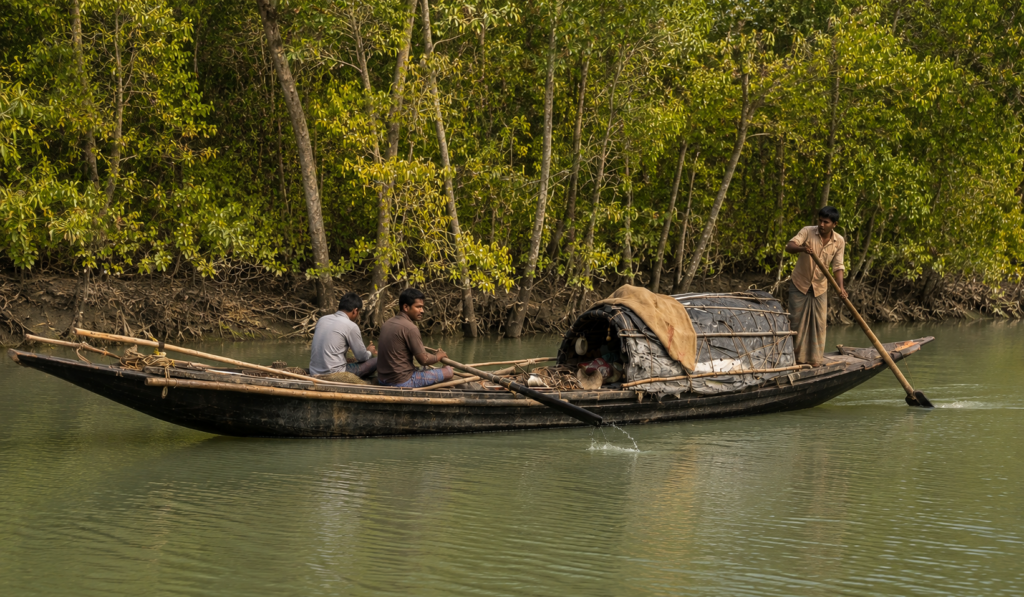
Fishing communities, honey collectors, farmers and other forest-dependent families have developed livelihoods around a landscape that can be both generous and dangerous. Their relationship with the forest, rivers and tides forms an important part of understanding the Sundarbans.
So whether you arrive as a tourist looking for a memorable holiday, a family wanting to experience something different, a wildlife enthusiast hoping for a tiger sighting, a photographer searching for unusual landscapes or a traveller interested in nature and culture, the Sundarbans offers different ways to connect with the same wilderness.
What Is There to See and Do in the Sundarbans?
For first-time visitors, the biggest surprise may be how much there is to experience beyond simply “going on safari.”
Explore the Sundarbans by Boat
A Sundarbans boat journey is central to most experiences. Instead of travelling through the forest by road, you move through its waterways, watching the landscape unfold from the river.
The journey itself becomes part of the attraction.
Tidal creeks, forest edges, muddy banks, distant fishing boats and changing light can make even a quiet stretch of water memorable.
Look for the Royal Bengal Tiger
The tiger is undoubtedly one of the biggest reasons people visit the Sundarbans.
But a responsible Sundarbans trip should never be built around the assumption that a tiger sighting is guaranteed. The forest is dense, the terrain is tidal and tigers are elusive.
The anticipation is part of the experience.
And when a tiger does appear, even briefly, the encounter can feel extraordinary precisely because it was never staged or promised.
Discover Wildlife Beyond the Tiger
The Sundarbans is home to a much wider cast of wildlife.
- Spotted deer may be seen along forest edges.
- Estuarine crocodiles can rest beside waterways.
- Water monitors move through the mangroves, while fishing cats remain far more elusive.
The waterways and surrounding habitats also support dolphins and a remarkable variety of fish and smaller aquatic life.
For birdwatchers, the landscape offers another world entirely, with kingfishers, herons, egrets, raptors, waders and other birds occupying different parts of the ecosystem.
Sometimes the smallest sightings are the ones that stay with you.
Experience the Mangrove Landscape

The mangroves themselves are one of the Sundarbans’ greatest attractions.
Look closely and the forest reveals details that are easy to miss from a distance: intricate root systems, pencil-like pneumatophores rising from muddy ground, tidal marks along the banks and tiny creatures moving across exposed mudflats.
The landscape is constantly changing with the water.
Visit Watchtowers and Wildlife Viewing Areas
Watchtowers provide visitors with opportunities to observe the surrounding forest and wetlands from elevated viewpoints.
They can offer a very different perspective from the boat, particularly when looking across open areas where wildlife may move between forest and water.
But they are not simply “tiger viewing points.” They are places to observe the wider ecosystem.
Experience the Islands and Local Communities
The inhabited islands surrounding the forest reveal another side of the Sundarbans.
Villages, waterways, fishing activity, agriculture and forest-dependent livelihoods show how closely human life remains connected to this tidal environment.
For a first-time visitor, understanding this human landscape can make the trip much more meaningful. The Sundarbans is not an empty wilderness separated completely from human life; it is a region where conservation, livelihoods, culture and nature exist in a complicated relationship.
Slow Down and Observe
Perhaps the most underrated thing to do in the Sundarbans is simply to pay attention.
- Watch the river.
- Listen to the birds.
- Notice how the tide changes the shoreline.
- Look closely at the mangrove roots.
- Observe the movement of boats and birds along the creek.
The Sundarbans reward visitors who are willing to slow down. It is not a destination that needs to constantly entertain you. Sometimes the most memorable moments happen when nothing dramatic seems to be happening at all.
And that is exactly when the forest begins to reveal itself.
Why the Sundarbans Is Explored From the Water
One of the first things a visitor notices in the Sundarbans is that the forest is not something you simply walk or drive through.
The waterways are its pathways.
Rivers and tidal creeks weave between islands and mangrove forests, creating the routes through which much of the Indian Sundarbans is experienced. A boat journey can take you past dense green walls of mangrove, exposed mudflats, narrow channels and wide stretches of tidal water, sometimes all within the same journey.
The tide is constantly changing the landscape. A bank that is exposed during low tide can disappear beneath the water later, while narrow creeks can become more difficult to navigate as conditions change.
This is why a Sundarbans boat safari is more than transportation between two points. The journey itself is part of the wildlife experience.
From the boat, visitors can observe the forest without entering the habitat directly. You may spend a long stretch seeing nothing obvious, followed by a sudden movement on the bank, a bird crossing the water or an animal emerging from the vegetation.
For first-time visitors, learning to appreciate these quiet stretches is important.
The Sundarbans is a place where observation matters as much as sightseeing
Beyond the Tiger: The Wildlife of the Sundarbans
The Royal Bengal Tiger may be the animal most closely associated with the Sundarbans, but it represents only one part of an exceptionally diverse ecosystem.
A first-time visitor who spends the entire journey looking exclusively for a tiger can easily miss the extraordinary wildlife happening all around them.
Royal Bengal Tiger
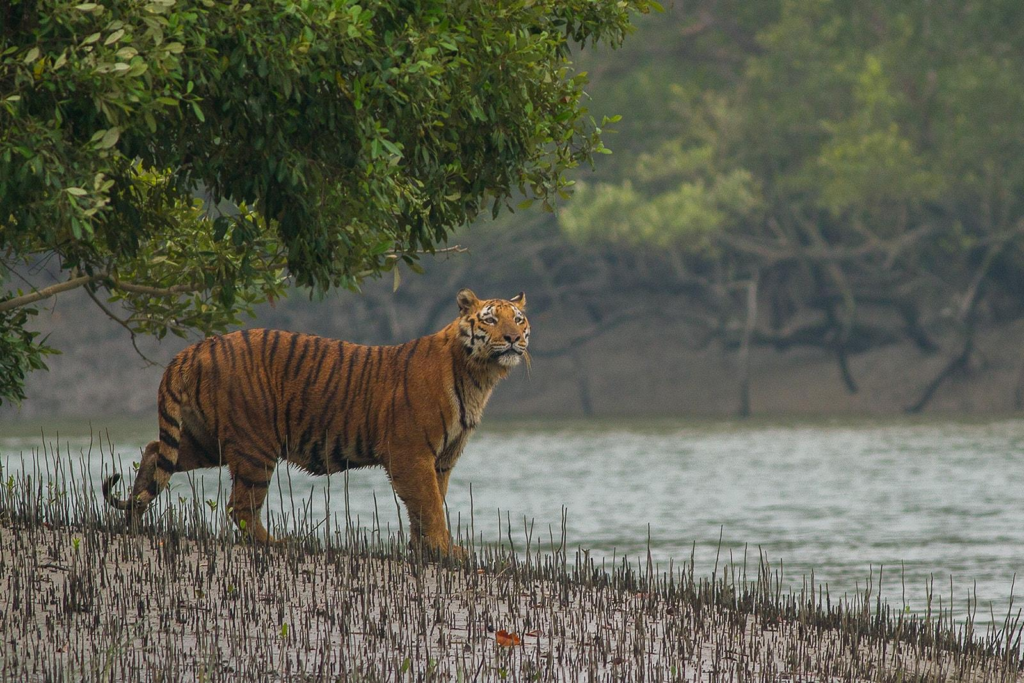
The Sundarbans is one of the world’s most distinctive tiger habitats.
Here, the tiger has adapted to a challenging environment of mangrove forests, tidal waterways and soft, muddy terrain. Sightings can be brief and unpredictable, and sometimes the forest gives no visible sign that a tiger is nearby.
That uncertainty is part of what makes a sighting so special.
The right mindset is not to expect the forest to produce a tiger on demand, but to remain alert to the entire landscape.
Spotted Deer
Spotted deer are among the more recognisable mammals visitors may encounter around forest edges and open areas.
Their presence can also create moments of heightened attention. A sudden movement among the vegetation may make everyone on the boat stop and look, even before anyone knows exactly what has moved.
Estuarine Crocodiles
The estuarine crocodile is another remarkable resident of the Sundarbans.
Seeing one resting quietly along a muddy bank can be deceptively easy to miss. Their ability to blend into the surrounding landscape is a reminder that wildlife viewing in the Sundarbans often depends on patience and careful observation rather than simply looking for obvious movement.
Fishing Cats and Other Mammals
The fishing cat is one of the more elusive mammals associated with the Sundarbans. Alongside it are species such as wild boar and rhesus macaques, each occupying different parts of the wider ecosystem.
Some animals may be relatively familiar to visitors, while others require considerably more luck and patience.
Birds
For birdwatchers, the Sundarbans opens an entirely different window into the landscape.
Kingfishers, herons, egrets, raptors, waders and other birds use the forest, mudflats and waterways in different ways. Some are easier to spot from a moving boat, while others reward careful observation along the forest edge.
The birdlife also adds movement and sound to stretches of forest where larger mammals remain completely hidden.
Aquatic Life and Smaller Creatures
The wildlife story continues beneath and around the water.
The Sundarbans support fish, crabs, mudskippers and other creatures adapted to the changing conditions of a tidal ecosystem. Dolphins may also be encountered in suitable waterways.
These smaller forms of life are easy to overlook, but they are essential to understanding how the wider ecosystem functions.
The Sundarbans is not defined by one spectacular species. It is an interconnected living system.
The Mangrove Forest Is an Attraction in Its Own Right
It is easy for first-time visitors to think of the mangroves simply as the background against which wildlife appears.
Look closer, and the forest becomes an attraction of its own.
Mangrove trees have evolved to survive in a demanding environment where salt, tides, waterlogged soil and shifting sediment shape everyday life. Their roots help anchor the forest in unstable ground, while specialised structures allow some mangrove species to exchange gases despite growing in saturated soil.
Along the muddy forest floor, pneumatophores can rise like small pencils from the sediment.
The shoreline itself can reveal traces of the tide, animal movement and changing water levels.
This is one reason the Sundarbans work particularly well for nature lovers and photographers. Even without a major wildlife sighting, the combination of mangroves, water, mud, sky and changing light creates an unusually atmospheric landscape.
Watchtowers: A Different Way to Read the Forest
Watchtowers and designated wildlife viewing areas provide another perspective on the Sundarbans.
From an elevated position, the visitor can look across forest, wetlands and open areas rather than experiencing the landscape only from water level.
The experience is often less about finding one particular animal and more about understanding the scale of the habitat.
Depending on the location and conditions, visitors may encounter birds, deer, reptiles or other wildlife, while the surrounding forest provides a broader view of the ecosystem.
For first-time travellers, it is worth remembering that a watchtower is not a guarantee of a tiger sighting. Wildlife decides where it moves and when it appears.
The real value lies in having another opportunity to observe the forest from a different vantage point.
Islands, Villages and the Human Side of the Sundarbans
See it for yourself
A private journey shaped around you — your group, your pace, your interests. Book a free consultation.
The Sundarbans is not only a protected wilderness. It is also a lived landscape.
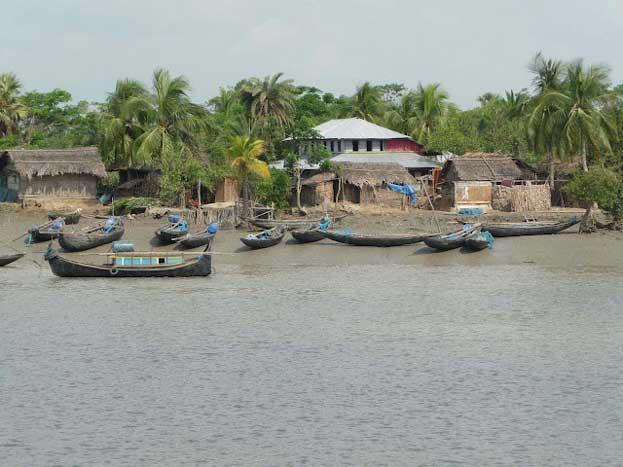
Across the inhabited islands, communities have built their lives around rivers, agriculture, fishing and other livelihoods connected to the surrounding environment.
A journey through the region can therefore reveal two very different but interconnected worlds: the protected forest and the communities living alongside it.
The relationship is not always simple.
The same forest that provides resources and livelihoods can also present serious risks. Tides, storms, wildlife and changing environmental conditions have shaped the lives of communities for generations.
This human dimension is essential to understanding the Sundarbans properly.
For visitors, it also means that villages and local communities should be approached with respect and curiosity rather than treated simply as another tourist attraction.
The stories of the people who live here are part of the larger story of the Sundarbans.
A Sundarbans Experience Is About More Than Sightseeing
Traditional tourism often begins with a simple question:
“What can I see?”
In the Sundarbans, a better question is:
“What can I notice?”
A tiger crossing the forest edge may become the unforgettable moment of a trip. But so can a kingfisher dropping toward the water, a crocodile lying motionless on a muddy bank, the sudden appearance of deer between mangrove trees, the sound of birds around a quiet creek or the changing shape of the shoreline as the tide moves.
That is what makes the Sundarbans suitable for different kinds of travellers.
- A family can experience its waterways and wildlife.
- A first-time tourist can enjoy its landscapes and distinctive boat journeys.
- A photographer can look for light, birds and wildlife.
- A birdwatcher can spend hours scanning the forest edge.
- A nature enthusiast can begin to understand the intricate relationship between mangrove, water, wildlife and people.
And for those who want to explore more deeply, the same landscape keeps revealing new layers.
The destination does not need to be experienced in only one way.
It simply asks you to pay attention.
How Many Days Should You Spend in the Sundarbans?
There is no single perfect length for a Sundarbans trip. It depends on what you want from the experience.
For many first-time visitors, a short visit can provide an introduction to the waterways, mangrove landscape, wildlife and local surroundings. Staying longer, however, gives you more time to settle into the rhythm of the destination rather than rushing from one experience to another.
This matters in the Sundarbans because wildlife does not appear according to an itinerary.
A longer stay can mean more time on the water, more opportunities for observation and a greater chance to experience the destination at different times of day and under changing tidal conditions.
If your interest extends beyond conventional sightseeing into wildlife photography, birdwatching or nature observation, allowing more time becomes even more valuable.
The best trip is not necessarily the one that fits the most activities into the shortest schedule. It is the one that gives you enough time to actually experience the landscape.
Getting to the Sundarbans
For a first-time visitor, the journey into the Sundarbans is part of the experience.
Most visitors travelling from Kolkata first make their way toward one of the mainland gateways before continuing by boat into the island and forest landscape. The exact route depends on your starting point, destination, accommodation and the type of trip you have planned.
Once the journey moves onto the waterways, the character of the trip changes completely.
- Roads give way to rivers.
- Traffic gives way to tidal movement.
- Urban sounds gradually disappear, and the landscape begins to open around you.
If you are planning your journey from Kolkata, our dedicated Kolkata to Sundarbans Guide explains the route and travel options in greater detail.
For visitors starting elsewhere, see our complete how to reach Sundarbans guide.
Understanding the Cost of a Sundarbans Trip
There is no single cost that defines a Sundarbans holiday.
The overall expense can vary depending on the style and duration of your trip, transportation, accommodation, boat arrangements, meals, applicable forest or permit-related charges, guide services and the level of comfort you choose.
A budget-oriented trip and a more comfortable or premium experience can therefore look very different even when they visit the same destination.
When comparing options, don’t look only at the headline price. Check what is actually included. Transportation, accommodation, meals, boat arrangements, guide support and applicable charges can make a significant difference to the overall experience.
For a detailed breakdown of the different components and travel styles, explore our Sundarbans cost guide.
What Should You Expect on a First Sundarbans Trip?
The Sundarbans can be surprisingly different from what a first-time visitor imagines.
You may spend considerable time travelling through quiet waterways without seeing a large animal. Then, almost without warning, a bird may appear on the bank, deer may emerge from the vegetation or another unexpected movement may catch everyone’s attention.
That contrast is normal.
The forest can also feel remarkably quiet. There may be stretches where the only sounds are the boat, wind, birds and water moving against the banks.
Don’t mistake quietness for a lack of activity.
The Sundarbans is constantly changing around you.
- Tides alter the waterways.
- Light changes the appearance of the mangroves.
- Birds move between habitats.
- Animals remain hidden within dense vegetation.
- Mudflats appear and disappear with the water.
The more closely you observe, the more you begin to notice.
A Few Things First-Time Visitors Often Get Wrong
Expecting a Guaranteed Tiger Sighting
The Royal Bengal Tiger is one of the great attractions of the Sundarbans, but no responsible visitor should expect a guaranteed encounter.
The forest is wild, and wildlife sightings are never fully predictable.
Treating It Like a Conventional Safari
The Sundarbans is fundamentally a water-based environment. Much of the experience happens from a boat, and the journey itself is part of the exploration.
Trying to See Everything
The destination is too diverse to experience properly by rushing between attractions.
Give yourself time to observe.
Focusing Only on Large Wildlife
Some of the most interesting moments can involve birds, reptiles, aquatic creatures, crabs, mudskippers or the mangrove ecosystem itself.
Choosing Only on Price
The cheapest option is not necessarily the best value. Consider what is included, how the experience is organised and whether the operator prioritises responsible wildlife tourism.
Ignoring the Environment
Heat, humidity, insects, changing weather and long periods on the water can all influence your comfort.
Prepare accordingly, and your experience will be much more enjoyable.
A Note on Seasons, Packing and Safety
The Sundarbans change with the seasons, and each period brings its own combination of weather, water conditions, landscape and wildlife opportunities.
Likewise, what you carry can make a meaningful difference to your comfort. Suitable clothing, sun protection, insect protection, binoculars, camera equipment and protection from rain or water are all worth considering.
Safety deserves equal attention.
You are entering a protected and dynamic wilderness, not an ordinary sightseeing destination. Follow applicable forest regulations, listen to your guide or naturalist, remain within designated areas and never attempt to approach wildlife.
Responsible Tourism Is Part of the Experience
A good Sundarbans visit should leave as little disturbance as possible.
Don’t feed wildlife. Don’t encourage guides or boat crews to chase animals for a better view. Avoid loud behaviour around wildlife, carry your waste back with you and respect the restrictions established for protected areas.
Just as importantly, respect the people who live around the forest.
The Sundarbans is home to communities whose relationship with the landscape is much deeper than a visitor’s short stay. Villages, fishing activity, agriculture, honey collection and other livelihoods are part of the region’s living reality.
Responsible tourism means experiencing this landscape with curiosity without turning its wildlife, people or culture into spectacles.
The goal is not simply to take something memorable home.
It is to leave the place with its character intact.
The Wild Orbit Expert Advice
A first visit to the Sundarbans becomes much more rewarding when you stop thinking of it as a checklist of things to see.
Here are a few things we believe every first-time visitor should know before entering this remarkable landscape.
Don’t spend the entire journey looking for a tiger
It is natural to hope for a Royal Bengal Tiger. But if you spend every minute scanning the forest for one, you may miss everything else happening around you.
- Watch the water.
- Look at the mudflats.
- Listen for birds.
- Notice movement along the forest edge.
The Sundarbans is much bigger than its most famous resident.
Learn to read the landscape
The colour of the water, exposed mud, tidal marks, mangrove roots, birds gathering along a bank and changes in the current can all tell you something about the environment.
You don’t need to be an expert.
Simply paying attention will make the journey more interesting.
Carry binoculars
A good pair of binoculars can transform a quiet boat journey.
Animals and birds may remain at a distance, and the best wildlife experiences often come from observing without disturbing.
Don’t underestimate the small things
A crab moving across the mud, a mudskipper appearing beside a creek, a kingfisher diving into the water or a monitor moving through the vegetation may last only a few seconds.
These encounters are easy to overlook if you are waiting only for something spectacular.
Give the forest time
The Sundarbans don’t operate on a tourist timetable.
There can be long stretches without an obvious wildlife sighting. That doesn’t mean the experience has failed.
Patience is one of the most valuable things you can bring with you.
Look beyond the forest
The river is not merely the road to the forest.
Watch the boats, the tidal movement, the changing shoreline and the life around the waterways. The relationship between water, forest and people is one of the defining characteristics of the Sundarbans.
Don’t turn wildlife into a competition
A good trip is not measured by how many animals you photograph or whether you can say you saw a tiger.
Responsible wildlife tourism means allowing animals to behave naturally and accepting that some encounters simply aren’t meant to happen.
Speak to your guide
Ask questions.
- Why is that particular tree growing there?
- What bird just crossed the creek?
- Why has the shoreline changed?
- How does the tide affect this channel?
A knowledgeable local guide can help you notice details you might otherwise pass without seeing.
Keep your camera ready but your eyes open
Photography can make a trip memorable, but don’t spend the entire journey viewing the Sundarbans through a screen.
Some moments are better experienced before they become photographs.
Leave room for the unexpected
Perhaps the most important advice is simple:
Don’t try to control the Sundarbans experience too tightly.
- You may arrive hoping for a tiger and remember a crocodile instead.
- You may plan to photograph birds and become fascinated by the mangroves.
- You may expect a wildlife safari and leave thinking about the people, rivers and tides.
Let the destination surprise you.
FAQs
Is the Sundarbans worth visiting?
Yes, particularly if you enjoy wildlife, nature, waterways, photography, birdwatching or distinctive landscapes. The experience is very different from a conventional sightseeing destination because much of the region is explored by boat.
What is the Sundarbans most famous for?
The Sundarbans is best known for its vast mangrove ecosystem and its population of Royal Bengal Tigers. It is also notable for its tidal waterways, biodiversity, islands and the communities living around the forest.
Can I see a Royal Bengal Tiger in the Sundarbans?
A tiger sighting is possible, but it can never be responsibly guaranteed. The animals are elusive and move through a complex tidal environment. A good visit should be about experiencing the wider ecosystem rather than expecting one particular sighting.
What can I see besides tigers?
Depending on the location and conditions, visitors may encounter spotted deer, wild boar, crocodiles, water monitors, birds, fishing cats and a variety of aquatic and smaller creatures. The exact experience varies from trip to trip.
What is there to do in the Sundarbans?
Popular experiences include boat journeys through rivers and creeks, wildlife observation, visiting designated watchtowers, birdwatching, photography and experiencing the landscape and communities around the forest.
Is the Sundarbans suitable for first-time visitors?
Yes. You don’t need to be an experienced wildlife traveller to enjoy the Sundarbans. Understanding the environment, preparing appropriately and keeping realistic expectations will make a first visit much more rewarding.
How long should I stay in the Sundarbans?
The ideal duration depends on your interests and travel style. A short visit can provide an introduction, while more time allows greater opportunity for wildlife observation, birdwatching, photography and experiencing the destination without rushing.
Is a Sundarbans trip only about wildlife?
Not at all. Wildlife is an important part of the attraction, but the Sundarbans is also about mangrove ecology, tidal rivers, islands, villages, local livelihoods, culture and conservation.
Is the Sundarbans a normal safari destination?
Not quite. Unlike destinations primarily explored by road, the Sundarbans is largely experienced through its waterways. The boat journey is therefore an important part of the destination itself.
Can families visit the Sundarbans?
Families can enjoy the destination, provided the trip is planned around everyone’s comfort and the group follows applicable safety and forest regulations. Boat travel, weather, walking and accommodation conditions should all be considered beforehand.
Is the Sundarbans good for photography?
Yes. The combination of wildlife, birds, mangroves, waterways, mudflats and changing light provides many photographic opportunities. Patience and suitable equipment are more valuable than simply expecting constant wildlife action.
Is birdwatching possible in the Sundarbans?
Absolutely. The mangroves, waterways and mudflats support a diverse birdlife, making the region interesting for both casual birdwatchers and dedicated birding enthusiasts.
What makes the Indian Sundarbans unique?
Its combination of tidal waterways, mangrove forests, islands, wildlife and human settlements creates an ecosystem unlike most conventional wildlife destinations. The landscape is continuously shaped by the relationship between land and water.
Should I expect the Sundarbans to feel busy like a typical tourist destination?
Some popular areas can have visitor activity, but much of the experience is defined by open waterways, forest, quiet observation and the natural rhythm of the landscape.
What is the most important thing to remember on a first visit?
Keep an open mind.
Come with the excitement of seeing wildlife, but don’t measure the entire trip by whether a particular animal appears. The Sundarbans reveals itself through small details, changing tides, quiet waterways, unexpected sightings and the relationship between forest and people.
Your First Journey Into the Sundarbans
Your first Sundarbans experience may begin with a simple idea: you want to see the famous mangrove forest and perhaps catch a glimpse of a Royal Bengal Tiger.
But the destination can leave you with something much bigger.
You may remember the silence of a tidal creek, the sudden flight of a kingfisher, deer standing at the edge of the forest, a crocodile almost hidden against the mud, the intricate roots of a mangrove tree or the changing landscape as the tide moves through the waterways.
You may also begin to understand that the Sundarbans is not simply a tourist attraction.
It is a living ecosystem, a wildlife habitat, a tidal landscape and a home for communities whose lives are connected to the forest.
That is what makes a first visit so memorable.
Come for the wildlife. Stay curious about everything else.
And let the Sundarbans reveal itself at its own pace.
Continue Exploring the Sundarbans
If you’re planning your first visit, explore our detailed guides on how to reach the Sundarbans, travelling from Kolkata, trip costs, what to pack, the best season to visit and staying safe in the forest.
And when you’re ready to go beyond the usual tourist experience, explore The Wild Orbit’s deeper stories on the wildlife, islands, rivers, villages, mangroves, birds and hidden landscapes of the Sundarbans.
Plan your private Sundarban expedition
A private journey shaped around you — your group, your pace, your interests. Book a free consultation.