


 Ghost Stories
There are places in the Sundarbans that seem to disappear after sunset.
Jambudwip is one of them.
By daylight, the island appears exposed and elemental — mangroves, mud, wind and the restless water of the Bay of Bengal. For decades, fishermen have come here seasonally, using the island as a base for their work and drying their catch beneath the open sky.
But after dark, the same landscape becomes almost impossible to read.
The boats turn into silhouettes.
The channels become black ribbons.
The horizon disappears.
And somewhere beyond the last visible edge of land, a light may appear.
Small.
Distant.
Impossible to place.
It can look, for a moment, like a lantern.
Or a beacon.
Or the light of a boat waiting somewhere beyond the darkness.
But there is a problem.
There is no lighthouse there.
The island at the edge
Jambudwip lies at the southern edge of the Sundarbans, exposed to the tides and weather of the Bay. Its history is closely tied to fishing, and its isolation has always made it a place where the boundary between land and sea feels particularly thin.
Here, darkness is not simply the absence of light.
It changes the geography.
A channel that seemed obvious during the afternoon can become difficult to recognise at night. A familiar bank disappears into shadow. The tide shifts beneath the boat. Wind and water erase the small details that fishermen use to understand where they are.
For someone alone on the water, a light in the distance can therefore mean everything.
It can mean another boat.
It can mean land.
It can mean safety.
And that is where an old Bengali story becomes strangely appropriate.
The light
Across Bengal’s wetlands and waterways lives a tradition known as the Aleya — mysterious lights said to appear over marshes and water after dark.
In folklore, they are sometimes associated with the spirits of fishermen who died in the wetlands and never found their way home. The lights may hover at a distance, resembling a lantern seen from another boat.
And the warning attached to them is simple:
Do not follow the light.
Stories of the Aleya have survived because they fit the landscape so perfectly.
Imagine being alone on a boat at night.
There are no streetlights.
No buildings.
No familiar landmarks.
Only the sound of water touching the hull and the dark outline of mangroves somewhere beyond it.
Then, ahead of you, a faint glow appears.
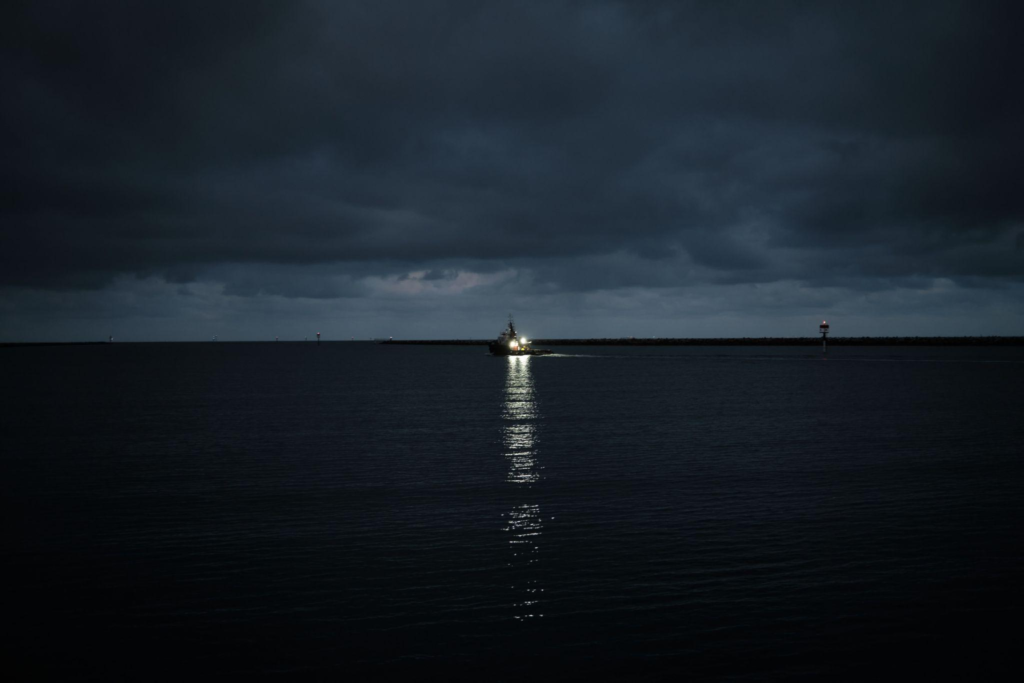
It is not bright enough to reveal the landscape.
It simply exists.
A little light inside an enormous darkness.
Your first thought might be relief.
Someone else is out there.
Perhaps there is a boat.
Perhaps there is a settlement.
Perhaps you have finally found the way back.
So you move towards it.
And the light seems to move too.
Not dramatically.
Not like something chasing you.
Just enough to remain ahead.
A lighthouse without a tower
Perhaps this is how a ghost lighthouse is born.
Not from stone.
Not from a tower.
Not from a rotating beam sweeping across the sea.
But from a light that people cannot explain.
There is no reliable evidence that Jambudwip once possessed a conventional lighthouse matching the legend. That distinction matters.
The island is real.
Its fishing history is real.
Its isolation is real.
And the Aleya belongs to a much older tradition of mysterious lights in Bengal’s wetlands.
The lighthouse is the story we build around the mystery.
A human mind naturally gives a distant light a purpose.
A beacon must be guiding someone.
A lamp must belong to someone.
A light must be coming from somewhere.
But what if it isn’t?
What if the most frightening thing about the light is that there is no tower beneath it?
What might be causing it?
There are scientific explanations for mysterious marsh lights.
Wetlands contain enormous quantities of decomposing organic material, and gases produced during decomposition have long been associated with will-o’-the-wisp phenomena in marshes around the world.
Atmospheric conditions, reflections and distant lights can also become strangely deceptive over dark water.
In a place like the Sundarbans, where water, mud, mist and darkness constantly alter what the eye can see, the ordinary can easily become mysterious.
But science does not necessarily erase the legend.
It simply gives the mystery another layer.
Because folklore is rarely only about explaining what people see.
It is also about explaining what they fear.
For a fisherman navigating unfamiliar water after dark, the message of the Aleya is remarkably practical:
Do not trust every light you see.
The darker meaning
Perhaps that is why the ghost lighthouse of Jambudwip feels different from an ordinary ghost story.
It does not need a ghost standing on a shore.
It does not need footsteps in the mud.
It does not need a figure emerging from the mangroves.
All it needs is a light.
A tiny point of brightness surrounded by darkness.
And the knowledge that the darkness around it is not empty.
There are tides beneath the boat.
Mudflats hidden beneath the water.
Mangrove roots waiting along the banks.
Crocodiles in the waterways.
And somewhere beyond the visible world, an entire landscape that becomes almost impossible to understand once night takes over.
The light becomes frightening because it offers exactly what you want.
Direction.
Company.
Hope.
And in the old stories, that is precisely what makes it dangerous.
When the light disappears
Eventually, the tide turns.
The wind changes.
The first grey hint of dawn begins to appear above the water.
The mangroves return from the darkness.
What seemed mysterious a few hours earlier becomes ordinary again.
The boat is still there.
The island is still there.
The water is still moving.
And the light is gone.
Perhaps it was a natural phenomenon.
Perhaps it was a distant boat seen through darkness and distortion.
Perhaps it was something the eye created because the mind desperately wanted to find a way home.
Or perhaps the fishermen who tell these stories would give another answer.
They might simply say that some lights are not meant to be followed.
Because the Sundarbans has always been a place where nature and folklore occupy the same landscape.
The tiger is real.
The tide is real.
The darkness is real.
And somewhere between those realities and the stories people have carried across generations, a small light continues to appear in the imagination.
A lighthouse without a tower.
A beacon without a shore.
A light without a known source.
And if you ever find yourself on the waters around Jambudwip after sunset, with nothing but darkness ahead and a faint glow appearing in the distance—
look carefully before you follow it.
Because the most unsettling lighthouses are sometimes the ones that were never built.
Plan your private Sundarban expedition
A private journey shaped around you — your group, your pace, your interests. Book a free consultation.


