

 Travel guide
Some wilderness destinations impress you with their scale.
Others with their abundance of wildlife.
The Sundarbans leave a different impression.
It makes you pay attention to the relationship between water, forest, wildlife and people.
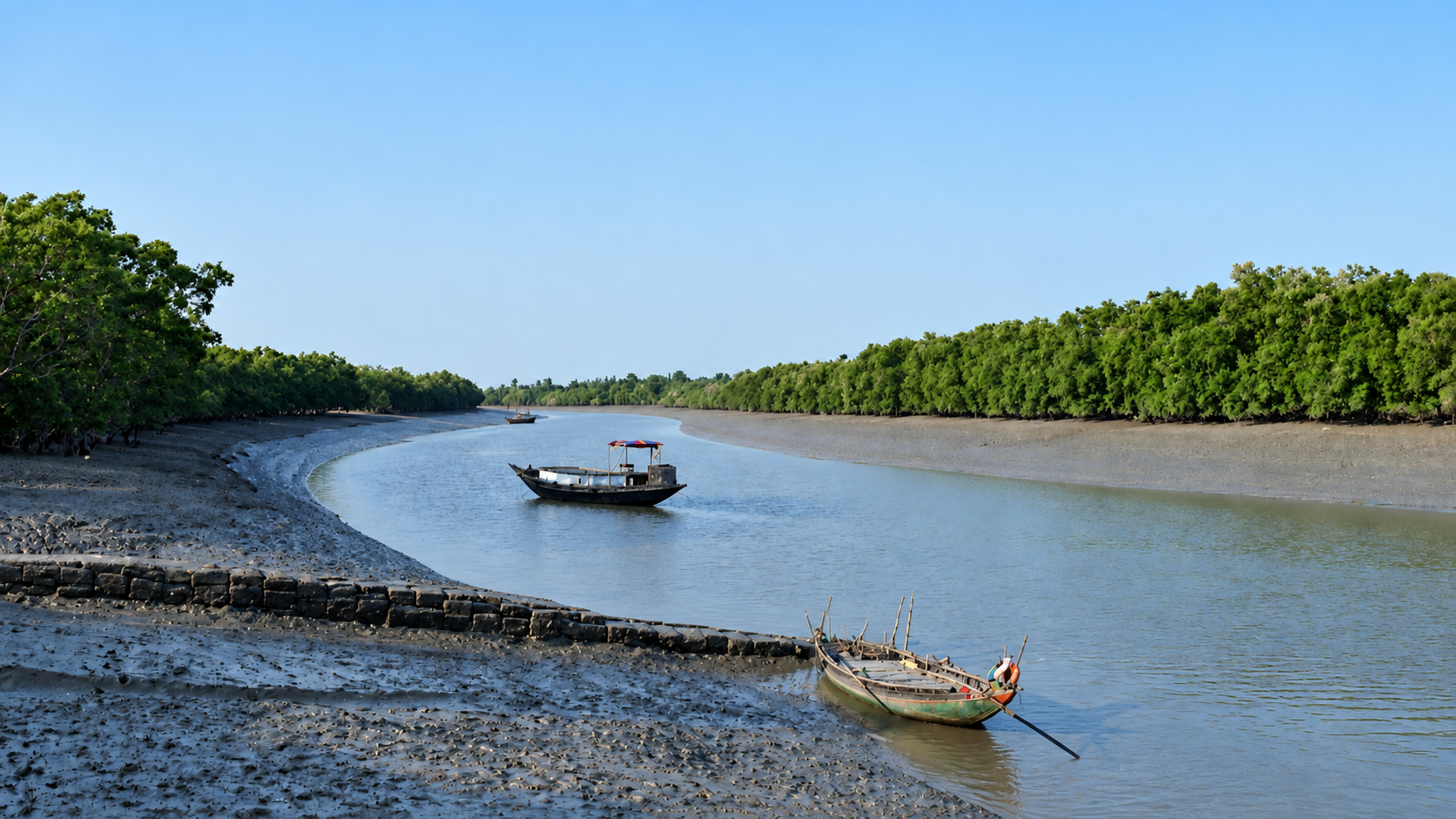
Here, the boundary between land and water is constantly changing. Rivers become routes, mudflats appear and disappear with the tide, mangroves survive in saline conditions, and wildlife has adapted to an environment that is unlike almost any other on Earth.
For German travellers drawn to nature, wildlife, photography, conservation and responsible exploration, the Sundarbans offers a particularly distinctive journey.
Located in the Ganges-Brahmaputra delta along the Bay of Bengal, the Indian Sundarbans forms part of one of the world’s great mangrove ecosystems. UNESCO recognises the Indian Sundarbans as a World Heritage property covering 133,010 hectares and describes it as an exceptional landscape shaped by tidal processes, monsoon flooding, sediment deposition, erosion and the formation of deltaic islands.
This is not simply a destination for seeing a Bengal tiger.
It is a place where you can begin to understand why the tiger lives here, how mangroves survive here, how tides shape the landscape and why protecting this ecosystem matters.
That is what makes a Sundarbans journey different.
Why the Sundarbans Is an Ecological Wilderness
Many wildlife destinations can be introduced through their most famous animals.
The Sundarbans is better understood through its entire system.
Its defining feature is the relationship between water, forest, wildlife and human life.
Freshwater, seawater, sediment, monsoon rainfall and the Bay of Bengal interact across the delta, creating an environment that is constantly being reshaped.
- A creek can look completely different at high and low tide.
- A mudflat can become a feeding ground and later disappear beneath the water.
- Mangroves have evolved specialised ways of surviving in saline, waterlogged conditions.
- Animals have adapted to a landscape divided between forest, mud and waterways.
And communities around the delta have developed livelihoods within an environment whose rhythms cannot simply be controlled.
UNESCO describes the Sundarbans as one of the world’s most biologically productive natural ecosystems, supporting important terrestrial and aquatic biodiversity.
For travellers who enjoy understanding how natural systems function, that interconnectedness is one of the destination’s greatest attractions.
You are not simply looking at nature.
You are watching a landscape at work.
The Sundarbans Among the World’s Great Wildlife Destinations
Germany has a strong tradition of nature travel, hiking, birdwatching and outdoor exploration.
That makes the question of how the Sundarbans compares with better-known wildlife destinations particularly interesting.
The answer is not that one wilderness is superior to another.
It is that each offers a different way of experiencing nature.
And the Sundarbans deserves its place in that global conversation.
African Safari
The African safari remains one of the world’s defining wildlife experiences.
Open savannahs, vast horizons and iconic large mammals create a sense of scale that is difficult to reproduce elsewhere.
The Sundarbans offer almost the opposite visual experience.
The landscape is enclosed rather than open.
The forest is interwoven with water.
And the boat, rather than the safari vehicle, becomes the principal means of exploration.
The Amazon
The Amazon is synonymous with tropical rainforest, immense rivers and extraordinary biological complexity.
Its scale is part of its identity.
The Sundarbans tell a different ecological story.
Its defining force is the tide.
The forest exists in an intertidal environment where water levels, salinity, sediment and land continuously interact.
The Galápagos
The Galápagos is famous for isolated island ecosystems and species shaped by evolutionary pressures over long periods of time.
The Sundarbans offer another remarkable story of adaptation.
Here, wildlife has evolved within a tidal mangrove environment where survival requires adaptation to water, mud, salinity and dense vegetation.
The Sundarbans
The Sundarbans combine mangrove forest, tidal waterways, deltaic processes, wetlands and one of the world’s most recognisable predators: the Bengal tiger.
UNESCO notes the Bengal tiger’s remarkable adaptation to this mangrove environment, including its ability to swim considerable distances.
This is why the Sundarbans should not be viewed simply as an alternative to more famous wildlife destinations.
The Sundarbans is not an inferior alternative to an African safari, the Amazon or the Galápagos. It is a fundamentally different wilderness experience and one that deserves its own place among the world’s great wildlife destinations.
For travellers interested in ecological uniqueness, that difference is precisely the attraction.
Why the Mangrove Ecosystem Matters
It is easy for a visitor to see mangroves as scenery.
In the Sundarbans, they are the foundation of the entire landscape.
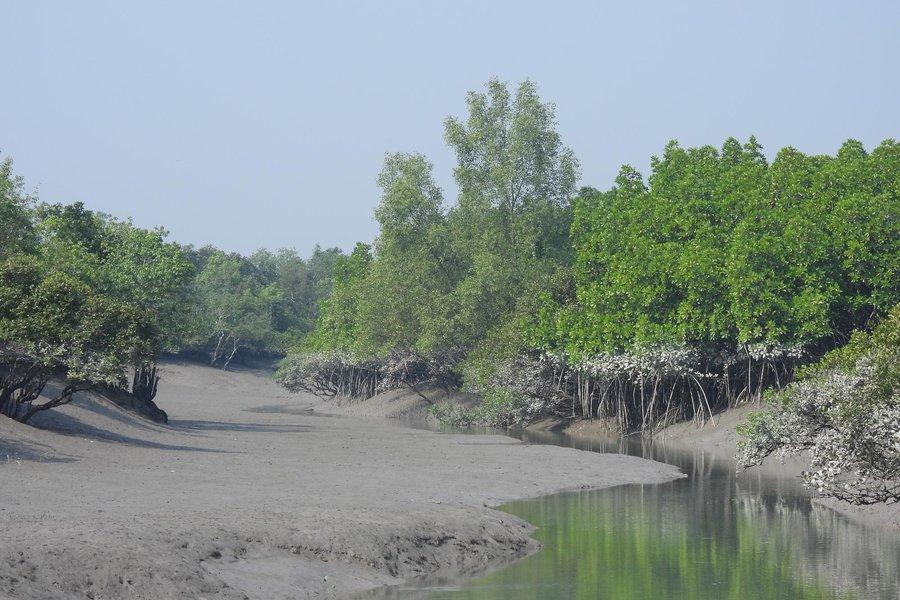
Mangroves have adapted to conditions where many ordinary terrestrial trees could not survive.
- Their roots interact with water and sediment.
- Their vegetation creates shelter and habitat.
- Their presence contributes to the stability of an environment constantly influenced by tides, erosion and deposition.
UNESCO records 78 mangrove species within the Sundarbans World Heritage property and identifies the mangrove ecosystem as central to its ecological importance.
Mangroves also provide important environmental functions, including shoreline stabilisation, sediment trapping and protection against coastal hazards.
For a traveller interested in environmental systems, this changes the way you see the forest.
The mangrove is no longer background scenery.
It becomes the starting point for understanding everything else.
The Bengal Tiger: Adaptation in a Tidal World
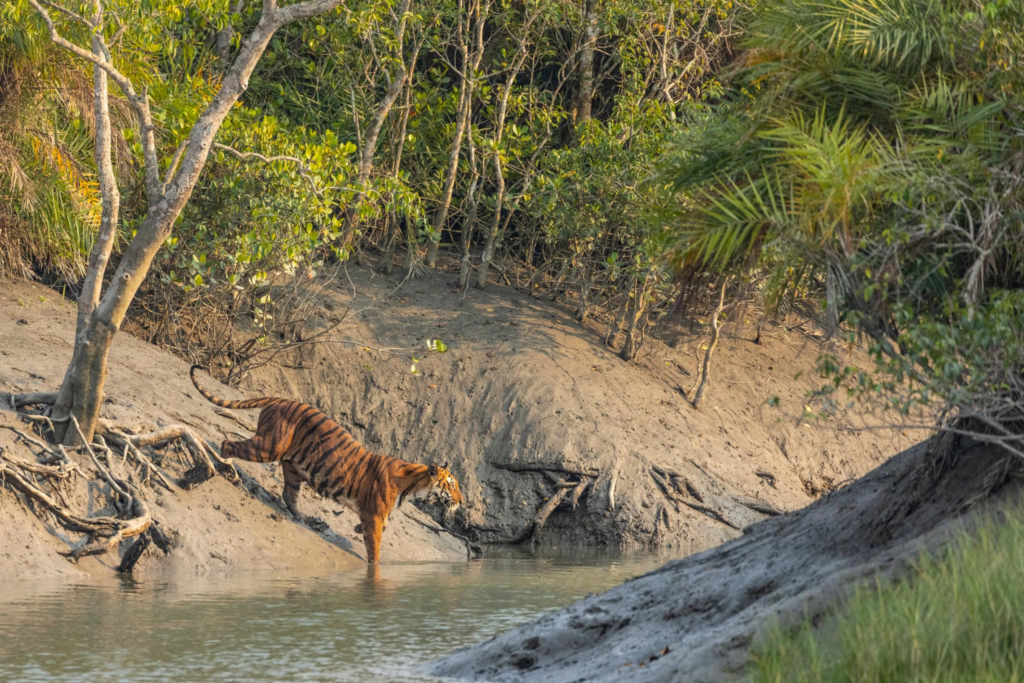
The Royal Bengal Tiger is understandably one of the major attractions of the Sundarbans.
But seeing a tiger here is different from seeing one in an open grassland reserve.
- The vegetation can be dense.
- The waterways can be broad.
- Visibility can be limited.
- The animal may be present without revealing itself.
There are no honest guarantees.
That uncertainty is part of authentic wildlife travel.
The purpose of an expedition should not be to force a sighting, but to enter the tiger’s habitat and understand the conditions that have shaped its behaviour.
A tiger crossing a creek is not simply an impressive photograph.
- It is evidence of an animal adapted to an unusual environment.
- Its swimming ability.
- Its movement through mangrove terrain.
- Its dependence on prey.
- Its relationship with the forest.
All of these details make the Sundarbans tiger story much richer than a simple wildlife checklist.
UNESCO specifically identifies the Bengal tiger as one of the defining species of the Indian Sundarbans and highlights its adaptation to the mangrove environment.
Sometimes the most valuable sighting is not the tiger itself.
It is learning to recognise the signs that something may be nearby.
Wildlife Beyond the Tiger
The tiger may be the headline species, but the Sundarbans is far more than a tiger destination.
Depending on location, season, tides and luck, an expedition may offer opportunities to observe:
- Spotted deer
- Wild boar
- Estuarine crocodiles
- Water monitors
- Macaques
- Kingfishers
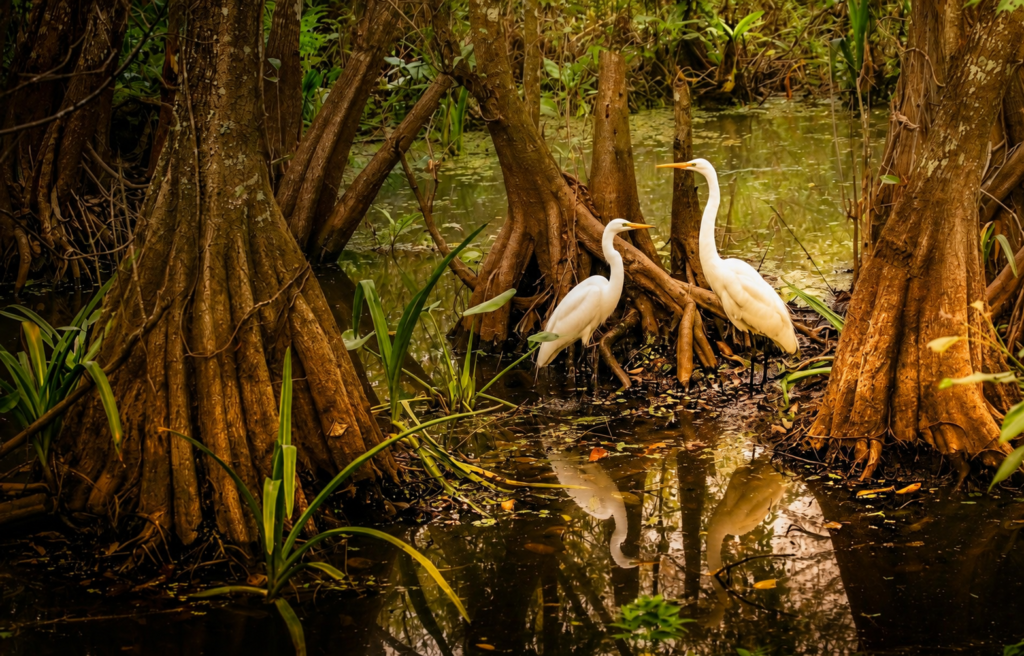
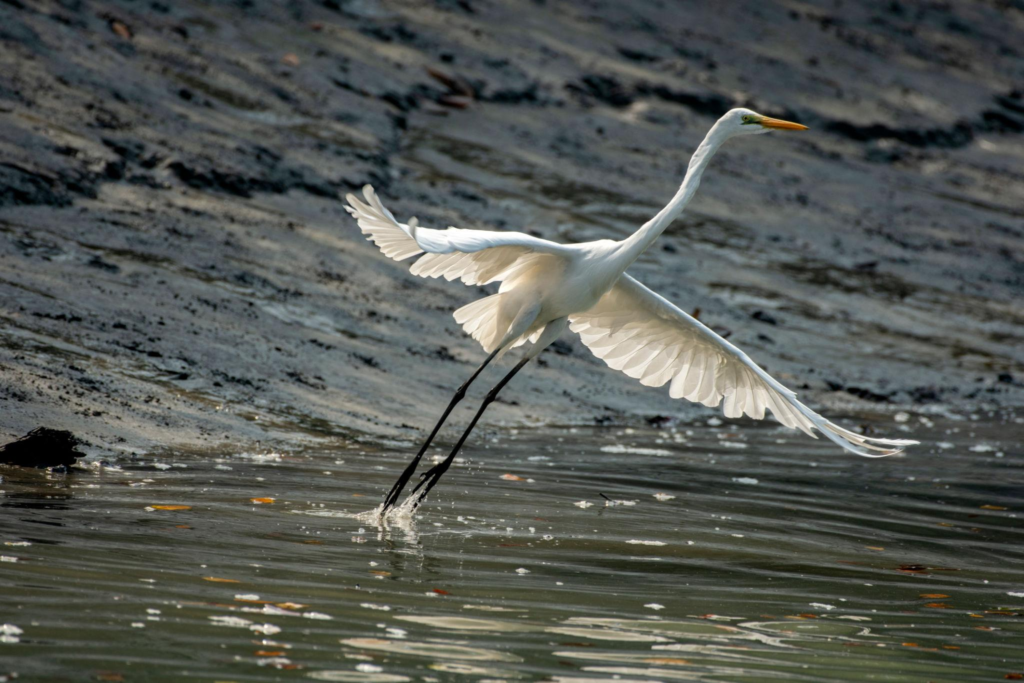
- Herons and egrets
- Raptors
- Forest birds
- Other wetland and aquatic wildlife
UNESCO documents significant diversity of mammals, birds, reptiles and aquatic species within the Indian Sundarbans.
This is particularly relevant for birdwatchers.
A morning on the waterways can become an opportunity to observe wetland behaviour, feeding patterns and interactions between species.
The more attention you give to the smaller details, the larger the Sundarbans becomes.
The Boat Is Part of the Experience
In many wildlife destinations, transportation exists simply to take you towards the animals.
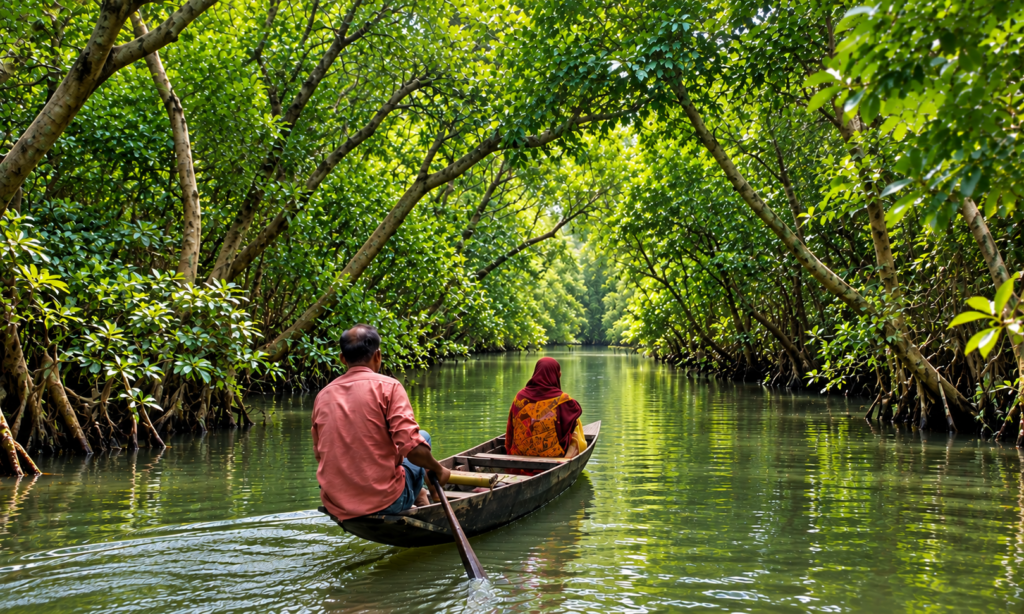
In the Sundarbans, the boat becomes part of the experience itself.
It takes you through the ecosystem rather than merely around it.
- The waterways reveal the geography.
- The changing tide reveals the mudflats.
- The forest edges provide opportunities for wildlife observation.
- The boat also offers a perspective on how people navigate and live around the delta.
This changes the rhythm of the journey.
There may be long periods when nothing dramatic happens.
That is perfectly normal.
You may watch a kingfisher.
- Follow a narrow creek.
- Notice a crocodile.
- See deer at the forest edge.
- Spend an hour seeing nothing more than mangroves and water.
Those quiet stretches are not wasted time.
They are when the landscape starts to become familiar.
When Is the Best Time for German Travelers to Visit the Sundarbans?
For most travellers, October through mid-March is the main tourism season in the Sundarbans.
This period is widely preferred for wildlife-focused travel, boat exploration and outdoor activities.
For German travellers, it can also fit naturally into a wider India journey during the European winter.
The best time ultimately depends on the experience you want, but if your priorities are wildlife, photography, birdwatching and comfortable exploration, the main tourism season is the natural starting point.
How Do You Travel to the Sundarbans from Germany?
See it for yourself
A private journey shaped around you — your group, your pace, your interests. Book a free consultation.
For international travellers, Kolkata is the principal gateway to the Indian Sundarbans.
The journey typically progresses through several stages: Germany → Kolkata → southern West Bengal → Sundarbans gateway → boat → mangrove wilderness
West Bengal Tourism identifies Kolkata, Canning and Godkhali among the important access points for reaching the Sundarbans.
That progression is worth appreciating.
The landscape changes gradually.
The urban environment of Kolkata gives way to rural Bengal.
Roads become less dominant.
Water becomes increasingly important.
Eventually, the boat becomes your principal means of moving through the landscape.
The journey itself explains why the Sundarbans is unlike a conventional national park.
Should You Combine Kolkata and the Sundarbans?
For most German travellers, yes.
If you are travelling this far to eastern India, combining Kolkata with the Sundarbans creates a more complete journey.
Kolkata introduces you to Bengal’s architecture, culture, food, history and urban life.
The Sundarbans introduce you to the delta’s wilderness.
The contrast is part of the appeal.
You can move from one of India’s great cities into a landscape where rivers replace roads and tides influence the rhythm of daily life.
The journey becomes: Kolkata → Bengal → delta → mangrove ecosystem → wilderness
It is a much more rewarding introduction to the region than treating the Sundarbans as a brief excursion.
How Many Days Should You Spend in the Sundarbans?
The number of days you spend in the Sundarbans changes the depth of the experience.
A short trip can introduce you to the landscape.
A longer expedition gives you time to notice its patterns.
2 Nights / 3 Days — The Minimum
2 nights and 3 days is the minimum for a meaningful introduction to the Sundarbans.
It allows time for boat-based exploration, wildlife observation and an initial understanding of the mangrove environment without reducing the experience to transfers and brief excursions.
4 Nights / 5 Days — The Ideal Overall Experience
For most German travellers, 4 nights and 5 days is the ideal overall experience.
It gives you more time for different waterways, changing tides, birdwatching, photography and wildlife observation.
More importantly, it removes some of the pressure to make every outing produce a major sighting.
The longer you stay, the more the landscape begins to reveal its patterns.
6–7 Days — For a Deeper Expedition
If your interests include ecology, conservation, wildlife photography, birdwatching, natural history or slow travel, consider 6–7 days.
With additional time, you can observe the Sundarbans under different conditions rather than experiencing it as a single snapshot.
- You can revisit waterways.
- Spend longer observing birds.
- Pay attention to mangrove structure.
- Notice how the landscape changes with the tide.
- Give yourself greater room for the unexpected.
You can visit the Sundarbans in three days. But five days gives you time to experience it. Seven days gives you time to understand it.
For a traveller making the journey from Germany, that extra time can transform the trip from a wildlife excursion into a genuine wilderness experience.
What Is a Sundarbans Expedition Actually Like?
The word “expedition” can sound adventurous.
In the Sundarbans, the reality is often quieter.
- Early mornings.
- Long stretches on the water.
- Changing tides.
- Bird calls.
- Forest edges.
- Periods of waiting.
And occasional moments of extraordinary wildlife activity.
- The landscape determines the rhythm.
- Tides influence movement.
- Weather influences visibility.
- Wildlife decides whether it appears.
That is why good expedition planning is not about guaranteeing a particular outcome.
It is about creating the conditions for meaningful observation while respecting the environment.
An experienced local team can also provide something maps and guidebooks cannot: interpretation.
Knowing where you are is useful.
Understanding what you are seeing is better.
Is the Sundarbans Good for Wildlife Photography?
Yes, especially for photographers interested in environmental storytelling.
The Sundarbans offers subjects far beyond close-up animal portraits:
- Mangrove landscapes
- Tidal rivers
- Mudflats
- Reflections
- Birds
- Crocodiles
- Deer
- Boats
- Local life
- Forest silhouettes
- Changing light
- Wildlife within its natural habitat
The challenge is patience.
You may not always get the perfect close-up.
Instead, you may photograph an animal as part of the landscape.
- A tiger partially concealed by mangroves.
- A crocodile blending into the shoreline.
- A kingfisher above a tidal creek.
- A boat disappearing into a forest channel.
For a photographer interested in nature rather than trophies, those environmental images can tell a much richer story.
What Should German Travelers Pack for the Sundarbans?
Pack for a warm, humid outdoor environment rather than a conventional sightseeing holiday.
Useful items include:
- Lightweight, breathable clothing
- Comfortable footwear
- Sun protection
- Sunglasses
- Insect repellent
- Reusable water bottle
- Personal medication
- Binoculars
- Camera equipment and spare batteries
- Waterproof protection for electronics
- Light rain protection when appropriate
- Small daypack
Binoculars are particularly useful.
The Sundarbans rewards observation at a distance.
You do not need to approach wildlife to experience it well.
Is the Sundarbans Suitable for First-Time Visitors to India?
Yes, with appropriate planning.
The Sundarbans is more remote and logistically distinctive than India’s major cities and cultural destinations.
Boat transfers, tidal conditions, forest regulations and remote locations all require some preparation.
For first-time visitors to India, an organised expedition can therefore make the experience considerably easier.
But the real advantage is not only convenience.
It is local knowledge.
An experienced team can help you understand the landscape, anticipate changing conditions and interpret wildlife behaviour.
That can make the difference between simply travelling through the Sundarbans and actually appreciating it.
Is the Sundarbans Safe for German Travelers?
The Sundarbans should be treated as genuine wilderness.
There are wild animals, waterways, tides, changing weather and remote forest areas.
Responsible travel therefore requires sensible behaviour.
- Stay with your group.
- Follow your guide’s instructions.
- Do not approach wildlife.
- Do not enter restricted areas independently.
- Respect boat and forest regulations.
Never attempt to turn a wildlife encounter into a closer photograph.
The guiding principle is simple:
You are entering the habitat of wild animals. Your responsibility is to adapt to the environment—not the other way around.
Responsible Travel in the Sundarbans
Responsible tourism is particularly important in a landscape where conservation and local livelihoods are closely connected.
The Sundarbans is not an empty wilderness.
Communities live around the wider ecosystem and depend on a variety of livelihoods, while the protected landscape supports globally important biodiversity.
That means responsible travel should consider both ecological and human dimensions.
As a traveller, you can:
- Reduce single-use plastic
- Take waste away from sensitive areas
- Respect local communities
- Never disturb wildlife
- Follow forest regulations
- Support legitimate local livelihoods
- Avoid products made from protected wildlife
- Choose responsible local operators
- Use water and other resources thoughtfully
UNESCO has highlighted both the ecological importance of the Sundarbans and the challenges faced by communities living alongside its wildlife, including human-tiger conflict.
Conservation is therefore not simply about protecting animals.
It is about maintaining a workable relationship between people, wildlife and the environment.
Visa Planning for German Travelers
German citizens travelling to India generally require an appropriate Indian visa or eligible eVisa unless they qualify for an applicable exemption.
India’s official visa portal provides current information on visa categories, requirements and eVisa eligibility. Because entry requirements can change, travellers should verify the latest rules before departure and use the official Indian visa system for their application where applicable.
It is also sensible to confirm passport validity, entry conditions and any required arrival formalities before finalising your itinerary.
Why Explore the Sundarbans with The Wild Orbit?
The Wild Orbit approaches the Sundarbans as an ecosystem first and a tourism destination second.
That philosophy changes the expedition.
The question is not simply: “Did you see the tiger?”
It is: “What did you understand about the place?”
A meaningful expedition connects the different parts of the system: tide → mangrove → waterways → prey → predator → communities → conservation
The tiger matters.
But so does the forest that supports it.
The waterways matter.
So do the communities that live around them.
And the changing tides matter because they influence the entire environment.
Our approach is built around experiencing the Sundarbans through that wider perspective.
That means paying attention to local knowledge, respecting wildlife distance, understanding the rhythm of the waterways and accepting that nature does not operate according to a timetable.
For German travellers who value responsible tourism, ecological awareness and meaningful exploration, this creates a different kind of wildlife journey.
- You may arrive hoping to see a tiger.
- You may leave thinking about mangroves.
- You may arrive looking for wildlife.
- You may leave thinking about ecosystems.
That is the kind of journey The Wild Orbit aims to create.
The Sundarbans Is a Different Kind of Global Wildlife Destination
The world’s great wildlife destinations each have a distinct identity.
The African savannah offers scale and iconic large mammals.
The Amazon offers immense rainforest and river systems.
The Galápagos offers island ecosystems and evolutionary history.
The Sundarbans offer tidal wilderness.
- Its forests exist between land and water.
- Its rivers determine movement.
- Its mangroves survive under difficult conditions.
- Its tiger has adapted to a world of mud, creeks and saline water.
- Its conservation story is inseparable from the people living around the ecosystem.
That is why the Sundarbans belong among the world’s great wildlife destinations.
Not because it replicates them.
Because it doesn’t.
The Sundarbans is not an inferior alternative to the world’s famous wildlife destinations. It is one of the world’s most distinctive wilderness experiences in its own right.
For travellers seeking something genuinely different, that distinction is its greatest strength.
Why the Sundarbans Deserves a Place on a German Traveller’s India Itinerary
For German travellers, the Sundarbans offers a remarkably complete nature experience.
It combines:
- Wildlife
- Mangrove ecology
- Wetland systems
- Tidal geography
- Photography
- Birdwatching
- Local communities
- Conservation
- Responsible travel
But perhaps its greatest quality is that it rewards curiosity.
You do not need every hour to produce something spectacular.
You need time to notice what is already happening.
- A tide changing direction.
- Birds moving across a mudflat.
- Mangrove roots exposed by receding water.
- A crocodile remaining almost perfectly still.
- A deer watching the forest edge.
- A distant movement that may or may not be a tiger.
The more you understand the environment, the more meaningful these moments become.
That is what makes the Sundarbans worth the journey from Germany.
FAQs
Is the Sundarbans worth visiting from Germany?
Yes. It is particularly rewarding for travellers interested in wildlife, ecology, mangrove ecosystems, photography, birdwatching and responsible travel. It offers a wilderness experience fundamentally different from an African safari, Amazon journey or Galápagos expedition.
Is the Sundarbans a world-class wildlife destination?
Yes. The Sundarbans is internationally recognised for its exceptional mangrove ecosystem, biodiversity and Bengal tiger habitat. The Indian Sundarbans was inscribed as a UNESCO World Heritage property in 1987.
How do German travellers get to the Sundarbans?
Most international visitors travel first to Kolkata and then continue by road towards a Sundarbans gateway before transferring to a boat for exploration of the waterways and forest areas.
Can German travellers see Bengal tigers?
A sighting is possible but never guaranteed. The Bengal tiger inhabits dense mangrove terrain where visibility can be difficult. Responsible wildlife travel should therefore never promise a particular animal encounter.
Is the Sundarbans like an African safari?
No. African safaris and the Sundarbans offer fundamentally different experiences. African safaris often involve open landscapes and large mammals, while the Sundarbans is a tidal, boat-based mangrove wilderness.
How does the Sundarbans compare with the Amazon?
Both are extraordinary ecosystems, but they have very different ecological structures. The Amazon is dominated by immense tropical rainforest and river systems, while the Sundarbans is defined by mangrove forests, tidal waterways and deltaic processes.
How does the Sundarbans compare with the Galápagos?
The Galápagos is renowned for island ecosystems and evolutionary history. The Sundarbans offers a different ecological story centred on mangrove adaptation, tides, wetlands and Bengal tigers.
How many days should I spend in the Sundarbans?
2 nights and 3 days is the minimum. 4 nights and 5 days is the ideal overall experience for most travellers. Those interested deeply in ecology, wildlife photography, birdwatching or conservation should consider 6–7 days.
When is the best time to visit the Sundarbans?
October through mid-March is generally considered the main tourism season and is a popular period for wildlife-focused travel.
Is the Sundarbans good for birdwatching?
Yes. Its wetlands, waterways, mudflats and mangrove forests support diverse birdlife, making the region rewarding for birdwatchers as well as general wildlife travellers.
Is the Sundarbans suitable for first-time visitors to India?
Yes, provided the wilderness portion is properly organised. It is more remote and logistically distinctive than India’s major cities, so experienced local planning can be valuable.
Is the Sundarbans safe?
It is a genuine wilderness environment. Travellers should follow guides, boat instructions and forest regulations and should never approach wildlife independently.
What makes the Sundarbans ecologically important?
Its mangrove forests support biodiversity, help stabilise shorelines, trap sediment and provide important wetland habitat. The ecosystem also contributes to natural protection from storms and other coastal hazards.
Give the Sundarbans Time to Reveal Itself
There is a difference between seeing a place and understanding it.
Three days can introduce you to the Sundarbans.
Five days can give you time to experience its waterways, wildlife and changing tides.
Seven days can allow you to start recognising its patterns.
- The forest becomes less mysterious.
- The tide becomes easier to read.
- Bird behaviour becomes more interesting.
- The mangroves stop being background scenery.
And the Bengal tiger becomes more than an iconic animal—it becomes part of an intricate ecological system.
That is the real value of travelling slowly through the Sundarbans.
You do not simply accumulate sightings.
You develop a relationship with the landscape.
You can visit the Sundarbans in three days. But five days gives you time to experience it. Seven days gives you time to understand it.
For a traveller coming from Germany in search of a meaningful wilderness experience, that may be the most important reason to stay longer.
Plan your private Sundarban expedition
A private journey shaped around you — your group, your pace, your interests. Book a free consultation.