 Sundarban Tales
At first, Sudhanyakhali can seem like a simple stop on a Sundarbans boat route: a jetty, a forest path, a watchtower and a freshwater pond surrounded by mangroves.
But the landscape reveals more when it is observed carefully.
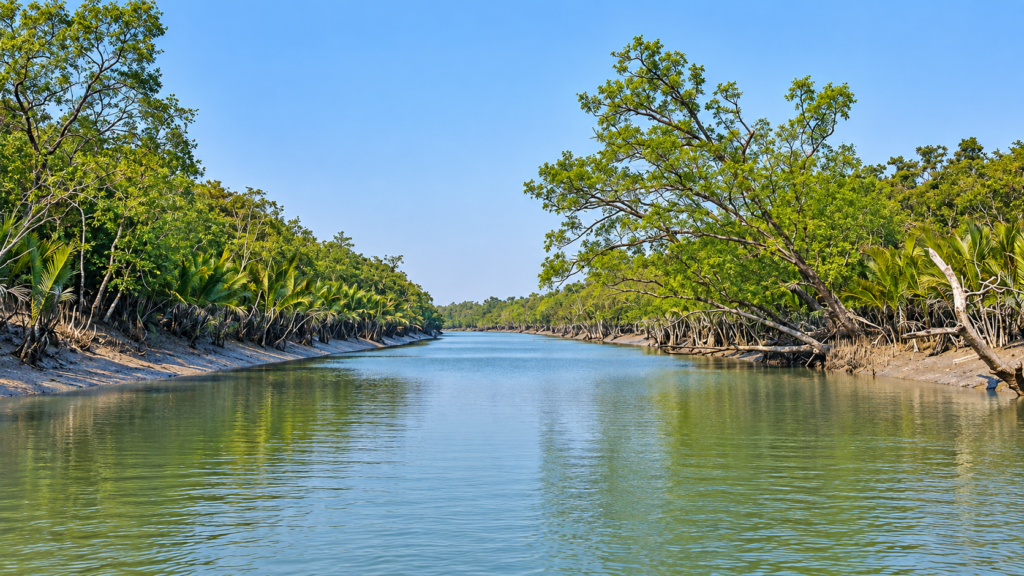
The water around the forest rises and falls with the tide. Mud, roots and narrow creeks form a shifting boundary between land and water. Beyond the pond, the vegetation opens into a comparatively visible stretch of forest, creating one of the few places in this part of the protected landscape where visitors can look across a terrestrial habitat rather than simply along a riverbank.
This is what makes Sudhanyakhali significant.
It is not simply a place associated with tiger sightings. It is a managed observation point within the northern Indian Sundarbans where freshwater availability, mangrove vegetation, tidal geography and wildlife movement come together within a protected landscape.
Sudhanyakhali Island lies within the Indian Sundarbans and has been identified in peer-reviewed research as an unpopulated protected island within the Sundarbans National Park, Tiger Reserve and World Heritage Site. The study gives its location as approximately 22.1058°N, 88.7841°E and describes the island as protected from human encroachment and use, apart from tightly managed ecotourism.
The Sudhanyakhali surface camp itself is part of the Sajnekhali Wildlife Sanctuary Range of Sundarban Tiger Reserve. The Tiger Reserve’s conservation plan identifies the Sudhanyakhali beat as covering part of Pirkhali 2, with the camp serving both tourism and forest-protection functions.
Sudhanyakhali At A Glance
- Location: Indian Sundarbans, West Bengal, within the protected Sundarban landscape
- Protected-area context: Sundarban Tiger Reserve / Sajnekhali Wildlife Sanctuary Range
- Landscape: Tidal mangrove forest, creeks, mudflats and managed freshwater habitat
- Known for: Sudhanyakhali Watchtower, Mangrove Park and wildlife observation
- Island status: Unpopulated protected island according to peer-reviewed research
- Approximate island coordinates: 22.1058°N, 88.7841°E
- Principal wildlife associated with the site: Royal Bengal Tiger, Spotted Deer, Wild Boar, Saltwater Crocodile and a range of birds and reptiles
- Visitor access: Regulated ecotourism by boat and designated landing facilities
- Notable feature: A freshwater pond beside the watchtower that creates an important wildlife-observation setting
- Cultural feature: A Banabibi shrine/temple is included on the official Sudhanyakhali visitor route.
- Accessibility: Accessible only by boat through regulated Sundarban Tiger Reserve routes; visitors must follow designated landing areas, walking routes and Forest Department access regulations
How to Reach Sudhanyakhali
Sudhanyakhali is accessible only by boat through the regulated waterways of the Sundarban Tiger Reserve.
- From Kolkata: Travel to Godkhali or Dhamakhali, depending on your tour and boat arrangements.
- By boat: Continue into the Reserve on a registered boat authorised by the Forest Department.
- Forest entry: The Sudhanyakhali route is accessed through Sajnekhali.
- Route: Sajnekhali → Sudhanyakhali → Sundarkhali → Choragazikhali → Dobanki, with the exact itinerary depending on the authorised tour route.
- Road access: There is no direct road access to Sudhanyakhali.
- Important: Visitors cannot enter independently or use an unauthorised boat; Forest Department regulations and current permits apply.
Geographic Setting
Sudhanyakhali lies in the northern part of the Indian Sundarbans, within a landscape where forest islands are separated by an intricate network of tidal rivers, creeks and channels.
The island is part of the protected forest landscape rather than an inhabited settlement. Research examining ecosystem services in the Indian Gangetic Delta describes Sudhanyakhali as a major unpopulated island protected from human encroachment within the Sundarbans National Park, Tiger Reserve and World Heritage Site.
The wider Sundarbans is a deltaic environment shaped continuously by river discharge, tides, sediment movement and salinity. UNESCO describes the Sundarbans as a complex network of tidal waterways, mudflats and small islands covered by salt-tolerant mangrove vegetation.
Sudhanyakhali therefore should not be understood as an isolated terrestrial destination. Its character is inseparable from the tidal landscape surrounding it.
Rivers Flowing Beside The Island
- Sudhanyakhali tidal waterway and associated creeks — the immediate waterways around the camp and landing area form part of the tidal drainage network.
- Bidya River system — an important regional waterway associated with access through the northern Sundarbans and the Sajnekhali–Sudhanyakhali tourism circuit.
- Pirkhali waterway network — the Sudhanyakhali camp is situated within the Pirkhali forest landscape, whose tidal creeks connect the forest compartments.
The exact channel immediately adjoining the landing point can vary in terminology between maps, management documents and local usage. For that reason, individual minor creeks should not be treated as fixed, permanent river channels without a current official map reference.
Nearby Forest Blocks
- Pirkhali Forest Block — the most directly relevant forest block; the Sudhanyakhali beat has jurisdiction in Pirkhali 2.
- Panchamukhani Forest Block — part of the adjoining Sajnekhali Wildlife Sanctuary landscape and connected to the broader northern tourism circuit.
- Pirkhali 4–7 — associated with the Dobanki beat farther along the same protected landscape.
Nearby Inhabited Islands & Human Settlements
Sudhanyakhali itself is not an inhabited island.
- Gosaba Island — a major inhabited island in the outer delta, situated near the protected Sudhanyakhali landscape. Peer-reviewed research specifically examined Sudhanyakhali and Gosaba as contrasting protected and inhabited island systems.
- Pakhiralay and surrounding settlements — part of the human settlement and tourism infrastructure on the northern approach to the protected forest.
- Gosaba and surrounding inhabited islands — form part of the wider human–forest interface surrounding the reserve.
The distinction matters. Sudhanyakhali represents a protected forest island, while nearby inhabited islands such as Gosaba demonstrate how closely protected mangrove landscapes coexist with densely used human landscapes in the Indian Sundarbans.
Landscape Character
The first thing to understand about Sudhanyakhali is that the forest does not look like a conventional inland forest.
There is no continuous floor of dry soil.
The ground is shaped by tides.
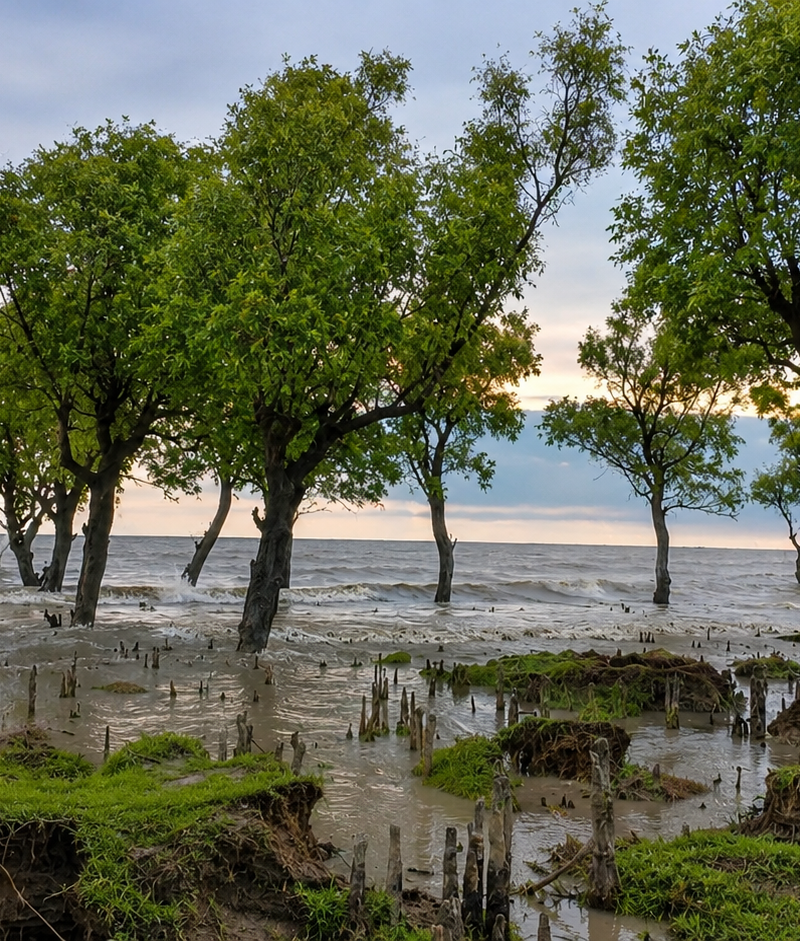
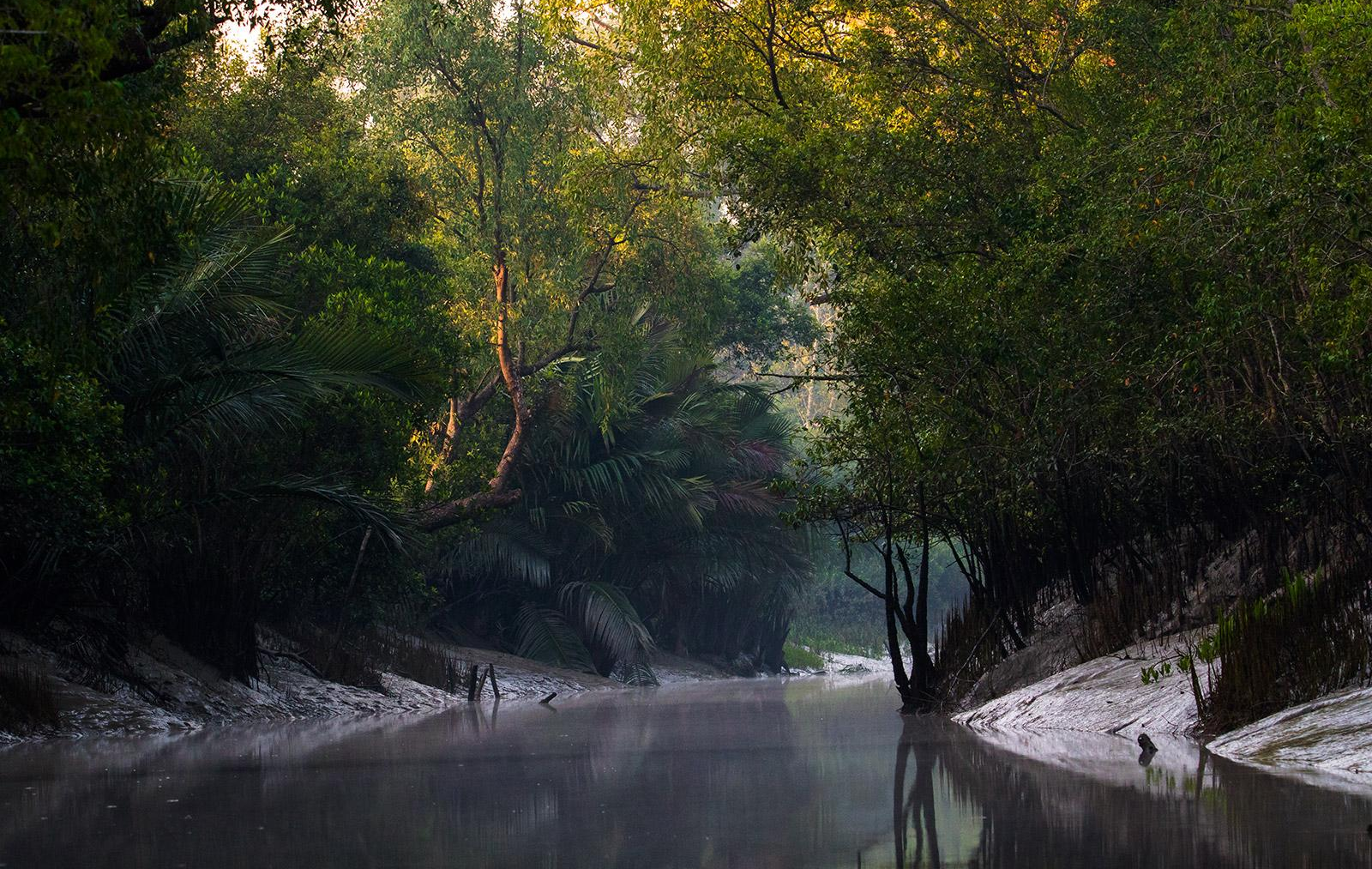
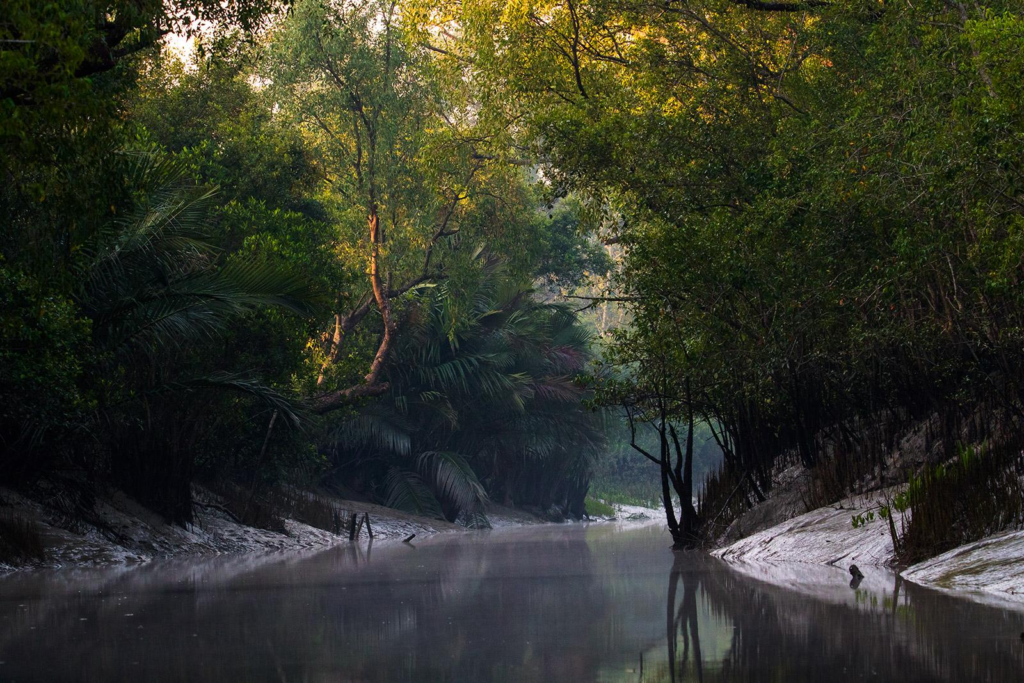
Mangrove roots emerge from soft sediment. Narrow channels penetrate the forest. Mudbanks appear and disappear with changing water levels. Vegetation is adapted to periodic inundation, saline or brackish conditions and waterlogged soils.
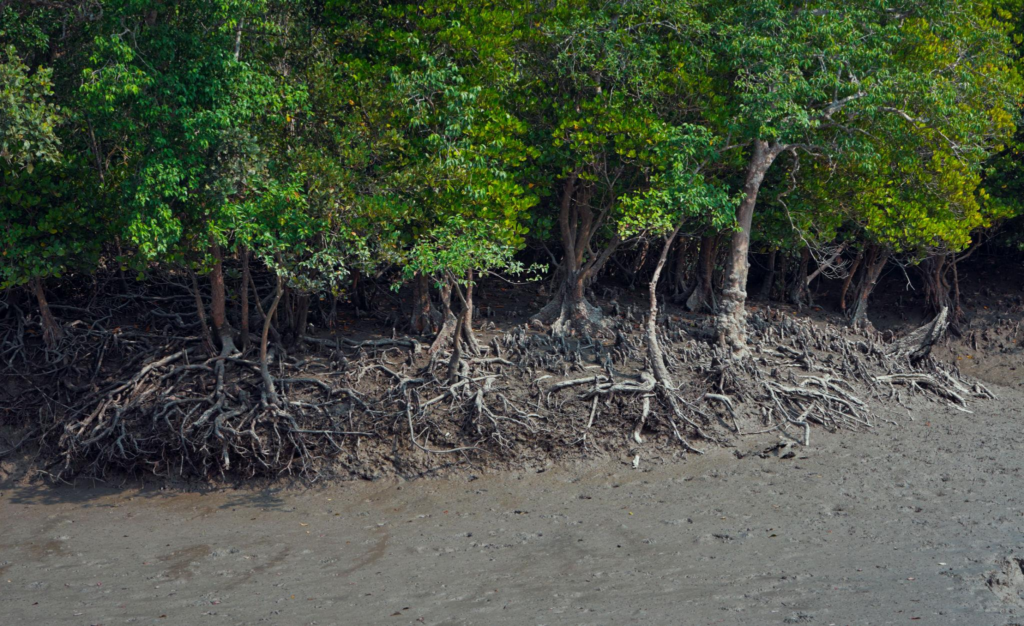
From a boat, the forest often appears as an almost continuous green wall. At Sudhanyakhali, however, the visitor is brought onto a managed forest site where the vegetation opens around a freshwater pond and observation area.
The result is an unusual contrast: dense mangrove forest surrounding a relatively open wildlife-viewing landscape.
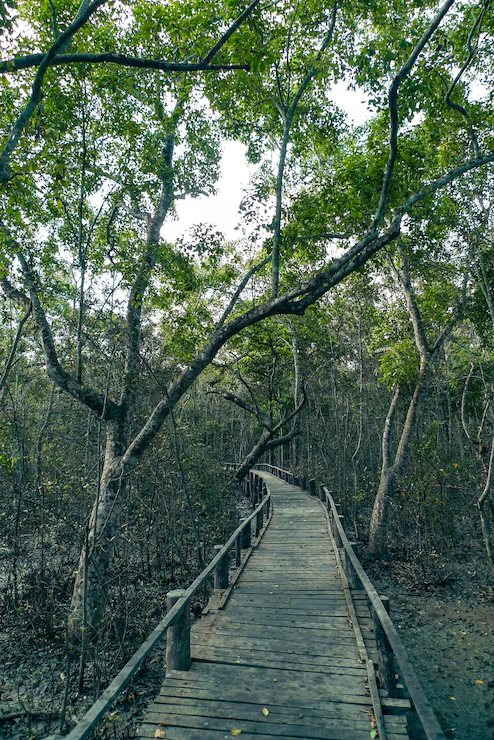
The official Tiger Reserve describes Sudhanyakhali as a site with a watchtower, Mangrove Park and a freshwater pond, while its tourism route identifies the watchtower and Mangrove Park as the principal visitor features.
The landscape is therefore not merely scenic infrastructure placed inside a forest. The physical arrangement of the site influences what visitors can observe.
The Sudhanyakhali Watchtower
The watchtower is the most recognisable feature of Sudhanyakhali.
Its purpose is simple: elevate the observer above the forest floor and provide a wider field of view.
That matters in the Sundarbans because visibility from ground level is extremely limited. Mangrove vegetation, dense undergrowth, uneven terrain, tidal creeks and the presence of potentially dangerous wildlife make unrestricted walking through the forest impossible.
The Tiger Reserve explicitly regulates tourism and restricts visitors from walking freely on the land. Designated locations such as Sudhanyakhali provide controlled opportunities for people to experience the forest without opening the wider habitat to unrestricted movement.
From the tower, the view is consequently less about seeing a large animal at close range and more about reading the landscape.
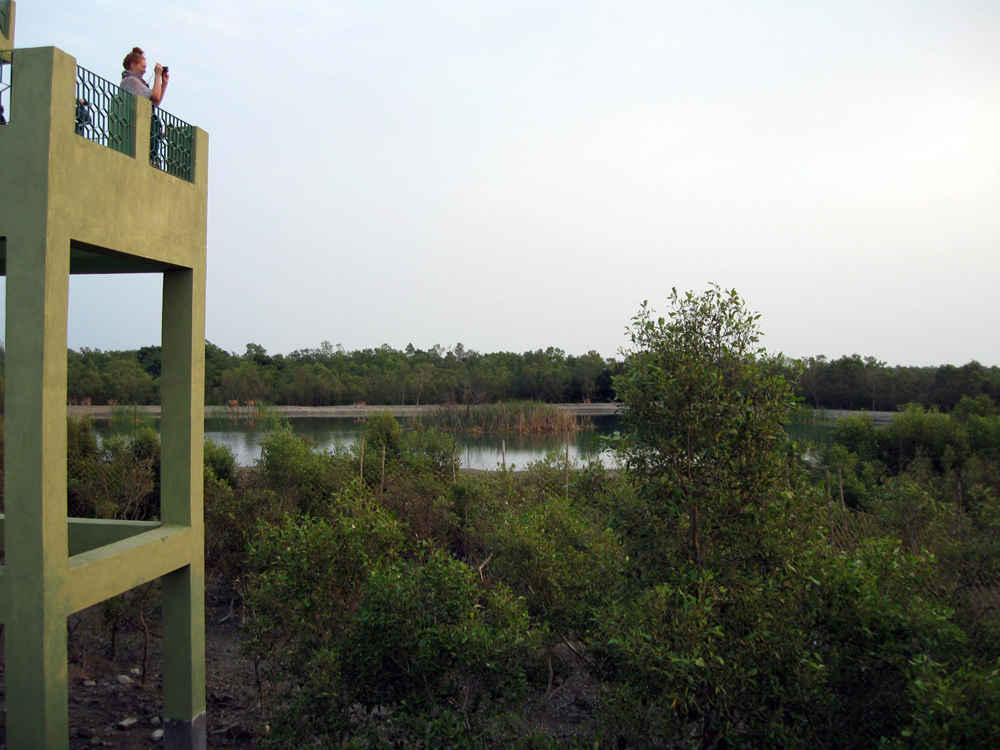
- A deer may appear beside the pond.
- A crocodile may remain motionless along the water’s edge.
- A bird may cross the open space. Vegetation may move somewhere beyond the visible clearing.
And sometimes nothing happens.
That is an important part of wildlife observation in the Sundarbans.
A watchtower is an observation platform, not a wildlife theatre.
The Freshwater Pond
The freshwater pond is one of the most important ecological features associated with Sudhanyakhali’s visitor landscape.
The surrounding Sundarbans is influenced by saline and brackish water, while freshwater availability within the forest can be limited and spatially variable.
The managed freshwater pond at Sudhanyakhali therefore creates a very different micro-habitat from the surrounding tidal waterways.
The Tiger Reserve itself identifies the freshwater pond as a feature associated with the Sudhanyakhali watchtower and notes that it provides opportunities to observe wildlife, including tigers.
It is important, however, not to interpret the pond as a guaranteed wildlife attractor.
Animals are not required to appear simply because a freshwater source exists.
Their movements depend on water availability, tide, temperature, vegetation, disturbance, season and individual behaviour.
The pond simply creates one ecological opportunity within a much larger landscape.
Mangrove Park
Sudhanyakhali also contains a managed Mangrove Park.
The official Tiger Reserve describes it as a planted and maintained collection representing major mangrove species.
For visitors, this can provide something that the surrounding wild forest often cannot: a relatively clear opportunity to understand mangrove diversity.
In the natural forest, different species may be difficult to identify from a moving boat. Their roots, leaves and growth forms can be partially obscured by neighbouring vegetation.
A managed planting can make comparison easier.
This distinction should be retained when discussing the Mangrove Park. It is not a substitute for the natural mangrove ecosystem. Instead, it provides an interpretive setting through which visitors can better recognise some of the plant diversity that structures the wider forest.
The Mangrove Ecosystem
Sudhanyakhali exists because of the larger deltaic system around it.
Mangroves are specialised plants adapted to environments where freshwater and seawater interact, soils remain waterlogged and oxygen availability in the sediment can be limited.
Different mangrove species have evolved different strategies for surviving these conditions.
Some develop specialised aerial roots. Others tolerate higher salinity. Some possess structures that help them exchange gases in oxygen-poor sediment.
The result is a forest that functions very differently from terrestrial woodland.
UNESCO identifies the Sundarbans as an outstanding example of ongoing ecological processes involving tidal waterways, mudflats and salt-tolerant mangrove forests.
Research from the Sudhanyakhali–Pirkhali area has recorded mangrove taxa including Ceriops decandra, Excoecaria agallocha and Xylocarpus mekongensis, with Bruguiera gymnorhiza and Avicennia species associated with creeks and creeklets. The same research describes thick undergrowth of Phoenix paludosa in the Pirkhali forest block.
These plants are not simply the background scenery of Sudhanyakhali.
They create the habitat.
They stabilise sediment, provide food and shelter for organisms, influence nutrient cycles and form the physical structure through which animals move.
Wildlife Of Sudhanyakhali
Sudhanyakhali is particularly associated with wildlife observation from the watchtower.
The species most closely associated with the site’s reputation is the Royal Bengal Tiger (Panthera tigris tigris).
But the ecological story is considerably broader.
Royal Bengal Tiger
The Sundarbans is one of the world’s most distinctive tiger habitats.
UNESCO notes that the mangrove environment supports a tiger population adapted to an unusually aquatic landscape, including the ability to swim long distances.
Sudhanyakhali is recognised by the West Bengal Tourism Department as one of the locations where visitors may have opportunities to see tigers and other wildlife.
That should never be translated into a promise of a tiger sighting.
A tiger may use the forest around Sudhanyakhali without ever becoming visible from the tower.
The value of the site lies in the possibility of observation within tiger habitat, not in guaranteed encounters.
Spotted Deer
Spotted Deer (Axis axis) are among the wildlife species associated with the open areas around Sundhanyakhali.
They are particularly relevant to the freshwater-pond landscape because deer can use open areas around water and vegetation.
Their presence also illustrates an important ecological relationship: large predators and herbivores are part of the same habitat system.
Where deer occur, the forest is supporting herbivorous mammals; where prey occurs, predators have access to one component of their food base.
Wild Boar
Wild Boar are also recorded from the wider Sundarbans and have been reported around Sudhanyakhali.
Their omnivorous feeding behaviour allows them to exploit a range of food resources in the mangrove environment.
Saltwater Crocodile
The Saltwater Crocodile (Crocodylus porosus) is another important predator of the Sundarbans’ tidal environment.
It is adapted to estuarine and coastal habitats and may be encountered in the waterways and around suitable banks.
The West Bengal Tourism Department lists crocodiles among the wildlife associated with the Sundarbans and specifically identifies Sudhanyakhali as a site where visitors may observe wildlife around the forest.
Birds and Smaller Wildlife
Sudhanyakhali’s open water and forest-edge conditions can also support birds, reptiles and smaller animals.
The important principle for visitors is to resist focusing exclusively on large mammals.
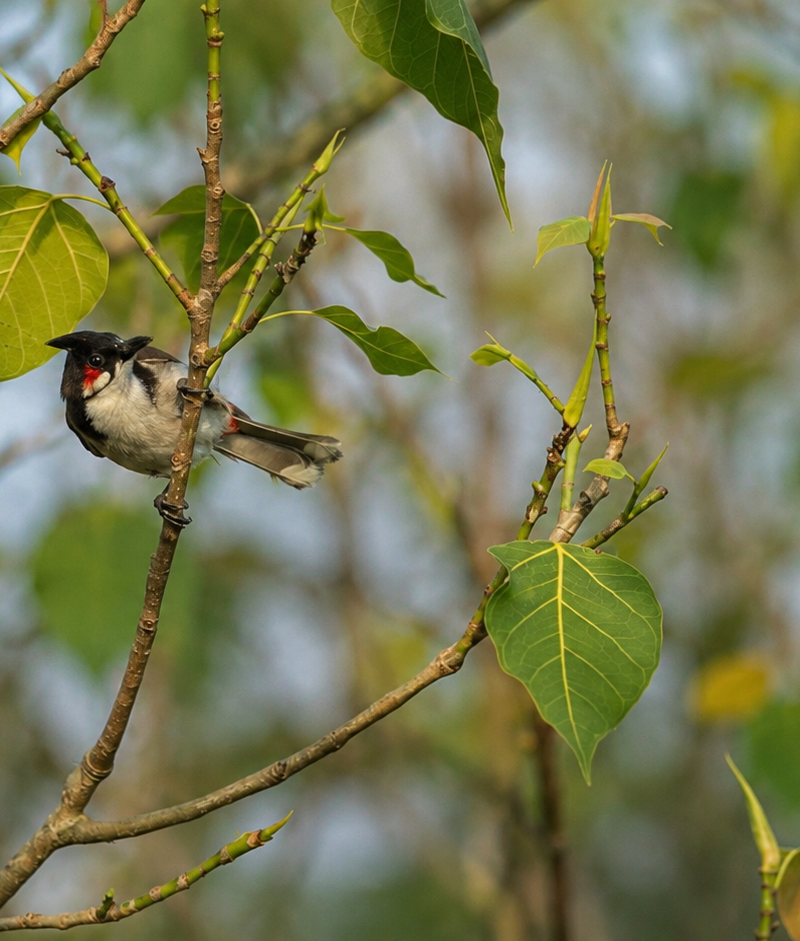
A watchtower can reveal a Brahminy Kite above the canopy, a heron near shallow water, a kingfisher moving between perches, a monitor lizard crossing an open patch, or smaller creatures living among the mangrove roots.
The forest is biologically richer than the animals large enough to attract a headline.
Why Tigers May Approach Water
The association between wildlife and the freshwater pond has a straightforward ecological explanation, but it should not be simplified into the idea that animals routinely arrive at predictable times.
Water availability is one of the fundamental requirements of terrestrial wildlife.
In a mangrove landscape where saline and brackish waters dominate much of the environment, freshwater sources can have particular importance.
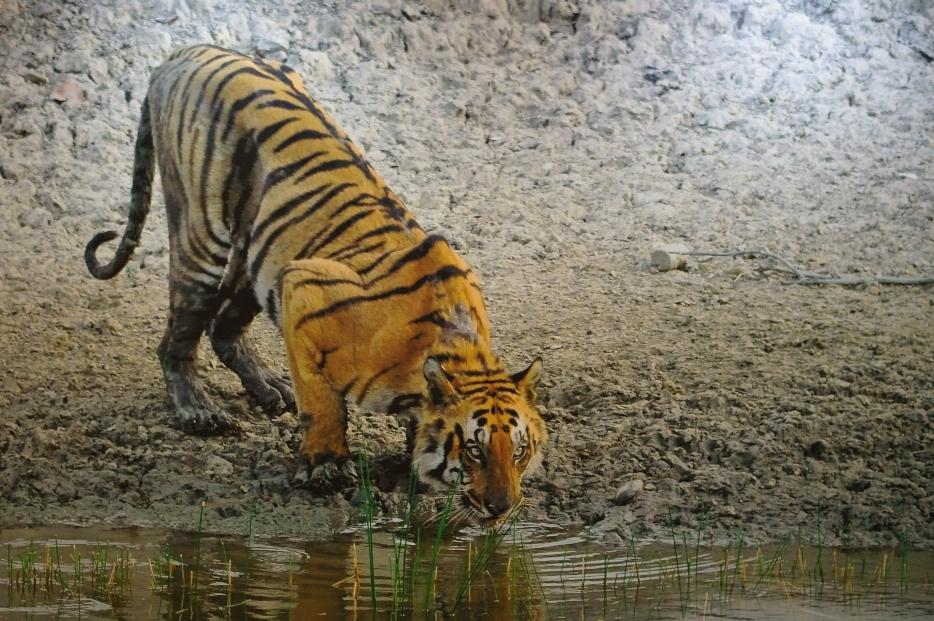
The Tiger Reserve’s own description of Sudhanyakhali specifically connects the freshwater pond with opportunities to sight wildlife.
But animal movement remains dynamic.
- A tiger may approach water and remain hidden.
- A deer may arrive and leave quickly.
- A crocodile may lie almost motionless and become visible only after careful observation.
The ecological value of the pond is therefore greater than its value as a “spotting point”.
It is an example of how water availability interacts with animal behaviour in a tidal forest.
Rivers and Water Systems
Water controls almost everything at Sudhanyakhali.
The forest is embedded within an estuarine system where tidal water moves through a complex network of rivers and creeks.
The broader Sundarbans is part of the Ganges–Brahmaputra delta and ultimately communicates with the Bay of Bengal. UNESCO identifies the complex network of tidal waterways and mudflats as a defining characteristic of the ecosystem.
The regional hydrology around Sudhanyakhali includes the Bidya and Pirkhali waterway systems, with smaller channels carrying tidal flows through the forest.
This means the landscape is never completely static.
A mudbank visible during one visit may be submerged during another tidal stage.
A creek that appears narrow may become substantially wider with rising water.
The same forest edge can therefore present a different physical appearance depending on tide, season, weather and light.
This is one reason boat-based observation is central to understanding Sudhanyakhali.
The journey through the waterways is not merely transportation between attractions. It is part of the geography of the place.
History
Sudhanyakhali does not have the kind of extensively documented architectural or archaeological history associated with places such as Netidhopani.
Its modern identity is closely tied to the development and management of the protected Sundarbans landscape and to regulated ecotourism.
The Tiger Reserve’s management records identify Sudhanyakhali as a forest beat and tourism site within the Sajnekhali Wildlife Sanctuary Range. The Sudhanyakhali camp also has a dual role: visitor management during the tourism season and forest-protection work during other periods.
This dual function is important.
Sudhanyakhali is not simply a facility built for visitors.
It is part of the administrative and protection infrastructure of a working protected area.
The wider conservation history of the Sundarbans is also substantial. The Sundarban Tiger Reserve is one of India’s designated tiger reserves, while the Indian Sundarbans has international recognition through its World Heritage status. UNESCO’s Sundarbans National Park entry records the area’s global importance for mangrove biodiversity and threatened fauna.
Culture And Folklore
Sudhanyakhali also has a cultural dimension.
The official Sundarban Tiger Reserve route identifies a Banabibi temple among the visitor features at Sudhanyakhali.
Banabibi occupies an important place in the cultural landscape of the Sundarbans, particularly among communities whose lives have historically been connected with forests, rivers, fishing and forest-resource collection.
The presence of a Banabibi shrine at a protected forest tourism site reflects the broader relationship between ecological landscape and cultural memory in the Sundarbans.
It is important, however, to distinguish documented cultural tradition from historical claims that cannot be independently established.
Sudhanyakhali should not be assigned an invented legend simply to make the article more dramatic.
Its significance is already strong enough: it sits at the intersection of protected forest, wildlife, water, conservation management and the cultural world of the Sundarbans.
Conservation Significance
Sudhanyakhali provides a useful example of what protected-area management looks like in a difficult tidal environment.
The forest is not fenced off from all human activity in the conventional sense.
Instead, access is controlled.
- Tourism is concentrated at designated sites.
- Boats follow regulated routes.
- Visitors are restricted from freely walking through the forest.
- Forest staff maintain protection infrastructure and monitor human activity.
The Tiger Reserve’s conservation plan explicitly states that tourism is highly regulated because of the difficult terrain and ecological sensitivity of the Sundarbans. It identifies Sudhanyakhali among the designated tourist locations.
The Sudhanyakhali beat also performs forest-protection functions outside the main tourism period, including protection of its Pirkhali jurisdiction and maintenance of fencing along the village–forest interface.
This makes Sudhanyakhali an interesting example of conservation infrastructure serving two purposes at once: controlled access for people and controlled protection for wildlife.
Tourism and Visitor Access
Sudhanyakhali remains an active ecotourism site.
The Sundarban Tiger Reserve’s most recent annual report lists Sudhanyakhali among its seven principal ecotourism sites, alongside Sajnekhali, Dobanki, Harikhali, Burirdabri, Jhingekhali and Netidhopani. The report records more than 608,000 Indian visitors and 3,300 foreign visitors across the entire Sundarban Tiger Reserve jurisdiction during FY 2025–26; this figure is for the reserve as a whole, not Sudhanyakhali individually.
That distinction matters.
There is no sound basis for presenting the reserve-wide visitor number as the visitor count for Sudhanyakhali.
Is Sudhanyakhali Open to Tourists?
Yes, Sudhanyakhali is currently listed by the Sundarban Tiger Reserve as an ecotourism site.
However, access is regulated, not unrestricted.
Visitors should follow the current permit requirements, designated routes, landing instructions and Forest Department rules applicable on the date of travel.
Can Visitors Walk Around Freely?
No.
The protected landscape is not an open walking environment.
The Tiger Reserve’s conservation plan states that tourists are not permitted to walk freely on forest land except at designated locations where protective measures are provided.
At Sudhanyakhali, visitors follow the designated route to the watchtower and other permitted facilities.
What Can Be Seen?
Possible observations include:
- Royal Bengal Tiger
- Spotted Deer
- Wild Boar
- Saltwater Crocodile
- Water Monitor
- Mangrove and wetland birds
- Rhesus Macaque
- Mangrove vegetation and associated smaller fauna
Sightings are never guaranteed.
The most responsible way to approach Sudhanyakhali is to regard the watchtower as a place for wildlife observation, not a guaranteed animal-viewing point.
A Note On Wildlife Sightings
The phrase “tiger spotting” is commonly associated with Sudhanyakhali.
There is a factual basis for that association: the site is within tiger habitat, and the official Tiger Reserve specifically describes the freshwater pond and watchtower as providing opportunities for wildlife sightings, including tigers.
But a responsible wildlife article must draw a line between opportunity and certainty.
A tiger sighting depends on an animal’s movements.
- It cannot be scheduled.
- It cannot be guaranteed by a guide.
- It cannot be produced by calling, feeding or otherwise disturbing wildlife.
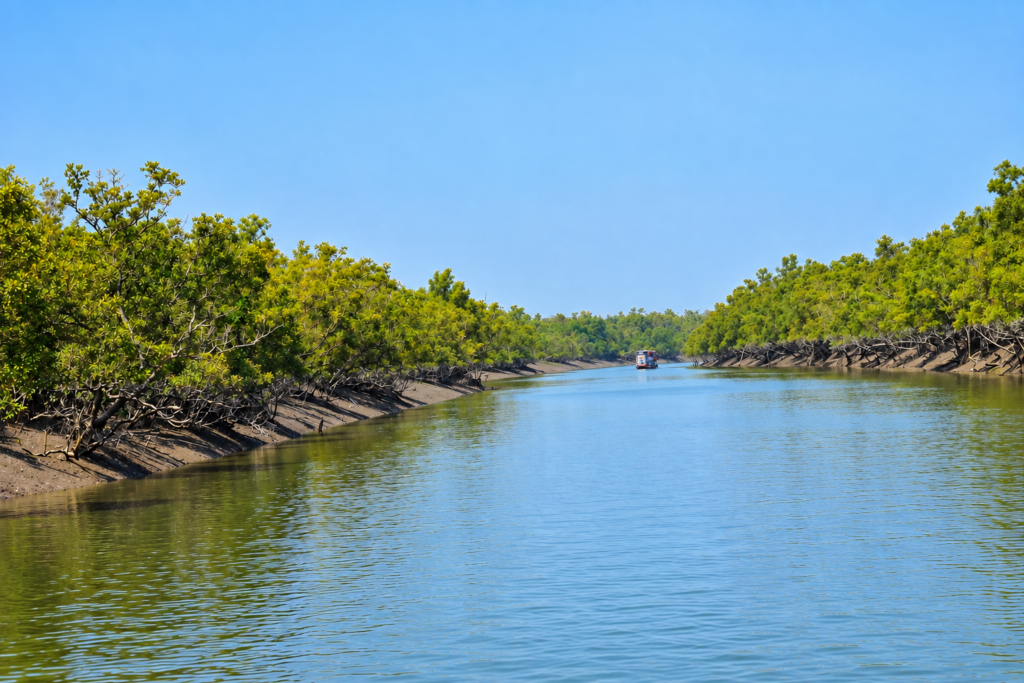
The most valuable observation may sometimes be a brief movement in vegetation, a set of tracks, a deer becoming alert, or the sudden silence of a forest edge.
For experienced wildlife observers, those details are part of reading the landscape.
Seasonal Character
Sudhanyakhali changes throughout the year because both vegetation and water conditions change.
WINTER | NOVEMBER–FEBRUARY
- Cooler conditions
- Clearer landscapes
- Comfortable river exploration
- Migratory bird activity
Winter is traditionally the most active period for organised tourism in the Sundarbans, although wildlife observation remains dependent on actual conditions rather than calendar dates.
SPRING | MARCH–APRIL
- Changing vegetation
- Active birdlife
- Warmer days
- Increasingly strong sunlight
The transition toward hotter conditions can alter animal behaviour and the appearance of the forest.
SUMMER | MAY–JUNE
- Hot and humid conditions
- Strong sunlight
- Increasing freshwater stress
- Storm and weather variability
Freshwater becomes an increasingly important ecological consideration as temperatures rise.
MONSOON | JULY–OCTOBER
- Heavy rainfall
- High humidity
- Stronger weather variability
- Dynamic river conditions
- Reduced predictability of boat movement
The monsoon transforms the physical character of the delta.
Water levels, rainfall and river conditions become especially important considerations for navigation and forest management.
Visitor access and tourism operations can also vary with official restrictions and weather conditions. Current regulations should always take precedence over generic seasonal guidance.
Sudhanyakhali and The Northern Sundarbans
Sudhanyakhali becomes more meaningful when viewed as part of a larger ecological corridor rather than as an isolated attraction.
Sajnekhali, Sudhanyakhali and Dobanki are connected through regulated tourism routes across the northern protected landscape.
The official Sudhanyakhali route describes a circuit beginning at Sajnekhali and proceeding through Sudhanyakhali, Sundarkhali and Choragazikhali before reaching Dobanki, with the possibility of continuing farther depending on the route.
Each location reveals a different aspect of the forest.
Sajnekhali provides interpretation and an introduction to the protected landscape.
Sudhanyakhali provides an elevated wildlife-observation setting around a freshwater pond.
Dobanki provides a different perspective through its elevated canopy walk.
Together, these locations allow visitors to experience the Sundarbans as more than a boat journey through green waterways.
Why Sudhanyakhali Matters Ecologically
Sudhanyakhali’s greatest value is not the watchtower itself.
The tower is simply the point from which people can observe a much larger system.
That system includes:
- Tidal waterways
- Mangrove forests
- Freshwater habitats
- Herbivores
- Carnivores
- Reptiles
- Birds
- Mudflats
- Sediment
- Salinity gradients
- Forest-management infrastructure
- Human activity outside protected areas
Research on Sudhanyakhali and nearby Gosaba demonstrates how contrasting forms of wetland management can exist within the same wider delta: a protected, unpopulated forest island beside inhabited landscapes with intensive human use.
This makes Sudhanyakhali useful not only as a wildlife-viewing location but also as a place through which the larger ecological geography of the Indian Sundarbans can be understood.
The Wild Orbit’s Interesting Facts About Sudhanyakhali
1. Sudhanyakhali is an unpopulated protected island
Peer-reviewed research identifies Sudhanyakhali Island as an unpopulated island within the Indian Sundarbans protected landscape.
2. The Sudhanyakhali beat has a conservation role beyond tourism
The Forest Department’s conservation plan records the Sudhanyakhali camp as part of the protection system for Pirkhali 2.
3. The site contains a managed Mangrove Park
The Tiger Reserve describes the Mangrove Park as a maintained collection representing major mangrove species.
4. A freshwater pond sits beside the watchtower
The pond is one of the defining features of the Sudhanyakhali observation site and is associated with opportunities for wildlife observation.
5. Sudhanyakhali is part of a designated tourism circuit
The official Tiger Reserve route connects Sajnekhali, Sudhanyakhali and Dobanki, with optional continuation toward other designated sites.
6. Sudhanyakhali is not a free-walking wildlife area
Visitors are restricted to designated areas because the Sundarbans is difficult terrain and contains potentially dangerous wildlife.
7. The site combines tourism with forest protection
The Sudhanyakhali camp performs visitor-related functions during the tourism season and protection work during other periods.
8. The wider landscape is internationally recognised
The Sundarbans is recognised by UNESCO for its exceptional mangrove ecosystem, tidal processes and biodiversity.
9. Tiger sightings are possible but never guaranteed
The Forest Department describes Sudhanyakhali as a wildlife-viewing location where tigers may be seen, but animal movements remain unpredictable.
10. Sudhanyakhali demonstrates how freshwater can shape wildlife observation
The freshwater pond creates a distinctive ecological feature within a predominantly tidal and saline landscape, helping explain why the location has long been associated with wildlife observation.
FAQs
Where is Sudhanyakhali?
See it for yourself
A private journey shaped around you — your group, your pace, your interests. Book a free consultation.
Sudhanyakhali is in the Indian Sundarbans of West Bengal, within the protected landscape of Sundarban Tiger Reserve. The Sudhanyakhali camp falls under the Sajnekhali Wildlife Sanctuary Range.
Is Sudhanyakhali an island?
Yes. Peer-reviewed research identifies Sudhanyakhali Island as an unpopulated protected island within the Indian Sundarbans.
Is Sudhanyakhali inside Sundarban Tiger Reserve?
Yes. The Sudhanyakhali camp is part of the Sundarban Tiger Reserve’s Sajnekhali Wildlife Sanctuary Range and is listed as an ecotourism site.
Is Sudhanyakhali inside the Sundarbans National Park?
Sudhanyakhali Island has been described in peer-reviewed research as lying within the Indian Sundarban National Park and Tiger Reserve landscape.
Is Sudhanyakhali open to tourists?
Yes. Sudhanyakhali is currently listed as one of the Sundarban Tiger Reserve’s ecotourism sites. Access remains regulated and subject to Forest Department rules and permits.
What is Sudhanyakhali famous for?
It is particularly known for its watchtower, freshwater pond, Mangrove Park and opportunities to observe wildlife in the surrounding mangrove forest.
Can you see a Royal Bengal Tiger at Sudhanyakhali?
A tiger can potentially be observed from Sudhanyakhali, and the Forest Department specifically identifies the site as providing opportunities for tiger and other wildlife sightings. However, no tiger sighting can be guaranteed.
What animals can be seen at Sudhanyakhali?
Possible sightings include Royal Bengal Tigers, Spotted Deer, Wild Boar, Saltwater Crocodiles, Water Monitors, birds and other mangrove wildlife. Actual sightings vary with animal behaviour and environmental conditions.
Does Sudhanyakhali have a freshwater pond?
Yes. A freshwater pond is one of the principal features associated with the Sudhanyakhali watchtower.
Does Sudhanyakhali have a Mangrove Park?
Yes. The official Tiger Reserve describes a maintained Mangrove Park containing representative mangrove species.
Can visitors walk into the forest?
No. Visitors cannot freely walk through the protected forest. Access is restricted to designated locations and routes.
How do you reach Sudhanyakhali?
Sudhanyakhali is reached by boat through the regulated Sundarban Tiger Reserve tourism network. The official route places Sudhanyakhali after Sajnekhali on a designated tourism circuit.
Is Sudhanyakhali near Sajnekhali?
Yes. Sudhanyakhali forms part of the same northern protected landscape and is included in the official Sajnekhali–Sudhanyakhali–Dobanki route.
Is Sudhanyakhali suitable for photography?
It can be, particularly for wildlife, bird, mangrove and landscape photography. However, photographers should treat wildlife encounters as unpredictable and maintain all Forest Department rules and required distances.
Is Sudhanyakhali a good place to see mangroves?
Yes, although its importance is greater than simply providing scenery. The site combines natural mangrove forest with a managed Mangrove Park, allowing visitors to observe both the wider ecosystem and representative plant diversity.
Does Sudhanyakhali have cultural significance?
The official tourism route identifies a Banabibi temple at Sudhanyakhali, connecting the protected landscape with the wider cultural traditions of the Sundarbans.
Is Sudhanyakhali inhabited?
The island itself is described in peer-reviewed research as unpopulated. It is part of a wider region surrounded by inhabited islands and human settlements.
What is the best time to visit Sudhanyakhali?
The most commonly used tourism season is during the cooler and comparatively more comfortable months, but the appropriate time also depends on official access conditions, weather, tides and current Forest Department regulations.
Visiting Sudhanyakhali Responsibly
A visit to Sudhanyakhali should begin with one principle:
The forest comes first.
Visitors are entering a protected tiger and mangrove ecosystem, not a conventional recreational park.
That means:
- Follow Forest Department instructions.
- Remain within designated visitor areas.
- Do not feed wildlife.
- Do not call or provoke animals to create sightings.
- Do not throw anything into the water.
- Carry waste back or use designated disposal systems.
- Avoid loud behaviour.
- Do not attempt to approach animals.
- Follow boating and landing regulations.
- Respect photography restrictions.
- Never treat a wildlife sighting as more important than the animal’s welfare.
The Tiger Reserve’s current rules also specify requirements for boats, including life jackets, first-aid provisions, waste bins and other safety arrangements.
The larger conservation issue is particularly important in the Sundarbans because the forest is both ecologically sensitive and heavily visited.
The reserve’s recent annual report notes that increasing tourism has created pressure on biodiversity.
Responsible tourism therefore means more than leaving no litter.
It means reducing disturbance.
Documentary Observation
Stand on the watchtower and look beyond the pond.
The first temptation is to search for movement.
Instead, look at the forest.
Notice how the vegetation changes toward the water. Look at exposed mud. Watch birds using the open spaces. Observe how deer behave when they become alert. Listen to the changes in sound when a boat approaches and then moves away.
Look at the water.
The pond is still.
The surrounding channels are not.
One is a managed freshwater body. The other belongs to a tidal world.
That contrast is perhaps the clearest lesson Sudhanyakhali offers.
The Sundarbans is not simply a forest growing beside a river.
It is an ecosystem in which water, sediment, salinity, vegetation and wildlife continuously influence one another.
The animal you hope to see is only one part of that system.
The Larger Story Of Sudhanyakhali
Sudhanyakhali’s importance becomes clearer when the visitor stops thinking of it as a “watchtower destination”.
The tower is the visible feature.
The real subject is the landscape.
- It is an unpopulated forest island within a protected delta.
- It is part of the Pirkhali forest landscape.
- It is influenced by tidal waterways.
- It contains a managed freshwater habitat.
- It supports mangrove vegetation.
- It provides habitat for predators, herbivores, reptiles and birds.
It is managed by a Forest Department whose responsibilities extend beyond tourism into protection and ecological management.
And it exists beside inhabited islands where people live within the same larger deltaic system.
That combination makes Sudhanyakhali particularly valuable as a place of interpretation.
It allows visitors to see, in one relatively compact setting, the relationship between water, mangroves, wildlife and conservation management.
Sudhanyakhali and The Living Sundarbans
By late afternoon, the light begins to change across the forest.
The pond becomes quieter.
The mangrove canopy absorbs the remaining brightness, while the waterways outside the forest continue their tidal movement.
Nothing about the scene needs to be dramatic.
Sudhanyakhali does not need a tiger to justify its existence.
The tiger is one part of the story.
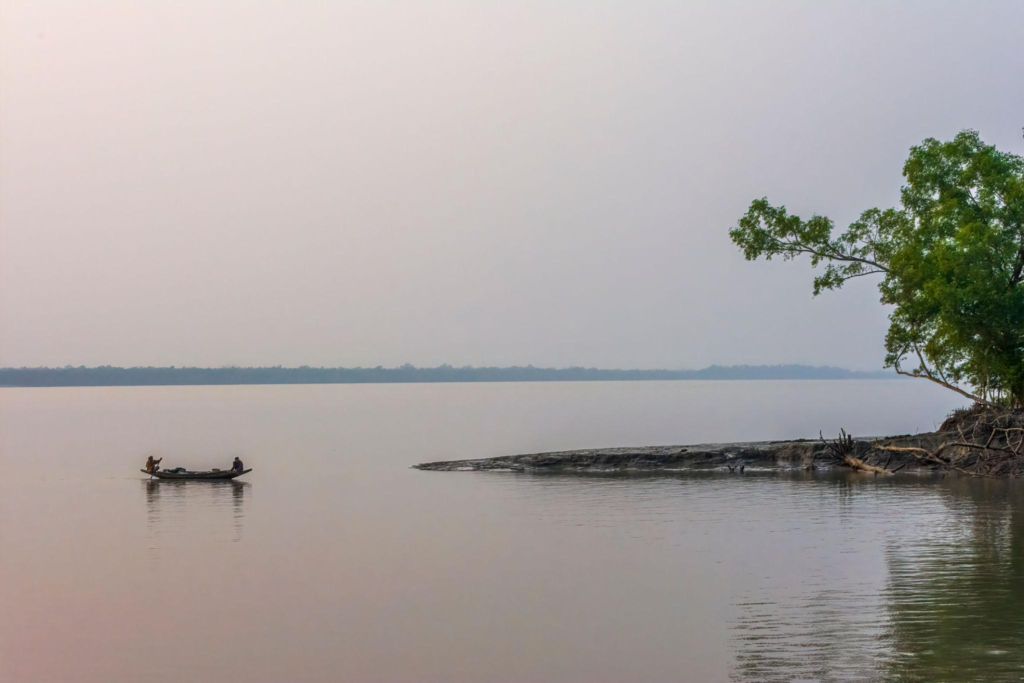
The deeper story is the forest itself: a protected mangrove landscape shaped by tides, freshwater scarcity, sediment, vegetation and wildlife, maintained through careful management in one of the most dynamic environments on the Indian subcontinent.
From the watchtower, the visitor may see a deer.
A crocodile.
A bird.
Perhaps, with extraordinary luck, a tiger.
But the most important thing to notice is what connects them.
- Water.
- Forest.
- Tide.
- Prey.
- Predator.
And the narrow boundary between human curiosity and the right of a wild ecosystem to remain wild.
That is Sudhanyakhali.
Not simply a place to look for a tiger, but a place to begin understanding the living geography of the Indian Sundarbans.
Plan your private Sundarban expedition
A private journey shaped around you — your group, your pace, your interests. Book a free consultation.