


 Seasonal Observations
Watch the Painted Stork return as the Sundarbans changes with the tide
The tide is falling.
Along the edge of a Sundarbans creek, dark mud begins to emerge from beneath the water, glistening in the pale morning light. Pneumatophores rise across the exposed ground like thousands of tiny fingers. A kingfisher calls from somewhere inside the mangroves.
Then a shadow crosses the sky.
White wings. A long neck. Black markings catching the morning light.
Another follows.
Then another.
The Painted Storks have returned.
They arrive without ceremony, gliding over the mangrove canopy as though the forest has been waiting for them. Below, the tidal landscape continues its endless movement—water entering, water leaving, mud appearing and disappearing with the rhythm of the tide.
The birds descend towards the shallows.
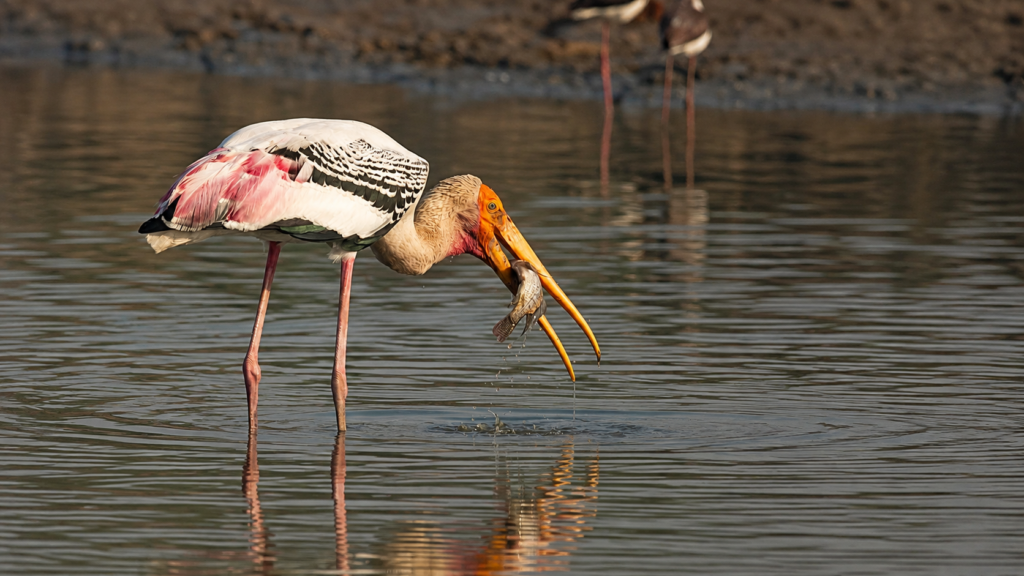
One by one, they step into the brown water, their long legs moving carefully across the submerged mud. Their plumage is striking: white across the body, black along the wings, a flush of pink beneath the feathers, and a long, heavy bill curving gently downward.
But there is nothing hurried about them.
A stork pauses.
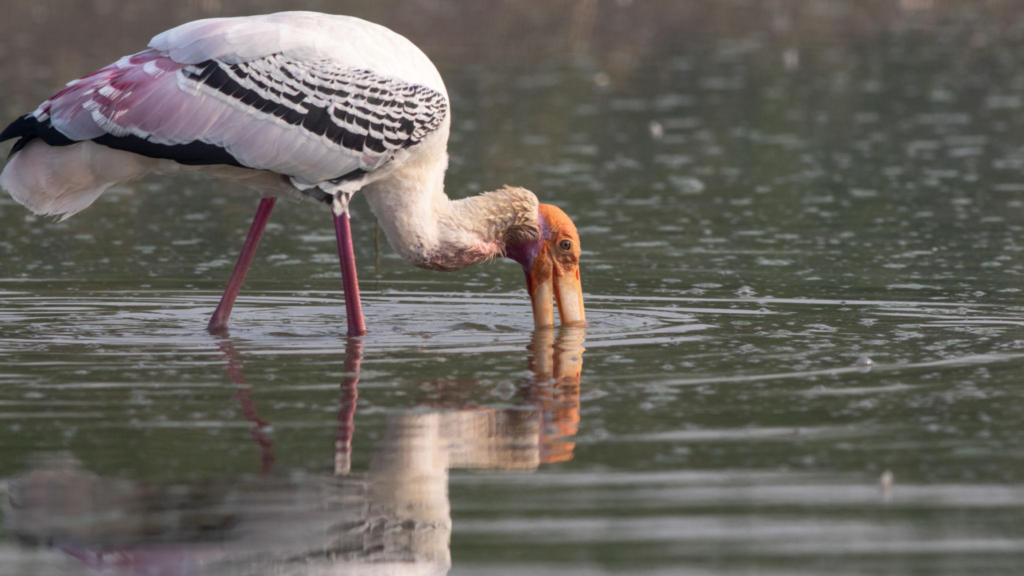
Its bill slips beneath the surface.
It searches.
Around it, the creek seems quiet. Yet beneath the water, the Sundarbans is alive. Small fish move through the shallows. Crabs retreat into their burrows. Tiny creatures stir beneath the soft sediment, exposed by the falling tide.
Then the stork moves again.
Its bill sweeps through the water.
A quick lift of the head.
A flash of silver.
The moment is gone.
This is how the season announces itself here—not with a date on a calendar, but with wings appearing above the mangroves.
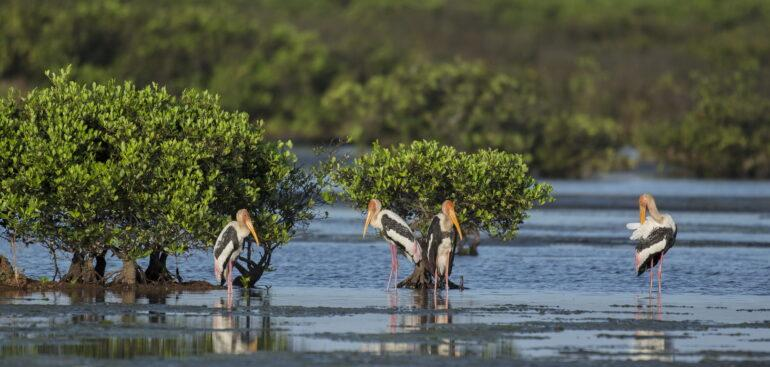
The Painted Storks move through the shallows in loose groups, sometimes close together, sometimes spread across an entire stretch of mudflat. Their bills probe and sweep as they search the water for food.
One bird takes a few deliberate steps.
Another follows.
A third suddenly lifts its wings, shifting a little farther along the creek.
There is a quiet rhythm to it.
Walk.
Search.
Wait.
Move again.
Behind them, the mangrove forest stands dark and dense, its roots holding the edge of the land together. Ahead, the creek continues towards the open tidal channels.
The landscape looks timeless.
It isn’t.
Every tide changes it.
Mud settles in one place and disappears from another. Channels widen, narrow and shift. Banks are slowly reshaped by water. What looks like a familiar feeding ground today may be different when the birds return again.
And still, they return.
That is what makes their presence feel larger than a simple wildlife sighting.
The Painted Stork becomes part of the Sundarbans’ seasonal rhythm—a visitor arriving when the wetlands can offer what it needs, sharing the exposed mudflats and shallow waters with the countless other lives that depend upon the tide.
For anyone watching from the edge of a creek, the experience can feel almost strangely quiet.
There is no announcement.
No sudden spectacle.
Just birds working their way through the water while the forest breathes around them.
By late afternoon, the light begins to soften.
The mudflats turn bronze.
The creek catches the colour of the sky.
A group of Painted Storks stands along the water’s edge, their reflections trembling whenever the tide touches their feet. One stretches its wings. Another folds its long neck beneath a wing and becomes almost motionless.
For a few moments, the forest seems to hold its breath.
Then the tide begins to rise.
Water slips back across the mud, covering footprints, feeding marks and the shallow pools left behind by the falling tide.
The birds lift their heads.
One takes flight.
Then another.
Their broad wings beat slowly above the mangroves, white and black against the fading light.
Soon, the flock becomes smaller, then smaller still, until the birds disappear beyond the winding creek.
Below them, the tide keeps moving.
Tomorrow, the mud will appear again.
The creeks will breathe in and out.
And somewhere along the forest edge, when the season turns once more, the Painted Storks may return to the same ancient landscape—not to the same forest, exactly, but to a place shaped by the same eternal rhythm of water, mud and life.
Plan your private Sundarban expedition
A private journey shaped around you — your group, your pace, your interests. Book a free consultation.


