Field guide
The Spotted Prey That Holds a Forest Together
There are places in the Indian Sundarbans where the forest seems to belong entirely to the tide.
- A creek rises through the mud.
- Water moves between mangrove roots.
- The ground is soft, broken by pneumatophores and narrow animal trails.
Beyond the creek, the forest changes from open patches to dense green walls. Nothing here is fixed for long.
- The shoreline shifts.
- Sediment settles and disappears again.
- Salinity changes with freshwater flow, rainfall and the movement of the tide.
And somewhere inside this moving landscape, a herd of spotted deer steps quietly through the vegetation.
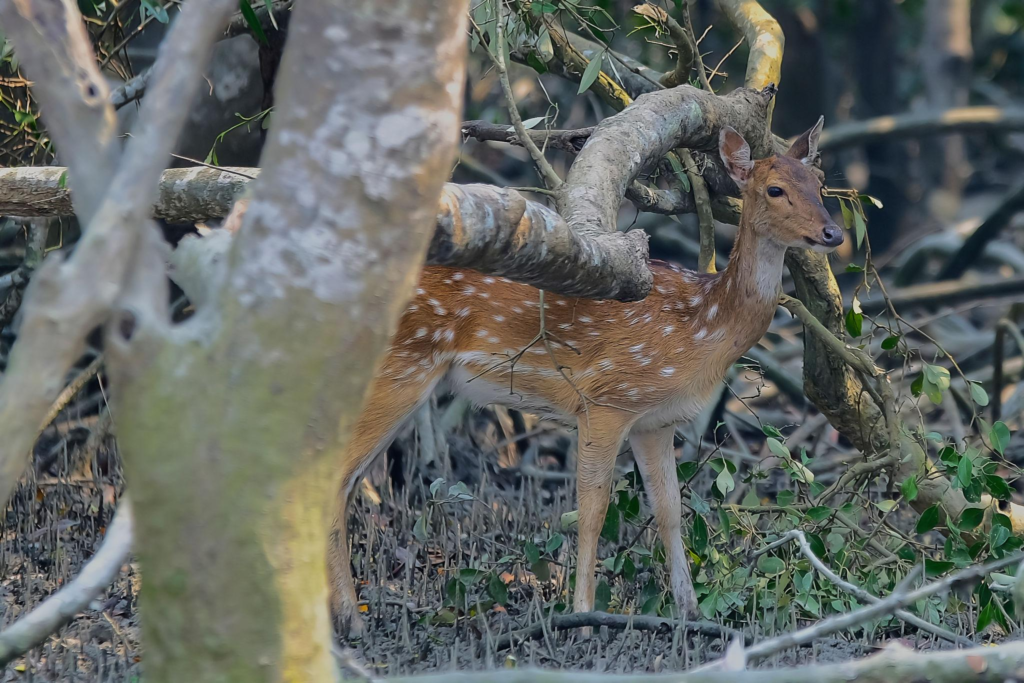
There are places in the Indian Sundarbans where the forest seems to belong entirely to the tide.
- A creek rises through the mud.
- Water moves between mangrove roots.
- The ground is soft, broken by pneumatophores and narrow animal trails.
Beyond the creek, the forest changes from open patches to dense green walls. Nothing here is fixed for long.
- The shoreline shifts.
- Sediment settles and disappears again.
- Salinity changes with freshwater flow, rainfall and the movement of the tide.
And somewhere inside this moving landscape, a herd of spotted deer steps quietly through the vegetation.
The chital, or spotted deer (Axis axis), is one of the most familiar large mammals of the Indian subcontinent. Yet in the Sundarbans, familiarity can be deceptive. This is not simply a deer living in another forest. It occupies a landscape shaped by tides, islands, brackish water, mangrove vegetation and one of the world’s most unusual predator-prey systems.
The spotted deer is also one of the most important links in that system.
For the Bengal tiger, the deer is not just another potential meal. Chital forms a major component of the tiger’s prey base in the Indian Sundarbans.
For the forest, that relationship connects herbivory to vegetation, prey availability to predator distribution, and the condition of individual islands to the wider functioning of the ecosystem.
A deer feeding quietly beneath mangroves can therefore be part of a much larger ecological story.
The species itself is widespread across South Asia and globally classified as Least Concern. But global conservation status does not mean every population is equally secure, nor does it tell us what makes a particular population ecologically important. The Sundarbans demand a more local question.
A Deer Recognised by its Spots
The spotted deer is one of the easiest Indian mammals to identify.
Its scientific name is Axis axis. It belongs to the family Cervidae, the deer family, and to the genus Axis. The species is also commonly called chital, axis deer or Indian spotted deer. Modern taxonomic literature places it within the subfamily Cervinae and tribe Cervini.
An adult chital carries a reddish-fawn to brown coat marked with rows of white spots. A dark dorsal stripe runs along the back from the neck towards the tail, while the belly, inner legs and portions of the underside are white. Unlike many mammals whose juvenile patterns disappear as they mature, the characteristic spotting of chital remains throughout adult life.
The pattern is beautiful, but beauty is not its ecological purpose.
In broken woodland, grasses and filtered sunlight, patches of light and shadow constantly interrupt the outline of a deer. The white spots help break up the animal’s visual form. The result is a coat that can make a moving herd surprisingly difficult to isolate against a complex background.
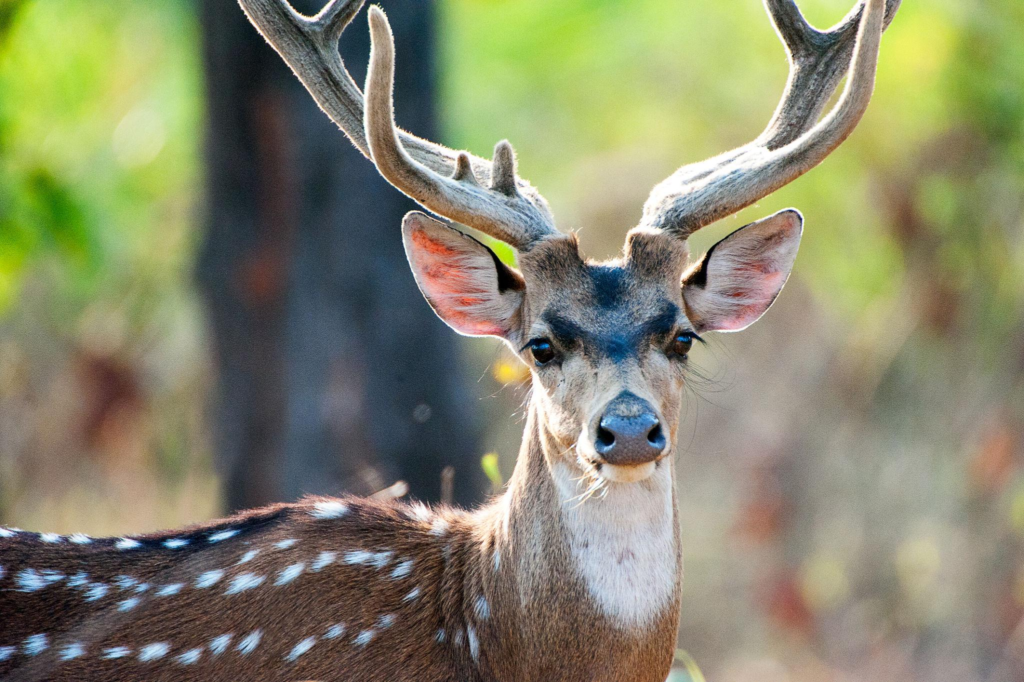
Males carry antlers. These are normally three-tined structures on each side, with a brow tine and additional branches forming the characteristic chital antler. The antlers are shed and regrown as part of a repeating biological cycle. Unlike temperate deer whose antler cycles can be strongly tied to changing day length, chital antler development is less tightly linked to photoperiod, consistent with the species’ tropical and subtropical evolutionary history.
The body itself is medium-sized for a deer, generally standing around 0.6–1 metre at the shoulder, with an average body length of roughly 1.5 metres. Size varies geographically and among individuals.
But measurements tell only part of the story.
The more important characteristic of the chital is its flexibility.
It is not a highly specialised animal tied to one narrow habitat type. Across its native range, it uses a variety of environments, particularly open grass-shrub areas, forest edges, riverine forests and other habitats where forage and cover occur together. It can occupy landscapes ranging from relatively dry environments to wetter forests, but it generally benefits from access to productive vegetation and suitable cover.
That flexibility matters enormously in the Sundarbans.
Because the Sundarbans is not simply forest.
It is a shifting mosaic.
There are mangrove stands, tidal channels, open patches, mudflats, creek margins and islands whose ecological conditions differ from one another. A species capable of using more than one habitat type has an advantage in such a fragmented and dynamic landscape.
A Social Deer in a Difficult Landscape
Chital are strongly social animals.
They can form groups containing females, males and young of different ages, while the precise structure and size of herds can change with season, food availability, predation risk and local conditions. Herds may sometimes become very large, although smaller groups are also common.
This social behaviour has an obvious benefit in a landscape where predators are present.
Many eyes can detect danger more effectively than one.
A deer feeding with its head lowered is not necessarily unaware of its surroundings. Individuals frequently pause, scan, listen and react to movements within the vegetation. When one animal detects danger, the response can spread rapidly through the group.
The herd therefore becomes more than a collection of individuals.
It becomes an information network.
And in the Sundarbans, where a tiger can disappear among vegetation and the visibility of the forest is often limited, early detection can be the difference between feeding and fleeing.
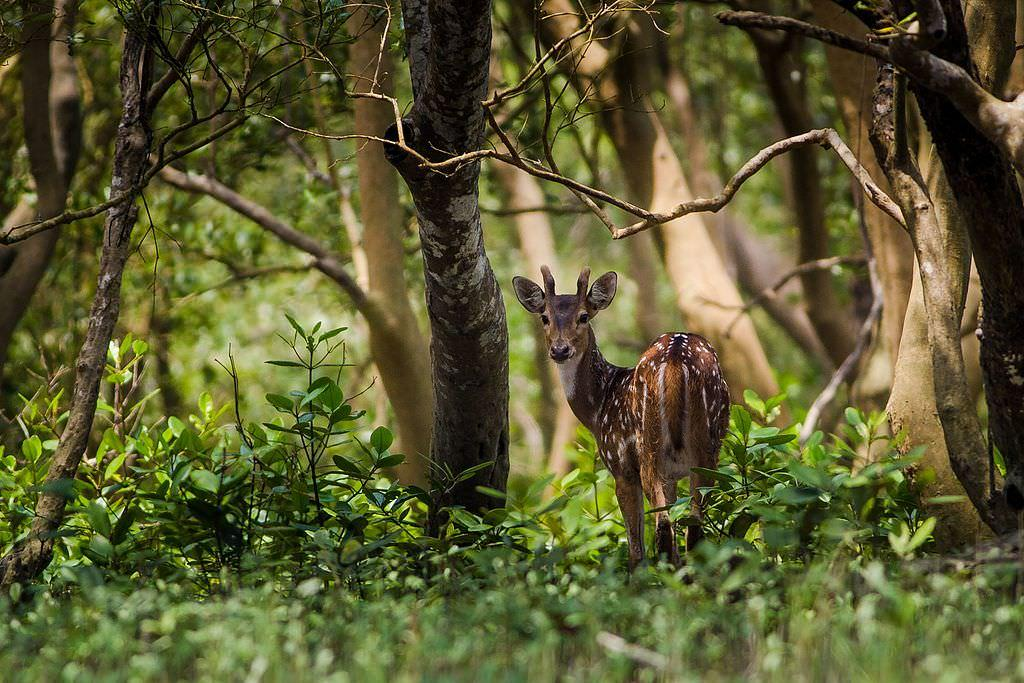
Why the Spotted Deer Matters
The chital is sometimes introduced to the public mainly through the tiger.
That undersells it.
The species is a herbivore, a consumer of vegetation, a prey animal, a disperser of ecological energy and a participant in the structure of the food web. Its grazing and browsing connect plant production to higher trophic levels.
In the Indian Sundarbans, its importance becomes even clearer because prey diversity available to tigers is relatively constrained compared with many mainland forests. Official landscape assessments identify chital as a major prey base of the Bengal tiger, while a 2025 study of the broader Sundarbans found a positive relationship between spotted-deer abundance and tiger abundance on the Bangladesh side. That study should not be used as an Indian population estimate, but it reinforces the ecological principle that prey availability is fundamental to predator populations in this mangrove system.
The deer is therefore not simply living beneath the tiger.
It is helping make the tiger’s existence possible.
A Deer in a Forest Built by Tides
The first thing to understand about the Sundarbans chital is what it is not.
It is not a mangrove specialist in the same sense as a mangrove plant that has evolved physiological mechanisms specifically for living in saline intertidal conditions.
Chital evolved as a broadly adaptable South Asian deer associated strongly with productive forest edges, grasslands and mixed habitats. The Sundarbans present it with an unusual version of those resources.
Instead of extensive mainland grasslands, the deer encounters a mosaic of island habitats created and continually modified by tidal processes.
Instead of a stable riverbank, there are creeks whose water level rises and falls.
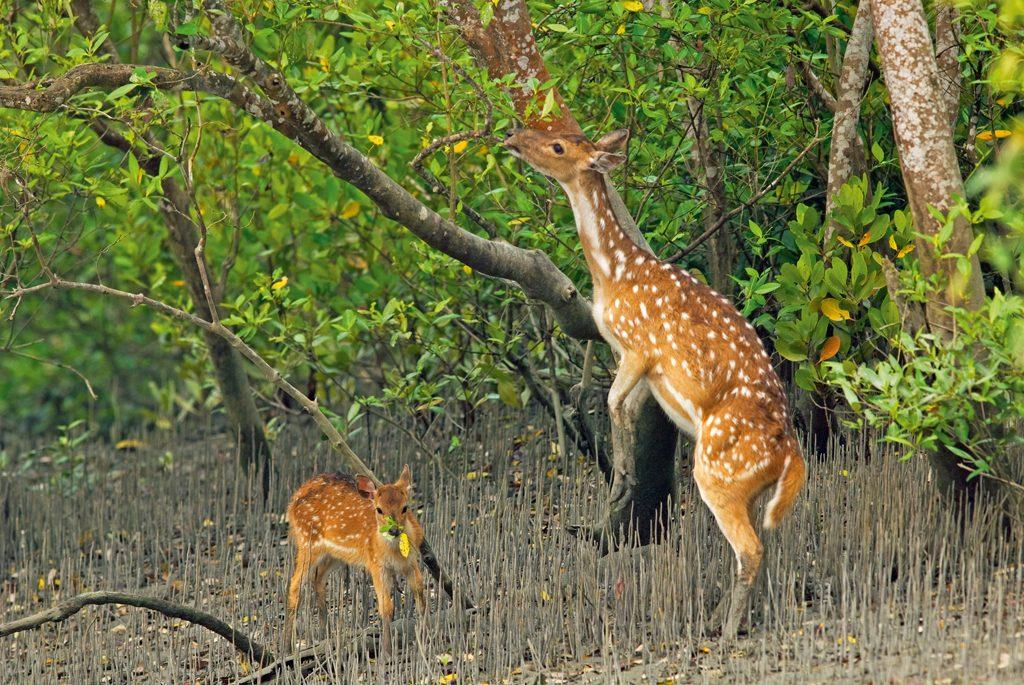
Instead of a conventional forest floor, there are places where exposed mud, roots, fallen leaves, low vegetation and mangrove growth form a complicated ground layer.
The deer survives here not because it has transformed into a “saltwater deer,” but because parts of the Sundarbans can provide enough food, cover and terrestrial space for a flexible herbivore to persist.
That distinction is important.
There is no good scientific reason to describe chital as specially adapted to drinking seawater or as a deer uniquely capable of living in saline water. Its success in the Sundarbans should instead be understood through habitat flexibility, access to vegetation, social behaviour and its ability to use the terrestrial portions of a tidal landscape.
Islands are Not Interchangeable
The Indian Sundarbans is a landscape of islands, but the word “island” can hide enormous ecological variation.
One island may contain vegetation and ground conditions that differ considerably from another. Exposure to tidal water, proximity to channels, freshwater influence, sedimentation, erosion and the structure of mangrove communities all affect what grows and where animals can move.
The 2022 assessment of ungulates in the Sundarbans recorded chital presence across most sampled areas and estimated that the species occupied approximately 1,653 km² of the Indian Sundarbans. The report also noted that chital formed a major prey base for tigers in the landscape. The absence recorded from a few sampled islands was explicitly noted as potentially reflecting sampling limitations, so it should not be interpreted as proof of true absence.
That distribution is revealing.
The chital is not restricted to a tiny ecological pocket.
It is spread across a substantial part of the Indian Sundarbans, but its presence does not mean every square kilometre is equally suitable. Deer distribution is likely shaped by the availability and quality of terrestrial forage, vegetation structure, water, cover and disturbance.
This is one reason broad population numbers can be misleading.
A forest may contain a large total area while offering very different amounts of usable deer habitat.
Where the Forest Opens
Chital generally performs well where food-rich vegetation meets protective cover.
Across South Asia, studies have repeatedly associated the species with grassland-forest ecotones, open woodland, riverine environments and areas where forage is available without eliminating cover.
In the Sundarbans, this principle takes a different form.
The deer must negotiate mangrove vegetation rather than simply choosing between a classic grassland and dry forest. Openings, margins, forest patches and vegetation communities can create feeding opportunities within an otherwise dense mangrove matrix.
This is why a mental image of a spotted deer standing on a broad green meadow can be misleading when imagining the Indian Sundarbans.
The authentic scene is subtler.
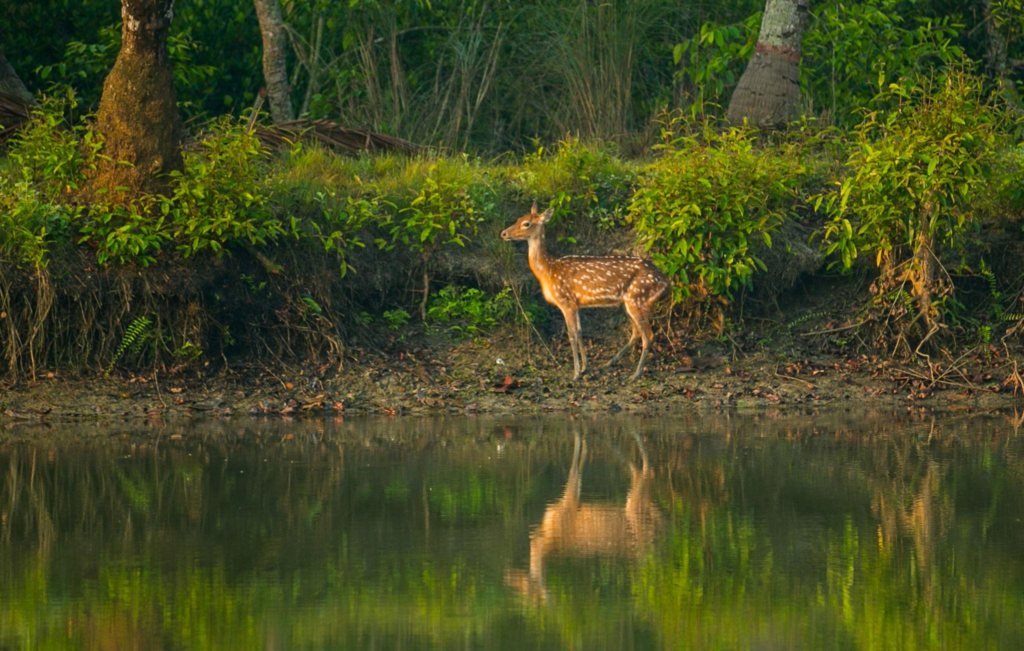
A deer may appear along an opening beside mangrove vegetation, move through a relatively open forest patch, browse near the edge of denser vegetation, or cross ground where the vegetation structure provides both food and a degree of visibility.
The forest floor is never merely background.
It is habitat.
Tides Shape the World Around the Deer
A chital does not need to swim with the tide to be influenced by it.
The tide changes the physical environment in which the deer lives.
- Water enters creeks.
- Mudflats appear and disappear.
- Soil moisture changes.
- Vegetation experiences different levels of saline influence.
- Sediment is deposited and removed.
- The shape and condition of island edges can change over time.
These processes determine the distribution and productivity of plants, and therefore indirectly influence herbivores.
Research on the Indian Sundarbans has documented significant ecological changes associated with salinity, cyclones and changes in mangrove composition. A 2023 study reported increasing tidal-water salinity trends in its study period from 2017 to 2021 and changes in mangrove community structure following major cyclones. Other research has documented erosion and changes in mangrove composition across the Indian Sundarbans.
For chital, the important lesson is not that the deer itself is necessarily becoming more salt-tolerant.
Rather, the habitat on which it depends can change.
If vegetation communities shift, if productive terrestrial patches become smaller, if erosion removes usable ground, or if the balance between freshwater influence and salinity alters plant communities, the food landscape experienced by deer can change with it.
The animal is therefore connected to hydrology without being an aquatic mammal.
That is one of the great ecological subtleties of the Sundarbans.
Movement Across a Fragmented World
Chital movement is influenced by forage availability, water, weather, temperature and disturbance, and movement patterns vary by location and season.
In a continental forest, an animal can sometimes respond to local conditions by moving over large continuous areas.
The Sundarbans is different.
- Waterways interrupt the landscape.
- Large channels can separate islands.
- Tidal creeks cut through forest.
- Human activity occurs around and within parts of the broader landscape.
- Erosion can remove land while sedimentation can create or reshape it.
This means that the ecological geography of a deer is partly determined by the geography of the islands themselves.
A channel is not just water.
For a terrestrial herbivore, it can be a boundary, a route, a barrier or a changing ecological edge.
The ability to move between suitable areas therefore becomes important not only for feeding but also for maintaining populations and avoiding excessive concentration in poorer habitats.
Feeding in a Landscape of Changing Vegetation
The chital is primarily a herbivore, but its feeding strategy is more flexible than the simple phrase “grass eater” suggests.
Across its range, it consumes grasses along with leaves, flowers, fruits and other plant material. It is often described as an intermediate feeder with a strong tendency toward grazing. Its diet can therefore shift according to what vegetation is available.
That flexibility is valuable in the Sundarbans.
The forest does not offer a uniform lawn of grass.
Instead, food availability changes across vegetation types and seasons. Fresh growth following rainfall can create different opportunities from the dry season, when other plant material may become more important.
The deer therefore operates as a moving sampler of the forest floor.
It selects what the landscape provides.
And there is an intriguing reminder that chital feeding ecology is more complicated than it first appears: recent research in other Indian forests has documented chital consuming insects, including observations of deer eating insects associated with fruiting trees. This is not evidence that Sundarbans chital routinely depend on insects, but it demonstrates that their feeding behaviour can be more flexible than a simplistic herbivore label suggests.
In the Sundarbans, the central question remains plant availability.
What grows determines what can be eaten.
And what can be eaten influences where deer can spend their time.
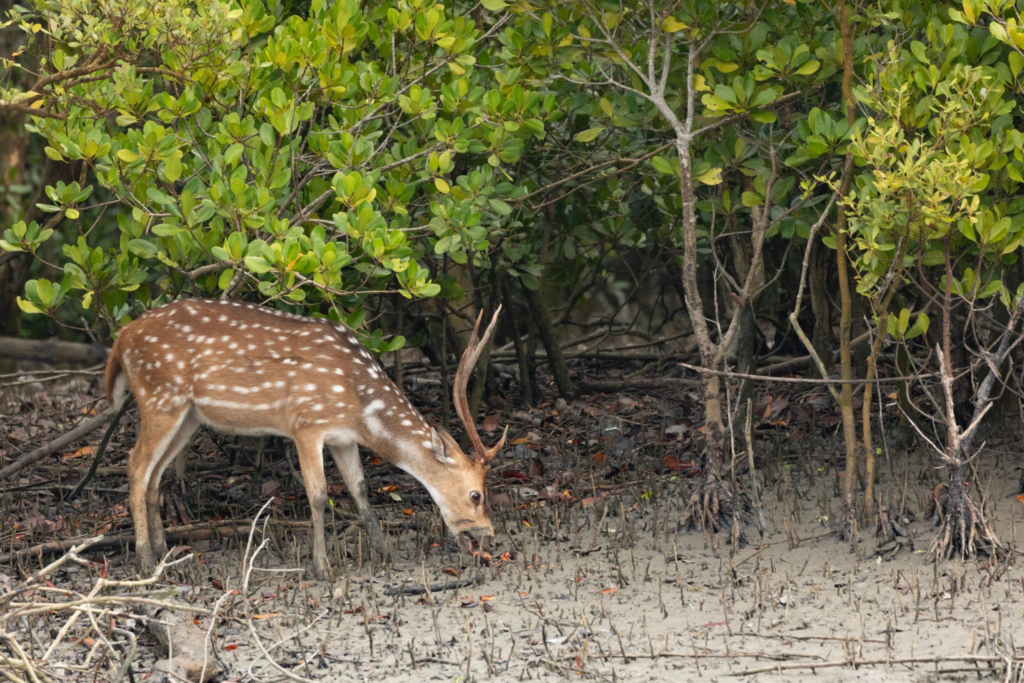
The Herd as a Survival System
A lone chital can hear danger.
A herd can detect it from several directions.
This is particularly important because the Sundarbans contains a predator capable of exploiting concealment extremely effectively: the Bengal tiger.
Chital are gregarious and may form mixed groups of females, young and males. Social units are relatively fluid, with individuals capable of joining and leaving larger aggregations. Family groups centred around adult females and their offspring are an important component of chital social organisation.
The value of grouping extends beyond simple safety in numbers.
It allows vigilance to be distributed.
While some animals feed, others may remain more alert to the surroundings. When danger is detected, rapid collective responses can follow.
For a predator, the opposite is true.
A large herd is a large concentration of potential prey, but it is also a system full of eyes and ears.
The result is a continual evolutionary contest between concealment and vigilance.
The Alarm
The Sundarbans can be visually confusing.
- Leaves move.
- Water reflects light.
- Roots create shadows.
- Tidal channels conceal movement.
The chital’s response to danger therefore relies heavily on sensory information.
An alarm response can travel through a herd quickly. The deer may freeze, stare, raise its head, change direction or flee. The entire group can shift from relaxed feeding to high alert within moments.
This behaviour is one reason the chital is such a useful animal for understanding the forest. A herd suddenly becoming restless is not merely a dramatic wildlife moment.
It is information.
Something has changed in the environment. The cause might be a predator, another animal, an unfamiliar disturbance or a human presence.
For a documentary observer, the herd’s behaviour is often the visible expression of an invisible ecological event.
Living Under a Predator
The relationship between tiger and chital is one of the defining ecological relationships of the Sundarbans.
- The tiger is the dominant terrestrial predator.
- The chital is one of its principal prey species.
That creates a landscape of constant pressure.
The deer cannot afford to ignore predators, but it also cannot spend all its time running. Energy must be allocated between feeding, vigilance, movement, social behaviour and reproduction.
- Too little vigilance increases predation risk.
- Too much vigilance reduces feeding time.
- Too little movement can leave animals in poor habitat.
- Too much movement wastes energy and can increase exposure.
Natural selection operates through these trade-offs.
This is what makes predator-prey ecology more interesting than the simple idea that “tigers eat deer.”
The tiger influences how deer behave.
The abundance and distribution of deer influence where tigers can live.
And the combined relationship helps shape the ecological functioning of the forest.
A 2025 study from the Bangladesh Sundarbans found a significant positive relationship between spotted-deer abundance and tiger abundance. Because the study was conducted on the Bangladesh side, its density estimate should not be transferred to the Indian Sundarbans. But the result provides strong comparative evidence for the importance of prey availability in this shared mangrove ecosystem.
Reproduction Without a Rigid Annual Clock
Chital reproduction is unusually flexible for a deer.
The species can breed throughout the year, although breeding peaks differ among regions and local climatic conditions. In northern India, breeding activity has been reported mainly from October to April, while southern populations show different seasonal patterns.
That geographic flexibility matters when discussing the Sundarbans.
It would be inaccurate to assign one universal “mating season” to every chital population and present it as a fixed rule.
The biological system is more flexible than that.
Gestation lasts roughly 228–239 days, and females normally produce a single young, with twins uncommon. Fawns may be concealed for periods while the mother moves away to feed, returning later to nurse.
This behaviour is particularly important in predator-rich landscapes.
A newborn fawn cannot outrun a tiger.
Its first defence is therefore concealment.
The mother-fawn relationship is a lesson in how survival can depend not on strength but on remaining unseen.
Antlers are More Than Decoration
Male chital antlers are among the species’ most recognisable features.
They are made of bone and grow from specialised structures attached to the skull. During growth, they are covered in velvet, a living tissue supplying the developing antler. Once growth is complete, the velvet is shed and the antler becomes hard.
The antler cycle is connected to hormones and reproductive condition. Research has shown relationships between antler stage, testosterone, testicular volume and sperm characteristics.
But the antler’s story is also about competition.
Antlers provide males with a structure used in social and reproductive interactions. Their size and condition are connected to maturity and reproductive status.
In a tropical deer whose antler cycle is not strictly synchronised by day length, the forest can contain males at different stages of antler development at the same time.
That creates an unusual visual rhythm within a herd.
- One male may carry polished hard antlers.
- Another may be in velvet.
- Another may have recently shed.
The herd is therefore also a living calendar of individual reproductive cycles.
Least Concern Does not Mean No Concern
Globally, the spotted deer is classified as Least Concern by the IUCN. That status reflects the species’ broad distribution and relatively strong overall population position, not a guarantee that every regional population is stable.
This distinction is essential for understanding the Sundarbans.
The conservation question here is not simply: “Is the species endangered worldwide?”
It is: “Are the ecological conditions that sustain chital in the Indian Sundarbans being maintained?”
A species can be globally widespread while a local population experiences pressure.
For the Sundarbans, conservation therefore has to operate at the level of habitat, prey availability, predator-prey relationships, protection and landscape change.
Habitat is the Foundation
- Chital require food.
- Food requires vegetation.
- Vegetation depends on the physical environment.
And in the Sundarbans, the physical environment is changing.
Research on the Indian Sundarbans has recorded mangrove loss through erosion, shifts toward more salt-tolerant vegetation communities, and deterioration in some vegetation-health indicators. A 2021 remote-sensing study reported about 110 km² of mangrove loss within the reserve forest between 2000 and 2020, much of it associated with erosion, while other analyses have identified salinity, temperature and rainfall changes as factors associated with ecological degradation.
This does not mean that every hectare lost equals a hectare of lost deer habitat.
Nor does it prove that climate change is currently causing a measured decline in the Indian Sundarbans chital population.
Those would be stronger claims than the evidence supports.
What it does establish is something more fundamental: The habitat in which chital live is dynamic and under pressure.
That matters because herbivores respond to the quantity and quality of available forage.
Salinity and Freshwater
See it for yourself
A private journey shaped around you — your group, your pace, your interests. Book a free consultation.
Salinity is one of the defining ecological variables of the Sundarbans.
But it is important to avoid a simplistic narrative in which “more salt” automatically means “fewer deer.”
The relationship is indirect.
- Salinity influences vegetation.
- Vegetation influences forage.
- Forage influences herbivores.
- Herbivores influence predators.
That chain can take many forms.
Research from the Indian Sundarbans has documented changes in surface-water and soil salinity following cyclonic events and associated changes in mangrove communities. The studies found shifts towards more salinity-tolerant vegetation and losses or declines in some salt-sensitive mangrove species in sampled areas.
For chital, this means long-term changes in the plant communities available to them deserve attention.
The deer may not need to physiologically adapt to seawater.
Its food landscape may adapt—or disappear—around it.
Erosion and the Disappearing Island Edge
The Sundarbans is a deltaic landscape. Land is built, reshaped and removed. Erosion is therefore more than a geological process. It can directly alter wildlife habitat.
- A forest edge that existed in one decade may be gone in another.
- A creek may widen.
- A mudbank may retreat.
- A vegetation patch may become exposed to stronger tidal influence.
The Indian Sundarbans have experienced substantial erosion and accretion over time. A 2025 analysis of land-use change estimated approximately 478 km² of land lost to erosion and 408 km² gained through accretion between 1973 and 2022 across the study area.
Again, these numbers describe landscape change, not chital population decline.
But they demonstrate why conservation in the Sundarbans cannot be reduced to protecting animals one species at a time.
The ground beneath the animal matters.
Climate Change is a Habitat Problem
Climate change presents the Sundarbans with several interacting pressures:
- sea-level rise
- coastal erosion
- altered rainfall
- increasing salinity in some areas
- stronger or more damaging storm events
- changes in mangrove composition
- shifts in freshwater availability
A 2023 modelling study focused specifically on the Indian Sundarbans projected substantial potential mangrove losses by 2100 under continued current management, with estimated losses ranging from 42% to 80% depending on the sea-level-rise scenario and model assumptions. These are projections, not observations of current deer decline, but they demonstrate the scale of the habitat challenge facing the wider ecosystem.
For chital, the implications are ecological rather than simplistic.
If productive vegetation patches shrink or become increasingly fragmented, the deer may face greater competition for forage, altered movement opportunities and increased dependence on remaining suitable areas.
If prey distribution changes, predator distribution may respond.
The impact therefore propagates through the food web.
The Predator-Prey Connection
Conserving chital in the Sundarbans is inseparable from conserving tigers.
This does not mean deer should be managed simply as “tiger food.”
It means the abundance of herbivores is an indicator of whether the lower levels of the food web are functioning sufficiently to support a large carnivore.
The 2022 Indian Sundarbans assessment identified chital as the major prey base of tigers in the landscape. Wildlife Institute of India research has also treated chital monitoring as central to understanding tiger-prey dynamics in the Sundarbans.
This creates an important conservation principle: Protecting the tiger without protecting its prey is incomplete conservation.
And protecting the deer without protecting the habitat that produces its food is equally incomplete.
Human Pressure
The Indian Sundarbans is not an isolated wilderness without people.
Human settlements surround and interact with the larger landscape. Communities depend on the wider delta for livelihoods, while fishing, resource collection, agriculture and other activities create varying levels of interaction between people and wildlife.
Conservation therefore has to recognise that wildlife protection occurs inside a human landscape.
The goal cannot simply be to draw a line around a forest and assume the problem is solved.
Effective protection requires enforcement against illegal hunting, careful monitoring of wildlife populations, habitat management, scientific research and cooperation with communities living around the ecosystem.
It also requires recognising that human disturbance can influence wildlife behaviour and predator-prey relationships.
The challenge is to protect ecological processes while understanding the social reality of the landscape.
What Conservation of Chital Really Means
Conserving the spotted deer means conserving more than the deer.
It means maintaining: productive vegetation → herbivores → predators → ecological balance.
- It means protecting forest structure and terrestrial habitat.
- It means monitoring deer populations rather than relying on impressions from occasional sightings.
- It means understanding how vegetation changes with salinity, erosion, freshwater supply and climate.
- It means continuing scientific monitoring of both prey and predators.
And it means treating the Indian Sundarbans as an interconnected ecosystem rather than a collection of charismatic species.
What Makes the Sundarbans Chital Extraordinary?
The spotted deer does not possess the kind of spectacular specialisation that immediately suggests a mangrove environment.
- It does not have webbed feet like an otter.
- It does not breathe through specialised aerial roots.
- It does not climb mangrove trunks.
Its extraordinary quality is different.
It is the ability to remain an adaptable terrestrial herbivore inside an ecosystem where almost everything is governed by water.
That story becomes clearer when we look at what makes the species remarkable.
The Spots Remain Throughout Life
Many mammals have juvenile patterns that fade as they mature.
Chital retain their characteristic white spotting as adults. The pattern occurs across the reddish coat and remains one of the species’ most reliable visual identifiers.
What: permanent white spotting.
How: the coat pattern persists beyond infancy.
Why it matters: the pattern breaks up the animal’s visual outline and contributes to its distinctive camouflage in broken vegetation and dappled light.
It is a Flexible Feeder
Chital are not locked into one plant species or one food type.
They primarily graze but can also browse and consume flowers and fruits. The species’ recorded plant diet is broad across its native range.
What: flexible feeding.
How: the digestive and behavioural systems allow the use of different plant resources.
Why it matters: flexibility gives the species a better chance of finding food when vegetation changes seasonally or spatially.
That is particularly useful in a heterogeneous ecosystem such as the Sundarbans.
It is Built for a Social Life
Chital can form mixed herds containing multiple ages and sexes.
What: strong social behaviour.
How: family groups and larger aggregations form fluid associations.
Why it matters: group living increases collective vigilance and can reduce the likelihood that every individual must detect predators independently.
The herd is therefore not simply a gathering of deer.
It is a distributed surveillance system.
Its Reproductive Biology is Unusually Flexible
Chital can reproduce throughout the year, with regional breeding peaks rather than one universal season.
What: flexible reproductive timing.
How: reproduction is not rigidly restricted to one short annual window.
Why it matters: in tropical environments where resources can vary differently from temperate seasonal systems, reproductive flexibility can allow populations to respond to local ecological conditions.
Fawns Survive by Disappearing
A young chital cannot defend itself against a tiger.
Instead, the mother may leave the fawn concealed for periods and return to nurse it.
What: concealment-based early survival.
How: the fawn remains hidden while the mother moves away.
Why it matters: invisibility can provide a stronger defence than movement during the earliest and most vulnerable stage of life.
In a forest dominated by predators, sometimes survival begins with not being seen.
Male Antlers Are Constantly Being Rebuilt
Chital antlers are not permanent structures.
They grow, mineralise, harden and eventually fall, beginning the cycle again. Their development is linked to hormonal and reproductive processes.
What: renewable antler architecture.
How: specialised bone tissue is repeatedly grown and shed.
Why it matters: the antler cycle is deeply integrated with male reproductive biology rather than being merely a visual ornament.
The Species Can Occupy an Unusually Broad Ecological Range
Chital occur across much of South Asia and can use habitats ranging from relatively dry environments to wetter forests, provided suitable food and cover exist.
What: broad habitat flexibility.
How: the deer uses different vegetation structures rather than depending on a single habitat type.
Why it matters: this flexibility partly explains how the species can persist in the unusual habitat mosaic of the Sundarbans.
It Becomes a Central Ecological Link in the Sundarbans
The chital’s greatest importance may not be a physical adaptation at all.
It is its position in the food web.
What: major prey species.
How: vegetation is converted into animal biomass that becomes available to predators.
Why it matters: the deer links primary productivity to the Bengal tiger and wider predator-prey dynamics. Indian assessments identify chital as a major tiger prey species in the landscape.
This makes an ordinary-looking deer extraordinarily important.
Its Distribution Tells Us Something About the Forest
Because chital depends on suitable forage and cover, its presence and density can provide useful ecological information.
A deer population is not a perfect indicator of ecosystem health, but changes in its distribution can be meaningful when interpreted alongside vegetation, predator abundance, human disturbance and habitat structure.
In the 2022 Indian Sundarbans assessment, chital was recorded across most sampled areas, with an estimated occupied area of approximately 1,653 km².
It Survives Without Being a Mangrove Specialist
This may be the most important misconception to correct. The chital does not need to be physiologically specialised for saltwater to live in the Sundarbans.
Its success comes from a different strategy: flexibility.
It uses the terrestrial opportunities embedded within the tidal forest. That is a quieter form of adaptation, but no less significant.
What Makes the Sundarbans Population Special?
The Indian Sundarbans does not necessarily produce a biologically separate “mangrove chital.”
There is no sound basis for inventing a unique Sundarbans subspecies or claiming that these deer possess a special saltwater physiology simply because they live in the delta.
The real uniqueness lies in ecology.

1. Chital occupies a tidal mangrove landscape
The species lives in an environment where tides, channels, sediment and salinity continually reshape terrestrial habitat.
That is fundamentally different from the grassland-forest systems with which chital is more commonly associated.
2. It forms the prey foundation for a mangrove tiger population
In the Indian Sundarbans, chital is a major prey species for Bengal tigers. The relationship gives the deer significance far beyond its own body size.
3. Its habitat is fragmented by water
The animal lives across islands separated by channels and creeks. That makes the physical geography of the delta part of its ecology.
4. Its food supply is tied to mangrove change
The deer does not eat “the mangrove ecosystem” as a single thing. It depends on particular plant communities and terrestrial forage. When vegetation changes because of salinity, erosion, cyclones or other pressures, its feeding landscape can change as well.
5. Its conservation is linked directly to tiger conservation
Monitoring chital is therefore part of understanding the ecological foundation of tiger conservation in the Sundarbans.
6. Its future depends on land that is never truly static
A chital population needs terrestrial habitat in a delta where land itself is continually being reshaped. That makes habitat continuity an especially important ecological question.
The extraordinary story of the Sundarbans chital is therefore not that it has somehow become a marine deer. It is more interesting than that. It is a terrestrial herbivore maintaining a place in one of the world’s most dynamic tidal ecosystems—and supporting one of the world’s most remarkable predator populations while doing so.
The Wild Orbit’s Quick Facts About Spotted Deer in Sundarbans
Common Name: Spotted Deer / Chital
Scientific Name: Axis axis (Erxleben, 1777)
Family: Cervidae
Order: Artiodactyla
Conservation Status: IUCN: Least Concern
Indian Legal Status: Schedule II under the Wildlife (Protection) Act, as amended in 2022
Native Range: South Asia
Indian Sundarbans: Widely distributed across suitable areas of the Indian Sundarbans
Habitat: Forest edges, open vegetation, grass-shrub habitats, riverine and mixed habitats; in the Sundarbans, terrestrial habitat within the tidal mangrove mosaic
Diet: Primarily grasses and other vegetation; also consumes leaves, flowers and fruits
Social Behaviour: Gregarious; forms mixed-sex and age groups
Male Feature: Branched antlers, typically with three tines per side
Key Ecological Role: Major herbivore and major prey species of Bengal tigers in the Sundarbans
Indian Sundarbans Occupancy: Approximately 1,653 km² in the 2022 assessment
Major Conservation Concern: Maintaining suitable habitat, forage, ecological connectivity and prey populations within a changing delta
The IUCN status and species biology are supported by the 2021 Mammalian Species review, while the Indian Sundarbans distribution and legal-status information come from the 2022 ungulate assessment.
FAQs
Where can spotted deer be found in the Indian Sundarbans?
Chital occur widely across suitable areas of the Indian Sundarbans. A 2022 assessment estimated an occupied area of approximately 1,653 km² within the Indian portion of the landscape. Presence was recorded across most sampled areas, although a few sampled islands showed no detections and the report cautioned that some absences could reflect sampling limitations.
What does the spotted deer eat?
Chital are primarily herbivorous grazers but are flexible feeders. Their diet includes grasses as well as leaves, flowers and fruits, depending on habitat and resource availability.
Why is the spotted deer important to the Sundarbans?
The species is an important herbivore and a major prey species for Bengal tigers in the Indian Sundarbans. Its abundance therefore has implications for the wider predator-prey system.
Is the spotted deer endangered?
Globally, Axis axis is classified as Least Concern by the IUCN. That does not mean individual populations are immune to local pressures or habitat change.
Does the spotted deer have special adaptations for saltwater?
There is no sound basis for describing chital as a saltwater-adapted deer. Its success in the Sundarbans is better understood through habitat flexibility and its ability to use terrestrial forage and cover within a tidal mangrove landscape.
How does a spotted deer avoid predators?
Chital rely on vigilance, social grouping, rapid alarm responses, movement and concealment. Fawns can remain hidden while their mothers leave temporarily to feed, reducing the chance of detection during a vulnerable life stage.
Why are chital important for tiger conservation?
Because chital form a major part of the tiger prey base in the Indian Sundarbans, maintaining healthy prey populations is an important part of maintaining a functioning tiger ecosystem.
Is the Sundarbans chital population declining?
There is not sufficient evidence to claim a current population-wide decline of chital in the Indian Sundarbans from the sources reviewed here. The responsible conclusion is that the population requires continued monitoring because its habitat is exposed to erosion, salinity change, cyclones, climate-related pressures and other ecological changes.
The Wild Orbit Perspective
At first glance, the spotted deer may seem almost too familiar to represent the wild heart of the Sundarbans.
It has no tiger’s stripes.
- No crocodilian armour.
- No spectacular mangrove-specialist anatomy.
It simply walks on four slender legs, feeds on vegetation, and moves with a herd through a forest shaped by water.
But that simplicity is exactly what makes the chital important.
The Sundarbans is an ecosystem built on relationships.
- Mangroves transform sunlight into living material.
- Herbivores consume that vegetation.
- Predators depend on those herbivores.
- Tides move nutrients through creeks.
- Sediment creates and removes land.
- Freshwater and saltwater influence vegetation.
- Islands separate and reconnect populations.
The spotted deer sits inside that network.
- It is both consumer and prey.
- It is both participant and indicator.
Its survival depends on the vegetation beneath its feet, the landscape around it and the protection of the wider ecosystem.
And the tiger, in turn, depends upon the deer.
This is why the spotted deer deserves to be seen as more than a beautiful animal moving through the mangroves.
It is one of the quiet structural elements of the Indian Sundarbans.
When a herd emerges from the vegetation and pauses beside a tidal creek, there is an entire ecosystem behind that moment.
The spots on its coat are only the beginning of the story.
The deeper story is about how life persists on islands where the boundary between land and water is never completely settled and how the survival of one seemingly ordinary deer can help reveal the health of one of Earth’s most extraordinary forests.
Plan your private Sundarban expedition
A private journey shaped around you — your group, your pace, your interests. Book a free consultation.