Field guide
The Ancient Serpent of the Tidal Forest
At first light, the Sundarbans can appear almost motionless.
The tide has withdrawn from a narrow creek, leaving a skin of wet silt between mangrove roots.
Pencil-like pneumatophores rise from the mud.
A thin film of water follows the channel back toward the estuary.
Somewhere beyond the creek, a spotted deer moves through the forest, while fish and crustaceans occupy the shallows left behind by the retreating tide.
Then, from the vegetation, something long and powerful moves across the forest floor.
It is not the familiar cobra of village folklore.
It is not a sea snake, although it lives in a landscape shaped by tides and salt.
And despite its name, it is not a king because of a crown.
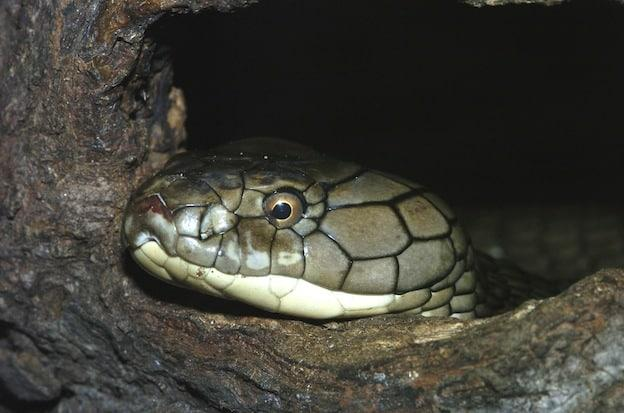
The king cobra is a predator that has evolved to hunt other snakes.
Its scientific name is Ophiophagus hannah, a name whose genus literally reflects this extraordinary feeding habit: Ophiophagus refers to a snake-eater. It belongs to the family Elapidae, the same broad snake family that includes cobras, kraits and mambas. But biologically, the king cobra occupies a remarkably different niche from the typical cobra.
There is another reason this particular population deserves attention.
The king cobra was originally described from the Sundarbans region in the nineteenth century. Cantor’s original description placed its type locality in the “Sunderbuns” and nearby jungle around Calcutta. Modern taxonomic work has since clarified that what was historically treated as one widespread king cobra actually represents several distinct evolutionary lineages. The population occurring across northern and eastern India, including the lineage associated with the Sundarbans, is retained as Ophiophagus hannah in the 2024 taxonomic revision and is referred to as the Northern King Cobra.
That history makes the Sundarbans more than another place on the king cobra’s distribution map.
It is tied to the animal’s scientific identity itself.
A Snake Built for Dominance But Not for Confrontation
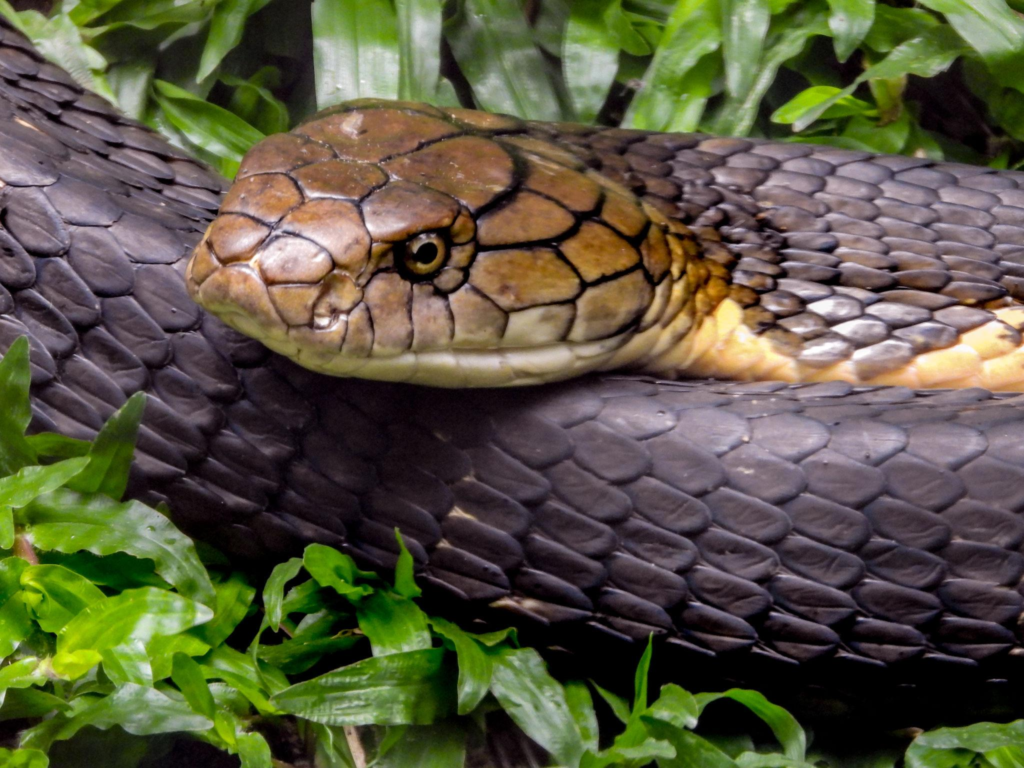
The king cobra is the world’s longest venomous snake. Individuals can reach exceptional lengths of around 5–5.8 metres, although such extremes should not be confused with the normal size of every wild animal. Its body is long and muscular, its head relatively broad, and its neck can expand into the characteristic hood when the snake is threatened. Adults are generally brownish, olive or otherwise subdued in colour, while young snakes are often much darker and strongly banded.
Yet size is only the most obvious part of the story.
The real distinction is behavioural.
A king cobra is not simply a larger cobra. Its entire way of life is shaped by its position as a specialised predator of reptiles, particularly snakes. Studies from other parts of its range have documented king cobras consuming pit vipers and other snakes, while research has also demonstrated that their diet can include monitor lizards. That places the king cobra relatively high within the terrestrial food web.
It is a predator of predators.
In the Sundarbans, this becomes particularly interesting because the snake lives inside one of the most unusual terrestrial ecosystems on Earth: a landscape where forests are repeatedly reshaped by tides, freshwater inflow, sediment deposition, erosion and changing salinity.
The king cobra therefore represents an unusual meeting point between snake ecology and tidal ecology.
But there is an important scientific caution.
The presence of king cobras in the Sundarbans is well documented, and the Government of West Bengal’s Department of Sundarban Affairs includes Ophiophagus hannah among the region’s wildlife. A Wildlife Institute of India publication also identifies the Sundarban Tiger Reserve as supporting significant populations of threatened reptiles including the king cobra.
What is much less certain is the fine-scale ecology of the species within the Indian Sundarbans.
We do not possess the same depth of radio-telemetry, population-density or behavioural research for Sundarbans king cobras that exists for some populations elsewhere in India. That distinction matters.
A credible wildlife story should not turn assumptions into adaptations.
So the fascinating question is not whether the king cobra has somehow become a “saltwater snake.”
It has not.
The more interesting question is: How does a primarily terrestrial snake predator persist inside a landscape where almost everything is governed by water?
To understand that, we have to look beyond the snake itself.
We have to enter the forest.
A Forest Written By the Tide
The Indian Sundarbans are not simply a forest beside the sea.
They are a vast deltaic landscape of islands, creeks, mudflats, tidal channels and mangrove forests in which land and water are constantly negotiating their boundaries.
Twice each day, and according to local tidal cycles and weather conditions, water moves through channels and creeks, flooding some areas and exposing others.
- Sediment settles.
- Banks erode.
- New deposits form.
- Mangrove roots stabilise sections of soft ground while other edges disappear.
For an animal such as the king cobra, that creates an environment in which microhabitat may matter enormously.
A snake does not need an entire island to be suitable.
It needs the right combination of cover, prey, shelter, movement routes and relatively secure places to rest or reproduce.
This is one reason it is misleading to describe the king cobra simply as a “mangrove snake.”
Its broader biology indicates a mainly terrestrial association with forest and other structurally complex habitats. It is also capable of climbing and swimming, but those abilities do not make it an aquatic specialist.
In the Sundarbans, the forest floor therefore remains important.
The Forest Floor is the Hunting Ground
Beneath the mangrove canopy, the world is very different from the open water of a tidal creek.
- Leaf litter collects around roots.
- Fallen branches create cavities and barriers.
- Dense vegetation provides concealment.
- Small reptiles move through the undergrowth.
- Other snakes occupy different ecological niches.
For a snake-eating predator, such structure can create opportunities.
The king cobra’s diet is dominated by snakes, and documented prey elsewhere include snakes from several genera. Field research in India’s Western Ghats has shown just how specialised its predatory behaviour can become: one tracked male was observed capturing and consuming 26 pit vipers over several months.
That observation does not mean a Sundarbans king cobra eats the same species at the same frequency.
- The prey community differs.
- The habitats differ.
- The research effort differs.
But it reveals something fundamental about the predator: the king cobra’s ecology is closely connected to the diversity and availability of other reptiles.
That makes the health of the lower levels of the food web relevant to the king cobra even when those animals are not obvious to a visitor.
Tidal Creeks are Boundaries, Not Necessarily Destinations
A narrow Sundarbans creek can look like an obvious place for a giant snake.
- The king cobra can swim.
- It can cross water.
- It can move through wet environments.
But it is important not to mistake capability for ecological dependence.
There is no strong basis for describing Ophiophagus hannah as a snake that routinely hunts in tidal water or as a species specifically adapted to marine salinity.
The Sundarbans-specific story is subtler.
The forest’s waterways divide islands, determine access between habitats and influence where prey can move. A terrestrial predator living within this system is consequently operating inside a landscape whose structure is repeatedly rearranged by water.
The tide becomes an indirect ecological force.
- It shapes the habitat.
- The habitat shapes prey distribution.
- Prey availability influences predator movement.
- And the predator exists within that chain.
This is the kind of relationship that makes the Sundarbans different from a generic forest.
An Island Landscape Changes the Meaning of Movement
In a continuous forest, a snake can potentially move through a broad terrestrial matrix.
In the Sundarbans, channels and creeks interrupt that matrix.
- Some are narrow.
- Some are wide.
- Some remain navigable during different tidal stages.
Others expose mudflats at low tide and become water barriers at high tide.
For a large terrestrial snake, this fragmented geography may influence movement and access to prey.
But the exact home ranges and movement corridors of king cobras in the Indian Sundarbans remain insufficiently documented.
That uncertainty is itself important.
Wildlife science often advances not by filling every blank with a guess, but by recognising which blanks still exist.
Mangrove Architecture Creates Shelter
Mangrove vegetation has an architecture unlike that of inland woodland.
Trees such as Avicennia and Sonneratia are associated with specialised root systems, while exposed pneumatophores can make the ground appear almost covered in small wooden spikes.
For a large snake, such a forest is not simply a collection of trees.
It is a three-dimensional maze.
Fallen branches, root structures, leaf litter and vegetation create concealment. A large predator does not necessarily need to be invisible at every moment. It needs enough structural complexity to move without being continuously exposed.
The king cobra’s body is exceptionally long, but its movement remains remarkably controlled. A snake does not need legs to navigate difficult terrain.
Its entire body becomes a locomotor system.
Muscular waves pass through the trunk, pushing against irregularities in the ground. Scales grip surfaces. The animal can alter the direction of its body while maintaining contact with the substrate.
That matters in an environment where the ground itself is rarely simple.
Water Shapes the Food Web
The Sundarbans is extraordinarily productive because tidal processes move nutrients and organisms through a complex estuarine system.
Fish, amphibians, reptiles, crustaceans and other organisms interact across the boundary between land and water.
A king cobra does not feed directly on that entire aquatic productivity.
Its importance lies farther up the terrestrial food web.
Snakes that prey on frogs, fish, rodents, lizards or other animals ultimately depend on resources generated by the wider ecosystem. A predator that eats those snakes becomes connected to that energy flow.
This is why protecting a predator cannot be reduced to protecting the predator itself. A large snake requires a functioning ecological network beneath it.
The Sundarbans Does Not Need to Be Perfect to Support a King Cobra
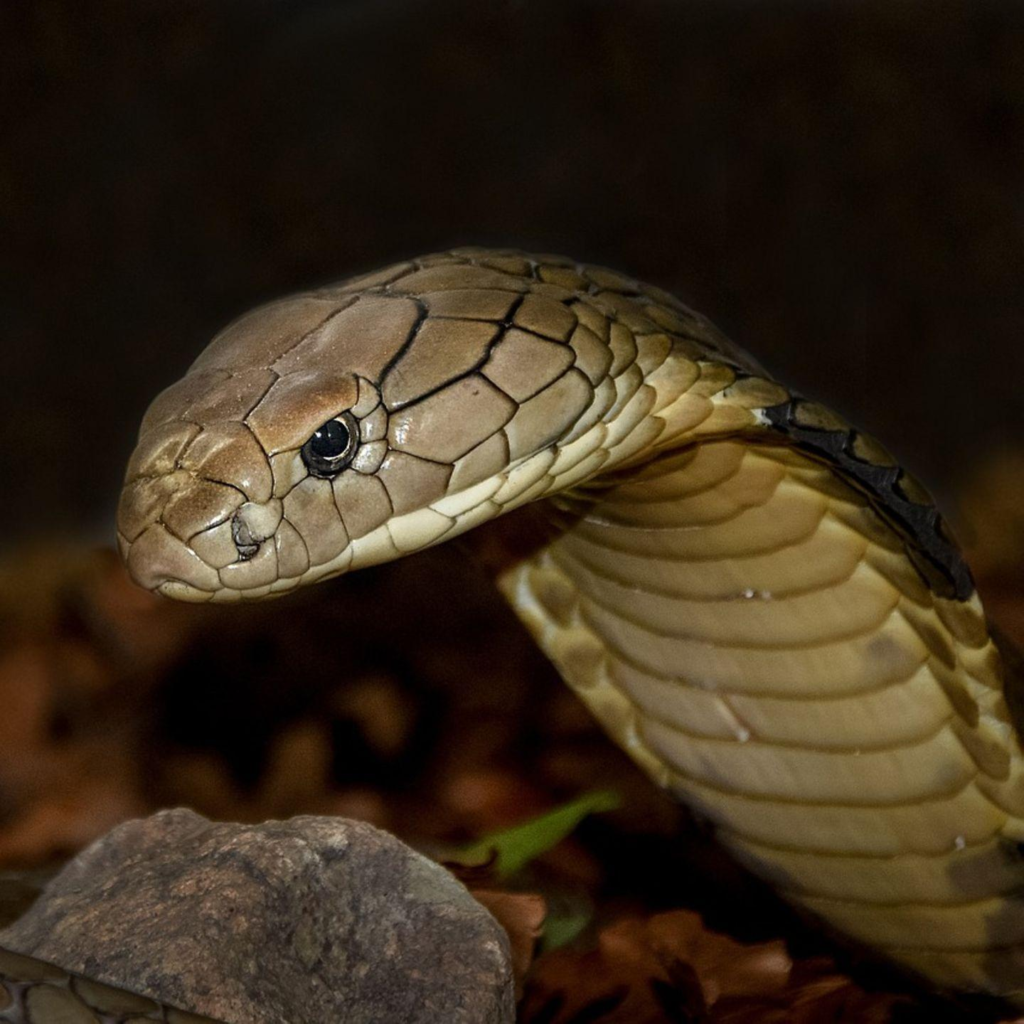
Wild habitats are rarely uniform.
- Some areas may be more suitable than others.
- Human settlements occur around parts of the Sundarbans.
- Agricultural land borders forest.
- Fish ponds and canals occur in the wider landscape.
King cobras elsewhere in Asia have demonstrated an ability to use a range of habitats, including natural forests and modified environments, although the species’ ecological requirements and tolerance differ among populations.
That flexibility should not be interpreted as proof that habitat degradation is harmless. A species can occupy altered habitat while still experiencing long-term decline.
The distinction between survival in a disturbed landscape and thriving in a healthy ecosystem is crucial.
For the king cobra, conserving the Sundarbans therefore means preserving not merely a patch of mangrove trees, but the ecological conditions that sustain reptiles, prey, shelter and connected habitat.
A Predator That Hunts Predators
The name Ophiophagus gives away the central fact of the king cobra’s ecology.
It eats snakes.
This is not an occasional curiosity. Other snakes form a major component of its natural diet. Field studies have recorded predation on vipers and other snakes, while additional observations have demonstrated that the species can also consume monitor lizards.
The king cobra is therefore a specialised predator—but not an absolutely exclusive one. That distinction matters. Biology is full of animals that have strong dietary preferences without obeying rigid rules.
Finding Another Snake
A snake-eating predator faces a difficult problem.
Its prey is itself a predator or highly mobile reptile capable of hiding, escaping and defending itself.
The king cobra must locate it.
Chemical information is critical.
Like many snakes, it uses its forked tongue to collect chemical particles from the environment. Those particles are transferred to the Jacobson’s organ, allowing the snake to interpret chemical information in its surroundings.
The tongue flicking seen in a searching snake is therefore not meaningless nervous movement.
It is environmental sampling.
The animal is effectively gathering information about what has passed through its surroundings.
For a predator that searches for other reptiles, this sensory system is fundamental.
The Hunt is Not a Spectacle
Popular images often portray king cobras as permanently raised, hood spread and ready to attack. That is defensive theatre, not their default lifestyle.
Most of the time, a wild snake benefits from avoiding unnecessary conflict.
- A confrontation costs energy.
- A bite carries risk.
- An injury can become catastrophic for an animal that must hunt, move and reproduce without medical assistance.
When threatened, however, the king cobra can raise the front portion of its body, spread its neck into a hood and appear dramatically larger.
The posture is an unmistakable warning.
The message is essentially: do not come closer.
That behaviour is one reason humans should never attempt to approach or provoke a king cobra in the wild.
The animal’s reputation for aggression is often overstated. Like many wild predators, it may prefer escape when given the opportunity, while nesting females can be especially defensive around their eggs.
Venom is a Hunting Tool
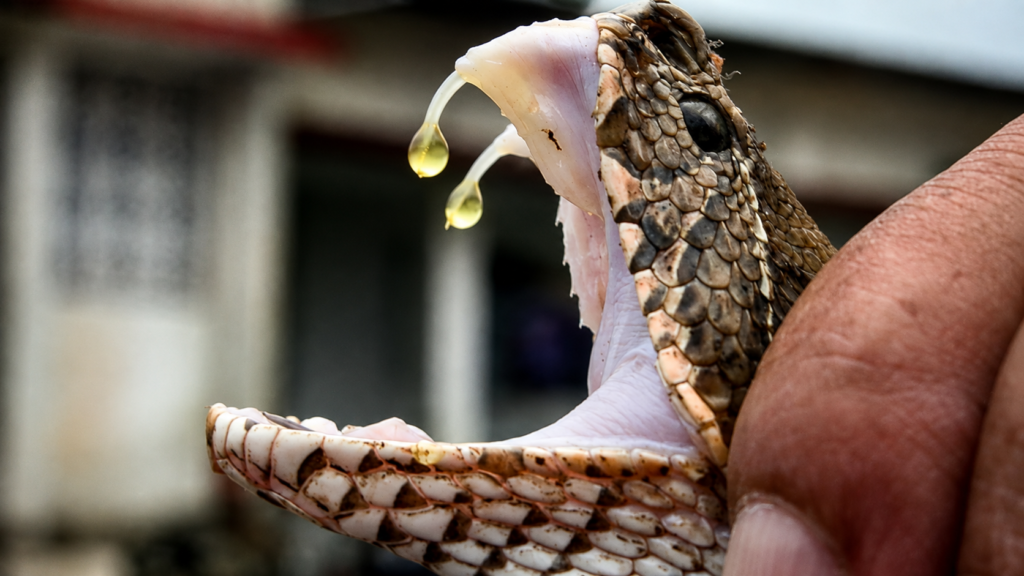
The king cobra is venomous.
Its venom contains toxins that affect the nervous system, and envenomation can interfere with neuromuscular function and breathing.
But venom should not be understood simply as a weapon. Evolution has shaped venom into a biological tool for immobilising prey.
The king cobra’s large size also allows it to deliver a substantial quantity of venom. This is one reason bites can be medically serious.
But the snake’s venom is only one part of its predatory system.
First comes detection.
- Then approach.
- Then restraint and striking.
- Then venom.
- Then swallowing.
The final stage is perhaps the most physically extraordinary.
A Snake That Eats Snakes
Snakes cannot chew their prey into manageable pieces. The king cobra must swallow its prey whole.
Its skull is therefore highly specialised for feeding. Like other snakes, it possesses movable connections between elements of the skull and lower jaws that allow the mouth to accommodate prey of considerable size.
This is often described casually as the snake “dislocating” its jaw. That is misleading. The jaws are not simply popping out of their sockets.
Instead, the skull and jaw system are highly flexible, allowing the two sides of the lower jaw to move in a coordinated but independent fashion while the snake progressively works the prey into its mouth.
For a predator that may swallow another snake, this flexibility is indispensable.
It is Not Limited to Snakes
The name king cobra can create another misconception: that it must eat only snakes. It does not.
Scientific observations have documented king cobras consuming monitor lizards, and other literature records additional reptilian prey. This broader diet can be ecologically useful.
A predator with a strong preference but some dietary flexibility may be better able to persist when particular prey species fluctuate.
Again, however, there is no scientific basis for assigning a precise Sundarbans diet without local field evidence.
The correct conclusion is more restrained: the king cobra is a specialised snake predator whose diet can include other reptiles, and its actual prey composition in the Indian Sundarbans deserves further study.
A Giant Snake Can Climb
Its size can make the king cobra look like a purely ground-bound animal. It is not. King cobras can climb trees and navigate elevated structures when necessary. That ability expands the animal’s three-dimensional world.
For a predator, climbing can provide access to prey, escape routes, resting locations or vantage points. In mangrove forests, where trunks, branches and roots create complex vertical structure, such behavioural flexibility can be useful.
But again, capability does not automatically mean that climbing is a defining Sundarbans adaptation. The evidence allows us to say that king cobras can climb. It does not allow us to invent a specialised mangrove-climbing lifestyle.
Swimming is Another Tool
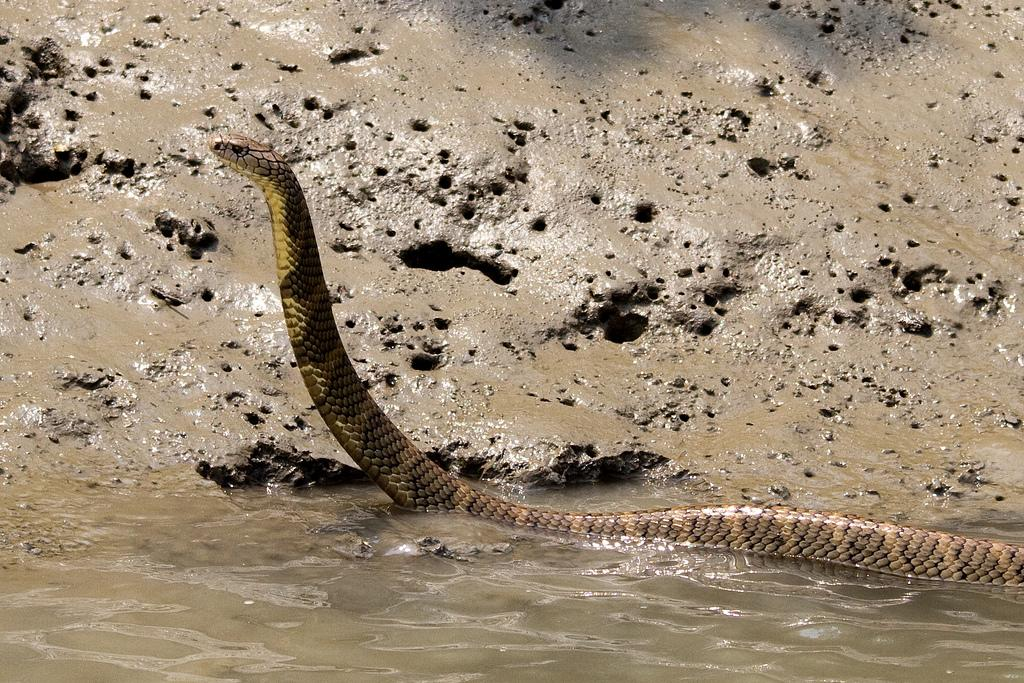
King cobras can swim effectively.
This is especially relevant when considering the Sundarbans. A forest broken by tidal channels is not an environment in which a snake must remain completely confined to one patch of dry land.
But swimming should be viewed as one component of behavioural flexibility rather than proof that the species is aquatic.
The king cobra remains primarily a terrestrial predator. That distinction is ecologically important. The Sundarbans did not transform the king cobra into a water snake.
Instead, the snake exists within a terrestrial habitat that happens to be profoundly influenced by water.
Reproduction: The Snake That Builds a Nest
Perhaps the most extraordinary part of king cobra biology begins when an adult female stops hunting and begins gathering leaves.
She builds a nest.
Among snakes, this is exceptionally unusual.
The female gathers vegetation and leaf litter, pushing and pulling material together with her body and tail to form a mound. Eggs are deposited within the structure. The female can remain nearby and guard the nest for an extended period. This behaviour is one of the strongest reasons the king cobra deserves to be considered more than simply a large venomous snake.
It displays a form of parental investment that is unusual among reptiles.
Recent research has even reported the first evidence of nest reuse in the northern king cobra, documenting cases in which the same mound structure contained separate clutches. The study was published in the Herpetological Bulletin in 2026. That discovery also illustrates how much remains to be learned.
Even an animal as famous as the king cobra still contains biological surprises.
Why Build a Nest?
See it for yourself
A private journey shaped around you — your group, your pace, your interests. Book a free consultation.
The answer lies in temperature, moisture and protection.
- Eggs are living developmental systems.
- Their environment influences embryonic development.
- A vegetation mound creates a microenvironment that differs from the surrounding forest floor.
- It can provide insulation, retain moisture and alter temperature.
The female’s presence adds another layer of protection. She does not incubate the eggs like a bird. But she constructs the environment in which development occurs and remains associated with the nest during a substantial part of incubation.
That is a remarkable behavioural investment.
The Sundarbans Make Nesting Especially Interesting
This is where the species’ biology meets its environment in a potentially fascinating way. The Sundarbans is humid, dynamic and subject to tidal disturbance.
A nest cannot simply be placed anywhere.
It must occupy a microhabitat that is sufficiently elevated or protected from inundation, while also providing suitable vegetation and environmental conditions.
However, detailed, population-level research on king cobra nesting sites specifically in the Indian Sundarbans is limited.
Therefore, it would be scientifically irresponsible to claim that Sundarbans king cobras build nests in a particular mangrove species or always choose a particular distance from tidal channels unless such behaviour has been documented.
What can be said with confidence is that nesting behaviour makes the availability of suitable terrestrial microhabitats important to reproduction.
That turns habitat quality into a reproductive issue, not merely a feeding issue.
The Future of a Giant Predator is Tied to a Fragile Landscape
The king cobra has an intimidating reputation.
- It is large.
- It is venomous.
- It eats other snakes.
- It can raise much of its front body when threatened.
None of that makes it immune to ecological change.
The IUCN has assessed the king cobra as Vulnerable, with the published assessment identifying a decline associated with habitat loss and exploitation. More recent scientific literature continues to cite the species as Vulnerable.
There is, however, an important taxonomic complication.
The 2024 revision of the king cobra group formally recognised four species-level lineages, restricting Ophiophagus hannah to the northern lineage and separating other populations into O. bungarus, O. kaalinga and O. salvatana. The older IUCN assessment predates this revision and therefore should not automatically be interpreted as a modern population assessment for each newly recognised species independently.
Habitat Loss
The first threat is habitat.
King cobras require landscapes capable of supporting their prey and movement. In the Sundarbans, habitat degradation can take several forms.
Mangrove clearance, conversion, erosion, fragmentation and changes in surrounding land use can reduce the continuity and quality of suitable habitat.
The species does not necessarily disappear the moment one patch changes. But cumulative change can affect the ecological network on which it depends.
A snake-eating predator ultimately requires snakes. Those snakes require prey. Their prey requires habitat. The habitat depends on functioning wetlands, vegetation and ecological processes.
Conservation therefore has to work from the bottom upward.
Human Persecution
Fear is another threat.
A large venomous snake encountered near people is often treated as a problem before it is recognised as wildlife.
This creates a dangerous situation for both humans and snakes.
A king cobra that enters a settlement, agricultural area or other human-modified landscape may be killed because of perceived danger.
The ecological role of the animal is rarely visible during such an encounter.
- What a person sees is simply a large venomous snake.
- What the ecosystem contains is a major reptilian predator.
This gap between perception and ecological reality is one of the central challenges of snake conservation. The answer is not to romanticise the king cobra.
It is to understand it.
Safe distance, trained rescue responses and public education can reduce unnecessary killing while protecting people.
Illegal Trade and Exploitation
The king cobra has also faced exploitation.
The IUCN assessment identified exploitation alongside habitat loss as a major conservation concern, while international conservation literature has documented use of king cobras in trade and traditional practices.
The international trade framework is therefore relevant.
India’s wildlife legislation provides strong protection to the species. Under the Wildlife (Protection) Act framework, the king cobra is included in Schedule I, which provides the highest level of legal protection under the current framework. Government documentation also identifies the king cobra among India’s Schedule I herpetofauna. Protection on paper, however, is only one part of conservation.
The real test is whether the animal’s habitat remains functional and whether illegal killing and trade can be prevented.
Climate Change and the Tidal Future
For the Sundarbans, climate change introduces another layer.
Sea-level rise, coastal erosion, changing sediment dynamics, extreme weather events and changes in salinity can alter the geography of the delta.
A mangrove island is not static.
- Its shape can change.
- Its banks can retreat.
- Channels can widen or shift.
- Vegetation patterns can change.
- Freshwater availability can vary.
For a large terrestrial predator, the consequences are unlikely to be as simple as “more salt equals less king cobra.”
Ecological change works through chains.
- If habitat changes, prey communities may change.
- If prey communities change, predator movement and reproduction may be affected.
- If nesting sites become less secure, reproductive success could change.
- If islands become more fragmented, movement between suitable areas may become more difficult.
The problem is therefore not merely whether king cobras can tolerate salt. The more important question is whether the whole habitat system on which they depend remains intact.
The Importance of Research
One of the most significant conservation needs is information.
King cobras are conspicuous animals, but conspicuous does not mean well studied.
Much of what scientists know about their detailed behaviour comes from populations outside the Indian Sundarbans.
Radiotelemetry work in the Western Ghats has revealed movement and feeding behaviour that would be impossible to understand through casual sightings alone.
Similar research in the Sundarbans could help answer questions such as:
- How large are individual home ranges?
- Which islands support regular populations?
- How frequently do individuals cross tidal channels?
- Which snakes form the most important prey?
- Where do females establish nests?
- How vulnerable are nests to flooding?
- Do individuals move seasonally?
- How does prey availability affect movement?
- How does habitat fragmentation influence genetic connectivity?
These are not academic luxuries. They are the information required to manage a species intelligently.
Why the King Cobra Matters to the Sundarbans
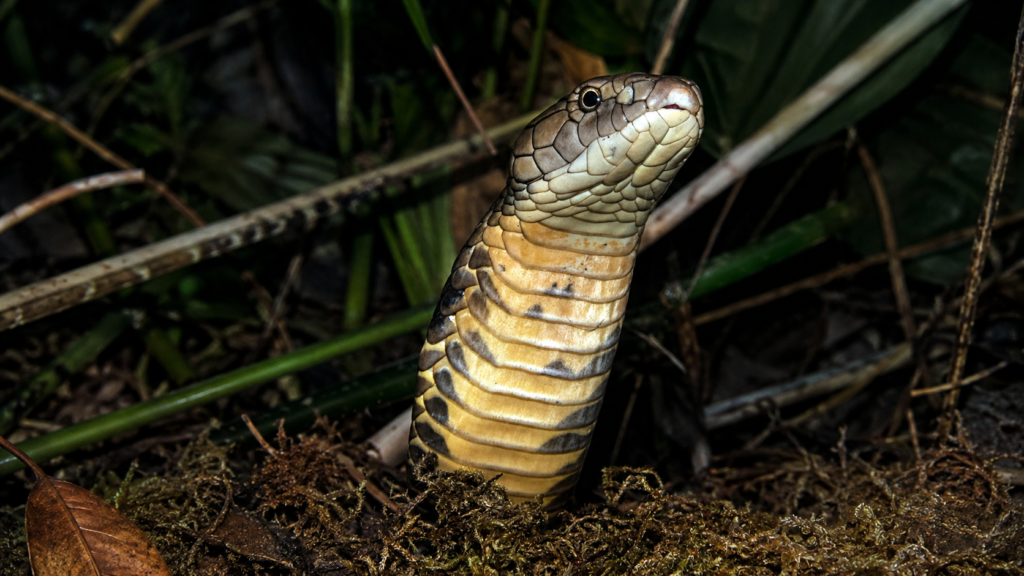
A predator’s ecological importance is not measured only by how many animals it eats.
Predators participate in regulating ecological communities. The king cobra occupies a high trophic position within the terrestrial reptile community.
Its presence reflects the existence of a functioning food web capable of supporting a large specialist predator. If the king cobra disappears, the immediate ecological consequences may be difficult to measure.
But its decline could indicate something deeper:
- the loss of prey
- the loss of habitat
- the disruption of ecological connectivity
- the increasing pressure from human activity
The species can therefore act as part of the broader ecological story of the forest. Protecting it means protecting the conditions that allow a complex reptilian community to persist.
What Makes the King Cobra Extraordinary?
The king cobra’s uniqueness is not one spectacular fact.
- It is the combination of traits.
- It is enormous, yet highly mobile.
- Venomous, yet primarily interested in avoiding unnecessary conflict.
- A snake, yet a predator of snakes.
- Capable of climbing and swimming, yet primarily terrestrial.
And, most remarkably, a reptile whose female constructs a nest and guards her eggs. The extraordinary story emerges when these characteristics are considered together.
1. It is the world’s longest venomous snake
WHAT: King cobras can reach exceptional lengths approaching 5.8 metres.
HOW: Their elongated, muscular bodies continue growing through life, with large adults becoming formidable predators.
WHY IT MATTERS: Size gives the species the physical capacity to overpower and swallow substantial reptilian prey.
But the impressive maximum should not become a sensational headline applied to every individual. Wild king cobras vary considerably in size.
2. Its name describes its diet
WHAT: Ophiophagus means snake-eating.
HOW: The king cobra actively searches for and captures other snakes.
WHY IT MATTERS: It occupies a specialised predatory niche uncommon among large terrestrial vertebrates.
It is, in effect, a predator living partly within the predator community.
3. It can hunt venomous snakes
WHAT: King cobras can prey on other venomous snakes.
HOW: Its own venom, physical control and specialised predatory behaviour allow it to attack potentially dangerous reptilian prey.
WHY IT MATTERS: The predator is operating inside a food web where its prey can itself be armed with venom.
Field observations in India have documented a king cobra consuming numerous pit vipers. That does not mean every king cobra specialises in vipers. It means the species possesses a remarkable ability to exploit dangerous reptilian prey.
4. It is not an absolute snake specialist
WHAT: King cobras can consume prey other than snakes.
HOW: Their broad feeding mechanics allow them to swallow suitable reptilian prey whole.
WHY IT MATTERS: Dietary flexibility can provide alternatives when preferred prey are unavailable.
Scientific observations have documented king cobras consuming monitor lizards. This is a useful reminder that common names and scientific names do not always describe rigid rules.
5. It can raise a remarkable portion of its body
WHAT: A threatened king cobra can elevate the front portion of its body while spreading its hood.
HOW: Muscular control of the trunk allows it to lift the anterior body and maintain an elevated defensive posture.
WHY IT MATTERS: It dramatically changes the snake’s apparent size and communicates a warning before physical contact becomes necessary. The hood is therefore not merely an icon. It is behavioural communication.
6. It uses a sophisticated chemical world
WHAT: The king cobra gathers chemical information with its forked tongue.
HOW: Tongue flicking samples particles from the environment, which are delivered to the Jacobson’s organ.
WHY IT MATTERS: For a predator searching through complex vegetation, chemical information can help reveal what has recently passed through the environment.
The forest may look visually empty. To a snake, it is not. The air, leaf litter and substrate contain information.
7. It can climb
WHAT: King cobras are capable climbers.
HOW: Their muscular bodies and scales allow them to move through branches and trunks.
WHY IT MATTERS: Climbing expands their available habitat and behavioural options beyond the forest floor.
In a structurally complex forest, three-dimensional movement can be an important advantage.
8. It can swim
WHAT: King cobras can cross water.
HOW: Their elongated bodies generate lateral undulation through the water, allowing them to propel themselves efficiently.
WHY IT MATTERS: Swimming provides mobility across aquatic barriers.
For the Sundarbans, that ability is particularly intriguing because channels divide the landscape. But it should not be confused with aquatic specialisation. The king cobra remains fundamentally a terrestrial snake.
9. The female builds a nest
This may be the most remarkable behaviour of all.
WHAT: Female king cobras construct above-ground nests from vegetation.
HOW: The female gathers leaf litter and other plant material using her body and tail, forming a mound in which eggs are deposited.
WHY IT MATTERS: Such nest construction and extended guarding behaviour are highly unusual among snakes and represent a significant investment in reproduction.
In the forest, a pile of leaves can therefore become something much more important than it appears. It can become a nursery.
10. The mother guards the nest
WHAT: Female king cobras can remain associated with and defend their nests.
HOW: The female stays near the structure during part of the incubation period and may become highly defensive when approached.
WHY IT MATTERS: It gives the developing eggs a degree of protection that is unusual among snakes.
This behaviour completely changes the usual image of a snake as an animal that lays eggs and immediately abandons them.
11. Its nest can function as a biological microhabitat
WHAT: A king cobra nest is more than a pile of vegetation.
HOW: The accumulated plant material alters the immediate temperature and moisture environment around the eggs.
WHY IT MATTERS: Embryonic development occurs inside a deliberately constructed microenvironment.
Recent observations have even documented nests being reused for separate clutches in northern king cobras. That finding demonstrates how little of the species’ reproductive biology may yet be fully understood.
12. Its scientific history is tied to the Sundarbans
This is perhaps the most distinctive connection of all.
WHAT: The king cobra’s original scientific description was associated with the Sundarbans region.
HOW: Theodore Edward Cantor described Hamadryas hannah in the nineteenth century from material associated with the “Sunderbans” and nearby jungle.
WHY IT MATTERS: The Sundarbans is not simply one location where the species happens to occur. It is part of the historical foundation of the animal’s scientific identity.
That gives the landscape an unusual place in herpetological history.
The Sundarbans-Specific Uniqueness
The strongest Sundarbans story is not that king cobras have developed a magical ability to live in seawater.
There is no sound scientific basis for such a claim. The real uniqueness lies elsewhere.
1. A terrestrial giant exists inside a tidal landscape
The king cobra is fundamentally a terrestrial predator.
The Sundarbans are fundamentally shaped by tides. That contrast makes its persistence remarkable.
The snake does not need to become an aquatic animal to survive here. Instead, it occupies the terrestrial component of an ecosystem whose boundaries are constantly influenced by water.
2. Its prey community is shaped by the mangrove ecosystem
A snake-eating predator depends upon a community of snakes and other reptiles.
The diversity and abundance of those prey are ultimately connected to habitat structure, food availability and ecological productivity.
The king cobra therefore links the reptile community to the larger mangrove food web.
3. Island geography may influence its ecology
The Sundarbans is broken into islands and channels.
For a large terrestrial predator, that geography creates a different ecological setting from a continuous inland forest.
The ability to swim may help a king cobra navigate some water barriers, but the actual frequency and ecological significance of such crossings in the Indian Sundarbans remain poorly documented.
That is a research opportunity rather than a fact to embellish.
4. Its reproductive biology makes high-ground microhabitat important
A nesting female requires a suitable terrestrial location.
In a tidal landscape, the difference between a secure patch of elevated ground and an area exposed to flooding can be critical.
Yet exactly how Sundarbans king cobras select nesting locations remains insufficiently studied.
The unanswered question is therefore as fascinating as the known biology.
5. The species connects the Sundarbans to wider Asian evolutionary history
The 2024 taxonomic revision has changed how scientists understand the king cobra.
The animal once treated as a single widespread species is now recognised as a complex containing four distinct lineages, with Ophiophagus hannah representing the northern lineage. The Sundarbans therefore sits within a much more complicated evolutionary story than older field guides suggested.
This matters for conservation because conservation boundaries should follow biological diversity.
When one “species” becomes several species, apparently widespread populations can turn out to have much smaller evolutionary ranges than previously believed.
The Wild Orbit’s Quick Facts About King Cobra
Common Name: King Cobra / Northern King Cobra
Scientific Name: Ophiophagus hannah
Family: Elapidae
Order: Squamata
Primary Indian Focus: Indian Sundarbans, West Bengal
Type Locality: Sundarbans region, historically recorded as “Sunderbuns”
Maximum Reported Length: Approximately 5–5.8 m
Diet: Primarily snakes; other reptiles may also be eaten
Lifestyle: Mainly terrestrial; capable of climbing and swimming
Activity: Primarily diurnal
Key Adaptation: Specialised snake predation
Reproduction: Female constructs vegetation nests and guards them
IUCN Status: Vulnerable under the established IUCN assessment; taxonomy has since been revised
Indian Legal Protection: Schedule I under India’s Wildlife (Protection) Act framework
Sundarbans Significance: A threatened apex-level terrestrial reptile predator historically tied to the region’s scientific description
FAQs
Is the king cobra found in the Indian Sundarbans?
Yes. Ophiophagus hannah is documented from the Sundarbans region of West Bengal and is part of the region’s reptile fauna.
What does a king cobra eat?
King cobras primarily eat other snakes, including some venomous species. They can also prey on other reptiles such as monitor lizards.
Is the king cobra dangerous to humans?
Yes. It is highly venomous and its bite can cause serious medical consequences. However, it generally does not need to be portrayed as a snake that actively seeks human confrontation.
How long can a king cobra grow?
Exceptional individuals can reach around 5–5.8 metres, making the king cobra the world’s longest venomous snake. Such extreme lengths are not typical of every individual.
Can king cobras swim?
Yes. King cobras are capable swimmers and can cross water, but they remain primarily terrestrial snakes rather than aquatic specialists.
Does the female king cobra build a nest?
Yes. Female king cobras construct nests from vegetation and leaf litter for their eggs and may guard them during incubation.
Is the king cobra endangered?
The established IUCN assessment classifies the king cobra as Vulnerable. However, its taxonomy was revised in 2024, so the older assessment needs to be interpreted alongside the newly recognised species-level divisions.
Why is the king cobra important to the Sundarbans?
The king cobra is a major terrestrial predator that depends on a functioning reptile community and healthy habitat. Protecting it also means protecting the wider ecological network of the Sundarbans.
The Wild Orbit Perspective
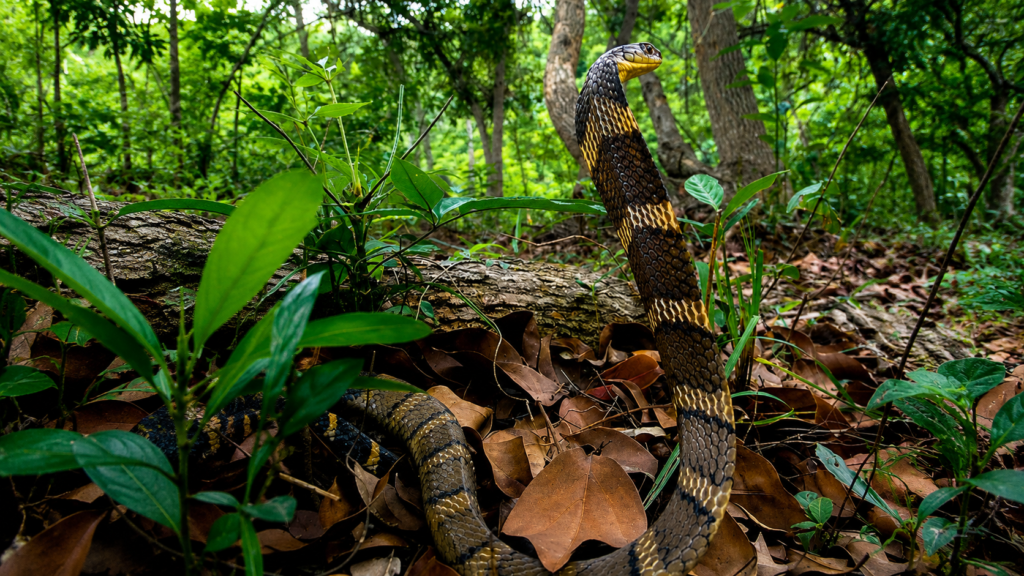
The king cobra is easy to misunderstand.
- Its size invites fear.
- Its venom invites alarm.
- Its hood invites mythology.
- Its name invites exaggeration.
But the real animal is more interesting than the legend.
- It is a predator moving quietly through a complicated food web.
- It depends on other reptiles.
- It reads the landscape through chemical information.
- It can cross water, climb through vegetation, and disappear into the structure of a forest that is constantly being rewritten by the tide.
And when the time comes to reproduce, the image changes completely. A giant venomous snake gathers leaves.
- It builds.
- It creates a nest.
- It guards its eggs.
In the Indian Sundarbans, that story acquires another dimension.
This is a landscape where land is never entirely permanent.
- Islands erode.
- Channels shift.
- Tides advance and retreat.
Mangroves hold the mud together, while the estuary continually reshapes their surroundings.
The king cobra survives not because it has conquered that environment, but because it has found a place within its ecological complexity.
That distinction matters.
Wildlife conservation is not about preserving impressive animals as isolated symbols. It is about preserving the relationships that allow those animals to exist.
For the king cobra, that means snakes to hunt, vegetation in which to move, terrestrial habitat in which to shelter, places suitable for reproduction, and enough ecological continuity for a large predator to remain part of the forest.
The Sundarbans does not need the king cobra merely because the snake is spectacular.
It needs functioning ecosystems capable of supporting animals at every level of the food web.
And the king cobra is one of the most powerful reminders that even inside a forest dominated by tides, there is an intricate terrestrial world unfolding beneath the mangrove canopy.
Plan your private Sundarban expedition
A private journey shaped around you — your group, your pace, your interests. Book a free consultation.