


 Wildlife Encounters
The night had not quite released the forest yet.
The Sundarbans was still wrapped in darkness when the boat lay anchored among the waterways. Beyond its edges, the mangroves were little more than silhouettes. The tide moved quietly through the creeks, and somewhere beyond the reach of the boat’s lights, the forest continued to breathe.
The last hours of darkness were slowly giving way to dawn, but the sun had not yet appeared.
By first light, the forest had almost vanished behind fog.
The boat moved towards the Pirkhali islands. Visibility was poor. The trees along the banks appeared and disappeared inside the white-grey haze, and the familiar shapes of the mangroves seemed strangely close and impossibly distant at the same time.
It was the sort of morning when a tiger could be standing only a short distance away and remain invisible.
Then came the shout.
“Bagh, bagh.”
Tiger.
The boatman had seen it.
Inside the tangled forest, partly obscured by vegetation and fog, a tiger sat on the mud.
For the people on the boat, the moment was almost unreal. They had come looking for the animal that rules this difficult landscape, but in the Sundarbans, looking is rarely enough.
The tiger had to reveal itself.
For a few minutes, it did.
Then it disappeared.
The boat remained in motion.
The forest gave away almost nothing. There were no open grasslands to scan, no distant ridge where a tiger might appear against the skyline. Here, the animal could vanish behind a wall of mangrove roots, a stand of hetal palms or a bend in the creek and be gone completely.
But the guides had learned to read the forest differently.
They anticipated where the tiger might emerge and slowly followed the line of the island.
Then, somewhere ahead, the animal appeared again.
It was a tigress.
She moved through the vegetation, appearing briefly between the trees before disappearing once more. The boat followed at a careful distance, while the fog gradually began to thin.
Then the tigress reached the water.
For most forests, a river can be a boundary.
In the Sundarbans, it is often only another part of the forest.
She entered the creek and began to swim.
The water closed around her body. Her head remained above the surface as she moved steadily towards the opposite bank. There was no hesitation, no great struggle against the water. For a tiger born among these islands, waterways are not obstacles in the way they might be elsewhere.
They are routes.
The Sundarbans is a landscape divided by tidal creeks, rivers and channels. Its tigers have adapted to a world in which movement often means entering the water. Scientific records have documented Sundarbans tigers swimming across channels ranging from narrow creeks to waterways hundreds of metres wide, with some records describing even longer crossings.
But knowing that a tiger can swim does not prepare you for seeing one do it.
The tigress reached the opposite bank.
She climbed onto the mud, water running from her coat, and began walking along the edge of the creek.
For a moment, she looked back.
The boat was still there.
Then she disappeared into the forest.
The sighting could have ended there.
Instead, the boat continued around the island.
And the tigress appeared again.
She settled among the trees near the bank, where the green of the forest formed a backdrop around her. For about fifteen minutes she remained there, repeatedly scanning the surroundings and keeping her attention on the boat.
The fog was lifting now.
The forest emerged slowly from the haze. Details returned first—the branches, the palms, the muddy bank—and then the larger shapes of the island. What had been a world of shadows became visible again.
The tigress remained watchful.
Then, just as quietly as she had appeared, she turned back towards the forest.
The encounter was over.
No roar announced her departure. No dramatic chase followed. There was only the movement of a large cat disappearing between the trees until the mangroves closed behind her.
For the people on the boat, the entire encounter had lasted around an hour and a half.
For the Sundarbans, it was simply another morning.
That is perhaps the most remarkable part of watching a tiger here.
In other landscapes, a tiger crossing water might seem extraordinary because the water separates one world from another.
Here, there is no such separation.
Forest becomes mud.
Mud becomes creek.
Creek becomes river.
River becomes forest again.
The tiger moves through all of it.
This is what makes the Sundarbans tiger different from the image of the species that most people carry in their minds. There are no open meadows here, no dry forest trails stretching beneath tall trees. Instead, the tiger lives in a shifting maze of saline water, tangled mangroves and soft tidal ground.
It has learned to swim through that maze.
And sometimes, when the tide is right and the fog is thick, the forest gives someone on a passing boat a glimpse of that hidden life.
A tiger on the mud.
A tiger between the palms.
A tiger slipping into a creek.
Then nothing.
The water closes over its tracks.
The mangroves take back the shoreline.
And the forest becomes quiet again.
Perhaps that is why the memory of such an encounter stays so powerful. The tigress was never performing for the people watching from the boat. She was simply travelling through her territory, crossing a piece of water that happened to lie between her and wherever she was going.
For a few minutes, the people on the boat were allowed to see it.
Then the Sundarbans took her back.
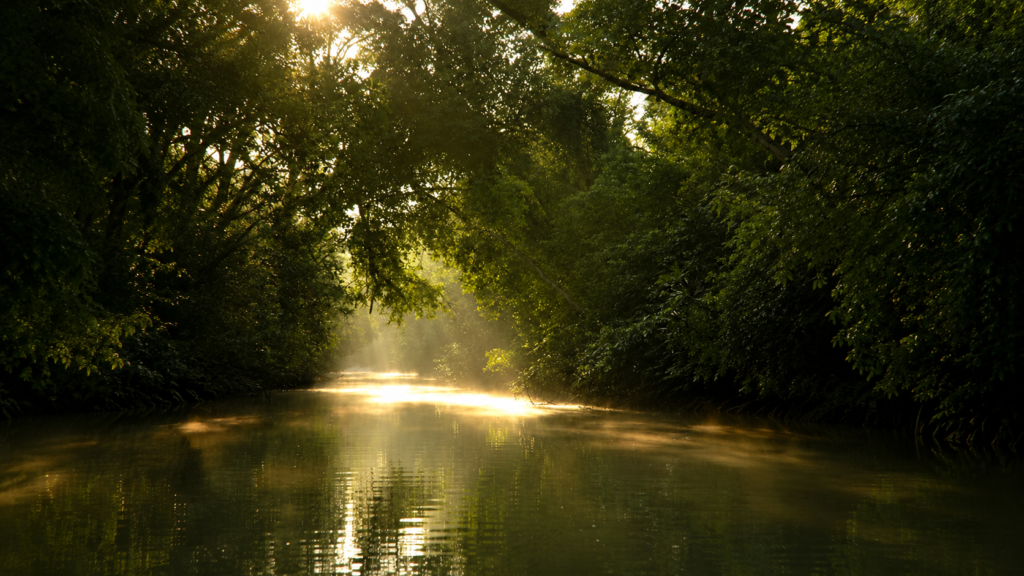
And the creek flowed on.
Plan your private Sundarban expedition
A private journey shaped around you — your group, your pace, your interests. Book a free consultation.


