

 Travel guide
There are places you visit to see wildlife.
And then there are places you visit because the landscape itself makes you look more closely.
The Sundarbans belong to the second category.
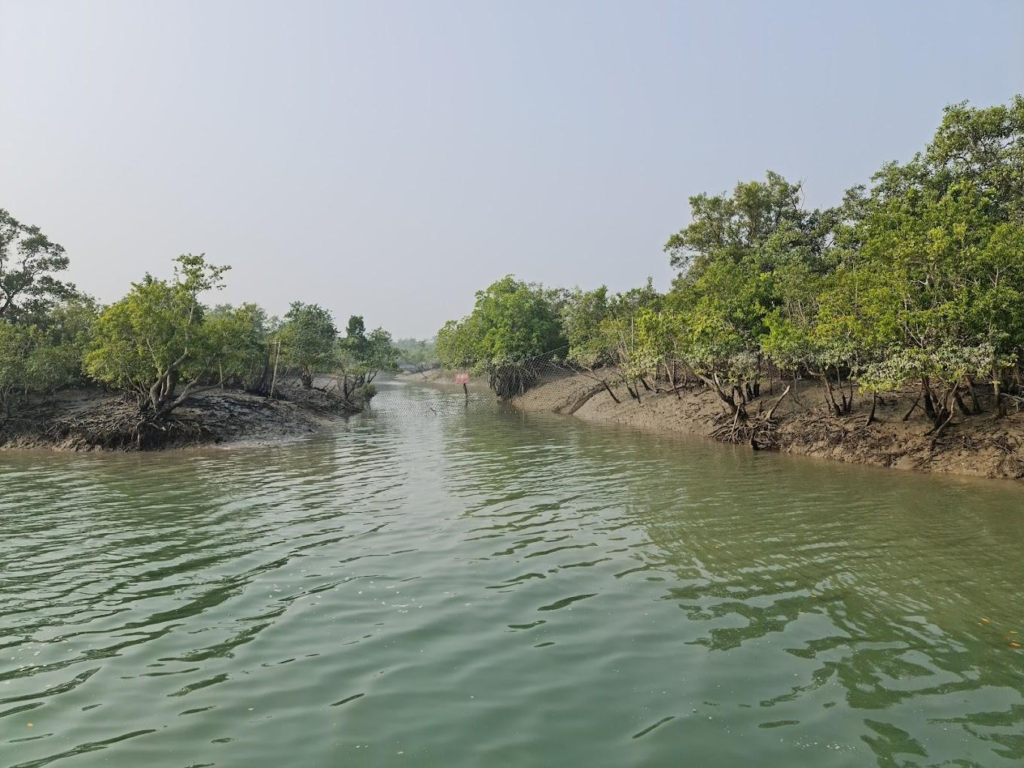
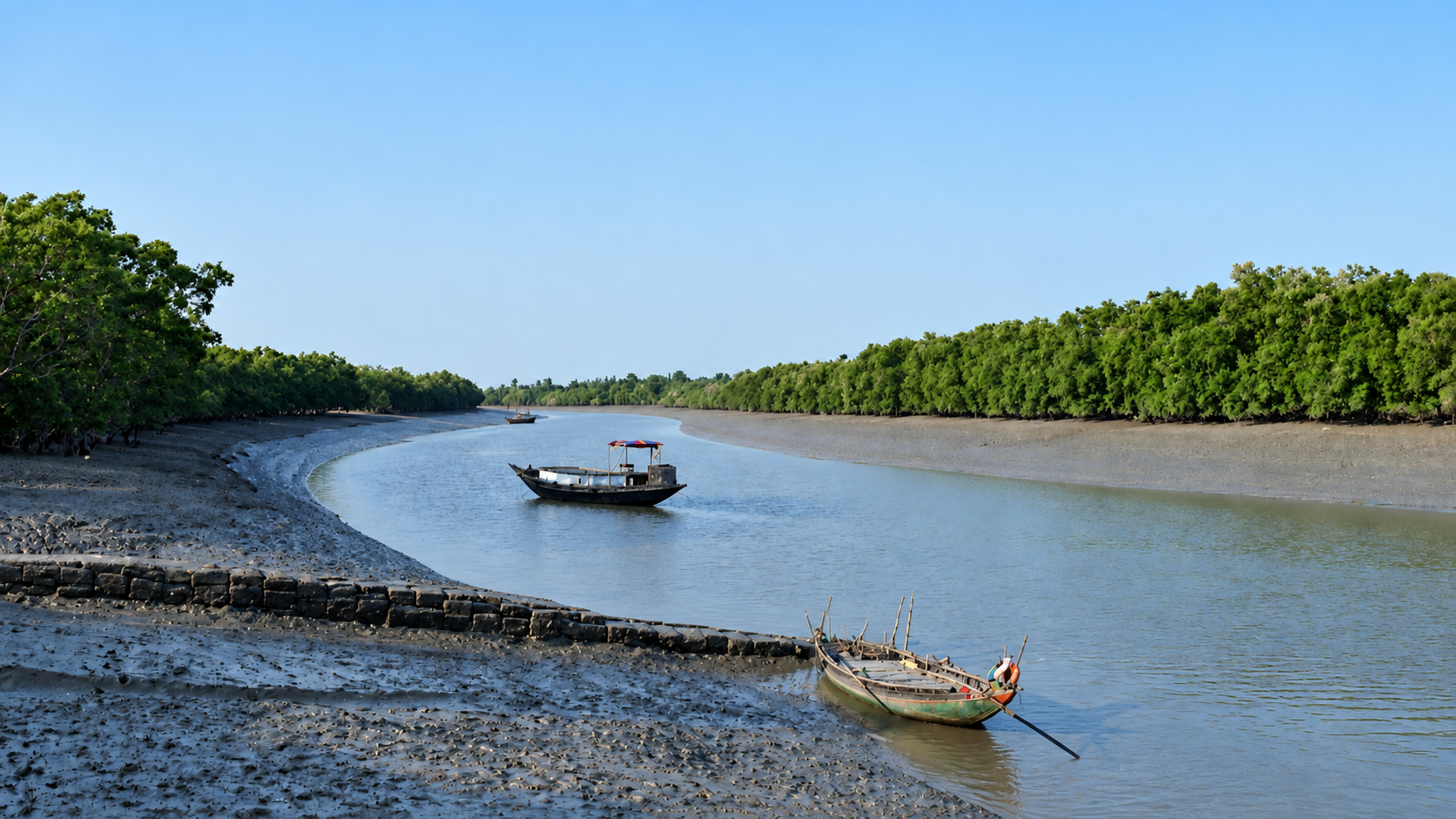
For British travellers accustomed to thinking about India through its great cities, Himalayan landscapes, historic architecture and famous wildlife reserves, the Sundarbans offers something rather different. There are no sweeping grasslands here and no straightforward road safari. Instead, the landscape is a shifting world of tidal rivers, narrow creeks, mudflats, mangrove islands and dense forest at the meeting point of land and sea.
This is the Indian Sundarbans: part of a much larger transboundary ecosystem shared by India and Bangladesh and one of the world’s great mangrove landscapes. UNESCO describes the Sundarbans as containing the world’s largest area of mangrove forests and as an exceptional example of ecological processes shaped by tides, monsoon flooding, sediment, delta formation and plant colonisation.
For a traveller interested in natural history, wildlife, photography, geography or simply the pleasure of paying attention, that makes the Sundarbans unusually rewarding.
And there is another layer that may make the journey especially interesting for British travellers.
The route into the delta passes through places connected with Bengal’s colonial history, including Canning, named after Lord Canning, and Gosaba, where the Scottish-born Sir Daniel Hamilton established an ambitious experiment in cooperative rural development in the early twentieth century.
But the modern Sundarbans is not a journey into colonial nostalgia.
It is a journey into a living ecosystem and into a landscape where understanding, conservation and responsible travel matter.
Why the Sundarbans Feels Like a Naturalist’s Destination
The word “safari” creates a particular expectation.
You picture an open vehicle, a broad landscape, a guide scanning the horizon and perhaps a large animal appearing against the grass.
The Sundarbans ask you to change that picture.
Your primary viewpoint is often a boat.
The forest closes around you rather than opening out in front of you.
- A creek can disappear behind mangrove vegetation.
- A mudflat can emerge with the falling tide and disappear again beneath the water.
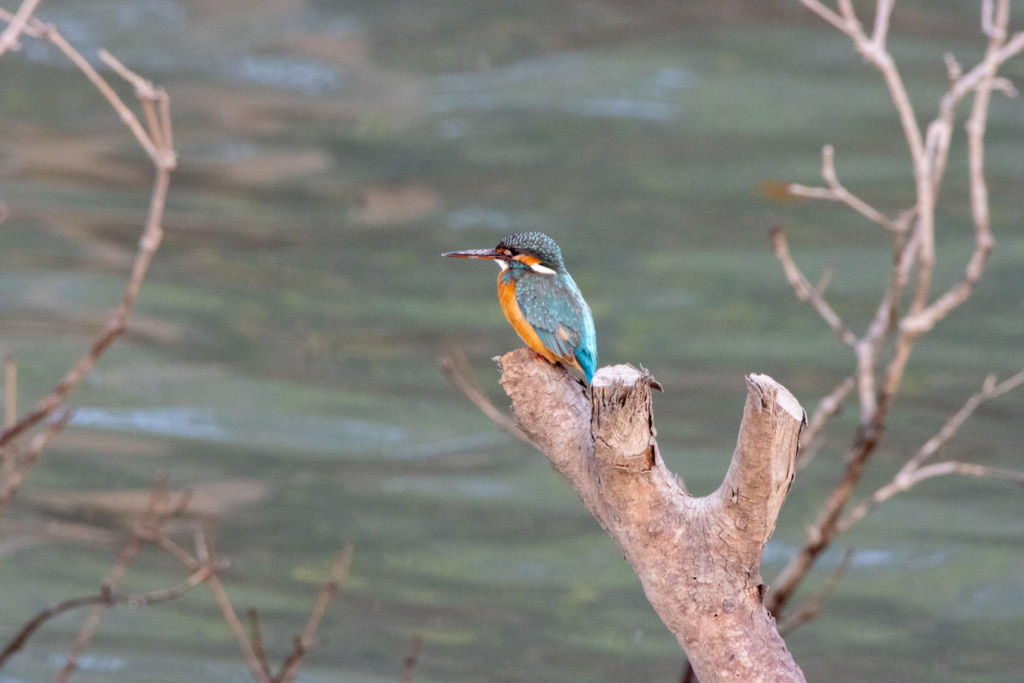
- A kingfisher may sit motionless for several minutes before suddenly breaking the silence.
The landscape demands attention.
That is what makes the Sundarbans particularly appealing to naturalists.
You begin to notice relationships rather than isolated sights.
- A mudflat matters because of what feeds there.
- A creek matters because of the tide.
- Mangrove roots reveal how plants survive in a difficult intertidal environment.
A movement among the trees may be more significant when you understand the behaviour of the deer nearby.
Even the absence of wildlife becomes informative.
UNESCO identifies the Sundarbans as one of the world’s most biologically productive natural ecosystems, with its landscape continually shaped by tidal influence, monsoon flooding, erosion, sediment deposition and the formation of deltaic islands.
You are not simply travelling through a forest.
You are travelling through a geographical process that is still happening around you.
A Different Chapter in the Story of Bengal
For British visitors, the journey becomes even more compelling when viewed through the broader story of Bengal.
Kolkata provides the first chapter.
The city introduces you to a very different side of the region: architecture, literature, food, commerce, art and an extraordinarily layered history.
Travel south, however, and the landscape gradually changes.
Urban streets give way to rural roads.
Rural roads give way to waterways.
And eventually, the tide becomes one of the defining forces of the journey.
One historical waypoint is Canning.
Canning and Lord Canning
Canning takes its name from Lord Canning, who served as Governor-General of India and later became the first Viceroy following the transfer of power from the East India Company to the British Crown in 1858. Historical records identify Port Canning as being named after him.
Today, Canning is better understood as part of the historical and logistical geography of the journey towards the Sundarbans than as a destination to romanticise.
That distinction matters.
The story of the Sundarbans is much older than colonial administration, and today’s visitor enters a landscape whose importance lies primarily in its ecological and cultural life.
But the journey becomes more interesting when you understand how different periods of Bengal’s history intersect with the delta.
And that brings you to Gosaba.
From Canning to Gosaba: The Hamilton Story
Few British connections to the Sundarbans are as unusual as that of Sir Daniel Hamilton.
A Scottish businessman who arrived in India in the nineteenth century, Hamilton became closely associated with Gosaba and the surrounding islands.
In 1903, he took land in the Gosaba area and began developing an ambitious experiment in rural reconstruction based around cooperative principles. His initiatives included agricultural development, cooperative institutions, education, healthcare and infrastructure.
Hamilton’s project was remarkable for its ambition.
He established cooperative organisations, a model farm and a cooperative bank, while also supporting schools and other institutions. His work attracted the attention of Indian intellectual and political figures, including Rabindranath Tagore, who visited Gosaba in 1932.
For today’s traveller, the significance of Hamilton’s story is not that he somehow “created” the Sundarbans.
He did not.
The delta had its own communities, ecological systems and history long before his arrival.
What makes his story interesting is that it forms one chapter in the complicated history of how people have attempted to settle, cultivate, organise and live within a landscape controlled by water.
Today, the emphasis has shifted.
The question is no longer simply how humans can reshape the delta.
It is how humans can live with it while protecting its ecological future.
That makes the transition from Canning to Gosaba more than a historical footnote.
It becomes part of the story of the landscape itself.
Beyond the Safari: Where the Sundarbans Stand Among the World’s Great Wild Places
British travellers have access to some of the world’s great wildlife journeys.
An African safari offers expansive landscapes and the possibility of watching large mammals across open country.
The Amazon offers immense rainforest, extraordinary river systems and overwhelming biological complexity.
The Galápagos offers isolated island ecosystems and wildlife shaped by evolutionary history.
All are extraordinary.
The Sundarbans do not need to imitate any of them.
Its appeal lies elsewhere.
The Galápagos
The Galápagos is defined by island ecology, isolation and remarkable species adaptation.
Its landscapes allow visitors to think about evolution in a particularly immediate way.
The Amazon
The Amazon is a vast tropical ecosystem where forest, river and biodiversity operate on an almost unimaginable scale.
Its sense of immensity is part of the experience.
The African Safari
The classic African safari provides an experience of open landscapes and iconic large mammals that is difficult to reproduce anywhere else.
It is one of the world’s great wildlife traditions.
The Sundarbans
The Sundarbans offer a different definition of wilderness.
Here, the landscape is tidal.
- The forest is amphibious.
- The waterways are part of the route.
- The islands are constantly shaped by water, sediment and erosion.
And the Bengal tiger has adapted to a mangrove environment unlike almost any other tiger habitat.
UNESCO describes the Indian Sundarbans World Heritage property as a 133,010-hectare landscape of forest and wetlands, including tidal rivers, creeks, canals and estuarine environments. It also highlights the Bengal tiger’s adaptation to this environment, including its ability to swim long distances.
The point is not that the Sundarbans is better than the Amazon, Galápagos or African safari.
It is that it is fundamentally different.
The Sundarbans isn’t trying to be another Amazon, another Galápagos or another African safari. It offers a different definition of extraordinary.
For a naturalist, that difference is precisely why it deserves attention.
What Makes the Sundarbans Ecologically Extraordinary?
The Sundarbans exist within the Ganges-Brahmaputra delta, where freshwater, sediment, tides and the Bay of Bengal interact.
That combination creates an ecosystem in constant motion.
Mangroves are specially adapted to difficult coastal conditions, occupying an intertidal environment where salinity, water levels and sediment can change dramatically.
The forest also performs functions that extend far beyond wildlife habitat.
Mangrove ecosystems help stabilise shorelines, trap sediment and provide nursery habitats for aquatic organisms. UNESCO identifies the Sundarbans as an exceptional example of ongoing ecological processes and highlights its role as a climatic buffer and natural barrier against storms.
For visitors, this means the forest is best understood as a system.
- A tiger is part of that system.
- A crocodile is part of it.
- A kingfisher using a creek is part of it.
So is the mangrove root holding soil in place.
So is the tide that changes the shape of the mudflat.
Once you start looking at the Sundarbans in those terms, the landscape becomes much more interesting.
The Bengal Tiger of the Mangroves
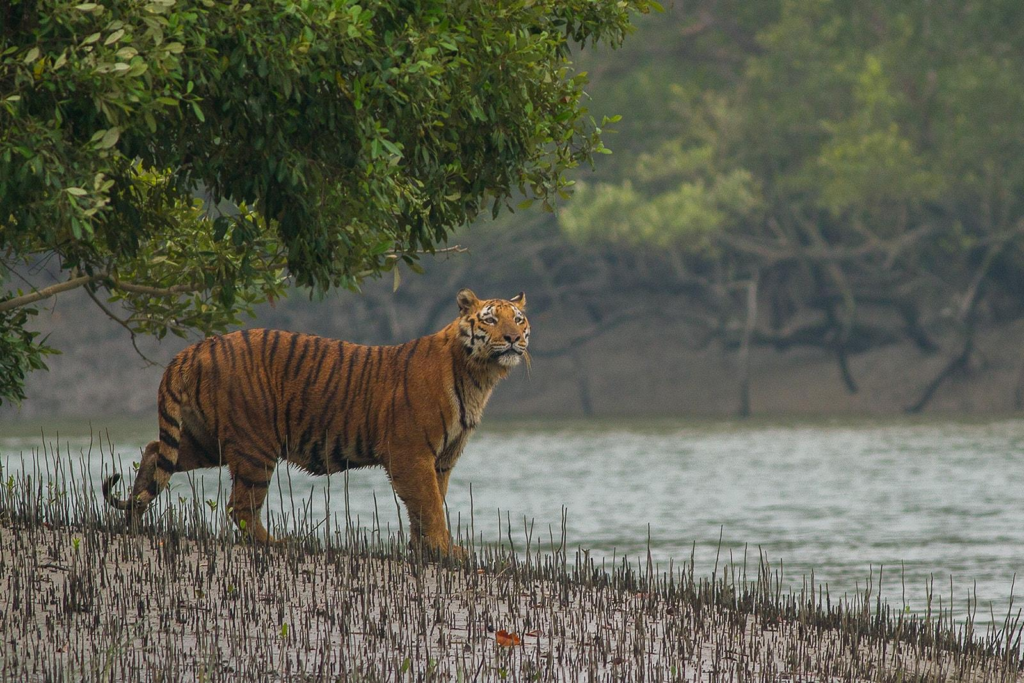
The Royal Bengal Tiger is an obvious attraction.
But a Sundarbans tiger experience is very different from seeing a tiger in an open grassland reserve.
- The vegetation can be dense.
- The waterways can be wide.
- Visibility can be limited.
- A tiger may be nearby without revealing itself.
And there are no honest guarantees.
That uncertainty should not be treated as a weakness.
It is part of genuine wildlife travel.
The objective is not to force an encounter. It is to enter the tiger’s environment, understand its adaptations and remain alert to the possibility of seeing one.
UNESCO identifies the Sundarbans as the world’s largest mangrove forest area and notes the unusual adaptation of its Bengal tigers to a semi-aquatic, tidal environment.
For a naturalist, the tiger story extends beyond the moment of a sighting.
- Tracks can tell a story.
- Alarm behaviour can tell a story.
- Deer movement can tell a story.
- Sudden silence can tell a story.
Sometimes the landscape tells you more than the animal.
What Wildlife Might You See in the Sundarbans?
The tiger may be the headline species, but it should never become the entire purpose of the expedition.
Depending on location, season, tides and luck, a journey may offer opportunities to observe:
- Spotted deer
- Wild boar
- Estuarine crocodiles
- Water monitors
- Kingfishers
- Herons and egrets
- Raptors
- Forest birds
- Macaques
- Aquatic and riverine wildlife
The wider Sundarbans supports remarkable biological diversity across terrestrial and aquatic environments. UNESCO records a wide range of mammals, birds, reptiles and aquatic species across the ecosystem.
For birdwatchers, the waterways and forest edges can be particularly rewarding.
The best approach is not to arrive with a rigid checklist.
Arrive curious.
A Boat Is More Than Transportation
This is perhaps the biggest adjustment for a British traveller accustomed to conventional wildlife reserves.
In the Sundarbans, the boat is not merely how you get from one point to another.
- It becomes your observation platform.
- It carries you through the geography.
- It reveals the relationship between forest and water.
- It allows you to watch changing light and tides.
- It gives you a perspective on how communities live within the delta.
The result is a slower rhythm.
A stretch of river can be interesting even when no large animal appears.
You may watch a kingfisher.
- Then follow a narrow creek.
- Then stop near a forest edge.
- Then continue as the tide changes.
Those quiet periods are not empty time.
They are part of the experience.
When Is the Best Time for British Travelers to Visit the Sundarbans?
See it for yourself
A private journey shaped around you — your group, your pace, your interests. Book a free consultation.
For most travellers, October through mid-March is the main tourism season in the Sundarbans.
This period is particularly attractive for visitors seeking more comfortable conditions for wildlife exploration, photography and boat-based travel.
For British travellers, it can also fit naturally into a wider winter journey through India.
The best timing ultimately depends on the kind of experience you want, but if your priorities are wildlife, photography, birdwatching and extended time outdoors, the main tourism season is the natural starting point.
How Do You Travel to the Sundarbans from the UK?
For British travellers, Kolkata is the practical gateway to the Indian Sundarbans.
A typical journey follows a progression such as: United Kingdom → Kolkata → road journey towards the delta → gateway such as Canning or Godkhali → boat → Sundarbans
West Bengal Tourism identifies Kolkata, Canning and Godkhali among the key access points used for travel into the Sundarbans.
The journey is worth understanding because it is part of what makes the destination distinctive.
You do not simply fly into a wildlife reserve.
You gradually move from one geographical world into another.
The transition from Kolkata’s urban environment to Bengal’s rural delta and finally to the waterways of the Sundarbans is part of the expedition itself.
Should You Combine Kolkata and the Sundarbans?
For most British travellers, yes.
Kolkata and the Sundarbans complement one another.
Kolkata provides the cultural and historical introduction.
The Sundarbans provide the wilderness.
Together, they offer a more complete experience of Bengal.
You can explore Kolkata’s architecture, food, markets, museums and cultural life before travelling south towards the delta.
That creates a natural progression: Kolkata → Bengal → delta → mangrove forest → tidal wilderness
It also gives you a better reason to build a longer India itinerary rather than treating the Sundarbans as a brief excursion.
How Many Days Should You Spend in the Sundarbans?
The Sundarbans rewards time.
A short visit can introduce you to the landscape.
A longer expedition gives you the opportunity to start reading it.
2 Nights / 3 Days — The Minimum
2 nights and 3 days is the minimum we recommend for a meaningful introduction to the Sundarbans.
It gives you time for boat-based exploration, wildlife observation and an initial understanding of the tidal environment without turning the experience into a rushed transfer.
4 Nights / 5 Days — The Ideal Overall Experience
For most British travellers, 4 nights and 5 days provides the ideal overall experience.
It gives the expedition room to breathe.
You have more opportunities to experience different waterways, changing tides, birdlife, photography and wildlife observation.
It also gives you something that a very short itinerary cannot provide:
time for the unexpected.
6–7 Days — For the Deeper Naturalist
If your interests include wildlife photography, birdwatching, ecology, natural history, conservation or simply travelling slowly, consider 6–7 days.
A longer stay changes the relationship you have with the destination.
The Sundarbans starts to feel less like somewhere you are visiting and more like somewhere you are learning to read.
You can visit the Sundarbans in three days. But five days gives you time to experience it. Seven days gives you time to understand it.
For a traveller coming this far from Britain, that extra time can make the difference between seeing the Sundarbans and actually experiencing it.
What Is a Sundarbans Expedition Actually Like?
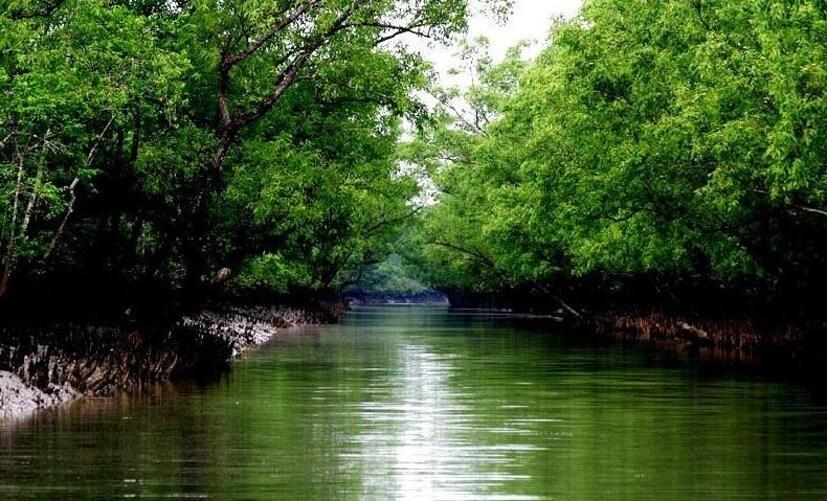
A genuine expedition is not simply a list of attractions.
It has a rhythm.
- Early mornings may bring softer light and increased wildlife activity.
- Boat journeys become periods of observation.
- Tides determine what parts of the landscape are exposed.
- Some hours may be quiet.
- Others may suddenly become unforgettable.
The difference is interpretation.
- Why is a bird using that mudflat?
- Why does the forest edge look like this?
- What does the tide reveal?
- Why are the mangroves structured as they are?
- What does a deer’s behaviour suggest about something moving nearby?
Those questions turn a boat journey into natural history.
Is the Sundarbans Good for Wildlife Photography?
Yes—particularly for photographers who enjoy environmental storytelling rather than only close-up animal portraits.
The Sundarbans offers opportunities to photograph:
- Mangrove textures
- Tidal waterways
- Reflections
- Mudflats
- Birds
- Crocodiles
- Deer
- Boats
- Village life
- Sunrise and sunset landscapes
- Forest silhouettes
- The relationship between people and the delta
- The Bengal tiger, if fortune allows
But wildlife photography here requires a different mindset.
- You may not get the perfect close-up.
- You may have to wait.
- You may have to photograph the habitat rather than the animal.
That is not a limitation. It is part of what makes the photography authentic.
What Should British Travelers Pack for the Sundarbans?
Think expedition rather than city break.
Useful items include:
- Lightweight, breathable clothing
- Comfortable footwear
- Sun protection
- Sunglasses
- Insect repellent
- Reusable water bottle
- Personal medication
- Binoculars
- Camera equipment and spare batteries
- Waterproof protection for electronics
- A light rain layer when appropriate
- Small daypack
Binoculars are particularly valuable.
In the Sundarbans, distance is part of wildlife observation. A good sighting does not have to mean a close sighting.
Is the Sundarbans Suitable for First-Time Visitors to India?
Yes, provided the journey is properly planned.
The Sundarbans is more remote and logistically distinctive than India’s major cities and cultural destinations, so independent travellers may find the transport arrangements more complicated.
With an experienced expedition operator, however, it can become a remarkably rewarding introduction to India’s wilderness.
There is also a useful contrast.
India can be intense, energetic and crowded.
The Sundarbans can be quiet, spacious and deeply observational.
Moving between those two experiences is part of the appeal.
Is the Sundarbans Safe for British Travelers?
The Sundarbans should be treated as a genuine wilderness environment.
There are wild animals, waterways, tides, changing weather and remote areas.
Sensible expedition practices therefore matter.
- Stay with your group.
- Follow your guide’s instructions.
- Do not approach wildlife.
- Do not enter restricted forest areas independently.
- Respect boat and forest regulations.
- Keep personal belongings secure.
- Allow experienced local professionals to manage the practical aspects of the journey.
The most important principle is simple: You are entering wildlife habitat. The landscape does not exist for the visitor.
Responsible Travel in the Sundarbans
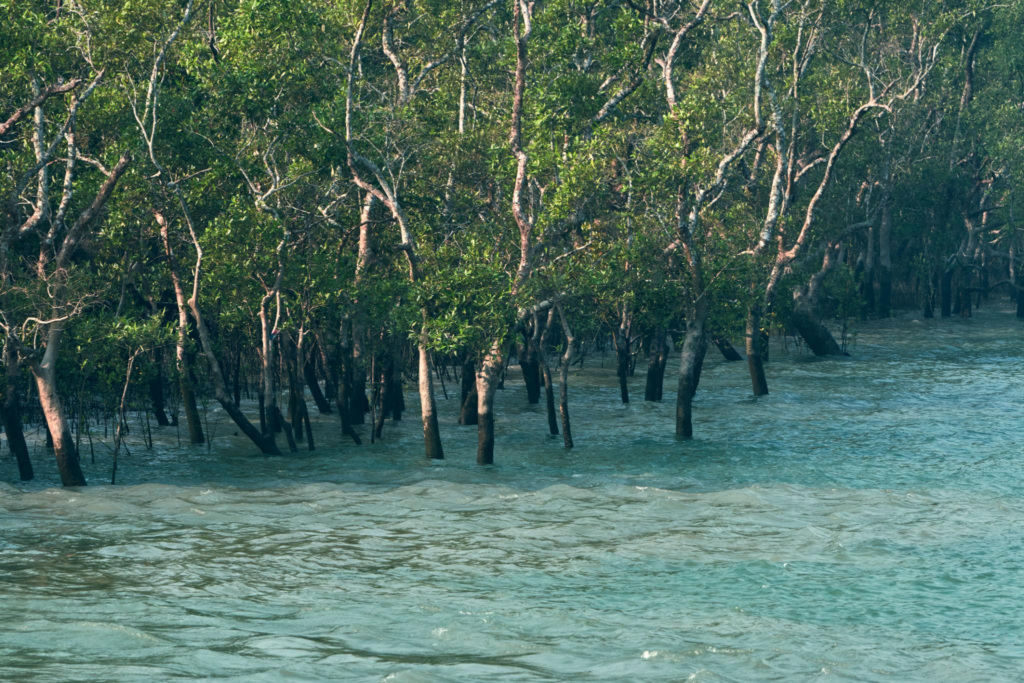
Responsible tourism matters enormously in a landscape where communities and a globally significant ecosystem exist side by side.
The Sundarbans provides important ecological services as well as wildlife habitat. UNESCO highlights its role in shoreline stabilisation, sediment trapping, wetland ecology and protection from storms.
For travellers, responsible behaviour can be straightforward:
- Avoid unnecessary plastic
- Take waste back with you
- Respect local communities
- Never disturb wildlife for photographs
- Follow forest and boat regulations
- Support legitimate local livelihoods
- Avoid purchasing products made from protected wildlife
- Choose responsible operators
- Treat the ecosystem as something to learn from, not consume
The goal should not simply be to leave with photographs.
It should be to leave with a better understanding of why the landscape matters.
Visa Planning for British Travelers
British citizens travelling to India generally need a valid visa unless they qualify for an exemption such as holding an Overseas Citizen of India (OCI) card.
Current UK government guidance states that British citizen passport holders should have a passport valid for at least six months after arrival in India and at least two blank pages. British travellers must also have the appropriate visa unless exempt, and foreign nationals arriving in India must complete the e-arrival card online before reaching immigration.
India’s official visa portal confirms that foreign nationals entering India generally require a valid passport and an Indian visa or eligible eVisa, subject to applicable exemptions. It also states that the e-arrival card is an arrival-information requirement and is not a substitute for a visa.
Visa rules can change, so always check the latest requirements through the official Indian visa system and current UK government travel advice before departure.
Why Explore the Sundarbans with The Wild Orbit?
The Wild Orbit approaches the Sundarbans as an expedition rather than a checklist.
The question is not simply: “Did you see the tiger?”
It is: “What did you understand about the place?”
The difference matters.
A meaningful Sundarbans journey should reveal the relationship between tiger and mangrove, tide and forest, river and island, wildlife and local communities.
That takes time.
- It requires patience.
- It requires local understanding.
- It requires a willingness to accept that nature does not operate according to an itinerary.
For British travellers with an interest in natural history, photography, wildlife and responsible exploration, that philosophy can make the journey particularly rewarding.
- You may arrive hoping to see a tiger.
- You may leave remembering the tide.
- You may arrive looking for wildlife.
- You may leave understanding the forest.
That is the kind of expedition The Wild Orbit is built to create.
The Sundarbans Is Not a Safari You Already Know
The great wildlife destinations of the world do not need to compete.
- The African plains are extraordinary.
- The Amazon is extraordinary.
- The Galápagos is extraordinary.
- The Sundarbans is extraordinary for a different reason.
Here, the landscape refuses to stay still.
- The tide redraws the edges of the forest.
- The rivers become roads.
- The mangroves become shelter.
- The tiger becomes an animal shaped by water.
- The visitor becomes an observer.
That is why the Sundarbans deserve a different kind of journey.
Not a rushed stop between major Indian cities.
Not simply a three-day wildlife tick on an itinerary.
But enough time to watch.
Listen.
Learn.
And understand.
Why the Sundarbans Deserves a Place on a British Traveller’s India Itinerary
For British travellers, the Sundarbans offers an unusually layered journey.
- There is the natural history.
- There is Bengal’s cultural richness.
- There is the history surrounding Canning.
- There is the unusual story of Daniel Hamilton and Gosaba.
- There is the Bengal tiger.
- There is birdlife.
- There is photography.
- There is the geography of one of the world’s great deltas.
- There is the increasingly important question of conservation.
Few destinations bring all of these dimensions together so naturally.
You can begin in Kolkata surrounded by one of India’s great urban cultures.
- Travel south through Bengal.
- Reach the waterways.
- Board a boat.
- Watch the roads disappear.
And gradually enter a landscape where the rhythm of the tide becomes more important than the rhythm of the road.
That transition is not merely the way to reach the destination.
It is part of the destination.
FAQs
Is the Sundarbans worth visiting from the UK?
Yes, particularly for travellers interested in wildlife, natural history, photography, conservation and unusual landscapes. The Sundarbans offers a fundamentally different experience from India’s more conventional wildlife parks and from the classic African safari.
How do British travellers get to the Sundarbans?
Most international visitors begin in Kolkata. From Kolkata, the journey continues by road towards gateways such as Canning or Godkhali before continuing into the Sundarbans by boat.
Can British travellers see Bengal tigers in the Sundarbans?
A tiger sighting is possible but never guaranteed. The Bengal tiger lives in dense mangrove habitat where visibility can be challenging. A responsible expedition should therefore focus on the ecosystem rather than promise an animal encounter.
Is the Sundarbans a conventional safari?
No. It is primarily a boat-based wilderness experience through tidal waterways, mangrove forests, islands, wetlands and forest edges.
How many days should I spend in the Sundarbans?
2 nights and 3 days is the minimum. 4 nights and 5 days provide the ideal overall experience. Travellers with a strong interest in photography, birdwatching, ecology or natural history should consider 6–7 days.
Can I combine Kolkata and the Sundarbans?
Yes. Kolkata makes an excellent cultural and geographical introduction before travelling south into the delta.
Is the Sundarbans good for birdwatching?
Yes. Its waterways, wetlands, mudflats and forest environments support diverse birdlife, making it rewarding for travellers who enjoy bird observation as well as larger wildlife.
Is the Sundarbans good for photography?
Yes. The landscape provides opportunities for wildlife, bird, river, mangrove, cultural and environmental photography. The challenge is often patience rather than access.
When is the best time to visit the Sundarbans?
October through mid-March is generally regarded as the main tourism season and is a popular period for wildlife-focused travel.
What is the connection between Canning and Lord Canning?
Canning takes its name from Lord Canning, who served as Governor-General of India and later as the first Viceroy. The town forms part of the historical geography of the route towards the Sundarbans.
Who was Daniel Hamilton?
Sir Daniel Hamilton was a Scottish businessman associated with Gosaba and the surrounding islands. From the early twentieth century, he developed a distinctive experiment in cooperative rural development involving agriculture, education, finance and local infrastructure.
Is the Sundarbans suitable for first-time visitors to India?
Yes, provided the wilderness portion is properly organised. It is more remote and logistically distinctive than a conventional city or cultural destination, so professional planning is valuable.
Is the Sundarbans safe?
It is a genuine wilderness environment and should be treated accordingly. Travellers should follow their guides, boat instructions, forest regulations and wildlife-safety practices throughout the expedition.
Give the Sundarbans Time to Reveal Itself
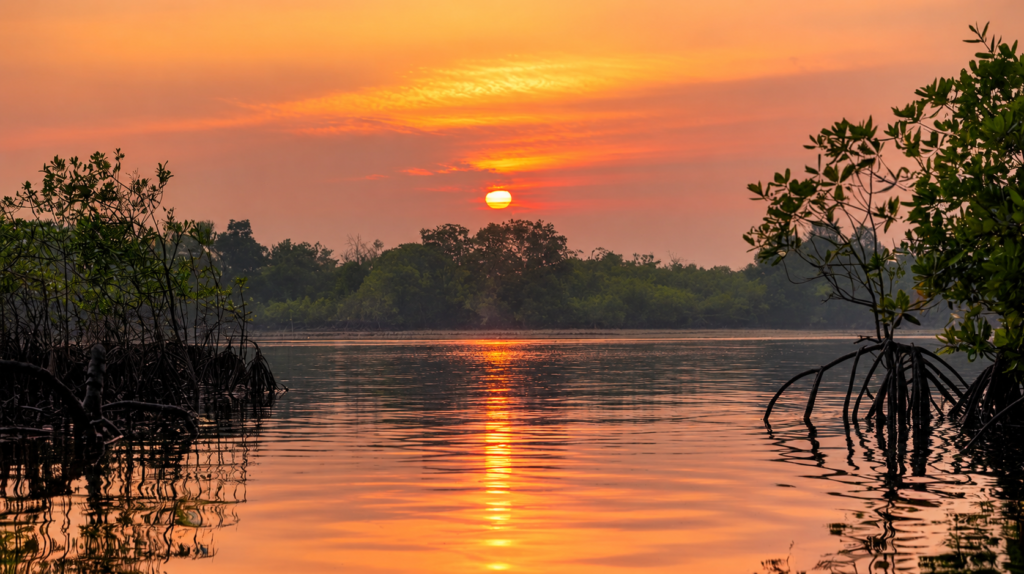
There is a temptation in modern travel to measure a destination by how much you can fit into an itinerary.
The Sundarbans resists that approach.
It rewards the traveller who stays a little longer.
The first day may simply introduce you to the waterways.
The next may reveal the rhythm of the tides.
Another morning may bring birds, deer, crocodiles or the fleeting possibility of a tiger.
And somewhere between those moments, the forest begins to make sense.
You start to understand why the mangroves grow where they do.
- Why the waterways matter.
- Why the tiger is so different here.
- Why communities have shaped and been shaped by the delta.
- Why conservation cannot be separated from the future of the landscape.
You can visit the Sundarbans in three days. But five days gives you time to experience it. Seven days gives you time to understand it.
For a British traveller looking for more than another wildlife checklist, that may be the most important reason to go.
Plan your private Sundarban expedition
A private journey shaped around you — your group, your pace, your interests. Book a free consultation.