

 Travel guide
Some journeys are remembered for the places they take you.
Others stay with you because of the way a landscape changes how you see the world.
The Sundarbans belongs to the second kind.
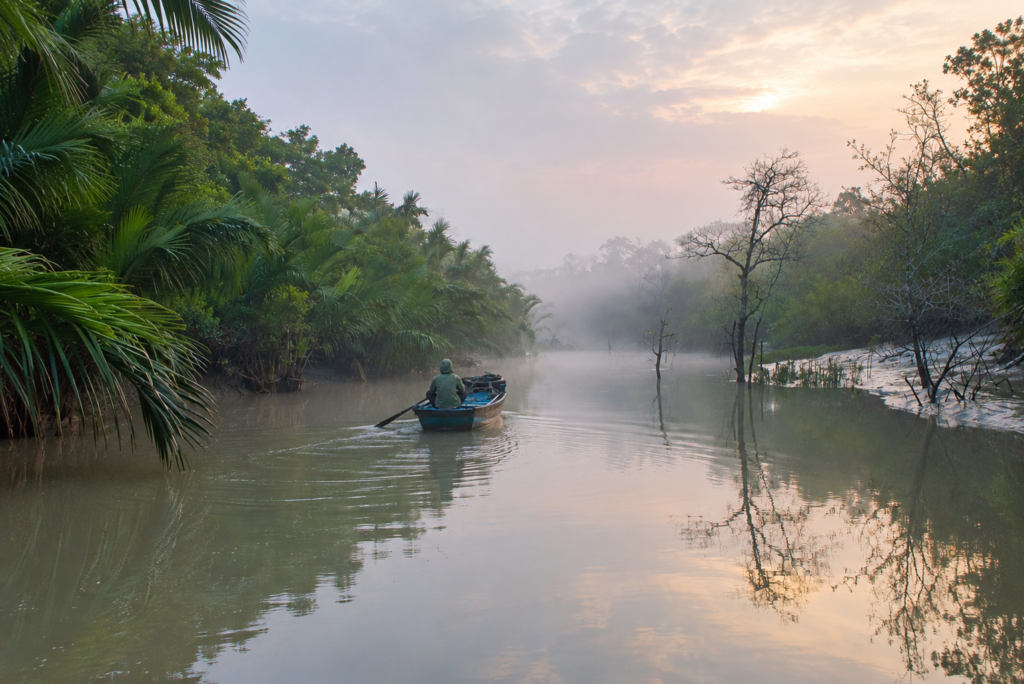
In southern West Bengal, rivers, tidal creeks, islands and mangrove forests form one of the world’s most distinctive natural landscapes. At the edge of the Bay of Bengal, land and water are constantly reshaped by the tide. Wildlife lives within this changing environment rather than apart from it.
This is where the Royal Bengal Tiger moves through mangrove forests.
- Where boats become pathways into the wilderness.
- Where villages exist alongside powerful rivers.
- Where a landscape can look completely different within the same day.
For French travelers looking beyond conventional sightseeing, the Sundarbans offers a journey where landscape, wildlife, culture and story come together.
It is not simply a destination to see.
It is a place to experience.
The Sundarbans Among the World’s Great Wildlife Destinations
When people imagine the world’s great wildlife journeys, certain landscapes immediately come to mind.
Africa evokes the classic safari: vast horizons, grasslands and iconic large mammals moving across open country.
The Amazon represents immense tropical rainforest, extraordinary biodiversity and a world where life exists across countless layers of the forest.
The Galápagos offers something entirely different: isolated islands, remarkable species and an evolutionary story unlike almost anywhere else.
And then there is the Sundarbans.
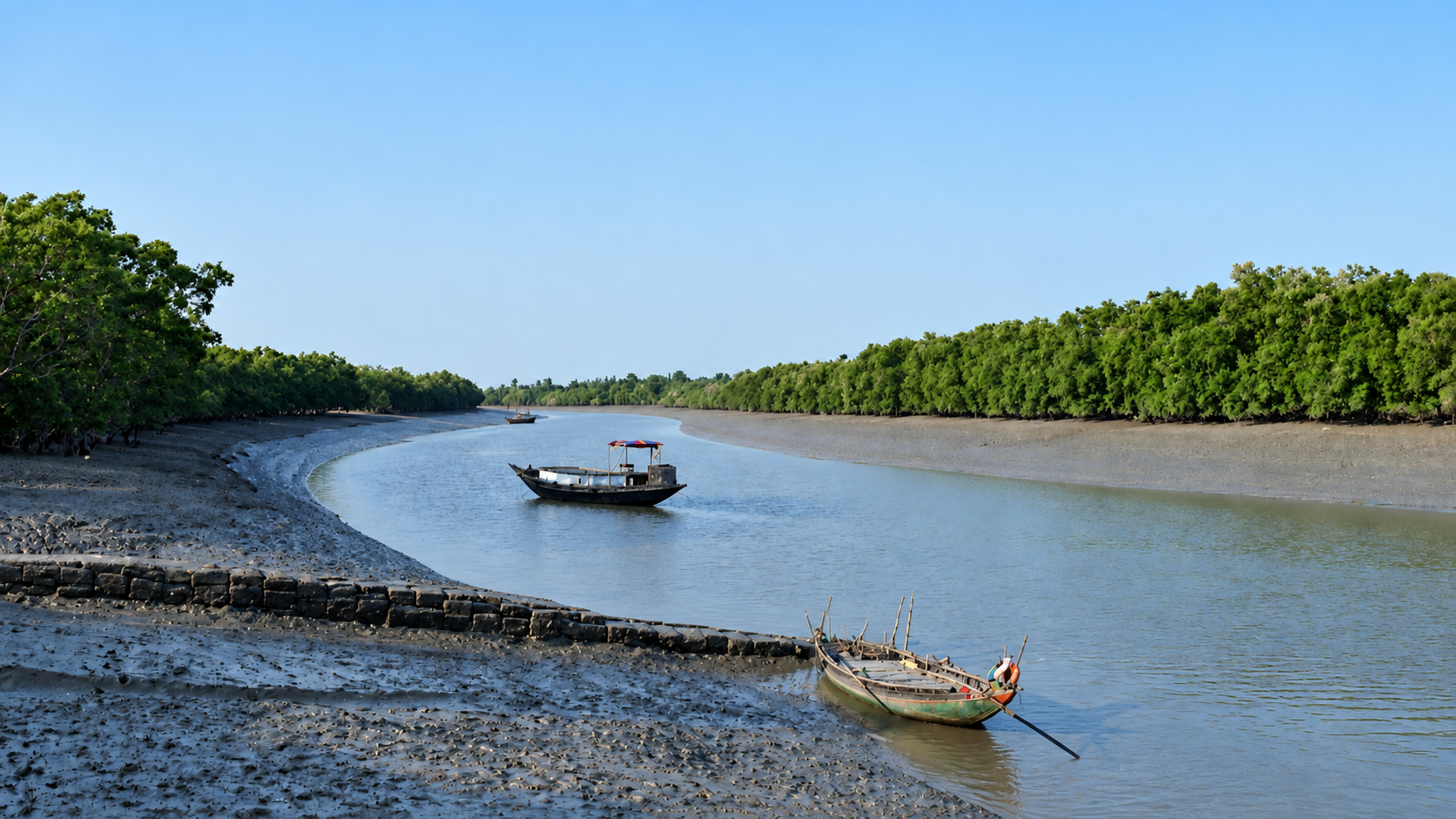
Its wilderness is defined by tidal waterways, mangrove forests, shifting mudflats, islands and the extraordinary Bengal tiger.
The Sundarbans does not need to compete with these destinations by trying to resemble them.
It offers another definition of what a great wildlife destination can be.
African Safari: Wilderness on the Open Horizon
The classic African safari often gives wildlife a dramatic sense of scale.
Open plains allow animals to be observed across enormous distances, with the landscape itself becoming part of the spectacle.
The Sundarbans reverses that experience.
Here, dense mangroves and waterways can limit visibility. The landscape feels more enclosed, intricate and unpredictable.
You do not simply cross the wilderness looking for animals.
You enter the wilderness through the water.
Amazon: Wilderness at Immense Scale
The Amazon overwhelms through the sheer scale and complexity of the tropical rainforest.
The Sundarbans also contain remarkable ecological complexity, but its defining force is different.
Here, the rhythm of the ecosystem is inseparable from the tides.
- Water moves between islands.
- Mudflats emerge and disappear.
- Creeks fill and empty.
Mangroves survive within a demanding environment shaped by freshwater, seawater, sediment and constant tidal movement.
The result is a wilderness whose character is shaped as much by water as by forest.
Galápagos: Islands Written by Nature
The Galápagos is renowned for isolated island ecosystems and the evolutionary stories expressed through its wildlife.
The Sundarbans is also an island world—but one continually reshaped by rivers, tides and sediment.
Its islands are not static backdrops.
They belong to a dynamic delta.
The landscape itself is constantly being rewritten.
Sundarbans: Wilderness Shaped by Tides
This is where the Sundarbans becomes truly distinctive.
Its defining experience is not simply a particular animal or spectacular viewpoint.
It is the relationship between: water + mangrove + tide + island + wildlife + people
The Royal Bengal Tiger is perhaps the most famous inhabitant of this environment.
But the tiger is part of a much larger ecological story.
- Mangroves provide habitat.
- Waterways influence movement.
- Mudflats create feeding grounds.
- Tides continually reshape the available landscape.
And communities live within the wider delta.
That is why the Sundarbans deserves its place among the world’s great wildlife destinations.
It is not an inferior alternative to an African safari, the Amazon or the Galápagos. It is a fundamentally different wilderness experience.
For travelers who appreciate nature as something to be experienced rather than simply consumed, that difference is precisely the attraction.
A Landscape First, a Wildlife Destination Second
The easiest way to misunderstand the Sundarbans is to think of it only as a place to find a tiger.
The tiger is extraordinary.
But the landscape is what makes the tiger story possible.
The Sundarbans is a vast tidal mangrove ecosystem where rivers and creeks pass between forested islands.
- Mudflats emerge as water retreats.
- Mangrove roots create shelter and habitat.
- Birds move between waterways and forest edges.
- Crocodiles rest beside channels.
- Deer feed near the forest.
And the tiger moves through an environment that demands extraordinary adaptation.
This is why the Sundarbans works so well as a landscape experience.
You are constantly observing relationships:
Forest and water.
Wildlife and habitat.
Human settlements and rivers.
Tides and islands.
Nature and survival.
The wildlife does not exist separately from the scenery.
The wildlife is part of the landscape.
The Beauty of a Moving Landscape
Some landscapes remain almost unchanged throughout a day.
The Sundarbans does not.
- A river can look completely different at high tide and low tide.
- A mudflat can appear where there was only water earlier.
- The colour of the landscape changes with the light.
- Mangrove silhouettes become sharper in the early morning and softer later in the day.
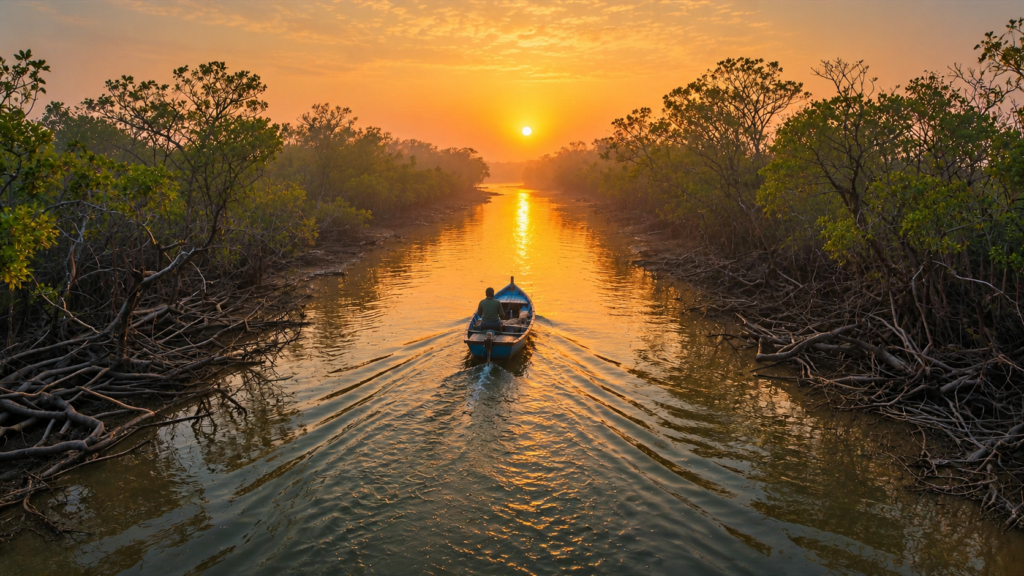
- Boats move through channels that can seem almost hidden within the forest.
This constant transformation gives the Sundarbans its distinctive visual character.
For photographers and landscape lovers, the possibilities come from a simple combination of elements: water, forest, sky, mud and light.
The attraction is not perfection.
It is movement.
Bengal: Where Landscape and Culture Meet
The Sundarbans does not exist separately from human life.
The wider delta is home to communities whose lives are connected in different ways to rivers, agriculture, fishing, boats and the changing environment.
Villages, waterways and forests form part of a larger cultural landscape.
This makes a journey through the Sundarbans more than a wildlife excursion.
You are travelling through Bengal.
Food, boats, village life, local stories and the rhythms of river communities all contribute to the experience.
For travelers interested in culture as well as nature, this creates an important distinction from a conventional wildlife itinerary.
The wilderness does not suddenly begin when you enter the forest.
The journey toward it is already part of the story.
The Royal Bengal Tiger: An Icon of a Tidal Wilderness
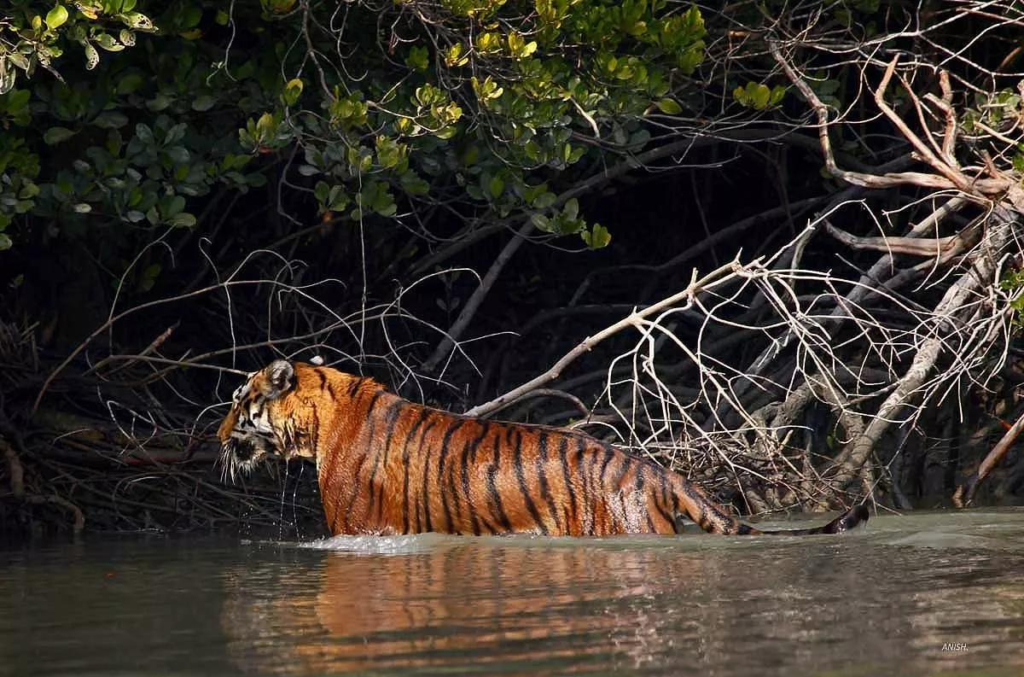
The Royal Bengal Tiger is the animal most closely associated with the Sundarbans.
But its significance becomes greater when you understand the environment in which it lives.
The Sundarbans tiger inhabits a mangrove landscape of islands, tidal channels and dense vegetation.
This is very different from the open grasslands often associated with classic wildlife viewing.
- Visibility can be difficult.
- A tiger may remain hidden.
- It may move along a distant bank.
- It may appear for only a few seconds.
There is no guarantee that the animal will reveal itself.
And that uncertainty matters.
A wild tiger should never be expected to behave according to a visitor’s itinerary.
A sighting becomes more meaningful when it is treated as a privilege rather than an expectation.
If the tiger appears, the moment can be extraordinary.
If it does not, the expedition still contains an entire ecosystem to discover.
Wildlife Beyond the Tiger
A richer understanding of the Sundarbans begins when you look beyond its most famous predator.
The ecosystem supports wildlife including:
- Spotted deer
- Wild boar
- Estuarine crocodiles
- Rhesus macaques
- King cobras and other reptiles
- Kingfishers
- Herons
- Egrets
- Raptors
- Water-associated birds
- Other terrestrial and aquatic species
Birdwatching can add another dimension to the journey.
- A morning on the water may produce a series of smaller encounters.
- A bird crossing the channel.
- A crocodile disappearing beneath the surface.
- Deer watching from the forest edge.
- A raptor circling above the canopy.
These moments become part of a larger composition.
The wildlife is not separate from the landscape.
It is one of the ways the landscape tells its story.
The Boat: Your Passage Into the Wilderness
In many wildlife destinations, the vehicle takes you through the landscape.
In the Sundarbans, the boat is part of the experience itself.
- You travel through rivers and tidal creeks.
- You pass between islands.
- You observe the forest from the water.
- You stop at appropriate locations for wildlife observation and exploration.
The boat also changes your relationship with distance.
- A wide river can make the wilderness feel immense.
- A narrow creek can make the mangroves feel close.
- A distant shoreline may suddenly become the focus of everyone’s attention.
And sometimes the best thing to do is simply stop moving.
Let the river flow.
Let the forest remain quiet.
Watch.
Dawn on the River
- There is a particular beauty to the Sundarbans early in the day.
- The waterways begin to catch the first light.
- The mangroves emerge from the morning haze.
- Bird activity increases.
- The surface of the river changes colour.
- The landscape seems to sit briefly between night and day.
Dawn can also provide excellent conditions for photography and wildlife observation.
But its value goes beyond either.
It gives you time to experience the Sundarbans before the day becomes busy.
For travelers drawn to landscape and atmosphere, an early morning on the river can become one of the defining memories of the expedition.
When Should French Travelers Visit the Sundarbans?
See it for yourself
A private journey shaped around you — your group, your pace, your interests. Book a free consultation.
The main tourism season in the Sundarbans generally runs from October through mid-March.
This is the strongest overall period to consider for comfortable exploration.
October and November bring the landscape into a changing post-monsoon phase.
December through February are popular months for wildlife-focused travel, with cooler conditions generally making extended time outdoors more comfortable.
March begins the transition toward warmer weather.
Summer travel continues, but heat and humidity become more demanding.
For French travelers planning their first Sundarbans expedition, October through mid-March is the strongest overall window to consider.
How to Travel to the Sundarbans From France
For most French travelers, the international journey begins with reaching Kolkata, the major gateway for exploring the Indian Sundarbans.
From Kolkata, the journey continues through southern West Bengal toward a Sundarbans gateway before moving onto the waterways.
The broad progression is: France → Kolkata → Bengal → Delta → Sundarbans
That transition matters.
You do not simply arrive at a wildlife park.
You gradually move from a major Indian city into rural Bengal and then into a landscape dominated by water.
Eventually, the road gives way to the boat.
And the character of the journey changes.
Why Kolkata Belongs in the Journey
Kolkata adds another layer to the Sundarbans experience.
The city introduces travelers to Bengal’s history, architecture, food, literature, art and everyday life before they enter the delta.
For travelers interested in culture, this makes Kolkata more than an airport connection.
Spend time in the city.
Experience Bengal.
Then travel south.
As the urban landscape fades, the delta becomes increasingly visible.
Villages appear.
Rivers become wider.
Waterways become more important.
Eventually, the mangroves take over.
The journey becomes a transition from: Culture → Landscape → Wilderness
How Many Days Should You Spend in the Sundarbans?
The Sundarbans can be visited quickly.
But experiencing it properly requires giving the destination enough time.
Minimum: 2 Nights / 3 Days
Two nights and three days provide a practical introduction.
You can enter the region, travel through waterways and experience the fundamental rhythm of a Sundarbans expedition.
It works well for travelers with limited time.
Ideal: 4 Nights / 5 Days
For travelers making the journey from France, four nights and five days offer a stronger balance.
The additional time creates more opportunities for wildlife observation, photography, changing tides and different waterways.
It also means the trip does not depend on a single short wildlife outing.
You have time to slow down.
Deeper Exploration: 6–7 Days
Six to seven days allow a more immersive experience.
There is greater opportunity for photography, birdwatching, ecological exploration, landscape observation and experiencing different parts of the waterways.
The objective changes from simply visiting to understanding.
You can visit the Sundarbans in three days. But five days gives you time to experience it. Seven days gives you time to understand it.
The Sundarbans as an Expedition
An expedition is different from a conventional tour.
It leaves room for uncertainty.
- Weather can change.
- Tides can influence the journey.
- Wildlife may remain hidden.
- A planned sighting may never happen.
- Another unexpected encounter may become the highlight of the day.
That uncertainty is part of authentic wilderness travel.
At The Wild Orbit, we approach the Sundarbans with this philosophy. The objective is not to manufacture an experience. It is to create the conditions in which travelers can experience the real one.
Photography in the Sundarbans
The Sundarbans offers far more than traditional wildlife photography.
Its greatest photographic strength may be the relationship between subject and environment.
Consider photographing:
- A boat crossing a wide tidal river
- Mangrove roots reflected in water
- Morning mist over the channels
- Birds against open sky
- Spotted deer near the forest edge
- Estuarine crocodiles beside a creek
- Local boats and waterways
- Villages along the delta
- Changing light across the mangroves
- Mudflats exposed by the retreating tide
- A distant tiger within its habitat
A powerful Sundarbans photograph does not always need to show an animal clearly.
Sometimes the landscape tells the stronger story.
What Should French Travelers Pack?
The Sundarbans is tropical, humid and water-oriented.
Practical preparation therefore matters more than elaborate packing.
Consider bringing:
- Lightweight, breathable clothing
- Comfortable footwear
- Hat
- Sunglasses
- Sun protection
- Insect protection
- Reusable water bottle
- Binoculars
- Camera equipment
- Spare batteries or charging equipment
- Power bank
- Waterproof protection for electronics
- Light rain protection
- Small day bag
- Personal medication and essentials
Neutral and comfortable clothing is practical for wildlife observation.
Binoculars can be particularly useful because many encounters happen at a distance.
Visiting India for the First Time
For French travelers visiting India for the first time, Kolkata can feel intense.
The traffic, population density, sounds, food, climate and pace can be very different from everyday life in France.
- Give yourself time to adjust.
- Keep your itinerary realistic.
- Allow extra travel time.
- Stay flexible.
And remember that India is not one single travel experience.
Kolkata is different from rural Bengal.
Rural Bengal is different from the Sundarbans.
The transition between them is part of the journey.
Safety in the Sundarbans
The Sundarbans is a genuine wilderness environment.
Wild animals should never be approached independently.
- Always follow the instructions of trained guides, boat crews and local authorities.
- Stay within designated areas.
- Do not feed wildlife.
- Do not attempt to attract animals for photographs.
- Avoid unnecessary noise.
- Follow boat-safety instructions.
- Respect restricted areas and forest regulations.
Responsible travel does not mean removing the wild character of the destination.
It means entering that environment with respect.
Responsible Travel in the Sundarbans
The Sundarbans is both a globally significant ecosystem and a lived landscape.
People across the wider delta depend on their environment in many ways.
Tourism should therefore contribute positively rather than treating the region simply as a backdrop.
- Choose responsible operators.
- Respect local communities.
- Reduce unnecessary plastic.
- Follow conservation regulations.
- Avoid disturbing wildlife.
- Respect local customs and privacy.
And remember that every photograph, boat journey and wildlife encounter takes place within a living ecosystem.
The best expedition is one that increases your understanding of the destination.
Visa and Entry Planning for French Travelers
French passport holders should check the latest Indian visa and entry requirements before travelling.
Depending on current eligibility and circumstances, applicable tourist visa or eVisa arrangements may be available.
Passport validity and entry requirements should be confirmed before departure because immigration procedures can change.
Complete these arrangements early so that the practical side of the journey does not distract from the experience itself.
Why Explore the Sundarbans With The Wild Orbit?
The Wild Orbit was created around a simple idea: Think Wild. Live Wild. Go Wild.
For us, the Sundarbans is not simply a destination to sell.
It is a landscape worth understanding.
That means looking beyond the tiger.
- Understanding the mangroves.
- Reading the tides.
- Watching birds.
- Following the waterways.
- Listening to local stories.
- Observing the relationship between communities and the delta.
- Recognising why conservation matters.
Our expeditions bring together exploration, storytelling, ecological understanding and responsible travel.
Because the more you understand a place, the more meaningful the journey becomes.
The Sundarbans Has Its Own Definition of Extraordinary
The world’s great wildlife destinations do not need to resemble one another.
Africa offers open horizons and iconic large mammals.
The Amazon offers immense rainforest and extraordinary biological complexity.
The Galápagos offers isolated islands and evolutionary history.
The Sundarbans offers something else entirely.
It offers a wilderness where water determines the landscape and the landscape shapes survival.
The Royal Bengal Tiger moves through mangroves.
- Deer feed near tidal edges.
- Crocodiles wait beside waterways.
- Birds follow changing feeding opportunities.
- Mangrove roots hold the boundary between land and water.
And the tide continually reshapes the environment.
The extraordinary thing is not simply the tiger.
It is the entire system.
That is what places the Sundarbans firmly among the world’s great wildlife destinations.
Why the Sundarbans Deserves a Place on a French Itinerary
India can offer extraordinary contrasts to a French traveler.
- Architecture and wilderness.
- Cities and villages.
- Cuisine and landscape.
- History and living culture.
The Sundarbans adds another dimension.
It takes you away from the familiar idea of a wildlife reserve and into a place where the boundaries between river, forest and human life are constantly shifting.
It is an experience for travelers who want more than a checklist.
More than a photograph.
More than a conventional safari.
- Explore the mangroves.
- Observe wildlife.
- Experience Bengal.
- Travel by boat.
- Watch the tides.
And discover a landscape whose character changes from hour to hour.
The Sundarbans is not trying to become another Amazon.
It is not another African safari.
It is not another Galápagos.
It is the Sundarbans.
And that is exactly why it deserves the journey.
FAQs
Is the Sundarbans worth visiting for French travelers?
Yes. The Sundarbans combines wildlife, landscape, culture and ecological exploration in a way that is very different from conventional wildlife destinations.
What is the best time to visit the Sundarbans?
The main tourism season generally runs from October through mid-March. This is the strongest overall period for a comfortable first visit.
How many days should I spend in the Sundarbans?
Two nights and three days is a practical minimum. Four nights and five days provides more time for wildlife observation and exploration, while six to seven days allows a deeper experience.
Can I see a Royal Bengal Tiger?
Tiger sightings are possible but never guaranteed. The Sundarbans is a genuine wild environment, and wildlife behaviour cannot be predicted.
Is the Sundarbans only a tiger destination?
No. Tigers are an important part of its identity, but the ecosystem also supports deer, wild boar, crocodiles, monkeys, reptiles and diverse birdlife.
Is the Sundarbans good for photography?
Yes. The combination of wildlife, mangroves, waterways, boats, villages and changing natural light makes it particularly attractive for landscape and wildlife photography.
How do French travelers reach the Sundarbans?
Most international travelers first reach Kolkata and then continue by road toward a Sundarbans gateway before transferring to boats.
Should I visit Kolkata before the Sundarbans?
Including Kolkata can make the journey more meaningful by introducing you to Bengal’s culture, history, food and urban landscape before you enter the delta.
Is the Sundarbans suitable for a first trip to India?
Yes, with thoughtful planning. Allow time to adjust to India’s climate and urban pace, and keep the journey between Kolkata and the Sundarbans realistic.
Does a longer stay guarantee a tiger sighting?
No. More time provides more opportunities for observation, but wildlife remains unpredictable. The value of a longer stay is the deeper experience of the ecosystem itself.
Let the Landscape Tell the Story
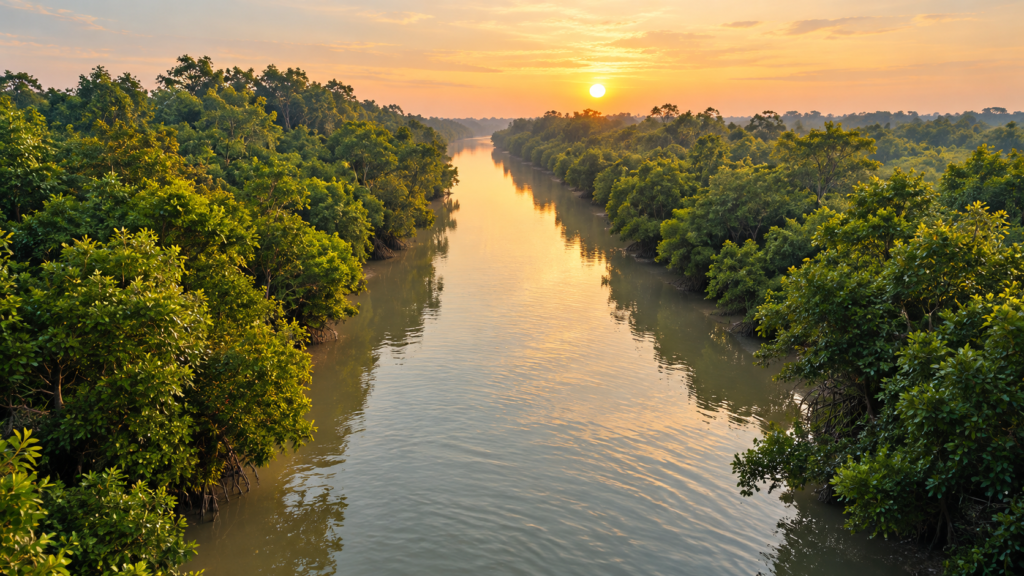
The Sundarbans does not reveal itself all at once.
First, there is the river.
- Then the islands.
- Then the mangroves.
- Then the birds.
- Then the changing light.
- Then the signs of wildlife.
And perhaps, somewhere along the shoreline, the movement of a tiger.
But the tiger is only one part of the story.
The deeper experience is understanding how everything connects.
- Water shapes the forest.
- The forest provides habitat.
- The tide shapes the waterways.
- Wildlife adapts.
- Communities live alongside the delta.
And travelers enter this world for a short time as observers.
That is the beauty of the Sundarbans.
It is not simply a place to visit. It is a landscape to experience, a wilderness to understand and a story to carry home.
You can visit the Sundarbans in three days. But five days gives you time to experience it. Seven days gives you time to understand it.
Plan your private Sundarban expedition
A private journey shaped around you — your group, your pace, your interests. Book a free consultation.