 Encyclopedia
As the tide begins to recede, the southern horizon of the Indian Sundarbans slowly reveals a landscape in constant negotiation with the sea. Broad mudflats emerge from opaque brown estuarine water, mangrove roots rise from the saturated sediment, and flocks of wading birds spread across freshly exposed tidal flats in search of food. Here, where the northern Bay of Bengal meets one of the world’s most dynamic deltas, lies Dhanchi—a protected forest island whose story is written not by permanent land, but by tides, sediment, storms, and time.
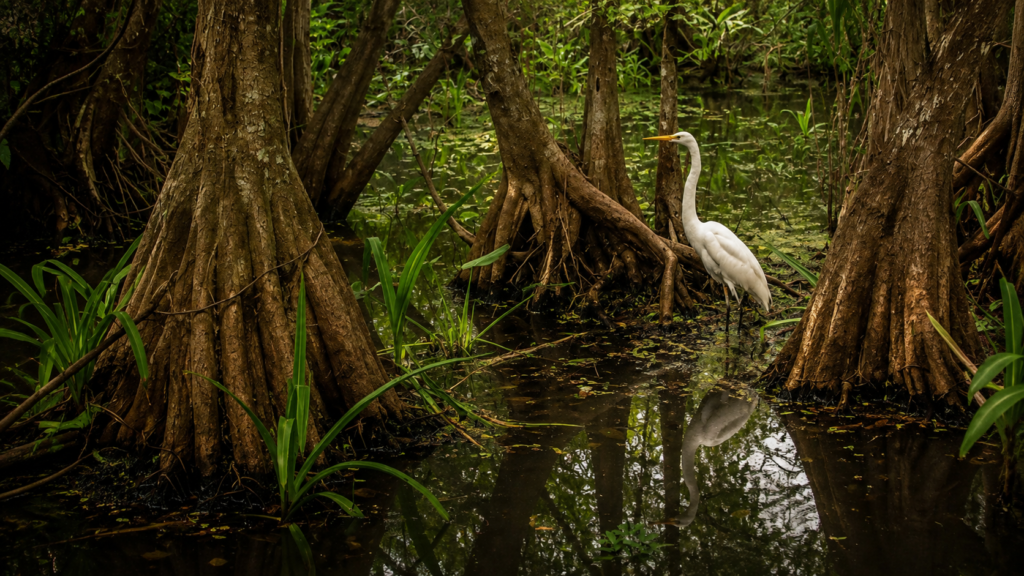
Unlike many well-known destinations within the Sundarbans Tiger Reserve, Dhanchi has remained relatively unfamiliar outside scientific and forest management circles. Yet recent research has brought renewed attention to the island because it represents one of the clearest examples of how coastal erosion, sea-level processes, and mangrove ecology interact within the Indian Sundarbans. Studies comparing historical satellite imagery have documented measurable shoreline retreat along Dhanchi’s southern margin, illustrating how even protected mangrove forests remain vulnerable to the powerful forces shaping the Bay of Bengal.
Dhanchi is not an inhabited island. It forms part of the protected reserve forest administered within the Sundarban Tiger Reserve, where ecological processes take precedence over human settlement. The island’s mangrove forests provide habitat for estuarine wildlife, stabilize tidal sediments, support nutrient cycling, and contribute to the wider ecological integrity of the UNESCO-recognized Sundarbans ecosystem.
Understanding Dhanchi therefore requires looking beyond maps. It is an island that demonstrates how coastlines evolve, how mangroves respond to environmental change, and how the Indian Sundarbans continue to reshape themselves under the combined influence of rivers, tides, cyclones, and the sea.
Dhanchi at a Glance
Type: Protected mangrove forest island
Administrative Region: Sundarban Tiger Reserve, South 24 Parganas, West Bengal
Country: India
Ecosystem: Tidal mangrove forest
Protection Status: Reserve Forest within the Sundarban Tiger Reserve
Human Settlement: None
Primary Landscape: Mangrove forest, tidal creeks, mudflats, and estuarine shoreline
Ecological Importance: Mangrove biodiversity, shoreline protection, and wildlife habitat
Major Environmental Concern: Southern shoreline erosion and coastal retreat
Access: Restricted. Entry is permitted only with Forest Department permission and an authorized guide. Dhanchi Forest Camp is among the regulated destinations that require permits.
How to Reach Dhanchi
Reaching Dhanchi is a journey through the waterways of the Indian Sundarbans. As a protected forest island within the Sundarbans Tiger Reserve, it is not directly accessible by road. The final approach is always by a registered boat operating under Forest Department regulations, and independent entry into the reserve is not permitted.
From Kolkata
Most journeys begin in Kolkata, the nearest major gateway to the Sundarbans.
- By Air: Fly into Netaji Subhas Chandra Bose International Airport, then continue by road to a designated embarkation point such as Godkhali, Sonakhali, or Dhamakhali before boarding a registered boat.
- By Train: Take a local train from Sealdah South to Canning, the nearest railway station. From Canning, shared vehicles connect travellers to Godkhali Jetty, one of the principal boarding points for the Sundarban Tiger Reserve.
- By Road: Buses and private vehicles from Kolkata reach embarkation points including Godkhali, Sonakhali, Canning, Dhamakhali, Raidighi, and Namkhana, all of which provide access to the Sundarbans’ river network.
By Boat into the Tiger Reserve
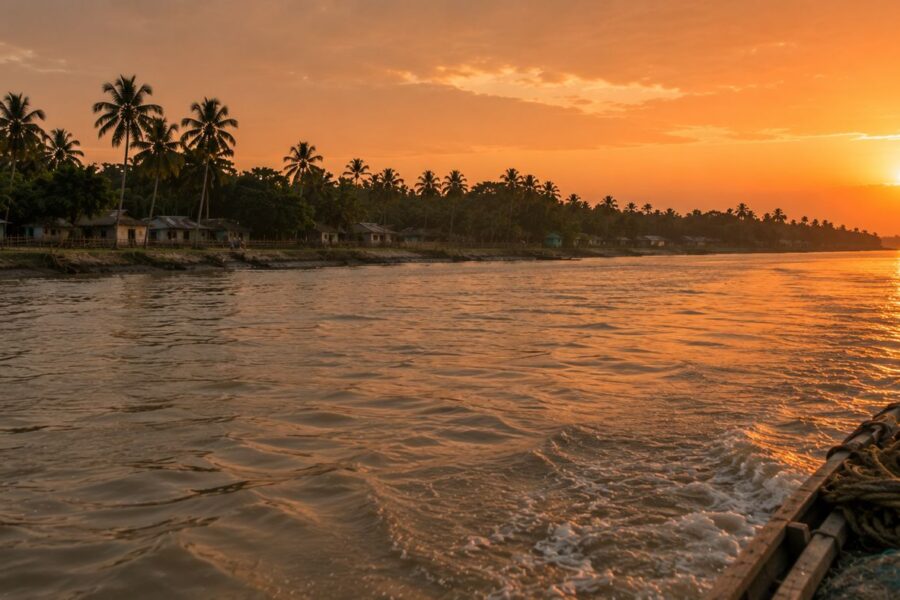
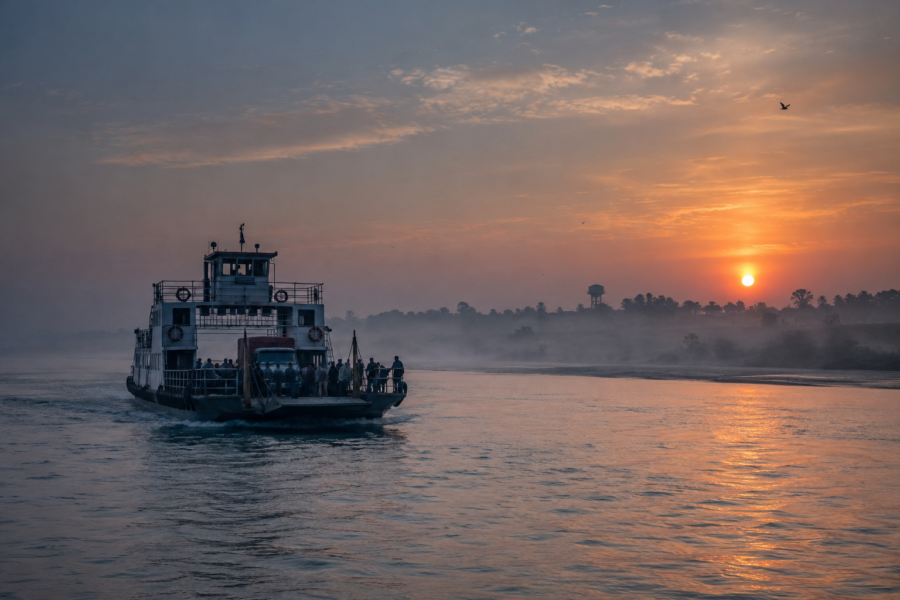
From the embarkation jetty, visitors continue by registered launch or motorboat, the only means of transport inside the Sundarbans Tiger Reserve. Boats travel through tidal rivers and mangrove-lined creeks toward the reserve’s ecotourism zone, with destinations varying according to the authorised itinerary. Dhanchi Forest Camp is one of the regulated locations that can be included on permitted routes operated by licensed boats.
Entry Permits
Access to Dhanchi is controlled by the West Bengal Forest Department.
- Visitors must travel on a registered boat operating under Tiger Reserve regulations.
- Entry permits are issued through authorised Forest Department offices and licensed tour operators.
- Every tourist boat inside the reserve is accompanied by an official ecotourism guide.
Practical Planning
Because Dhanchi lies within a protected forest rather than an inhabited island, it is best visited as part of a guided Sundarban Tiger Reserve itinerary that includes the necessary permits, registered boat, and Forest Department-approved route. This ensures both legal access and minimal disturbance to the fragile mangrove ecosystem.
Geographic Setting
Dhanchi occupies the southern reaches of the Indian Sundarbans, within the extensive network of reserve forests that stretch toward the Bay of Bengal. The island belongs to the protected wilderness of the Sundarbans Tiger Reserve rather than the inhabited delta where villages, embankments, and agricultural land dominate the landscape.
Its location places it within one of Earth’s youngest and most dynamic coastal environments. The Sundarbans themselves form the seaward edge of the vast Ganges–Brahmaputra–Meghna delta, where Himalayan sediments transported over thousands of kilometres are continually redistributed by tides and coastal currents. Unlike stable inland landscapes, these islands are products of ongoing geomorphological processes. Shorelines migrate, creek mouths shift, new mudbanks emerge, and older land gradually disappears beneath the sea.
Dhanchi is especially notable because it lies close to the exposed coastal margin of the Bay of Bengal. This position subjects the island to stronger wave action, storm surges, tidal currents, and saline influence than many interior forest islands. Consequently, the island serves as an important natural laboratory for understanding coastal evolution within the Indian Sundarbans.
From an ecological perspective, Dhanchi also functions as part of a much larger landscape rather than an isolated island. Wildlife moves between neighbouring forest blocks through tidal channels, birds use adjacent mudflats and creeks as feeding grounds, and tidal waters connect Dhanchi to an extensive estuarine network extending across southern West Bengal.
Rivers Flowing Beside Dhanchi
Available authoritative sources clearly identify Dhanchi as a coastal reserve forest island but do not consistently identify every river or tidal channel immediately bordering the island. Rather than speculate, the following hydrological context can be stated with confidence:
- Numerous unnamed tidal creeks surround the island.
- The southern shoreline opens toward the northern Bay of Bengal.
- Connected to the broader estuarine network of the Sundarbans.
- Water levels fluctuate twice daily under strong semi-diurnal tides.
- Salinity varies seasonally according to freshwater discharge and monsoon rainfall.
Nearby Forest Blocks
Dhanchi forms part of the larger protected forest landscape of the Sundarban Tiger Reserve. Nearby protected destinations within the reserve include:
- Netidhopani
- Dobanki
- Sudhanyakhali
- Bonnie Camp
- Kalash
- Burirdabri
- Jhingekhali
These locations are managed under the Forest Department’s protected-area system and collectively represent different habitats within the reserve, ranging from interior mangrove forests to coastal and border landscapes.
Nearby Inhabited Islands and Human Settlements
Dhanchi itself has no permanent human settlement.
The nearest inhabited parts of the Indian Sundarbans lie considerably farther north within the inhabited delta, where embanked islands support villages, agriculture, fishing, aquaculture, and transportation. Human activity inside Dhanchi is generally limited to:
- Forest Department operations
- Scientific research
- Authorized conservation work
- Regulated eco-tourism under permit
- Patrol and wildlife monitoring
This absence of permanent habitation distinguishes Dhanchi from much of the inhabited Sundarbans and allows ecological processes to occur with comparatively limited direct human disturbance.
Geological Origin
Dhanchi is a remarkably young landscape in geological terms. Like every island within the Indian Sundarbans, it owes its existence to the immense sediment load carried from the Himalayas by the Ganges, Brahmaputra, and Meghna river systems. Over thousands of years, these rivers have deposited layers of silt, clay, and fine sand across the delta before tidal currents redistributed them into countless islands, creeks, and mudflats.
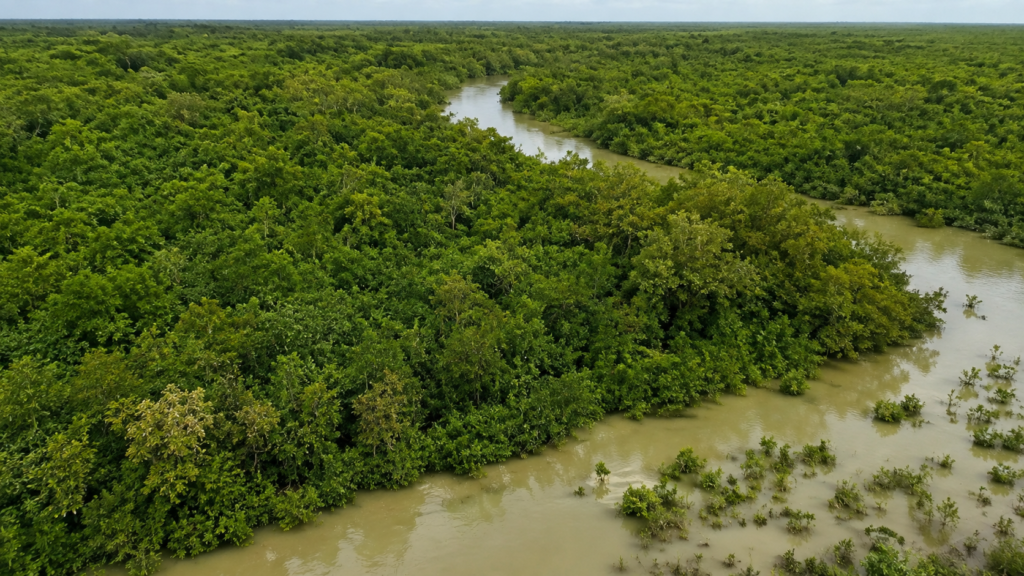
Unlike rocky islands formed through volcanic or tectonic processes, Dhanchi is built almost entirely from unconsolidated alluvial sediments. This gives the island both its ecological richness and its physical fragility. Mangrove roots bind the soft sediment together, reducing erosion under ordinary tidal conditions. Yet during powerful cyclones, storm surges, or prolonged wave attack, sections of shoreline may retreat rapidly despite this natural protection.
Scientific analyses of historical shoreline change demonstrate that Dhanchi has experienced measurable land loss over recent decades, with erosion concentrated along its southern coastline facing the Bay of Bengal. Limited accretion has occurred in some northern areas, illustrating the continual redistribution of sediment rather than simple land disappearance.
Landscape Character
Approaching Dhanchi by boat is an exercise in careful observation rather than dramatic spectacle.
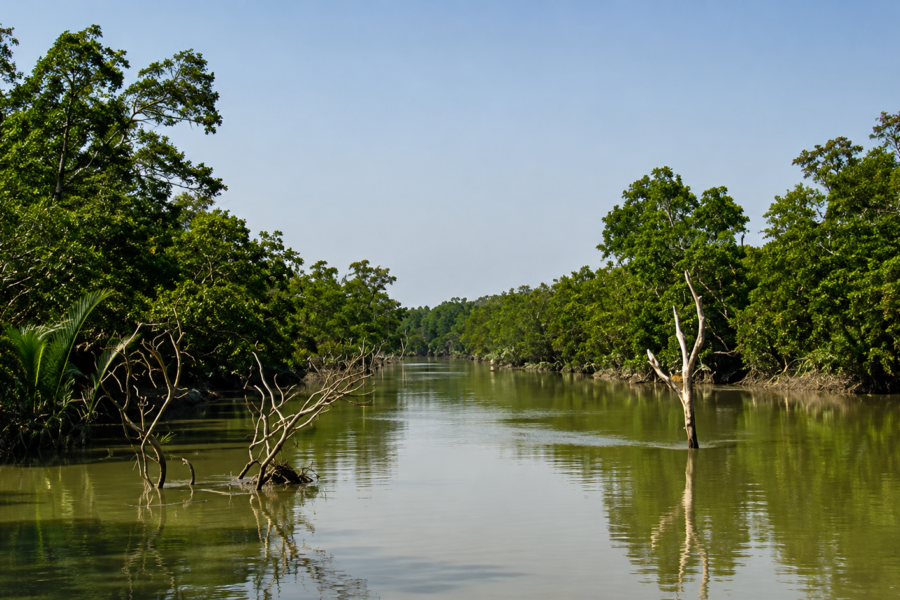
The first impression is one of uninterrupted green. Dense mangrove canopies extend almost to the water’s edge, broken only where tidal creeks penetrate the forest or where recent erosion has exposed fresh sediment. At low tide, wide expanses of soft mud emerge along the shoreline, patterned with crab burrows, mollusc trails, and the pencil-like breathing roots of mangrove trees. During high tide, much of this same landscape disappears beneath opaque estuarine water, leaving only the elevated forest canopy visible above the tide.
Unlike inland forests where topography defines the scenery, Dhanchi’s landscape is governed almost entirely by water. The tidal rhythm determines which areas are submerged, which become feeding grounds for shorebirds, where sediments accumulate, and how wildlife moves through the forest.
The island’s southern edge presents a noticeably different character from its more sheltered interior. Here the coastline is more exposed to wave energy generated across the Bay of Bengal, and evidence of shoreline retreat can often be observed in collapsing banks, undercut mangrove roots, and newly deposited sediment elsewhere along the island. Scientific monitoring has shown that this exposed margin has undergone substantial erosion over recent decades, making Dhanchi an important example of the changing geomorphology of the Indian Sundarbans.
Yet despite these changes, Dhanchi remains unmistakably a mangrove landscape. Every tide brings suspended sediment, every creek carries nutrients, and every stand of mangroves continues the slow work of stabilizing land that is never truly permanent. In this way, the island illustrates one of the central ecological truths of the Sundarbans: stability is achieved not by resisting change, but by constantly adapting to it.
Rivers and Water Systems
Twice each day, the waters surrounding Dhanchi reverse direction. Rising tides push saline water inland through a maze of creeks and estuarine channels, while ebb tides carry suspended sediments, nutrients, and organic matter back towards the Bay of Bengal. This perpetual exchange is the defining process that shapes every ecological function on the island.
Unlike upland forests where rainfall is the dominant hydrological force, Dhanchi exists within a tidal ecosystem. Water movement is governed primarily by semi-diurnal tides, which inundate the forest floor, recharge intertidal sediments, transport nutrients, and disperse mangrove propagules. The height and duration of tidal flooding vary throughout the lunar cycle and are further influenced by monsoon freshwater discharge and seasonal salinity gradients.
During the southwest monsoon, freshwater flowing through the distributaries of the Ganges delta reduces salinity across parts of the Indian Sundarbans. In contrast, the dry season brings stronger marine influence, allowing saline water from the Bay of Bengal to penetrate farther inland. These seasonal fluctuations influence mangrove distribution, soil chemistry, aquatic biodiversity, and the reproductive cycles of numerous estuarine species.
Observation at low tide reveals broad expanses of exposed mud, intersected by shallow tidal channels that appear almost insignificant. Within a few hours, these same channels become navigable waterways as the incoming tide transforms the landscape. This continual alternation between land and water is fundamental to the ecology of Dhanchi and distinguishes mangrove forests from almost every other terrestrial ecosystem.
Mangrove Ecosystem
Dhanchi supports a mature tidal mangrove ecosystem representative of the southern Indian Sundarbans, where vegetation has evolved to survive conditions that would prove hostile to most terrestrial plants. High salinity, oxygen-poor soils, tidal inundation, and unstable sediments create an environment in which only highly specialized species can thrive.
Mangroves are not a single type of tree but a diverse ecological community comprising numerous plant species that have independently evolved similar adaptations to life along tropical and subtropical coasts. On Dhanchi, these adaptations include salt filtration, aerial breathing roots, floating propagules, and extensive root systems capable of stabilizing unconsolidated sediment.
The mangrove forest performs several critical ecological functions simultaneously:
- Stabilizes newly deposited sediments.
- Reduces shoreline erosion.
- Dissipates wave energy.
- Stores significant quantities of carbon within soils.
- Provides nursery habitat for fish and crustaceans.
- Supports complex food webs.
- Regulates nutrient cycling between terrestrial and marine ecosystems.
The ecological productivity of the Sundarbans is closely linked to mangrove leaf litter. As leaves fall into tidal waters, they are decomposed by fungi, bacteria, and detritivores, producing organic matter that forms the foundation of estuarine food chains. This process supports countless invertebrates, fishes, and ultimately larger predators throughout the delta.
Dominant Mangrove Flora
Walking through Dhanchi would reveal subtle changes in vegetation corresponding to elevation, tidal inundation frequency, and salinity. Species composition varies across the island because different mangroves tolerate different environmental conditions.
Among the important mangrove species likely to occur within Dhanchi are:
Sundari (Heritiera fomes)
The Sundari tree lends its name to the Sundarbans itself and remains one of the most ecologically significant mangrove species in the region. Although historically abundant, its distribution has declined in many areas owing to increased salinity, disease, and environmental change.
Gewa (Excoecaria agallocha)
One of the common mangrove trees of the Indian Sundarbans, Gewa tolerates varying salinity levels and contributes significantly to canopy structure. The tree produces a milky latex that can irritate skin and eyes, earning it the common name “Blind-your-eye Mangrove” in some regions.
Goran (Ceriops decandra)
Goran frequently forms dense stands within moderately saline environments and plays an important role in stabilizing sediments. Scientific studies have documented noticeable shoreline retreat affecting Goran-dominated coastal margins around Dhanchi, highlighting the vulnerability of this habitat to erosion.
Avicennia Species
Species such as Grey Mangrove (Avicennia marina) and related members of the genus are among the first colonizers of newly deposited mudflats. Their dense fields of pencil-like pneumatophores emerge above the sediment during low tide, allowing oxygen uptake from the atmosphere while the roots remain buried in oxygen-deficient mud.
Keora (Sonneratia apetala)
Keora commonly occupies newly formed coastal areas and creek margins. It grows rapidly, helps stabilize young sediments, and produces flowers visited by insects and nectar-feeding animals.
Hental Palm (Phoenix paludosa)
This distinctive mangrove palm forms dense thickets along higher ground and creek banks. It provides shelter for numerous small vertebrates while contributing to habitat complexity.
Together, these species create a structurally diverse forest capable of withstanding continual tidal flooding while supporting one of the world’s richest mangrove ecosystems.
Wildlife
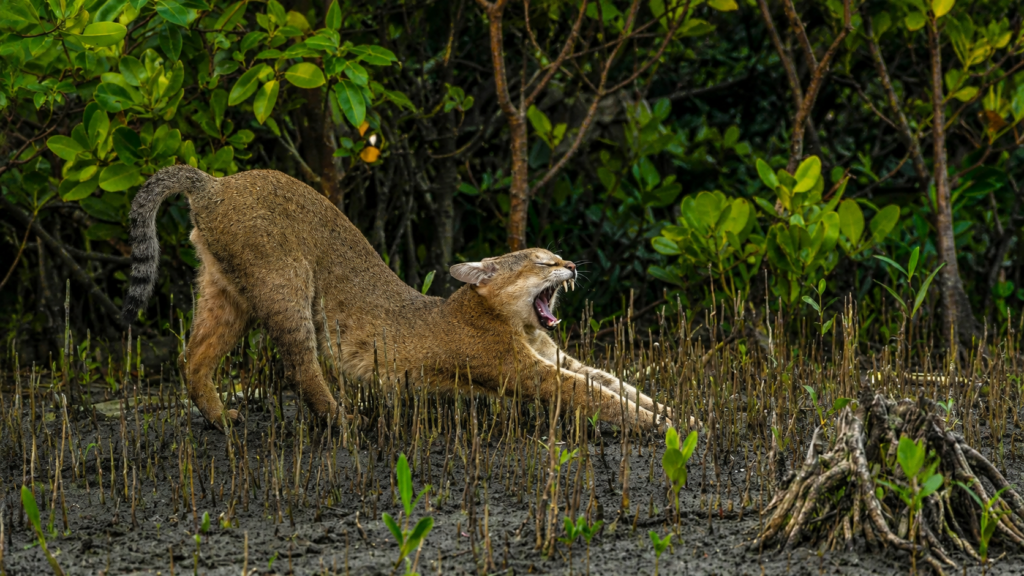
Dhanchi lies within one of the largest remaining continuous mangrove forests on Earth, where terrestrial, freshwater, estuarine, and marine ecosystems overlap. Although wildlife observations depend heavily on season, tide, weather, and chance, the island forms part of the habitat network supporting many iconic species of the Indian Sundarbans.
The absence of permanent human settlement allows wildlife to utilize the forest with comparatively limited disturbance. Dense vegetation, intricate creek systems, and extensive mudflats provide feeding grounds, breeding habitat, resting sites, and movement corridors for mammals, reptiles, birds, fishes, and countless invertebrates.
Observation at dawn often begins not with large mammals but with subtler signs of life—the bubbling of mudskippers, the clicking of fiddler crabs, kingfishers scanning tidal pools, and the distant calls of herons leaving their roosts. These smaller ecological interactions collectively sustain the larger predators for which the Sundarbans is internationally renowned.
Mammals
Royal Bengal Tiger (Panthera tigris tigris)
Dhanchi falls within the protected landscape of the Sundarban Tiger Reserve, making it part of the habitat available to the Royal Bengal Tiger. Unlike tigers inhabiting terrestrial forests elsewhere in India, Sundarbans tigers have adapted remarkably to tidal mangrove conditions. They are capable swimmers, regularly crossing wide tidal channels while navigating a landscape fragmented by water.
Tiger presence is usually detected through indirect evidence such as pugmarks, scratch marks, scat, or camera-trap records rather than direct observation. The dense mangrove vegetation provides exceptional concealment, making sightings rare even in areas known to support resident individuals.
Fishing Cat (Prionailurus viverrinus)
The Fishing Cat represents one of the Sundarbans’ most specialized small predators. Adapted to wetlands, it feeds primarily on fish, crabs, molluscs, and amphibians while moving efficiently through tidal marshes and mangrove creeks.
Jungle Cat (Felis chaus)
This adaptable carnivore inhabits forest edges and marshy habitats where it preys upon rodents, birds, reptiles, and other small vertebrates.
Small Indian Civet (Viverricula indica)
Mostly nocturnal, the Small Indian Civet contributes to seed dispersal and helps regulate populations of small animals throughout the mangrove ecosystem.
Smooth-coated Otter (Lutrogale perspicillata)
See it for yourself
A private journey shaped around you — your group, your pace, your interests. Book a free consultation.
Although difficult to observe, otters inhabit suitable tidal waterways within the Sundarbans. Their presence reflects healthy estuarine fish populations and relatively undisturbed aquatic habitat.
Reptiles
The tidal waterways surrounding Dhanchi support an impressive diversity of reptiles adapted to brackish-water environments.
Saltwater Crocodile (Crocodylus porosus)
As the world’s largest living reptile, the Saltwater Crocodile occupies tidal rivers, estuaries, and coastal waters throughout the Sundarbans. Large individuals are apex aquatic predators capable of exploiting a wide range of prey.
Water Monitor (Varanus salvator)
Frequently observed along muddy banks, the Water Monitor is an opportunistic predator and scavenger feeding on fish, crabs, birds, eggs, carrion, and small mammals.
King Cobra (Ophiophagus hannah)
The world’s longest venomous snake occurs within parts of the Sundarbans, although sightings remain uncommon due to its secretive behaviour.
Indian Python (Python molurus)
This large constrictor inhabits suitable mangrove and swamp habitats where it preys upon mammals and birds.
Several additional snake species, including both venomous and non-venomous forms, inhabit the wider Sundarbans, although local occurrence varies according to habitat conditions.
Birds
Dhanchi forms part of an internationally important wetland supporting resident and migratory birds throughout the year.
The mosaic of mudflats, mangrove canopy, tidal creeks, and open estuarine water creates habitat for numerous ecological guilds:
- Kingfishers
- Herons
- Egrets
- Bitterns
- Storks
- Raptors
- Waders
- Sandpipers
- Plovers
- Terns
- Gulls
- Bee-eaters
- Drongos
- Woodpeckers
- Orioles
- Babblers
- Sunbirds
During winter migration, many shorebirds utilize exposed tidal flats for feeding before continuing along the East Asian–Australasian Flyway. Seasonal variation in water levels and sediment exposure strongly influences bird abundance and species composition.
Observation during early morning often reveals kingfishers perched motionless above tidal creeks while egrets follow the retreating tide to capture fish trapped within shallow pools. Overhead, Brahminy Kites patrol the coastline, scanning exposed mudflats for carrion or vulnerable prey.
Aquatic Biodiversity
Observation of Dhanchi’s tidal waters often reveals little at first glance. The opaque, sediment-rich estuarine water conceals almost all life beneath its surface. Yet this apparent emptiness masks one of the most productive aquatic ecosystems in India. Every incoming tide carries plankton, nutrients, fish larvae, crustaceans, and organic matter into the mangrove creeks, while the outgoing tide exports energy and biomass back into the wider Bay of Bengal.
The aquatic biodiversity surrounding Dhanchi is inseparable from the mangrove forest itself. Leaf litter, decomposing wood, microbial communities, and tidal flushing collectively create nutrient-rich conditions that sustain an intricate estuarine food web.
Fish Communities
The creeks and estuarine channels around Dhanchi function as nursery habitats for numerous marine and estuarine fishes. Juvenile fish seek refuge among submerged mangrove roots where dense root systems reduce water velocity and provide protection from larger predators.
Common ecological groups include:
- Mullets
- Catfishes
- Gobies
- Perches
- Barramundi (Asian Sea Bass)
- Threadfins
- Glassfishes
- Halfbeaks
- Anchovies
Many commercially important marine fishes spend part of their early life within mangrove estuaries before migrating into deeper coastal waters. This nursery function makes mangrove conservation directly relevant to regional fisheries.
Crustaceans
Crabs are among the most visible inhabitants of Dhanchi’s intertidal mudflats.
As the tide retreats, thousands of small burrows become visible across the exposed sediment. Fiddler crabs emerge to feed on microscopic organic particles while males wave their enlarged claws in territorial and courtship displays. Larger mud crabs excavate deeper burrows that provide shelter during high tide.
These crustaceans play several important ecological roles:
- Recycling organic matter
- Mixing and aerating sediments
- Accelerating decomposition
- Supporting nutrient cycling
- Providing prey for birds, reptiles, fishes, and mammals
Shrimps and prawns also utilize tidal creeks extensively during juvenile stages before dispersing into larger estuarine and marine habitats.
Molluscs and Other Invertebrates
Mangrove ecosystems support a remarkable diversity of molluscs and other invertebrates.
Oysters, mussels, snails, and gastropods colonize submerged roots, muddy banks, and intertidal substrates. Their feeding activity filters suspended organic particles from tidal waters while contributing to nutrient cycling.
Mudskippers—amphibious gobies capable of moving across exposed mud—occupy the boundary between aquatic and terrestrial environments. Their behaviour exemplifies the ecological transitions that characterize the Sundarbans.
Together, these seemingly inconspicuous organisms form the foundation of the estuarine food web upon which larger predators ultimately depend.
Ecological Importance
Dhanchi’s significance extends far beyond its physical boundaries. As a protected mangrove island within the Sundarban Tiger Reserve, it contributes to ecological processes operating across the entire Indian Sundarbans.
Rather than functioning as an isolated forest patch, Dhanchi is integrated into a vast ecological network connected by tides, sediments, wildlife movements, and nutrient exchange.
Its ecological functions include:
- Stabilization of unconsolidated coastal sediments
- Natural protection against shoreline erosion
- Carbon sequestration within mangrove soils
- Maintenance of estuarine biodiversity
- Nursery habitat for marine fisheries
- Wildlife refuge
- Support for migratory birds
- Hydrological regulation
- Nutrient recycling
- Maintenance of ecological connectivity across the reserve
These interconnected processes illustrate why conservation of individual forest islands contributes to the resilience of the wider Sundarbans ecosystem.
Food Web and Ecological Processes
The ecological productivity of Dhanchi originates not with large mammals but with microscopic organisms.
Sunlight supports photosynthesis in mangrove leaves, algae, and phytoplankton. Mangrove trees shed enormous quantities of leaves throughout the year, and this organic material accumulates within tidal sediments.
Rather than being wasted, leaf litter becomes food for bacteria and fungi, which break complex plant material into smaller organic particles. Detritivorous crabs, worms, molluscs, and shrimps consume this material, transferring energy to progressively larger predators.
A simplified ecological pathway appears as follows:
Mangrove leaves
↓
Microbial decomposition
↓
Detritus
↓
Crabs, worms, molluscs, shrimps
↓
Small fishes
↓
Larger fishes
↓
Birds, crocodiles, Fishing Cats, otters
↓
Royal Bengal Tiger (indirectly through terrestrial prey populations)
This detritus-based food web distinguishes mangrove ecosystems from many terrestrial forests, where primary productivity depends more directly upon herbivory.
Coastal Erosion and Shoreline Change
Perhaps no aspect of Dhanchi has attracted greater scientific attention than its rapidly changing coastline.
Unlike stable continental shorelines, mangrove islands within the Sundarbans continually gain and lose land through the interaction of tides, sediment transport, river discharge, wave action, and storms. Dhanchi provides one of the clearest examples of these geomorphological processes in action.
Satellite analyses conducted over multiple decades have documented measurable retreat along Dhanchi’s southern coastline facing the Bay of Bengal. This erosion is especially significant because it affects mature mangrove habitats rather than recently deposited sediment.
Researchers have identified several interacting drivers:
- Strong wave energy from the Bay of Bengal
- Cyclonic storm surges
- High tidal currents
- Redistribution of estuarine sediments
- Changes in sediment supply
- Rising relative sea level
- Natural geomorphological adjustment
While portions of the southern coastline continue to erode, limited sediment deposition has been observed elsewhere around the island. This demonstrates that the landscape is continually reorganizing rather than simply disappearing.
Recent research has also highlighted the vulnerability of mangrove communities dominated by Goran (Ceriops decandra) and Avicennia species, where shoreline retreat removes entire sections of forest before natural regeneration can occur. Scientific assessments have identified Dhanchi as one of the reserve forest islands experiencing significant coastal change, making it an important location for long-term monitoring of mangrove resilience under changing environmental conditions.
Importantly, these shoreline dynamics are not evidence of ecological failure. They represent the natural behaviour of a young deltaic landscape, although accelerating climate-related pressures may increase the rate of change beyond historical conditions.
Climate Change and Future Challenges
Climate change introduces additional complexity to an already dynamic ecosystem.
The Indian Sundarbans are widely recognised as one of the world’s most climate-sensitive coastal landscapes because they combine:
- Extremely low elevation
- Tidal inundation
- Soft alluvial sediments
- Cyclone exposure
- Variable freshwater inflow
- High dependence on mangrove stability
For Dhanchi, several climate-related pressures are of particular concern.
Rising Sea Level
Even modest increases in relative sea level may alter tidal inundation patterns, increase saline intrusion, and accelerate erosion along exposed coastlines.
Mangroves possess a natural ability to adapt by trapping sediments and building soil elevation. However, their capacity to keep pace depends upon continued sediment supply and the rate of sea-level rise.
Increasing Cyclone Intensity
The Bay of Bengal experiences some of the world’s most powerful tropical cyclones.
Storm surges generated by severe cyclones can:
- Remove large sections of shoreline
- Uproot mangrove trees
- Alter creek morphology
- Deposit new sediment
- Increase salinity
- Damage wildlife habitat
Events such as Cyclones Aila (2009), Amphan (2020), and Yaas (2021) demonstrated how rapidly coastal landscapes within the Sundarbans can be transformed.
Salinity Changes
The balance between freshwater inflow and marine influence governs soil salinity throughout the Sundarbans.
Reduced freshwater discharge during dry periods can increase salinity sufficiently to influence:
- Mangrove species composition
- Seedling survival
- Forest regeneration
- Aquatic biodiversity
- Nutrient cycling
Different mangrove species possess different salinity tolerances, meaning shifts in environmental conditions may gradually alter forest composition over time.
Conservation Significance
Dhanchi occupies a strategically important position within one of the world’s most significant protected mangrove landscapes.
The island contributes to multiple internationally recognised conservation frameworks:
- Sundarban Tiger Reserve
- Sundarbans National Park protected landscape
- UNESCO World Heritage ecosystem
- UNESCO Biosphere Reserve
- Ramsar Wetland of International Importance
- National Tiger Conservation landscape
Its importance extends beyond charismatic wildlife.
Protecting Dhanchi helps conserve:
- Mangrove genetic diversity
- Coastal geomorphological processes
- Estuarine fisheries
- Carbon-rich coastal ecosystems
- Migratory bird habitat
- Predator-prey interactions
- Natural shoreline protection
Scientific monitoring of islands such as Dhanchi also provides valuable evidence for understanding how mangrove ecosystems respond to environmental change across the wider Bay of Bengal.
Forest Department Management
Because Dhanchi forms part of the protected reserve forest, human activity is tightly regulated.
Management priorities include:
- Wildlife protection
- Anti-poaching patrols
- Habitat monitoring
- Mangrove conservation
- Visitor regulation
- Scientific research support
- Coastal monitoring
- Fire prevention where applicable
- Biodiversity documentation
Entry into Dhanchi is therefore governed by Forest Department regulations rather than unrestricted public access. This controlled management helps minimise disturbance while allowing ecological and scientific functions to remain the primary priorities.
Scientific Research and Long-Term Monitoring
Over recent decades, Dhanchi has become increasingly valuable as a natural laboratory for studying coastal change within the Indian Sundarbans.
Research has focused on:
- Shoreline migration
- Mangrove succession
- Coastal erosion
- Sediment dynamics
- Sea-level interactions
- Remote sensing
- GIS-based landscape analysis
- Habitat resilience
- Climate adaptation
Satellite imagery combined with field surveys enables researchers to quantify shoreline movement over time, identify vulnerable coastal sectors, and evaluate how mangrove forests respond to changing environmental conditions.
Such long-term monitoring is essential because the Sundarbans is not a static landscape. Understanding how islands like Dhanchi evolve today will help guide future conservation planning for one of Earth’s most dynamic coastal ecosystems.
Seasonal Character
Dhanchi is a landscape of continual seasonal transformation. Although the island remains tidal throughout the year, changes in rainfall, freshwater discharge, salinity, wind patterns, and temperature alter the appearance and ecological dynamics of the forest from one season to the next.
Rather than viewing the Sundarbans as a static ecosystem, it is more accurate to understand it as a living delta whose character changes with every season and every tide.
Winter (November – February)
Observation begins on cool mornings when mist hangs over the tidal creeks before gradually lifting with the rising sun. The mangrove canopy appears crisp beneath clear skies, while exposed mudflats attract large numbers of resident and migratory birds.
Winter is generally regarded as the most stable season for ecological observation because:
- Humidity is comparatively low.
- Visibility is often excellent.
- Bird diversity reaches its annual peak.
- Water temperatures remain moderate.
- Cyclonic activity is relatively uncommon.
The calm weather also allows researchers and Forest Department personnel to conduct fieldwork more consistently than during the monsoon months.
Summer (March – June)
As temperatures rise, evaporation increases and saline influence becomes more pronounced across much of the southern Sundarbans.
During this period:
- Water temperatures increase.
- Salinity often reaches seasonal highs.
- Many mangrove species begin flowering or fruiting.
- Wildlife activity shifts towards cooler morning and evening hours.
The exposed mudflats become intensely warm under direct sunlight, yet beneath the surface countless crabs, worms, molluscs, and microorganisms continue sustaining the estuarine food web.
Southwest Monsoon (June – September)
Dark clouds gather across the Bay of Bengal before heavy rain transforms the landscape.
Freshwater flowing through the delta reduces salinity across many parts of the Sundarbans, while tidal creeks swell with increased discharge.
During the monsoon:
- Rainfall replenishes freshwater supplies.
- Sediment transport increases.
- Creek morphology may change.
- Mangrove seedlings establish more successfully.
- Vegetation growth accelerates.
Field observations become more challenging because of heavy rainfall, reduced visibility, strong currents, and difficult navigation.
Post-Monsoon (October)
As floodwaters gradually recede, the forest enters a period of ecological recovery.
New sediment deposited during the monsoon begins stabilising beneath mangrove roots. Fresh vegetation appears along creek margins, while improved weather conditions encourage renewed wildlife activity.
For researchers, this period provides valuable opportunities to examine:
- Recent shoreline changes.
- Storm impacts.
- Mangrove regeneration.
- Sediment deposition.
- Seasonal bird movements.
The Wild Orbit’s Interesting Facts About Dhanchi
- Dhanchi forms part of the protected reserve forest within the Sundarban Tiger Reserve.
- The island has no permanent human settlement.
- It represents one of the southern mangrove landscapes directly influenced by the Bay of Bengal.
- Dhanchi has become an important study area for shoreline erosion and coastal geomorphology.
- Mangrove forests surrounding the island help reduce wave energy reaching inland areas.
- The island contributes to nursery habitat supporting estuarine fisheries.
- Shoreline positions naturally change over time because the Sundarbans is an active delta.
- Wildlife movement across Dhanchi depends more on tidal channels than terrestrial pathways.
- The island illustrates how mangrove ecosystems continually adapt to environmental change rather than remaining static.
FAQs
Where is Dhanchi located?
Dhanchi is a protected forest island within the Indian Sundarbans, situated inside the Sundarban Tiger Reserve in South 24 Parganas, West Bengal.
Is Dhanchi inhabited?
No.
Dhanchi has no permanent human settlement and remains part of the protected reserve forest.
Why is Dhanchi scientifically important?
Dhanchi provides researchers with valuable opportunities to study mangrove ecology, shoreline erosion, sediment dynamics, tidal processes, and climate-related coastal change.
Can tourists visit Dhanchi?
Access is regulated by the West Bengal Forest Department. Entry requires appropriate permissions and is generally available only through authorised routes and approved itineraries.
Does Dhanchi have Royal Bengal Tigers?
Dhanchi lies within the habitat of the Royal Bengal Tiger (Panthera tigris tigris) inside the Sundarbans Tiger Reserve. However, tiger sightings are uncommon due to dense mangrove vegetation and the species’ naturally elusive behaviour.
Why is shoreline erosion occurring at Dhanchi?
Multiple natural processes contribute to shoreline change, including:
- Wave action
- Tidal currents
- Sediment redistribution
- Cyclones
- Relative sea-level rise
- Dynamic delta evolution
Scientists continue monitoring these interacting factors through long-term field studies and satellite imagery.
What makes Dhanchi different from inhabited Sundarbans islands?
Unlike many northern islands protected by embankments and settlements, Dhanchi remains a largely natural mangrove landscape where ecological processes operate with comparatively little direct human disturbance.
Where the Tide Writes the Landscape
As evening approaches, the final incoming tide begins to reclaim the exposed mudflats. Crab burrows disappear beneath the rising water, mangrove roots become submerged once more, and the forest slowly returns to the appearance it held only hours earlier. To an unfamiliar observer, the landscape seems unchanged. Yet every tide has subtly rearranged sediments, dispersed seeds, transported nutrients, and reshaped the shoreline.
Dhanchi exemplifies the essential character of the Indian Sundarbans—a landscape defined not by permanence but by continual transformation. Here, rivers, tides, mangroves, wildlife, and the Bay of Bengal remain locked in an enduring ecological dialogue that has unfolded over millennia. The island’s value lies not only in the species it supports or the forests it protects, but also in the insight it provides into how one of the world’s largest mangrove ecosystems functions as a living, evolving delta.
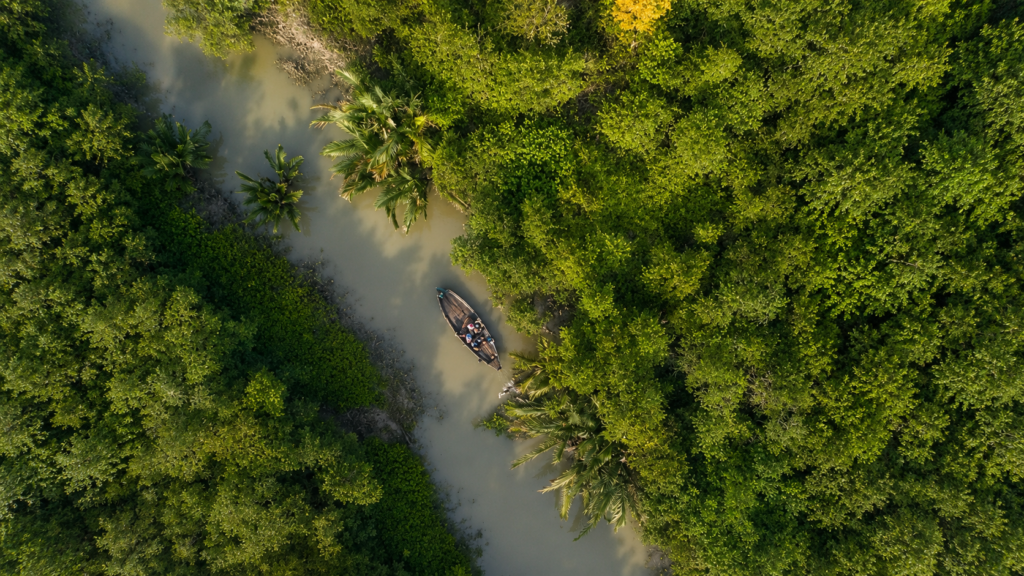
Recent scientific studies documenting shoreline retreat remind us that Dhanchi is also a sentinel of environmental change. Its eroding coasts, resilient mangrove communities, and dynamic tidal systems offer important lessons about the future of coastal ecosystems in an era of rising sea levels and changing climatic conditions. Protecting Dhanchi is therefore about more than preserving a single forest island; it is about safeguarding the ecological processes that sustain the broader Sundarbans and the biodiversity upon which countless species—including people beyond its boundaries—ultimately depend.
In the end, Dhanchi is not defined by fixed shorelines or permanent boundaries. It is defined by movement: the rhythm of the tides, the growth of mangroves, the migration of birds, the passage of wildlife, and the continual renewal of one of Earth’s most remarkable coastal landscapes. Through careful observation and scientific understanding, Dhanchi reminds us that the true strength of the Sundarbans lies in its extraordinary capacity to adapt, endure, and evolve.
Plan your private Sundarban expedition
A private journey shaped around you — your group, your pace, your interests. Book a free consultation.