 Field guide
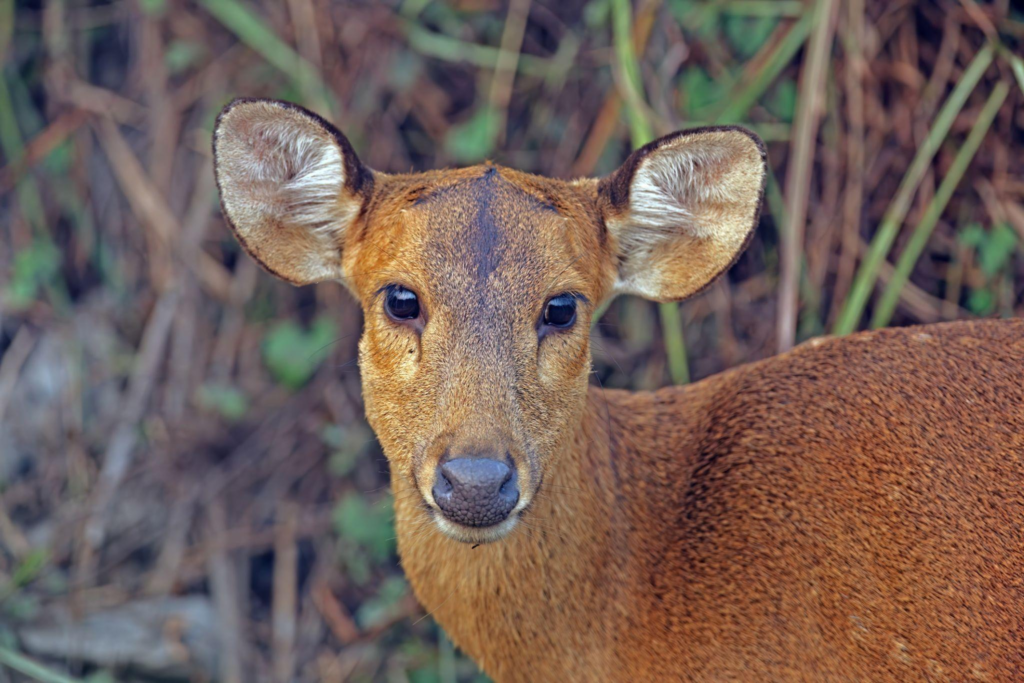
The Hog Deer (Axis porcinus) is a medium-sized member of the family Cervidae, which includes deer, elk and related hoofed mammals. It is native to parts of South Asia and mainland Asia, although its distribution has contracted substantially in parts of its former range.
Its common name comes from its characteristic low-headed movement through vegetation, which has been compared to the way a pig moves through undergrowth. The name does not mean that the animal is related to pigs. It is a true deer, with the anatomical characteristics of a hoofed ruminant.
The species is especially associated with grasslands, tall wet grass, riverine habitats, woodland margins and other landscapes offering a combination of feeding grounds and protective cover. Although it can occur near forest, it is not best understood as a specialist of closed-canopy mangrove forest.
This ecological preference helps explain why historical references to Hog Deer in the Sundarbans should be interpreted carefully. The historic delta included varied environments, and its wildlife habitats were not limited to the tidal mangrove forests that dominate the modern public image of the region.
Hog Deer At A Glance
| Feature | Details |
| Common Name | Hog Deer |
| Scientific Name | Axis porcinus |
| Family | Cervidae |
| Order | Artiodactyla, as traditionally classified; included within Cetartiodactyla in some modern systems |
| Conservation Status | Endangered (IUCN Red List) |
| Natural Range | Parts of South Asia and mainland Asia; the precise range depends on current taxonomic and distributional assessments |
| Preferred Habitat | Tall grasslands, wet grasslands, riverine plains, clearings and woodland edges |
| Diet | Primarily grasses, supplemented by herbs, leaves, shoots and fruits |
| Typical Shoulder Height | Approximately 60–80 cm in general species profiles |
| Body Weight | Varies by sex and population; published profiles report animals reaching around 50 kg |
| Social Behaviour | Often solitary, although small groups may form |
| Distinctive Features | Stocky build, relatively short legs, low-headed movement and short, branched antlers in males |
| Global Conservation Concern | Habitat loss, degradation, hunting and declining or fragmented populations |
| Sundarbans Significance | Historically recorded in the region; published regional accounts describe it as extinct there by the end of the nineteenth century |
Scientific Classification And Identity
| Taxonomic Rank | Classification |
| Kingdom | Animalia |
| Phylum | Chordata |
| Class | Mammalia |
| Order | Cetartiodactyla |
| Family | Cervidae |
| Genus | Axis |
| Species | Axis porcinus |
The scientific name is the most reliable way to identify the species across different publications and languages. Common names can vary regionally, while taxonomic treatments can differ in how they recognize related forms within the Hog Deer complex.
Research published in Scientific Reports in 2018 identified two distinct genetic lineages within the endangered Hog Deer, demonstrating that its evolutionary and conservation history is more complex than a single common name might suggest. Such findings are important for conservation planning because populations that look similar may carry distinct genetic histories. They do not, by themselves, establish that every lineage should be treated as a separate species.
Conservation Status: Endangered Across Its Range
The Hog Deer is classified as Endangered on the IUCN Red List. This category indicates a high risk of extinction in the wild under the assessment’s criteria; it does not mean that the species is extinct throughout its range.
The global conservation concern is associated with substantial historical declines, loss and degradation of suitable habitat, hunting and the disappearance or isolation of populations. The species’ remaining distribution is uneven, and secure populations in protected landscapes do not eliminate the threats facing more vulnerable populations elsewhere.
In India, the Hog Deer is also listed under Schedule I of the Wild Life (Protection) Act, 1972, as amended. It is included in Appendix I of CITES, which regulates international trade in listed species and their specimens. These protections reflect the need for strict control of activities that could threaten the species.
Three different conservation questions should not be confused:
| Question | What The Evidence Indicates |
| Is the Hog Deer globally extinct? | No. The species survives in parts of its broader range. |
| Is the Hog Deer Endangered? | Yes. It is listed as Endangered globally. |
| Does it survive in the Indian Sundarbans today? | Historical and regional mammal accounts report its disappearance from the Sundarbans by the end of the nineteenth century; a current resident population is not established by the sources reviewed here. |
The final distinction is particularly important for wildlife education. A species may remain globally endangered even after disappearing from one part of its former range. Local extinction and global extinction describe different conservation outcomes.
Where Did The Hog Deer Live In The Indian Sundarbans?
Historical distribution records provide the starting point for understanding this question.
A published account of the ungulates of West Bengal and adjoining regions cites an 1858 reference in The Calcutta Review describing Hog Deer as abundant in the more open parts of the Sundarbans forests. The same account discusses the species’ historical presence elsewhere in West Bengal, including the Terai and Duars, where it was associated particularly with large rivers.
The word open is ecologically significant. The Hog Deer is strongly associated with grassland and riverine vegetation. Open patches, grass-covered margins and transitional habitats can support herbivores that would not find their preferred food and movement conditions within dense, closed-canopy forest.
The historical Sundarbans was not ecologically uniform. The delta’s broader landscape included waterways, grassier openings, woodland transitions and human-influenced areas alongside forests. The historical record therefore offers a plausible ecological context for the animal’s former presence, but it does not provide a modern map of its distribution or identify a precise surviving population.
A later scientific assessment of Sundarban Tiger Reserve’s mammal fauna, published by J. K. Mallick in 2011, identifies the Hog Deer among mammals reported to have disappeared from the region during the previous two centuries. A separate mammal-fauna account explicitly gives the end of the nineteenth century as the time by which the species had become extinct in the Sundarbans.
Habitat: Why Grasslands Matter More Than Dense Mangroves
The Hog Deer’s ecology is shaped by the relationship between food, cover and movement. It requires vegetation that provides edible growth and places in which it can remain concealed from predators and disturbance.
Tall grasslands and riverine openings can offer both. Young grasses provide a substantial part of its diet, while nearby thickets or woodland margins can supply shelter. Wet grasslands and floodplain habitats also create a seasonal mosaic of vegetation, with food and cover changing as water levels rise and fall.
This does not mean that Hog Deer cannot use habitats containing trees or shrubs. It means that the structure of the habitat is important: a landscape with abundant ground-level forage and suitable cover may be more useful than a uniformly dense forest.
The Indian Sundarbans presents a different combination of conditions. Its mangrove vegetation is adapted to tidal flooding, saline influence and unstable muddy substrates. Species such as Avicennia and Sonneratia can grow in these environments, with exposed aerial roots helping some mangroves exchange gases in waterlogged sediments.
Those adaptations belong to the plants, not the Hog Deer. There is no established evidence that the Hog Deer possesses specialized physiological adaptations for surviving saline tidal mangrove conditions. Its historical presence in the region should not be used to imply that it was a mangrove specialist.
Instead, the most defensible ecological interpretation is that the animal historically occupied suitable open habitats within a much larger deltaic landscape.
A Compact Body For Moving Through Cover
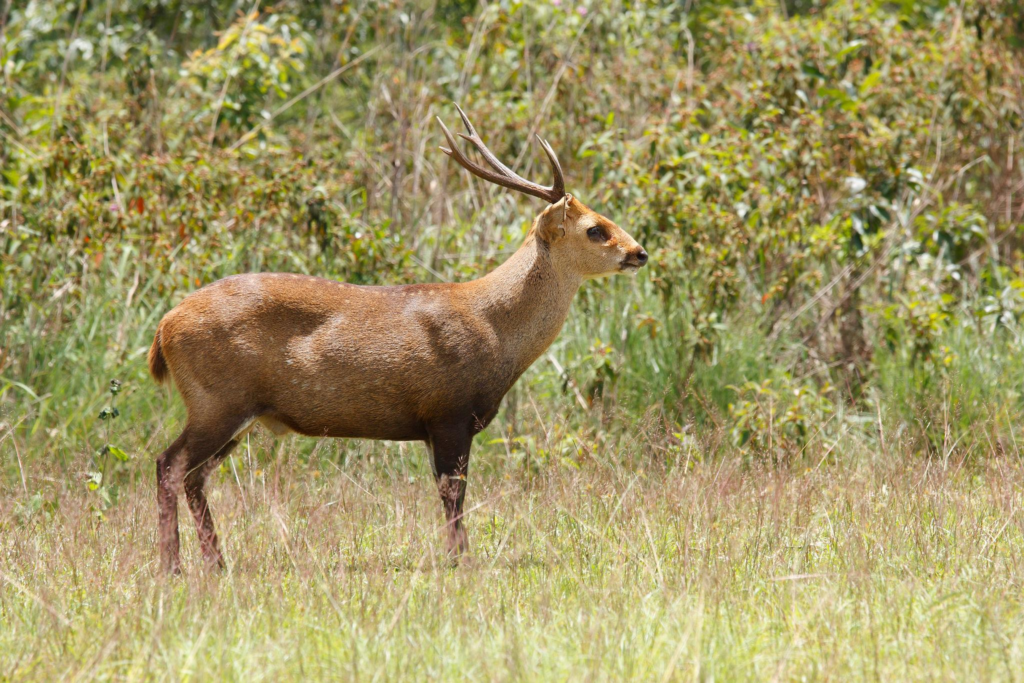
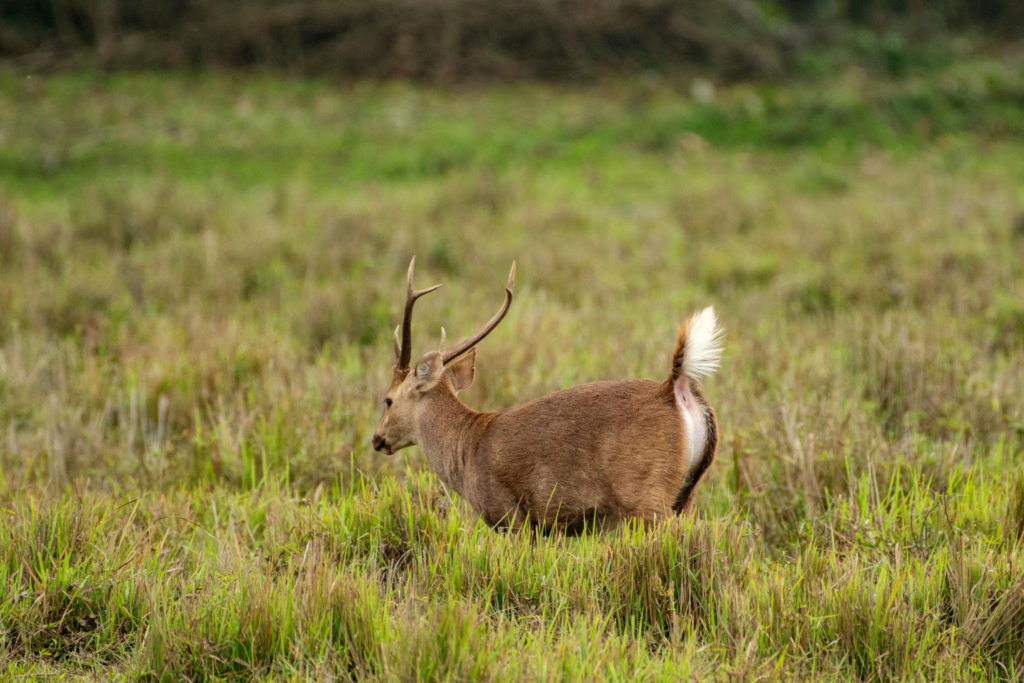
The Hog Deer has a stocky, muscular body, a relatively short face and short limbs compared with the long-legged appearance of many other deer. Its hindquarters sit higher than its shoulders, contributing to its characteristic body outline. These features give it a distinctive silhouette when it moves through tall vegetation.
Its body proportions are consistent with an animal that often moves through dense ground-level cover rather than relying exclusively on long, open-ground leaps. Its movement has helped give the species its common name: when travelling through vegetation, a Hog Deer may lower its head and pass beneath obstacles rather than immediately jumping over them.
This is a characteristic of its movement, not a rule that it never jumps. Like other deer, it can respond to danger with rapid flight, and its behaviour varies according to the terrain and the threat it perceives.
The Hog Deer’s build should also not be interpreted as evidence of an inability to move quickly. Its compact form is compatible with sudden acceleration and manoeuvring through vegetation, although the precise advantage of individual body proportions depends on the environment in which the animal is moving.
Coat, Colour And Seasonal Appearance
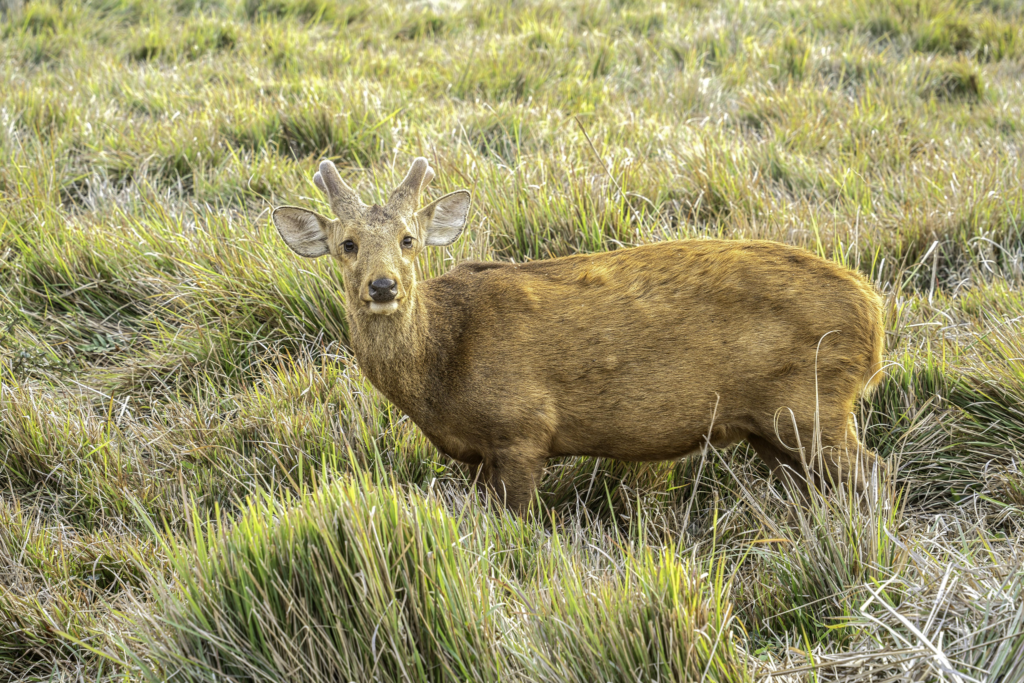
The adult Hog Deer’s coat is generally brown, with colour varying from lighter yellowish or reddish-brown shades to darker brown depending on the individual, season and population.
Newborn fawns typically have pale coats marked with light spots along their flanks. These markings can help young animals blend into the broken patterns of light and shade found in vegetation. The spotted pattern gradually changes as the animal matures. Some adults may also show faint spotting under certain seasonal conditions.
The coat’s appearance should not be confused with that of the Chital, or Spotted Deer (Axis axis). The Chital typically retains prominent white spots across the adult body, whereas the Hog Deer is generally more uniformly coloured as an adult.
The distinction is useful in wildlife identification. Body shape, coat pattern, habitat and antler structure should be considered together rather than relying on a single visual feature.
In the Sundarbans, where Hog Deer are not established as a living resident population, these identifying characteristics are relevant primarily to natural-history interpretation and to understanding historical species records, not to predicting present-day sightings.
Antlers And Sexual Differences
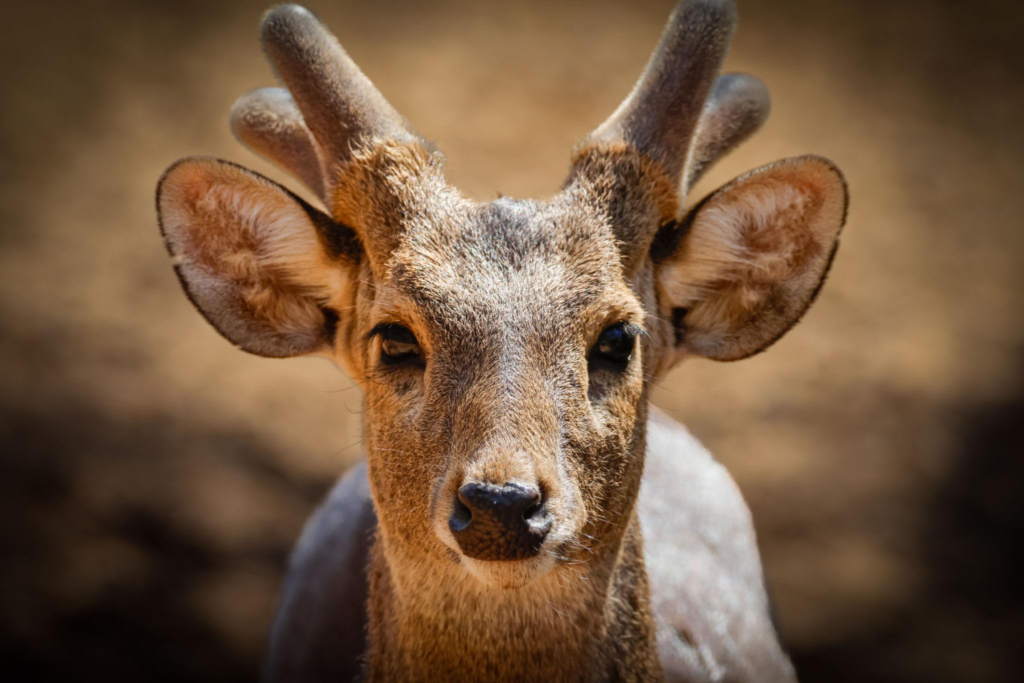
Adult male Hog Deer grow antlers, while females do not. The antlers are relatively simple and typically have three points on each side, although additional points can occur. Males are generally larger and darker than females, and the neck may appear more robust.
Antlers are made of bone and are shed and regrown in a recurring cycle. During their development, they are covered in a living, blood-supplied layer known as velvet. The timing of antler growth and shedding varies geographically and with individual condition, so one calendar schedule should not be treated as universal across the species’ range.
Antlers also have a behavioural role. Males may challenge one another during the breeding season, using displays and pushing contests to establish dominance. These encounters can involve interlocking antlers, although not every contest escalates into serious fighting.
The Hog Deer’s antlers are not elaborate structures designed to support a large herd hierarchy in the way popularly imagined for some larger deer. Their form is consistent with the species’ smaller body size and its particular reproductive behaviour.
How The Hog Deer Moves Through Vegetation
The animal’s low-headed movement is among its most recognizable traits. Rather than always lifting its body over obstructions, it may move beneath branches and through tall grass with its head lowered. This behaviour can help it travel through dense ground-level vegetation.
Its feet are adapted to terrestrial movement. Like other deer, it walks and runs on cloven hooves, with weight distributed across two principal digits on each foot. This structure supports movement across a range of natural ground conditions, though deep mud, flooding and unstable substrates can still impose constraints.
Hog Deer are capable swimmers, and published species profiles describe water as a potential refuge when danger threatens. This does not establish a special adaptation to the saline channels of the Sundarbans. Swimming ability in a deer should not be mistaken for an ability to thrive in any aquatic environment.
In a riverine grassland, a short crossing may be part of ordinary movement. In a tidal mangrove delta, however, currents, changing water levels, muddy banks and salinity create a different set of conditions. No evidence reviewed here establishes that the Hog Deer was specially adapted to navigate those conditions.
The Senses Behind Survival
A deer survives by detecting threats early enough to respond. Vision, hearing and smell all contribute to its ability to assess its surroundings, locate food and respond to other animals.
The Hog Deer’s relatively large ears are a visible feature of its head. Hearing helps a terrestrial herbivore detect movement and sounds that may indicate danger, although an individual sound cannot always identify a predator or determine its distance precisely.
Smell also plays an important role in deer behaviour. Scent cues can communicate information about other animals, reproductive condition and the use of space. The Hog Deer possesses scent glands, including glands associated with the feet and the region around the eyes. These are relevant to chemical communication, although the meaning of any particular scent mark depends on its context.
The eyes support visual detection and movement through a changing environment. The species’ survival, however, does not depend on one exceptional sense. It depends on combining sensory information with suitable cover, knowledge of familiar surroundings and an appropriate response to danger.
What Does The Hog Deer Eat?
See it for yourself
A private journey shaped around you — your group, your pace, your interests. Book a free consultation.
The Hog Deer is primarily a grazer. Its diet consists mainly of grasses, with additional feeding on herbs, flowers, young shoots, leaves and fruits. The relative importance of these foods changes with their availability and the habitat in which a population lives.
Young grasses are particularly important. Grassland plants can produce fresh growth after flooding, seasonal dieback or disturbance, creating feeding opportunities in landscapes where vegetation changes over the year.
As a ruminant, the Hog Deer has a digestive system adapted to extracting nutrients from plant material. Microorganisms in its foregut help break down plant fibres that mammals cannot efficiently digest using their own enzymes alone. This digestive partnership allows it to make use of fibrous vegetation.
Its feeding is not entirely restricted to grass. Browsing on leaves and shoots, along with the consumption of fruits and other plant matter, broadens the range of foods available.
This flexibility does not mean that all plant communities are equally suitable. Food quality, vegetation height, accessibility and seasonal availability affect how effectively a habitat supports a population.
For the historical Hog Deer of the Sundarbans, the available records do not establish a detailed local diet. It would be speculative to claim that the animals regularly fed on particular mangrove species or depended on saline-tolerant plants. The most defensible description is based on the species’ established feeding ecology elsewhere.
Living With Floods And Seasonal Change
Flooding is an important ecological influence across the Hog Deer’s broader range. In some landscapes, rising water levels can displace deer from low-lying grasslands and lead them to use higher ground. Movements associated with monsoon flooding have been documented in parts of the species’ range.
This response is not evidence of a specialized ability to cope with the twice-daily tidal cycle of the Sundarbans. Seasonal river flooding and regular tidal inundation differ in their timing, duration, salinity and effects on vegetation.
The distinction is essential when interpreting the species’ history in West Bengal. A deer adapted to floodplain grasslands may use seasonal water-level changes as part of its natural habitat cycle without being adapted to a permanently saline or frequently inundated mangrove environment.
Temperature and humidity also influence activity and the availability of food. Like other mammals, Hog Deer need to balance feeding, movement and rest with the environmental conditions they experience. Yet there is insufficient evidence here to identify a unique heat-management or salt-tolerance mechanism specific to the Sundarbans population.
The lesson is straightforward: the species has ecological flexibility, but that flexibility has limits. Survival depends on the availability of the right habitat, not merely on an ability to tolerate difficult weather.
Solitary By Nature, Flexible In Company
Hog Deer are often solitary, but they may gather in small groups when food is abundant or conditions favour feeding in the same area. Females and their young may also associate, while adult males can spend considerable time apart from other individuals. Social behaviour varies with habitat, season and local conditions.
This flexible social structure suits an animal whose resources can be distributed unevenly. A productive patch of grassland may attract several animals, whereas a less productive area may support individuals that feed separately.
Group size alone does not reveal whether animals are related, whether a male is defending a territory, or whether a temporary gathering has any lasting social significance. Those interpretations require observations of behaviour over time.
The Hog Deer is generally considered relatively sedentary compared with highly migratory ungulates, but it can move in response to changing food availability, flooding and other environmental pressures. Movements in floodplain habitats are especially relevant because water can temporarily make familiar feeding areas inaccessible.
Territory, Scent And Communication
Chemical communication is an important part of deer behaviour. Scent glands provide information that may help individuals recognize one another, assess reproductive condition and communicate through scent marks.
Male Hog Deer can show territorial behaviour, particularly in relation to other males and reproductive opportunities. The strength and form of this behaviour vary with local conditions. It should not be assumed that every male maintains a clearly bounded territory throughout the year.
Vocal communication can also play a role. Hog Deer are reported to produce warning sounds when alarmed, helping communicate a response to danger. However, a call heard in a grassland or wetland cannot automatically be attributed to this species; identification requires a reliable observation or recording.
The species’ communication system is therefore best understood as a combination of sound, posture, scent and movement. No single signal tells the complete story of an animal’s behaviour.
Breeding And The First Months Of Life
Hog Deer reproduce sexually, and breeding is seasonal in many populations. Published accounts describe rutting during the autumn months in parts of the Indian subcontinent, while the timing of births varies geographically. Gestation is approximately seven months, although figures differ somewhat between sources and populations.
During the breeding season, males may compete for access to females. Displays and pushing contests can help establish dominance. The outcome depends on factors such as the males’ condition and the circumstances of the encounter.
Following gestation, females generally give birth to one fawn, although reproductive details can vary and occasional reports of twins exist in deer species. Hog Deer fawns are typically spotted, and their markings gradually fade as they mature.
For a young deer, remaining concealed is an important part of early survival. A fawn that lies quietly in vegetation may be less conspicuous to predators than one that moves constantly through open ground. Its mother must still find food and return to care for it, so concealment does not remove the risks associated with predation or disturbance.
As the fawn grows, it becomes increasingly capable of moving with its mother and eventually living independently. The timing depends on its development and local ecological conditions.
These are general features of Hog Deer reproduction, not observations from a surviving Sundarbans population. No modern breeding population in the Indian Sundarbans is established by the historical sources reviewed for this article.
Predators And The Wider Food Web
Hog Deer are herbivores, but they are also potential prey for large carnivores. Predators reported to hunt them in parts of their range include tigers and leopards; young animals can also be vulnerable to other predators. The importance of each predator depends on which species coexist locally and on the availability of alternative prey.
The Hog Deer contributes to its ecosystem through grazing, browsing and the transfer of plant-derived energy into animal biomass. Its feeding can influence the structure of vegetation locally, while its dung returns organic material and nutrients to the ground.
Predation links the deer to the wider food web. Where Hog Deer are abundant, they may contribute to the prey base available to carnivores. Where their populations decline, predators may be affected, although the consequences depend on the abundance of other prey species.
This relationship is relevant to the broader history of the Sundarbans, but it must be framed correctly. The modern Sundarbans has its own prey community, including Chital and Wild Boar. The disappearance of the Hog Deer does not mean that its ecological role was simply transferred to one other species, nor can the effect of its disappearance on tiger populations be quantified from the evidence cited here.
The Hog Deer And Human Landscapes
Across its wider range, the Hog Deer has faced pressure from hunting, habitat loss and the conversion of grasslands and wetlands for agriculture and other human uses. Habitat degradation can reduce food availability and cover, while fragmented landscapes may isolate populations and restrict movement.
The relationship between people and Hog Deer is not uniformly one of conflict. Some human-modified landscapes may still provide feeding habitat, while agricultural areas can also expose deer to hunting, vehicle collisions, disturbance and crop damage.
These interactions depend on the surrounding habitat, local land use and the condition of the population. A species’ ability to feed in a modified landscape should not be confused with long-term security.
In the Sundarbans, human activity has long been connected to the changing structure of the delta. Settlement, cultivation, resource extraction and changes in forest boundaries have shaped the relationship between people and wildlife. However, it would be inaccurate to assign the Hog Deer’s disappearance to a single cause without species-specific historical evidence.
The historical accounts establish former presence and subsequent disappearance. They do not, on their own, provide a complete reconstruction of the events that led to local extinction.
How Scientists Establish Whether A Species Is Present
Confirming the presence of a terrestrial mammal in a large, difficult-to-access landscape requires more than a single unverified report. Wildlife researchers use several complementary methods to establish species occurrence and, where possible, estimate population size.
| Method | What It Can Establish |
| Direct Observation | A sighting can establish presence when the animal is identified reliably and the observation is documented. |
| Camera Traps | Photographs can confirm presence, help distinguish species and support repeated monitoring. |
| Tracks And Hoofprints | Footprints may indicate the passage of a hoofed mammal, but identification must account for similarities between species and substrate conditions. |
| Dung Analysis | Dung can provide evidence of presence; laboratory analysis may help confirm species identity. |
| Habitat Surveys | Surveys identify suitable vegetation, water availability, cover and other conditions needed to assess whether a landscape could support the species. |
| Historical Records | Archival publications and older wildlife accounts can establish that a species was recorded in a region in the past. |
| Genetic Evidence | Suitable biological samples may help confirm identity and investigate population relationships, provided contamination and sample origin are addressed. |
For a species reported as extinct locally, these methods have different evidentiary value. A habitat survey might establish that some conditions appear suitable, but it cannot demonstrate that the animal is actually present. A historical report can establish former occurrence, but it cannot prove modern survival.
Similarly, a footprint that resembles a deer’s track would not be enough to establish the presence of Hog Deer in the Sundarbans. Confirmation would require reliable identification supported by appropriate documentation.
The Difference Between Historical Presence And A Living Population
Historical wildlife accounts are essential for understanding former distributions, especially in landscapes that have undergone major ecological change. Yet historical records must be interpreted according to their date, precision and reliability.
For the Hog Deer, the available literature provides a clear sequence of evidence: a historical account described its former occurrence in the more open parts of the Sundarbans, and later regional assessments reported that the species had disappeared by the end of the nineteenth century.
What these records do not provide is equally important. They do not establish a precise last sighting, a final known breeding population, a detailed local extinction timeline or a fully demonstrated set of causes.
Nor do the sources reviewed here establish a verified contemporary reappearance. A recent, well-documented observation would need to be assessed on its own evidence rather than accepted simply because the species historically occurred in the region.
The responsible conclusion is that the Hog Deer is considered locally extinct in the Indian Sundarbans according to published regional accounts, while the species remains extant elsewhere.
Conservation Challenges Across Its Wider Range
The Hog Deer’s global conservation status reflects pressures that operate across multiple landscapes. The exact importance of each threat differs between populations, but several broad challenges are well established.
| Conservation Challenge | Potential Effect On Hog Deer |
| Loss Of Grasslands | Removes feeding areas and can reduce access to nutritious young grasses. |
| Wetland Alteration | Changes flooding patterns, vegetation and the availability of suitable cover. |
| Agricultural Expansion | Can fragment natural habitat and increase exposure to people and disturbance. |
| Hunting And Poaching | Directly removes individuals and can undermine small populations. |
| Habitat Fragmentation | Isolates populations and restricts movement between suitable areas. |
| Flooding And Extreme Events | Can temporarily eliminate refuges, displace animals or cause mortality in vulnerable landscapes. |
| Declining Population Size | Can increase the risk of local extinction and reduce genetic diversity. |
These challenges are connected. A population already reduced by hunting may be less able to withstand habitat loss. Fragmentation can prevent animals from recolonizing suitable areas after a local decline. Poorly managed water regimes can further reduce the quality of grasslands on which the species depends.
Conservation therefore requires more than protecting individual animals. It also requires maintaining the landscapes and ecological processes that allow populations to feed, reproduce and move safely.
Climate Change, Floods And The Future Of Grassland Deer
Climate change adds uncertainty to the future of many floodplain and wetland species. Changes in rainfall, flood intensity, temperature and seasonal vegetation growth can affect food availability and the accessibility of refuge areas.
For Hog Deer, the consequences will depend on local conditions. In some areas, flooding may maintain productive grasslands; in others, severe or prolonged floods may reduce access to feeding habitat or cause mortality. The effects cannot be assumed to be identical across its range.
Sea-level rise and saline intrusion are especially relevant to low-lying coastal deltas such as the Sundarbans. They influence the broader landscape through changes in tidal flooding, erosion, sediment movement and vegetation. However, there is no basis in the sources reviewed here for attributing the Hog Deer’s historical disappearance from the Sundarbans specifically to modern climate change or sea-level rise.
The timeline matters: the regional accounts place the species’ disappearance by the end of the nineteenth century. Contemporary climate pressures are a separate issue from the historical causes of that disappearance.
For conservationists, the wider lesson is that habitat protection must consider ecological change over time. A landscape suitable for a species in one period may not remain suitable as its vegetation, hydrology and land use change.
Protected Areas And Conservation Response
The Hog Deer benefits from legal protection and from conservation efforts that preserve the grasslands and riverine habitats required by remaining populations.
In India, protected-area management, habitat monitoring and enforcement against illegal hunting are important parts of species conservation. Management should also consider the ecological processes that sustain productive grassland: seasonal flooding, vegetation renewal, access to refuge and connectivity between habitat patches.
The Wildlife Institute of India’s 2025 report, Status of Ungulates in Tiger Habitats of India, provides a wider framework for understanding ungulate ecology, distribution and conservation in important tiger landscapes. The report emphasizes the relevance of prey populations and habitat suitability to wildlife management.
For Hog Deer, effective conservation requires attention to the animal’s own ecological requirements rather than assuming that protection of any forest automatically benefits every deer species.
A dense forest reserve may be valuable for many forms of wildlife while offering limited feeding habitat for a grassland-associated deer. Conservation planning must account for habitat structure, not merely the total area designated as protected.
For the Indian Sundarbans specifically, the first requirement is historical and ecological clarity. Any proposal to restore or reintroduce a species would require rigorous assessment of habitat suitability, historical evidence, potential ecological effects, genetic considerations and long-term management. The available sources do not establish that a Hog Deer reintroduction is planned, approved or ecologically justified for the region.
Where Can The Hog Deer Be Observed In The Sundarbans?
There is no verified Hog Deer viewing location in the Indian Sundarbans established by the sources reviewed for this article.
Historical references to the species in the Sundarbans should not be converted into present-day wildlife recommendations. Locations such as Sajnekhali, Sudhanyakhali, Dobanki, Netidhopani, Bonnie Camp and Burirdabri are associated with wildlife observation in the wider delta, but the evidence cited here does not establish any of them as a current Hog Deer observation site.
The distinction between suitable habitat and documented presence is essential.
| Observation Question | Responsible Interpretation |
| Was Hog Deer historically recorded in the Sundarbans? | Yes, historical literature records its former presence in the region. |
| Is there a verified current population in the Indian Sundarbans? | No such population is established by the sources reviewed here. |
| Can a visitor reasonably expect to see one on a Sundarbans expedition? | No. It should not be presented as a species visitors can currently expect to encounter there. |
| Could a new record change this assessment? | Yes, if it were supported by reliable, independently verifiable evidence. |
The most useful way to encounter the Hog Deer today is through well-documented natural-history material and through observation in regions where the species is confirmed to survive. In the Sundarbans, its story is best told through historical ecology and the changing distribution of wildlife.
The Important Truth About Wildlife Sightings
Wildlife observation is never entirely predictable. Animals may remain hidden, move outside the area being surveyed or become active when observers are absent. A failure to see an animal does not automatically establish its absence from a landscape.
But the reverse is equally important: an animal’s historical presence or the apparent suitability of its habitat does not establish its current survival there.
In the Hog Deer’s case, the distinction is especially clear. Its former occurrence in the Sundarbans is documented in historical literature, while published regional accounts describe its disappearance by the end of the nineteenth century. A responsible wildlife account should communicate both facts without promising sightings or implying an unverified modern population.
This is how natural-history interpretation remains useful to visitors, researchers and conservation-minded readers: it distinguishes what has been recorded, what is inferred and what remains unknown.
What Makes The Sundarbans Hog Deer Unique?
The Hog Deer’s significance in the Sundarbans lies not in a special adaptation to mangroves, but in the relationship between its historical distribution and the changing ecology of the delta.
Its story reveals five important natural-history lessons.
| Distinctive Aspect | Ecological Significance |
| A Historical Resident | Nineteenth-century literature records the Hog Deer in the more open parts of the Sundarbans landscape. |
| A Grassland-Associated Deer | Its feeding ecology highlights the importance of grasslands, riverine openings and transitional habitats within broader landscapes. |
| A Species Lost Locally | Published regional assessments report its disappearance from the Sundarbans by the end of the nineteenth century. |
| Part Of West Bengal’s Wildlife History | Its former distribution connects the Sundarbans with the wider riverine and grassland ecosystems of eastern India. |
| A Conservation Reminder | Its history demonstrates that protecting a landscape today does not necessarily restore every species that once lived there. |
The Hog Deer also illustrates why wildlife conservation cannot rely on a single definition of habitat. The Sundarbans is internationally recognized for its tidal mangroves, estuarine waterways and distinctive wildlife. Yet its ecological history includes animals associated with more open habitats, too.
That wider perspective helps avoid a common mistake: assuming that every mammal recorded from a delta must be adapted to living among mangrove roots and saline tidal creeks.
The Hog Deer is a deer of grasslands and riverine landscapes. Its historical association with the Sundarbans belongs to the changing mosaic of habitats that once existed across the region.
Its disappearance also raises a question that extends beyond this species: how many changes in wildlife distribution occur gradually, leaving behind only scattered records in older publications?
The answer requires continued research into historical documents, species records and the ecological history of the lower Gangetic delta.
Myths And Facts About The Hog Deer
| Myth | Fact |
| Hog Deer are related to pigs. | They are members of the deer family, Cervidae. Their name refers to their characteristic movement through vegetation. |
| Hog Deer are spotted throughout adulthood. | Fawns have conspicuous pale spots, but adults are generally more uniformly brown. |
| Hog Deer live exclusively in dense forests. | They are strongly associated with grasslands, wet grasslands, riverine habitats and forest edges. |
| Hog Deer are extinct everywhere. | The species survives in parts of its wider range, although it is globally Endangered. |
| Hog Deer can still be seen in the Indian Sundarbans. | Historical records establish former occurrence, but the sources reviewed here do not establish a current resident population. |
| Every deer habitat is suitable for Hog Deer. | Habitat suitability depends on vegetation, food availability, cover, water conditions and other ecological factors. |
FAQs
Is The Hog Deer Found In The Sundarbans Today?
Published regional accounts report that the Hog Deer disappeared from the Sundarbans by the end of the nineteenth century. A current resident population in the Indian Sundarbans is not established by the sources reviewed here.
What Is The Scientific Name Of The Hog Deer?
The scientific name is Axis porcinus. It belongs to the family Cervidae, which includes deer and related hoofed mammals.
Why Is It Called The Hog Deer?
The name refers to its characteristic low-headed movement through vegetation, which resembles the way a pig moves through undergrowth. It is a deer, not a member of the pig family.
Is The Hog Deer Endangered?
Yes. The Hog Deer is classified as Endangered on the IUCN Red List. Habitat loss, degradation, hunting and declining populations are among its major conservation concerns.
What Does The Hog Deer Eat?
It feeds primarily on grasses, supplemented by herbs, flowers, young leaves, shoots and fruits. Its diet varies according to the vegetation available in its habitat.
Where Does The Hog Deer Normally Live?
Its preferred habitats include tall grasslands, wet grasslands, riverine plains, clearings and woodland margins. These environments provide both food and cover.
Can Hog Deer Swim?
Yes. Published species profiles describe Hog Deer as capable swimmers. However, this does not establish a special adaptation to the saline, tidal channels of the Sundarbans.
Why Did The Hog Deer Disappear From The Sundarbans?
Historical accounts document its former presence and subsequent disappearance, but the sources reviewed here do not establish a complete, species-specific explanation. Hunting, habitat modification and changes in open habitats are relevant regional pressures, but their individual contributions cannot be confidently quantified.
Can Tourists See Hog Deer During A Sundarbans Expedition?
Hog Deer should not be advertised as a species tourists can currently expect to see in the Indian Sundarbans. No verified present-day viewing location is established by the evidence reviewed for this article.
What Is The Difference Between Hog Deer And Spotted Deer?
The Hog Deer generally has a stockier body, shorter limbs and a more uniformly brown adult coat. The Spotted Deer (Axis axis) typically retains conspicuous white spots across its adult coat. Both belong to the deer family but are distinct species.
The Wild Orbit Perspective
The Sundarbans is often understood through the wildlife that survives there today: the Royal Bengal Tiger moving through the mangroves, Chital feeding along forest edges, Rhesus Macaques travelling through the canopy and aquatic mammals navigating the estuarine channels.
But a landscape’s natural history is not limited to its living inhabitants.
The Hog Deer belongs to another layer of the Sundarbans story, one preserved in historical records rather than confirmed modern sightings. Its former presence reminds us that the delta’s wildlife distribution has changed and that its ecological past was more varied than a simple picture of dense mangrove forest might suggest.
The animal itself is not a mangrove specialist. Its life is tied more closely to grasses, open ground, protective cover and the changing conditions of riverine habitats. Understanding that distinction allows us to tell its story without inventing adaptations or claiming a survival that has not been verified.
For conservation, the lesson is equally important. Protecting wildlife means understanding the particular conditions each species requires, preserving the habitats that remain, and recording changes before knowledge of a species becomes confined to old publications.
The Wild Orbit approaches the Sundarbans as a living ecosystem, but also as a landscape with a deep natural history. Some of its stories unfold in front of us; others must be reconstructed from scientific evidence and historical memory.
The Hog Deer reminds us that the story of a wilderness includes not only the animals we can still encounter, but also those whose disappearance changed it.
Sometimes, the most important wildlife story is the one that teaches us what a landscape has already lost.
Plan your private Sundarban expedition
A private journey shaped around you — your group, your pace, your interests. Book a free consultation.