 Field guide
The Golden Jackal is one of the adaptable carnivores of the Indian Sundarbans, a landscape where tidal rivers, mangrove islands, mudbanks and human settlements meet. Unlike the Royal Bengal Tiger, which dominates the region’s image of wildness, the jackal occupies a quieter ecological role: searching for food, exploiting changing opportunities and helping connect the food web through its varied diet.
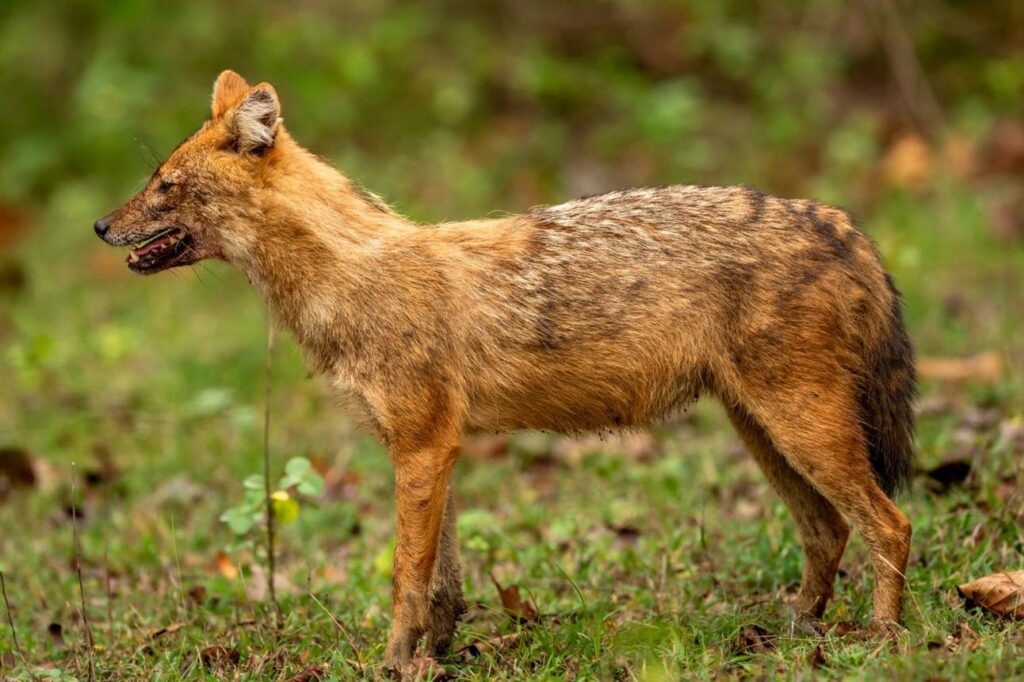
Scientific literature and regional mammal records establish the Golden Jackal’s presence in the Sundarbans landscape, including its fringe areas. However, its local population size, distribution across individual forest blocks and frequency of sightings are not sufficiently established here to justify precise estimates or claims of reliable encounters.
For The Wild Orbit, understanding this mammal means looking beyond its familiar appearance. The Golden Jackal is a useful subject through which to explore the relationship between wildlife, changing habitats, natural food resources and the communities living along the mangrove frontier.
Golden Jackal At a Glance
| Attribute | Details |
| Common Name | Golden Jackal |
| Scientific Name | Canis aureus |
| Family | Canidae |
| Order | Carnivora |
| Class | Mammalia |
| Global IUCN Conservation Status | Least Concern |
| Geographic Distribution | Parts of Asia, including India and Bangladesh, with a wider range extending into parts of Europe |
| Habitat | Forests, scrublands, grasslands, wetlands, agricultural landscapes and human-modified environments |
| Diet | Omnivorous and opportunistic; includes animal prey, carrion, insects, fruit and other available food |
| Social Structure | Usually solitary, in pairs or in family groups |
| Activity | Frequently active during twilight and at night, although activity varies with local conditions |
| Ecological Role | Predator, scavenger and consumer of diverse food resources |
| Sundarbans Significance | A documented component of the regional mammal community, particularly associated in older regional accounts with fringe areas |
| Distinctive Adaptation | Behavioural flexibility and the ability to exploit varied food sources |
Scientific Classification and Identity
The Golden Jackal’s scientific name is Canis aureus, established by Carl Linnaeus in 1758. It belongs to the order Carnivora and family Canidae.
Despite its name, the Golden Jackal is not simply a small wolf or a fox. It is a distinct canid species with its own evolutionary history, physical characteristics and behavioural ecology.
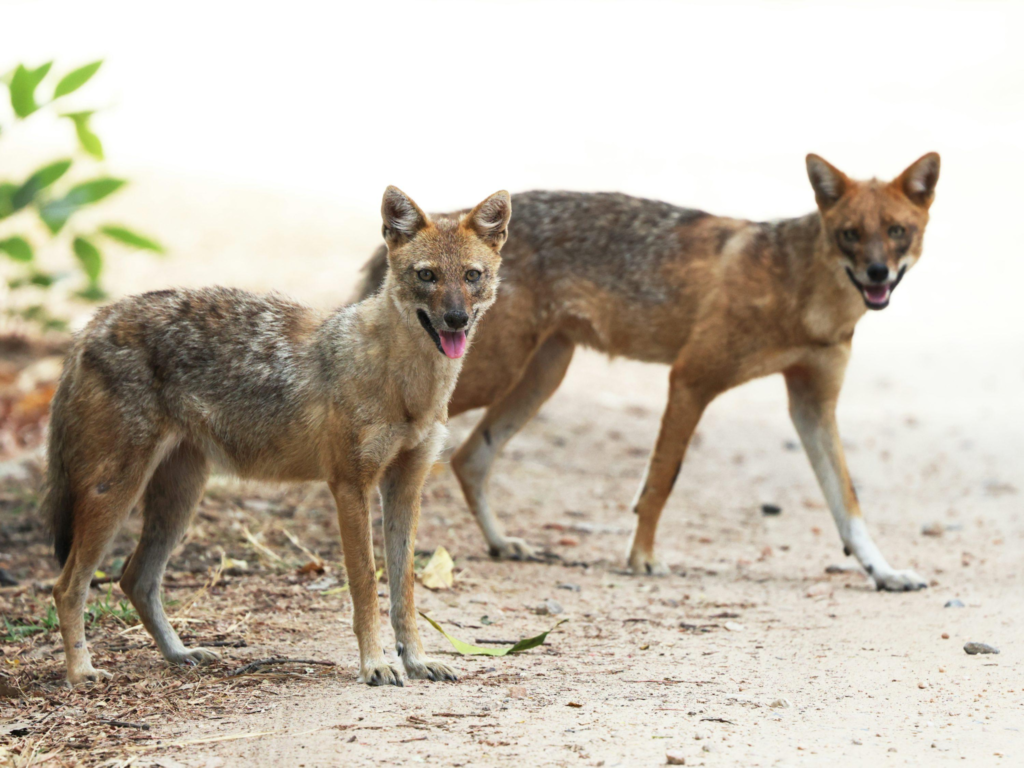
The species’ appearance can vary geographically. Individuals may have golden, buff, grey, brown and black tones in their coats, often with a darker saddle along the back. Coat colour can change seasonally and is influenced by individual and regional variation. The common name describes a general appearance rather than a uniform golden colour.
Taxonomic distinctions within the broader jackal group have also changed as researchers have used genetic evidence to reassess relationships among canids. For a Sundarbans wildlife guide, Canis aureus is the appropriate scientific name for the Golden Jackal discussed here. There is no basis for describing the Sundarbans animals as a separate species simply because they inhabit a distinctive environment.
Where Does the Golden Jackal Live?
Golden Jackals have a broad geographic range and are known for their ability to use habitats that differ in vegetation, moisture, temperature and human influence. Across India, the species is recorded in a wide range of landscapes, from natural habitats to agricultural and semi-urban environments. Its distribution is not limited to formally protected forests.
The Indian Sundarbans forms part of the lower Ganges delta in West Bengal. Here, land and water continually interact. River channels shift, mudbanks emerge and disappear with the tides, and islands experience erosion, deposition and changes in salinity.
Such conditions do not create equally suitable habitat everywhere for a terrestrial mammal. The dense, frequently inundated mangrove interior differs substantially from raised ground, forest margins, agricultural land and settlements.
Golden Jackals are reported in the fringe areas of the Sundarban Tiger Reserve in regional mammal accounts. A regional study of the reserve’s mammal fauna describes the jackal alongside the Indian fox among the carnivores present in fringe areas. A separate survey also lists the species among the mammals of the Sundarbans.
These records support the species’ presence in the wider landscape. They do not, by themselves, establish how many jackals currently occupy each island, how frequently they enter the forest interior or whether their distribution has expanded or contracted in recent years.
The Golden Jackal in the Sundarbans: Forest and Fringe
The Sundarbans is famous for its mangrove forests, but the ecology of the region cannot be understood by looking at trees and tidal creeks alone. The surrounding human landscape is also important.
Villages, agricultural plots, fishery areas, embankments and paths create a network of terrestrial spaces. These may provide cover and food resources for adaptable mammals, although the availability of resources varies considerably between sites.
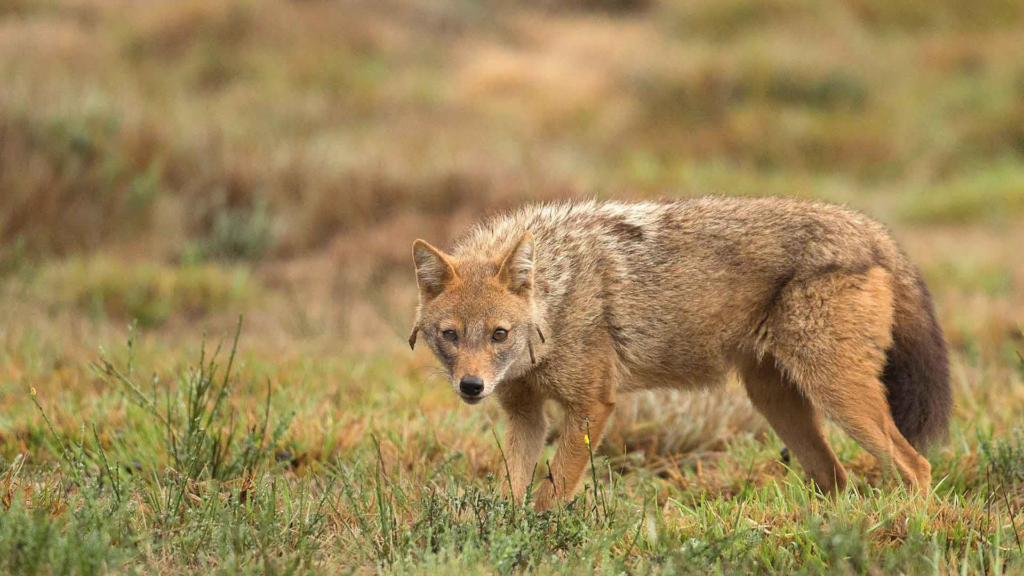
For the Golden Jackal, the forest fringe can be particularly relevant. It offers a potential interface between natural prey, carrion, vegetation cover and human-associated food resources. The precise balance depends on local conditions and should not be assumed to be the same throughout the delta.
A jackal’s presence in a fringe landscape does not mean it depends entirely on people. Nor does the presence of settlements prove that the animal regularly enters them. These are questions that require field observations, camera-trap records, tracks, scat analysis or other appropriate evidence.
This distinction matters in a region where wildlife encounters can easily become exaggerated in tourism narratives. A species may be present without being readily visible, and a record from one location cannot automatically be transferred to every island or forest block.
Habitat: Why the Mangrove Fringe Matters
The Golden Jackal is a terrestrial mammal, and its habitat requirements differ from those of aquatic mammals and species closely associated with permanently wet forest floors.
Across its range, the species uses habitats where it can find food, concealment and suitable sites for resting or breeding. It can tolerate considerable environmental variation, but it still depends on access to usable ground and resources.
In the Sundarbans, several landscape features may be relevant to its habitat use:
| Habitat Feature | Ecological Significance |
| Raised Ground and Forest Edges | Potentially provide more continuous terrestrial movement routes than frequently inundated surfaces. |
| Vegetation Cover | Offers concealment and may support prey species. |
| Agricultural Margins | Can attract rodents and other small animals, although actual use depends on local conditions. |
| Village Fringes | May provide opportunities to scavenge, but can also expose jackals to dogs, traffic, persecution and disease. |
| Natural Feeding Areas | Mudflats and other open spaces may contain accessible food, depending on the tide and season. |
These are ecological interpretations based on the species’ documented general behaviour and the physical character of the Sundarbans. They are not a mapped inventory of confirmed Golden Jackal habitat within the reserve.
Why Does the Golden Jackal Occur in This Landscape?
The most defensible explanation is that the species’ ecological flexibility allows it to use suitable terrestrial habitats in the broader Sundarbans region.
The Golden Jackal does not need a single, highly specialised food source. Instead, it can adjust its diet to what is available. Its presence in a landscape containing both natural habitat and human-modified areas is consistent with this generalist ecology.
However, the Sundarbans also imposes important constraints. Tidal flooding, saline water, soft mud and the fragmentation of terrestrial routes can make movement difficult. A habitat that appears suitable on a map may not be accessible throughout the tidal cycle or during every season.
The species’ regional occurrence should therefore be understood as a relationship between adaptability and local habitat conditions, not evidence that the Golden Jackal can thrive equally well in every part of the mangrove ecosystem.
Ecological Importance of the Golden Jackal
The Golden Jackal contributes to the food web through several feeding roles.
First, it is a predator of smaller animals. By consuming rodents and other small prey where available, jackals participate in the natural regulation of prey populations. The strength of this effect depends on local prey abundance and the jackal’s diet.
Second, it is a scavenger. Carrion provides energy without requiring the animal to kill the source of the food. Scavenging can help return nutrients to the food web, while reducing the persistence of some animal remains.
Third, its omnivorous diet allows it to consume plant material and other resources. This flexibility connects the jackal to several parts of the ecosystem rather than placing it in a single, narrow feeding relationship.
Golden Jackals may also compete with other medium-sized carnivores for certain resources. The nature of such interactions depends on the species present, the food available and how different animals use the same landscape. Research from other Indian ecosystems demonstrates the importance of understanding diet and resource sharing when studying carnivore communities, but findings from those sites should not be treated as direct evidence of the same patterns in the Sundarbans.
In the Sundarbans, the jackal’s importance lies partly in these multiple ecological connections. It is not an apex predator, but neither is it an incidental part of the landscape.
A Body Built for Adaptability
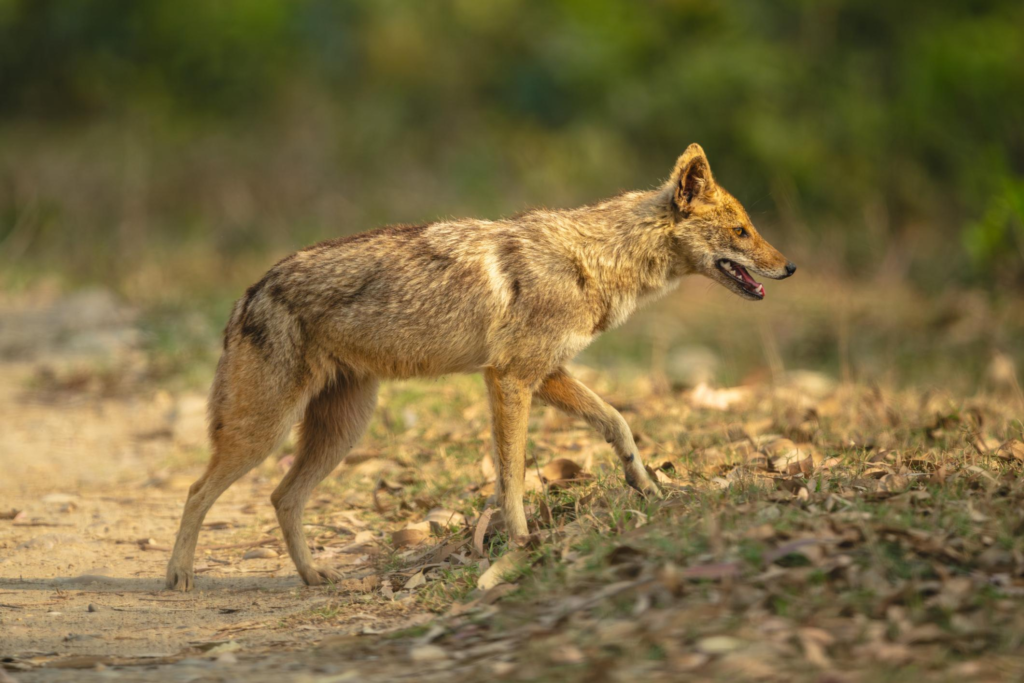
The Golden Jackal has the familiar outline of a medium-sized canid: a relatively narrow muzzle, upright ears, long legs, a lean body and a bushy tail. Its build supports efficient movement across terrestrial landscapes and helps it locate and exploit a variety of food resources.
Its physical form is not an adaptation exclusively to mangroves. Rather, it is a generalist design that works across several habitat types. This distinction is important when discussing the species in the Sundarbans. The jackal has not been demonstrated to possess a unique anatomical adaptation specifically for the region’s saline tidal forests.
Its advantage comes primarily from the combination of a mobile body, well-developed senses and flexible behaviour.
Size and Appearance
Golden Jackals are medium-sized carnivores, generally smaller and more lightly built than wolves. Their size and body mass vary by region and individual. Because regional measurements specific to the Indian Sundarbans are not established in the sources reviewed here, precise local measurements should not be presented as though they were taken from Sundarbans animals.
The coat usually combines several colours rather than displaying a uniform gold. Grey, buff, tawny and darker hairs create a mottled appearance that can help break up the animal’s outline against dry grass, soil, scrub and shaded vegetation.
In the Sundarbans, the surrounding environment changes rapidly between dark mangrove cover, exposed mud, grass-covered ground and settled landscapes. A jackal’s coat is not a specialised mangrove camouflage, but its mixed colouring can be less conspicuous in some terrestrial settings than a sharply contrasting coat would be.
The Face: Senses for Finding Food
The Golden Jackal’s muzzle, nose, eyes and ears form an effective sensory system for a flexible forager.
Smell
Olfaction plays a central role in canid life. A jackal can use scent to investigate food, identify other animals and gather information about its surroundings.
Smell is particularly useful for a mammal that may encounter food sources scattered across a large landscape. Carrion, animal trails and scent marks can all provide information that is not immediately visible.
In the Sundarbans, wind, rain, humidity and the changing distribution of exposed ground may influence how scent travels. However, the degree to which these factors affect Golden Jackal behaviour locally has not been established by the regional evidence cited here.
Hearing
The jackal’s upright ears help collect sound. Hearing can alert it to prey movement, other jackals and potential threats.
Sound also matters in a landscape where natural and human activity overlap. Birds call from vegetation, insects produce continuous background noise, and boats and settlements introduce additional sounds. It would be misleading, however, to claim that jackals in the Sundarbans have developed a unique response to boat noise without direct research.
Vision
The Golden Jackal uses vision to detect movement, navigate its surroundings and respond to other animals. As with many canids, visual information works alongside smell and hearing rather than replacing them.
Low-light conditions can be useful for an animal that often forages during twilight or at night. Yet activity patterns vary with location, disturbance and food availability; the species should not be described as exclusively nocturnal.
Legs, Feet and Movement
Golden Jackals have long limbs suited to walking, trotting and running over terrestrial ground. Their movement is efficient rather than specialised for swimming or climbing.
In suitable habitat, jackals can travel between feeding areas, resting places and territories. They may use tracks, field boundaries and the edges of vegetation, although the exact routes taken by Sundarbans individuals require local evidence.
The region’s ground conditions create a significant contrast. Firm raised ground may allow relatively easy travel, while soft mud, exposed roots and tidal channels can interrupt movement. Pneumatophores—the pencil-like breathing roots of many mangrove trees—rise from the mud and form a distinctive feature of the Sundarbans forest floor. Such terrain presents a different physical environment from open grassland or agricultural land.
There is no sound basis for claiming that the Golden Jackal has special feet that allow it to move effortlessly through deep mangrove mud. Its terrestrial locomotion is better suited to accessible ground, and tidal conditions may limit where it can travel safely.
Can Golden Jackals Swim?
Golden Jackals are capable of swimming, as are many canids, but this does not make them aquatic specialists.
The Sundarbans contains broad rivers and narrow creeks that separate islands and forest blocks. The ability to swim across water in some circumstances should not be confused with evidence that a particular jackal routinely crosses major tidal channels.
There is insufficient evidence here to quantify how frequently Golden Jackals swim in the Indian Sundarbans or to identify regular crossing routes. For this species, swimming is a general capability rather than a proven defining adaptation to the local estuary.
Teeth and Feeding Strategy
The Golden Jackal’s teeth reflect its flexible diet. Its canine teeth help seize and kill prey, while its other teeth are suited to cutting and processing animal food. It can also consume a range of non-animal materials.
Unlike a highly specialised predator that depends on one particular prey species, the jackal can switch among different food sources when circumstances change. This flexibility is one of the strongest explanations for its broad ecological distribution.
The ability to eat carrion is especially important in understanding the species. Scavenging can provide a substantial food opportunity when animal remains are available, but the availability of such food varies by place and season.
In settled landscapes, discarded food may also become a resource. This can help jackals survive in modified environments, but it may increase contact with people and domestic dogs.
What Does the Golden Jackal Eat?
The Golden Jackal is an omnivore and opportunistic feeder. Its diet can include:
- Small mammals, particularly rodents where available.
- Birds and their eggs when accessible.
- Insects and other invertebrates.
- Carrion and animal remains.
- Fruit and other plant material.
- Discarded food and other human-associated resources.
- Occasionally, livestock or poultry, depending on local circumstances.
These are documented general dietary categories for the species, not a measured list of food items from the Indian Sundarbans. The proportions of each food type in the local diet remain uncertain.
Hunting, Foraging and Scavenging
Golden Jackals do not rely on hunting alone. They can locate small prey, investigate food-rich areas and exploit carrion when it becomes available.
A jackal hunting a rodent and a jackal feeding on an animal carcass are performing different ecological functions, even though both behaviours contribute to the same animal’s survival.
The balance between hunting and scavenging may change according to season, habitat and the availability of food. Studies from other parts of India have used scat analysis to investigate these changes, demonstrating why diet should be examined locally rather than inferred from the species’ reputation as a scavenger.
For the Sundarbans, a dedicated dietary study would be needed to determine how much the local population relies on natural prey, carrion, plant foods or resources associated with settlements.
Activity Patterns: When Is a Jackal Most Active?
See it for yourself
A private journey shaped around you — your group, your pace, your interests. Book a free consultation.
Golden Jackals are often active during twilight and nighttime hours. Their activity can also extend into daylight, particularly where human disturbance is low or where local conditions make daytime foraging advantageous.
Activity is influenced by food availability, temperature, disturbance, social behaviour and the need to avoid potential threats. There is no universal timetable that applies to every population.
In the Sundarbans, it is reasonable to expect that light levels, heat, access to terrestrial routes and human activity could influence when jackals use particular areas. But without local tracking or camera-trap data, an exact schedule for the regional population cannot be stated confidently.
This is one reason why daytime wildlife cruises cannot be treated as reliable opportunities to observe every mammal known from the region.
Surviving a Landscape That Never Stays Still
The Sundarbans is shaped by tides, sediment movement, river currents and the interaction between fresh water and seawater. These processes affect where terrestrial ground remains exposed and how accessible different habitats are.
The Golden Jackal’s generalist ecology may help it use parts of this changing landscape, particularly where terrestrial habitat and food resources remain available. Yet flexibility is not the same as immunity to environmental pressure.
A terrestrial animal still needs suitable resting sites, opportunities to feed and routes through its habitat. When land is eroded, flooded or divided by water, these requirements can become more difficult to meet.
The jackal’s relationship with the Sundarbans is therefore not a story of an animal perfectly adapted to every challenge. It is a story of a flexible mammal living within a landscape that continues to impose physical and ecological limits.
A Social Life Built Around Family
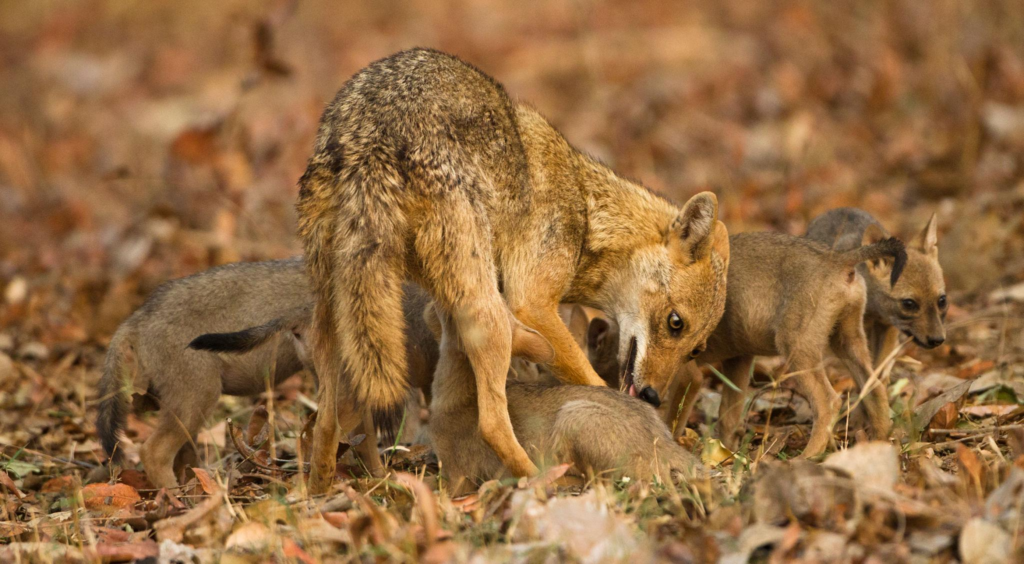
Golden Jackals can live as solitary animals, in pairs or in family groups. Social organisation varies with habitat, food availability and the circumstances of individual animals.
In many studied populations, a breeding pair forms the core of a family unit. Young animals may remain associated with their parents for a period after birth, learning to forage and navigate their environment before dispersing or establishing their own territories.
This flexibility in social organisation allows the species to use different landscapes. A pair may exploit a local food resource, while a family group may benefit from shared vigilance and parental care.
However, the social structure of Golden Jackals in the Indian Sundarbans has not been sufficiently documented in the sources reviewed here. It would be inappropriate to claim that local animals consistently live in a particular group size or form stable packs of a specified number.
Territory, Scent and Communication
For a territorial canid, scent carries information about identity, reproductive condition and the presence of other animals.
Golden Jackals use scent marking and vocal communication as part of their social behaviour. Their calls may help individuals maintain contact, communicate with nearby jackals or respond to other members of their social group.
Vocalisations can include howls, yelps and other calls. The sound and frequency of communication vary with circumstances, and hearing a jackal call does not necessarily mean that several animals are nearby.
In a region as acoustically varied as the Sundarbans, calls may be difficult to distinguish from the broader soundscape. Birds, insects, domestic dogs and human activity all contribute to the sounds heard around settlements and forest edges.
No verified local acoustic study is cited here to establish a distinctive Golden Jackal calling pattern in the Indian Sundarbans. Its general communication behaviour is well recognised, but local differences should remain an open research question.
Breeding: Raising the Next Generation
Golden Jackals reproduce sexually, and the female gives birth after a gestation period of approximately two months. Reference accounts commonly report a litter of several pups, with litter size varying among individuals and populations. Both parents may contribute to the care and protection of the young.
Pups are born in a protected site, such as a den or sheltered burrow. During early life, they depend on adults for food and protection. As they develop, they begin to consume solid food and gradually acquire the skills required for independent survival.
The timing of breeding varies geographically. Tropical populations may not follow the same seasonal pattern as jackals living in temperate climates. It would therefore be unreliable to apply a breeding calendar from Europe or Africa directly to the Indian Sundarbans.
The local breeding season, typical litter size and den-site preferences would need to be established through regional field observations.
Parental Care and Juvenile Development
Parental investment is important in a species whose young require protection and food during their early development.
Adults may bring food to pups and provide protection around the den. As the young become more mobile, they learn through experience and observation. Their survival depends on more than physical growth: they must also learn to find food, recognise danger and respond to the presence of other animals.
For a population living near settlements, these lessons may include avoiding roads, domestic dogs and human disturbance. This is an ecological possibility, not a documented account of juvenile behaviour specific to Sundarbans jackals.
How Long Do Golden Jackals Live?
Golden Jackal lifespan varies with environmental conditions, access to food, disease, injury and human-related mortality. Animals in captivity may live longer than many individuals do in the wild.
A single lifespan figure should not be presented as a measured average for the Indian Sundarbans. Reliable local survival estimates would require long-term monitoring, individual identification or other suitable research methods.
For conservation, survival at different life stages matters as much as the maximum age an animal can reach. The loss of breeding adults, mortality among dispersing juveniles and changes in access to suitable habitat can all influence the persistence of a local population.
The Golden Jackal and Other Sundarbans Wildlife
The Golden Jackal belongs to a wider community of mammals that use the region’s varied habitats.
The Sundarbans supports carnivores with different ecological strategies, including the Fishing Cat, Jungle Cat and Leopard Cat, alongside the Royal Bengal Tiger. These species do not occupy identical niches. They differ in body size, preferred prey, habitat use and their relationship with water.
The jackal’s flexible diet may bring it into competition with other animals when food resources overlap. Rodents, birds, carrion and other food sources can attract more than one species. The intensity of competition, however, depends on the availability of resources and whether animals use the same places at the same times.
It would be an overstatement to assign a specific competitive relationship between Golden Jackals and each of the Sundarbans’ other carnivores without local evidence.
Is the Golden Jackal Prey for the Royal Bengal Tiger?
The Golden Jackal is much smaller than the Royal Bengal Tiger and may face danger from larger predators in landscapes where they overlap. Nevertheless, the existence of a larger predator does not establish how frequently it hunts or kills jackals.
The tiger’s ecology in the Sundarbans is strongly associated with its principal prey and the challenges of hunting in mangrove terrain. The jackal’s role in that food web should not be exaggerated by suggesting that it is a regular or significant tiger prey species without supporting data.
For this reason, a Sundarbans wildlife guide should distinguish between a plausible predator–prey interaction and one that has been demonstrated to be important in the local ecosystem.
The Human–Jackal Interface
The relationship between Golden Jackals and people is complex. The species can use human-modified environments, sometimes benefiting from food sources that are more predictable than those available in natural habitats.
In parts of India, jackals have been observed near villages, agricultural land and waste-disposal sites. They may scavenge discarded food or carrion and hunt small animals around fields. Such behaviour can reduce the distance between wildlife and human activity.
In the Sundarbans, the distinction between forest and settlement is especially important. People live alongside a dynamic estuarine environment, depending on land and water for farming, fishing, transport and other livelihoods.
A jackal near a settlement may be responding to available food, cover or a route through the landscape. It should not automatically be described as aggressive or dangerous.
At the same time, proximity can create genuine concerns. Poultry losses, access to refuse, encounters with domestic dogs and the risk of disease transmission may affect how people perceive and tolerate jackals.
The local importance of each issue needs to be assessed rather than assumed. There is insufficient evidence here to quantify Golden Jackal attacks on livestock, poultry losses or conflict incidents in the Indian Sundarbans.
Coexistence Without Simplification
Coexistence does not mean that wildlife and people never come into conflict. It means understanding the circumstances that bring them into contact and identifying ways to reduce avoidable harm.
For the Golden Jackal, responsible waste management can reduce opportunities for scavenging around settlements. Protecting poultry, avoiding the deliberate feeding of wild carnivores and securing animal remains where practical can also help limit unnecessary contact.
If a jackal is seen near a home, people should not attempt to catch, corner or feed it. Any injured animal or recurring conflict should be reported to the appropriate local wildlife authority.
Local communities should not be blamed for the presence of wildlife in shared landscapes. Human–wildlife interactions are shaped by habitat, food availability, infrastructure and the practical needs of people living in the region.
The Bengali Name and Cultural Familiarity
The Golden Jackal is commonly known as shiyal in Bengali. The name is familiar across Bengal, where jackals also appear in traditional stories and popular expressions.
Cultural familiarity, however, should not be confused with scientific evidence. Stories may preserve local observations about animal behaviour, but they can also exaggerate characteristics or assign human motives to wildlife.
For a natural-history account, folklore is most useful when clearly identified as cultural tradition. It should not be used to infer population trends, diet, aggression or conservation status.
The jackal’s place in the Sundarbans deserves attention in its own right: as a living carnivore responding to food, habitat and other animals, rather than merely as a character in human stories.
Is the Golden Jackal Endangered?
Globally, the Golden Jackal is classified as Least Concern on the IUCN Red List. The assessment recognises the species’ broad distribution, ecological flexibility and ability to persist in a variety of habitats. The global assessment also notes that population trends can vary across the range.
Least Concern does not mean that every local population is secure. A widespread species can still face local declines caused by habitat loss, persecution, road mortality, disease or changes in food availability.
The global assessment should not be used as a substitute for information about the Golden Jackal in the Indian Sundarbans. A separate, current population estimate for the region has not been established by the evidence reviewed here.
Conservation Status in India
The Golden Jackal is part of India’s native mammal fauna. The country’s wildlife protection framework has undergone amendments, so legal claims should be checked against the current legislation and official schedules rather than repeated from older species accounts.
Regardless of its global IUCN category, a wild jackal should not be captured, injured or killed by members of the public. Anyone dealing with an injured animal, suspected illegal killing or a recurring conflict should contact the appropriate wildlife authorities.
Conservation also involves protecting the ecological conditions that allow the species and other native wildlife to persist. This includes suitable terrestrial habitat, functional connections between habitat patches and responsible management of human-associated food resources.
What Threatens Golden Jackals?
The Golden Jackal’s adaptability allows it to use a range of environments, but it does not remove all threats. The most important pressures vary across its geographic range.
Habitat Loss and Fragmentation
Development, land conversion and the loss of suitable vegetation can reduce the availability of resting, feeding and breeding sites.
In the Sundarbans, erosion and changing river channels can alter the distribution of terrestrial ground. Human infrastructure and land-use changes may also affect the connections between habitat patches.
The exact effect of these processes on local Golden Jackal populations has not been quantified here. They are relevant landscape pressures to investigate, not proof of a measured local decline.
Conflict and Persecution
When jackals take poultry, feed on livestock remains or enter areas where people keep domestic animals, they may be perceived as pests.
Retaliatory killing can threaten local wildlife populations, particularly where habitat is already limited. A balanced response requires distinguishing between actual losses and assumptions about the animal’s behaviour.
The objective should be to reduce the circumstances that lead to conflict while maintaining a respectful distance from wild animals.
Disease and Domestic Dogs
Contact with free-ranging domestic dogs can create opportunities for disease transmission and competition. These interactions are recognised concerns in the study of wild canids and other carnivores in human-dominated landscapes.
The degree of disease exposure among Golden Jackals in the Indian Sundarbans is not established by the sources cited here. Local surveillance would be needed to understand the scale of the issue.
Roads, Boats and Human Activity
Road mortality can affect terrestrial mammals in landscapes with increasing transport infrastructure. The effect on Golden Jackals depends on their movements and the location and intensity of traffic.
Boat activity is an important feature of the Sundarbans, but it would be inaccurate to claim that boat traffic is a demonstrated major cause of Golden Jackal mortality without evidence. Boats may affect the broader ecosystem in different ways, while jackal-specific impacts require targeted research.
Climate Change, Erosion and Salinity
The Sundarbans faces environmental pressures associated with changing sea levels, cyclones, erosion and shifting salinity. These processes influence the distribution and condition of mangrove habitats, agricultural land and settlements.
For a terrestrial carnivore such as the Golden Jackal, the consequences are likely to depend on changes in accessible ground, food resources and connections between habitat patches.
It is important not to assume that every environmental change will affect jackals in the same way. Some areas may lose suitable habitat, while others may experience changes in food availability or land use that alter the species’ presence.
The local effects need to be assessed through long-term ecological monitoring.
How Is the Golden Jackal Monitored?
Monitoring a widespread, adaptable mammal requires methods suited to its behaviour and the environment being studied.
Camera Traps
Motion-triggered cameras can record jackals passing through suitable habitat, using tracks or investigating food sources. They are particularly valuable for animals that are difficult to observe directly.
Camera traps can help establish presence, identify patterns of activity and investigate habitat use. However, a camera record does not automatically provide a population estimate. Reliable estimates require an appropriate study design, adequate sampling and suitable analytical methods.
Tracks and Other Signs
Tracks can indicate that a jackal has moved through an area. Scat may provide evidence of presence and, when analysed, information about diet.
Both forms of evidence require careful identification. Tracks can be confused with those of domestic dogs, while scat identification may require expert examination or genetic analysis.
In soft Sundarbans mud, tracks may be visible under favourable conditions but can be erased or distorted by tides, rainfall and other animal activity. Their absence is not proof that jackals are absent from the wider area.
Direct Observation
Direct sightings can provide useful information about behaviour, habitat and interactions. Yet sightings alone are not a reliable measure of population size, particularly when observers concentrate on a limited number of accessible places.
Repeated surveys using consistent methods are more useful than isolated observations for determining whether a species is becoming more or less frequently detected.
Scat Analysis and Genetic Research
Scat analysis can reveal dietary patterns and help researchers understand how a jackal uses available resources. Genetic methods may also help confirm species identity and investigate relationships between populations.
These methods could be valuable for understanding Golden Jackals in the Sundarbans, especially where direct observations are limited. Their usefulness depends on appropriate sampling, laboratory methods and carefully interpreted results.
Where Can the Golden Jackal Be Observed in the Sundarbans?
Historical regional mammal accounts identify the Golden Jackal among the carnivores present in the fringe areas of the Sundarban Tiger Reserve. Other regional inventories also include the species in the wider Sundarbans mammal community.
These records support the following cautious interpretation:
| Location / Habitat | Ecological Significance |
| Sundarban Tiger Reserve Fringe Areas | Historical regional records support the species’ presence in the fringe landscape. They do not establish current sighting frequency. |
| Terrestrial Habitat Around the Mangrove Landscape | Areas with suitable cover and food may be relevant to jackal habitat use, but suitability alone does not confirm current occupancy. |
| Village and Agricultural Margins | The species’ general ecology makes these environments plausible foraging areas. Specific sites should not be advertised as confirmed Golden Jackal locations without local records. |
No reliable evidence reviewed here supports assigning high sighting probabilities to particular islands, watchtowers, rivers or tourist routes.
For this reason, the Golden Jackal should not be marketed as a guaranteed wildlife encounter in the Sundarbans. Any future location-specific recommendation should be based on recent, verifiable records and appropriate guidance from local wildlife authorities.
The Important Truth About Wildlife Sightings
Wildlife presence and wildlife visibility are two different things.
A Golden Jackal may inhabit an area without appearing during a visit. It may be active at a different time, remain concealed by vegetation or use a route away from people.
Tides and changing ground conditions add another layer of uncertainty to the Sundarbans. The animal’s movements cannot be predicted simply by identifying a suitable habitat on a map.
Responsible wildlife observation therefore requires patience, realistic expectations and respect for the animal’s space. A sighting is valuable, but the absence of a sighting does not mean that the landscape lacks wildlife.
For naturalists, photographers and expedition leaders, accurate interpretation is part of the experience. The aim is to understand the ecosystem, not to promise an encounter that cannot be guaranteed.
Conservation Priorities for the Sundarbans Golden Jackal
Although the species is globally widespread, its local ecology deserves more detailed investigation.
Several research and management priorities would help build a stronger understanding of Golden Jackals in the Indian Sundarbans:
| Research Priority | Objective |
| Updated Distribution Records | Establish where the species is currently documented and distinguish recent observations from older reports. |
| Camera-Trap Monitoring | Use systematic sampling to investigate habitat use and patterns of activity. |
| Dietary Research | Analyse scat to determine the contribution of natural prey, carrion and human-associated food. |
| Human–Wildlife Interaction Surveys | Document actual incidents and identify practical ways to reduce avoidable conflict. |
| Disease Surveillance | Investigate potential interactions with domestic dogs and relevant disease risks. |
| Habitat Assessment | Examine how erosion, land-use change and fragmentation influence access to suitable terrestrial habitat. |
| Community Participation | Incorporate local observations responsibly while verifying records through appropriate scientific methods. |
These are recommended priorities, not a list of confirmed ongoing Golden Jackal projects in the Sundarbans.
Better information would allow conservationists to move beyond assumptions about a familiar species and determine what is actually happening to the regional population.
What Makes the Golden Jackal of the Sundarbans Unique?
The Golden Jackal of the Indian Sundarbans belongs to a species known for its flexibility, but the environment in which it lives creates a distinctive ecological context.
1. Life at the Mangrove Frontier
The jackal is associated with the terrestrial fringe of a landscape dominated by tidal processes. Its presence illustrates that the mammal community of the Sundarbans extends beyond the most frequently photographed forest animals.
2. A Generalist in a Specialist Landscape
The mangrove ecosystem contains species with highly specialised relationships to water, mud, vegetation and prey. The Golden Jackal represents a different strategy: the ability to exploit a range of terrestrial food resources rather than depending on one narrow feeding niche.
This contrast helps explain its relevance to the wider ecological community.
3. A Connection Between Natural and Human-Modified Habitats
The species’ adaptability can bring it into landscapes where forest, agricultural land and settlements meet. These connections can provide feeding opportunities while also creating risks associated with conflict, waste and domestic animals.
The ecological significance of this relationship depends on local conditions and requires further regional study.
4. A Mammal Whose Local Story Is Still Incomplete
The presence of Golden Jackals in the Sundarbans is supported by regional records, but important questions remain unanswered about current distribution, population size, diet and movement.
That uncertainty is itself significant. It shows why conservation narratives should be based on verifiable evidence rather than assumptions that a widespread species must be equally well understood everywhere.
The Sundarbans jackal is not known to be a separate species or a uniquely evolved mangrove subspecies. Its distinctive value lies in the relationship between a flexible mammal and one of the world’s most dynamic coastal ecosystems.
Myths and Facts About the Golden Jackal
Myth: Golden Jackals eat only carrion.
Fact: They are opportunistic omnivores that can hunt small animals, consume plant material and scavenge when food is available.
Myth: A jackal seen near a village is automatically dangerous.
Fact: Its presence may reflect feeding opportunities or movement through the area. People should maintain a safe distance and avoid feeding or cornering wild animals.
Myth: Golden Jackals are found only in forests.
Fact: The species uses a variety of habitats, including agricultural and human-modified landscapes.
Myth: Golden Jackals can be reliably spotted on every Sundarbans expedition.
Fact: Regional presence does not guarantee visibility at a particular location or time.
Myth: Least Concern means that local monitoring is unnecessary.
Fact: A favourable global category does not rule out local declines or ecological pressures.
FAQs
1. What is the scientific name of the Golden Jackal?
The scientific name of the Golden Jackal is Canis aureus. It belongs to the family Canidae, which includes wolves, dogs and foxes.
2. Is the Golden Jackal found in the Sundarbans?
Yes. Regional mammal inventories and historical accounts of the Sundarban Tiger Reserve document its presence, particularly in fringe areas. Current distribution and local population estimates require further verification.
3. Is the Golden Jackal endangered?
The Golden Jackal is classified as Least Concern globally on the IUCN Red List. This does not establish the conservation status or population trend of jackals specifically in the Indian Sundarbans.
4. What does the Golden Jackal eat?
It is an opportunistic omnivore that may eat rodents, birds, insects, fruit, carrion and discarded food. Its precise diet in the Indian Sundarbans has not been quantified by the evidence discussed in this article.
5. Is the Golden Jackal nocturnal?
Golden Jackals are often active during twilight and at night, but they may also be active during daylight. Their activity depends on local food availability, disturbance and other environmental conditions.
6. Does the Golden Jackal live inside mangrove forests?
The species is documented in the wider Sundarbans landscape, particularly in historical accounts of fringe areas. Its distribution within the dense mangrove interior is less clearly established, and its presence should not be assumed in every forest block.
7. What is the Bengali name of the Golden Jackal?
The Golden Jackal is commonly called shiyal in Bengali.
8. Can Golden Jackals be seen during a Sundarbans expedition?
They may be encountered in suitable parts of the landscape, but sightings are unpredictable. No specific expedition route should be presented as a guaranteed Golden Jackal viewing location without reliable, recent evidence.
9. How is the Golden Jackal different from a fox?
The Golden Jackal belongs to the genus Canis, while the Bengal Fox belongs to the genus Vulpes. Jackals generally have a more robust canid build, whereas Bengal Foxes are smaller and typically have a more slender appearance with a distinctive bushy tail.
10. Why is the Golden Jackal important to the Sundarbans ecosystem?
The species contributes to the food web as a predator, scavenger and consumer of varied food resources. Its presence also helps illustrate the ecological relationships between terrestrial wildlife, the mangrove fringe and human-modified habitats.
The Wild Orbit Perspective
The Golden Jackal rarely receives the attention given to the Sundarbans’ larger and more iconic mammals. Yet it offers a valuable way to understand how wildlife persists beyond the familiar image of a tiger moving through mangroves.
Its life depends on access to food, suitable terrestrial ground and the ability to respond to changing circumstances. Its relationship with people can create opportunities as well as conflict. Its presence also raises important questions about how much we know about the mammals inhabiting the edges of the tidal forest.
For The Wild Orbit, natural history begins with careful observation and an honest distinction between what is known and what remains uncertain. The Golden Jackal reminds us that a wildlife landscape cannot be understood through its most famous species alone.
The Sundarbans is shaped by countless ecological relationships, many of them quiet and rarely seen. The jackal is one part of that living system—moving between opportunity and risk in a landscape where neither land nor water remains unchanged for long.
Plan your private Sundarban expedition
A private journey shaped around you — your group, your pace, your interests. Book a free consultation.