 Field guide
The Gangetic River Dolphin is one of the Indian subcontinent’s most distinctive aquatic mammals. Adapted to life in murky river water, it navigates and hunts through echolocation, moving through an underwater world where vision offers little help.
Yet its relationship with the Indian Sundarbans presents a conservation question that deserves careful attention. Although the species is historically associated with the Hooghly River system and the wider Ganges delta, a scientific study published in 2018 reported evidence suggesting that it may have disappeared from the major waterways of the Indian Sundarbans. Its historical range, present-day distribution and the region’s changing freshwater conditions must therefore be understood separately.
For The Wild Orbit, this is more than a species profile. It is a story about freshwater, tidal rivers, ecological change and the importance of protecting the connections between river systems and the mangrove landscape.
What Is the Gangetic River Dolphin?
The Gangetic River Dolphin (Platanista gangetica) is a freshwater cetacean native to the river systems of South Asia. Unlike oceanic dolphins that travel through open seas, it is adapted to the confined, often turbid channels of large rivers and their tributaries.
It is commonly called the Ganges River Dolphin, Ganges Susu or Gangetic Dolphin. The name susu reflects the characteristic breathing sound associated with the animal as it surfaces. In India, the Ganges River Dolphin was declared the National Aquatic Animal in 2009, recognising its importance to the country’s river heritage.
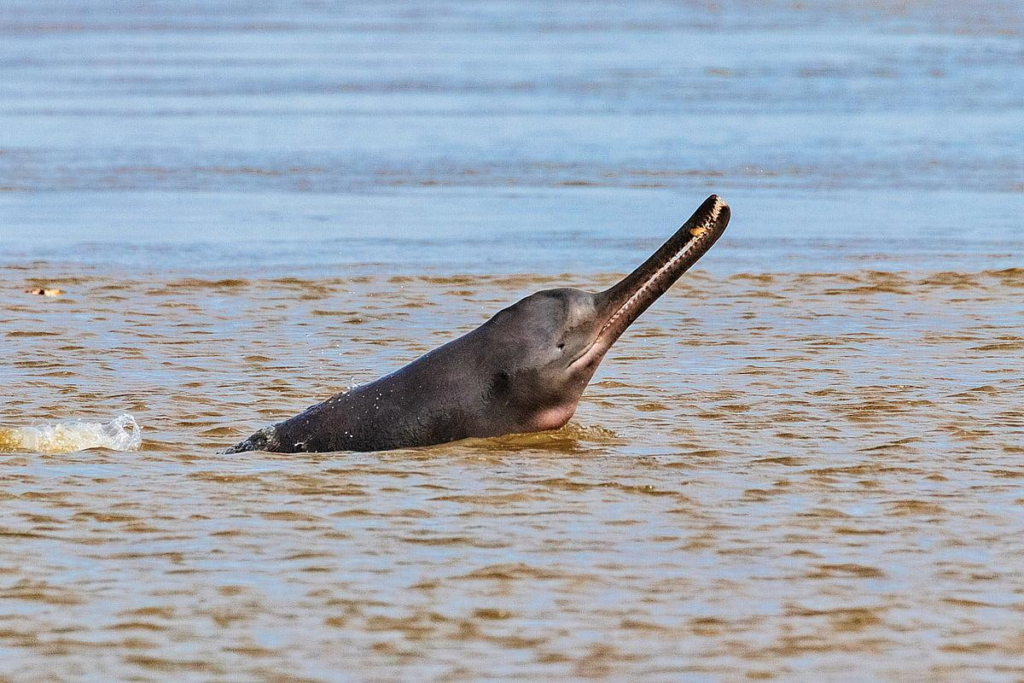
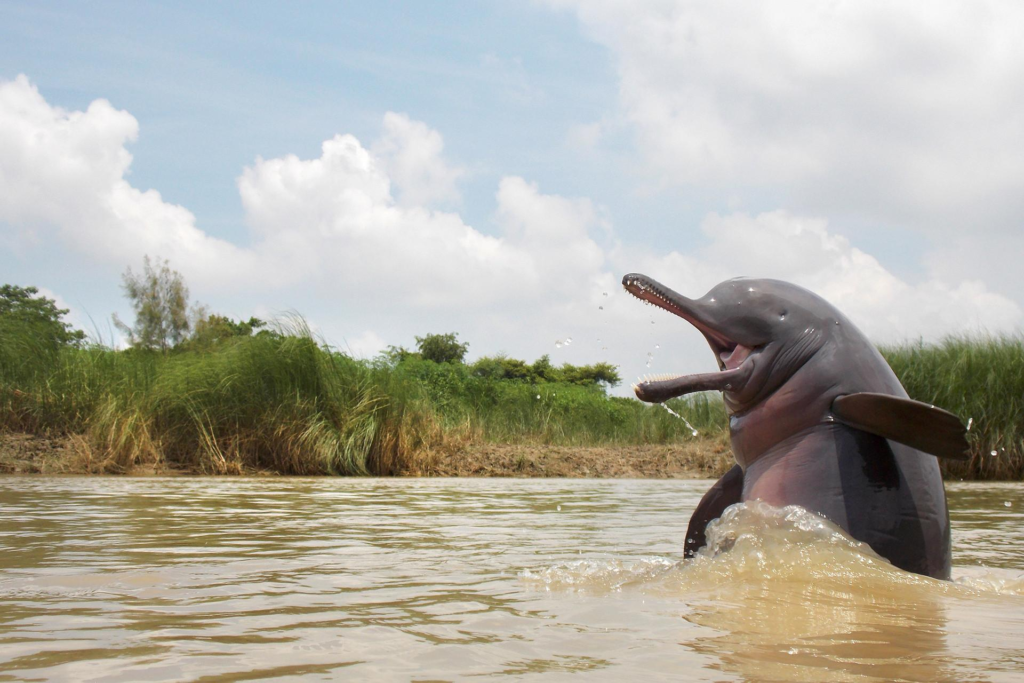
A long, slender snout, rounded forehead, stocky body and broad flippers distinguish this dolphin from more familiar marine species. Its small eyes are poorly suited to forming detailed images, but its sophisticated acoustic abilities allow it to navigate and find prey in water carrying suspended silt.
The Gangetic River Dolphin belongs to an ancient evolutionary lineage. Its survival depends not on clear water or spectacular leaps above the surface, but on the continued functioning of the river environment beneath it.
For the Sundarbans, an important distinction must be made: the dolphin’s historical association with the lower Ganges and Hooghly does not establish that it currently occupies the Indian Sundarbans’ tidal waterways. A regional study found evidence of a substantial range contraction, with possible persistence confined to the westernmost lower Hooghly during the study period. Current occupancy requires updated field verification.
Gangetic River Dolphin at a Glance
| Feature | Details |
| Common name | Gangetic River Dolphin |
| Other names | Ganges River Dolphin, Ganges Susu, Blind River Dolphin |
| Scientific name | Platanista gangetica |
| Family | Platanistidae |
| Class | Mammalia |
| Order | Cetartiodactyla |
| Conservation status | Endangered (IUCN Red List assessment) |
| Distribution | River systems of India, Bangladesh and Nepal; taxonomy and range treatments vary by source |
| Habitat | Freshwater rivers and suitable river channels |
| Diet | Mainly fish, with other aquatic prey reported |
| Distinctive adaptation | Echolocation in turbid water |
| Reproduction | Usually one calf at a time; birth intervals reported at approximately two to three years |
| National significance | National Aquatic Animal of India |
| Sundarbans significance | Historically documented in the delta; contemporary presence in the Indian Sundarbans requires careful verification |
Scientific Classification and Naming
| Classification | Scientific placement |
| Kingdom | Animalia |
| Phylum | Chordata |
| Class | Mammalia |
| Order | Cetartiodactyla |
| Family | Platanistidae |
| Genus | Platanista |
| Species | Platanista gangetica |
Natural Distribution Across South Asia
The Gangetic River Dolphin evolved in a river landscape shaped by monsoon rainfall, seasonal flooding, sediment transport and changing water levels. Its distribution historically extended through parts of the Ganges–Brahmaputra–Meghna and Karnaphuli–Sangu river systems.
Today, its populations are distributed unevenly. Dams, barrages, altered river flows, pollution and other human pressures have fragmented suitable habitat, leaving dolphins in separate stretches of river rather than one continuous population.
This fragmentation matters because dolphins need more than water in which to swim. They require adequate depth, prey, suitable channel conditions and opportunities to move between habitats. A river can remain visibly full while becoming less useful to a freshwater cetacean.
The Gangetic River Dolphin and the Indian Sundarbans
The Indian Sundarbans occupy the southern delta of West Bengal, where freshwater discharge meets tidal influence. The landscape is a shifting network of distributaries, estuarine channels, mudbanks, islands and mangrove-lined creeks.
Historically, river dolphins were recorded in the wider lower Ganges delta, including waterways associated with the Hooghly. A scientific paper examining observations and survey reports from 2011–2016 raised concern that the Gangetic River Dolphin had disappeared from most major waterways of the Indian Sundarbans. The authors identified anthropogenic and geo-climatic factors as potential contributors, while suggesting that the westernmost lower Hooghly might have retained the species.
This is an important historical finding, not proof of the dolphin’s present-day absence from every part of the region. The available evidence cited here does not establish a comprehensive, current population estimate for the Indian Sundarbans.
The distinction between the Indian and Bangladeshi portions of the Sundarbans is equally important. The wider transboundary mangrove system supports documented populations of Gangetic River Dolphins in Bangladesh. A Marine Mammal Protected Areas Task Force assessment identifies the Bangladeshi Sundarbans as significant habitat, drawing on earlier research and regional counts. Those figures cannot be transferred to the Indian side.
Why Freshwater Matters in a Tidal Landscape
The Gangetic River Dolphin is a freshwater specialist. Its presence depends on the relationship between river discharge, water depth, prey availability and the quality of the channels it occupies.
In the lower delta, tides can reverse the direction of surface flow, while freshwater discharge varies with season and upstream water management. Salinity also changes along the estuarine gradient. These conditions create a complex boundary between freshwater river habitat and increasingly saline estuarine water.
For the Gangetic River Dolphin, the critical question is not whether a channel is tidal, but whether it maintains conditions suitable for this freshwater-dependent mammal.
Reduced freshwater flow can allow saline influence to extend farther inland, alter fish communities and affect the availability of suitable habitat. In the Indian Sundarbans, research into the dolphin’s historical decline has specifically examined freshwater conditions and changing salinity among the possible explanatory factors.
The mangrove forest and the dolphin are connected through the wider river system, but they do not have identical habitat requirements. A channel suitable for an estuarine dolphin is not automatically suitable for the Gangetic River Dolphin.
Ecological Importance
The Gangetic River Dolphin is a predator within its freshwater food web. By feeding on fish and other aquatic prey, it forms part of the ecological relationships connecting river channels, fish populations and the wider freshwater ecosystem.
Its presence can also provide useful information about river conditions. Dolphin monitoring requires attention to water depth, channel structure, prey availability, disturbance and the quality of the surrounding habitat. In this sense, conservation of the species can help focus attention on the health of the river system as a whole.
The dolphin’s ecological importance does not mean that every river containing dolphins is pristine, or that dolphin presence alone can measure water quality. Rather, it is a sensitive conservation subject whose needs reveal how multiple pressures affect aquatic wildlife.
A Body Shaped by Underwater Survival
The Gangetic River Dolphin has a long, narrow rostrum, a rounded forehead, a robust body and large flippers. Its smooth, grey-brown skin lacks the conspicuous markings found in some other dolphin species. Calves are reported to be darker, with a chocolate-brown appearance.
Its shape reflects a life spent navigating rivers rather than travelling across open ocean. A flexible body and powerful tail help it move through channels with changing currents, while its flippers contribute to manoeuvring in confined spaces.
Its external appearance can seem unusual to observers accustomed to bottlenose dolphins. The extended snout, small eyes and less prominent dorsal profile are part of the animal’s distinctive anatomy, not signs of injury or deformity.
Why Its Eyesight Is Limited
The Gangetic River Dolphin is often described as blind, but this familiar label requires qualification. Its eyes are extremely reduced and provide limited visual information compared with those of many other dolphins. It relies heavily on sound to understand its surroundings.
River water often carries fine sediment that reduces visibility. In such conditions, detailed vision would be of limited use for locating small prey at close range. Echolocation offers a more effective means of detecting objects in the water column and near the riverbed.
The dolphin’s small eyes are therefore part of a broader sensory system adapted to underwater life. Its survival depends on the interaction between hearing, sound production, movement and the physical structure of the river.
Echolocation: Navigating a World of Sound
The Gangetic River Dolphin produces high-frequency sounds that travel through water and return as echoes when they encounter fish or other objects. By interpreting these returning signals, it can detect prey and orient itself in surroundings where visibility is poor.
This ability is particularly relevant in turbid rivers. Suspended silt, changing depths and irregular channel boundaries can make the underwater environment difficult to navigate visually. Sound provides information that the dolphin can use to locate food and move through its habitat.
Echolocation should not be confused with a perfect underwater map. River channels are acoustically complex, and the quality of information available to an animal can vary with its surroundings. Research on river dolphins has examined how they use sound in shallow, acoustically complicated habitats.
For scientists, acoustic behaviour is both a biological adaptation and a potential subject of conservation research.
The Distinctive Sideways Swimming Behaviour
One of the most unusual characteristics reported for the Gangetic River Dolphin is its tendency to swim on one side, allowing a flipper to trail close to the muddy bottom. The Wildlife Institute of India notes that this behaviour is understood to assist in finding food.
In a river where visibility is poor and prey may be distributed near the bottom, close contact with the underwater terrain can be useful. The behaviour is especially striking because it differs from the upright swimming style most people associate with dolphins.
However, it should not be assumed that every individual always swims sideways, or that the same movement has been documented in every habitat. It is a reported foraging-related behaviour rather than a universal description of every movement.
What Does the Gangetic River Dolphin Eat?
See it for yourself
A private journey shaped around you — your group, your pace, your interests. Book a free consultation.
Fish form a major part of the Gangetic River Dolphin’s diet. Its feeding ecology is tied to the fish communities of the rivers it inhabits, making prey availability an important factor in habitat suitability.
The dolphin does not need clear water to hunt. Instead, its echolocation allows it to detect prey in conditions where vision is restricted. Its elongated snout and underwater sensory abilities work together as part of its feeding strategy.
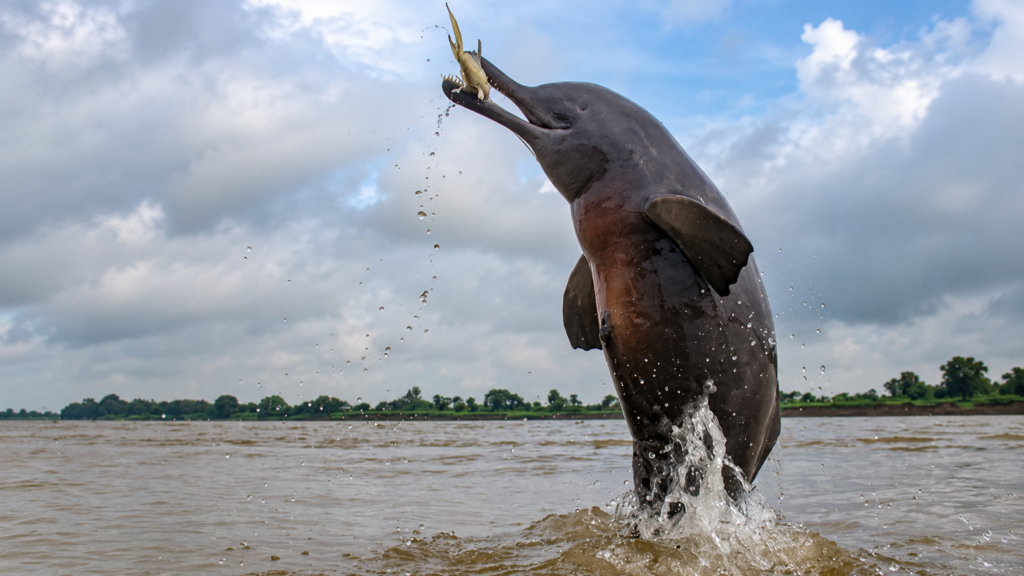
A healthy river must provide more than sufficient water volume. It must support aquatic food webs, including fish populations, and maintain the channel conditions that allow a predator to forage.
Fishing pressure can affect this relationship in two ways: it may reduce the availability of prey, and fishing gear can entangle dolphins directly. These are separate problems, requiring both ecosystem-level management and practical measures to reduce accidental capture.
Breathing in an Aquatic World
Although the Gangetic River Dolphin spends its life underwater, it is a mammal and must breathe air. Its blowhole sits on top of its head, allowing it to surface briefly to inhale and then return below the water.
The Wildlife Institute of India reports that surfacing may occur every 30–120 seconds, although breathing intervals vary with activity and conditions.
The sound associated with breathing is one reason the animal is known as susu in local usage. In a quiet stretch of river, a brief surfacing movement or audible breath may reveal the dolphin’s presence when the rest of its body remains hidden.
Movement Through Rivers and Seasonal Water
River dolphins do not occupy every part of a river equally. Depth, current, channel shape, fish availability and seasonal water levels influence where they can travel and feed.
The Wildlife Institute of India notes that Gangetic River Dolphins may move upstream when water levels rise and enter smaller streams. Such movements are not simply wanderings: seasonal changes can open access to feeding areas and alter the availability of suitable channels.
Barriers can interrupt these movements. Dams and barrages divide river systems into separate stretches, while reduced dry-season flow can leave some channels too shallow or otherwise unsuitable.
For a species whose habitat follows the river network, connectivity is fundamental. A collection of isolated water bodies cannot necessarily replace a functioning river system.
Adaptation to the Sundarbans: An Important Qualification
The Gangetic River Dolphin should not be described as a mangrove specialist in the same way that the Fishing Cat is associated with wetlands or the Royal Bengal Tiger is associated with the wider Sundarbans landscape.
Its defining adaptation is to freshwater river life. Historically, the lower delta connected it to the Sundarbans, but increasing salinity and altered freshwater conditions may constrain where it can persist.
This distinction prevents a common ecological error: assuming that because an animal once occurred within a mangrove region, it must be adapted to every estuarine condition found there.
The Gangetic River Dolphin’s story in the Indian Sundarbans is partly a story of habitat limits. Its needs illustrate why freshwater flow matters even in a landscape widely recognised for tidal channels and saline mangroves.
A Quiet and Elusive River Mammal
Gangetic River Dolphins are frequently encountered alone or in small groups. A mother and calf may travel together, while larger gatherings can occur under particular habitat conditions. Their social behaviour should not be interpreted through the behaviour of more familiar, highly social oceanic dolphins.
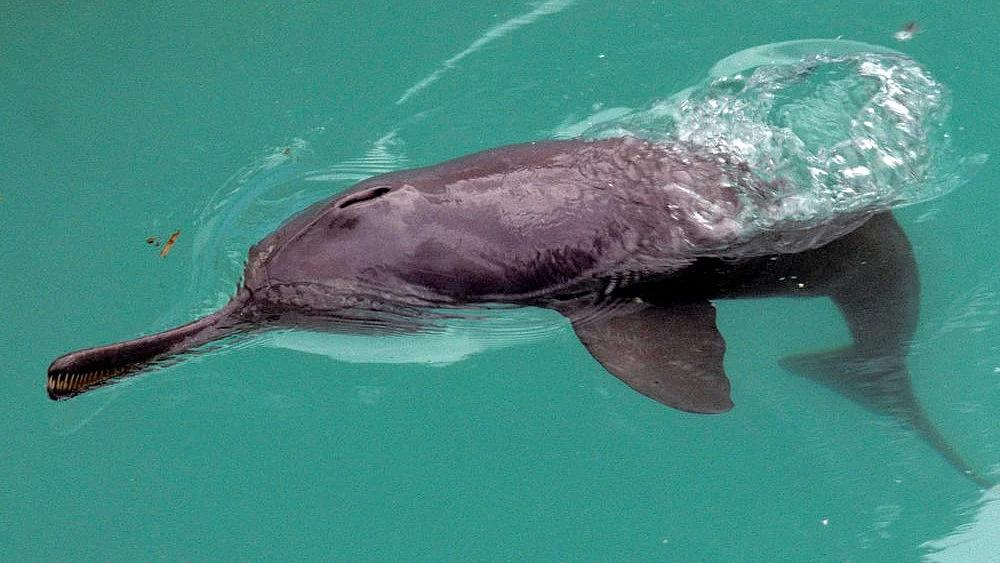
In turbid rivers, the animal may be present without being readily visible. It may surface briefly, move below the water again and continue feeding without producing a dramatic display.
For researchers, this makes repeated surveys and consistent observation methods more valuable than isolated encounters.
Reproduction and the Next Generation
Gangetic River Dolphins give birth to live young and nurse their calves. The Wildlife Institute of India reports that females give birth to a single calf at intervals of approximately two to three years. Females are generally larger than males.
A calf enters a world where survival depends on its mother’s care and the availability of suitable river habitat. As it grows, it must develop the sensory and feeding abilities needed to navigate turbid water, locate prey and move through changing currents.
The relatively slow reproductive cycle means that losses cannot necessarily be offset quickly. When adult dolphins die through entanglement or other human pressures, protecting the remaining population becomes especially important.
Detailed information about breeding behaviour and calf survival remains incomplete across parts of the species’ range. Precise reproductive statistics should therefore be applied cautiously, especially when discussing the population historically associated with the Indian Sundarbans.
Communication Beneath the Surface
Sound plays a central role in the dolphin’s life. Echolocation helps it detect prey and navigate, while its breathing sounds can make its presence noticeable to people above water.
The underwater environment is not acoustically empty. Currents, boat engines, fishing activity and other river sounds can contribute to a complex soundscape.
Vessel noise is recognised among the pressures affecting river dolphins. Excessive disturbance may interfere with the acoustic environment on which these animals depend, although the impact varies with the type, intensity and duration of the noise.
Protecting the species therefore involves more than preventing direct killing. It also means considering how human activity changes the conditions in which the animal hunts, moves and communicates.
Relationships With Other River Wildlife
The Gangetic River Dolphin occupies a different ecological niche from many animals encountered in the Sundarbans.
| Wildlife group | Ecological relationship |
| Freshwater fish | Important prey and a foundation of the dolphin’s feeding ecology |
| Other aquatic predators | May share river habitat while using different feeding strategies |
| Estuarine dolphins | Can occur in the wider deltaic region, but have different ecological requirements |
| Humans | Share waterways through fishing, transport, water management and other river-dependent activities |
The distinction between the Gangetic River Dolphin and the Irrawaddy Dolphin is particularly important in the Sundarbans. Both species have been documented in the wider transboundary mangrove region, but they differ in their ecological requirements and distribution. The Gangetic River Dolphin is freshwater-dependent, whereas Irrawaddy Dolphins occupy coastal and estuarine waters as well as some freshwater environments.
A dolphin observed in an estuarine channel should therefore not automatically be identified as a Gangetic River Dolphin. Accurate identification is essential for reliable wildlife records.
Fishing Communities and Shared Waterways
Rivers in southern West Bengal are working landscapes. They support fishing, boat transport, local livelihoods and connections between settlements. Wildlife conservation must recognise these everyday uses rather than treating human presence as inherently incompatible with biodiversity.
Fishing gear presents a genuine danger to Gangetic River Dolphins. Animals can become entangled in nets and drown, while intensive fishing can also affect prey availability. Other pressures include water pollution, vessel traffic and changes caused by river infrastructure.
Reducing these risks requires cooperation among wildlife authorities, fisheries departments, researchers and fishing communities. Practical measures may include identifying dangerous gear and locations, improving reporting of accidental captures, reducing pollution and designing local solutions that protect both wildlife and livelihoods.
Local observations can also contribute valuable information. Fishers and boat operators may notice unusual surfacing events, stranded animals or changes in wildlife distribution. Such reports become most useful when they are recorded consistently and verified by trained observers.
When a Dolphin Is No Longer Seen
The apparent disappearance of a species from part of its historical range is not always easy to explain. An animal may become rare, move into another suitable area or become difficult to detect. In other cases, habitat conditions may deteriorate until the local population can no longer persist.
The study of the Gangetic River Dolphin in the Indian Sundarbans highlights this uncertainty. Mitra and Roy Chowdhury examined historical records and observations from 2011–2016 and reported a possible range contraction associated with human and environmental changes.
This is an example of local extirpation: the disappearance of a species from a particular area without the species becoming extinct everywhere.
It is not the same as global extinction, and it should not be confused with a confirmed absence based on a single unsuccessful survey. Establishing the current status requires renewed surveys, reliable identification and sufficient coverage of suitable habitat.
For the Indian Sundarbans, this distinction is essential. A historical record proves that an animal occurred in a region; it does not establish that a viable population remains there today.
Why Is the Gangetic River Dolphin Endangered?
The Gangetic River Dolphin is listed as Endangered on the IUCN Red List. Its conservation challenges include the fragmentation and degradation of river habitat, accidental capture in fishing gear, pollution and changes to freshwater flow.
These threats often interact. Reduced river flow may alter depth and fish distribution. Barriers can restrict movement between feeding areas. Pollution can degrade aquatic habitat, while fishing pressure may reduce prey and increase the risk of entanglement.
The result is a species whose future depends on the condition of entire river systems rather than isolated stretches of water.
The Main Threats to Its Survival
| Threat | Potential ecological effect |
| Dams and barrages | Fragment river habitat and restrict movement |
| Reduced freshwater flow | Alter depth, current and suitable habitat |
| Salinity changes in the lower delta | May limit freshwater-dependent populations |
| Fishing gear | Cause accidental entanglement and drowning |
| Pollution | Degrade aquatic habitat and affect prey species |
| Vessel activity | Create noise and disturbance |
| Prey depletion | Reduce available food |
| Climate change and sea-level rise | May alter freshwater–salinity boundaries and estuarine conditions |
These pressures are documented across the species’ wider range. Their relative importance varies among rivers, so it would be misleading to assume that every threat operates with equal intensity in every part of the Sundarbans.
Freshwater Flow and the Changing Delta
The Sundarbans is a dynamic delta, shaped by sediment movement, tidal exchange, freshwater discharge and coastal processes. Its ecological conditions are also affected by upstream water management and changing climatic conditions.
For a freshwater-dependent dolphin, the quantity and seasonal distribution of river discharge matter greatly. A reduction in freshwater influence can alter the salinity gradient and the distribution of aquatic prey.
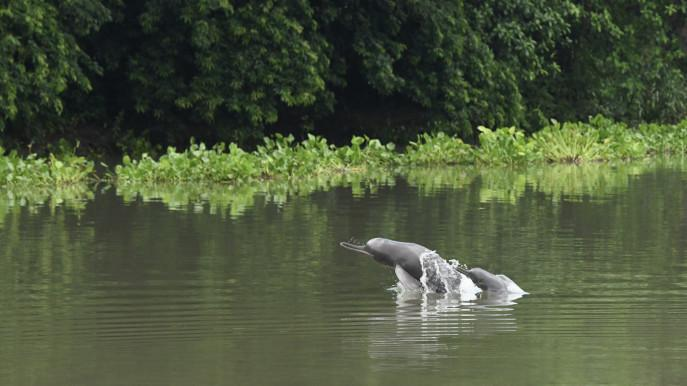
Research on the Indian Sundarbans has investigated changes in salinity and their possible relationship with the historical decline of the Gangetic River Dolphin. However, a complex ecological change should not be attributed to one factor alone. The species’ distribution may reflect the combined effects of freshwater availability, habitat alteration, prey conditions and direct human pressures.
Climate change and sea-level rise add another layer of uncertainty. They can influence the balance between freshwater and saline water in deltaic channels, although the exact consequences for individual dolphin populations require local evidence.
Conservation planning must therefore consider the river system upstream as well as the mangrove landscape downstream.
How Scientists Monitor River Dolphins
Monitoring a species that spends most of its life underwater requires methods designed for rivers with limited visibility.
| Monitoring method | Purpose |
| Boat-based visual surveys | Record surfacing dolphins and estimate encounter rates |
| Repeated channel surveys | Compare observations across seasons and years |
| Acoustic research | Investigate sound production, echolocation and underwater activity |
| Photo and video documentation | Support identification and verify sightings |
| Stranding and mortality records | Document deaths, injuries and potential causes |
| Habitat assessment | Measure channel conditions, water depth, flow and other relevant variables |
| Fishery interviews | Gather information about accidental captures and local observations |
| Water-quality monitoring | Assess environmental conditions relevant to aquatic life |
No single method provides a complete picture. Visual surveys can miss animals that remain submerged, while acoustic detections require careful interpretation and suitable equipment.
Population estimates also depend on survey coverage and methodology. Counts from the Bangladeshi Sundarbans, for example, cannot be used as an estimate for the Indian Sundarbans.
For this reason, any claim that the Gangetic River Dolphin has returned to a particular Indian channel should be supported by a verifiable observation or an appropriate scientific survey.
Conservation Measures That Can Make a Difference
Protecting the Gangetic River Dolphin requires a coordinated approach to river management and wildlife conservation.
- Maintain suitable river flow. Environmental planning should consider the seasonal water requirements of freshwater wildlife.
- Reduce accidental capture. Work with fishing communities to identify dangerous gear, improve reporting and develop locally appropriate mitigation.
- Improve water quality. Reduce untreated sewage, industrial discharge and agricultural pollutants entering rivers.
- Protect river connectivity. Assess the effects of barriers and water-management infrastructure on dolphin movement.
- Monitor changing habitat. Track salinity, depth, prey availability and the condition of important channels.
- Strengthen cross-border cooperation. River systems and wildlife populations do not follow political boundaries.
- Support reliable research. Repeated surveys and transparent reporting can distinguish genuine population changes from gaps in observation.
India has recognised the importance of river-dolphin conservation through government programmes and legal protection. The Wildlife Institute of India has also been involved in developing conservation approaches for dolphins and their river habitats.
Conservation must address the needs of people who depend on these same waterways. Durable solutions are more likely when ecological protection and local livelihoods are considered together.
Where Can the Gangetic River Dolphin Be Observed in the Sundarbans?
The answer requires caution.
The Gangetic River Dolphin was historically documented in the lower Ganges delta, and the 2018 study by Mitra and Roy Chowdhury identified the lower Hooghly as a possible area of continued occurrence at the time of their research. However, that study’s observations covered 2011–2016 and do not independently confirm current occupancy.
The following distinctions are useful when interpreting reports:
| Area or region | Evidence and interpretation |
| Lower Hooghly River | Historically associated with the species; the 2018 study suggested possible persistence in its westernmost lower reaches during the study period |
| Major waterways of the Indian Sundarbans | The 2018 study reported evidence of substantial range contraction; current distribution needs verification |
| Bangladeshi Sundarbans | Documented Gangetic River Dolphin habitat, with research reporting significant populations in the wider tidal-waterway system |
No particular Indian Sundarbans watchtower, creek, island or expedition route should be promoted as a reliable Gangetic River Dolphin sighting location without current, species-specific evidence. The presence of other dolphins in the same waterways is not sufficient confirmation.
For The Wild Orbit, responsible wildlife interpretation means presenting the historical record honestly while recognising the need for updated research.
The Important Truth About Wildlife Sightings
Wildlife observation is unpredictable, particularly when the animal lives underwater. Even in a well-documented habitat, a dolphin may remain submerged or move through a channel without being detected.
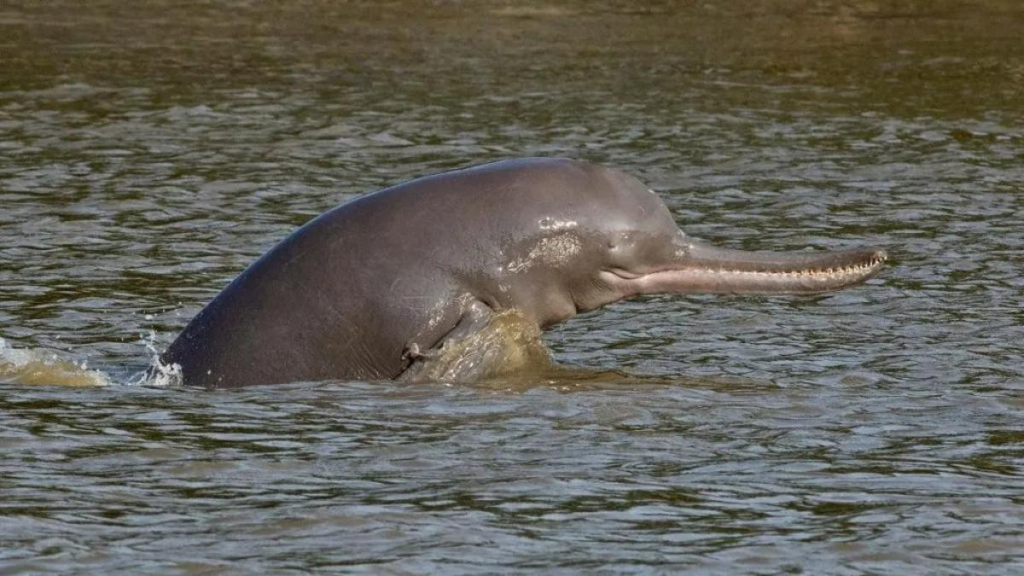
An unsuccessful survey does not automatically prove absence. Equally, a single unverified report does not establish a resident population.
The most responsible approach is to distinguish confirmed observations from historical records, possible occurrence and suitable habitat. This distinction is especially important for the Gangetic River Dolphin in the Indian Sundarbans, where evidence of historical decline makes contemporary verification a conservation priority.
What Makes the Sundarbans Gangetic River Dolphin Unique?
The Gangetic River Dolphin is distinctive in the Sundarbans story because it represents the ecological connection between a great freshwater river system and a tidal mangrove delta.
Its presence in the wider lower Ganges region demonstrates that the delta’s wildlife cannot be understood through mangrove habitat alone. River discharge, seasonal flooding, fish communities and salinity gradients help determine which aquatic mammals can occupy different channels.
The historical decline reported in the Indian Sundarbans adds another dimension. It raises questions about what happens when the environmental conditions that once supported a freshwater species change within a landscape that remains rich in other wildlife.
Several features make this relationship particularly important:
| Key Factor | Significance for the Gangetic River Dolphin in the Sundarbans |
| Freshwater Dependence | The dolphin’s ecological requirements differ from those of animals adapted to more saline estuarine waters. |
| A Changing River Boundary | The lower delta is shaped by freshwater discharge, tidal exchange and salinity gradients. |
| A Historical Range Warning | Scientific research indicates a possible substantial contraction within the Indian Sundarbans. |
| A Transboundary Conservation Connection | The wider Sundarbans supports documented populations in Bangladesh, demonstrating the importance of protecting aquatic habitat across the delta. |
| An Indicator of Ecological Change | The species’ distribution draws attention to river connectivity, water quality and the availability of suitable freshwater habitat. |
The important point is not that this dolphin has evolved a special ability to thrive in saline mangroves. It is that its history reveals the limits of freshwater wildlife in a changing delta.
Myths and Facts About the Gangetic River Dolphin
| Myth | Fact |
| All dolphins live in the sea. | The Gangetic River Dolphin is a freshwater cetacean. |
| It is completely blind. | Its eyesight is extremely limited, and it relies heavily on echolocation. |
| Every dolphin seen in the Sundarbans is a Gangetic River Dolphin. | The region supports other dolphin species, including the Irrawaddy Dolphin. |
| Historical records prove the species still lives throughout the Indian Sundarbans. | Historical occurrence and current occupancy are different questions. |
| A dolphin’s presence alone proves a river is pollution-free. | Its presence provides ecological information but is not a complete measure of water quality. |
FAQs
What is the Gangetic River Dolphin?
The Gangetic River Dolphin (Platanista gangetica) is an endangered freshwater dolphin native to South Asian river systems. It uses echolocation to navigate and locate prey in often turbid water.
Is the Gangetic River Dolphin found in the Sundarbans?
The species has historical records in the wider lower Ganges delta. A 2018 study reported a substantial range decline in the Indian Sundarbans, so its current distribution there requires updated verification.
Is the Gangetic River Dolphin endangered?
Yes. The IUCN Red List classifies the species as Endangered. Habitat fragmentation, fishing-gear entanglement, pollution and changes to river flow are among its major threats.
Why is the Gangetic River Dolphin called Susu?
Susu is a commonly used local name associated with the sound the dolphin makes when it surfaces to breathe. Local names vary across the species’ range.
What does the Gangetic River Dolphin eat?
Its diet consists mainly of fish, with other aquatic prey also reported. It uses echolocation to find food in water where visibility is often poor.
Why is its eyesight so limited?
The dolphin has highly reduced eyes and depends heavily on acoustic information. Echolocation helps it navigate and locate prey in turbid river water.
Can the Gangetic River Dolphin live in seawater?
It is a freshwater-dependent species. Salinity and freshwater availability are important factors influencing its distribution, particularly in deltaic environments.
How is the Gangetic River Dolphin different from the Irrawaddy Dolphin?
The Gangetic River Dolphin is adapted to freshwater river systems, while the Irrawaddy Dolphin occurs in coastal and estuarine waters as well as some freshwater habitats. Both have been documented in the wider Sundarbans region.
What threatens the Gangetic River Dolphin?
Major threats include dams and barrages, altered river flow, fishing-gear entanglement, pollution, prey depletion and vessel disturbance. The relative importance of these threats varies across its range.
Can visitors reliably see a Gangetic River Dolphin in the Indian Sundarbans?
There is insufficient evidence here to identify a reliable present-day sighting location in the Indian Sundarbans. Historical records should not be presented as a guarantee of current sightings.
The Wild Orbit Perspective
The Sundarbans is often understood through its mangroves, tigers, estuarine wildlife and shifting tidal channels. Yet the story of the Gangetic River Dolphin reminds us that the delta is also shaped by the freshwater systems that reach it from far upstream.
A river can continue to flow while its ecological character changes. Its channels may remain navigable, its banks may remain green with mangroves, and its waters may continue to support abundant wildlife, even as the conditions required by a particular species become harder to find.
The Gangetic River Dolphin makes that change visible through the questions its distribution raises. Where does freshwater remain suitable? How are river habitats connected? What happens when water management, pollution and changing salinity combine to alter the living conditions of an aquatic mammal?
For conservation, these questions matter as much as any individual sighting. Protecting a river dolphin means protecting the functioning river system on which it depends, while working with the communities whose lives are intertwined with those waters.
The future of the Gangetic River Dolphin in the Indian Sundarbans will depend on reliable research, healthier waterways and a willingness to recognise ecological change before it becomes irreversible.
Sometimes, the most important wildlife story is not the animal we see on the water, but the one whose absence asks us to look more closely at the river beneath it.
Plan your private Sundarban expedition
A private journey shaped around you — your group, your pace, your interests. Book a free consultation.