 Field guide
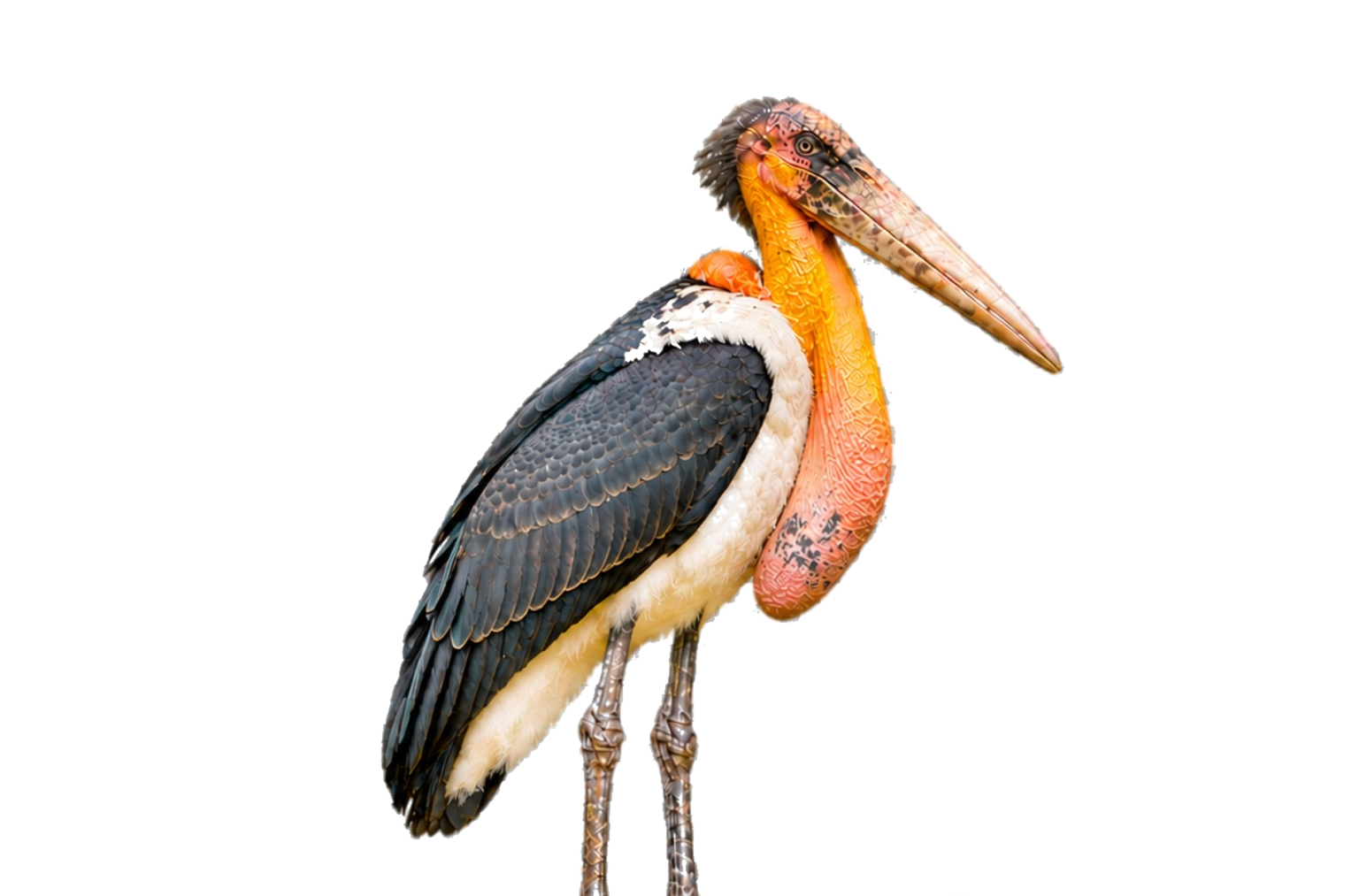
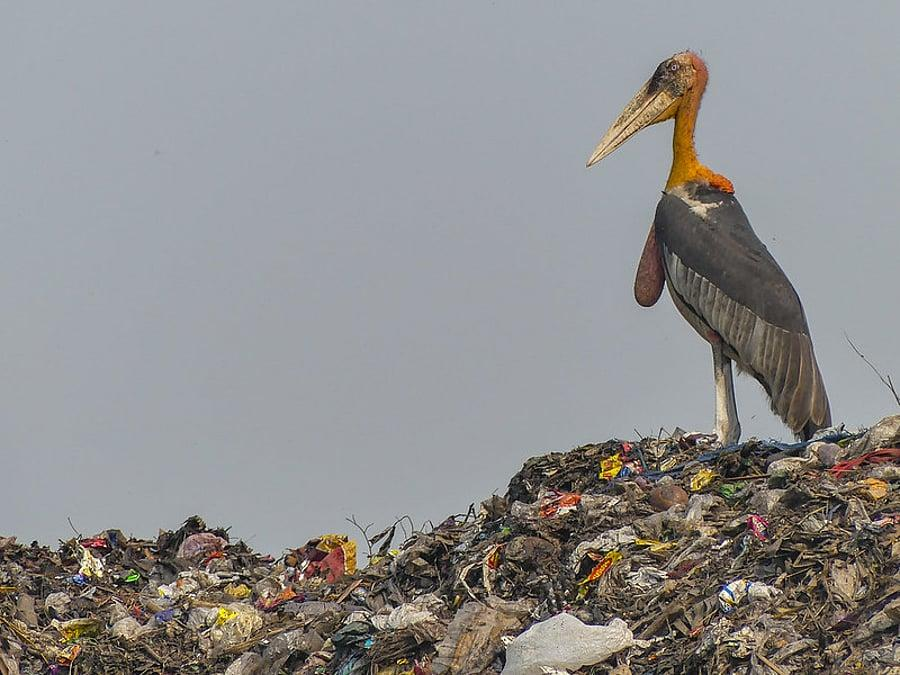
Among the world’s great storks, few possess a silhouette as unmistakable as the Greater Adjutant (Leptoptilos dubius). Standing nearly as tall as an adult human, with exceptionally long legs, a massive wedge-shaped bill, a largely featherless head and a conspicuous hanging throat pouch, it is a bird that commands attention even at a considerable distance.
Yet its story is not simply one of impressive anatomy. It is also a story of ecological change, disappearing nesting colonies and the complicated relationship between wildlife and human settlements.
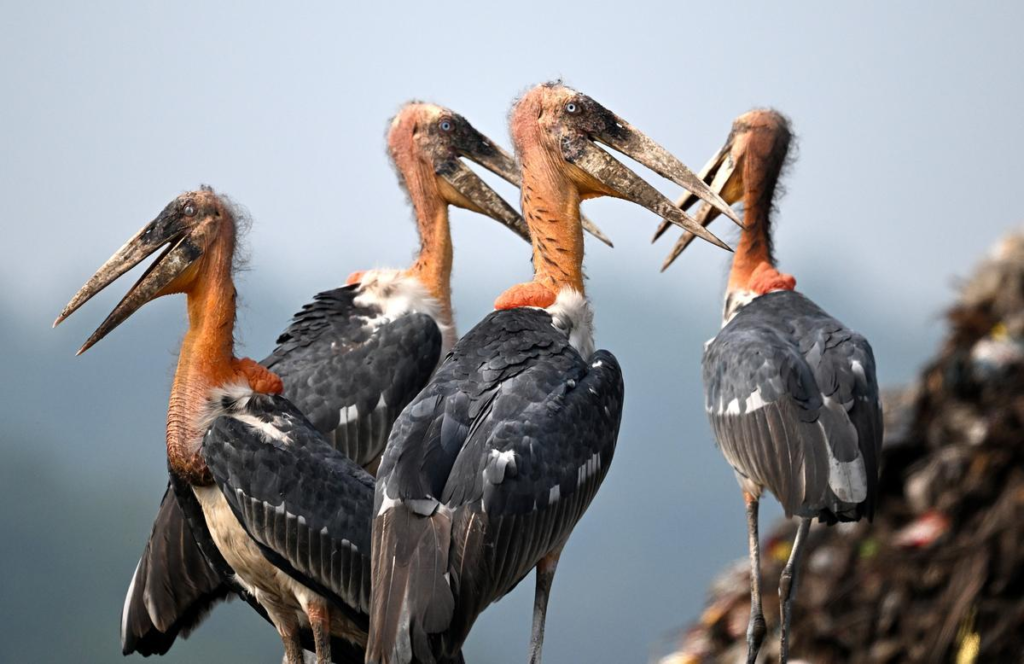
The Greater Adjutant once occupied a much wider area across South and Southeast Asia. Bengal was an important part of its historical distribution. Nineteenth-century naturalists recorded large numbers around Calcutta, while historical ornithological accounts documented breeding colonies in the wider Sundarbans landscape.
Today, however, its distribution is dramatically reduced. Its principal surviving populations are associated with northeastern India and Cambodia, with an additional breeding population established in Bihar.
For the Indian Sundarbans, this distinction matters. The species belongs to the region’s natural-history record, but historical occurrence should not be confused with evidence of a thriving contemporary population.
The Greater Adjutant is therefore an especially interesting bird through which to understand the changing ecology of Bengal’s wetlands.
Greater Adjutant at a Glance
| Field | Information |
| Common name | Greater Adjutant |
| Scientific name | Leptoptilos dubius |
| Order | Ciconiiformes |
| Family | Ciconiidae |
| Genus | Leptoptilos |
| Scientific authority | (Gmelin, 1789) |
| Global conservation status | Near Threatened (IUCN, 2023) |
| Indian legal protection | Schedule I, Wildlife (Protection) Act, as reported by State of India’s Birds |
| Global population | Estimated 1,360–1,510 mature individuals |
| Population trend | Increasing globally |
| Principal Indian populations | Assam and Bihar |
| Historical Bengal association | Documented around Calcutta and in historical Sundarbans accounts |
| Present Indian Sundarbans status | Historical association; contemporary local population not established by the sources reviewed |
| Habitat | Wetlands, marshes, open landscapes and human-modified feeding grounds |
| Diet | Carrion, fish, amphibians, reptiles, crustaceans and other animals |
| Identification | Huge stork, massive bill, bare head, pendulous throat pouch and dark upperparts |
Distribution: From Bengal to a Much Smaller Range
Historically, the Greater Adjutant was distributed across parts of India, Bangladesh and Southeast Asia. Its range included extensive wetlands, floodplains and open landscapes where food was readily available.
Bengal was particularly significant.
Accounts from the nineteenth century describe the bird gathering on buildings in Calcutta, including Government House and the Park Street cemetery. One historical account even described more than a hundred birds on Government House during the rainy season.
These were not isolated associations with a distant landscape. The Greater Adjutant was once a recognizable component of Bengal’s urban and wetland ecology.
Its decline subsequently transformed its distribution.
According to BirdLife International’s 2023 assessment, the remaining global population is concentrated in two principal subpopulations: northeastern India and Cambodia. In India, the established breeding populations are associated with Assam and Bihar.
Is the Greater Adjutant Found in the Indian Sundarbans?
This question requires particular care.
The historical ornithological literature records Greater Adjutants in the wider Sundarbans region, including accounts of breeding colonies. BirdLife International’s historical Red Data Book documents records from the Sundarbans, including reports of approximately 50 pairs in January 1883.
However, the geographical references in that historical account specifically include the southeastern Sundarbans and Morellgunj, now in Bangladesh. They cannot automatically be treated as records from the Indian Sundarbans.
The same publication describes the former Sundarbans breeding colony as defunct.
A 2024 commercial publication titled Birds of Sundarbans National Park also includes the Greater Adjutant in its species checklist, marking it with the letter B. However, the table does not provide a dated observation, precise locality or supporting breeding documentation. Its conservation category is also outdated compared with the 2023 IUCN assessment.
The 2024 peer-reviewed checklist of West Bengal birds includes the Greater Adjutant, but statewide inclusion does not establish contemporary occurrence within Sundarbans National Park.
The scientifically responsible conclusion: The Greater Adjutant has a genuine historical association with Bengal and the wider Sundarbans, but the available evidence reviewed here does not establish a present-day resident or breeding population in the Indian Sundarbans. A recent, independently verifiable local sighting would be valuable evidence.
This distinction is important for wildlife documentation. A species can belong to a landscape’s historical natural history without necessarily being part of its regularly observed contemporary birdlife.
Habitat and Ecological Context
The Greater Adjutant is not exclusively a mangrove bird. Its ecology is associated with a wider combination of wetlands, open habitats and human-modified landscapes.
It uses marshes, shallow wetlands, floodplains and other productive feeding grounds. It can also exploit slaughterhouse surroundings, refuse disposal sites and other locations where animal remains are available.
This flexibility has helped the species survive in landscapes where natural feeding opportunities have changed.
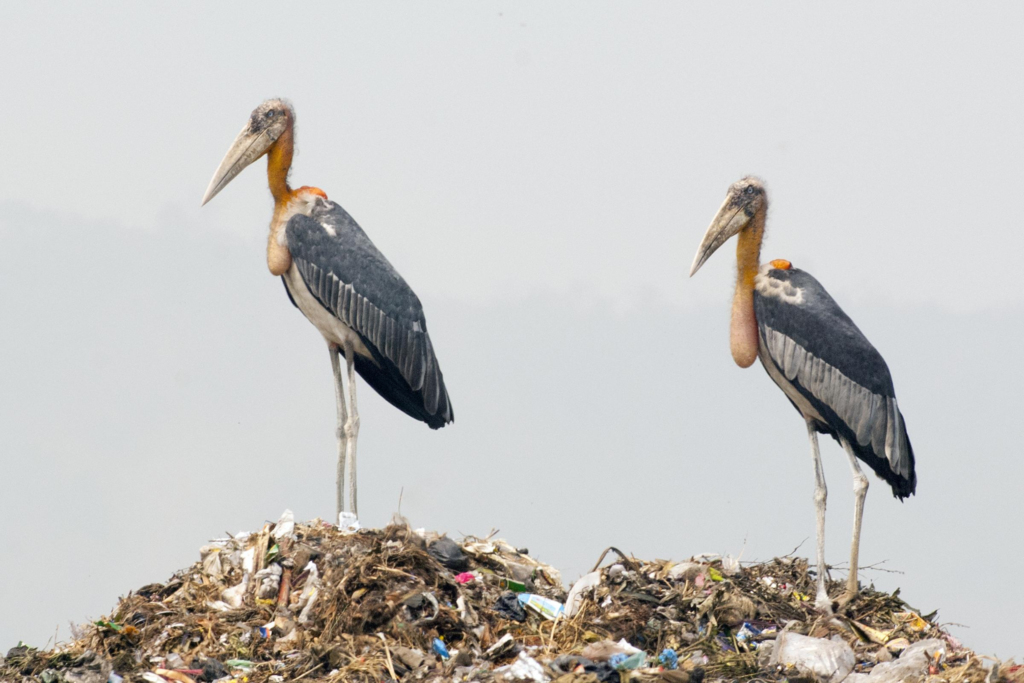
The Indian Sundarbans contains an extensive mosaic of tidal rivers, creeks, mudflats, islands, agricultural settlements and wetlands. Some of these habitats may provide feeding opportunities for large storks, but habitat suitability alone cannot establish the presence of Greater Adjutants.
The distinction between the Greater Adjutant and species that regularly occupy mangrove environments is essential when interpreting the region’s bird diversity.
How to Identify the Greater Adjutant
The Greater Adjutant is among the largest members of the stork family. Adults generally measure approximately 145–150 cm in length, with a wingspan that can approach 250 cm.
Its most distinctive characteristics are its massive bill, bare head and neck, and pendulous throat pouch.
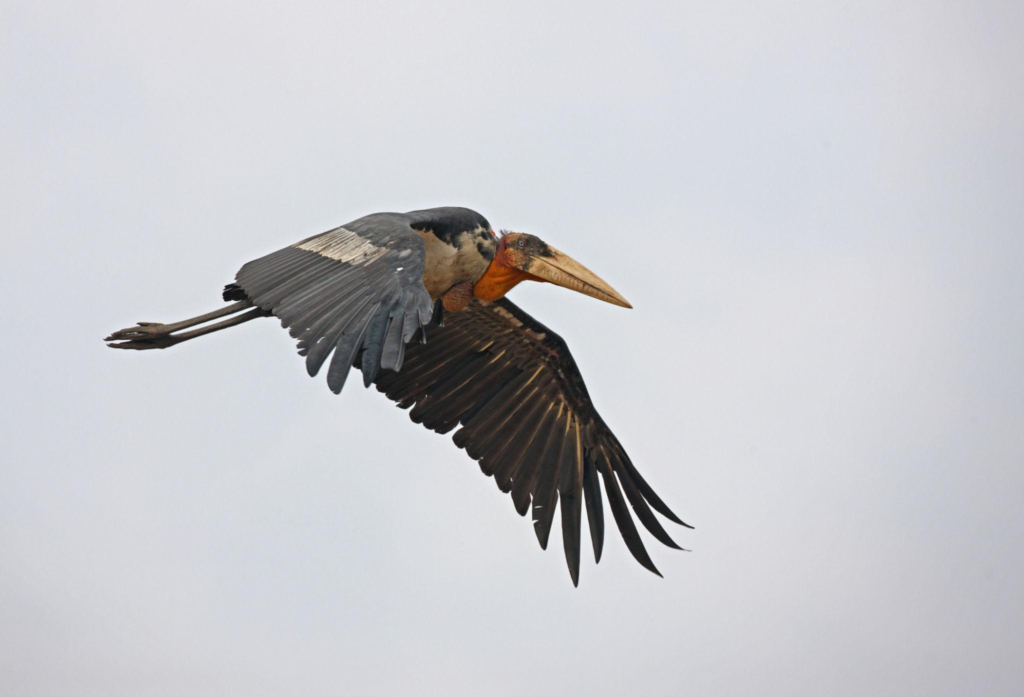
The body is predominantly dark grey to blackish, with contrasting pale or white areas around the lower neck and underparts. The upper wing coverts can display a noticeable pale grey band, particularly useful when observing the bird in flight.
Its head and neck are largely unfeathered, with sparse hair-like feathers. Their appearance can vary with age and breeding condition.
The enormous bill is deep, heavy and powerful, suited to handling substantial food items. The long legs and upright posture give the bird an unmistakable appearance.
The Difference Between Greater and Lesser Adjutant
| Identification feature | Greater Adjutant | Lesser Adjutant |
| Overall size | Much larger | Smaller |
| Throat pouch | Prominent pendulous pouch | No comparable prominent pouch |
| Bill | Very massive and deep | Comparatively slimmer |
| Appearance | More bulky and imposing | Generally more streamlined |
| Identification | Distinctive large pouch and proportions | Smaller body and absence of large pouch |
The Remarkable Throat Pouch and Its Anatomy
One of the most striking features of the Greater Adjutant is its pendulous gular pouch, a structure extending from the throat.
Despite its unusual appearance, it should not be assumed to function as a food-storage pouch like that of a pelican.
The bare head and neck are characteristic features of the species, while the enormous bill is central to its feeding strategy.
Its long legs provide elevation above shallow water and muddy ground, allowing the bird to move through suitable feeding environments without dragging its body through the substrate.
The combination of a powerful bill, long legs and broad wings makes the Greater Adjutant particularly well suited to a life involving ground-based scavenging, wetland feeding and soaring flight.
What Does the Greater Adjutant Eat?
The Greater Adjutant is an opportunistic carnivore and scavenger.
Its diet includes:
- Carrion and animal remains
- Fish
- Frogs and other amphibians
- Reptiles
- Crustaceans
- Large insects
- Small or vulnerable vertebrates, including young birds and mammals
Its feeding behaviour varies according to the availability of food.
In wetlands, the bird may probe muddy ground or sweep its bill beneath the water surface to locate prey. At disposal sites, it can feed on discarded animal matter and compete with other scavengers.
This adaptability is one of the defining features of its ecology.
Unlike birds that depend on a narrow prey category, the Greater Adjutant can exploit several food sources across natural and human-modified habitats.
Flight and Movement
See it for yourself
A private journey shaped around you — your group, your pace, your interests. Book a free consultation.
Despite its large body, the Greater Adjutant is an accomplished soaring bird.
Its broad wings allow it to take advantage of rising warm air currents, reducing the energy needed for sustained flight.
In suitable atmospheric conditions, it can remain airborne for extended periods, using thermals to gain height and travel across open landscapes.
On the ground, it walks with long, deliberate strides. Its upright stance and slightly hunched appearance create the distinctive silhouette responsible for its English name, which refers to the formal, military-like posture of an adjutant.
These characteristics are particularly useful for recognizing the species in open wetlands and agricultural landscapes.
Social Behaviour and Feeding Associations
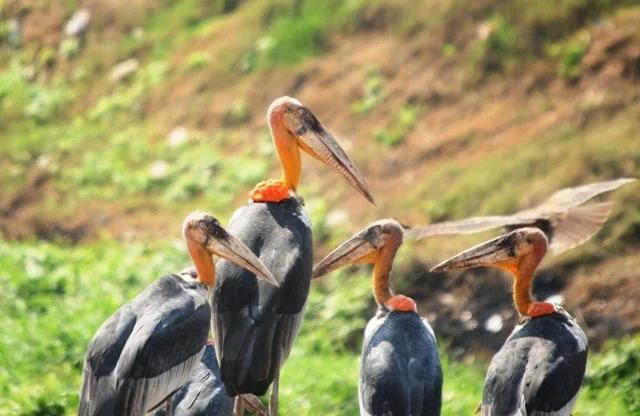
The Greater Adjutant is often encountered in groups, particularly around feeding grounds and breeding colonies.
Its social behaviour is strongly influenced by food availability and breeding activity.
At wetlands, it may associate with other waterbirds and scavengers. At refuse disposal sites, Greater Adjutants can gather alongside vultures, kites and other opportunistic feeders.
Competition for food can be intense. The Greater Adjutant is a large, physically imposing bird and may dominate smaller scavengers at feeding sites.
Its ability to exploit human-modified food sources has also contributed to its survival in some parts of its remaining range.
Breeding and Nesting Behaviour
Greater Adjutants are colonial breeders. They establish nests in large trees, often close to human settlements, and depend on suitable nesting structures and nearby feeding grounds.
The nesting colony is an important part of the species’ life cycle.
Historical accounts describe breeding activity in the Sundarbans. However, these records refer to a former colony, not evidence of contemporary breeding in the Indian Sundarbans.
In its surviving Indian breeding range, particularly Assam, the species has benefited from conservation initiatives involving local communities and protection of nesting trees.
The breeding season in Assam generally falls within the dry months, with birds congregating at nesting locations from around October and laying eggs between November and January. Some chicks may remain dependent on parental feeding into April.
These timings describe the documented Assamese breeding population and should not be transferred to the Indian Sundarbans as a local seasonal pattern.
The Greater Adjutant and the People of Bengal
The history of the Greater Adjutant in Bengal is closely connected with the changing relationship between wildlife and human settlements.
In nineteenth-century Calcutta, the bird was a familiar sight around buildings, cemeteries and riverbanks.
Its scavenging behaviour made it particularly visible in urban environments, where animal remains and discarded organic material provided food.
Historical accounts describe birds gathering on rooftops and other elevated structures. The Greater Adjutant was so strongly associated with Calcutta that it became popularly known as the Calcutta Adjutant.
This association offers an unusual insight into the history of urban wildlife. A species that is now globally restricted to a few surviving populations was once a familiar component of everyday life in Bengal.
Its decline illustrates how quickly a species can disappear from landscapes where it was once commonplace.
What Happened to the Former Sundarbans Population?
Historical accounts indicate that Greater Adjutants once bred in the wider Sundarbans region.
BirdLife International’s historical assessment describes the Sundarbans colony as having disappeared, associating its loss with long-term forest logging and the destruction of nesting habitat.
The loss of large nesting trees is particularly serious for a species that depends on tall trees for colonial breeding.
This historical decline also demonstrates why conservation cannot focus only on protecting feeding grounds. Nesting trees, surrounding wetlands, food availability and disturbance levels all influence the survival of breeding populations.
Conservation Status of the Greater Adjutant
The Greater Adjutant was historically classified as Endangered. However, conservation improvements and population recovery in its remaining strongholds led to a change in its global conservation category.
The 2023 IUCN assessment classifies the species as Near Threatened (NT), with an increasing global population trend.
This is an important conservation success, but it does not mean the species is secure everywhere.
BirdLife International identifies two principal surviving subpopulations: northeastern India and Cambodia. Within India, Assam remains particularly important.
The 2025 State of India’s Birds assessment also identifies the Greater Adjutant as a High Priority species in West Bengal, reporting insufficient data to determine its state-level population trend.
Major Threats to Its Survival
Although conservation initiatives have improved the species’ prospects, several ecological pressures remain important.
Loss of nesting trees: The Greater Adjutant requires large trees for colonial nesting. The removal of mature trees can eliminate suitable breeding locations.
Wetland degradation: Drainage, encroachment, pollution and changes in wetland productivity can reduce feeding opportunities.
Human disturbance: Disturbance around nesting colonies can affect breeding activity and the survival of young birds.
Food availability and waste management: The species can benefit from human-generated food sources, but dependence on unmanaged waste is not necessarily a safe or sustainable conservation strategy.
Habitat fragmentation: The separation of suitable nesting and feeding areas can make it more difficult for populations to persist.
Conservation must therefore protect both natural feeding environments and the mature trees used for breeding.
Conservation Success: The Role of Local Communities
One of the most important developments in Greater Adjutant conservation has taken place in Assam.
Community-led conservation initiatives have helped protect nesting colonies, raise awareness and reduce disturbance around breeding trees.
The work demonstrates that protecting a large bird does not always require separating wildlife from people. In landscapes where nesting trees stand within villages, local participation can be central to conservation success.
The conservation experience in Assam provides a valuable example for other regions where large waterbirds share landscapes with human settlements.
Where Can the Greater Adjutant Be Observed in the Indian Sundarbans?
At present, the available sources reviewed for this article do not establish a reliable contemporary observation location for the Greater Adjutant within the Indian Sundarbans.
The following distinctions are important:
| Geographic area | Evidence |
| Calcutta (historic Kolkata) | Well-documented historical occurrence |
| Wider Sundarbans | Historical occurrence and former breeding colony |
| Morellgunj and southeastern Sundarbans | Historical records, now in Bangladesh |
| Indian Sundarbans National Park | Included in a 2024 commercial checklist, but no supporting dated local record provided |
| Assam | Established surviving Indian population |
| Bihar | Documented breeding population |
The species should not be advertised as a regular sighting possibility at Sajnekhali, Sudhanyakhali, Dobanki, Netidhopani or other Indian Sundarbans birdwatching locations without independently verified observations.
For wildlife enthusiasts, this is an important distinction between a bird’s historical distribution and its present-day observability.
When Is This Bird Present?
The Greater Adjutant is classified as a non-migrant in the 2023 global assessment, although dispersal and movements between feeding and nesting locations occur.
Historically, its movements across parts of India were more extensive and included seasonal appearances associated with rainfall and changing wetland conditions.
However, these historical movement patterns should not be interpreted as evidence of a predictable arrival season in the Indian Sundarbans today.
No reliable contemporary seasonal window has been established for the species in this particular landscape.
The Important Truth About Bird Observation
Birdwatching is an exercise in patience, observation and interpretation.
A bird’s presence in a regional checklist does not mean it can be encountered on every expedition. Similarly, suitable habitat does not guarantee that a particular species occupies it.
Tides, weather, feeding conditions, habitat availability, seasonal movements and observation effort all influence whether a bird is detected.
The Greater Adjutant provides an especially important example of this principle. Its historical presence in Bengal is well documented, but its contemporary occurrence in the Indian Sundarbans requires further verification.
A responsible wildlife record must be based on an identifiable bird, a reliable observation, a verifiable locality and, wherever possible, photographic or other supporting evidence.
What Makes the Sundarbans Greater Adjutant Unique?
The Greater Adjutant is not biologically exclusive to the Sundarbans. Its significance to the region lies instead in its historical relationship with Bengal’s wetlands and settlements.
Three aspects make this association particularly interesting.
A historical connection with Bengal: The Greater Adjutant was once common around Calcutta, making it an important part of the region’s urban natural history.
A former wetland breeding association: Historical ornithological literature documents breeding colonies in the wider Sundarbans. Their disappearance represents a significant change in the region’s birdlife.
A reminder of ecological transformation: The Greater Adjutant’s changing distribution illustrates how habitat loss and the disappearance of nesting sites can transform a species’ relationship with an entire landscape.
Its story is therefore not about a bird that can routinely be seen in the present-day Indian Sundarbans. It is about a remarkable stork whose historical connection with Bengal deserves to be remembered and scientifically documented.
Myths and Facts About the Greater Adjutant
| Myth | Fact |
| The Greater Adjutant is a type of vulture. | It is a stork belonging to the family Ciconiidae. |
| It feeds only on dead animals. | It is an opportunistic carnivore that also captures living prey. |
| Every large adjutant stork is a Greater Adjutant. | The Lesser Adjutant is a separate species with different identification features. |
| The Greater Adjutant is still common throughout Bengal. | Its historical abundance has declined dramatically. |
| It is exclusively a mangrove bird. | It uses a wider range of wetlands and open habitats. |
| A Sundarbans checklist entry proves regular local occurrence. | A checklist entry requires supporting evidence and geographic interpretation. |
FAQs
1. Is the Greater Adjutant found in the Sundarbans?
The species has a historical association with the wider Sundarbans, including former breeding colonies. However, a contemporary resident or breeding population in the Indian Sundarbans has not been established by the evidence reviewed here.
2. What is the scientific name of the Greater Adjutant?
Its scientific name is Leptoptilos dubius. It belongs to the stork family, Ciconiidae.
3. Is the Greater Adjutant endangered?
Its current global IUCN Red List classification is Near Threatened, based on the 2023 assessment. Its population has improved following conservation initiatives.
4. How large is the Greater Adjutant?
It measures approximately 145–150 cm in length, and its wingspan can approach 250 cm.
5. What does the Greater Adjutant eat?
It feeds on carrion, fish, frogs, reptiles, crustaceans, large insects and other available animal prey.
6. What is the difference between Greater and Lesser Adjutant?
The Greater Adjutant is considerably larger and has a prominent hanging throat pouch. The Lesser Adjutant is smaller and lacks a comparable prominent pouch.
7. Where is the Greater Adjutant found in India?
Its principal surviving Indian populations are in Assam, with an additional breeding population in Bihar.
8. Does the Greater Adjutant migrate?
The 2023 IUCN assessment classifies it as non-migratory. However, birds can disperse between breeding and feeding locations.
9. Does the Greater Adjutant breed in the Sundarbans?
Historical records describe breeding colonies in the wider Sundarbans. The former colony is considered defunct, and there is no established contemporary breeding population in the Indian Sundarbans based on the evidence reviewed.
10. Why is the Greater Adjutant important?
It is an important large wetland predator and scavenger. Its feeding ecology connects natural wetlands with human-modified environments, while its conservation history demonstrates the importance of protecting nesting trees and feeding habitats.
The Wild Orbit Perspective
The story of the Greater Adjutant is a reminder that a landscape is defined not only by the wildlife visible within it today, but also by the species that once shaped its ecological history.
In Bengal, this enormous stork was once part of everyday life. It occupied rooftops, riverbanks, wetlands and nesting trees, living alongside people in a way that would be difficult to imagine today.
Its disappearance from much of its former range tells us something important about the fragility of ecological relationships.
The Sundarbans continues to support an extraordinary diversity of birds, from small mangrove specialists to migratory shorebirds and large wetland predators. Understanding that diversity requires more than collecting species names. It requires examining historical records, questioning assumptions and recognising where scientific knowledge remains incomplete.
For The Wild Orbit, the Greater Adjutant represents an important chapter in Bengal’s natural history: a giant stork whose story connects the wetlands of the past with the conservation responsibilities of the present.
Plan your private Sundarban expedition
A private journey shaped around you — your group, your pace, your interests. Book a free consultation.