 Field guide
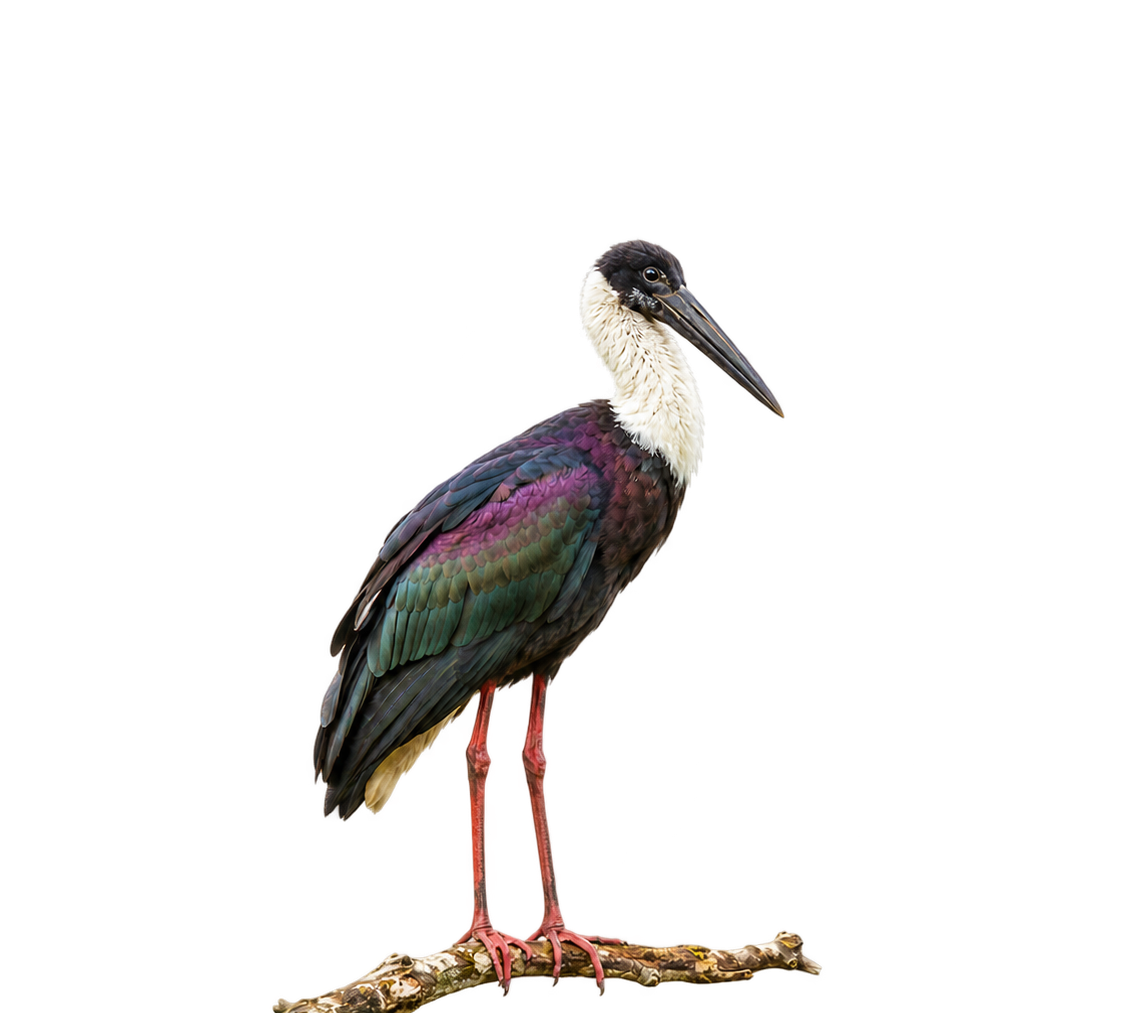
Where open wetlands meet the edges of forests and agricultural landscapes, a large black-and-white stork may stand motionless, watching the ground for its next meal. Its dark body catches the light, while its thick, soft-looking white neck creates a striking contrast against the surrounding landscape.
This is the Asian Woollyneck (Ciconia episcopus), also known as the Woolly-necked Stork or White-necked Stork.
Unlike many waterbirds that depend almost entirely on shallow water, the Asian Woollyneck uses a broader range of environments. Inland wetlands, marshes, grasslands, river margins, forest openings and cultivated landscapes all form part of its ecological world.
In eastern India, this distinction is particularly important. The Sundarbans is not simply a mangrove forest. It is a larger ecological landscape comprising tidal waterways, wetlands, settlements, agricultural land and forest islands. Understanding where a bird occurs within this landscape requires more than identifying suitable habitat.
For the Asian Woollyneck, the available evidence provides an interesting starting point: its occurrence is recognised in West Bengal, and a published checklist of the wider Sundarbans region includes the species. However, the exact Indian Sundarbans sighting locations and supporting dated observations require stronger documentation.
Asian Woollyneck At a Glance
| Field | Information |
| Common name | Asian Woollyneck |
| Alternative names | Woolly-necked Stork, White-necked Stork |
| Scientific name | Ciconia episcopus |
| Order | Ciconiiformes |
| Family | Ciconiidae |
| Conservation status | Near Threatened (IUCN, 2020 assessment) |
| Population trend | Decreasing globally |
| Global population estimate | 50,000–249,999 mature individuals |
| Indian status | Resident |
| West Bengal status | Resident |
| Indian Sundarbans occurrence | Included in a regional Sundarbans bird checklist; precise dated local records need further verification |
| Habitat | Wetlands, grasslands, forest openings, river margins and cultivated land |
| Diet | Animal prey, including amphibians, reptiles, fish and invertebrates |
| Height | Approximately 86–95 cm |
| Ecological role | Predator of small aquatic and terrestrial animals |
Taxonomy and Scientific Classification
The Asian Woollyneck belongs to the stork family Ciconiidae, a group of large, long-legged birds characterised by their substantial bills, elongated necks and predominantly terrestrial or wetland-associated feeding habits.
Its scientific name is Ciconia episcopus, originally described by Boddaert in 1783.
An important development in its classification concerns the African Woollyneck. Birds once grouped together under the broader Woolly-necked Stork classification are now recognised as two separate species:
- Asian Woollyneck — Ciconia episcopus
- African Woollyneck — Ciconia microscelis
A 2024 genomic study using historical museum specimens provided genetic evidence supporting this separation. It also identified substantial genetic divergence between the two recognised Asian subspecies, highlighting questions that require further research.
Global Distribution and Occurrence in India
The Asian Woollyneck occurs across South and Southeast Asia, including India, Bangladesh, Nepal, Bhutan, Myanmar, Thailand and parts of mainland and island Southeast Asia.
Within India, it is a resident species, although its distribution is not uniform. It is associated with a variety of wetland and open-country environments, from lowland areas to elevations of approximately 1,400 metres.
The State of India’s Birds 2026 assessment identifies a very large national distribution range and a declining long-term population trend. Its West Bengal factsheet also identifies the species as resident, although the state-level trend is classified as insufficient data.
For the Indian Sundarbans, an important distinction must be maintained.
A Sundarbans bird checklist published by Waxpol Hotels includes the Woolly-necked Stork among species reported by its team during the preceding five years. A separate West Bengal checklist also recognises the species at state level. These sources support its regional relevance, but do not provide sufficient detail to establish a particular forest block, island, nesting location or regular local population.
The Bangladesh Sundarbans has a more clearly documented historical record. Sayam U. Chowdhury’s 2020 paper, Birds of the Bangladesh Sundarbans: Status, Threats and Conservation Recommendations, describes a bird flying south over Kotka on 9 October 2009. The species was classified as rare in that study. This is valuable regional evidence, but it must not be mistaken for an Indian-side observation.
Habitat: Beyond the Mangrove Forest
The Asian Woollyneck is not an exclusively mangrove-dwelling bird.
Its ecological requirements are more closely associated with access to suitable feeding grounds, relatively open vegetation and places where animal prey can be located.
Its preferred environments include:
- Inland freshwater wetlands and marshes.
- Shallow water bodies and seasonal pools.
- Riverbanks and open floodplains.
- Grasslands and wet agricultural fields.
- Forest edges and clearings.
- Irrigation channels and other human-modified wetlands.
This flexibility is relevant to the Sundarbans, where the ecological landscape changes significantly between forest interiors, inhabited islands, agricultural settlements and freshwater-influenced wetlands.
The presence of mangroves alone, however, cannot establish that a particular forest creek or island supports the species. Its actual habitat use within the Indian Sundarbans needs dedicated observation and documentation.
Conservation Status
The Asian Woollyneck is globally classified as Near Threatened on the IUCN Red List, following its 2020 assessment by BirdLife International.
Earlier assessments classified it as Vulnerable. The change reflected a reassessment of population estimates and differences in population trajectories across its geographical range.
The species is estimated to have between 50,000 and 249,999 mature individuals globally. Its overall population trend remains decreasing.
South Asian populations have generally shown greater stability than several Southeast Asian populations, where hunting, wetland degradation, agricultural pollution and habitat loss have contributed to declines.
How to Identify the Asian Woollyneck
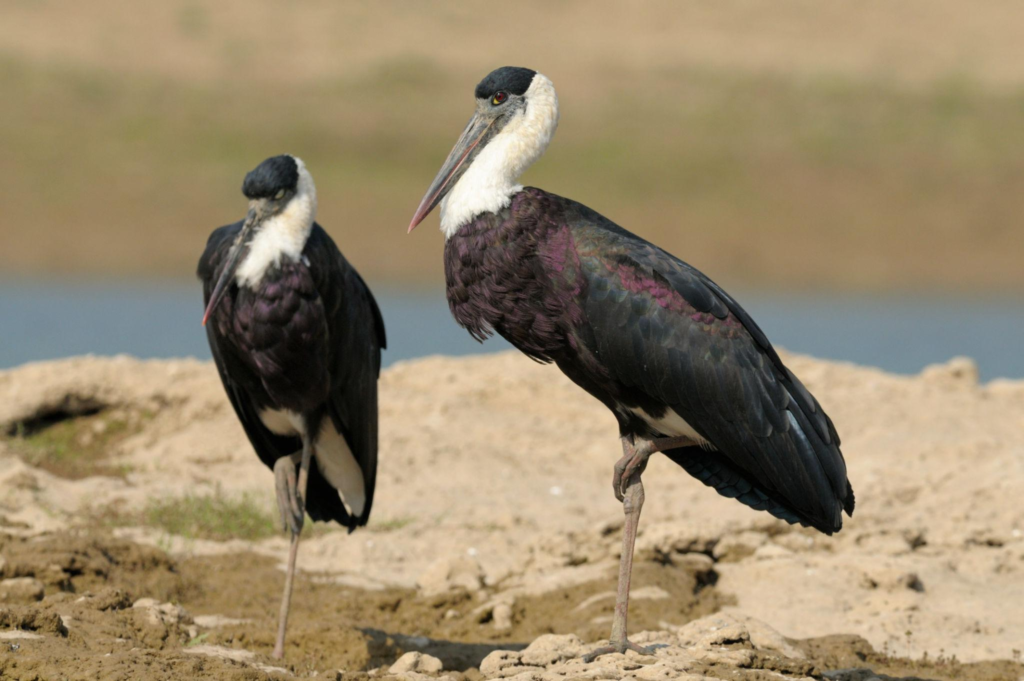
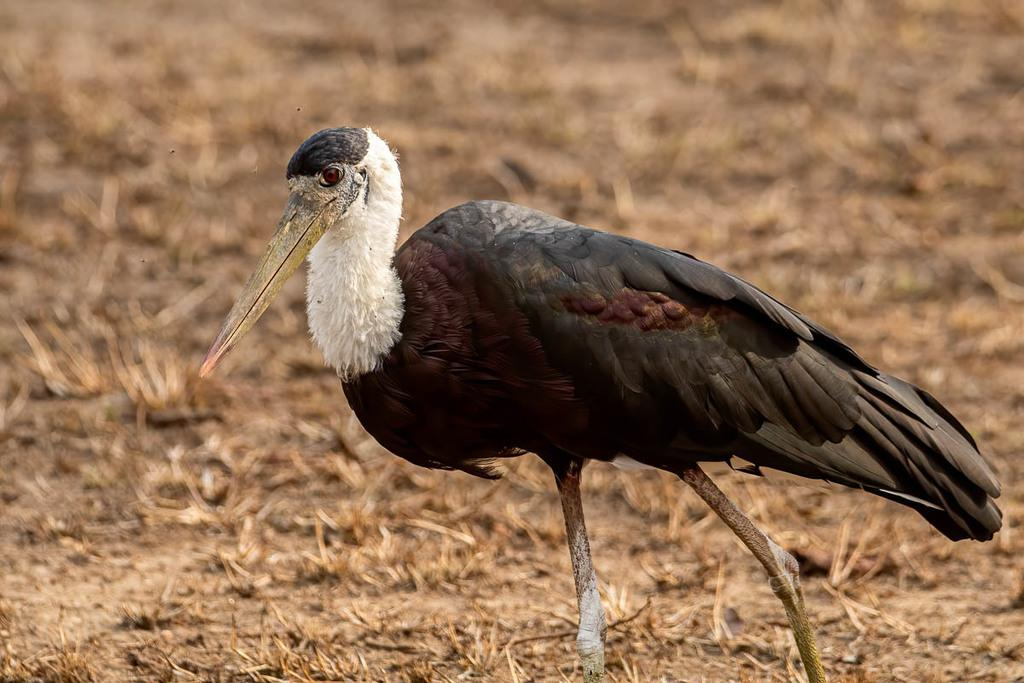
The Asian Woollyneck is a large, unmistakable-looking stork when seen clearly. Its most distinctive feature is the contrast between its glossy dark body and its pale, fluffy-looking neck.
Adults measure approximately 86–95 centimetres in height. Their overall appearance is elegant but robust, with long legs, a strong bill and broad wings.
The most useful identification features include:
- A predominantly glossy black body.
- A conspicuous white neck with elongated, soft-looking feathers.
- A sharply defined black crown or cap.
- White lower belly and undertail areas.
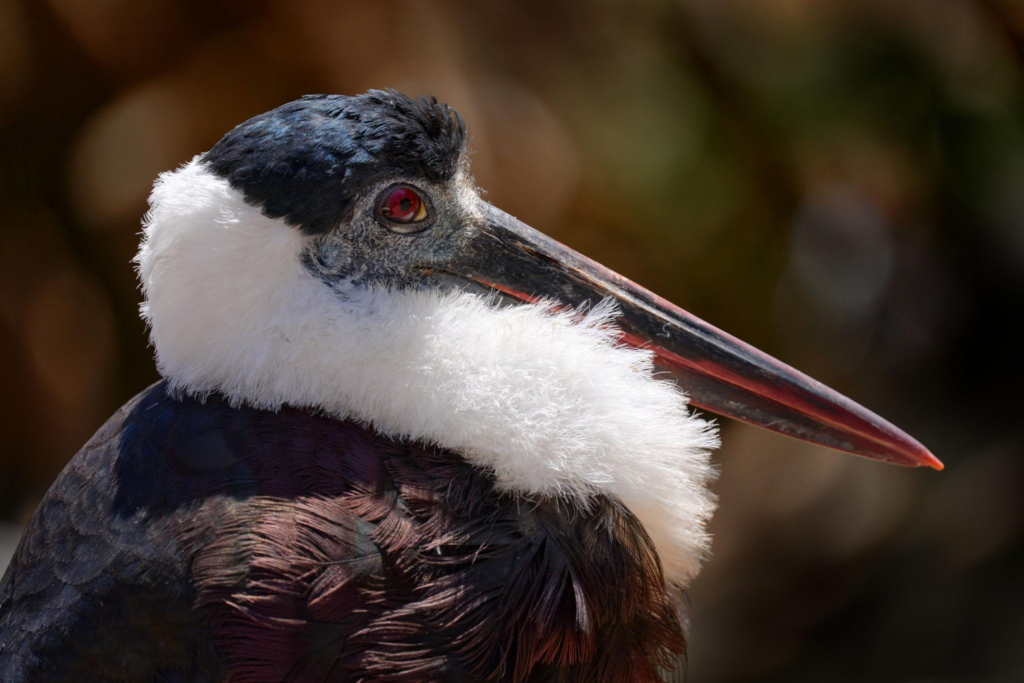
- A long, pointed bill, generally dark with a reddish area near the tip.
- Long legs that appear orange-red.
- Bare facial skin around the eye and base of the bill.
The white neck is responsible for the bird’s familiar common name. Its elongated feathers create a woolly appearance, particularly when viewed from a short distance.
Plumage and Distinctive Field Marks
The bird’s dark upperparts can appear almost metallic under direct sunlight. Depending on lighting conditions, the plumage may reveal subtle greenish or purplish iridescence.
The white neck is particularly striking because it contrasts with the black crown. The white lower belly and tail feathers provide additional contrast when the bird is standing or flying.
The exposed facial skin and the reddish tones around the bill and legs are also useful identification features.
Juvenile plumage can be duller than that of adults. Identification should therefore consider the complete combination of body shape, neck colour, crown pattern, bill and legs rather than relying on a single colour feature.
The Bill: An Instrument for Finding Prey
The Asian Woollyneck possesses a long, strong, pointed bill suited to capturing animal prey.
Unlike the specialised bill of the Asian Openbill, which has a distinctive gap between its mandibles for handling certain molluscs, the Woollyneck has a more conventional pointed stork bill.
It uses this structure to seize and handle a variety of prey, including small aquatic and terrestrial animals.
Its feeding strategy is primarily visual and opportunistic. Rather than depending on a single prey species, it can exploit different food sources according to habitat and availability.
How It Moves Through Its Habitat
See it for yourself
A private journey shaped around you — your group, your pace, your interests. Book a free consultation.
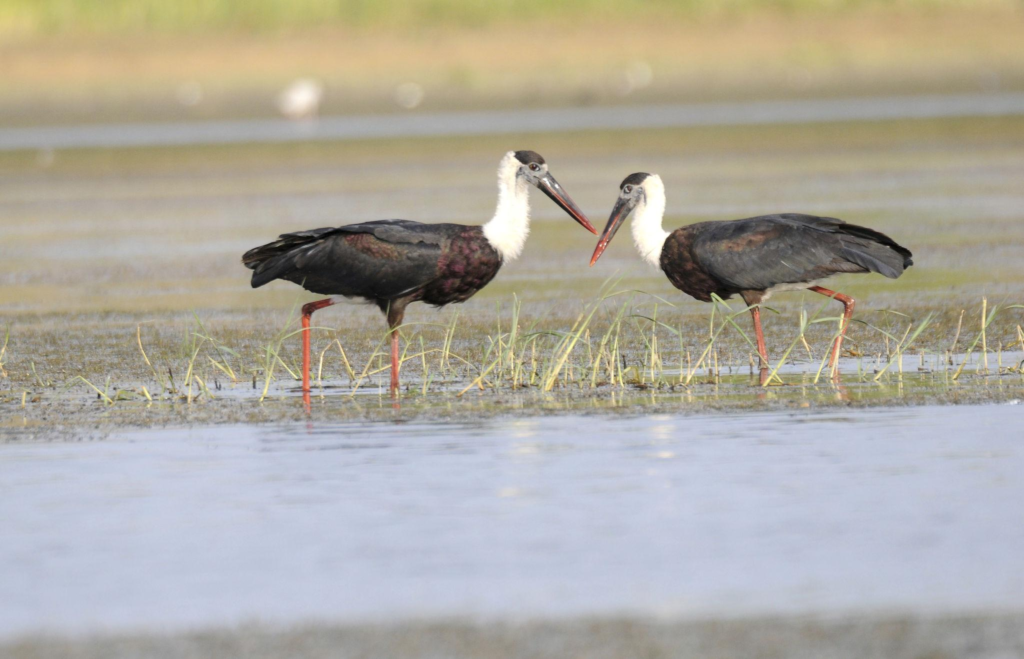
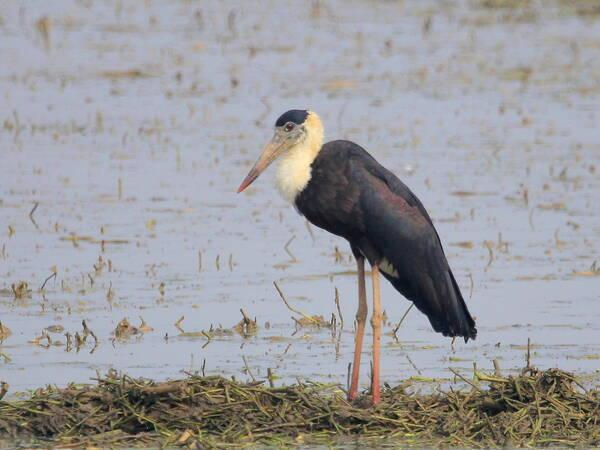
The Asian Woollyneck generally walks across open ground and shallow wetland margins while searching for prey.
Its long legs allow it to move through shallow water and wet vegetation without constantly submerging its body.
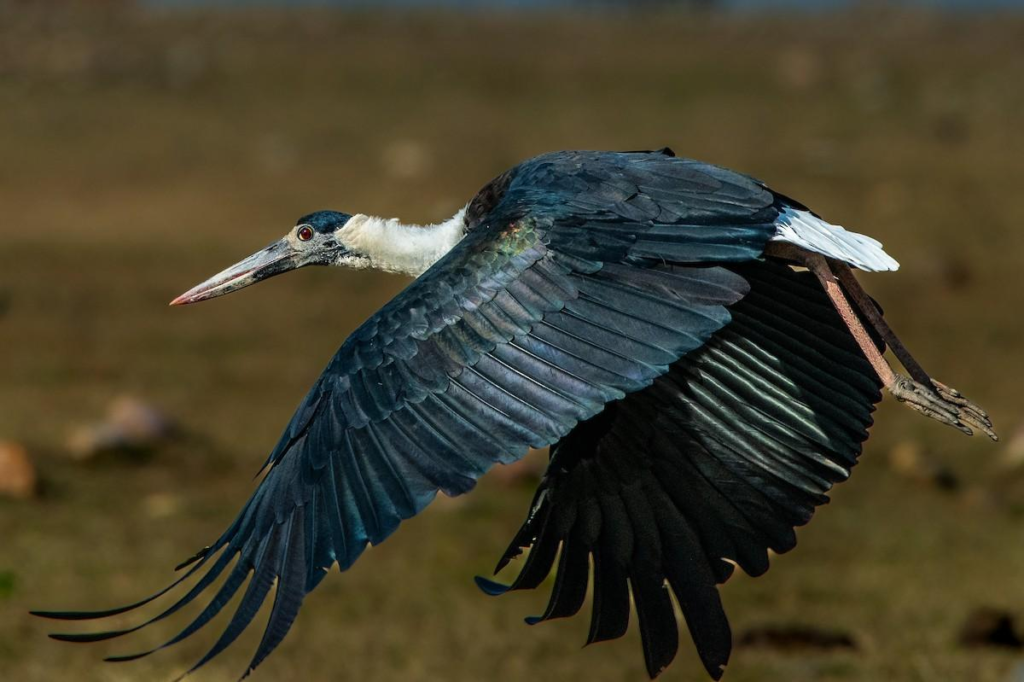
When disturbed or travelling between feeding areas, it takes flight with broad wings and an extended neck and legs. Like other large storks, it is capable of using rising air currents to soar, reducing the energy required for longer movements.
Its flight silhouette is characteristic of storks: the neck is extended forward rather than folded back.
What Does the Asian Woollyneck Eat?
The species is carnivorous, with a varied diet of small animals.
Its prey may include:
- Frogs and other amphibians.
- Small fish.
- Reptiles.
- Insects and other invertebrates.
- Other small animals available within its feeding habitat.
The exact composition of its diet changes according to local prey availability.
This flexibility allows the bird to exploit both natural wetlands and modified landscapes, including agricultural fields and waterlogged open ground.
In ecological terms, its feeding activity connects wetland and terrestrial food webs. However, its precise ecological contribution within the Indian Sundarbans has not been quantified in the sources reviewed.
Social Behaviour and Daily Life
The Asian Woollyneck is generally encountered alone or in pairs, particularly when feeding or occupying a territory.
Outside the breeding season, however, it can become more social. Groups may gather around permanent wetlands where food remains available.
The IUCN species account documents aggregations of up to approximately 80 birds at suitable natural and artificial wetlands in dry landscapes. Such gatherings demonstrate the species’ ability to exploit concentrated food resources.
Its feeding behaviour is relatively deliberate. The bird walks across open ground, pauses to inspect its surroundings and captures prey when an opportunity arises.
Calls and Communication
The Asian Woollyneck is not known for elaborate song performances.
Like other storks, its communication includes visual behaviour, body posture and physical displays. Information about its vocal repertoire is less extensive than that available for many commonly studied passerines.
Storks also use bill-clattering and physical displays in certain social and breeding contexts. However, these behaviours should not automatically be attributed to every encounter with an Asian Woollyneck.
For field identification, observers should prioritise the bird’s appearance and behaviour rather than depending on an assumed characteristic call.
Breeding Behaviour and Nest Construction
The Asian Woollyneck generally breeds in solitary pairs rather than forming large colonial nesting groups.
Its nest is a substantial platform constructed from sticks and placed on a large tree, commonly on a strong branch or fork.
The IUCN account describes nesting sites approximately 10–30 metres above the ground, occasionally reaching greater heights.
Important aspects of its breeding biology include:
| Breeding feature | Documented information |
| Nest type | Large stick platform |
| Nesting arrangement | Generally solitary pairs |
| Nest location | Tall trees, occasionally artificial structures |
| Typical clutch | 3–4 eggs |
| Reported clutch range | 2–5 eggs |
| Incubation | Approximately 35–40 days |
| Breeding season | Varies geographically |
These breeding details are compiled from published studies across the species’ range and should not be interpreted as confirmed observations from the Indian Sundarbans.
A Stork That Can Adapt to Human-Dominated Landscapes
One particularly interesting aspect of the Asian Woollyneck’s ecology is its ability to use landscapes influenced by human activity.
It has been documented nesting in agricultural environments and on artificial structures. Research in northern India has demonstrated that traditional agricultural landscapes, irrigation channels and suitable nesting trees can support breeding populations.
More recent research from central Kerala, published online in January 2026, documented 30 active nests across four districts during the 2022 and 2023 breeding seasons. The study recorded nests on both natural and artificial substrates.
A 2025 study from Bangladesh also documented nesting on communication towers and identified disturbance during tower maintenance and potential nest predators as concerns.
These findings illustrate that conservation does not always mean protecting only remote wilderness. The surrounding agricultural landscape, large nesting trees and human infrastructure can all influence the survival of a species.
There is currently insufficient evidence to establish whether the same nesting patterns occur in the Indian Sundarbans.
Conservation Challenges
The Asian Woollyneck faces different conservation pressures across its distribution.
Although South Asian populations have shown comparatively greater stability, the global assessment identifies an overall declining population trend.
The major documented pressures include:
Wetland degradation: The conversion and deterioration of natural wetlands reduce the availability of suitable feeding grounds.
Agricultural pollution: Chemical contamination and changes in agricultural practices can affect the availability and quality of prey.
Hunting and trapping: Exploitation has contributed to declines in parts of Southeast Asia.
Loss of nesting trees: The removal of mature trees can reduce suitable nesting opportunities in agricultural and inhabited landscapes.
Disturbance: Human activity around active nests, including maintenance of artificial structures, can interfere with breeding success.
Conservation in India
The State of India’s Birds 2026 assessment identifies the Asian Woollyneck as a species of Moderate Priority in India.
Its national long-term population trend is declining, with an estimated change of -17.22% in the assessment’s long-term trend indicator. The West Bengal factsheet, however, reports insufficient data to calculate reliable state-specific trends.
The species is also listed under Schedule II of India’s Wild Life (Protection) Act.
For conservation in West Bengal, maintaining wetlands, protecting large nesting trees, limiting disturbance and improving systematic bird monitoring are important priorities.
Where Can This Bird Be Observed in the Indian Sundarbans?
The Asian Woollyneck should be approached as a species of regional interest rather than a guaranteed Sundarbans sighting.
A Sundarbans bird checklist published by Waxpol Hotels includes the species among birds reported by its team within the preceding five years. This provides a useful indication of local occurrence, although the published list does not supply the individual observation dates, coordinates or supporting photographs needed to establish particular hotspots.
The available evidence does not justify identifying Sajnekhali, Sudhanyakhali, Dobanki, Netidhopani, Bonnie Camp or any particular Indian Sundarbans island as a confirmed Woollyneck observation site.
For responsible birdwatching, it is more useful to understand the habitats that may support the species:
- Open wetland margins.
- Agricultural fields and waterlogged land.
- Freshwater-influenced channels.
- Riverbanks and exposed open ground.
- Suitable clearings and forest edges.
These are habitat-based observation considerations, not verified sighting locations.
A dated photograph, a precise location and a reliable identification record would help improve the available understanding of this species in the Indian Sundarbans.
When Is the Asian Woollyneck Present?
The Asian Woollyneck is generally considered a resident rather than a long-distance migratory species.
However, local movements can occur, and its availability in a particular habitat can change with rainfall, water levels, food resources and breeding activity.
The 2026 State of India’s Birds assessment classifies it as resident in both India and West Bengal.
Its breeding season also varies geographically. Published accounts describe different seasonal patterns across northern and southern India.
For the Indian Sundarbans, there is insufficient evidence to establish a precise arrival, departure or seasonal abundance pattern.
The Important Truth About Bird Observation
A bird’s presence in a regional checklist does not mean it will be encountered during every expedition.
Observation depends on several interacting factors:
- Water levels and tidal conditions.
- Weather and visibility.
- Availability of feeding grounds.
- Seasonal movements and breeding activity.
- Human disturbance.
- The amount of time spent observing suitable habitats.
There is also an important distinction between abundance and detectability.
A species may occur in an area but remain difficult to observe. Conversely, one memorable sighting does not establish that the species is common.
For the Asian Woollyneck, more systematic observations would help determine whether its occurrence in the Indian Sundarbans is occasional, seasonal or more regular.
What Makes the Asian Woollyneck of the Sundarbans Unique?
The Asian Woollyneck is not endemic to the Sundarbans, nor does it represent a separate mangrove-adapted species.
Its significance lies in its relationship with the wider wetland landscape.
Unlike birds that depend heavily on a single habitat type, the Woollyneck can use a variety of open environments. This makes it an interesting species to consider when examining the ecological connections between wetlands, agricultural land, forest edges and human settlements.
The wider Sundarbans provides a particularly interesting setting for understanding these connections.
On the Bangladesh side, a documented observation at Kotka in October 2009 established the species’ occurrence within the mangrove landscape. The 2020 ornithological study classified it as rare there. On the Indian side, regional checklist evidence supports its inclusion in the wider bird inventory, but detailed local observations remain limited.
This difference in the strength of available evidence is important.
It identifies an opportunity for future ornithological research: to establish where the species occurs, which habitats it uses, how frequently it is recorded and whether it breeds within the Indian Sundarbans.
The most valuable contribution may not be another general description of its biology, but a better understanding of its actual relationship with this complex tidal landscape.
Myths and Facts About the Asian Woollyneck
| Common misconception | Scientific understanding |
| It lives exclusively in mangrove forests. | It uses many habitats, including inland wetlands, grasslands and agricultural landscapes. |
| It is a long-distance migratory stork. | It is generally classified as resident, although local movements occur. |
| Its white neck is entirely white. | The head has a distinct black cap, separated from the white neck. |
| It always nests in colonies. | It generally breeds in solitary pairs. |
| A suitable Sundarbans habitat guarantees a sighting. | Habitat suitability does not establish the presence of the species. |
FAQs
1. Is the Asian Woollyneck found in the Sundarbans?
The species is included in a published Sundarbans bird checklist, and there is a documented record from Kotka in the Bangladesh Sundarbans. However, precise, independently verifiable Indian-side sighting records remain limited.
2. What is the scientific name of the Asian Woollyneck?
Its scientific name is Ciconia episcopus. It belongs to the family Ciconiidae, which includes storks.
3. Why is it called the Woollynecked Stork?
Its name comes from the elongated, soft-looking white feathers covering its neck, which create a woolly appearance.
4. Is the Asian Woollyneck endangered?
It is classified as Near Threatened on the IUCN Red List. Its global population is declining, although trends vary across its distribution.
5. What does the Asian Woollyneck eat?
It feeds on animal prey, including frogs, fish, reptiles, insects and other small animals. Its diet varies according to habitat and prey availability.
6. Is the Asian Woollyneck a migratory bird?
It is generally considered a resident species across much of its range, including India. Local movements may occur in response to food availability, water conditions and breeding requirements.
7. Where does the Asian Woollyneck build its nest?
It generally constructs a large stick nest on the branches of tall trees. It has also been documented nesting on artificial structures, including communication towers and electricity pylons.
8. When does the Asian Woollyneck breed in India?
Its breeding season varies geographically. Published accounts describe breeding during the monsoon in northern India, with different seasonal patterns in southern India.
9. How can birdwatchers identify the Asian Woollyneck?
Look for its glossy black body, fluffy white neck, distinct black crown, white lower belly, long pointed bill and reddish legs. The combination of these features helps distinguish it from other storks.
10. What is the conservation status of the Asian Woollyneck in India?
The species is Near Threatened globally and is listed under Schedule II of India’s Wild Life (Protection) Act. The State of India’s Birds 2026 assessment identifies it as a declining species nationally.
The Wild Orbit Perspective
The Asian Woollyneck reminds us that the ecology of a landscape cannot be understood by looking only at its most famous habitats.
The Sundarbans is widely recognised for its mangroves, tidal rivers and extraordinary wildlife. Yet its ecological story extends beyond the forest boundary, connecting wetlands, agricultural fields, settlements and the changing freshwater and saline environments of the delta.
A stork such as the Asian Woollyneck brings attention to these less-explored relationships.
Its presence in West Bengal is recognised, and regional Sundarbans checklists provide a reason to include it in the wider conversation about the delta’s birdlife. But its precise distribution within the Indian mangrove landscape deserves better documentation.
For naturalists, photographers and conservation researchers, this is an invitation to observe carefully, record responsibly and distinguish what is known from what is merely possible.
Because understanding the Sundarbans is not simply about counting the birds we see. It is also about recognising the ecological relationships that make their presence possible—and the unanswered questions that still deserve attention.
Plan your private Sundarban expedition
A private journey shaped around you — your group, your pace, your interests. Book a free consultation.