Field guide
Across the tidal rivers of the Indian Sundarbans, where muddy banks emerge and disappear with the changing tides, an impressive raptor sometimes patrols the open water. Its wings stretch wide, its flight is deliberate, and its attention remains fixed on the water below.
This is the Osprey (Pandion haliaetus), one of the world’s most specialised fish-hunting birds of prey.
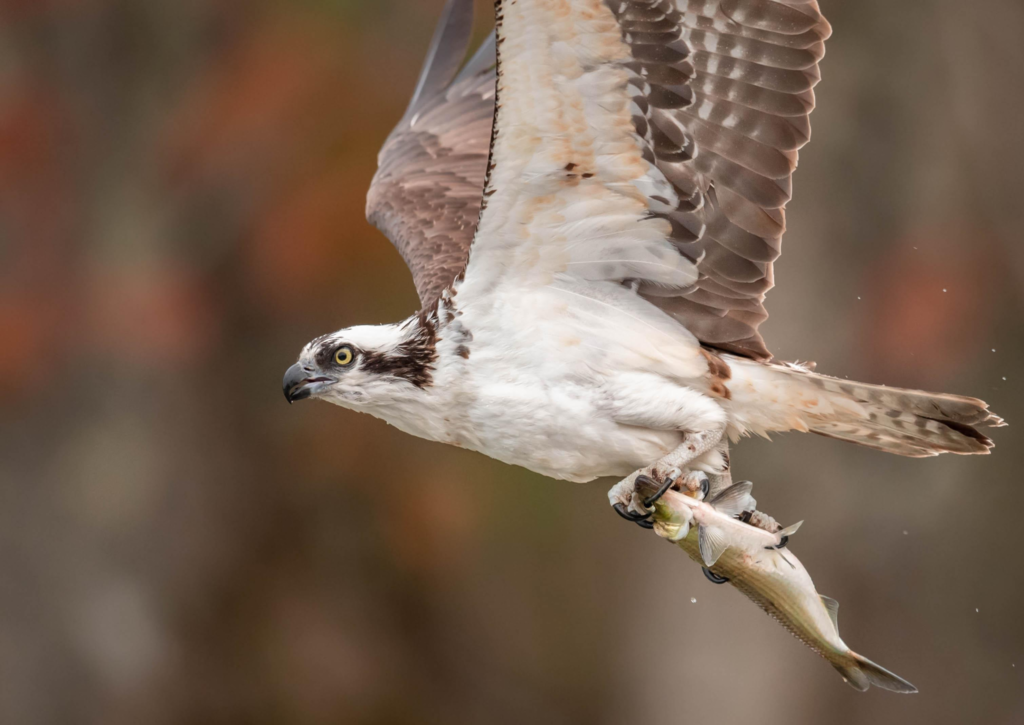
Unlike most raptors that pursue mammals, reptiles, or other birds, the Osprey has built almost its entire hunting strategy around catching live fish. It searches from above, studies the movement beneath the surface, and plunges feet-first into the water when an opportunity presents itself.
Its presence is particularly interesting in the Indian Sundarbans. This enormous tidal landscape offers an extensive network of rivers, estuarine channels, creeks and open-water habitats. The Osprey is documented in the region’s bird checklists and has been included in the bird records associated with the Sundarban Bird Festival.
The species is therefore more than a possibility based on suitable habitat. It is a recognised member of the region’s recorded avifauna.
Osprey (Pandion haliaetus) at a Glance
| Field | Details |
| Common name | Osprey |
| Other names | Fish Hawk, Fish Eagle, Sea Hawk |
| Scientific name | Pandion haliaetus |
| Order | Accipitriformes |
| Family | Pandionidae |
| Genus | Pandion |
| Global conservation status | Least Concern (IUCN, 2021 assessment) |
| Indian conservation assessment | High Priority, State of India’s Birds |
| Indian status | Winter migrant |
| Sundarbans occurrence | Documented migrant |
| Primary habitat | Rivers, estuaries, lakes, coastal wetlands |
| Principal diet | Live fish |
| Approximate body length | 53–65 cm |
| Approximate wingspan | 145–170 cm |
| Distinctive features | White head, dark eye stripe, angled wings, specialised feet |
| Ecological role | Fish-eating predator |
Distribution: A Raptor Found Across Continents
The Osprey has one of the broadest geographical distributions among birds of prey. It occurs across large parts of Europe, Asia, Africa, North America and Australasia, occupying suitable freshwater, brackish and marine environments.
Different populations follow different movement patterns. Some remain close to their breeding territories throughout the year, while others undertake long-distance seasonal migrations.
In South Asia, the species is principally encountered as a winter visitor. Birds arriving from northern breeding populations use suitable wetlands, rivers and coastal environments where fish are accessible.
India forms part of this non-breeding distribution. The State of India’s Birds assessment classifies the Osprey as a winter migrant in the country.
Is the Osprey Found in the Indian Sundarbans?
Yes. The Osprey is documented in the Indian Sundarbans of West Bengal.
Two useful regional references support this:
- The Birds of Sundarbans National Park checklist published by Sunderban Tiger Camp includes Pandion haliaetus, marked with the migrant symbol.
- The 2024 Sundarban Bird Festival report, published by the Sundarban Tiger Reserve, includes the Osprey in its regional bird checklist.
These records establish its occurrence in the Indian Sundarbans. However, they should not be interpreted as evidence of a permanent breeding population or a consistently high local population.
The distinction matters. A migratory bird can regularly use a landscape during part of the year without maintaining a permanent population there.
The Estuarine Habitat of the Osprey
The Osprey is primarily associated with water bodies that support accessible fish populations. It does not depend on dense forest interiors or mangrove vegetation for hunting.
In the Indian Sundarbans, its relevant habitat includes:
- Broad tidal rivers and estuarine channels.
- Open stretches of water around mangrove islands.
- River bends and exposed banks.
- Creek mouths and wider tidal passages.
- Wetland edges and suitable coastal waters.
These habitats provide the open-water visibility and fishing opportunities that an Osprey requires.
The distinction between forest habitat and aquatic feeding habitat is important. Although the Sundarbans is internationally recognised for its mangrove forests, its ecological richness also comes from the extensive waterways and intertidal environments surrounding those forests.
For a fish-eating raptor, the water is the principal hunting ground.
How to Identify the Osprey
The Osprey has a distinctive appearance that makes it relatively recognisable when observed at a reasonable distance.
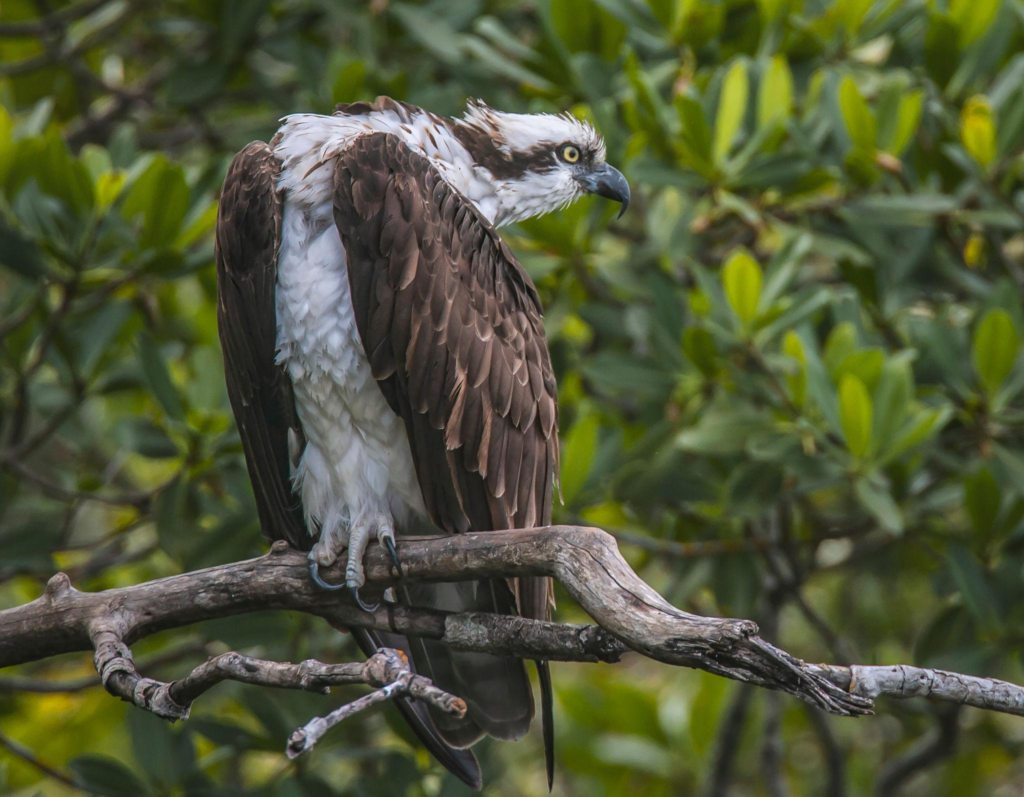
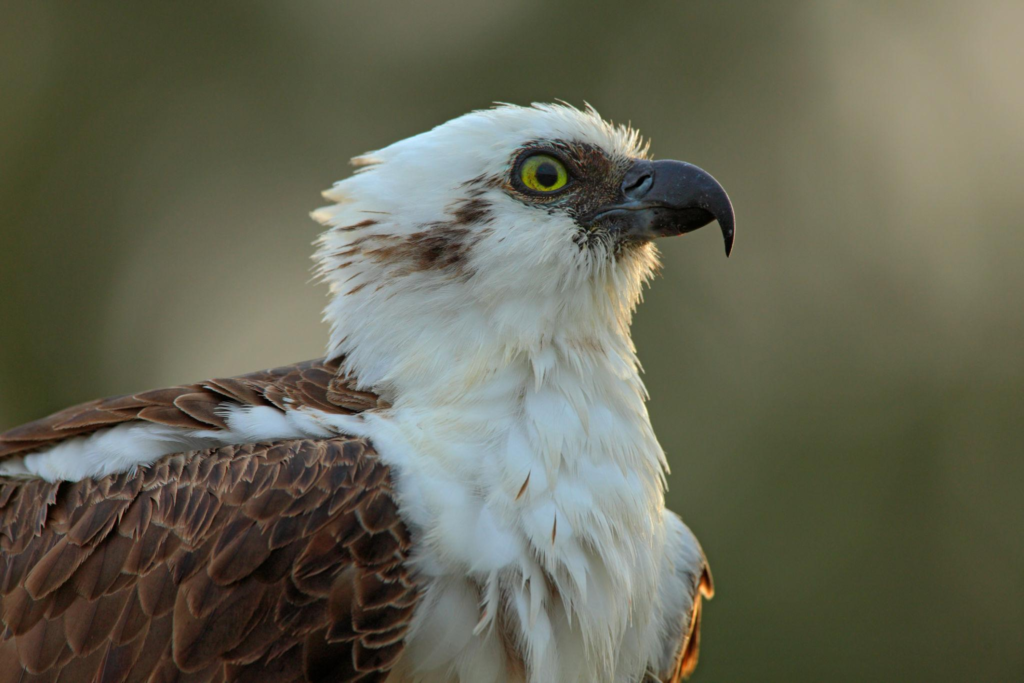
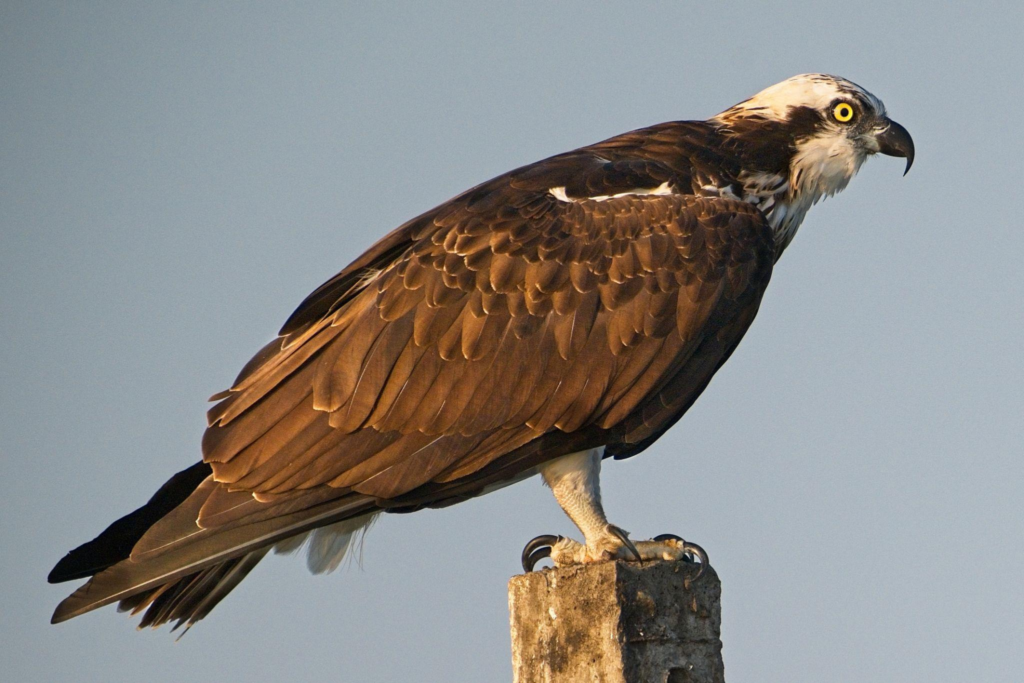
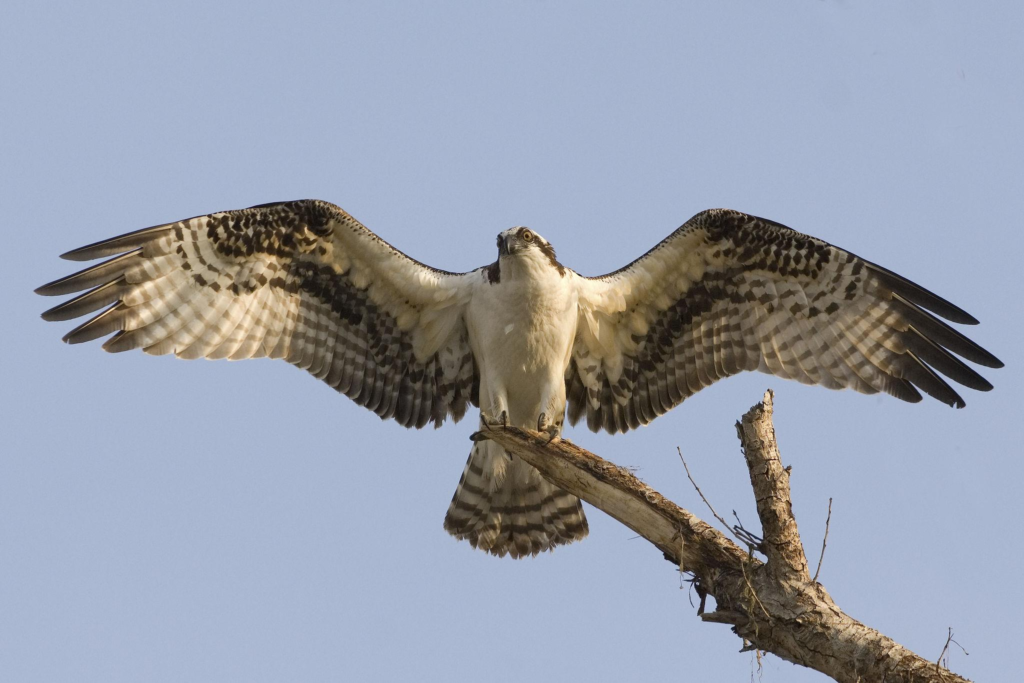
Its upperparts are predominantly dark brown, contrasting sharply with its white underparts. The head is white, with a prominent dark brown stripe running through the eye towards the back of the head.
The breast usually carries a variable brown necklace or streaked band. Its underside is predominantly white, while the underwings display contrasting dark patches around the wrist joints.
When perched, the combination of a white head, dark eye stripe and brown upperparts is particularly useful for identification.
Plumage and Distinctive Field Marks
Adult Ospreys have a dark brown back and wings, white head and underparts, and yellow eyes. Their hooked black bill is designed for gripping and tearing fish.
Juveniles resemble adults but have a more mottled appearance. Their upperparts often show pale or buff-coloured feather edges, producing a speckled pattern. The breast and head may also appear more heavily streaked.
Females are generally larger than males and often show a more pronounced breast band. However, sex determination from a distant field observation can be difficult.
Wings Designed for Fishing
One of the most recognisable features of the Osprey is its flight silhouette.
Its long wings have a distinctive bend at the wrist, giving the bird a characteristic angled appearance. When viewed from below, the wings can appear slightly bowed, with dark patches contrasting against the lighter underwing.
This structure supports sustained flight over open water and the controlled movements needed during hunting.
An Osprey may circle above a river, glide across an estuarine channel or briefly hover while examining the water.
It is particularly impressive when it transitions from searching flight into a steep fishing dive.
The Specialised Feet: Nature’s Fishing Equipment
Perhaps the Osprey’s most remarkable adaptation lies in its feet.
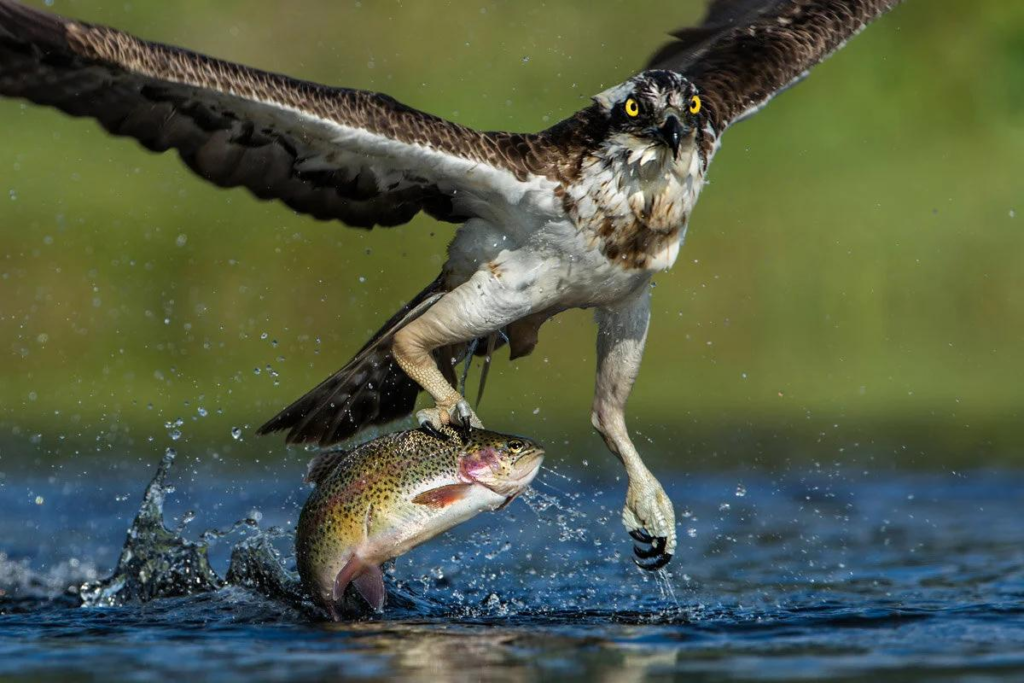
Unlike most birds of prey, the Osprey can rotate its outer toe backwards. This arrangement allows it to grip fish with two toes pointing forwards and two backwards.
Its feet also contain small, rough projections called spicules. These help provide additional friction when holding slippery prey.
Together with its long, sharply curved talons, these features make the Osprey exceptionally effective at catching and carrying fish.
Its nostrils can also close during dives, while its plumage has properties that help it manage contact with water.
The Osprey’s specialised feet allow it to secure slippery fish with remarkable precision.
What Does the Osprey Eat?
Fish constitute almost the entire diet of the Osprey.
It is a specialist piscivore, meaning a predator that feeds primarily on fish. Rather than relying on carrion or hunting terrestrial animals, it generally captures live fish directly from the water.
The species is opportunistic in its choice of prey. The particular fish consumed depends on availability, accessibility, size and local conditions.
In an estuarine environment such as the Sundarbans, a variety of fish occupy different water depths and habitats. However, the exact composition of the Osprey’s local diet has not been established by the regional records discussed here.
It would therefore be inappropriate to assign particular Sundarbans fish species as its preferred prey without supporting dietary research.
How the Osprey Hunts
See it for yourself
A private journey shaped around you — your group, your pace, your interests. Book a free consultation.
The Osprey’s fishing technique is among the most distinctive hunting behaviours in the bird world.
Its hunting sequence generally involves four stages:
Searching: The bird flies above the water, scanning the surface for visible fish.
Positioning: After detecting potential prey, it adjusts its flight path and may briefly hover.
The Dive: It folds its wings and plunges towards the water, extending its feet forward to seize the fish.
The Capture: Once the fish is secured, it uses powerful wingbeats to lift itself out of the water.
The bird may then carry the fish to a suitable feeding perch.
This is a highly specialised hunting method. Unlike a kingfisher, which typically catches fish with its bill, the Osprey uses its feet as its primary fishing equipment.
Flight, Perching and Daily Activity
The Osprey is a diurnal raptor, meaning it is primarily active during daylight hours.
It commonly uses exposed branches, dead trees, poles and other elevated structures as observation or feeding perches.
These positions offer a clear view of nearby water and allow the bird to rest between fishing attempts.
Its hunting activity is closely connected to prey visibility and accessibility. Water clarity, surface conditions and the movement of fish can all influence the effectiveness of a fishing attempt.
Is the Osprey a Solitary Bird?
The Osprey is generally encountered individually when hunting and feeding. Its fishing behaviour is largely independent, with each bird searching for and capturing its own prey.
However, individuals may share productive feeding landscapes, particularly where fish are abundant. During migration, several Ospreys may also pass through the same geographical region.
Outside the breeding season, their interactions are generally less territorial than during nesting.
Calls and Communication
The Osprey is not particularly vocal during ordinary hunting activity.
Its calls are generally described as sharp, high-pitched whistles or chirping notes. Vocal communication becomes more important around nesting territories, during courtship and when responding to potential disturbances.
The bird’s visual displays and vocal signals help maintain communication between breeding partners and defend nesting areas.
Breeding and Nesting Behaviour
Ospreys generally form breeding pairs and construct large nests made from sticks and other vegetation.
Nests are commonly built on elevated structures, including tall trees, cliffs and artificial platforms, depending on geographical conditions.
A breeding pair may return to the same nesting territory over successive seasons. The nest itself can become substantial through repeated additions of material.
The female typically lays two to four eggs, although clutch size varies. Both parents participate in incubation and parental care, with the female generally undertaking more incubation while the male supplies food.
The young remain dependent on their parents after hatching until they develop sufficient flight and hunting abilities.
Does the Osprey breed in the Indian Sundarbans?
The available regional checklists establish its presence as a migrant, but they do not establish local breeding. Its breeding elsewhere in its global range should not be confused with confirmed nesting in West Bengal’s Sundarbans.
Migration: A Long-Distance Traveller
The Osprey is a migratory species across much of its geographical range.
Northern populations undertake seasonal movements towards warmer regions when conditions in their breeding grounds become unsuitable. Some individuals travel thousands of kilometres between breeding and wintering areas.
India is an important non-breeding destination for migratory Ospreys.
The Sundarbans forms part of a wider wetland landscape used by migratory birds. Its combination of estuarine waterways, open water and coastal habitats provides potentially valuable feeding environments.
However, a specific migration route connecting individual Ospreys to the Indian Sundarbans has not been established by the regional sources consulted here.
Human Interaction and the Changing Landscape
The relationship between Ospreys and people is closely connected to the condition of aquatic environments.
Fishing communities and Ospreys depend, in different ways, on healthy fish populations. Both are connected to the productivity of rivers, creeks and estuarine waters.
The Sundarbans also experiences substantial environmental changes through tidal erosion, sediment deposition, cyclones and changing coastal conditions.
The Sundarban Tiger Reserve’s 2024 Bird Festival report highlights how erosion, habitat changes and cyclones affect the region’s bird habitats, particularly elevated trees and mangrove vegetation used by some raptors. These are landscape-level conservation concerns rather than evidence of a measured, species-specific impact on the Osprey.
Conservation Status of the Osprey
The Osprey is classified as Least Concern (LC) on the IUCN Red List, according to its 2021 global assessment by BirdLife International.
The assessment describes its global population trend as increasing. However, this global picture should not be interpreted as evidence that every regional population is stable.
In fact, India’s conservation assessment presents a different concern.
The State of India’s Birds 2025 update identifies the Osprey as a High Priority species in India, reporting a rapid long-term decline of approximately 57.1% and a current annual decline of approximately 4.26%.
The assessment also identifies it as a winter migrant and lists it under Schedule I of India’s Wildlife (Protection) Act framework.
Global and Indian Conservation Assessment
Global IUCN status
Least Concern
India’s conservation priority
High Priority
India’s reported long-term population trend (SoIB 2025)
-57.1%
Reported long-term trend, not a Sundarbans-specific population estimate.
India’s current annual trend (SoIB 2025)
-4.26%
National assessment; not a local annual count.
Source: State of India’s Birds 2025 and IUCN Red List 2021.
This difference between global and national assessments is important. A species can remain globally widespread while experiencing significant declines within a particular country.
Threats to the Osprey
Although the Osprey has a broad distribution, its survival depends on the availability of suitable aquatic habitats and healthy fish populations.
Some important conservation concerns include:
Wetland degradation: Changes in aquatic ecosystems can reduce suitable feeding habitat and affect fish availability.
Pollution: Contaminants entering freshwater and coastal systems can affect aquatic food chains. Persistent pollutants may also accumulate in fish-eating birds.
Fishing-related pressures: Changes in fish availability and fishing practices can influence the accessibility of prey. However, the precise impact on Ospreys in the Indian Sundarbans requires further investigation.
Habitat disturbance: Human activity around feeding and potential nesting sites can disturb birds, particularly during sensitive periods.
Climate change and coastal instability: Rising sea levels, changing salinity, cyclones and coastal erosion can transform wetland habitats.
These concerns should be considered alongside the specific conservation requirements of the Sundarbans’ wider aquatic ecosystem.
Research and Monitoring: Understanding the Osprey’s Presence
More systematic research would help establish how Ospreys use the Indian Sundarbans.
Useful monitoring approaches include:
- Seasonal bird surveys across different estuarine habitats.
- Standardised counts along rivers and open-water channels.
- Recording individual observations with photographs and dates.
- Monitoring feeding behaviour without disturbing hunting birds.
- Identifying potential changes in seasonal occurrence.
- Recording fish availability and relevant habitat conditions.
Citizen-science platforms such as eBird can help researchers understand distribution patterns, provided observations are properly identified and documented.
A particularly valuable research question concerns the seasonal use of different parts of the Indian Sundarbans by migratory Ospreys.
Where Can the Osprey Be Observed in the Indian Sundarbans?
The Osprey is documented in the Indian Sundarbans, but the available regional records consulted for this article do not provide sufficiently detailed, independently verifiable, species-specific sighting locations to identify particular creeks, watchtowers or islands as confirmed hotspots.
Nevertheless, its ecology indicates the types of environments worth understanding:
| Habitat | Why It Matters |
| Broad tidal rivers | Offer open-water fishing opportunities |
| Estuarine channels | Provide access to fish-bearing waters |
| Creek mouths | Connect different aquatic habitats |
| Open riverbanks | Can offer suitable elevated observation points |
| Coastal wetlands | Form part of the wider aquatic feeding landscape |
The 2024 Sundarban Bird Festival covered six birding trails: National Park East, National Park West, Basirhat, Sajnekhali Wildlife Sanctuary, Kalas and Matla. These are documented survey areas, not verified Osprey hotspots.
When Is the Osprey Present in the Sundarbans?
The Osprey is classified as a migrant in the regional Sunderban Tiger Camp checklist and as a winter migrant in India’s State of India’s Birds assessment.
This supports its seasonal visitor status rather than permanent residency in the Indian Sundarbans.
The winter months are therefore a sensible period to pay attention to migratory Ospreys. However, the available local checklist does not establish precise arrival and departure dates or a reliable month-by-month occurrence pattern.
Its actual presence on a particular day will depend on individual movement, weather, prey availability and other ecological conditions.
The Important Truth About Bird Observation
Wildlife observation in the Sundarbans is never entirely predictable.
Tides change the shape of the waterways, mudflats emerge and disappear, and fish move through different parts of the estuary.
A bird may use a particular river stretch one day and remain absent from the same location during another visit.
It is also important to distinguish between a species’ abundance and its detectability. A bird that is difficult to observe is not necessarily rare, while the absence of a sighting does not establish that the species is absent from the wider landscape.
For the Osprey, patient observation of open water, distant riverbanks and suitable perching structures is more meaningful than relying on guaranteed sighting locations.
What Makes the Osprey of the Sundarbans Unique?
The Osprey is not an endemic bird of the Sundarbans. Its distribution extends across several continents, and its specialised fishing behaviour is not exclusive to this mangrove landscape.
What makes its presence interesting is the relationship between a migratory fish-eating raptor and one of the world’s most dynamic estuarine environments.
The Indian Sundarbans is a landscape where freshwater influence, tidal movement and saline conditions interact. Rivers constantly reshape their banks, while fish occupy different parts of the aquatic ecosystem according to environmental conditions.
For a bird that depends almost entirely on live fish, these changing waterways provide an interesting ecological setting.
The Osprey also offers an important perspective on the Sundarbans beyond its famous terrestrial wildlife. The region is not simply a mangrove forest supporting tigers, deer and other forest animals. It is an interconnected aquatic ecosystem that supports migratory birds, fish-eating raptors, waterbirds and numerous other organisms.
Its presence reminds us that the conservation value of the Sundarbans extends well beyond the forest canopy.
Myths and Facts About the Osprey
| Common Misconception | The Scientific Fact |
| The Osprey is an ordinary eagle. | It belongs to its own family, Pandionidae. |
| It eats mainly dead fish. | It is primarily a hunter of live fish. |
| It is a permanent resident of the Indian Sundarbans. | Regional records identify it as a migrant. |
| It catches fish using its beak. | Its specialised feet and talons secure the fish. |
| It is globally endangered. | Its global IUCN category is Least Concern, despite India’s concerning population trend. |
| It breeds in the Indian Sundarbans. | Local breeding has not been established by the available regional records. |
FAQs
1. Is the Osprey found in the Indian Sundarbans?
Yes. The Osprey (Pandion haliaetus) appears in regional Sundarbans bird checklists, including the 2024 bird records associated with the Sundarban Bird Festival.
2. Is the Osprey a resident or migratory bird in the Sundarbans?
It is documented as a migrant in the Indian Sundarbans. India’s national assessment also classifies it as a winter migrant.
3. What is the scientific name of the Osprey?
Its scientific name is Pandion haliaetus. It belongs to the family Pandionidae and order Accipitriformes.
4. What does the Osprey eat?
The Osprey feeds primarily on live fish. It searches for prey from above the water and captures fish using its specialised feet and sharp talons.
5. How does an Osprey catch fish?
It spots fish while flying above the water, adjusts its position and dives feet-first to capture its prey. Its reversible outer toe and spiny footpads help it maintain a secure grip.
6. How can you identify an Osprey?
Look for its white head, distinctive dark eye stripe, brown upperparts, white underparts and long angled wings with dark wrist patches.
7. Is the Osprey endangered?
Globally, it is classified as Least Concern by the IUCN. However, India’s State of India’s Birds assessment reports a rapid decline in its national population trend.
8. Does the Osprey breed in the Sundarbans?
Breeding in the Indian Sundarbans has not been established by the regional records consulted for this article. The species breeds in other parts of its global range.
9. When is the best time to look for an Osprey in the Sundarbans?
Winter is a sensible period to look for this migratory species. However, precise local arrival dates and sighting probabilities have not been established.
10. What makes the Osprey different from other birds of prey?
Its almost exclusively fish-based diet and specialised fishing feet make it particularly distinctive. It can dive into water and secure slippery fish using two toes pointing forward and two pointing backwards.
The Wild Orbit Perspective
The Sundarbans is often introduced through its most celebrated wildlife: the Royal Bengal Tiger, saltwater crocodile, fishing cat and magnificent kingfishers.
But its natural history is equally fascinating when observed from above the water.
The Osprey represents another dimension of this extraordinary landscape. A migratory raptor, arriving from distant geographical regions, it brings a remarkable fishing strategy to the tidal waterways of Bengal.
Its presence also raises an important conservation question: how well are we understanding the migratory birds that depend on the health of these estuarine systems?
Protecting the Sundarbans means looking beyond its forests and recognising the importance of its rivers, fish populations, mudflats, wetlands and interconnected habitats.
Because the story of the mangroves is not written only among the roots of the trees. It is also written across the water, in the movements of the birds that depend on it.
And sometimes, high above a tidal channel, the unmistakable silhouette of an Osprey tells another part of that story.
Plan your private Sundarban expedition
A private journey shaped around you — your group, your pace, your interests. Book a free consultation.