 Field guide
Where the tidal rivers of the Indian Sundarbans divide into narrow creeks, where muddy banks emerge with the retreating water, and where mangrove islands meet open wetlands, a remarkable bird moves through the landscape with deliberate, unhurried steps.
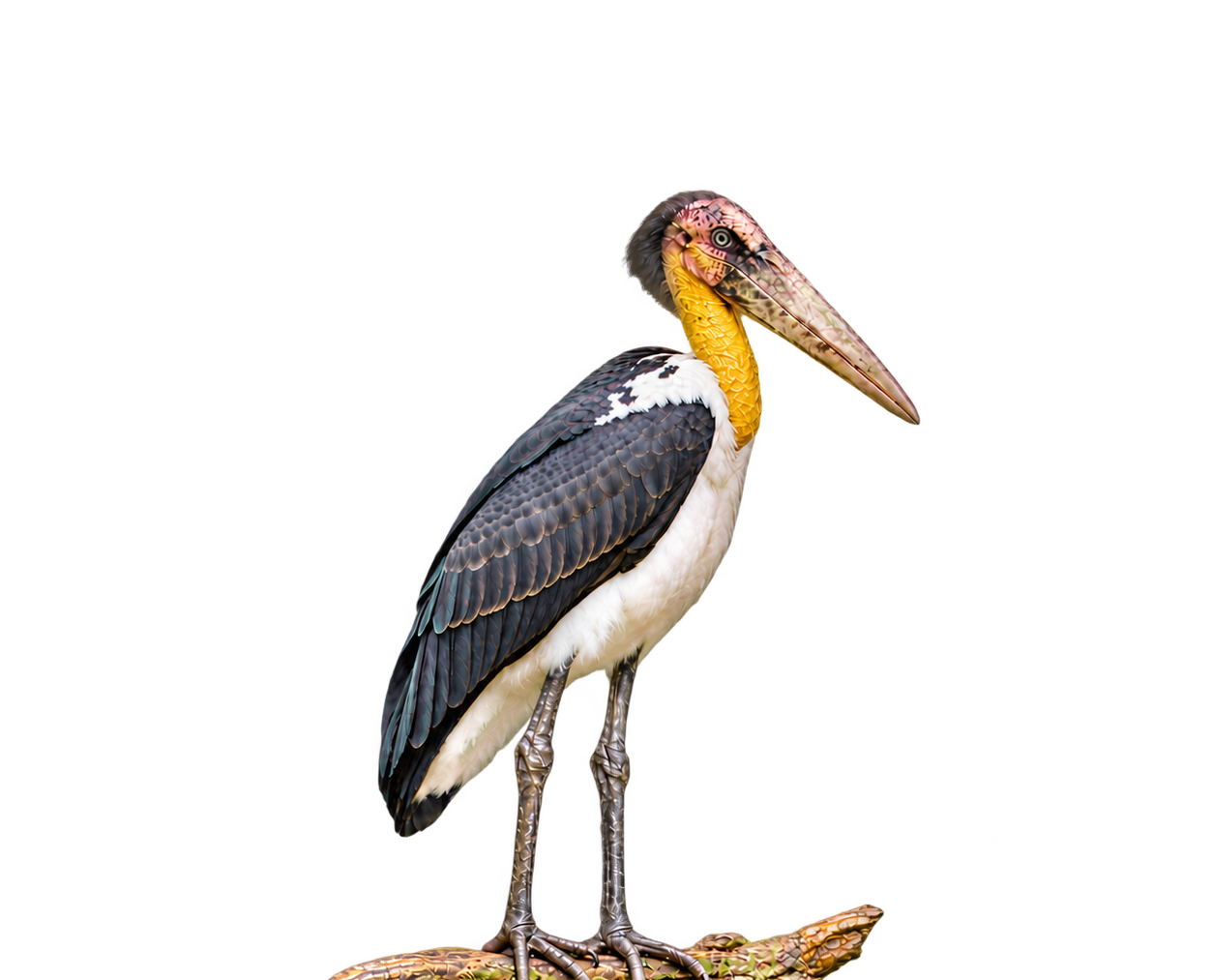
It is the Lesser Adjutant (Leptoptilos javanicus), a large member of the stork family that commands attention through its sheer size and unusual appearance. Unlike the colourful kingfishers or the familiar silhouettes of eagles, this bird carries a more understated presence. Its dark upperparts, white underside, long legs and almost naked head give it an unmistakable character.
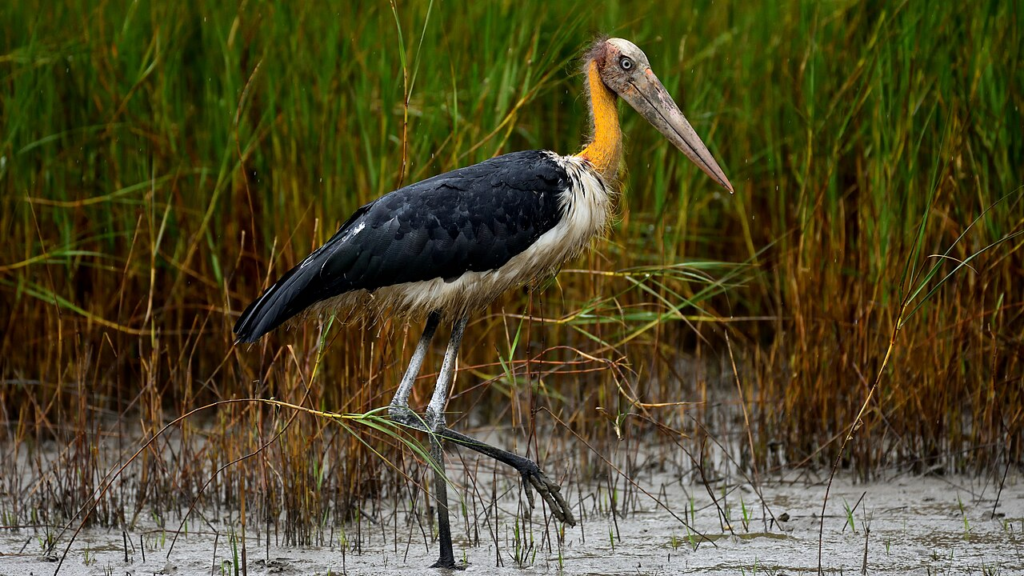
Although it is not among the birds encountered frequently during ordinary birdwatching excursions, the Lesser Adjutant has a documented presence in the Indian Sundarbans. Its relationship with the region’s wetlands makes it an important species within the wider avifaunal landscape.
The Zoological Survey of India (ZSI), in its October 2013 publication, specifically mentioned the Indian Sundarbans among the locations where this species had been recorded. More recently, the West Bengal Forest Department’s Second Sundarban Bird Festival report (2024) included the Lesser Adjutant among the threatened birds recorded during its bird trails.
These records establish that the species belongs to the Indian Sundarbans’ documented birdlife, although its precise population, breeding distribution and regularity of occurrence require further local investigation.
Lesser Adjutant At a Glance
| Field | Information |
| Common Name | Lesser Adjutant |
| Scientific Name | Leptoptilos javanicus |
| Order | Ciconiiformes |
| Family | Ciconiidae |
| Genus | Leptoptilos |
| Authority | (Horsfield, 1821) |
| Global IUCN Status | Near Threatened (2023) |
| Indian Wildlife Protection Act | Schedule I |
| Indian Sundarbans Occurrence | Documented |
| Seasonal Status in India | Resident and local migrant |
| Habitat | Wetlands, mudflats, mangroves, marshes and flooded grasslands |
| Diet | Fish, frogs, reptiles, crustaceans, insects and small animals |
| Approximate Standing Height | 110–120 cm |
| Ecological Association | Large wetland-dependent bird |
Taxonomy and Distribution
The Lesser Adjutant belongs to the family Ciconiidae, which includes storks characterised by their long legs, substantial bills and broad wings.
Its scientific name, Leptoptilos javanicus, places it within a genus of large Asian storks. It is distributed across parts of the Indian subcontinent and Southeast Asia, including India, Bangladesh, Nepal, Sri Lanka, Myanmar, Thailand, Cambodia, Vietnam, Malaysia and Indonesia.
Within India, its distribution is particularly associated with the eastern states of Assam, West Bengal and Bihar. The State of India’s Birds assessment identifies these states among the regions where the species is a key conservation priority.
The Indian Sundarbans form an interesting part of its broader distribution because the landscape combines coastal wetlands, tidal mudflats, mangrove edges and open estuarine habitats.
Is the Lesser Adjutant Found in the Indian Sundarbans?
Yes. Its occurrence in the Indian Sundarbans is supported by historical scientific documentation and more recent bird survey records.
The ZSI publication of 2013 specifically identifies the Indian Sundarbans as one of the locations where small groups of Lesser Adjutants had been recorded. It also raised the possibility that the species might still breed in the region, although this was not presented as confirmed breeding evidence.
The Second Sundarban Bird Festival, organised by the Sundarban Tiger Reserve and South 24 Parganas Forest Division in January 2024, provides more recent regional documentation. The festival report identifies the Lesser Adjutant among the threatened bird species recorded during the bird trails and highlights it as one of West Bengal’s highest-priority bird conservation species.
This is significant because it moves the discussion beyond a simple assumption based on the bird’s wider geographical range.
However, there is an important distinction: documented occurrence does not automatically establish a resident breeding population or regular sightings throughout the Indian Sundarbans. Detailed, site-specific population monitoring remains necessary.
Habitat and Ecological Association
The Lesser Adjutant is primarily a wetland-associated bird. It uses a variety of environments, including freshwater wetlands, marshes, flooded fields, shallow waterbodies, coastal swamps, mudflats and mangrove landscapes.
In the Indian Sundarbans, this habitat diversity creates several potentially suitable feeding environments.
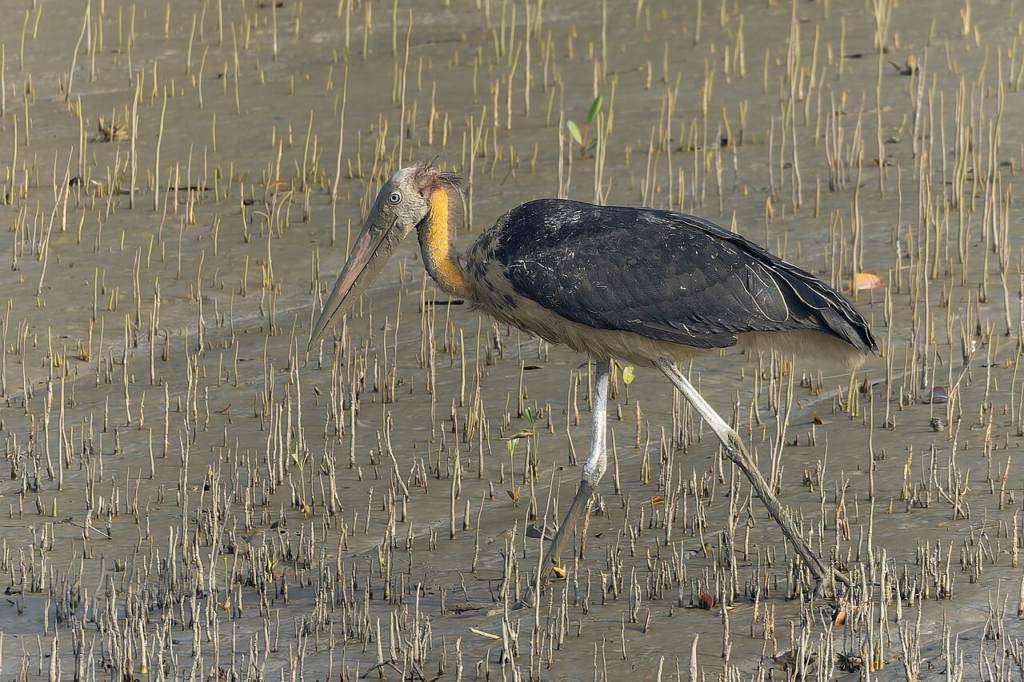
The exposed muddy edges of tidal creeks, shallow estuarine margins and open wetland areas offer opportunities for a large wading bird to search for prey. Unlike smaller mangrove specialists that depend heavily on the vegetation itself, the Lesser Adjutant is more closely associated with open feeding grounds and wetland edges.
Its presence also illustrates an important ecological characteristic of the Sundarbans: the region’s birdlife is not sustained by mangrove forest alone. Mudflats, water channels, open banks, freshwater pockets and surrounding wetlands are equally important components of the wider habitat system.
The Lesser Adjutant is therefore better understood as a bird of the larger wetland landscape rather than exclusively as a bird of dense mangrove vegetation.
How to Identify the Lesser Adjutant
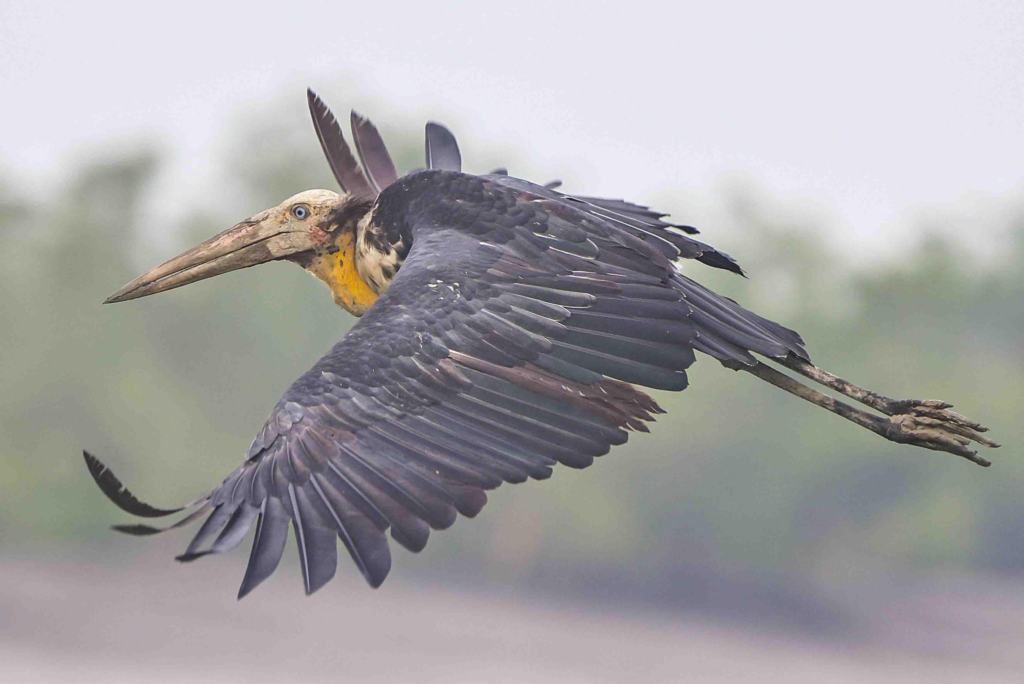
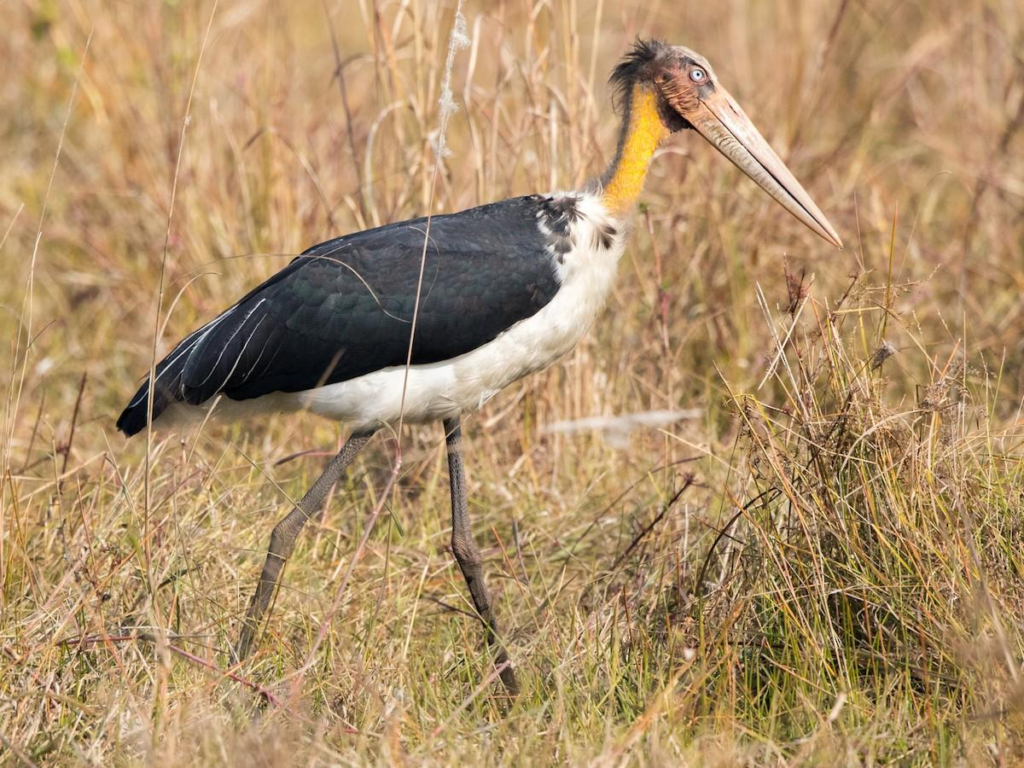
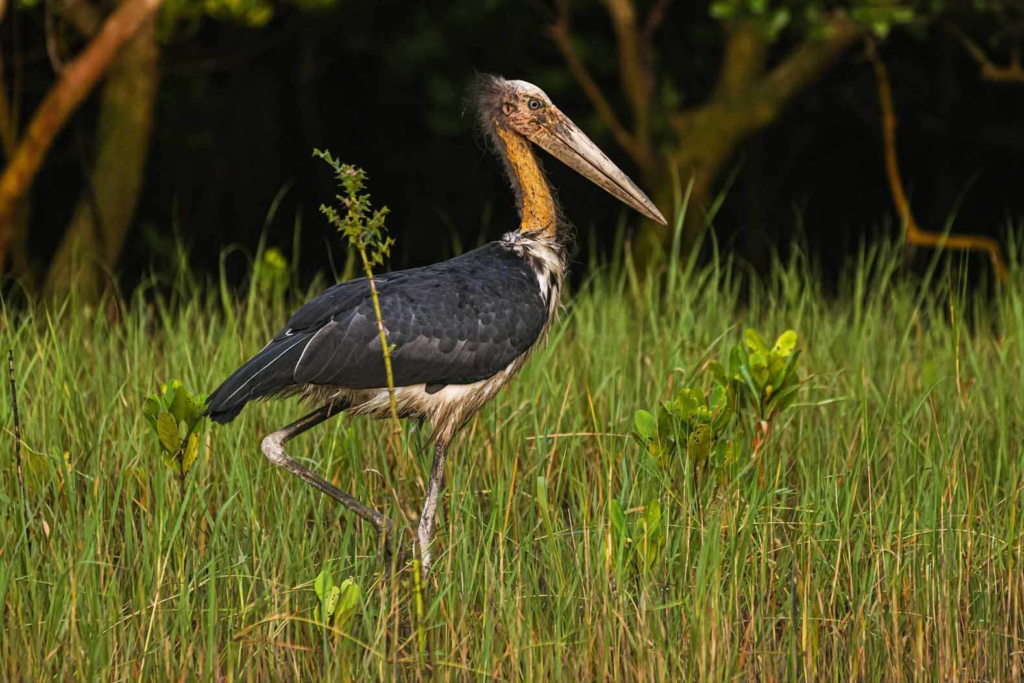
Standing beside a wetland, the Lesser Adjutant can appear almost prehistoric. Its unusually upright posture, long legs, heavy bill and bare head distinguish it from most other large waterbirds.
It is a very large stork, generally standing approximately 110–120 centimetres tall. Its body is predominantly dark above and white below, creating a strong contrast that is particularly noticeable when the bird is standing or flying.
The most distinctive feature is its largely unfeathered head and neck. The exposed skin is generally reddish to yellowish, with sparse hair-like feathers around parts of the head.
Its powerful bill is long, thick and wedge-shaped, typically appearing pale yellowish or dirty yellow.
The overall appearance is somewhat unusual, but each feature serves as a useful identification characteristic.
Plumage and Distinctive Field Marks
The adult Lesser Adjutant has glossy, dark bluish-black to black upperparts, including the wings and back. Its underparts, particularly the belly and undertail, are white.
The head and neck are mostly bare, with scattered fine feathers. The exposed skin can vary in colour, appearing reddish, yellowish or orange depending on breeding condition and individual variation.
During the breeding period, the facial and neck skin can become more intensely coloured. Subtle coppery markings on the wing coverts may also become visible.
Juveniles are generally duller than adults, with less glossy upperparts and more feathering around the head and neck.
Males and females are broadly similar in appearance, making field identification by sex difficult without closer examination.
A Beak Shaped by Its Feeding Strategy
The Lesser Adjutant possesses a strong, elongated bill with a broad, wedge-shaped appearance.
It uses this powerful structure to seize and handle a varied range of prey, including fish, frogs, reptiles and crustaceans.
Unlike birds with narrow, highly specialised bills, the Lesser Adjutant has a relatively versatile feeding apparatus suited to capturing different types of wetland prey.
Its feeding behaviour is generally deliberate rather than highly energetic. It moves through shallow water or across exposed ground, searching for suitable food before striking or picking up prey.
How It Moves Through the Tidal Landscape
See it for yourself
A private journey shaped around you — your group, your pace, your interests. Book a free consultation.
The Lesser Adjutant is primarily a terrestrial and wading forager.
It walks slowly through shallow water, grassland and muddy wetland margins, using its long legs to negotiate uneven ground and shallow inundated areas.
Its broad wings support powerful flight. Like other members of the genus Leptoptilos, it flies with its neck retracted rather than extended forward like many herons.
When airborne, its large wings allow it to make use of rising warm air currents, helping it gain altitude and travel with relatively little continuous flapping.
Its flight silhouette is therefore quite distinctive: broad dark wings, a pale underside and long legs extending behind the body.
What Does the Lesser Adjutant Eat?
The Lesser Adjutant is an opportunistic carnivorous bird with a varied diet.
Its feeding preferences include:
- Fish, including mudskippers.
- Frogs and other amphibians.
- Crabs and other crustaceans.
- Reptiles, including smaller lizards.
- Large insects and their larvae.
- Rodents and other small mammals.
- Occasionally carrion.
In the Sundarbans, mudskippers and other small fish are particularly interesting components of its known feeding ecology.
Mudskippers occupy the intertidal environment, moving between shallow water and exposed muddy surfaces. These fish are a characteristic part of the mangrove ecosystem and provide potential prey for larger wetland predators.
However, the actual contribution of individual prey groups to the Lesser Adjutant’s diet in the Indian Sundarbans has not been sufficiently quantified.
The species should not be described exclusively as a scavenger. Although it can consume carrion, active hunting and prey capture form important parts of its feeding behaviour.
A Solitary Presence in the Wetlands
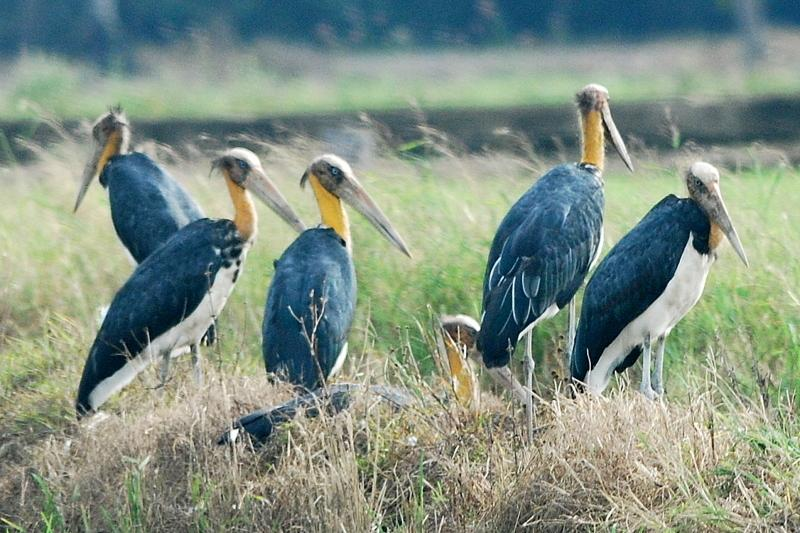
The Lesser Adjutant is generally encountered alone or in small, scattered groups.
It is considered a relatively shy and retiring bird, often avoiding close proximity to human activity. This behaviour, combined with its relatively localised distribution, can make encounters less predictable than those with more familiar wetland birds.
Although individuals may feed independently, the species can become more social during the breeding season, when loose nesting colonies may develop.
This contrast between solitary feeding and seasonal breeding gatherings is an interesting aspect of its natural history.
Calls and Communication
The Lesser Adjutant is not particularly vocal during ordinary activities.
Unlike songbirds, it does not rely on elaborate musical calls for communication. Its vocal behaviour is relatively subdued.
At nesting sites, however, it may produce bill-clattering sounds, hissing and low, guttural vocalisations.
Courtship and interactions between individuals can also involve physical displays. One described behaviour is the balancing posture, in which a bird raises its head and moves its bill in a characteristic scooping motion accompanied by bill-clattering.
These behaviours are particularly relevant during pair formation and breeding interactions.
Breeding and Nesting Behaviour
The Lesser Adjutant is a tree-nesting stork.
It constructs a substantial platform-like nest using large sticks, usually positioned high in a tall tree. Such nesting locations provide a suitable elevated platform for incubation and the rearing of young.
The species can breed in loose colonies, although it is not necessarily colonial throughout its distribution.
The nest is generally a large structure, sometimes exceeding a metre in diameter. The female usually lays two to four eggs, which are white and become stained during incubation.
The incubation period is approximately 28–30 days.
Breeding timing varies geographically. The available Indian species accounts describe November to January as an important breeding period in northeastern India, while other regional populations may breed during different months.
For the Indian Sundarbans, however, the available evidence does not establish a reliable local breeding calendar or a confirmed nesting colony.
The 2013 ZSI account specifically suggested that the species probably still bred in the Indian Sundarbans, but this remains an indication rather than definitive proof of contemporary breeding activity.
The Relationship Between People and the Lesser Adjutant
The Lesser Adjutant occupies a landscape where wildlife and human livelihoods frequently overlap.
Fishing settlements, agricultural land, wetlands and tidal waterways form an interconnected environment throughout the wider Sundarbans region.
Because the species uses open wetlands and feeding grounds, its habitat requirements can extend beyond formally protected forest areas.
The conservation of such birds therefore cannot depend exclusively on the protection of forest interiors. Maintaining wetland edges, large nesting trees and undisturbed feeding areas across the wider landscape is equally important.
There is also a need to avoid disturbing birds during feeding, resting and nesting. A large bird may appear comfortable at a distance but can abandon a suitable feeding or nesting area when repeatedly disturbed.
Responsible coexistence requires understanding the bird’s ecological requirements without placing unnecessary restrictions or blame on communities whose livelihoods depend on the same landscape.
Conservation Status of the Lesser Adjutant
The Lesser Adjutant is classified as Near Threatened (NT) on the global IUCN Red List, following the 2023 assessment by BirdLife International.
This classification indicates that the species is not currently placed in a threatened category globally but faces conservation concerns that warrant attention.
In India, the State of India’s Birds 2023 assessment identifies it as a species of Moderate Conservation Priority.
The assessment also reports:
- Long-term population trend: Inconclusive.
- Current annual trend: Decline.
- Estimated long-term trend: approximately 34.09% decline.
- Estimated current annual trend: approximately 3.23% decline.
- Migratory status: Resident and local migrant.
- Habitat specialisation: Wetland.
These figures represent the national assessment, not a population estimate or measured decline specifically for the Indian Sundarbans.
The same assessment identifies the Lesser Adjutant as a Schedule I species under India’s Wildlife (Protection) Act.
Major Conservation Challenges
Several pressures affect Lesser Adjutant populations across its distribution.
Wetland degradation and habitat loss
The conversion and degradation of wetlands can reduce the availability of suitable feeding grounds. Changes to agricultural wetlands, marshes and shallow waterbodies can also affect prey availability.
Loss of large nesting trees
As a tree-nesting species, the Lesser Adjutant depends on mature trees suitable for supporting substantial nests.
Tree felling and the loss of established nesting sites can therefore affect its reproductive opportunities.
Human disturbance
Disturbance around feeding and nesting locations can discourage birds from using otherwise suitable habitat.
Fishing-related pressures
Fishing activity and changes to wetland conditions can affect prey availability and the quality of feeding habitats.
In the Sundarbans, the 2024 Bird Festival report specifically identifies destructive fishing practices, disturbance, pollution and changing wetland habitats as wider conservation concerns affecting avifauna.
Climate change and coastal instability
The Sundarbans is a dynamic estuarine landscape shaped by tides, sediment movement, erosion and accretion.
Cyclones and changing coastal conditions can damage vegetation, alter wetland habitats and affect the availability of suitable ecological spaces.
These pressures are relevant to the conservation of the wider bird community, although their individual impacts on Lesser Adjutant populations in the Indian Sundarbans have not yet been adequately quantified.
Where Can the Lesser Adjutant Be Observed in the Indian Sundarbans?
The Lesser Adjutant has documented occurrences in the Indian Sundarbans, but publicly available records do not establish a dependable list of current, species-specific observation hotspots.
The Second Sundarban Bird Festival recorded the species during its January 2024 birding exercise, which covered six survey routes:
- National Park West
- Basirhat
- Sajnekhali
- National Park East
- Kalas
- Matla
However, the report does not provide a sufficiently clear species-specific location and observation count for the Lesser Adjutant across these individual routes.
Consequently, these areas should be understood as part of the wider documented survey landscape, not as verified Lesser Adjutant hotspots.
The ZSI’s earlier documentation also identifies the Indian Sundarbans at the regional level without establishing precise contemporary sighting locations.
For responsible bird observation, the most relevant habitats to understand are:
- Open wetland margins.
- Muddy tidal banks.
- Shallow waterbodies.
- Mangrove-edge feeding grounds.
- Suitable open areas near freshwater wetlands.
The presence of suitable habitat should never be confused with a confirmed sighting.
When Is the Lesser Adjutant Present?
The Lesser Adjutant is not considered a conventional long-distance seasonal migrant throughout its range.
The State of India’s Birds assessment categorises it in India as a resident and local migrant.
This means that individuals may undertake local movements in response to changing conditions, including food availability and habitat requirements, rather than following a single, predictable international migration schedule.
For the Indian Sundarbans, there is insufficient species-specific evidence to establish a precise arrival or departure calendar.
The January 2024 Sundarban Bird Festival provides a documented seasonal observation, but a single survey period cannot establish that January is the species’ preferred or exclusive observation season.
The Important Truth About Bird Observation
Observing the Lesser Adjutant requires patience.
Its large size does not necessarily make it an easy bird to encounter. A species can be physically conspicuous yet locally uncommon, widely dispersed or irregularly encountered.
Tide conditions, water levels, feeding opportunities, weather, disturbance and the availability of suitable habitat all influence bird activity and detectability.
A bird that is not encountered during an expedition is not necessarily absent from the landscape.
Equally, a suitable mudflat or wetland does not guarantee that a Lesser Adjutant will be present.
Responsible observation means allowing wildlife to determine the encounter, rather than attempting to force one.
What Makes the Sundarbans Lesser Adjutant Unique?
The Lesser Adjutant is not an endemic bird of the Sundarbans. Its distribution extends across several countries in South and Southeast Asia.
What makes its relationship with the Indian Sundarbans interesting is the ecological setting in which it occurs.
Unlike birds that depend primarily on the interior vegetation of mangrove forests, the Lesser Adjutant is closely associated with open wetland habitats.
The Sundarbans offers a complex combination of tidal creeks, exposed mudflats, estuarine banks and mangrove edges. These habitats form an interconnected feeding landscape for a variety of wetland-dependent species.
Its documented presence also adds another dimension to the region’s bird conservation story.
The species is not merely a large stork passing through a mangrove landscape. It represents the importance of maintaining wetland habitats beyond the forest canopy.
Its occurrence raises valuable questions about the availability of suitable feeding grounds, the condition of large nesting trees and the extent of its local breeding population.
These questions deserve further systematic investigation.
Myths and Facts About the Lesser Adjutant
| Common misconception | The factual position |
| The Lesser Adjutant is exclusively a scavenger. | It actively hunts fish, amphibians, reptiles and other prey, although it can consume carrion. |
| It is a migratory bird that visits only during winter. | It is classified as resident and local migrant in India. |
| It breeds throughout the Sundarbans. | Local breeding requires specific confirmation; historical documentation only suggested probable breeding. |
| It lives exclusively inside dense mangrove forests. | It uses several open wetland habitats, including mudflats and marshes. |
| It is the same bird as the Greater Adjutant. | They are two distinct species belonging to the same genus. |
FAQs
1. Is the Lesser Adjutant found in the Sundarbans?
Yes. The Lesser Adjutant has been documented in the Indian Sundarbans. The Zoological Survey of India mentioned its occurrence in the region, and the 2024 Sundarban Bird Festival also recorded the species.
2. What is the scientific name of the Lesser Adjutant?
Its scientific name is Leptoptilos javanicus. It belongs to the family Ciconiidae.
3. Is the Lesser Adjutant an endangered bird?
Globally, it is classified as Near Threatened (NT) by the IUCN. In India, it is included in Schedule I of the Wildlife (Protection) Act.
4. How can you identify a Lesser Adjutant?
Look for its large upright body, dark upperparts, white belly, long legs, heavy pale bill and largely bare reddish-yellow head and neck.
5. What does the Lesser Adjutant eat?
Its diet includes fish, mudskippers, frogs, reptiles, crabs, large insects, rodents and occasionally carrion.
6. Is the Lesser Adjutant a migratory bird?
In India, it is classified as a resident and local migrant. It may move locally in response to ecological conditions rather than following a fixed long-distance migration schedule.
7. Does the Lesser Adjutant breed in the Indian Sundarbans?
Historical documentation by the Zoological Survey of India suggested that it probably bred in the Indian Sundarbans. However, reliable contemporary evidence establishing its local breeding population remains limited.
8. What is the difference between the Lesser Adjutant and Greater Adjutant?
The Lesser Adjutant is smaller, has uniformly dark upperparts and lacks the prominent inflatable throat pouch characteristic of the Greater Adjutant. The Greater Adjutant also has a noticeably bulkier appearance.
9. Where can you see the Lesser Adjutant in the Indian Sundarbans?
Its regional occurrence is documented, but reliable public records do not establish specific current sighting hotspots. Open wetlands, mudflats and mangrove-edge habitats are ecologically relevant environments, not guaranteed observation locations.
The Wild Orbit Perspective
There is something particularly revealing about the Lesser Adjutant.
It is a bird that does not need colourful plumage or spectacular behaviour to command attention. Its presence is expressed through its size, its measured movements and its ability to navigate a landscape that is constantly changing.
In the Indian Sundarbans, the story of this stork is also a story about the spaces between the mangroves: the muddy banks, shallow wetlands, exposed feeding grounds and the larger ecological connections that sustain wildlife.
The region is often discussed through its most celebrated inhabitants. Yet the health of the Sundarbans cannot be understood through its iconic species alone.
Every wetland-dependent bird contributes another piece to the ecological picture.
The Lesser Adjutant reminds us that conserving the Sundarbans means protecting more than its forests. It means preserving the complete landscape of water, land, vegetation and life that makes this extraordinary estuary function.
And sometimes, understanding a wilderness begins with recognizing the birds that quietly inhabit its less explored corners.
Plan your private Sundarban expedition
A private journey shaped around you — your group, your pace, your interests. Book a free consultation.