 Field guide
The Indian Sundarbans is a landscape shaped by tides, mud and mangrove vegetation. Tidal rivers wind between forested islands, narrow creeks cut through the land, and the exposed ground changes as water rises and retreats. For terrestrial wildlife, finding food and suitable places to move requires flexibility in an environment where conditions are constantly changing.
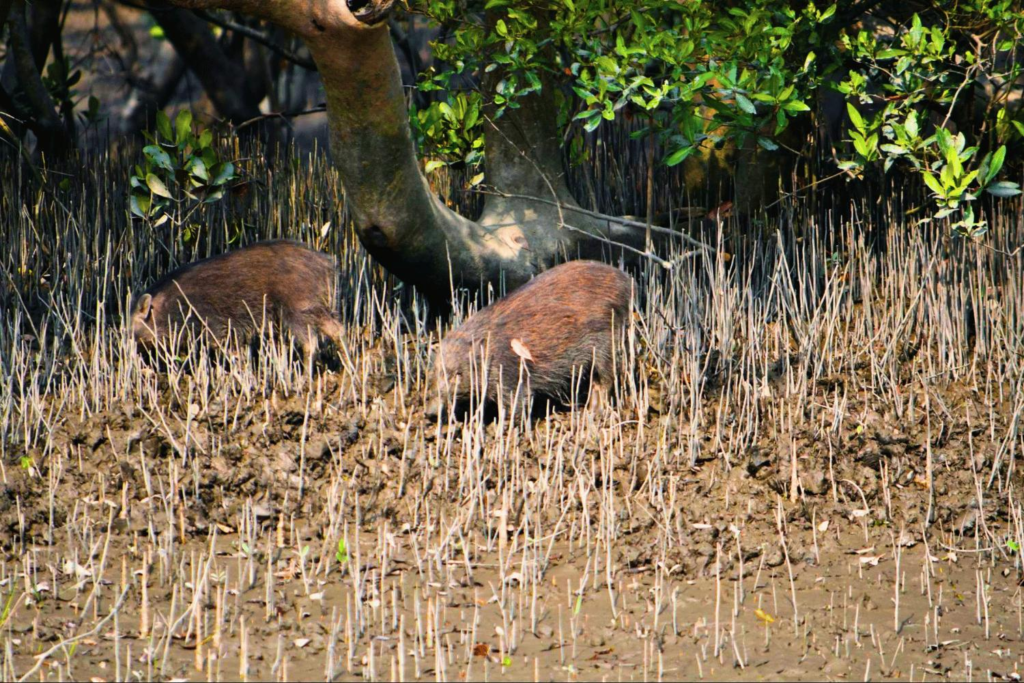
Among the mammals living in this landscape is the wild boar (Sus scrofa), an adaptable, ground-dwelling omnivore. Although it receives less attention than the Royal Bengal Tiger or the spotted deer, the wild boar has an important place in the ecological relationships that sustain the Sundarbans.
Its survival strategy is based on versatility. Instead of relying on a single food source, it consumes a wide variety of plant material and animal matter. Its powerful snout helps it investigate the ground, uncover underground food and disturb patches of soil and leaf litter. These activities connect the animal directly with the forest floor.
The wild boar is also a recognised prey species of the Royal Bengal Tiger. Research examining the diet of Sundarbans tigers has recorded wild boar alongside spotted deer, rhesus macaques and other prey animals. The spotted deer is generally a more prominent component of the tiger’s diet, but wild boars remain part of the wider predator–prey system.
The wild boar’s significance extends beyond its role as prey. Through feeding, movement and rooting, it interacts with vegetation, soil organisms and other members of the food web. These relationships make it an important animal to understand when examining the ecology of the Indian Sundarbans.
However, the species should not be portrayed as possessing extraordinary adaptations unique to mangroves without supporting evidence. Its ability to exploit different foods and habitats is well established across its broader range. How these characteristics influence its distribution, behaviour and ecological effects in individual parts of the Sundarbans requires region-specific research.
Understanding the wild boar therefore means looking beyond its physical appearance. It means examining how an adaptable mammal functions within a tidal forest, where the relationship between land, water and wildlife is never entirely static.
Wild Boar at a Glance
- Common name: Wild boar or wild pig
- Scientific name: Sus scrofa
- Family: Suidae
- Order: Artiodactyla
- Animal group: Mammal
- Diet: Omnivorous
- Habitat: Forests, scrublands and other suitable terrestrial environments
- Global conservation status: Least Concern
- Social behaviour: Females commonly form family groups; adult males are often solitary outside the breeding season
- Distinctive feature: Strong snout used for searching and uncovering food
- Ecological role: Ground-foraging omnivore, soil disturber and prey for large predators
- Sundarbans significance: Part of the terrestrial mammal community and the Royal Bengal Tiger’s prey base
Scientific Classification and Identity
The wild boar belongs to the family Suidae, which includes pigs and related mammals. Its scientific name is Sus scrofa. It is one of the most widely distributed wild pig species, occurring naturally across extensive parts of Eurasia and represented by different regional forms.
Wild boars show variation in size, coat colour and physical appearance. Age, sex, individual differences and geographical variation can all influence their appearance.
Although wild boars and domestic pigs belong to the same species, their lives and behaviours differ according to domestication and environment. Wild boars retain the characteristics associated with independent survival in natural habitats, including flexible feeding behaviour and the ability to search for food across varied terrain.
The scientific identity of the wild boar found in the Sundarbans does not mean that it represents a separate Sundarbans species. No claim of a distinct local species or subspecies should be made without appropriate taxonomic evidence.
Its importance in West Bengal comes from its ecological role within the regional wildlife community, rather than from an established classification unique to the mangrove forest.
Distribution and Presence in the Indian Sundarbans
Wild boars are known from India, including West Bengal, and have been documented in studies of the Sundarbans mammal community.
A study of mammal fauna in the Sundarban Tiger Reserve recorded wild boars across its surveyed areas. The findings provide evidence of the species’ presence, but historical observations cannot establish its current population size or distribution throughout the region.
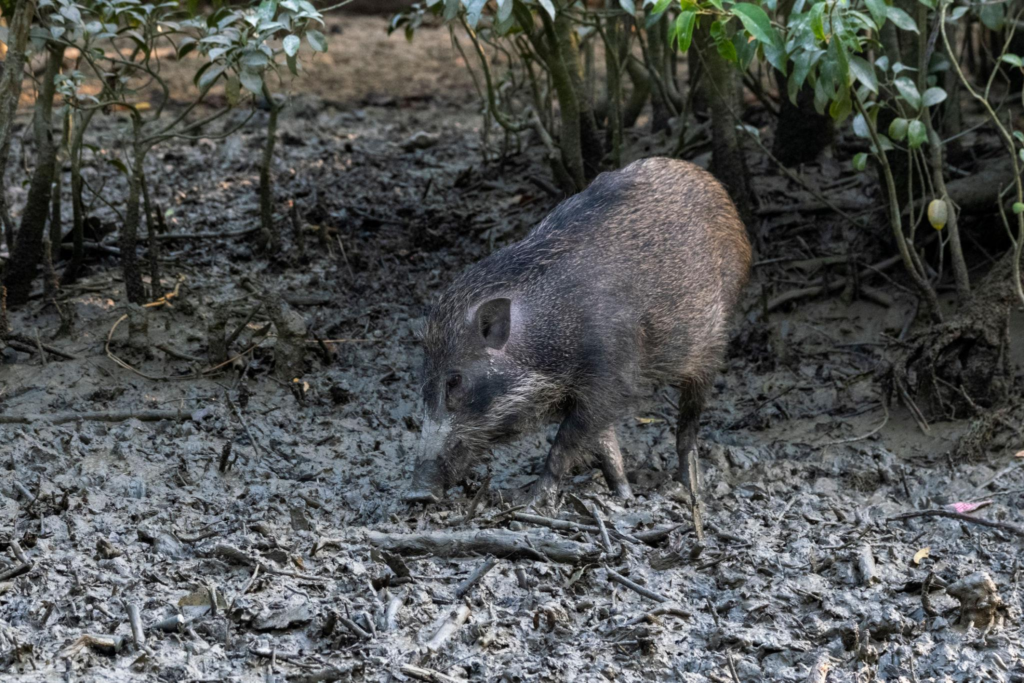
The Indian Sundarbans contains a mosaic of mangrove forests, tidal channels, muddy banks, islands and other habitats. Terrestrial wildlife cannot use every part of this landscape in the same way. Access to food, cover and suitable ground differs between locations, while tides can alter the accessibility of particular areas.
Consequently, it would be misleading to assume that wild boars occur at equal densities across every island or forest block. Reliable conclusions about local distribution require systematic surveys, camera-trap records and other suitable evidence.
The distinction between documented presence and present-day abundance is important. A species may be recorded in a forest without researchers knowing precisely how many individuals currently occupy each section of it.
For the wild boar, continued monitoring would help clarify how its distribution relates to vegetation, food availability, environmental conditions and human activity across the Indian Sundarbans.
Habitat: Finding Food in a Tidal Landscape
The Sundarbans is not simply a forest beside a river. It is a tidal mangrove ecosystem in which water movement influences the ground, vegetation and availability of terrestrial habitat.
For a ground-foraging mammal such as the wild boar, this environment presents both opportunities and constraints. The animal needs access to food, places to move and sufficient cover to reduce exposure to danger. The exact combination varies according to local conditions.
Mangrove vegetation includes species such as Avicennia and Sonneratia, alongside other plants adapted to saline and brackish environments. Their roots, fallen leaves and surrounding sediments contribute to the structure of the forest floor.
However, not every mangrove stand provides the same feeding opportunities. Soil conditions, vegetation density, tidal exposure and the availability of edible material all influence how useful a particular area may be.
The wild boar’s relationship with this environment is best understood through ecological flexibility. It can use suitable terrestrial habitat within a landscape dominated by tidal processes, but it is not immune to flooding, strong currents or changing ground conditions.
The availability of food and accessible ground may change from one location to another. These differences can influence where animals forage, although the precise movement patterns of wild boars in the Indian Sundarbans should not be assumed without local evidence.
Why the Wild Boar Matters to Mangrove Ecology
The wild boar’s ecological importance begins with its feeding behaviour.
By searching for underground food and disturbing the surface of the ground, it can move soil, expose buried organic material and alter small patches of leaf litter. This behaviour, known as rooting, creates localised disturbance within the habitat.
Rooting may expose invertebrates or redistribute plant material. Depending on its intensity and location, it may also disturb vegetation or damage young plants. The ecological outcome is therefore context-dependent rather than automatically beneficial or harmful.
In some environments, rooting can affect seedling survival and soil structure. However, the specific effects of wild boar activity on mangrove regeneration in the Indian Sundarbans cannot be established simply from general observations of the species elsewhere.
The consequences would depend on the vegetation, soil, frequency of disturbance and local tidal conditions. Establishing a direct relationship would require field research comparing areas with different levels of rooting activity.
Wild boars also participate in nutrient movement. By consuming plant and animal material, they transfer energy through their bodies and return nutrients to the environment through waste. Their remains can provide food for scavengers and decomposers.
These processes connect the wild boar to a larger ecological network involving vegetation, invertebrates, herbivores, predators and organisms that break down organic matter.
Its importance does not depend on being the rarest or most spectacular animal in the forest. It lies in the everyday ecological processes through which it interacts with its environment.
A Body Built for Foraging
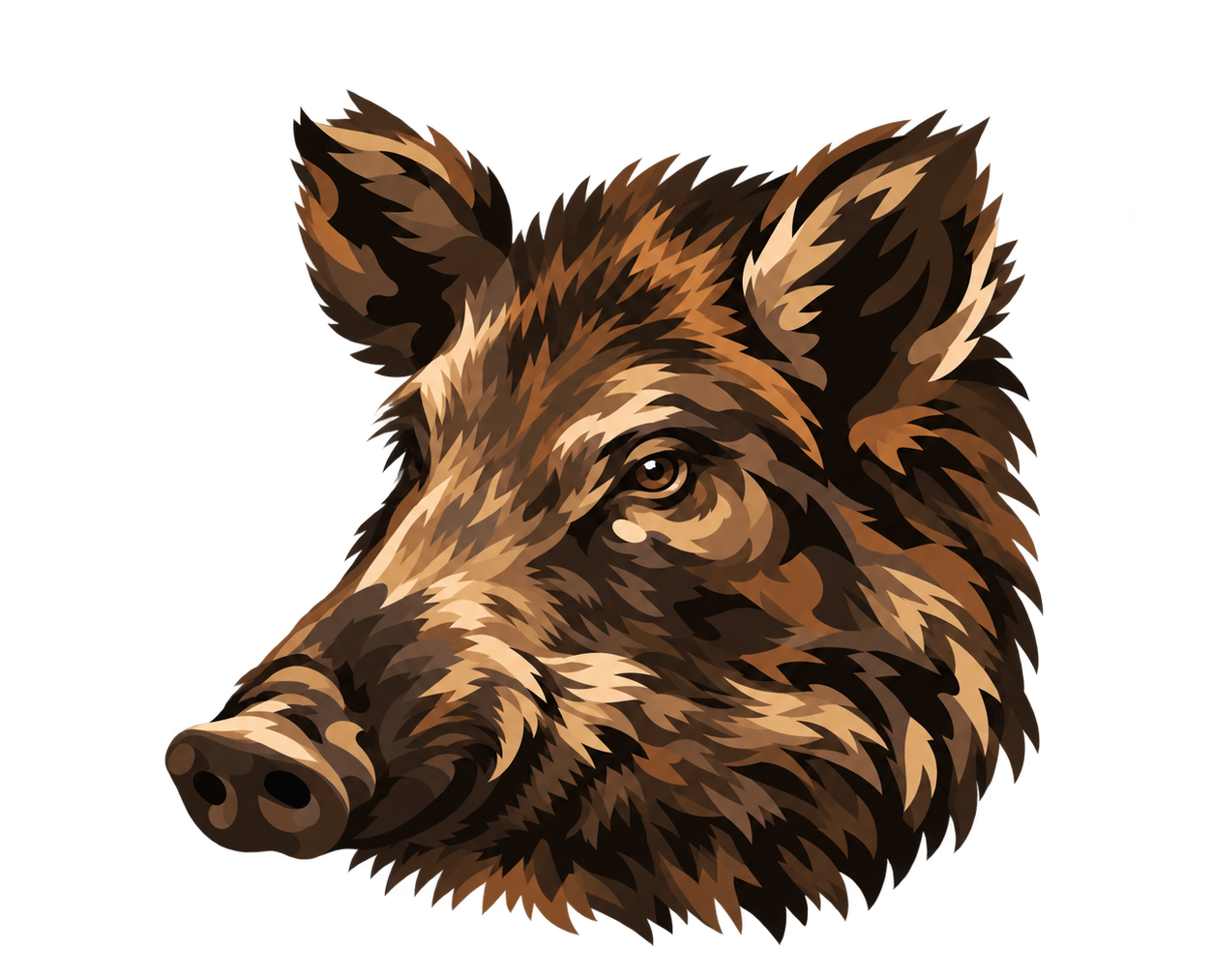
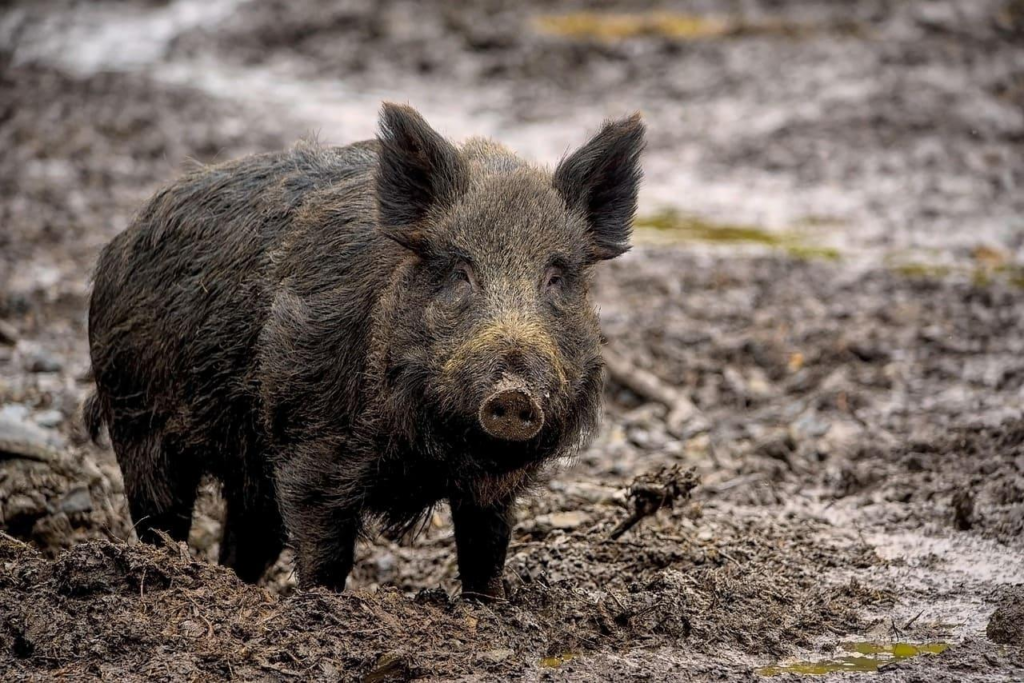
The wild boar has a sturdy body, powerful neck, relatively short legs and an elongated snout. These features support movement through vegetation and the search for food on or beneath the ground.
Its coat is generally coarse, with colours that may range from brown to dark grey or nearly black. Appearance varies according to age, sex and individual characteristics.
The head is particularly important to the animal’s feeding strategy. Its snout is sensitive and strong enough to investigate the ground, push aside loose material and uncover food hidden beneath leaves or soil.
Wild boars possess strong teeth suited to processing a varied diet. Adult males may develop prominent tusks, which are enlarged canine teeth that can be used during defence and confrontations with other boars.
Their limbs and cloven hooves support movement across suitable terrain. However, these structures do not guarantee safe movement across deep mud, unstable sediment or flooded ground.
The wild boar’s physical advantage comes from the combination of a robust body, a versatile feeding apparatus and the ability to exploit different food resources. It is an adaptable generalist rather than a specialist uniquely designed for mangrove life.
The Snout: A Tool for Finding Hidden Food
For a wild boar, the ground contains more than soil. It may hold roots, tubers, seeds, insects, larvae and other edible material that is not immediately visible.
The animal uses its snout to investigate these resources. By pushing aside leaves and disturbing the surface, it can uncover food that a browsing animal might overlook.
Rooting is widespread among wild boars across their geographical range. The behaviour allows them to exploit underground and concealed food, but the type of food obtained depends on the local environment.
In the Sundarbans, the effects of rooting are likely to vary according to soil and sediment conditions, vegetation and the length of time that particular patches remain accessible before tidal water covers them.
The snout does not allow a wild boar to detect every buried food item. Nor does it make feeding independent of environmental conditions. The animal must still locate accessible resources and expend energy to obtain them.
Rooting also leaves physical evidence of activity. Disturbed ground may help researchers identify areas used by wild boars, although signs can be altered by rainfall, tidal flooding and other animals.
Senses and Awareness
Wild boars use smell, hearing, vision and physical awareness to navigate their environment.
Smell is particularly important in locating food and detecting information associated with other animals. Scent also contributes to communication, allowing individuals to respond to the presence of other boars.
Hearing can alert the animal to movement or unfamiliar sounds. In areas with thick vegetation, detecting activity beyond immediate visual range can be valuable.
Vision helps the wild boar recognise nearby animals, obstacles and movement. However, its eyesight should not be exaggerated, and it cannot be assumed to see clearly through dense mangrove vegetation.
The effectiveness of these senses depends on surrounding conditions. Wind, background noise, vegetation and the movement of other animals can influence what a boar detects and how it responds.
These sensory abilities also help explain why people may not see a wild boar even when one is present. An animal may remain concealed, move away before an observer approaches or use a part of the habitat outside the observer’s view.
For wildlife observers, an empty-looking stretch of forest does not necessarily mean that the habitat is unoccupied.
Movement Through Forest, Mud and Water
Wild boars are capable walkers and runners. They travel through forested areas, scrub and other habitats while searching for food or responding to disturbance.
In the Sundarbans, movement takes place within a landscape shaped by tidal channels and changing ground conditions. Areas that are accessible at one stage of the tidal cycle may become wetter or more difficult to reach later.
This does not mean wild boars follow one predictable route with every tide. Their movements depend on suitable habitat, food, cover and local conditions. The precise relationship between tidal changes and wild boar movement in the Indian Sundarbans requires further observation.
Wild boars can swim, which may allow them to cross some bodies of water. Nevertheless, swimming ability does not make tidal rivers harmless. Strong currents, changing water levels and wide channels can create serious risks.
It would be inaccurate to claim that wild boars routinely swim long distances between Sundarbans islands or possess a special ability to navigate every tidal channel.
The more defensible conclusion is that the species can move through varied terrestrial habitats and swim when conditions permit, while waterways remain a significant physical constraint.
What Does the Wild Boar Eat?
See it for yourself
A private journey shaped around you — your group, your pace, your interests. Book a free consultation.
The wild boar is an omnivore, meaning that its diet includes both plant material and animal matter. The balance between these foods varies according to availability, habitat and season.
Its general diet can include:
- Roots and tubers
- Seeds and fallen fruits
- Grasses and other accessible vegetation
- Insects and their larvae
- Earthworms and other invertebrates
- Small animals when encountered
- Carrion and other animal matter
These categories describe the species’ broader feeding ecology, not a verified list of every food consumed by wild boars in the Indian Sundarbans.
The advantage of omnivory is flexibility. An animal that can use different food sources is not entirely dependent on a single plant or prey species. This can be valuable in environments where resource availability changes across space and time.
However, a varied diet does not mean the animal can survive without adequate food. Availability, nutritional quality and access to resources still influence its condition and reproduction.
In the Sundarbans, tidal flooding and vegetation patterns can affect access to ground-based food. A patch that is accessible at one time may become submerged later, making the distribution of feeding opportunities uneven.
The wild boar’s feeding strategy therefore connects its behaviour to the wider dynamics of the tidal forest.
Rooting and Its Ecological Consequences
Rooting is one of the wild boar’s most distinctive behaviours. By pushing its snout into the ground, the animal uncovers food and turns over small amounts of soil and leaf litter.
The resulting disturbance can change the immediate structure of the forest floor. It may expose invertebrates, redistribute organic material and create patches that differ from the surrounding ground.
The effects depend on the intensity and location of the activity. Limited disturbance may expose resources for other organisms, while repeated rooting in the same area may damage vegetation or affect young plants.
These possibilities should not be treated as proof that wild boars are causing a particular level of damage to mangrove regeneration in the Indian Sundarbans. That conclusion would require local evidence.
Researchers would need to examine factors such as rooting frequency, vegetation cover, seedling survival, soil conditions and tidal exposure. Without such evidence, it is more accurate to describe the possible ecological effects than to label the behaviour uniformly beneficial or harmful.
Rooting illustrates a broader principle of ecology: an animal can alter its habitat simply by carrying out its normal feeding behaviour. The scale and consequences of those changes depend on the environment in which the animal lives.
Activity Patterns in a Changing Environment
Wild boars can be active during both day and night. In many populations, activity often increases around dusk or at night, although local conditions can change this pattern.
Food availability, temperature, human disturbance and the risk of encountering predators may influence when animals move and feed. Their behaviour is not identical across every habitat.
It would therefore be misleading to state that all wild boars in the Sundarbans are nocturnal or always emerge at a particular hour.
Heat and humidity may influence the timing and intensity of activity, as they do for many terrestrial mammals. However, the precise relationship between temperature, tides and wild boar activity in the Indian Sundarbans has not been established here.
Tides change the accessibility of exposed ground and river margins. These changes may affect where terrestrial animals can forage, but their exact influence on wild boar activity requires systematic local observation.
Camera traps and repeated field surveys can help researchers identify patterns of activity and establish whether those patterns vary between habitats or seasons.
Social Structure: Family Groups and Solitary Males
Wild boars have a flexible social structure. Females commonly live in family groups, often accompanied by their young. These groups are known as sounders.
Group size and composition vary according to family relationships, local conditions and resource availability. Adult males are often solitary outside the breeding season, although their behaviour can change when seeking mates or interacting with other males.
Family groups may provide benefits for young animals. Remaining close to the mother allows piglets to receive care and protection while they develop the ability to move and feed independently.
However, social behaviour is not rigid. Not every female group has the same number of individuals, and adult males do not remain solitary under all circumstances.
The size and composition of wild boar groups in the Indian Sundarbans should not be assumed from observations made in other countries. Region-specific research would be needed to establish local patterns.
Social behaviour also matters during wildlife encounters. A boar seen alone may be a male, but it could also be separated from a group. A female seen without piglets may have young concealed nearby.
Observers should therefore avoid assuming that an animal is alone simply because only one individual is visible.
Communication and Behaviour
Wild boars communicate through vocalisations, body movements and scent.
Their vocalisations can include grunts and other sounds associated with contact, alarm or interactions between individuals. The meaning of a sound depends on its context, and it would be unwise to assign a precise meaning to every call heard in the field.
Scent is another important source of information. Like many mammals, wild boars use scent-related behaviour to communicate and recognise the presence of other animals.
Body posture can also reveal how an animal is responding to its surroundings. A boar may turn towards a disturbance, raise its head, pause or attempt to move away. Such responses must be interpreted cautiously because behaviour depends on distance, cover, the presence of young and the immediate circumstances.
Wild boars are not automatically aggressive towards people. Many will avoid close contact when they have an opportunity to move away. However, they are powerful wild animals capable of defending themselves when threatened.
An animal that feels cornered, is injured or is protecting piglets may be dangerous. Adult males can also use their tusks during confrontations.
People should maintain distance, avoid sudden attempts to approach and never surround or chase a wild boar. Giving the animal space to move away is the safer response.
Breeding and the Early Life of Piglets
Wild boars reproduce by giving birth to litters of young. The female is known as a sow, and the young are called piglets.
The species can produce several offspring in a litter, although litter size and breeding patterns vary across its range. Gestation commonly lasts around four months, but precise reproductive statistics should not automatically be applied to the Sundarbans population without local evidence.
Before giving birth, a sow may select a sheltered location where she can protect her young. Some wild boar populations prepare nest-like resting sites from vegetation. This is part of the species’ broader reproductive behaviour, not proof that every sow in the Sundarbans uses an identical nesting strategy.
Piglets are vulnerable during their early life. They depend on their mother for milk, protection and guidance while gradually learning to move and feed independently.
Young wild boars are often recognised by their striped coat pattern, which changes as they mature. The pattern helps distinguish piglets from the more uniformly coloured appearance of many adults.
Maternal care is important because young animals face multiple challenges, including predators, disease, environmental exposure and the need to locate suitable food as they grow.
The survival of piglets depends on more than the number born. Habitat conditions, food availability, disturbance and predation can all influence how many reach adulthood.
Reliable, current estimates of wild boar reproductive success or piglet survival specifically in the Indian Sundarbans are not established here.
The Wild Boar and the Royal Bengal Tiger
The wild boar’s relationship with the Royal Bengal Tiger is one of its most important ecological connections in the Sundarbans.
Studies examining tiger diet in the Indian Sundarbans have identified wild boar as prey, alongside spotted deer and other animals. A study published in 2013 examined undigested remains from 214 tiger scat samples and reported that spotted deer were consumed more frequently than wild boar.
This relationship connects a ground-foraging omnivore with a large predator at the top of the food web. The tiger’s ability to survive depends partly on the availability of suitable prey, while wild boars are influenced by habitat conditions, food resources and predation.
However, the wild boar should not be described as the tiger’s principal prey throughout the Sundarbans. Research generally identifies spotted deer as a major component of the tiger’s diet.
A 2025 study in the Bangladesh Sundarbans examined prey abundance between 2021 and 2023. It reported a positive but statistically non-significant relationship between wild boar and tiger abundance, while the relationship between spotted deer and tiger abundance was statistically significant. These findings are relevant to understanding predator–prey dynamics but should not be treated as direct measurements of the Indian Sundarbans.
The wider lesson is that predator and prey relationships are complex. More wild boars do not automatically mean more tigers. Tiger abundance also depends on habitat conditions, other prey species, human disturbance and the broader ecological environment.
Protecting the tiger therefore requires attention to the entire wildlife community and the habitats that support it.
Wild Boars, Other Animals and the Food Web
The wild boar occupies several positions in the food web because of its omnivorous diet.
When it consumes roots, fruits, seeds and other plant material, it uses resources produced by vegetation. When it consumes invertebrates or other animal matter, it draws energy from additional parts of the ecosystem.
This flexibility can create overlap with other species. Animals that feed on fruits, seeds or ground-dwelling invertebrates may use some of the same resources. The degree of competition depends on food availability and the number of animals using it.
Wild boars can also influence the accessibility of food through rooting. Disturbed ground may expose organisms that were previously concealed, potentially making them available to other animals. The scale of this effect in the Indian Sundarbans remains uncertain.
Their remains can provide food for scavengers and decomposers, helping transfer energy through the ecosystem.
These interactions demonstrate why an animal’s ecological role cannot always be reduced to one category. A wild boar can consume vegetation, feed on invertebrates, disturb soil and become prey for a tiger.
The importance of each role varies with local conditions. Understanding the species requires looking at these relationships together rather than treating it as an isolated animal.
Wild Boars and People in the Sundarbans
The relationship between wild boars and people depends on the location and circumstances.
Across their wider range, wild boars can sometimes damage crops or come into conflict with people where food sources overlap. Their strength, tusks and defensive behaviour can also make close encounters dangerous.
These general patterns do not establish the frequency or severity of wild boar conflict in every part of the Indian Sundarbans. Local conditions must be considered before making claims about attacks, crop damage or population pressure.
The Sundarbans is both a wildlife habitat and a working landscape. People live in settlements, cultivate land, use waterways and depend on natural resources for their livelihoods. The relationship between wildlife and people must be understood within this ecological and socioeconomic context.
Where wild boars and people use neighbouring areas, access to food and cover may influence encounters. Avoiding deliberate feeding and managing food waste are sensible precautions wherever wild animals could be attracted to human food sources.
People should not attempt to corner, chase or handle a wild boar. If an animal is encountered near a settlement, maintaining distance and allowing it to move away is safer than trying to drive it off at close range.
Wildlife management should also avoid blaming local communities without evidence. Effective coexistence depends on understanding the circumstances of an encounter, the needs of people and the ecological requirements of the animal.
Conservation Status: What Does Least Concern Mean?
The wild boar is classified globally as Least Concern. This classification reflects the species’ broad distribution and overall global condition; it does not mean that every local population is secure or that monitoring is unnecessary.
A widespread species can remain globally common while individual populations face local pressures. Equally, the presence of an animal in a protected area does not automatically demonstrate that its population is increasing.
For the Indian Sundarbans, a current and reliable population estimate for wild boars is not established here. Historical records confirm the species’ place in the regional mammal community, but they cannot answer every question about its present distribution or abundance.
The distinction between global and local status is important in an ecosystem undergoing environmental change.
Monitoring Wild Boars in the Sundarbans
Wildlife monitoring helps researchers determine where wild boars occur, how they use different habitats and whether their activity changes over time.
Camera traps can record animals passing through selected locations without continuous human observation. Repeated photographs may help establish presence, activity patterns and group composition. However, the number of photographs alone does not automatically provide a reliable population estimate.
Tracks and rooting signs can indicate recent activity. Footprints, disturbed soil and feeding marks may help researchers identify areas used by wild boars. These signs require careful interpretation because tides, rain and other animals can alter them.
Scat analysis can help researchers investigate diet or confirm the use of an area. Identifying the species responsible for a sample may require specialist examination.
Repeated field surveys can help establish patterns of presence across different locations. Consistent methods are essential if researchers want to compare observations between years or habitats.
No single method answers every question. Camera traps may miss animals that do not pass within their detection area, while field signs can disappear quickly in a tidal environment.
A strong monitoring programme combines appropriate methods and records their limitations. Over time, this evidence can help distinguish changes in animal activity from genuine changes in population size.
Habitat Protection and Environmental Pressures
The wild boar depends on suitable habitat, accessible food and the wider ecological processes that sustain terrestrial wildlife.
The Indian Sundarbans faces environmental pressures that affect the landscape as a whole. These include coastal erosion, cyclones, flooding, changes in salinity and other effects associated with a dynamic delta and a changing climate.
Such pressures can alter vegetation, modify the distribution of suitable ground and affect wildlife resources. Their specific effects on wild boar populations, however, should not be assumed without direct evidence.
Erosion may remove terrestrial habitat in one location, while sediment deposition changes landforms elsewhere. Cyclones can damage vegetation and reshape local conditions, but the consequences for individual mammals depend on the severity of the event and the habitat involved.
Changes in salinity can influence mangrove communities and other organisms. Any resulting effects on wild boars would depend on how vegetation, food resources and access to ground change in response.
Human disturbance is another consideration. Appropriate management of protected areas and the preservation of wildlife habitat are important for maintaining the region’s mammal community, including species that receive less attention than flagship animals.
The ecological value of a species should not be judged solely by whether it is rare. Widespread animals can still perform important roles in food webs and habitat processes.
Conservation planning should therefore be based on evidence about local populations, habitat use and ecological relationships rather than assumptions derived from global conservation status alone.
Where Can Wild Boars Be Seen in the Sundarbans?
Wild boars have been documented in the wider Indian Sundarbans, including in research on the mammal community of the Sundarban Tiger Reserve. However, the available evidence does not justify naming a particular island, watchtower or tourism route as a guaranteed wild boar hotspot.
Nor is there a sound basis for assigning a percentage chance of seeing one at a specific location.
The presence of suitable habitat does not guarantee an encounter. An animal may remain concealed even when it uses an area regularly, and wildlife distribution varies across space and time.
The tidal landscape creates additional limits on observation. Forest interiors are not freely accessible, and many areas can only be approached under applicable forest regulations and authorised arrangements.
Visitors should follow the guidance of authorised guides and forest personnel, remain within permitted areas and never attempt to enter restricted habitat to search for wildlife.
The most responsible approach is to treat a sighting as a possibility rather than an entitlement. A Sundarbans expedition can provide opportunities to learn about the forest’s ecological relationships even when a particular mammal remains unseen.
Signs of feeding and other indirect evidence may be useful to researchers, but they should be interpreted carefully rather than treated as proof of a recent sighting without verification.
The Important Truth About Wildlife Sightings
Wildlife observation is unpredictable because animals do not follow human schedules.
A species may use a habitat without appearing during a visitor’s passage. Weather, disturbance, food availability and the animal’s own movements can influence whether it is visible.
In the Sundarbans, vegetation, tidal waterways and restricted access to forest areas make observation particularly challenging. A boat passing through a channel cannot reveal every animal living beyond the banks.
The absence of a sighting therefore does not establish the absence of a species. Equally, one sighting does not prove that a species is abundant or regularly visible at that location.
Responsible wildlife interpretation distinguishes between documented presence, suitable habitat and an actual encounter. These are different concepts and should not be used interchangeably.
For The Wild Orbit, a meaningful wildlife experience is not measured only by the number of animals photographed. It also includes understanding the landscape, recognising ecological relationships and respecting the limits of observation.
What Makes the Wild Boar of the Sundarbans Unique?
The wild boar of the Sundarbans is not known to represent a separate species. Its significance lies in the way a widespread, adaptable mammal participates in one of India’s most distinctive tidal ecosystems.
Its first distinctive feature is dietary flexibility. By consuming different types of plant and animal material, the wild boar uses resources from several parts of the food web. This flexibility can be valuable in an environment where resources vary across locations and seasons.
Its second important feature is its relationship with the forest floor. Rooting disturbs soil and leaf litter, exposes concealed food and changes small patches of habitat. These effects may influence other organisms, although their specific consequences for mangrove vegetation require local research.
Its third ecological connection is its role as tiger prey. Studies of Sundarbans tiger diets have recorded wild boar among the animals consumed by this large predator. Its presence contributes to the wider predator–prey system, alongside the more prominent role of spotted deer.
Its fourth defining context is the tidal environment. The wild boar is not a specialist uniquely adapted to saltwater or tidal flooding. Instead, it uses suitable terrestrial habitat within a landscape where exposed ground and waterways change continually.
Finally, the species highlights the importance of looking beyond famous wildlife. The Sundarbans is not defined by its tiger alone. Its ecological integrity depends on a wider community of mammals, birds, reptiles, invertebrates and plants, connected through feeding, movement and habitat use.
The distinctive story of the wild boar is not that it possesses a mysterious mangrove adaptation. It is that an adaptable ground-foraging mammal has a place in an ecosystem where the availability of land and food is shaped by tides.
Myths and Facts About Wild Boars
Myth: Wild boars eat only plants.
Fact: Wild boars are omnivores. Their diet includes plant material and may also include invertebrates, small animals and carrion.
Myth: A globally Least Concern species needs no conservation attention.
Fact: Global status does not establish the condition of every local population. Regional monitoring remains important.
Myth: Wild boars can swim, so tidal rivers are no obstacle.
Fact: Wild boars can swim, but strong currents, changing water levels and wide channels can still create serious risks.
Myth: Every rooting patch damages mangrove regeneration.
Fact: Rooting disturbs the ground, but its effects depend on local conditions and intensity. Specific impacts on Sundarbans mangrove seedlings require evidence.
Myth: A wild boar sighting is guaranteed in suitable forest habitat.
Fact: Habitat suitability does not guarantee visibility. Wildlife observation depends on many changing factors.
FAQs
What is the scientific name of the wild boar?
The scientific name is Sus scrofa. It belongs to the family Suidae.
Are wild boars found in the Indian Sundarbans?
Yes. Wild boars have been documented in studies of the Indian Sundarbans mammal community, including the Sundarban Tiger Reserve. Their present distribution and population size across individual locations require current monitoring.
What do wild boars eat in the Sundarbans?
Wild boars are omnivores. Their general diet includes roots, tubers, seeds, fruits, vegetation, invertebrates and other animal matter when available. The precise diet of the Indian Sundarbans population is not fully established here.
Are wild boars prey for Royal Bengal Tigers?
Yes. Wild boars are among the documented prey species of Sundarbans tigers, although spotted deer are a major component of the tiger’s diet.
Are wild boars endangered?
The species is globally classified as Least Concern. This does not necessarily describe the condition of every local population.
Can wild boars swim across rivers?
Wild boars can swim, but this does not make them immune to strong currents or other hazards in tidal waterways.
Why do wild boars dig into the ground?
They use their strong snouts to uncover food such as roots, tubers and invertebrates. This behaviour is called rooting and can disturb soil and leaf litter.
Are wild boars dangerous to humans?
They can be dangerous if threatened, cornered, injured or protecting young. People should maintain distance and never attempt to approach or feed them.
Where can visitors see wild boars in the Sundarbans?
The species is documented in the wider Indian Sundarbans, but the available evidence does not establish a particular location as a guaranteed sighting hotspot. Wildlife sightings remain unpredictable.
What is the ecological importance of wild boars?
Wild boars are omnivorous foragers, can disturb the ground through rooting and form part of the prey community supporting large predators. Their effects on particular habitats depend on local conditions.
The Wild Orbit Perspective
The wild boar’s story begins close to the ground, among roots, fallen leaves and the shifting surfaces of the mangrove forest. Its feeding behaviour reveals a world that is easy to overlook: the organisms beneath the soil, the plant material that sustains omnivores and the connections that link them to larger predators.
In the Indian Sundarbans, these relationships exist within a landscape governed by tidal water. Terrestrial habitat is part of a wider system of islands, creeks, rivers and mangrove vegetation, all influenced by natural processes and environmental change.
The wild boar does not need to be rare or spectacular to matter. Its flexible diet, role in the food web and interactions with the ground make it a meaningful member of the region’s mammal community.
Understanding this animal also requires scientific honesty. Its general biology is well established, but questions about its present distribution, population trends and specific ecological effects in the Indian Sundarbans need further research. Recognising those gaps is part of responsible natural-history writing.
The Wild Orbit approaches the Sundarbans as a living ecosystem rather than a checklist of wildlife encounters. Every species, from a large predator to a ground-foraging mammal, contributes to the wider story of how the tidal forest functions.
To understand the Sundarbans is to look beyond the animals that command attention and recognise the relationships that sustain them.
The wild boar is one thread in the living fabric of the mangroves—a reminder that the health of a great ecosystem depends on far more than the wildlife we happen to see.
Plan your private Sundarban expedition
A private journey shaped around you — your group, your pace, your interests. Book a free consultation.