
 Field guide
Among the kingfishers of the Indian Sundarbans, few possess the imposing appearance of the Stork-billed Kingfisher (Pelargopsis capensis). Its exceptionally large red bill, broad head, sturdy body and striking plumage make it one of the most distinctive members of the kingfisher family.
Unlike the smaller kingfishers that are often recognised by their rapid movements and compact silhouettes, this species has a substantial presence. It can frequently be associated with waterside perches, where it surveys the water below before making a calculated move towards potential prey.

The Sundarbans provides a landscape of tidal rivers, interconnected creeks, wooded banks and wetland edges. Within this changing estuarine environment, the Stork-billed Kingfisher represents an important component of the region’s diverse birdlife.
Its presence also illustrates an important aspect of Sundarbans biodiversity: the mangrove landscape supports not only birds that live deep within the forest but also species that depend on the interface between vegetation and water.
Stork-billed Kingfisher At a Glance
| Field | Information |
| Common Name | Stork-billed Kingfisher |
| Alternative Name | Brown-headed Stork-billed Kingfisher |
| Scientific Name | Pelargopsis capensis |
| Scientific Authority | (Linnaeus, 1766) |
| Order | Coraciiformes |
| Family | Alcedinidae |
| Genus | Pelargopsis |
| Global Conservation Status | Least Concern |
| IUCN Assessment | 2025 |
| Indian Status | Resident |
| West Bengal Status | Resident |
| Sundarbans Occurrence | Included in regional bird checklist |
| Habitat | Wooded waterways, wetlands and suitable waterside habitats |
| Diet | Fish and other small animals |
| Ecological Association | Aquatic and waterside food webs |
Taxonomy and Scientific Identity
The Stork-billed Kingfisher belongs to the family Alcedinidae, which includes the world’s kingfishers. Its genus, Pelargopsis, contains large-bodied kingfishers characterised by their powerful bills and robust appearance.
The scientific name Pelargopsis capensis dates to the original description by Carl Linnaeus in 1766.
The name Stork-billed refers to its exceptionally large bill, whose proportions give the bird an appearance somewhat reminiscent of a stork. It is also called the Brown-headed Stork-billed Kingfisher in some references.
In West Bengal, the state Biodiversity Information System records the Bengali name Gurial, alongside the Hindi name Bada Kilkila.
Distribution: From South Asia to the Sundarbans
The Stork-billed Kingfisher has a broad distribution across parts of South and Southeast Asia. Its range includes the Indian subcontinent and extends through several countries of tropical Asia.
In India, the species occurs across multiple regions, including eastern India. West Bengal is part of its documented distribution.
The West Bengal Biodiversity Information System records the species in the state, while the State of India’s Birds assessment identifies it as a resident species nationally and within West Bengal.
In the Indian Sundarbans, its inclusion in the regional bird checklist establishes its presence in the wider landscape. However, this should not be interpreted as evidence of equal abundance across every island, forest block or river system.
Habitat: Where Water Meets Vegetation
The Stork-billed Kingfisher is associated with waterside habitats where suitable perches and feeding opportunities are available.
Its habitat preferences include wooded waterways, rivers, lakes, wetlands and other aquatic environments. The species can use vegetation along water bodies as a vantage point from which to search for prey.
In the Indian Sundarbans, the wider habitat mosaic includes tidal creeks, riverbanks, mangrove edges and freshwater-influenced wetlands. These environments offer different combinations of vegetation, water depth and potential prey.
However, not every mangrove creek should automatically be considered suitable habitat. The availability of appropriate perches, prey and relatively undisturbed feeding areas is important.
Conservation Status
The Stork-billed Kingfisher is classified as Least Concern on the IUCN Red List. Its latest global assessment was published in 2025, with the population trend listed as unknown.
The State of India’s Birds assessment places the species in the Low Priority category nationally. Its West Bengal assessment also provides state-level distribution and population-trend indicators, although these estimates should not be interpreted as direct measurements of the Sundarbans population.
Least Concern does not mean that individual habitats are free from ecological pressures. The condition of wetlands, waterways and waterside vegetation remains relevant to the species’ long-term persistence.
How to Identify the Stork-billed Kingfisher
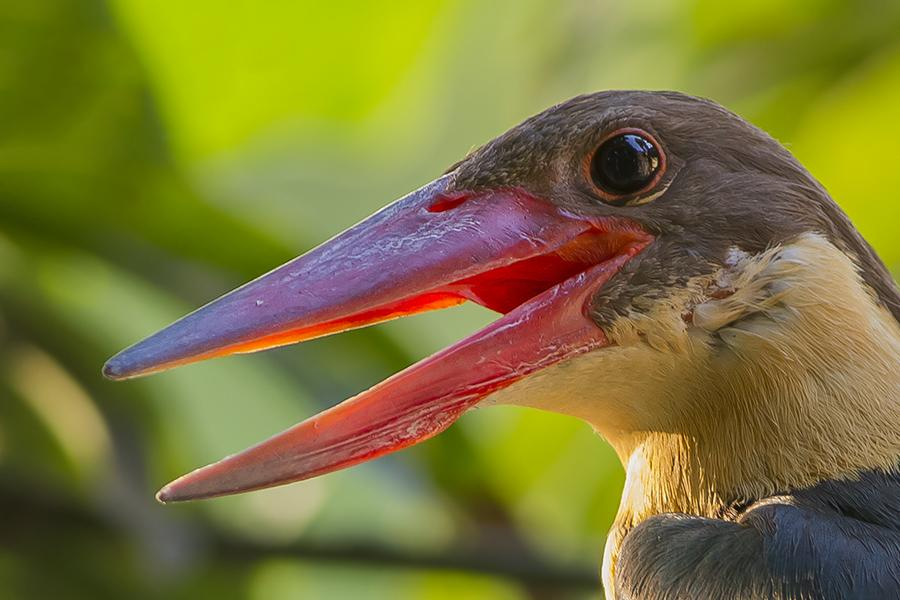
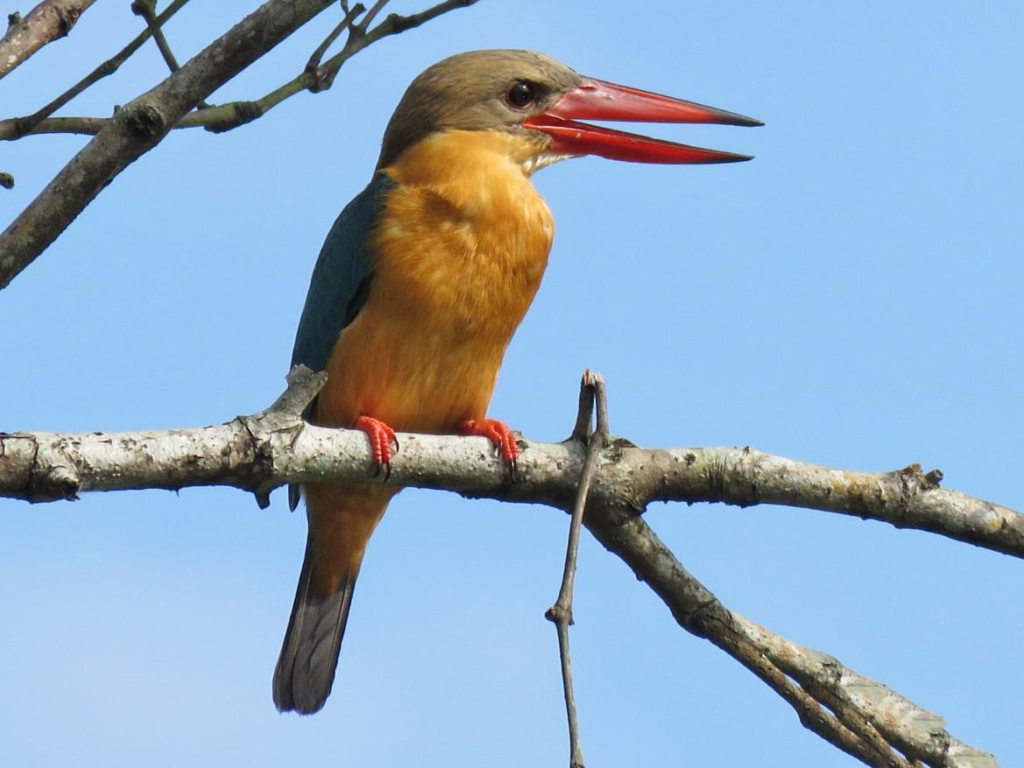
The first feature that attracts attention is its enormous reddish bill. Even from a distance, the combination of a large head, heavy bill and substantial body makes this kingfisher relatively straightforward to distinguish from smaller species.
An adult typically measures approximately 35–38 cm in length. Its sexes are broadly similar in appearance, making size and plumage differences between males and females difficult to establish reliably in ordinary field observations.
Its principal identification features include:
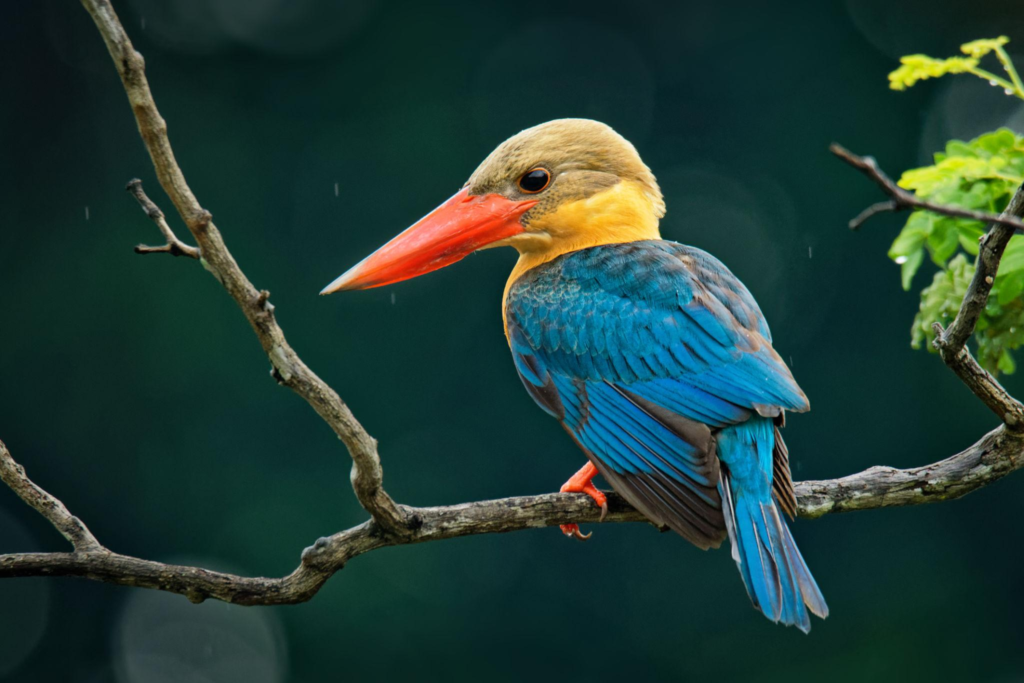
- Olive-brown to brownish, with a slightly paler appearance around the head and neck
- Greenish to dark green-blue
- Blue, sometimes appearing darker depending on lighting
- Blue, contrasting with the brownish head
- Buff to pale yellowish
- Exceptionally large and predominantly bright reddish-orange
- Red legs
- Dark, surrounded by relatively subtle bare facial skin
Understanding Its Remarkable Bill
The bill is the most recognisable anatomical feature of the Stork-billed Kingfisher.
Unlike the relatively slender bills of some smaller kingfishers, its bill is exceptionally thick, powerful and elongated. The reddish colour makes it particularly conspicuous against the bird’s contrasting plumage.
Its structure is associated with capturing and handling a varied range of prey, including fish and other small animals.
The bill is not simply a visual feature. It is an important part of the bird’s feeding equipment, allowing it to seize prey and manipulate food before swallowing.
Wings, Tail and Flight
Despite its substantial body, the Stork-billed Kingfisher is capable of moving efficiently between waterside perches and surrounding vegetation.
Its flight is generally direct, with strong, relatively heavy wingbeats rather than the rapid, delicate movement associated with smaller kingfishers.
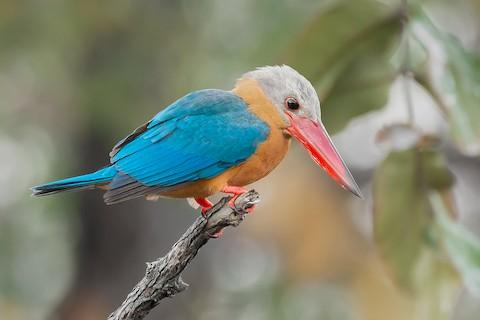
The blue wings and tail become particularly noticeable when the bird takes flight. Its greenish upperparts and contrasting pale underparts provide additional identification clues.
The tail also contributes to the bird’s overall balance during perching and movement.
What Does the Stork-billed Kingfisher Eat?
See it for yourself
A private journey shaped around you — your group, your pace, your interests. Book a free consultation.
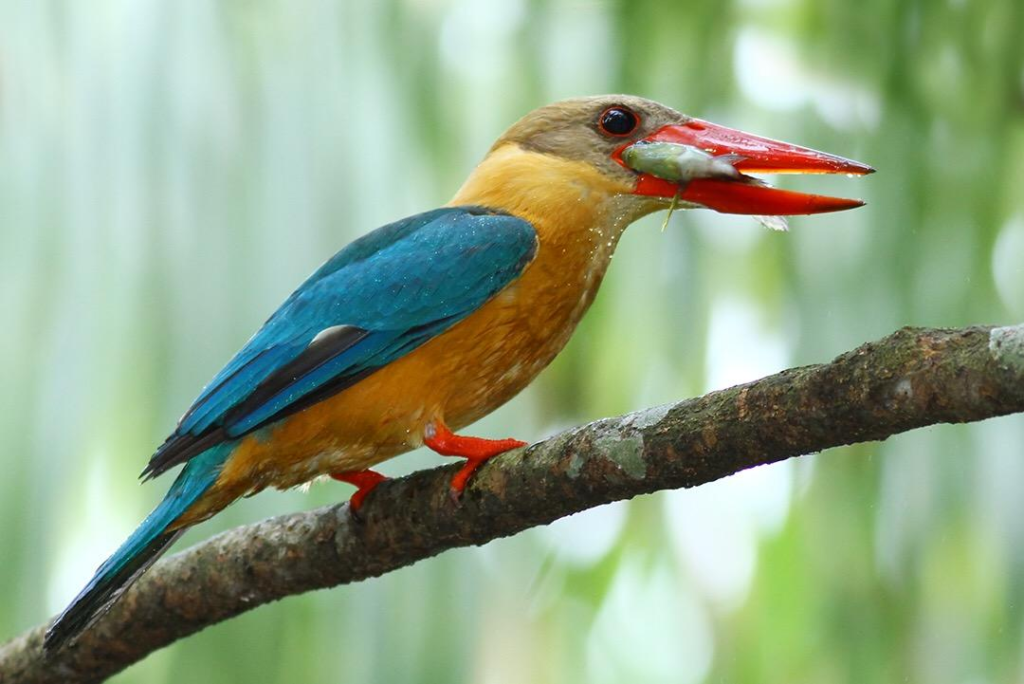
Although fish form an important part of its diet, the Stork-billed Kingfisher is not exclusively a fish-eating bird.
Its feeding behaviour is more varied than its common name might suggest.
Documented prey includes:
| Food Category | Examples |
| Fish | Small freshwater and marine fish |
| Crustaceans | Crabs and other crustaceans |
| Amphibians | Frogs |
| Reptiles | Small lizards |
| Mammals | Small rodents |
| Birds | Occasionally young birds |
| Invertebrates | Insects and other manageable prey |
How Does It Hunt?
The Stork-billed Kingfisher is a patient ambush hunter.
It commonly uses a suitable branch or other elevated waterside perch to watch the surroundings. From there, it scans the water and nearby ground for potential prey.
Once an opportunity appears, it makes a rapid movement to capture its target.
Fish may be seized directly from the water, while other prey can be taken from vegetation or the ground.
After capturing prey, the bird may return to a perch to reposition or manipulate it before swallowing.
This hunting strategy makes the availability of suitable perches an important aspect of its habitat.
How It Uses the Sundarbans’ Tidal Habitat
The Indian Sundarbans is a constantly changing landscape. Water levels rise and fall, mudflats become exposed, and tidal currents alter the appearance of creeks and riverbanks.
For a waterside predator such as the Stork-billed Kingfisher, these changes influence the availability and accessibility of feeding habitat.
Vegetated banks and branches overlooking water can provide useful hunting positions. Different water conditions may also change where prey becomes accessible.
However, the species should not be described as exclusively adapted to mangrove environments. It occupies a much wider range of aquatic and wooded habitats throughout its distribution.
Its presence in the Sundarbans is best understood as part of its broader association with vegetated waterways and wetlands.
A Solitary Hunter With Territorial Behaviour
The Stork-billed Kingfisher is generally encountered alone or in pairs rather than in large feeding flocks.
It can remain remarkably still while waiting for prey. Its substantial body and colourful plumage may make it appear conspicuous, but its patient behaviour can make detection surprisingly difficult when it is perched among vegetation.
The species is also known for territorial behaviour. Breeding pairs defend suitable areas, particularly where feeding and nesting opportunities are available.
Its territories are associated with access to appropriate habitat rather than simply a fixed section of water.
Calls and Vocal Communication
The Stork-billed Kingfisher is a vocal species, with calls that can be heard across its waterside habitat.
Its vocal repertoire includes loud, harsh, cackling notes, often described as a repeated series of ke-ke-ke sounds.
A longer, more musical whistle is also described in ornithological accounts.
Calls are useful for communication and can be especially noticeable during periods of territorial and breeding activity.
For birdwatchers, recognising its vocalisations can help detect the species when vegetation obstructs a clear view.
Breeding and Nesting Behaviour
Like other kingfishers, the Stork-billed Kingfisher has specialised nesting behaviour.
Rather than constructing a conventional nest from twigs and leaves, breeding pairs excavate a cavity or tunnel.
Reported nesting locations include:
- Steep earthen banks near waterways.
- Decaying tree trunks.
- Rotten wood.
- Arboreal termite nests.
The tunnel generally leads to a nesting chamber where the eggs are laid.
Published natural-history accounts report clutches commonly containing two to five white eggs.
Does the Stork-billed Kingfisher Breed in the Indian Sundarbans?
This is an important distinction.
The species’ breeding behaviour is documented across its wider distribution, but the regional checklist evidence reviewed for this article does not establish a confirmed breeding site or breeding population in the Indian Sundarbans.
Its presence in the region should therefore not be treated as proof of local nesting.
Further systematic observations and breeding records would help establish its reproductive status in this particular landscape.
Human Connections and the Waterside Landscape
The Stork-billed Kingfisher shares parts of its wider habitat with fishing communities and people who depend on rivers and wetlands.
Fishing settlements, waterways and vegetated banks create a landscape where human activity and wildlife habitat can overlap.
The presence of fishing activity does not automatically mean that the bird experiences conflict with people. Its ecological requirements are broader than the availability of fish alone, and its diet includes other prey.
Maintaining waterside vegetation, suitable nesting substrates and healthy aquatic habitats can contribute to the ecological conditions on which this species depends.
For the Sundarbans, this relationship highlights the importance of viewing wildlife conservation within the context of the wider estuarine landscape and the people who live alongside it.
Conservation Status and Ecological Challenges
The Stork-billed Kingfisher currently has a global IUCN conservation classification of Least Concern. Nevertheless, its continued presence depends on the availability of suitable aquatic and wooded habitats.
Some of the broader environmental pressures relevant to its habitat include:
- Changes to the quality and availability of wetlands can affect feeding opportunities.
- Removal of suitable trees and vegetation may reduce available perching and nesting locations.
- Pollution can affect aquatic food webs and the condition of habitats used by fish-eating birds.
- Erosion and alterations to natural banks can affect potential nesting substrates.
- Changes in rainfall, tidal conditions and coastal environments may influence the wider wetland ecosystem.
These are habitat-related conservation concerns, not evidence that each pressure has been measured as a direct population-level threat to the Stork-billed Kingfisher in the Indian Sundarbans.
The available regional evidence does not provide a reliable population estimate or a species-specific assessment of these pressures within the Sundarbans.
Where Can the Stork-billed Kingfisher Be Observed in the Indian Sundarbans?
The Stork-billed Kingfisher is included in the published Birds of Sundarbans National Park checklist and the Sunderban Biosphere Reserve regional checklist. These establish its occurrence within the wider Indian Sundarbans landscape.
However, the available sources do not establish a sufficiently detailed, independently verified list of recent sightings at individual locations such as Sajnekhali, Sudhanyakhali, Dobanki or Bonnie Camp.
It would therefore be misleading to advertise these locations as confirmed hotspots for this particular species.
For responsible birdwatching, suitable habitats to pay attention to include:
- Vegetated riverbanks
- Larger tidal channels with suitable perching vegetation
- Wooded freshwater and brackish-water margins
- Quiet wetland edges
- Waterways adjoining mangrove vegetation
These are habitat-based observation suggestions, not confirmed species-specific sighting locations.
The distinction matters: a suitable habitat increases the possibility of an encounter but does not establish that the species is present at a particular site.
When Is the Stork-billed Kingfisher Present?
The Stork-billed Kingfisher is classified as a resident species in the State of India’s Birds assessments for India and West Bengal.
This indicates that it is not categorised as a regular long-distance winter migrant in the regional assessment.
However, resident status does not mean that an individual bird will remain in exactly the same location throughout the year.
Local movements can occur, and the availability of food, habitat conditions and breeding requirements may influence where individuals are encountered.
There is insufficient species-specific evidence in the reviewed Indian Sundarbans sources to establish a precise monthly arrival, departure or peak-sighting calendar.
The Important Truth About Bird Observation
Birdwatching in the Sundarbans is influenced by several constantly changing factors.
The tide determines how much mudflat and shallow feeding habitat becomes exposed. Weather affects visibility and bird activity. Vegetation can obstruct observations, while the bird’s own behaviour determines whether it remains visible or moves into cover.
Survey effort also matters.
A bird recorded during one visit may go undetected during another, even when the habitat has not changed substantially.
It is equally important to distinguish between abundance and detectability. A species that is difficult to observe is not necessarily rare, and a lack of sightings during a particular expedition does not prove its absence.
Responsible observation requires patience, repeated surveys and respect for natural behaviour.
What Makes the Stork-billed Kingfisher of the Sundarbans Unique?
The Stork-billed Kingfisher is not an endemic bird of the Sundarbans, nor does it possess a scientifically established Sundarbans-specific subspecies.
Its wider distribution extends far beyond the mangrove delta.
What makes its presence interesting is the relationship between a large, predominantly waterside kingfisher and one of the world’s most dynamic tidal wetland environments.
The Indian Sundarbans is not simply a landscape of mangrove trees. It is an interconnected system of rivers, creeks, islands, freshwater-influenced wetlands and estuarine habitats.
The Stork-billed Kingfisher belongs to this wider ecological picture.
Its association with vegetated waterways demonstrates how the biodiversity of the Sundarbans extends beyond species that are exclusively dependent on dense mangrove forest.
It also offers an interesting contrast with another member of its genus, the Brown-winged Kingfisher (Pelargopsis amauroptera), which has a much more specialised association with mangrove habitats.
Both species belong to the same genus, but their ecological relationships and conservation circumstances are different. The Brown-winged Kingfisher is globally classified as Near Threatened, whereas the Stork-billed Kingfisher is classified as Least Concern.
The Stork-billed Kingfisher therefore adds another dimension to understanding the diversity of kingfishers inhabiting the Sundarbans.
Stork-billed Kingfisher: Myths and Facts
| Common Assumption | Scientific Understanding |
| It eats only fish | Its diet also includes crabs, frogs, lizards, rodents and other small animals. |
| All kingfishers are small birds | The Stork-billed Kingfisher is a large-bodied species, measuring approximately 35–38 cm. |
| It is found only in mangroves | It also occupies rivers, streams, lakes and other wooded aquatic habitats. |
| It is a winter migrant to the Sundarbans | Regional assessments classify it as resident. |
| Every sighting indicates local breeding | Presence does not establish nesting or successful reproduction. |
| Least Concern means no conservation concerns | Its global classification does not eliminate habitat-related conservation concerns. |
FAQs
1. What is the scientific name of the Stork-billed Kingfisher?
Its scientific name is Pelargopsis capensis. It belongs to the family Alcedinidae and the order Coraciiformes.
2. Is the Stork-billed Kingfisher found in the Indian Sundarbans?
Yes. It is included in published regional bird checklists for the Sundarbans, confirming its occurrence in the wider Indian Sundarbans landscape.
3. How can you identify a Stork-billed Kingfisher?
Look for its exceptionally large reddish bill, olive-brown head, blue-green upperparts, buff underparts and red legs. Its substantial body also distinguishes it from smaller kingfishers.
4. What does the Stork-billed Kingfisher eat?
Its diet includes fish, crabs, other crustaceans, frogs, lizards, rodents, insects and occasionally young birds.
5. Is the Stork-billed Kingfisher a migratory bird?
It is classified as a resident species in the State of India’s Birds assessment for West Bengal. Local movements may nevertheless occur.
6. How large is the Stork-billed Kingfisher?
It measures approximately 35–38 cm in length, making it one of the larger kingfishers found in the Indian subcontinent.
7. Does the Stork-billed Kingfisher build a nest?
It excavates nesting cavities or tunnels in suitable earthen banks, decaying wood and other substrates. It does not construct a conventional twig nest.
8. Is the Stork-billed Kingfisher endangered?
No. Its global IUCN conservation category is Least Concern, according to the 2025 assessment.
9. Is the Stork-billed Kingfisher different from the Brown-winged Kingfisher?
Yes. They are different species belonging to the same genus, Pelargopsis. The Stork-billed Kingfisher has predominantly blue-green wings, whereas the Brown-winged Kingfisher has distinctive brown wings and a more specialised mangrove association.
10. What is the Bengali name of the Stork-billed Kingfisher?
The West Bengal Biodiversity Information System records the Bengali name Gurial.
The Wild Orbit Perspective
There is something remarkable about a bird that can remain almost motionless while watching the water beneath its perch.
The Stork-billed Kingfisher does not need the speed of a diving seabird or the height of a soaring raptor. Its hunting strategy relies on patience, observation and a powerful bill capable of handling a surprisingly varied range of prey.
In the Indian Sundarbans, its presence adds to the diversity of a landscape shaped by tides, sediment, freshwater influence and the movement of countless aquatic organisms.
It also reminds us that the ecological importance of the Sundarbans cannot be understood by looking at its mangrove trees alone.
The rivers, creeks, wetlands and vegetated banks are equally important parts of this living system.
For The Wild Orbit, documenting birds such as the Stork-billed Kingfisher is about understanding these relationships rather than simply recording another species on a checklist.
Every bird contributes another piece to the natural history of the delta.
And sometimes, the most revealing stories begin with a bird quietly watching the water.
Plan your private Sundarban expedition
A private journey shaped around you — your group, your pace, your interests. Book a free consultation.