 Encyclopedia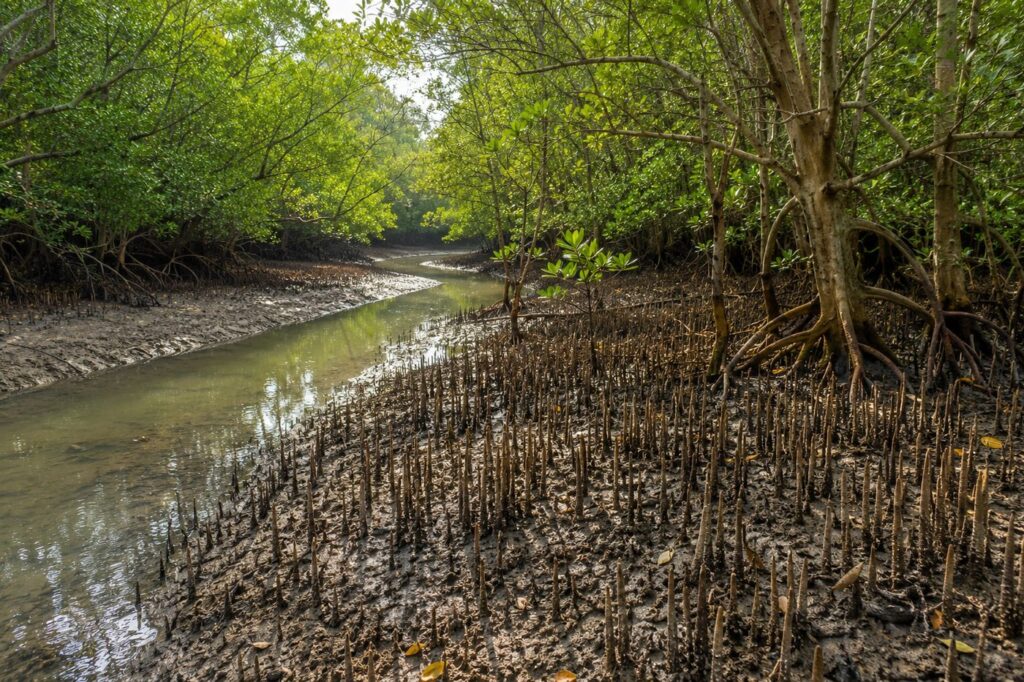
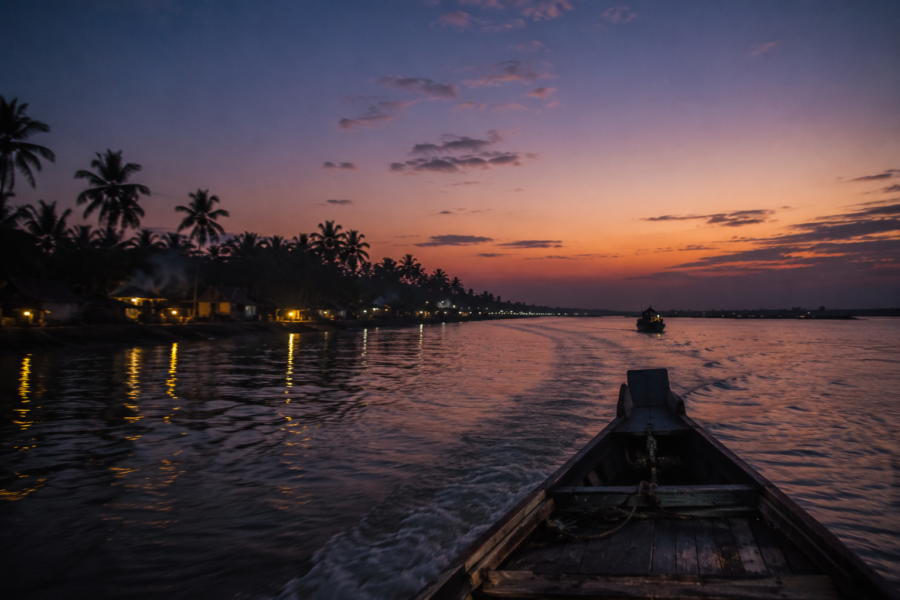
The river is still black when we leave.
Not dark blue. Not grey. Black.
The kind of black that exists only before dawn, when the world has shape but no colour.
The engine coughs to life at the jetty and sends a tremor through the wooden hull. Somewhere beyond the darkness, invisible currents are already moving beneath the surface. The tide has turned during the night. The river knows it. The boatman knows it. Even the egrets standing motionless along the mudbanks seem to know it.
Only the visitor remains uncertain. Ahead lies Gosaba.
A name spoken so often in conversations about the Sundarbans that it almost loses its mystery. Yet from the water, before sunrise, the island reveals nothing easily.
The river widens. Mangrove shadows gather along distant banks. The smell arrives before the island itself.
- Salt.
- Mud.
- Wet leaves.
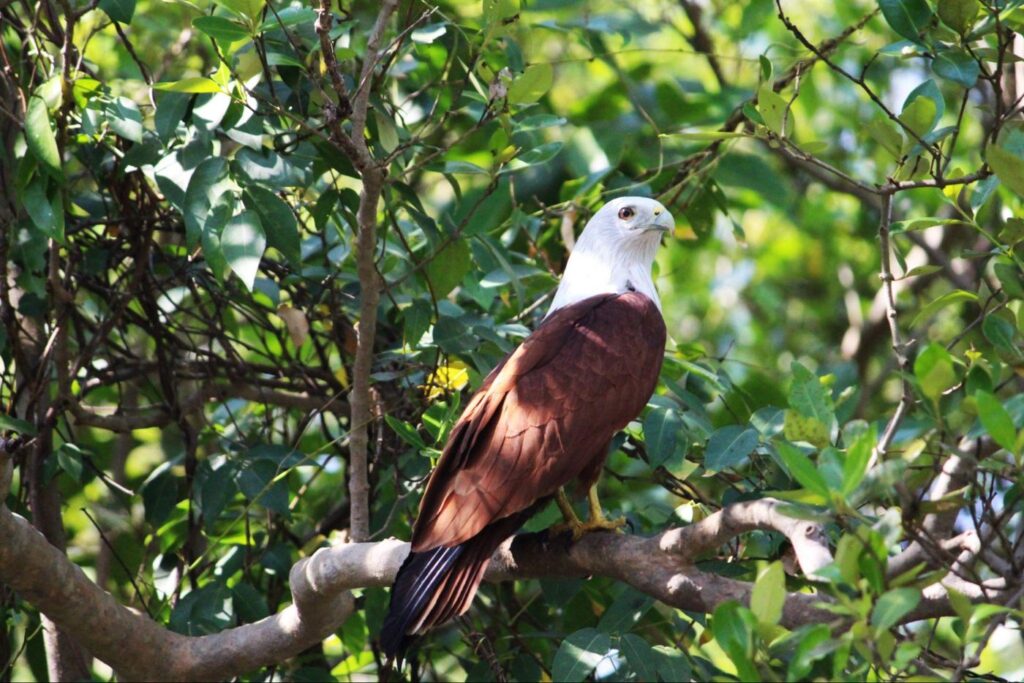
The faint metallic scent of tidal water. Above us, a brahminy kite circles silently, appearing and disappearing against a sky slowly abandoning the stars. For long stretches, there is nothing but the rhythm of the engine and the slap of water against the hull.
Then a fisherman appears.
A single lantern hangs from his boat.
The light swings with the river.
For a moment, it looks less like a boat and more like a wandering star.
The boatman points ahead.
“Gosaba.”
At first, there is nothing.
- Then a line emerges between river and sky.
- Then trees.
- Then embankments.
- Then the faint suggestion of homes.
An island materialising from darkness. Not discovered. Revealed. Like something that had been waiting for daylight. And suddenly it becomes clear that Gosaba is not merely a place within the Sundarbans. It is one of the great human experiments of the delta.
A frontier where rivers, forests, storms, wildlife and people have spent more than a century negotiating the terms of coexistence. The sun finally breaks the horizon.
The island steps into view.
And the expedition begins.
First Encounter
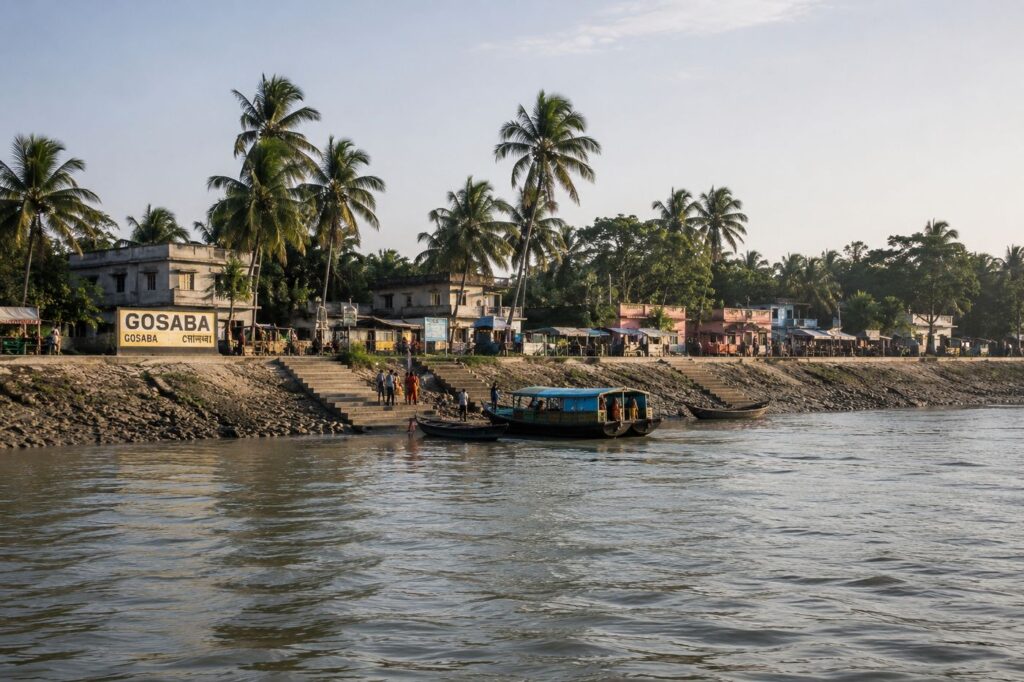
Seen from the river, Gosaba does not announce itself dramatically.
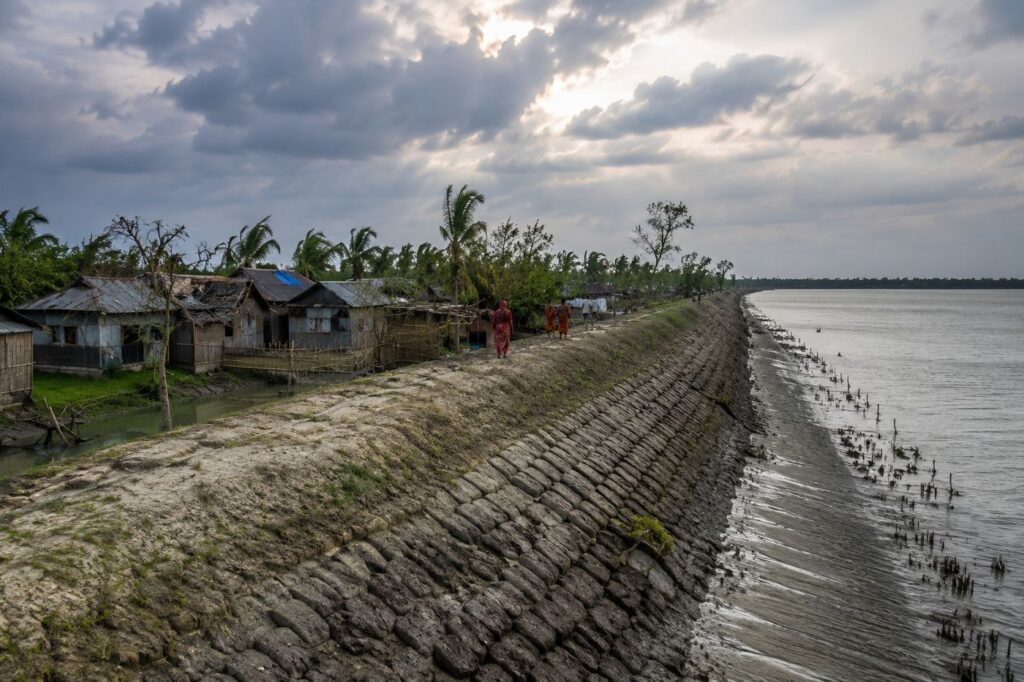
There are no cliffs. No mountains. No monumental landmarks. The island rises only slightly above the surrounding water, protected by long earthen embankments that trace the shoreline like scars left by countless battles with the tide.
Yet the longer one looks, the more details emerge.
- Palm trees sway above clusters of houses.
- Fishing boats are moored beside muddy banks.
- School buildings appear behind rows of betel nut trees.
- Motorcycles move along narrow roads built atop embankments.
- The landscape feels suspended between land and water.
Nothing here seems entirely permanent. Everything carries the awareness that the river remains close.
- The Matla River flows nearby with its enormous tidal pulse.
- Creeks branch away like veins.
- Water is never absent.
Even when unseen, it shapes every decision.
- Children walking to school.
- Farmers preparing fields.
- Boatmen calculating journeys.
- Shopkeepers waiting for ferries.
Life in Gosaba unfolds according to rhythms older than clocks. The tides still hold authority. As the morning brightens, the island begins revealing its personality.
- Not wild enough to be a forest.
- Not urban enough to be a town.
- Not isolated enough to be forgotten.
Gosaba occupies a unique middle ground. A settlement balanced on the edge of the world’s largest mangrove delta.
Island Identity
To understand Gosaba, one must first understand where it sits within the vast geography of the Indian Sundarbans.
Administratively, Gosaba lies within the Gosaba Community Development Block of South 24 Parganas district in West Bengal. It serves as one of the most important inhabited centres in the region and acts as a gateway between mainland Bengal and the forested wilderness farther south and east.
The village of Gosaba itself had a recorded population of just over five thousand residents in the 2011 Census, though the wider Gosaba Block supports nearly a quarter of a million people spread across dozens of islands and settlements.
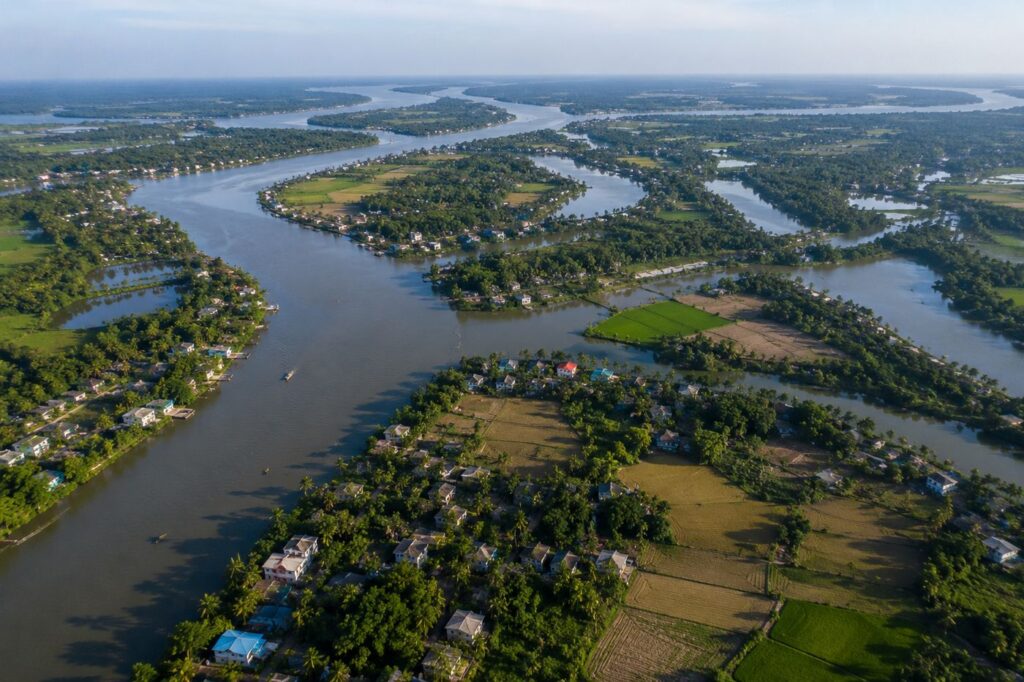
From above, the island appears as part of an intricate mosaic.
- Rivers.
- Creeks.
- Agricultural fields.
- Villages.
- Mangrove remnants.
- Tidal channels.
Every feature is shaped by water.
Researchers describe Gosaba as being enclosed by tidal river systems, including the Matla, Bidyadhari and Zilli river networks and their associated creeks. These waterways are not merely geographical boundaries.
- They are architects.
- They built the island.
- They continue rebuilding it every day.
Stand on an embankment long enough and the truth becomes obvious. The land does not dominate the water here. The water permits the land.
The Rivers That Built Gosaba
Every island has a history. Gosaba has rivers.
And in the Sundarbans, those are often the same thing. The Matla is perhaps the most influential presence in the region. Broad, restless and tidal, it behaves less like a river and more like a breathing creature.
Twice each day, it expands. Twice each day, it retreats.
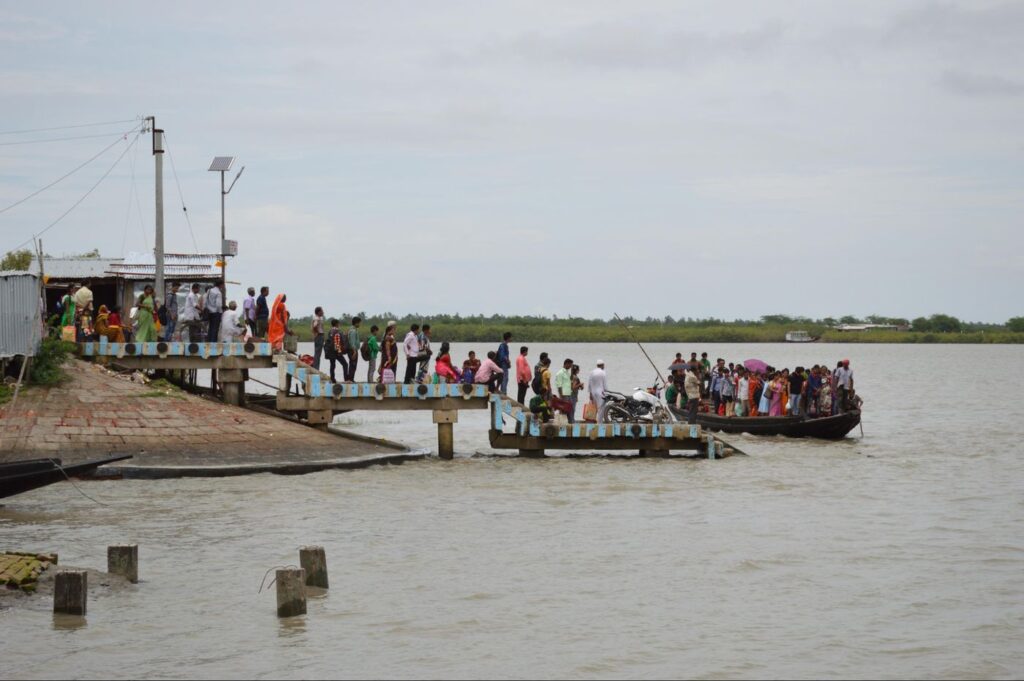
Its influence reaches fields, villages, fisheries and forests. For generations, people arriving in Gosaba have arrived by water. Before roads connected much of the delta, rivers were highways.
- Markets travelled on them.
- Ideas travelled on them.
- Migrants travelled on them.
So did storms.
- A boatman sitting near the ferry ghat explains it simply. “The river brings everything.”
- Then, after a pause: “And sometimes takes everything.”
No statement better captures the history of Gosaba. The same tidal channels that enabled settlement have also delivered devastation.
- Floodwaters.
- Cyclones.
- Salinity intrusion.
- Erosion.
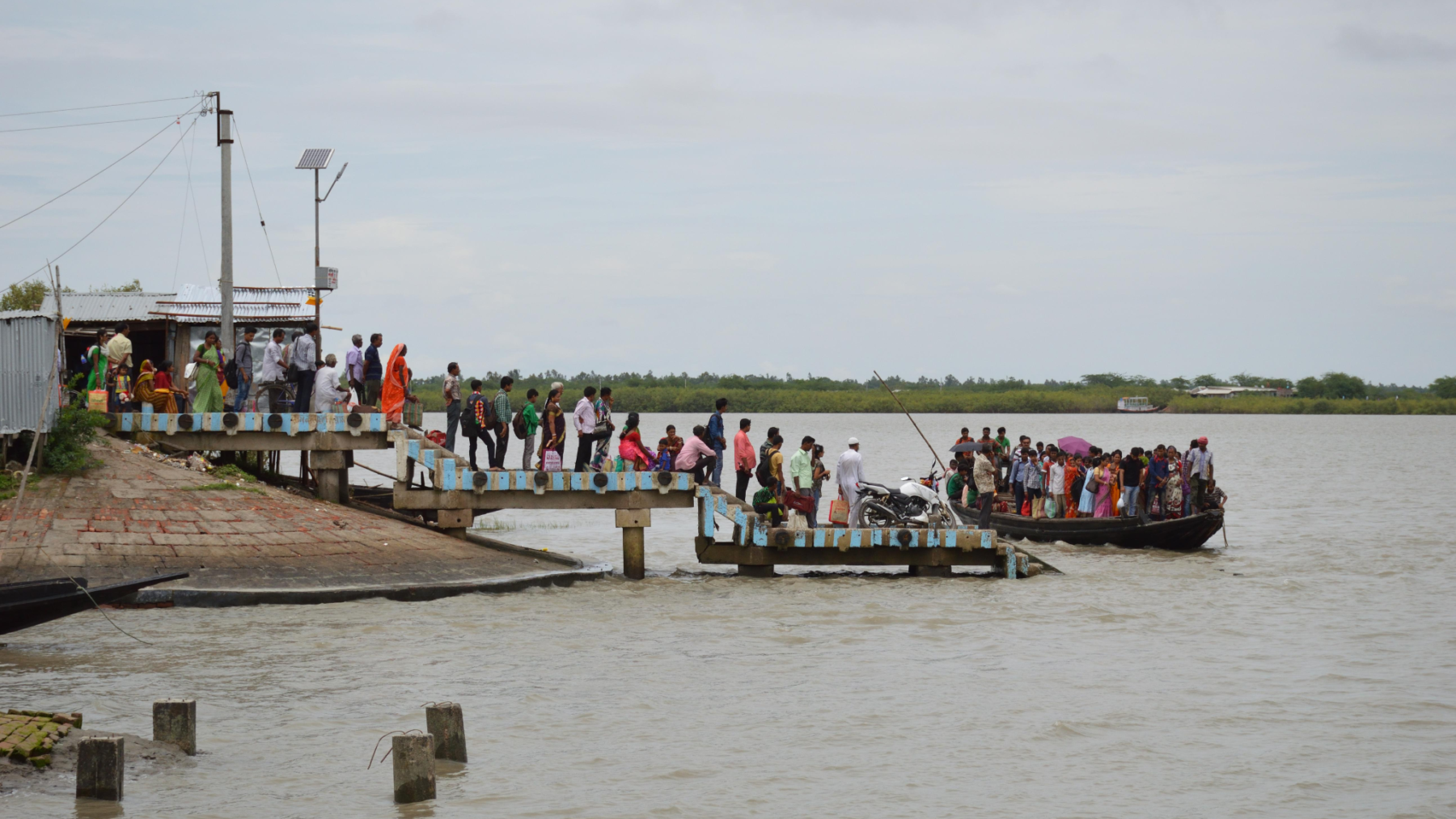
The rivers are providers and destroyers simultaneously. Throughout the day, boats continue crossing.
- Schoolchildren.
- Vegetable traders.
- Fishermen.
- Government workers.
- Tourists heading toward Sajnekhali.
- Patients travelling for treatment.
Each crossing becomes a reminder that water remains the island’s primary connective tissue.
The rivers built Gosaba. They still operate it.
Historical Footprints
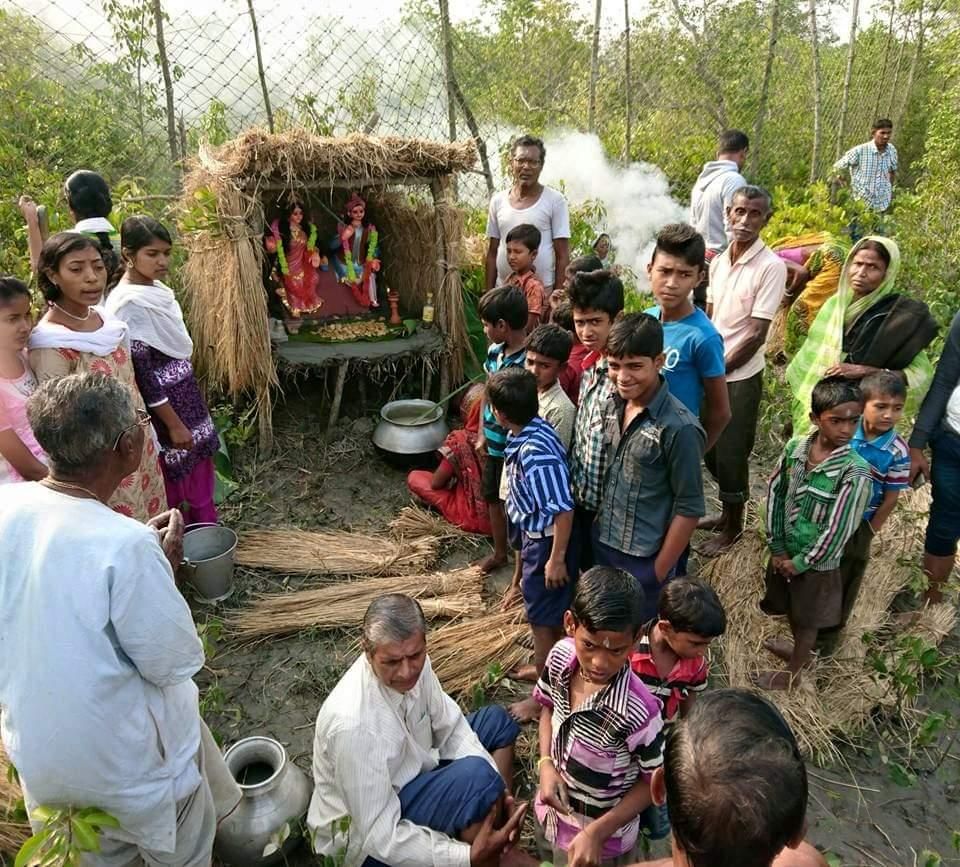
There was a time when much of this landscape belonged more to tigers than to people.
Dense mangrove forests dominated large sections of the region. Human habitation existed, but the frontier remained unstable. The delta shifted constantly. Disease was common. Wildlife encounters were routine. Permanent settlement required extraordinary determination.
The modern story of Gosaba began in the early twentieth century when large-scale efforts were undertaken to reclaim land from the tidal wilderness. Much of this transformation became associated with the vision of a Scottish entrepreneur named Sir Daniel Hamilton, whose influence remains visible more than a century later.
Hamilton acquired roughly 10,000 acres in the Sundarbans, including Gosaba, Rangabelia and Satjelia, and initiated ambitious settlement and development projects.
The challenge was immense.
- Forests had to be cleared.
- Embankments constructed.
- Drainage systems established.
- Communities organised.
The settlers who arrived were not merely farmers. They were pioneers confronting one of the most difficult environments in Bengal.
- Tigers.
- Crocodiles.
- Malaria.
- Cyclones.
- Isolation.
The delta demanded a price from everyone.
Yet people stayed. And gradually, Gosaba evolved from a frontier settlement into a functioning island society. The marks of that transformation remain visible everywhere.
- In roads.
- In embankments.
- In schools.
- In village layouts.
Even in the confidence with which local people speak about surviving adversity. The history of Gosaba is ultimately not a story about conquering nature. It is a story about negotiating with it. A negotiation that continues today.
Historical Personalities & Transformations
If one figure still lingers over Gosaba’s story, it is Sir Daniel Mackinnon Hamilton.
Mention his name to older residents and conversations become animated.
Some describe him as a visionary.
Others as a reformer.
Most simply call him “Sir Daniel.”
Hamilton arrived in Bengal through commercial success but became fascinated by the possibilities of cooperative rural development. Rather than treating the Sundarbans as a distant estate, he attempted to create a functioning social experiment built around cooperation, local institutions, education and self-governance.
His initiatives included schools, cooperative societies, healthcare facilities and embankment construction. Contemporary accounts described Gosaba as an unusual experiment in rural organisation during the colonial era.
Walking through Gosaba today, fragments of that legacy remain.
- Buildings.
- Stories.
- Archives.
Memories passed between generations. Perhaps the most remarkable moment in Gosaba’s intellectual history occurred in December 1932 when the poet and Nobel Laureate Rabindranath Tagore visited and stayed at Hamilton’s residence on the island.
The image is striking. A poet. A reformer.
An island emerging from the mangrove frontier. The meeting seems almost symbolic. Two visions of Bengal meet at the edge of the tide country.
Today, long after both men have passed into history, Gosaba continues evolving.
- Solar panels appear beside traditional homes.
- Mobile phones connect villages once accessible only by boat.
- Students leave for universities in Kolkata.
Yet the island remains recognisably itself.
- Still shaped by rivers.
- Still dependent on embankments.
- Still listening to the tide.
Still carrying the memory of those who imagined a future here when many believed none was possible.
CTA: Explore Gosaba With The Wild Orbit
Folklore & Legends
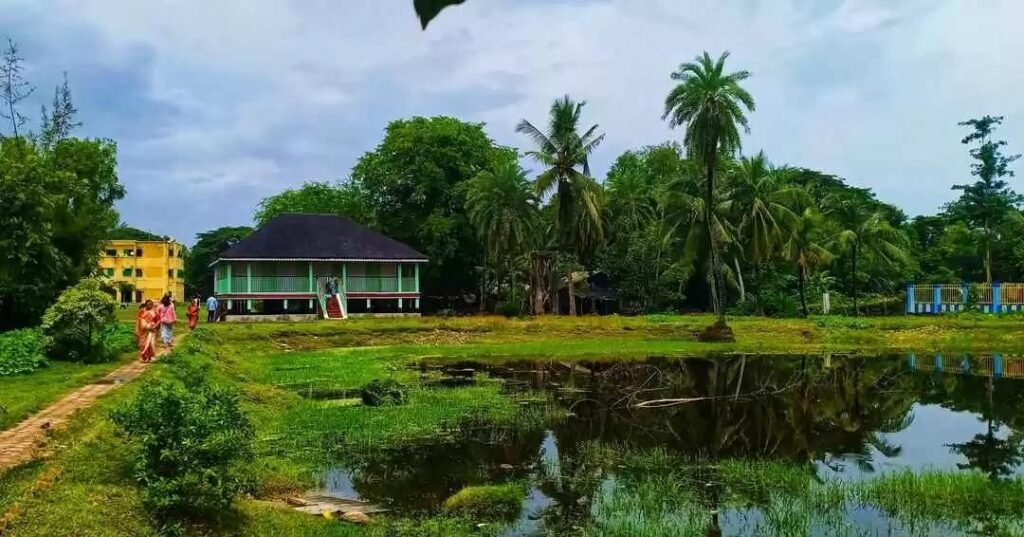
By late morning, the tea stall near the ferry ghat has become crowded.
- Fishermen occupy one bench.
- A schoolteacher occupies another.
- A vegetable trader waits for the next boat.
Conversations drift between politics, rainfall, fish prices, cyclone forecasts and cricket scores.
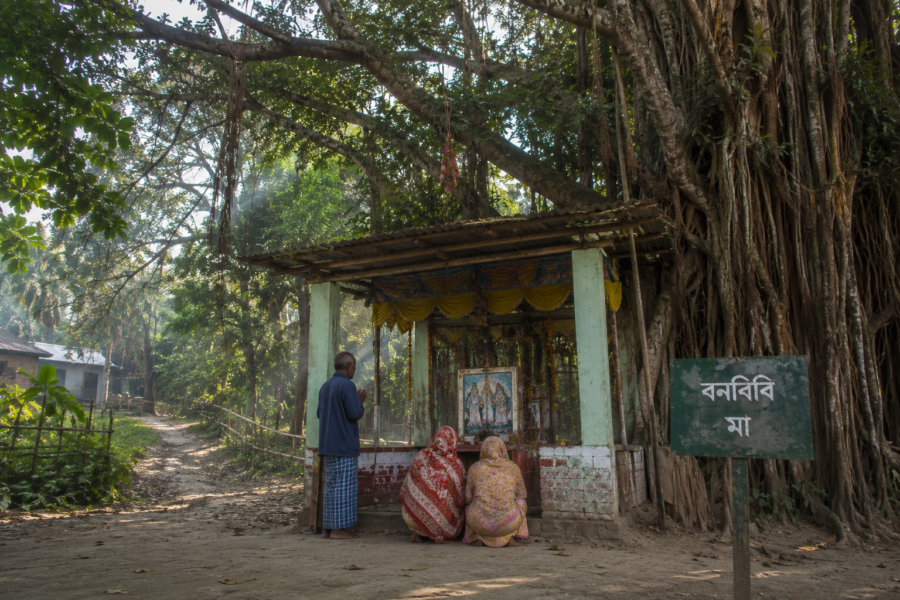
Then someone mentions Bonbibi. The discussion changes instantly. Voices soften. People lean closer. In the Sundarbans, folklore is not preserved in books.
- It travels through conversation.
- It survives because people continue telling it.
An elderly man stirring tea in a glass cup points toward the south. Toward the forests. Toward the land where rivers disappear into mangrove wilderness.
“Out there,” he says, “you must never forget whose kingdom you enter.” The kingdom belongs to Bonbibi.
At least according to generations of woodcutters, fishermen, honey collectors and crab gatherers who have ventured into the forests surrounding Gosaba.
Bonbibi is not merely a religious figure.
- She is a protector.
- A guardian of balance.
- A reminder that humans do not own the forest.
They borrow passage through it. The stories vary from village to village. Yet the central narrative remains remarkably consistent.
Bonbibi protects those who enter the forest with humility. Dakshin Ray, often depicted as a powerful tiger lord, represents greed, pride and danger. Between them unfolds an eternal struggle. Not simply between good and evil. But between balance and excess.
Many households in Gosaba maintain small shrines dedicated to Bonbibi. Before entering forest zones, workers frequently offer prayers. Even boat crews sometimes pause briefly before departing. Not because they reject modernity. But because folklore here functions differently.
It serves as a survival language. A way of remembering that the forest is unpredictable. That the tide can turn. That the tiger remains real. The most fascinating stories, however, rarely appear in published accounts. They emerge after trust develops.
A fisherman recalls seeing mysterious lights moving across a creek decades ago. Another describes hearing voices from an abandoned embankment after midnight. A honey collector tells of a tiger that appeared silently behind his group, watched them for several minutes, then vanished without making a sound.
Nobody insists these stories are true.
Nobody insists they are false.
In Gosaba, certainty is less important than respect.
The rivers carry facts.
The forests carry mysteries.
Both are considered equally worthy of attention.
Life Between The Tides
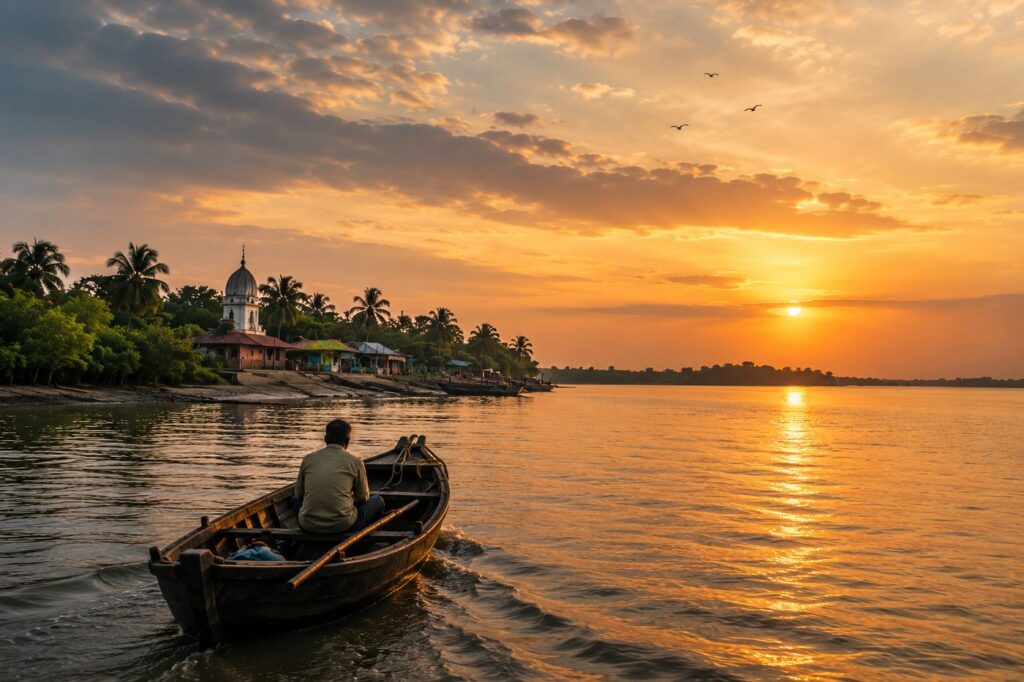
By noon, Gosaba reveals its true rhythm.
The island is busy. Not hurried. Busy. There is a difference. Life here moves according to tidal schedules rather than urban deadlines. At one creek, fishermen unload their morning catch. Silver fish flash briefly in the sunlight before disappearing into baskets. Nearby, a group of women sorts prawns beneath a temporary shade structure. Conversations flow continuously.
Work and storytelling remain inseparable. Further inland, agricultural fields stretch beyond village roads. Rice dominates much of the landscape. Yet farming here differs from mainland Bengal.
Every field exists under constant negotiation with salinity.
The sea may be distant. Its influence is not.
Farmers discuss rainfall with unusual seriousness.
- Too little rain.
- Salt accumulates.
- Too much rain.
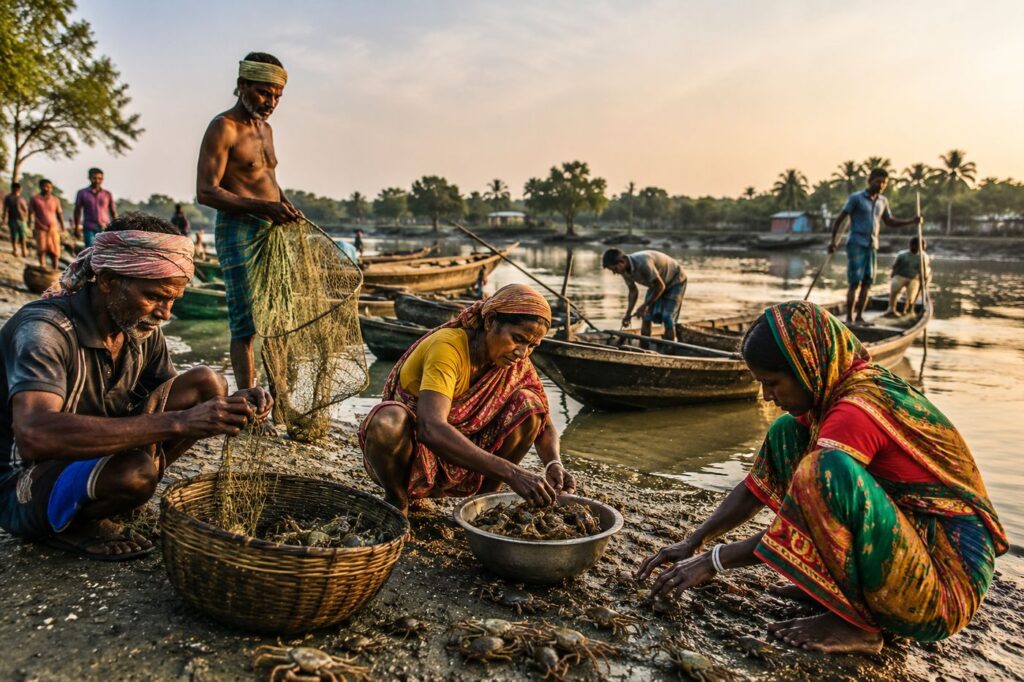
Flooding becomes a threat. The balance remains fragile. Near another embankment, a small group prepares for crab collection. The baskets appear simple. The work is not.
Mud crabs represent one of the region’s most valuable resources. Yet gathering them requires patience, knowledge and considerable physical effort. The collectors speak of tidal windows the way stockbrokers discuss market opportunities.
Timing determines success. Everything revolves around timing.
- The same principle governs fishing.
- The same principle governs transportation.
- The same principle governs survival.
Schoolchildren in neatly pressed uniforms walk home beneath the midday sun.
- Many carry smartphones.
- Some discuss social media.
- Others discuss exams.
The contrast feels striking. The future and the delta walk side by side. One teenager explains that he wants to study engineering in Kolkata. Another dreams of becoming a forest officer. A third intends to remain in Gosaba.
His father fishes. His grandfather fished. The river remains part of his identity.
There is no sense that one path is superior. Only different. That perhaps is one of Gosaba’s defining characteristics. People understand movement. Yet they also understand belonging.
Walking Through The Villages
The best way to understand Gosaba is on foot.
Roads narrow quickly. The further one walks, the more details emerge.
- A bicycle leaning against a mango tree.
- A hand-painted sign advertising private tuition classes.
- A goat sleeping beneath a veranda.
- A row of fishing nets drying in the sun.
Village architecture reflects adaptation rather than aesthetics. Homes are designed to endure humidity, storms and heat. Some structures remain traditional. Others incorporate concrete and modern materials. Almost every household appears prepared for uncertainty.
- Water storage.
- Raised platforms.
- Cyclone awareness.
The lessons of past disasters are visible everywhere. Near a small temple, bells ring softly in the afternoon breeze. Children chase each other across an open field. An elderly woman sits beneath a neem tree sorting vegetables. The pace feels unforced.
Human.
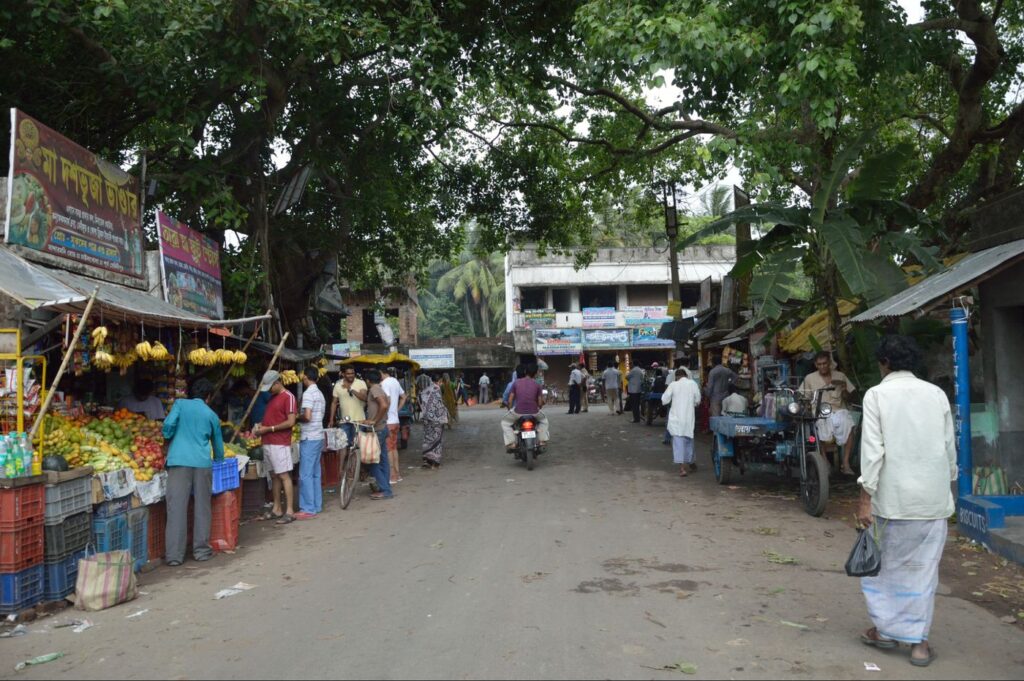
A tea stall becomes an unofficial information centre. Every visitor eventually arrives. Every local story eventually passes through. One learns quickly that Gosaba’s social geography extends far beyond maps.
- Relationships connect villages.
- Families connect islands.
- Marriage connects riverbanks.
- Trade connects settlements.
- The delta functions as a living network.
At the local market, fish sellers compete with vegetable vendors. The smell of coriander mixes with river mud. Boat schedules become topics of intense discussion. Someone mentions approaching rain. Everyone looks up. Weather remains everyone’s business.
A school stands near the edge of a settlement. Its walls display educational murals. Inside, students recite lessons. Outside, kingfishers hunt along a drainage channel.
Education and ecology coexist naturally. One never fully excludes the other. Walking through Gosaba produces a recurring realisation. This is not an island surviving despite the environment.
It is an island continuously adapting to it.
Sounds Of The Island
Every landscape possesses a soundtrack. Gosaba is composed of water. Even when invisible, the river announces itself.
- The distant throb of a boat engine.
- The soft collapse of mud beneath an incoming tide.
- The splash of fish breaking the surface.
- The creaking of wooden jetties.
- The afternoon wind introduces another layer.
- Palm fronds begin whispering.
- Bamboo fences vibrate slightly.
- Loose tin sheets produce metallic rhythms.
- Birds contribute constantly.
- A kingfisher’s sharp call.
- The chatter of mynas.
- The sudden cry of an egret was disturbed by passing children.
Higher overhead, brahminy kites circle silently before releasing haunting whistles across the sky. Near villages, human sounds dominate.
- Pressure cookers whistle.
- Motorcycles pass.
- Teachers call students to attention.
- Conversations spill from tea stalls.
- Laughter emerges unexpectedly.
Then disappears. By late afternoon, the island becomes quieter. Not silent. Different. The heat softens. People retreat indoors briefly. Even the birds seem less active.
The evening arrives. And everything changes again.
- Temple bells begin ringing.
- The evening azan drifts across the landscape.
- Boat engines return.
- Fishing crews prepare for departure.
- Somewhere, a radio plays old Bengali songs.
- A dog barks.
- Another responds.
- The tide turns.
- Water begins moving against embankments.
The island breathes differently. Listening carefully, one begins to understand something fundamental.
Gosaba is not merely seen. It is heard.
Wildlife Expedition
See it for yourself
A private journey shaped around you — your group, your pace, your interests. Book a free consultation.
The wildlife of Gosaba often appears indirectly.
- A footprint.
- A call.
- A movement within reeds.
- A ripple across water.
The island sits close enough to forest habitats that nature remains an everyday presence rather than a distant attraction.
- Birdlife provides the most immediate evidence.
- Kingfishers seem almost impossibly common.
- White-throated kingfishers perch on electrical wires.
- Black-capped kingfishers occasionally appear near creeks.
- Pied kingfishers hover above water before diving with astonishing precision.
- Egrets patrol mudflats.
- Herons stand motionless for long periods.
- Cormorants dry their wings beside channels.
Above them all, brahminy kites patrol the sky like aerial custodians. For birdwatchers, Gosaba functions as an ecological crossroads.
- Freshwater systems.
- Brackish environments.
- Agricultural landscapes.
- Mangrove habitats.
Each attracts different species. Reptiles remain less visible but equally important. Water monitors occasionally appear along creek banks. Various snake species inhabit fields and wetlands. Most remain unseen. Residents learn early that awareness matters more than fear.
Mammals are more elusive. Fishing cats move through the landscape largely unnoticed. Jackals occasionally emerge near village edges. Otter sightings are reported sporadically along quieter waterways.
Then there is the animal that occupies every conversation without necessarily appearing. The tiger. Most visitors never see one. Many residents never see one. Yet its presence shapes local consciousness.
Stories circulate. Tracks are reported. Occasional incidents occur in forest-adjacent areas. The tiger exists simultaneously as reality and symbol. An apex predator. A cultural force. A reminder that the wilderness remains close.
Along broader waterways, another possibility emerges. Dolphins. Fishermen occasionally report sightings in tidal channels connected to larger river systems. The sightings are brief.
- A curved back.
- A sudden breath.
- A disappearance.
The river closes again. By late afternoon, standing beside a creek and watching egrets move across golden mudflats, the ecological significance of Gosaba becomes increasingly clear. The island is not separate from the Sundarbans. It is part of a larger living system.
- Every fish.
- Every bird.
- Every mangrove.
- Every tide.
- Every human settlement.
Connected. The boundaries visible on maps tell only part of the story. The ecological boundaries are far more fluid. And the wildlife understands this better than anyone.
CTA: Discover The Wild Side Of Gosaba
Mangrove Chronicles
By late afternoon, the light changes. The harsh brightness of midday softens into something more forgiving. Shadows lengthen. Colours deepen. This is the hour when the mangroves seem most alive.
A short boat ride from Gosaba’s settlements is enough to enter a different world entirely. The transition happens gradually.
- Concrete disappears.
- Roads vanish.
- Human noise fades.
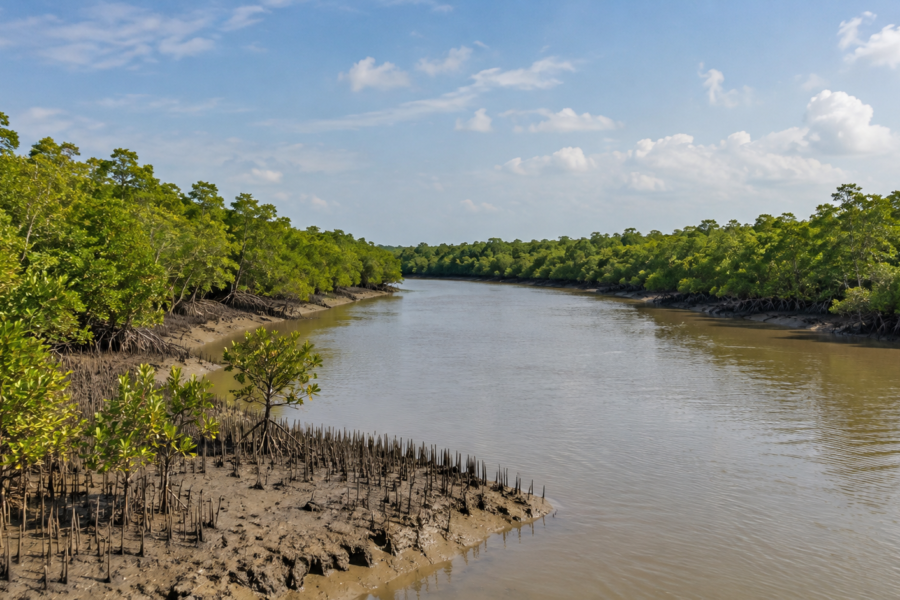
Then suddenly there are only waterways and trees. Not ordinary trees. Mangroves. The architects of the Sundarbans. The reason these islands exist at all. Seen from a distance, they appear almost uniform.
A green wall. A tangled forest. Approach closer and individuality emerges. Each species possesses its own personality. It’s own strategy for survival. It’s own relationship with the tide.
The Sundari stands with quiet authority. Once far more abundant than today, it lends its name to the Sundarbans themselves. Its roots anchor fragile soil against relentless tidal currents. It feels like an elder of the forest.
- Patient.
- Enduring.
- Watching.
Nearby grows Goran. Less imposing perhaps, but remarkably resilient. Dense and determined. It forms thickets that challenge both animal and human movement. Where Sundari appears dignified, Goran appears stubborn.
Then comes Keora. Its roots rise from the mud like thousands of fingers reaching toward the air. These breathing roots transform the landscape into something almost surreal. Walking among them feels like entering another planet.
Mudskippers hop between root systems. Tiny crabs disappear into burrows. Life occupies every available space.
Dhundul sways gently above tidal creeks. Gewa thrives in saline environments where many other species struggle. Together, these trees perform a task so enormous that it often goes unnoticed.
They hold the delta together. Literally.
Without mangroves, erosion accelerates. Storm surges penetrate deeper inland. Biodiversity declines. Entire islands become vulnerable. The people of Gosaba understand this instinctively.
Even those who cannot identify individual species recognise their importance. The forest is not merely scenery. It is infrastructure.
- Protection.
- Livelihood.
- Inheritance.
A fisherman watching the tide enter a mangrove creek says something simple. “If the forest becomes weak, we become weak.”
The statement requires no further explanation.
Explorer’s Field Notes
05:08 AM
First glow appears above the eastern horizon. The river remains dark. A solitary egret stands motionless near the bank.
05:37 AM
Brahminy kite observed circling above the Matla. No sound from nearby villages yet. Only water.
06:14 AM
Fishing boats begin returning from overnight operations. Nets glisten with river water. Voices carry surprisingly far across the morning air.
07:02 AM
Children in school uniforms appear along embankment roads. Many wave enthusiastically at passing boats.
08:26 AM
A tea stall near the ferry ghat becomes unexpectedly valuable. Not for tea. For information. Every local story seems to pass through this location.
10:43 AM
Tide receding. Mudflats expanding. Crabs emerge almost immediately. The landscape changes shape within minutes.
12:11 PM
Heat intensifies. Village activity slows noticeably. Dogs seek shade. Bird activity decreases. Human conversations continue uninterrupted.
02:58 PM
Kingfisher observed diving repeatedly beside a drainage canal. Success rate appears alarmingly high. Fish less fortunate.
04:17 PM
Cloud shadows move across agricultural fields. A fisherman studies the sky with concern. Weather remains everyone’s business here.
05:46 PM
Temple bells begin ringing. Their sound travels across water. The river seems to carry every note.
06:29 PM
Sunset reflected in tidal channels. The entire landscape briefly becomes gold. Then copper. Then grey.
08:02 PM
Boat engines are audible in the darkness. Unable to see vessels. Only sound. The river remains active long after sunset.
Nightfall On The Island
The most overlooked chapter of Gosaba begins after sunset.
Visitors often leave before dark. That is unfortunate. Because the island changes character completely. The day belongs to movement. Night belongs to reflection. As the sun sinks beyond distant tree lines, the rivers transform first. Their surfaces lose detail.
- Colours dissolve.
- Water becomes shadow.
- Fishing boats emerge one by one.
- Lanterns flicker into existence.
- Small points of light drifting across darkness.
For centuries, the people of this delta have watched evenings arrive in much the same way. Technology changes. The river does not.
In village homes, dinner preparations begin. The smell of cooking rice drifts through narrow lanes. Fish curries simmer. Conversations gather around courtyards.
Children finish homework. Elders discuss weather forecasts and memories. The pace slows. Yet the island never truly sleeps.
Temple bells ring softly. The evening azan echoes across settlements. Somewhere a generator hums. Somewhere a radio broadcasts old songs. The sounds overlap gently.
No single voice dominates. The darkness itself feels different from city darkness.
- Deeper.
- More complete.
- Streetlights exist.
Yet vast sections of the landscape remain governed by natural night.
Look upward.
Stars emerge.
Look outward.
The river disappears.
One hears it without seeing it. Perhaps this is why stories flourish in the Sundarbans.
The darkness encourages imagination. The unseen becomes significant. A rustle in nearby vegetation. A distant splash. A boat engine beyond the horizon. Every sound acquires mystery. Even the most practical resident occasionally pauses to listen.
By midnight, the island appears calm. Yet tides continue shifting. Fish continue moving. Crabs continue feeding. Mangrove forests continue breathing. Life persists beyond human schedules. Night simply reveals another version of it.
The Seasons Of The Island
To visit Gosaba only once is to know only one face of the island.
The seasons alter everything. The same embankment can feel like four different worlds within a single year.
Winter (December – February)
Winter arrives gently.
- Morning fog drifts across rivers.
- Fields appear silver beneath dew.
- Bird activity increases dramatically.
This is perhaps the most comfortable season for exploration.
- The air remains cool.
- Visibility improves.
- Village life spills outdoors.
- Markets feel livelier.
- Boat journeys become pleasant rather than exhausting.
Many locals describe winter as the island’s breathing season. A period of relative calm between climatic extremes.
Spring (March)
Spring is brief. Almost shy.
- Mango trees begin flowering.
- Temperatures rise.
- The landscape appears caught between comfort and approaching intensity.
- Birdsong seems louder.
- Agricultural activity accelerates.
Everyone knows summer is coming. Preparations begin.
Summer (April – June)
Heat settles over Gosaba like a physical weight. Afternoons become challenging.
- Roads shimmer.
- Rivers reflect fierce sunlight.
- Daily schedules adapt accordingly.
- Work begins earlier.
- Shade becomes valuable.
- Storm clouds occasionally gather with dramatic speed.
The atmosphere feels charged.
- Waiting.
- Expectant.
Then comes rain.
- Brief.
- Explosive.
- Transformative.
Monsoon (June – September)
The monsoon changes everything.
- Rivers swell.
- Creeks expand.
- Fields become greener.
- The landscape appears renewed.
- Rainfall dominates conversations.
- Boat journeys become unpredictable.
- Travel plans become flexible.
The island feels simultaneously more beautiful and more vulnerable.
- Water is abundant.
- Water is a risk.
Both truths exist together.
Post-Monsoon (October – November)
Many residents consider this the most beautiful period.
- The air becomes clearer.
- Fields mature.
- The sky deepens into remarkable shades of blue.
- Wildlife activity increases.
- Agricultural optimism returns.
- The island appears refreshed.
Yet this is also the season when memories of cyclones remain fresh. Beauty and caution coexist.
As they often do in Gosaba.
Cyclone Season
Technically part of broader seasonal cycles. Emotionally its own category. No discussion of Gosaba can ignore it. Cyclones are not rare historical events. They are recurring possibilities.
- Every family carries memories.
- Every embankment tells stories.
- Every storm warning commands attention.
The island has learned vigilance.
Cyclones And Survival
Ask residents about history. Eventually, the conversation reaches a storm. Not because outsiders ask. Because locals remember, cyclones are woven into collective memory. Older residents recall storms from decades ago. Younger generations speak about more recent disasters. Names become milestones.
- Aila.
- Amphan.
- Yaas.
Each altered the landscape. Each tested resilience. Cyclone Aila in 2009 remains particularly significant in local memory. Embankments failed. Saline water entered agricultural land. Livelihoods suffered. Recovery required years rather than months.
Many families still reference time as “before Aila” and “after Aila.” The distinction remains meaningful. Amphan in 2020 brought another wave of challenges.
- Power outages.
- Infrastructure damage.
- Flooding.
- The familiar pattern repeated.
Nature is reminding everyone who ultimately controls the delta. Yet survival stories prove equally important.
- Communities rebuilding together.
- Schools functioning as shelters.
- Neighbours sharing food.
- Volunteers repairing damaged embankments.
- Resilience is often discussed abstractly.
In Gosaba, it becomes visible. One sees it in reinforced homes.
- Elevated roads.
- Cyclone shelters.
- Community planning.
- Mangrove restoration efforts.
Children growing up with disaster awareness that would surprise most urban populations. A local resident standing beside an embankment once damaged by storm surge says something remarkable.
“We are not stronger than the cyclone.” He pauses.
“We are simply better prepared to meet it again.” That may be the most accurate description of Gosaba itself.
Not invincible.
Not victorious.
Persistent.
A community shaped by uncertainty yet unwilling to surrender to it. The tides continue arriving. The storms continue returning. And still the island remains. Waiting for another dawn. Listening to another tide.
Teaching another generation how to stay.
Ferry Routes & Hidden Paths
Every journey to Gosaba begins with water.
Even today, despite roads, bridges and expanding infrastructure elsewhere in Bengal, the final approach still belongs to the rivers. That fact alone explains much about the island. Accessibility here is never merely about distance. It is about tides.
- Weather.
- Timing.
- Patience.
Most travellers approaching the island pass through Canning, the historic gateway to the Sundarbans. From there, roads continue toward ferry points and river crossings that gradually draw visitors deeper into the delta.
Yet maps often create a false impression. They suggest certainty. The reality feels more fluid. Ask three boatmen for directions and you may receive three slightly different answers. Not because anyone is confused. Because river routes are living things.
They shift. Adapt. Respond to conditions.
The people of Gosaba navigate according to practical knowledge accumulated over generations.
- They know which channels remain reliable during low tide.
- They know where currents become deceptive.
- They know which embankments reveal hidden shortcuts.
For explorers, the most rewarding journeys often begin away from major routes.
- A narrow embankment road.
- A village pathway disappearing between ponds.
- A forgotten jetty where fishing boats outnumber passengers.
- A creek that appears insignificant on maps but reveals extraordinary birdlife.
The island rewards curiosity. Not speed. One of the great pleasures of wandering in Gosaba lies in accepting uncertainty. The most memorable discoveries rarely appear on itineraries. They appear around corners.
At the end of muddy paths. Beyond the next bend in the river.
How to Reach Gosaba
Reaching Gosaba is a gradual transition from the urban landscape of Bengal into the tidal world of the Sundarbans. The journey unfolds in three distinct stages.
Kolkata → Canning
Most journeys begin in Kolkata.
Road and rail connections link Kolkata with Canning, the historic gateway to the Indian Sundarbans.
As the city recedes, wetlands, fisheries, agricultural fields and tidal channels begin appearing across the landscape.
Canning → Godkhali
From Canning, the route continues by road toward Godkhali.
This stretch marks the transition from mainland Bengal to the edge of the delta.
Godkhali serves as one of the principal embarkation points for the inhabited islands of the Sundarbans.
Godkhali → Gosaba
The final stage belongs to the river.
Passenger ferries and local vessels cross the tidal waterways connecting Godkhali with Gosaba. As the boat moves away from the jetty, the landscape begins to change.
- The river widens.
- Mangroves appear.
- Fishing boats pass silently.
- Embankments emerge from the horizon.
And gradually, Gosaba reveals itself. For many travellers, this river crossing becomes the moment when the Sundarbans truly begins.
Things to See Around Gosaba
Gosaba occupies a central position within one of the most fascinating inhabited landscapes of the Sundarbans. Several important settlements, cultural landmarks and forest gateways lie within easy reach.
Gosaba
The historic heart of the region.
Known for its association with Sir Daniel Hamilton, cooperative settlement history, embankment life, river culture and its role as one of the most significant inhabited centres in the Indian Sundarbans.
Pakhiralay
A settlement whose name translates to “abode of birds.”
Located close to major forest-access routes, Pakhiralay is known for its birdlife, riverside atmosphere and connections with nearby wildlife landscapes.
Dayapur
One of the best-known settlements in the tourism and expedition corridor of the Sundarbans.
Dayapur serves as an important access point for river journeys toward surrounding mangrove forests and watchtower regions.
Rangabelia
Historically linked with the development initiatives that transformed parts of the Sundarbans during the twentieth century.
Rangabelia remains one of the region’s most culturally significant settlements and offers insight into community life beyond the better-known tourism circuits.
Sajnekhali
Among the most important forest gateways in the Indian Sundarbans.
Its watchtower, interpretation facilities and strategic location make it one of the best places to begin understanding the relationship between people, rivers and protected mangrove ecosystems.
Nearby Islands
Gosaba exists within a larger network of inhabited islands, each contributing its own story to the Sundarbans landscape.
Satjelia
One of the islands is most closely associated with the historic settlement experiments of Sir Daniel Hamilton.
Satjelia combines agricultural landscapes, village life and strong connections to the region’s social history.
Bali Island
A quieter island where everyday delta life unfolds beyond the more frequently visited routes.
Bali offers a glimpse into agricultural traditions, river-dependent livelihoods and the slower rhythms that continue to define much of the Sundarbans.
Kumirmari
Located within the northern island network of the Indian Sundarbans, Kumirmari is known for its riverfront settlements, embankments and long-standing relationship with the surrounding tidal landscape.
It remains one of the most interesting islands for understanding how communities adapt to life between river and forest.
Photography Expedition Guide
Photographing Gosaba is less about equipment and more about patience. The island does not reveal itself immediately. It emerges gradually. Like the tide.
Sunrise Expedition
Before dawn, position yourself near an open riverbank or embankment facing east.
- The first light arrives slowly.
- Mist often lingers above waterways.
- Fishing boats become silhouettes.
- Birds begin moving before the sun appears.
The moments immediately before sunrise frequently produce the most atmospheric images. The island seems suspended between dream and reality.
Morning Village Photography
After sunrise, village life unfolds naturally.
- Schoolchildren walking along embankments.
- Fishermen repairing nets.
- Women sorting vegetables.
- Tea stalls are becoming social hubs.
These scenes work best when observed quietly. The strongest photographs often emerge from patience rather than intervention.
Wildlife Photography
The wetlands surrounding Gosaba reward careful observation.
- Kingfishers rarely remain still for long.
- Brahminy kites provide dramatic aerial subjects.
- Egrets and herons often gather near exposed mudflats during low tide.
The best wildlife photographers learn to watch the water as carefully as the animals. The two are inseparable.
Mangrove Landscapes
Mangroves change character throughout the day.
- Morning reveals detail.
- Afternoon creates texture.
- Evening introduces drama.
The breathing roots of Keora forests offer particularly striking compositions when side-lit by low-angle sunlight.
Sunset Expedition
As evening approaches, rivers become mirrors.
- Fishing boats return.
- Cloud formations often intensify.
- Golden light washes across embankments.
The final twenty minutes before sunset can transform ordinary scenes into extraordinary ones. Then comes twilight. The most underrated photography window in the delta.
- When colours fade.
- When lanterns appear.
- When the island begins changing into something else.
Cultural Photography
Photograph respectfully. Listen before lifting the camera. Conversations often produce stronger images than observation alone.
The most meaningful photographs frequently emerge from relationships rather than opportunities.
In Gosaba, stories matter as much as pictures.
Expedition Notes
Every island contains details that escape guidebooks. Gosaba contains hundreds. These are some of the observations collected along the way.
Expedition Note 01
Many residents still describe directions using rivers and historical landmarks rather than formal addresses. The landscape remains the primary map.
Expedition Note 02
The island often appears quiet from a distance. Walking reveals otherwise. Every village lane contains activity. Every embankment contains stories.
Expedition Note 03
Tea stalls function as information networks. Spend enough time in one location and the entire island eventually passes through conversation.
Expedition Note 04
The river is almost never absent from daily life. Even residents living inland speak about tides with remarkable precision.
Expedition Note 05
Birdwatchers frequently become distracted by human stories. Human observers frequently become distracted by birds. Both outcomes are acceptable.
Expedition Note 06
The most revealing hours are often neither morning nor evening. They are the quiet periods between. When daily life becomes visible.
Expedition Note 07
Older residents frequently remember historical events through cyclones rather than calendar years. Storms function as chronological markers.
Expedition Note 08
The boundary between village and wilderness feels unusually thin. One never forgets that the greater Sundarbans remain nearby.
Expedition Note 09
Children often possess the best local knowledge. Particularly regarding birds, shortcuts and hidden ponds.
Expedition Note 10
The island rewards slow travel. Perhaps more than any other destination in the Sundarbans.
The Wild Orbit Quick Facts
Island Name
Gosaba
District
South 24 Parganas, West Bengal
Administrative Block
Gosaba Block
Region
Indian Sundarbans
Landscape Type
Inhabited Delta Island
Ecosystem
Mangrove-Tidal Delta System
Major River Systems
Matla River and associated tidal channels
Nearest Major Gateway
Canning
Best Visiting Season
November to February
Wildlife Highlights
Kingfishers, Brahminy Kites, Egrets, Herons, Fishing Cats, Water Monitors, Estuarine Wildlife
Key Themes
River Culture, Cooperative History, Mangrove Ecology, Delta Resilience
The Wild Orbit Expedition Snapshot
Accessibility
★★★★☆
Among the more accessible islands of the Sundarbans, it still retains a strong sense of remoteness.
Wildlife Potential
★★★★☆
Excellent birdlife and estuarine ecology. Larger wildlife remains elusive but possible.
Photography Potential
★★★★★
Exceptional opportunities across landscapes, rivers, village life and wildlife.
Cultural Richness
★★★★★
One of the most historically and socially significant islands in the Indian Sundarbans.
Historical Interest
★★★★★
The legacy of Sir Daniel Hamilton and early settlement history makes Gosaba uniquely important.
Solitude Level
★★★☆☆
Active communities reduce isolation, yet moments of profound quiet remain easy to find.
Frequently Asked Questions
1. Where is Gosaba located?
In the Indian Sundarbans of South 24 Parganas district, West Bengal.
2. Why is Gosaba important?
It serves as a major inhabited centre and gateway to many parts of the Sundarbans.
3. Is Gosaba an island?
Yes. It is part of the tidal island network that forms the Sundarbans delta.
4. Which river influences Gosaba the most?
The Matla River exerts significant ecological and geographical influence.
5. Who was Sir Daniel Hamilton?
A Scottish entrepreneur and social reformer associated with Gosaba’s development.
6. Did Rabindranath Tagore visit Gosaba?
Yes, he visited during the colonial period.
7. Is Gosaba inside the Sundarbans?
Yes, it forms part of the inhabited Sundarbans region.
8. Are there mangroves on Gosaba?
Yes, although extensive mangrove forests occur mainly in surrounding protected areas.
9. Can tigers be found on Gosaba?
Tigers are associated primarily with nearby forest regions rather than village areas.
10. What is the best season to visit?
Winter generally offers the most comfortable conditions.
11. How do people reach Gosaba?
Through combinations of road transport and ferry crossings.
12. Is fishing important here?
Extremely important for many households.
13. Do people farm on the island?
Yes, agriculture remains a major livelihood.
14. What challenges do farmers face?
Salinity, flooding and changing climatic conditions.
15. Why are embankments important?
They help protect settlements and farmland from tidal inundation.
16. What birds are commonly seen?
Kingfishers, egrets, herons, kites and numerous wetland species.
17. Is Gosaba suitable for birdwatching?
Very much so.
18. Are dolphins ever seen nearby?
Occasional sightings occur within connected river systems.
19. What language do people speak?
Primarily Bengali.
20. What role does folklore play?
Folklore remains deeply connected to local identity and forest culture.
21. Who is Bonbibi?
The revered guardian figure of Sundarbans folklore.
22. What is Dakshin Ray?
A legendary tiger lord appearing in regional narratives.
23. Has Gosaba experienced cyclones?
Repeatedly throughout its history.
24. How have communities adapted?
Through embankments, preparedness and collective resilience.
25. Is Gosaba urban or rural?
Predominantly rural.
26. What makes Gosaba unique?
Its blend of river culture, ecological significance, history and resilience.
27. What should visitors observe most carefully?
The relationship between people, tides and landscape.
28. What defines life on the island?
Adaptation.
29. What is the most valuable lesson Gosaba offers?
That coexistence often succeeds where domination fails.
30. Why does Gosaba matter?
Because it demonstrates how human communities endure at the edge of uncertainty.
After A Day In Gosaba
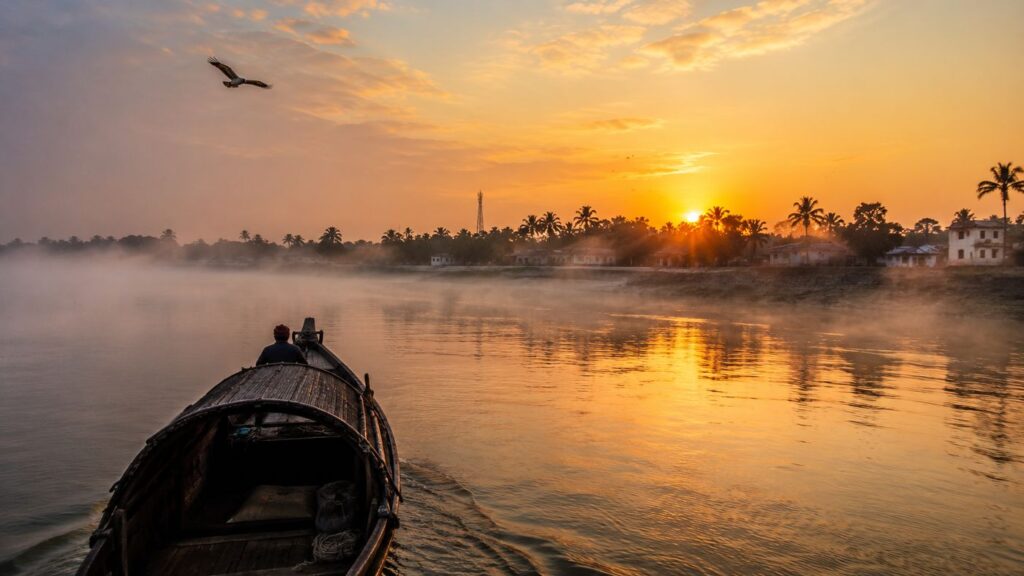
The return journey begins quietly. No announcement marks the departure. No ceremony accompanies the moment. One simply unties the rope. Steps into the boat. And lets the river take hold.
- The evening tide is moving again.
- The same tide that arrived before dawn.
- The same tide that shaped the island long before people arrived.
Behind us, Gosaba begins withdrawing into the distance.
- Palm trees merge into silhouettes.
- Fishing boats become shadows.
- The outlines of homes soften against the fading sky.
Soon, individual details disappear.
- The schoolyards.
- The markets.
- The tea stalls.
- The temples.
- The stories.
Yet somehow the island feels more present than ever. Perhaps because places like Gosaba are not remembered through landmarks.
- They are remembered through impressions.
- The smell of tidal mud after sunrise.
- The whistle of a brahminy kite above the river.
- The rhythm of boat engines crossing evening water.
- The confidence of people who have learned to live with uncertainty.
- The memory of mangroves standing patiently against storms.
Darkness gathers slowly. The first stars appear. The river widens ahead. Behind us, Gosaba becomes only a line between water and sky. Then even that disappears. But the island does not leave.
It remains.
- In the stories carried home.
- In the questions it inspires.
- In the quiet understanding that some places never truly leave.
They are simply experienced. And long after the last light has faded from the river, Gosaba continues drifting beside us. Like the tide itself. Never entirely gone.
Always returning.
Plan your private Sundarban expedition
A private journey shaped around you — your group, your pace, your interests. Book a free consultation.