Field guide
The Tiger of the Tidal Forest
The only tiger population in the world that has adapted to a mangrove estuary. They swim between islands as a matter of routine, drink brackish water, and are seen by perhaps one visitor in twenty.
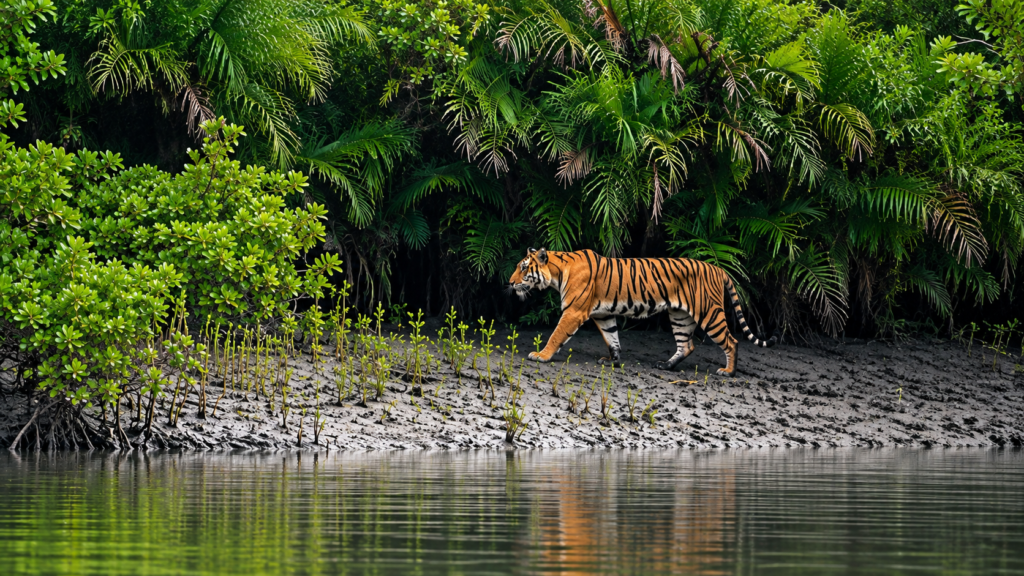
There are forests where a tiger disappears into tall grass.
There are forests where it slips between towering trees, leaving behind little more than a silent trail.
And then there is the Sundarbans.
Here, the forest breathes with the tide.
- Rivers rise and retreat twice each day.
- Mudbanks appear only to vanish beneath swirling estuarine water.
- Mangrove roots emerge from the earth like thousands of natural barriers.
- Islands are continually reshaped by erosion and sediment carried from the Himalayas to the Bay of Bengal.
Somewhere within this shifting landscape moves one of the world’s most extraordinary apex predators—the Royal Bengal Tiger.
The tiger of the Sundarbans is not a different species, nor even a different subspecies. It is the Bengal Tiger (Panthera tigris tigris), the same magnificent predator found across parts of the Indian subcontinent. What makes the Sundarbans tiger remarkable is the world it inhabits—a tidal mangrove ecosystem unlike any other occupied by wild tigers.
To understand this animal, it is not enough to admire its stripes.
You must first understand the forest that shaped its life.
At a Glance
Common Name: Royal Bengal Tiger
Scientific Name: Panthera tigris tigris
Family: Felidae
Conservation Status: Endangered (IUCN Red List)
Habitat: Tidal mangrove forests, estuarine islands and mudflats
Ecological Role: Apex predator
Male Weight: Around 180–260 kilograms
Female Weight: Around 100–160 kilograms
Average Lifespan: Around 10–15 years in the wild
Top Speed: Up to 50–60 kilometres per hour in short bursts
Primary Prey: Chital (Spotted Deer), Wild Boar and other suitable prey
Global Significance: The Sundarbans supports the world’s only tidal mangrove tiger habitat
The World’s Largest Mangrove Forest
The Sundarbans is more than a forest. It is a living delta.
Stretching across the lower reaches of the Ganges–Brahmaputra–Meghna Delta, this vast coastal wilderness forms the largest mangrove forest on Earth. Thousands of square kilometres of mangrove vegetation spread across a maze of tidal rivers, creeks, mudflats and islands along the northern edge of the Bay of Bengal.
Unlike inland forests, where landscapes remain relatively stable, the Sundarbans is constantly changing. Every incoming tide carries water through narrow channels. Every retreating tide exposes fresh mud. Sediment builds new land while erosion quietly claims old shorelines.
UNESCO recognises the Indian Sundarbans as a World Heritage Site because of its exceptional ecological importance, describing it as a globally significant mangrove ecosystem shaped by tides, flooding and coastal processes.
This dynamic landscape creates a world unlike any other tiger habitat.
A Forest Without Fixed Boundaries
In most forests, the ground beneath your feet offers certainty. In the Sundarbans, certainty is a luxury.
- A creek that appears narrow today may become wide tomorrow.
- A muddy bank can disappear beneath rising water.
- A stretch of exposed ground may exist for only a few hours before the tide claims it again.
For the Royal Bengal Tiger, territory is not simply a collection of trees. It is a landscape in motion.
The animal must move through forested islands separated by tidal channels, navigate muddy ground that changes with the water level, and survive in an environment where land and water constantly exchange places.
Few large terrestrial predators live under such conditions. Fewer still have made them home.
The Tiger at the Top of the Food Web
Every healthy ecosystem has relationships that remain invisible until something changes. In the Sundarbans, the Royal Bengal Tiger sits at the very top of those relationships.
As an apex predator, it influences the balance of the wider ecosystem through its connection with prey, habitat and ecological processes.
But a tiger does not exist independently of the forest.
- It depends on prey.
- Prey depends on vegetation.
- Vegetation depends on tidal processes, sediment and freshwater dynamics.
Remove one layer, and pressure spreads through the others. This is why conservationists often describe the tiger as an umbrella species. Protecting the tiger helps protect countless other organisms that share the same mangrove landscape. The story of the tiger is therefore also the story of the Sundarbans itself.
Why the Tiger Matters to the Forest
The Royal Bengal Tiger does far more than occupy the highest position in the food chain. As the Sundarbans’ apex predator, it helps maintain the ecological balance that allows the mangrove ecosystem to function.
By naturally regulating prey populations such as chital (spotted deer) and wild boar, the tiger influences how animals use different parts of the forest, preventing excessive pressure on vegetation in particular areas.
Its presence also signals the health of the wider ecosystem. A landscape capable of supporting a tiger must also sustain mangroves, prey species, wetlands and countless smaller organisms that form the foundation of life in the delta.
For this reason, conservationists often describe the Royal Bengal Tiger as an umbrella species—protecting its habitat helps safeguard an entire web of biodiversity that extends far beyond a single predator.
A Landscape Shared With Water
Most people imagine a tiger as an animal of solid ground. The Sundarbans challenges that image.
- Water is everywhere.
- Wide rivers divide islands.
- Narrow creeks cut through dense mangroves.
- Hidden channels weave beneath overhanging branches.
For the tiger, these waterways are not distant features on the horizon. They are part of everyday life. The forest exists as a network of connected habitats rather than a single uninterrupted block of land.
This unusual geography shapes how wildlife moves, how prey distributes itself and how predators survive. It also explains why the Sundarbans has become one of the most scientifically fascinating tiger landscapes in the world.
A Forest That Keeps Its Secrets
One of the greatest misconceptions about the Sundarbans is that a tiger should be easy to find. The reality is the opposite.
- Dense mangrove vegetation limits visibility.
- Creek bends hide movement.
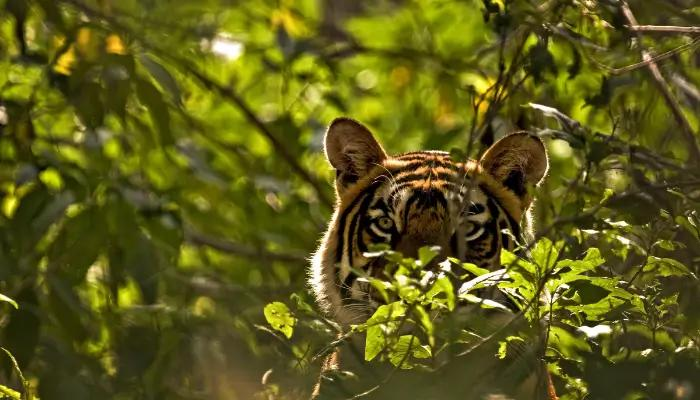
- Filtered sunlight breaks up the tiger’s striped outline.
A visitor can travel through the forest for hours without seeing the animal, even when it may be surprisingly close. Unlike open grasslands where predators can often be spotted from a distance, the Sundarbans rewards patience rather than expectation.
The tiger remains unseen not because it is absent. It remains unseen because the forest was built to hide it.
That hidden existence has become one of the defining characteristics of the Sundarbans experience.
More Than a Wildlife Icon
Across the world, the Royal Bengal Tiger represents strength, beauty and wilderness. In the Sundarbans, it represents something more complex.
Around the protected forests live communities whose lives remain connected to the wider delta through fishing, honey collection, crab harvesting and river travel.
The tiger shares the landscape without becoming part of human life.
- Its presence inspires admiration.
- Its reputation commands respect.
- Its existence reminds us that truly wild places still survive.
Understanding this relationship requires more than seeing the tiger as a tourist attraction or a symbol on a conservation poster.
It requires recognising it as a living predator whose survival depends upon the health of an entire coastal ecosystem.
A Story Written Into the Tides
Perhaps the most remarkable thing about the Royal Bengal Tiger of the Sundarbans is not its size.
- It is not even its famous stripes.
- It is its ability to belong here.
This is a predator living where rivers become roads, where mud becomes ground, where tides redraw the landscape every day and where the forest itself never stops changing.
The Sundarbans does not simply contain tigers. It shapes them.
Every silent movement through mangrove shadows, every hidden trail beside a tidal creek and every unseen footprint pressed into wet mud tells the same story.
This is a tiger whose life is written into the rhythm of the tides.
And that rhythm becomes even more extraordinary when we look beyond the landscape itself.
Built for the Mangroves
The Sundarbans is not a forgiving place for a large predator.
The ground is often soft enough to swallow footprints within hours. Mangrove roots rise through the mud like natural barricades. Narrow creeks interrupt the forest in every direction, and the tides constantly reshape the routes available for movement.
Yet the Royal Bengal Tiger moves through this landscape with remarkable confidence.
- It crosses muddy banks without hesitation.
- It slips through dense vegetation where visibility can disappear within a few metres.
- It enters tidal waterways that would stop many other terrestrial mammals.
This is not because the tiger has become a different animal. It is because the Bengal Tiger has mastered one of the most demanding environments on Earth.
A Body Designed for Power
The Royal Bengal Tiger is the largest cat naturally found in the Indian subcontinent, and every part of its anatomy reflects its role as an ambush predator.
Adult males are generally larger and more heavily built than females, with broad shoulders, muscular forelimbs and powerful neck muscles that help control large prey. Their jaws deliver immense bite force, while long canine teeth are designed to grip and subdue animals quickly.
Large paws serve several purposes at once.
They distribute weight across muddy ground more effectively than smaller feet would, provide traction during sudden bursts of acceleration and become powerful paddles when the tiger enters water.
Retractable claws remain protected while walking, helping them stay sharp for climbing, gripping and hunting.
Even the tiger’s whiskers contribute to survival, allowing it to sense nearby obstacles when moving through dense vegetation or low-light conditions.
Every feature works together.
Nothing exists in isolation.
The Language of Stripes
The tiger’s orange coat and black stripes are among the most recognisable patterns in the animal kingdom.
Yet their greatest purpose is not beauty.
It is deception.
In broken light beneath mangrove leaves, shadows fall unevenly across trunks, branches and roots. The tiger’s stripe pattern breaks up the outline of its body, making it surprisingly difficult for prey and sometimes even people to recognise the shape of a predator.
Each tiger carries a unique stripe pattern, much like a human fingerprint.
This individuality has become invaluable for conservation.
When camera traps photograph a tiger, researchers can identify the same individual again months or even years later simply by comparing its stripes.
The pattern that helps the tiger remain hidden has also become one of science’s most powerful identification tools.
The Tiger That Swims Between Forests
Perhaps no behaviour captures the imagination more than seeing a Royal Bengal Tiger swimming across a tidal creek.
Unlike many large cats, tigers are naturally capable swimmers.
But in the Sundarbans, swimming is not an occasional skill used only during floods or extreme circumstances.
It is woven into everyday life.
The forest is divided into countless islands separated by rivers and creeks. A tiger moving through its territory cannot simply walk around every waterway.
Sometimes, the shortest route is through the water itself.
UNESCO highlights this remarkable adaptation, noting that Sundarbans tigers can swim considerable distances across tidal waterways within the mangrove landscape.
Watching such a powerful terrestrial predator become equally confident in water is one of the defining images of the Sundarbans.
The tiger lowers itself into the creek.
- Its head remains above the surface.
- Its large paws pull rhythmically through the water.
Within moments, it reaches another bank and disappears back into the mangroves as though nothing extraordinary has happened.
When Are Sundarbans Tigers Most Active?
Life in the Sundarbans is governed by both temperature and tide, and the Royal Bengal Tiger adjusts its movements accordingly. While it can be active at any hour, it is generally most active during the cooler hours of dawn, dusk and night, when moving through the forest demands less energy and prey is often easier to approach.
The heat and humidity of the day encourage long periods of rest in shaded mangrove cover, where the tiger conserves energy before becoming more active as temperatures begin to fall.
Tides add another layer of timing. A rising creek, an exposed mudbank or changing water levels can influence how the tiger moves through its territory, making its daily routine more flexible than a fixed day-or-night schedule.
Rather than following a clock, the Sundarbans tiger follows the rhythm of the forest itself.
Water Is Part of Its Territory
For many animals, rivers mark boundaries. For the Sundarbans tiger, they often connect territory instead of dividing it.
A creek is not merely something to cross. It is part of the landscape the tiger understands.
Waterways influence movement, hunting opportunities and access to different parts of the forest. The tiger reads these channels as naturally as it reads the ground beneath its feet.
But water is never effortless.
Swimming demands energy. Strong tidal currents create additional challenges. The tiger must judge when movement is worthwhile and when conserving energy offers a better chance of survival.
This careful balance between effort and reward defines much of its behaviour.
Living in a Saline Coastal World
One of the most misunderstood aspects of the Sundarbans tiger is its relationship with saltwater.
Popular stories often claim that these tigers have evolved to drink seawater.
The scientific evidence tells a more careful story.
The Sundarbans is an estuarine ecosystem where freshwater and saline water mix continuously. Salinity changes with seasons, tides and location, creating a landscape where suitable freshwater is not always abundant.
Tigers still require fresh or less-saline water whenever it is available.
They also obtain moisture from the animals they hunt.
Their remarkable adaptation lies not in becoming seawater-drinking cats, but in surviving within a coastal environment where freshwater availability is one of many ecological challenges.
Separating documented biology from popular myth matters.
The real story is more impressive than the myth.
It shows a predator thriving through behavioural flexibility rather than extraordinary physiology.
A Forest That Rewards Patience
See it for yourself
A private journey shaped around you — your group, your pace, your interests. Book a free consultation.
Strength alone does not make a successful hunter. Patience does. The Royal Bengal Tiger is an ambush predator, relying on stealth rather than long-distance pursuit.
In the Sundarbans, that strategy becomes even more effective.
- Mangrove vegetation limits visibility.
- Creek banks create natural bottlenecks.
- Shadows constantly shift across the forest floor.
Instead of chasing prey across open ground, the tiger attempts to close the distance before revealing itself. Its movements become deliberate.
- A paw settles quietly into the mud.
- Its body remains low.
- Its eyes stay fixed.
Every unnecessary movement risks losing the opportunity. Then, when the moment arrives, stillness becomes explosive power.
Hunting in a Mangrove Maze
Hunting inside the Sundarbans is unlike hunting in open grasslands. The forest itself becomes part of the strategy.
- Dense vegetation provides concealment.
- Raised banks offer observation points.
- Creek edges concentrate animal movement.
The tiger uses these natural features instead of relying purely on speed. This relationship between predator and landscape reveals something deeper about the Sundarbans.
The tiger does not simply occupy the forest. It understands its architecture. Every root, channel and shadow becomes part of the environment through which it hunts.
The Senses Behind the Predator
Many people think of the tiger’s strength first. Its senses deserve equal admiration. Excellent night vision allows it to remain effective in low-light conditions. Sensitive hearing detects movement long before prey becomes visible.
Its sense of smell helps interpret information left by other tigers, prey and the surrounding environment. Even its whiskers contribute by detecting nearby objects in tight spaces.
Together, these senses create an animal capable of reading a forest that often appears silent to human observers.
A muddy creek bank may look empty.
To a tiger, it can contain the scent of prey, the presence of another tiger and clues about the changing environment—all without a single visible sign.
Energy Is Everything
Every movement through the Sundarbans carries a cost. Walking through soft mud demands more effort than walking across firm ground.
Swimming requires additional energy. Searching too long for prey can become expensive. The tiger therefore behaves like an efficient strategist rather than a reckless hunter.
- It rests when resting saves energy.
- It waits when waiting improves the odds.
- It moves when movement offers opportunity.
This careful economy of effort is one of the least visible but most important adaptations of the Sundarbans tiger. Its greatest strength is not endless power. It is knowing when to use it.
The Predator Beneath the Tide
By now, the Sundarbans tiger looks very different from the familiar image many people carry.
- It is not simply a striped cat wandering through mangroves.
- It is a swimmer navigating tidal creeks.
- A patient hunter using shadows instead of open ground.
A predator surviving where freshwater can be scarce and mud constantly reshapes the landscape.
- Its body provides the power.
- Its senses provide the information.
- Its behaviour provides the flexibility.
Together, they create one of the world’s most remarkable examples of adaptation to a changing environment.
But survival is about more than movement and hunting.
A tiger must defend territory, raise cubs, communicate without speaking and share the edges of its world with human communities whose lives have long been tied to the same rivers.
Life, Territory and People
A tiger’s life is measured by more than successful hunts.
It is measured by territory defended without constant conflict, cubs raised in secrecy, prey found before energy runs out, and decisions made in a forest where every movement carries consequences.
The Sundarbans tiger lives alone for much of its life. Yet its world is full of invisible conversations.
- Scent marks announce its presence.
- Scratch marks communicate ownership.
Footprints pressed into wet mud tell stories that other tigers can read long after the tide has begun to erase them.
- To human eyes, the forest often appears empty.
- To a tiger, it is alive with information.
Territory in a Moving Landscape
Unlike many forests where mountains or valleys create obvious boundaries, the Sundarbans offers few permanent landmarks.
- Waterways shift.
- Mudbanks change shape.
- Creeks widen and narrow with the tide.
The tiger’s territory exists within this constantly changing geography.
Rather than defending a neatly drawn piece of land, it maintains access to the resources it needs—prey, shelter, water and safe routes through the mangroves.
Adult males generally occupy larger territories than females, while female territories are often closely linked to areas suitable for raising cubs.
These ranges are not rigid boxes.
They are living landscapes that change with environmental conditions and the movements of wildlife.
The tiger does not simply remember where trees stand.
It remembers how the forest behaves.
A Forest That Speaks Without Words
Tigers rarely need to meet face-to-face to communicate. The forest carries their messages.
Scent marking is one of the most important forms of communication. Urine, glandular secretions and other scent cues provide information about identity, territory and reproductive condition.
Scratch marks add another layer. To a passing tiger, a scratched tree or disturbed patch of earth is more than physical damage. It is a message.
These invisible conversations reduce unnecessary confrontation.
For two powerful predators, avoiding conflict is often safer than fighting.
The Sundarbans therefore contains an unseen network of communication that exists alongside its visible rivers and mangroves.
The Animals That Sustain the Tiger
No apex predator survives without a healthy prey base.
In the Sundarbans, one of the tiger’s most important prey species is the spotted deer, also known as the chital. Wild boar also forms a significant part of the prey community, while the broader ecosystem supports numerous other animals that contribute to the balance of the food web.
The relationship is straightforward.
- Healthy mangroves support healthy prey populations.
- Healthy prey populations support healthy tigers.
- When one layer weakens, the others feel the impact.
This is why tiger conservation begins long before anyone counts tigers. It begins with protecting the ecosystem beneath them.
The Silent Mathematics of a Hunt
Every hunt is an energy calculation.
A failed chase wastes precious effort. A successful ambush can provide food that sustains the tiger for days. This is why the Sundarbans tiger rarely behaves recklessly.
- It watches.
- It waits.
- It chooses carefully.
The dense mangrove environment often forces encounters at shorter distances than open landscapes would allow, making patience even more valuable.
Sometimes the tiger abandons a hunt before attacking.
- The wind changes.
- A branch moves unexpectedly.
- The prey becomes alert.
Walking away from a poor opportunity is often a better survival strategy than pursuing failure. This discipline is one of the hidden strengths of the species.
From Cub to Predator
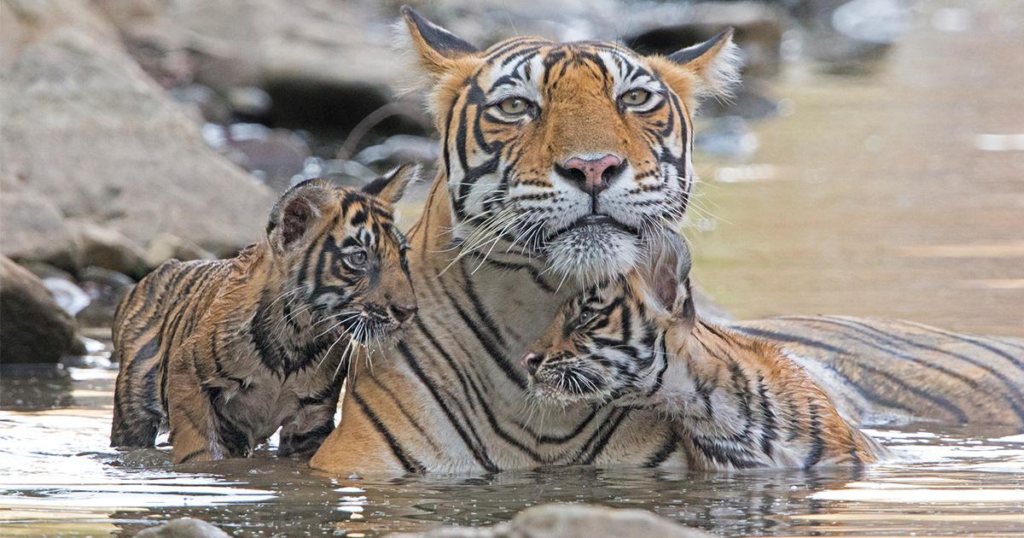
Every Royal Bengal Tiger begins life completely dependent on its mother.
Hidden within secure shelter, newborn cubs rely on her for warmth, protection and nourishment. Their early world is remarkably different from the powerful predator they will eventually become.
At first, survival depends entirely on maternal care. As the cubs grow, curiosity begins to shape their education.
- They follow.
- They observe.
- They play.
What looks like play often becomes practice.
- A stalking movement.
- A careful step.
- A pounce on a sibling.
These small actions help develop the coordination and instincts that will later become essential for survival.
The mother provides more than food. She provides lessons.
Eventually, young tigers begin accompanying her more regularly, witnessing the realities of life inside the mangrove forest before becoming independent.
Growing Up in the Sundarbans
Learning the Sundarbans is different from simply growing larger.
A young tiger must understand muddy ground, tidal creeks, dense vegetation and changing environmental conditions.
It has to recognise where cover exists.
- Where prey may appear.
- How the forest sounds before danger.
- How silence itself can become information.
These experiences cannot be replaced by instinct alone. The Sundarbans teaches every generation of tigers how to live within its constantly changing landscape.
Eventually, the young tiger leaves its mother’s care to establish a life of its own. Its journey becomes solitary. But it carries forward everything the forest has already taught it.
Why Are Sundarbans Tigers Considered So Ferocious?
Few wild animals carry a reputation as powerful as the Sundarbans tiger.
Stories passed through generations have reinforced its image as an exceptionally fearsome predator.
The reality deserves careful understanding.
There is no scientific evidence that Sundarbans tigers are a genetically different or inherently more aggressive form of Bengal tiger.
- Their reputation comes largely from the environment they inhabit.
- Dense mangroves dramatically reduce visibility.
- Encounters can occur at very close range.
For centuries, fishermen, honey collectors and crab collectors have worked around tiger habitat, and these interactions have shaped local memory and folklore.
When an encounter happens, it can happen suddenly. The tiger’s ambush hunting strategy naturally contributes to this perception.
Seen through human experience rather than biology alone, its reputation becomes easier to understand. The Sundarbans tiger is not defined by unusual aggression.
It is defined by extraordinary capability.
When Two Worlds Meet
The Sundarbans presents one of the world’s most complex relationships between people and large predators.
Around the protected forest live communities whose livelihoods remain closely connected to the wider delta.
- Fishing boats travel through tidal rivers.
- Honey collectors enter forest areas during seasonal harvests.
- Crab collectors work along muddy creek margins.
These activities can bring people into landscapes that tigers also use. From the tiger’s perspective, it is simply moving through its territory. From the human perspective, entering the forest may be necessary for earning a livelihood.
Neither side intends conflict. Yet conflict remains possible. This reality makes the Sundarbans different from many wilderness landscapes where human presence is minimal.
Here, conservation must consider both wildlife and people.
Respecting a Wild Predator
The Royal Bengal Tiger deserves admiration.
It also deserves respect. Respect begins with recognising what the tiger is not.
- It is not a performing animal.
- It is not a guaranteed wildlife attraction.
- It is not a creature that exists for human entertainment.
Every decision it makes—whether to remain hidden, cross a creek or disappear into dense mangroves—belongs to the animal itself.
That independence is part of what makes the Sundarbans feel genuinely wild. The most meaningful encounter is not necessarily the closest one.
It is the one where the tiger remains completely free to behave as a wild predator should.
A Life Hidden Beneath the Mangroves
Most of a tiger’s life unfolds beyond human observation.
- A scent mark on a tree.
- A fresh footprint in wet mud.
- A hidden trail through mangrove roots.
These signs reveal a world that continues whether people witness it or not. The Sundarbans tiger lives according to its own rhythms—territory, prey, reproduction and survival—not according to boat schedules or visitor expectations.
That hidden life has always been part of its strength. But today, another challenge shapes its future. The forest itself is changing.
Scientists are monitoring tiger populations more carefully than ever before, climate pressures continue to reshape the delta, and conservation increasingly depends on understanding a predator that remains difficult to see.
The Future of the Tidal Predator
The Royal Bengal Tiger has survived the Sundarbans for centuries.
It has learned to navigate rivers that change with the tide, disappear into mangrove shadows, and raise generations of cubs in one of the world’s most demanding coastal landscapes.
But the greatest challenge facing the tiger today is no longer survival within the forest alone.
It is the future of the forest itself.
- Sea levels are rising.
- Cyclones reshape coastlines.
- Freshwater and salinity continue to influence the mangroves.
And scientists are working harder than ever to understand a predator that rarely allows itself to be seen.
The story of the Sundarbans tiger is therefore no longer only about adaptation.
It is also about protection.
Seeing the Tiger Without Seeing the Tiger
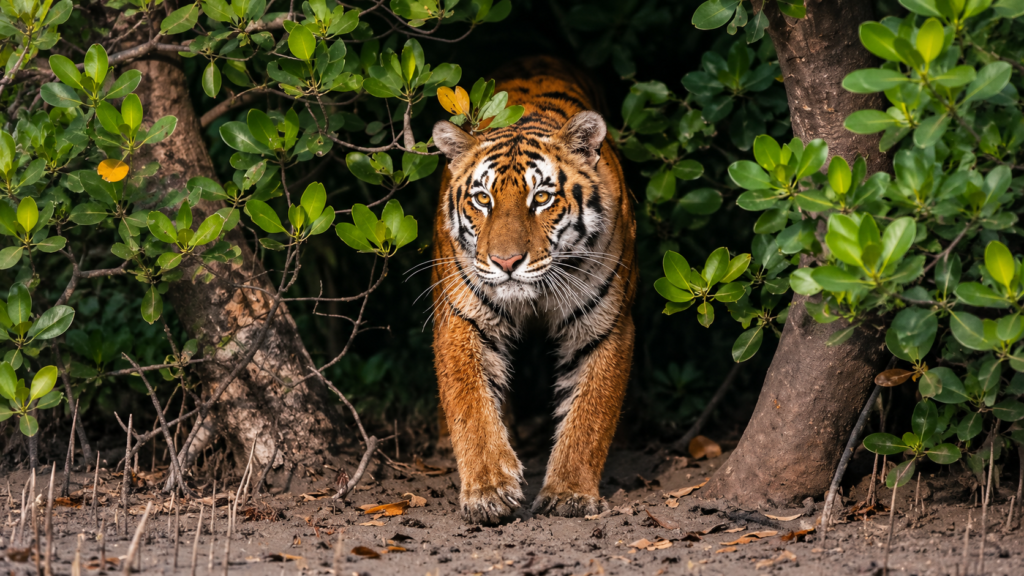
For much of history, understanding Sundarbans tigers depended on rare encounters, footprints in wet mud and scattered observations.
Today, conservation has a far more powerful ally.
The camera trap.
Hidden along forest trails and creek edges, these motion-activated cameras quietly record wildlife without disturbing it. In a landscape where direct sightings are uncommon, they have transformed how researchers study tiger populations.
Every photograph captures more than a moment.
It captures an individual.
Each Royal Bengal Tiger carries a unique stripe pattern, allowing scientists to identify the same animal repeatedly without handling or marking it.
A photograph taken months apart can reveal whether a tiger has returned to the same area, expanded its territory or continued surviving within the forest.
The stripes that help the tiger disappear into the mangroves also help researchers recognise it.
Reading a Hidden Population
Monitoring tigers is far more than counting photographs.
Researchers combine camera-trap images with other field evidence to build a clearer picture of life inside the forest.
- Fresh pugmarks pressed into mud can reveal recent movement.
- Scratch marks indicate territorial activity.
- Scat provides biological information.
Together, these clues help scientists understand where tigers occur, how populations change over time and how they use different parts of the landscape.
This knowledge becomes essential for conservation.
The less visible a species is, the more important careful monitoring becomes.
Protecting More Than a Predator
The Royal Bengal Tiger cannot be protected in isolation. Its survival depends on everything beneath it.
- Mangroves provide habitat.
- Prey populations provide food.
- Tidal rivers connect ecosystems.
- Wetlands support countless other species that form the foundation of life within the delta.
This is why tiger conservation is ultimately ecosystem conservation.
When mangroves remain healthy, they continue supporting an extraordinary web of life—from fish and crustaceans to birds, reptiles and mammals.
The tiger becomes both a symbol and a reminder. Protecting one species often protects many others.
A Landscape Under Pressure
The Sundarbans has always changed.
- Tides have always risen.
- Sediment has always shifted.
- Cyclones have always shaped the coast.
But climate change adds new pressure to an already dynamic system.
As a low-lying delta, the Sundarbans is particularly vulnerable to rising sea levels, coastal erosion and increasingly intense storms. These forces can reshape habitat, influence freshwater availability and alter the ecological balance that supports both wildlife and surrounding communities.
For the tiger, these changes matter even when the animal is never directly touched by a storm. A changing landscape can influence prey, habitat and movement. The future of the tiger is therefore tied to the resilience of the delta itself.
When Conservation Includes People
No serious conversation about the Sundarbans can ignore the people who live around it.
Fishing, honey collection and crab harvesting have connected communities to these waterways for generations. Conservation cannot succeed by treating people as separate from the landscape.
Instead, it depends on reducing dangerous encounters while protecting both wildlife and livelihoods.
- Scientific monitoring helps authorities understand tiger movement.
- Protected forests help preserve habitat.
- Community awareness strengthens preparedness.
Together, these efforts contribute to a future where people remain safer and tigers remain wild. The goal is not to make the tiger less wild. The goal is to allow it to remain wild without unnecessary conflict.
Responsible Wildlife Observation
A tiger sighting is one of nature’s greatest privileges. It should never become an expectation. The Sundarbans does not reveal its wildlife on demand.
The best wildlife experiences happen when the forest remains undisturbed. That means respecting protected-area rules.
- Keeping appropriate distances.
- Avoiding unnecessary noise.
- Allowing the tiger complete freedom to choose its own path.
- A photograph is valuable.
A truly wild tiger is priceless. The greatest success of a wildlife expedition is not forcing an encounter. It is leaving the forest exactly as wild as it was found.
Frequently Asked Questions
Are Royal Bengal Tigers found only in the Sundarbans?
No. The Royal Bengal Tiger (Panthera tigris tigris) is found across several landscapes in the Indian subcontinent. However, the Sundarbans is unique because it supports the world’s only tidal mangrove tiger habitat.
Why do Sundarbans tigers swim so often?
Unlike inland forests, the Sundarbans is divided by rivers, creeks and tidal channels. Swimming is an essential part of moving through their territory rather than an occasional behaviour.
Do Sundarbans tigers drink saltwater?
Freshwater remains important whenever available, and tigers also obtain moisture from their prey. The popular claim that they have evolved to drink seawater as a unique adaptation is not supported as a defining scientific characteristic.
Why are Sundarbans tigers considered so dangerous?
Their reputation comes largely from dense mangrove habitat, close-range encounters and the long history of human–tiger interactions around the forest, rather than evidence that they are a separate, unusually aggressive tiger.
What do Royal Bengal Tigers eat in the Sundarbans?
Their primary prey includes chital (spotted deer) and wild boar, along with other suitable prey available within the mangrove ecosystem.
How many cubs does a Royal Bengal Tiger usually have?
A female typically gives birth to two to four cubs after a gestation period of around three and a half months, and the cubs usually remain with their mother for about two years.
How are Sundarbans tigers monitored?
Researchers use camera traps, pugmarks, scratch marks and other field evidence to identify individual tigers and understand their movements through the forest.
Why are tiger sightings so rare?
Dense mangrove vegetation, winding tidal creeks and the tiger’s natural camouflage make it one of the most difficult big cats in the world to observe in the wild.
Are Royal Bengal Tigers endangered?
Yes. The Royal Bengal Tiger is classified as Endangered on the IUCN Red List, making habitat protection and conservation efforts increasingly important.
What is the best way to observe a tiger responsibly?
The best approach is to respect forest regulations, maintain a safe distance, avoid disturbing wildlife and accept that a truly wild tiger chooses when—and whether—to reveal itself.
Myths and Facts About Sundarbans Tigers
The Royal Bengal Tiger of the Sundarbans has inspired countless stories over generations. Some are rooted in scientific observation, while others have grown into enduring myths. Separating fact from folklore helps us appreciate the tiger for what it truly is—an extraordinary predator shaped by an extraordinary landscape.
Myth: Sundarbans tigers are a different species.
Fact: They are Bengal Tigers (Panthera tigris tigris), the same subspecies found across parts of the Indian subcontinent. Their uniqueness comes from living in the world’s only tidal mangrove tiger habitat, not from belonging to a different species.
Myth: They survive by drinking seawater.
Fact: The Sundarbans is an estuarine ecosystem where freshwater and saline water mix, but scientists do not recognise regular seawater drinking as a unique biological adaptation of these tigers. They depend on suitable freshwater sources whenever available and also obtain moisture from their prey.
Myth: Every Sundarbans tiger attacks humans.
Fact: Human–tiger conflict is a complex issue shaped by overlapping landscapes, forest-dependent livelihoods and the tiger’s natural behaviour as an ambush predator. Most tigers avoid people, and conflict represents only a small part of their lives.
Myth: Tiger sightings are common in the Sundarbans.
Fact: The opposite is true. Dense mangrove vegetation, winding tidal creeks and the tiger’s natural camouflage make it one of the most difficult big cats in the world to observe in the wild.
Myth: Swimming makes Sundarbans tigers unique.
Fact: Tigers are naturally capable swimmers, but what makes the Sundarbans population exceptional is that swimming has become an essential part of navigating a landscape divided by rivers, creeks and tidal channels.
What Makes the Sundarbans Tiger Unique?
By now, one thing becomes clear. The Royal Bengal Tiger of the Sundarbans is remarkable not because it became a different tiger.
It became a Bengal Tiger capable of thriving where few other large terrestrial predators could. Here are the qualities that make this population unlike any other.
It Lives in the World’s Only Tidal Mangrove Tiger Habitat
No other tiger population lives across such an extensive tidal mangrove ecosystem, where rivers, creeks and mudflats shape daily life as much as the forest itself.
Water Is Part of Its Territory
For many animals, rivers create barriers. For the Sundarbans tiger, waterways become part of movement, territory and survival.
It Thrives in a Saline Coastal Landscape
Rather than evolving into a seawater-drinking tiger, it has adapted to living in an estuarine environment where freshwater availability can vary and survival depends on flexibility.
Its Reputation Was Shaped by the Forest
Dense mangroves, close-range encounters and generations of human experience have given the Sundarbans tiger a powerful reputation—one rooted in the realities of living beside a wild apex predator.
It Is One of the World’s Hardest Tigers to See
Its camouflage, solitary behaviour and the architecture of the mangrove forest allow it to remain hidden even when it is surprisingly close.
Every Tiger Can Be Identified by Its Stripes
The same stripe pattern that helps conceal the animal also allows scientists to recognise individual tigers through camera-trap photographs.
Its Future Depends on the Future of the Delta
Perhaps its greatest uniqueness is this: The tiger’s future cannot be separated from the future of the Sundarbans itself.
- Protect the mangroves.
- Protect the waterways.
- Protect the prey.
And the tiger still has a chance to remain exactly what it has always been— a wild predator of the tidal forest.
The Wild Orbit Perspective
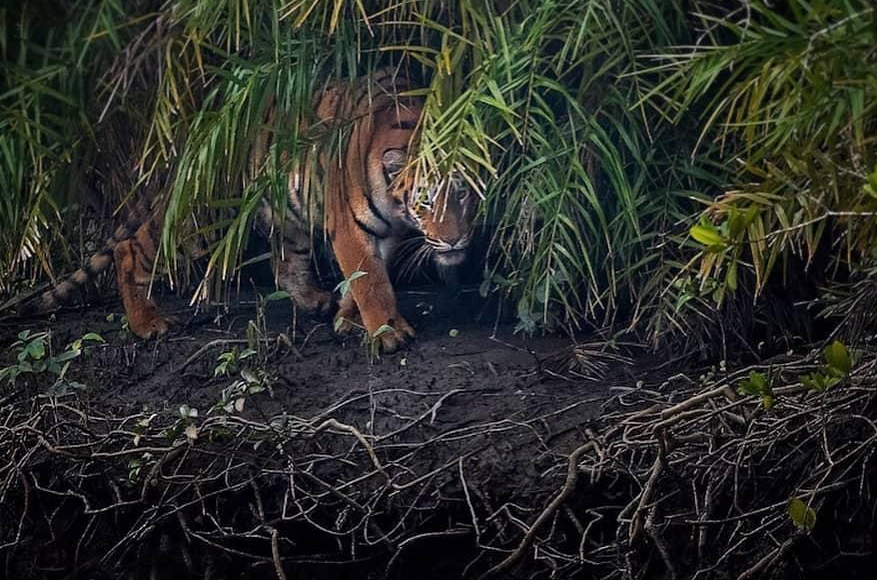
The Royal Bengal Tiger is often introduced as the king of the Sundarbans. But titles alone do not explain why it matters. The tiger is connected to mangrove roots holding the shoreline together.
- To chital moving through filtered light.
- To tidal creeks carrying sediment across the delta.
- To forest guards protecting hidden trails.
- To researchers identifying stripes in silent camera-trap photographs.
- To fishermen navigating rivers that wildlife has used for generations.
Every footprint pressed into wet mud tells a story larger than a single animal. It tells the story of an ecosystem still capable of hiding one of the world’s greatest predators.
Perhaps that is the Sundarbans’ greatest gift.
- It reminds us that true wilderness is not measured by how easily we find its wildlife.
- It is measured by whether that wildlife can continue living on its own terms.
Somewhere beyond the next creek, where mangrove shadows meet rising water, a Royal Bengal Tiger is moving through the forest.
- It may cross a river before dawn.
- It may disappear into the mangroves before anyone notices.
- It may leave behind nothing more than a fading footprint in the mud.
And that is exactly how it should be. Because the greatest symbol of a healthy Sundarbans is not a tiger standing before a camera.
It is a tiger that remains free enough to disappear into the tides.
See the Tiger’s World for Yourself
The Sundarban Tiger Expedition is a private journey into this tidal wilderness — the rivers, mangrove forests and islands where the Royal Bengal Tiger lives. A storytelling expedition, guided by an experienced Sundarban specialist.