 Field guide
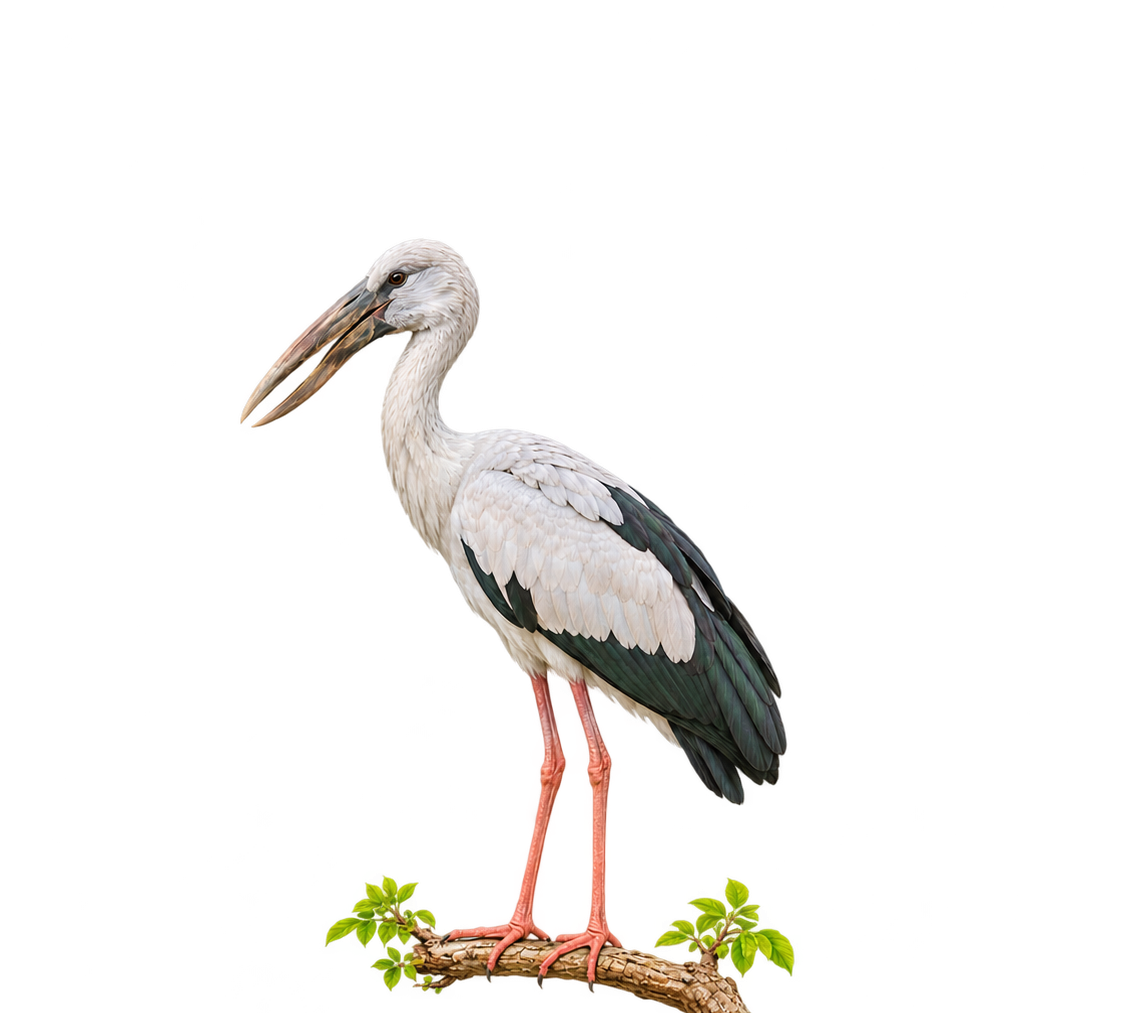
Across the wetlands of eastern India, a pale stork moves slowly through shallow water, its long legs carrying it across submerged vegetation and exposed mud. At first glance, it may resemble an ordinary white wading bird. A closer look reveals something unusual: its bill does not close completely.
This is the Asian Openbill (Anastomus oscitans), a medium-sized stork belonging to the family Ciconiidae. Its distinctive bill, specialised feeding behaviour and close association with wetland environments make it one of the more recognisable storks of the Indian subcontinent.
Unlike many birds associated with mangrove forests, the Asian Openbill is not primarily a deep-forest species. It is more closely associated with shallow wetlands, marshes, flooded agricultural fields, ponds and other water-rich landscapes.
Yet its relationship with the Indian Sundarbans is worth understanding. Official regional records establish its occurrence in the landscape, including documentation through the Sundarban Bird Festival.
The species offers an interesting reminder that the ecological character of the Sundarbans extends beyond its mangrove forests. Its wider wetland landscape, including open water, river margins and human-influenced habitats, supports a much broader bird community.
Asian Openbill at a Glance
| Field | Details |
| Common name | Asian Openbill |
| Alternative name | Asian Openbill Stork |
| Scientific name | Anastomus oscitans |
| Order | Ciconiiformes |
| Family | Ciconiidae |
| Genus | Anastomus |
| Conservation status | Least Concern (IUCN, 2025) |
| Indian status | Resident |
| West Bengal status | Resident |
| Indian Sundarbans occurrence | Documented in official bird checklists and surveys |
| Primary habitat | Shallow wetlands, marshes and flooded fields |
| Diet | Primarily aquatic molluscs, especially freshwater snails |
| Body length | Approximately 68–81 cm |
| Wingspan | Approximately 147–149 cm |
| Distinctive feature | A visible gap between the upper and lower mandibles of the adult bill |
Taxonomy and Classification
The Asian Openbill belongs to the stork family Ciconiidae, a group of long-legged, long-necked birds that includes the Painted Stork, Black-necked Stork, Lesser Adjutant and Greater Adjutant.
Its scientific name, Anastomus oscitans, distinguishes it from the African Openbill (Anastomus lamelligerus), its closest living relative within the same genus.
The species is widely distributed across the Indian subcontinent and parts of mainland Southeast Asia. India represents a major part of its native range, where it occupies a variety of inland wetland environments.
Conservation Status and Population Trends
The Asian Openbill is classified as Least Concern on the IUCN Red List, with the 2025 assessment reporting an increasing global population trend. This global classification does not mean that every regional population is increasing or that its wetland habitats are free from pressure.
The State of India’s Birds 2025 assessment provides a more geographically relevant picture for West Bengal:
- Migratory status: Resident.
- Habitat specialisation: Wetland.
- Long-term trend: Insufficient Data.
- Current annual trend: Stable.
- Global conservation category: Least Concern.
The West Bengal assessment is particularly useful because it separates state-level information from national and global assessments. Its long-term trend remains uncertain, despite the species’ widespread distribution.
Is the Asian Openbill Found in the Indian Sundarbans?
Yes. The Asian Openbill is documented in the Indian Sundarbans.
An important regional reference is the 1st Sundarban Bird Festival report (2023), published under the West Bengal Forest Department’s wildlife management framework. Its official checklist includes the Asian Openbill under the scientific name Anastomus oscitans.
A historical UNESCO periodic conservation report for Sundarban National Park also includes the Openbill Stork in its bird checklist.
More recent evidence requires careful interpretation. The 4th Sundarban Bird Festival report (2026) includes the Asian Openbill in its comparative species-presence table for 2025. However, its Annexure 1 contains a mismatch between the common and scientific names in the Ciconiidae entries. Consequently, its individual abundance figures should not be attributed to the Asian Openbill without clarification from the original survey data.
These records establish regional occurrence, but they do not independently establish a permanent breeding population, a particular nesting colony or regular abundance throughout the mangrove forest.
Habitat and Ecological Context
The Asian Openbill is primarily a wetland specialist. Its preferred feeding environments are generally shallow enough to allow it to walk while searching for aquatic prey.
Across its range, suitable habitats include:
- Freshwater marshes and seasonal wetlands.
- Shallow ponds and lakes.
- Flooded agricultural fields.
- Wet grasslands.
- Waterlogged lowlands.
- Shallow river margins and wetland edges.
In the Indian Sundarbans, the wider landscape contains several different habitat types. Tidal channels, freshwater-influenced wetlands, settlement ponds, agricultural areas and exposed river margins provide ecological conditions distinct from the saline interior of the mangrove forest.
This distinction matters. The presence of an aquatic bird in the Sundarbans does not necessarily mean it depends on dense mangrove vegetation.
For the Asian Openbill, the availability of suitable shallow-water feeding grounds and molluscan prey is more relevant than the density of mangrove trees.
Its Ecological Importance
The Asian Openbill is an important consumer of aquatic molluscs, particularly freshwater snails. Through its feeding activity, it participates in the food-web relationships of wetland ecosystems.
Its presence can also contribute to our understanding of wetland habitat use. However, its occurrence alone should not be treated as a direct measurement of water quality or overall ecosystem health.
The condition of its feeding habitat, availability of prey and continuity of suitable wetlands are more informative indicators when assessing its ecological requirements.
How to Identify the Asian Openbill
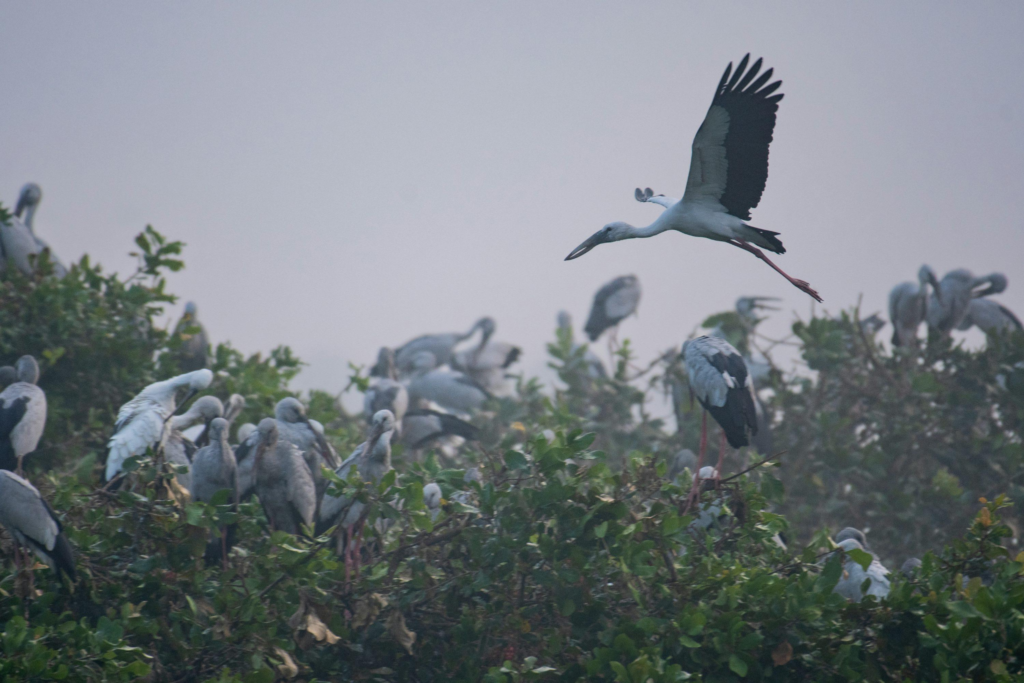
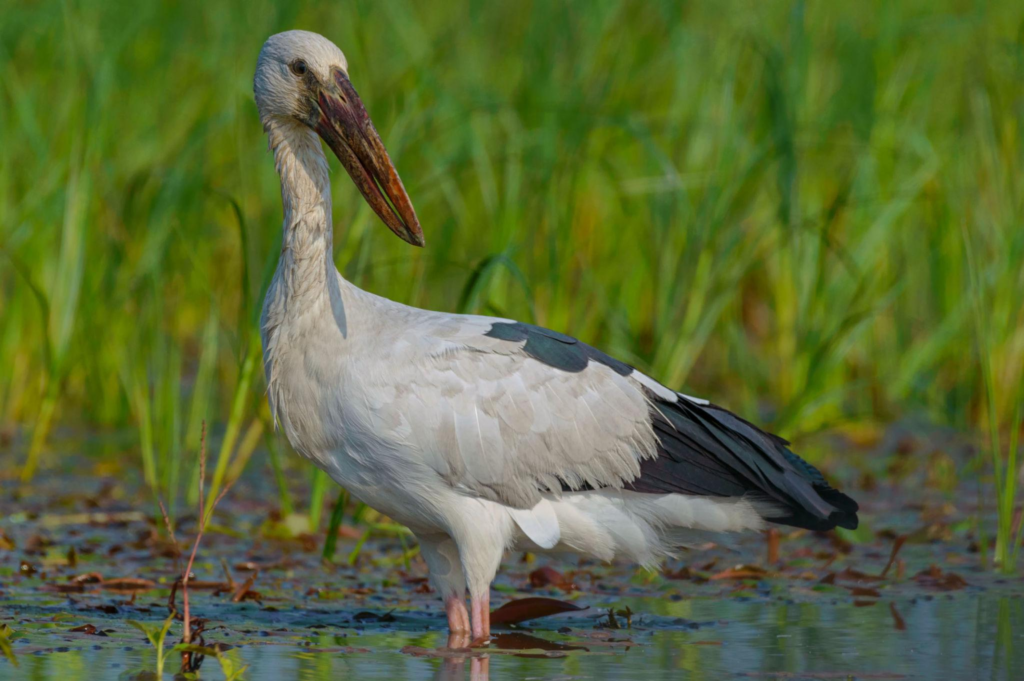
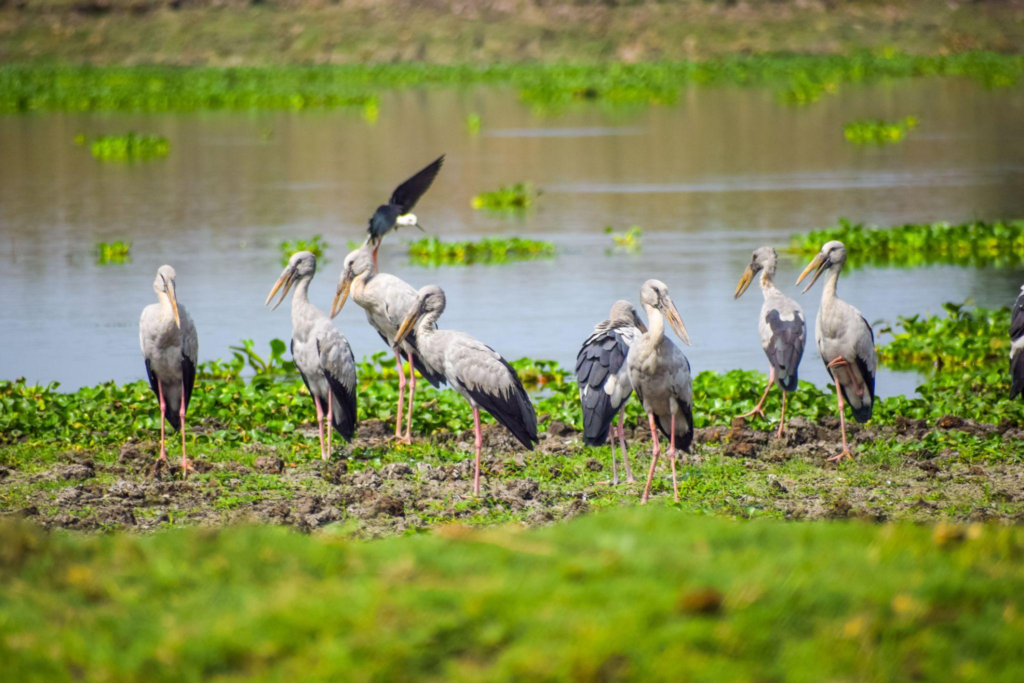
The Asian Openbill is a medium-sized stork with a relatively compact body, long legs and a long, straight neck. Its appearance is dominated by pale greyish-white plumage contrasted by dark flight feathers.
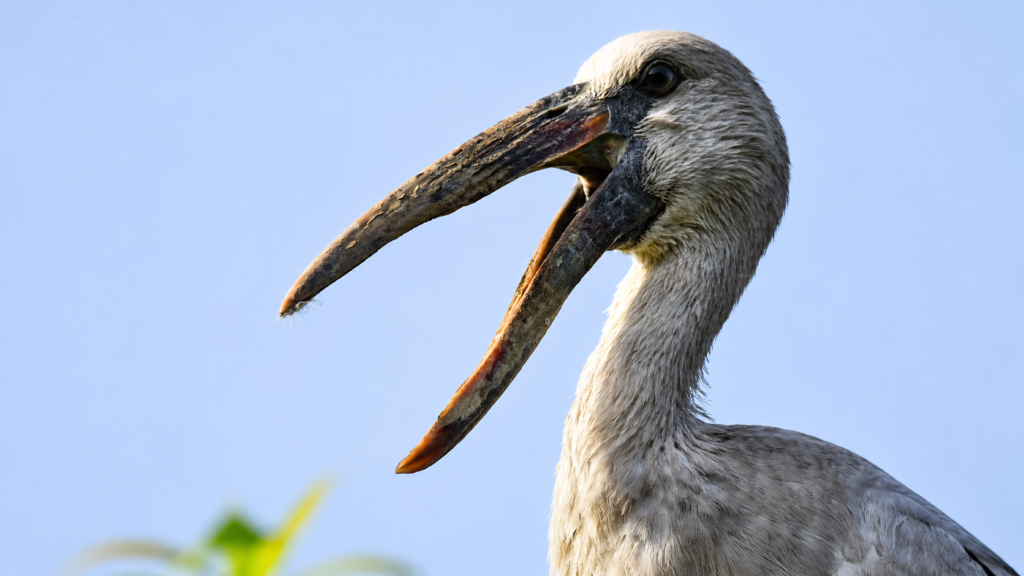
Its most important identification feature is its unusual bill.
Unlike the bills of most other storks, the upper and lower mandibles of an adult Asian Openbill do not meet along their entire length. Instead, a conspicuous gap remains between them, with the mandibles approaching each other towards the tip.
This distinctive structure gives the species its English name.
Other useful identification features include:
- Pale greyish-white body plumage.
- Contrasting black flight feathers and tail.
- Long pinkish to reddish-grey legs.
- A dull horn-grey or yellowish-grey bill.
- A relatively upright posture when standing or walking.
The open bill is particularly useful when distinguishing an adult Asian Openbill from other pale-coloured waterbirds.
Plumage and Distinctive Field Marks
Adult Asian Openbills may appear predominantly white, especially during the breeding period. Outside this period, their plumage can take on a more greyish or off-white appearance.
The black flight feathers create a strong contrast when the bird spreads its wings. In flight, this contrast becomes especially noticeable against the pale body.
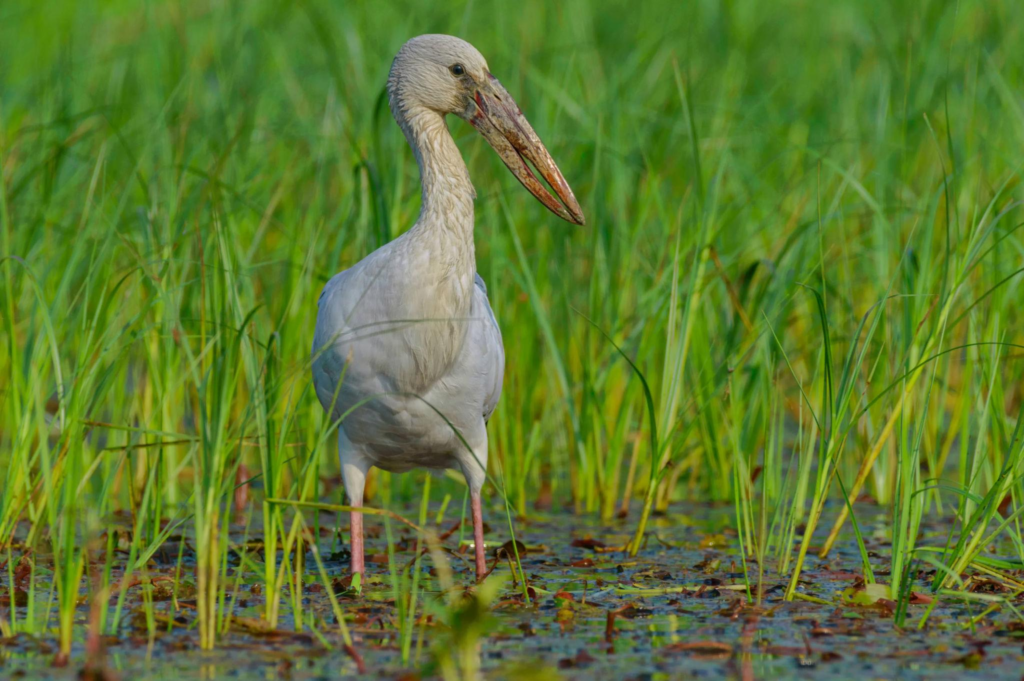
Juveniles are generally duller, with brownish or grey-brown tones in their plumage. Their bills do not possess the characteristic adult gap in the same developed form.
Male and female Asian Openbills are very similar in appearance. Reliable field identification based on plumage alone is generally not possible.
A Bill Specialised for Feeding on Snails
The Asian Openbill’s bill is more than an unusual identification feature. It is closely associated with the bird’s specialised feeding behaviour.
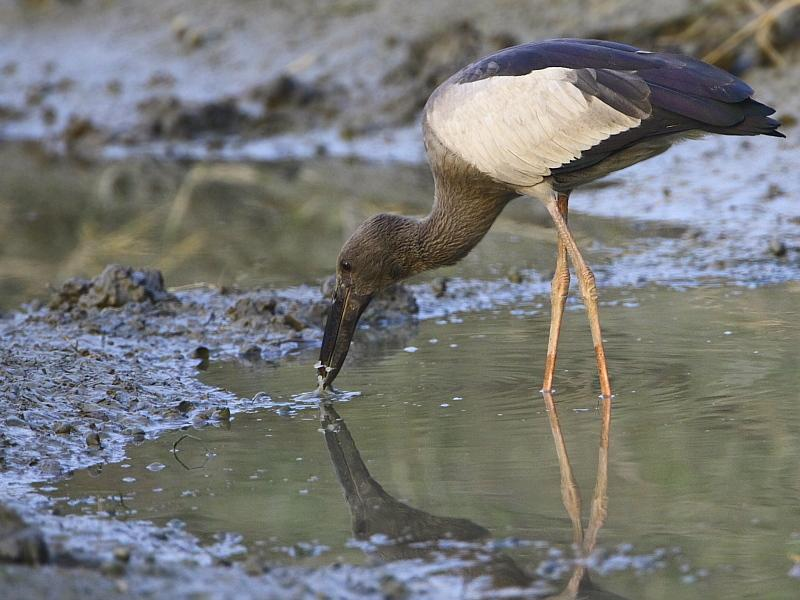
Its principal food includes freshwater snails, particularly species of the genus Pila. Other aquatic molluscs and invertebrates may also form part of its diet.
The open space between the mandibles helps the bird handle the shells of its preferred prey.
During feeding, the stork uses the pointed lower mandible to work around the snail’s shell opening and extract its soft body. This allows it to exploit a food resource that many other waterbirds cannot handle in quite the same way.
The bill therefore represents a specialised feeding structure rather than simply an unusual variation in appearance.
What Does the Asian Openbill Eat?
See it for yourself
A private journey shaped around you — your group, your pace, your interests. Book a free consultation.
Its diet is predominantly animal-based, with aquatic molluscs forming an important component.
| Food | Dietary importance |
| Freshwater snails | Principal food resource |
| Other molluscs | Additional prey |
| Aquatic insects | Supplementary food |
| Crustaceans | Opportunistic prey |
| Worms | Supplementary food |
| Frogs and other small aquatic animals | Occasional prey |
The importance of individual food items varies with habitat conditions and prey availability. The species should not be described as exclusively dependent on a single snail species.
How It Moves Through Wetlands
Asian Openbills generally forage by walking through shallow water or marshy ground. They move with measured steps, frequently lowering their heads to investigate the water and sediment.
They may forage individually or in groups, particularly where food is plentiful.
In flight, their long necks remain extended, unlike the folded-neck flight posture typical of herons and egrets.
They are also capable of soaring on rising warm air currents. This behaviour allows them to travel efficiently between feeding grounds, roosting areas and other suitable wetlands.
Their broad wings are particularly noticeable when several birds rise together and circle above a wetland.
Flight and Feeding Adaptations
Three features are especially relevant to understanding the species:
- The open bill: Helps in handling and extracting molluscan prey.
- Long legs: Allow the bird to walk through shallow water while searching for food.
- Broad wings: Support sustained flight and soaring between wetland habitats.
These characteristics are not exclusive adaptations to mangrove environments. They reflect the Asian Openbill’s broader ecological relationship with shallow-water habitats across its range.
Social Behaviour and Flocking
The Asian Openbill is often encountered in groups, although individuals may also feed independently.
Its social behaviour becomes particularly noticeable when suitable feeding grounds contain abundant aquatic prey. Several birds may forage within the same wetland, moving through shallow water without maintaining a rigid flock formation.
Large gatherings are also associated with communal roosting and breeding colonies.
During flight, groups may form loose formations or circle together on rising air currents. These movements are characteristic of a bird that regularly travels between different wetland habitats.
Calls and Communication
The Asian Openbill is not known for an elaborate song. Like other storks, it relies substantially on body movements and physical displays for communication.
At breeding colonies, bill-clattering and other mechanical sounds can become important. Vocalisations are generally less prominent than those of many songbirds.
Communication becomes particularly relevant during interactions between adults at nesting sites, where courtship, territorial behaviour and nest defence may involve a combination of postures and physical displays.
Breeding and Nesting Behaviour
The Asian Openbill is a colonial breeder. It commonly nests in groups, sometimes alongside other waterbirds, including egrets and cormorants.
Its nest is generally a platform of sticks and branches constructed in trees. Nests may be positioned in clusters, creating substantial breeding colonies.
Breeding timing varies geographically and is influenced by rainfall and wetland conditions. In northern India, the breeding season commonly follows the monsoon, while other parts of the species’ range can have different nesting periods.
A typical breeding cycle involves:
- Nest construction: Adults collect sticks and branches to build a platform.
- Egg laying: The female generally lays a clutch of approximately two to four eggs.
- Incubation: Both adults participate in parental care.
- Chick development: Young birds depend on adults for food and protection.
- Fledging: Juveniles gradually develop the ability to leave the nest and become independent.
Breeding information from other parts of India should not be interpreted as evidence of breeding within the Indian Sundarbans.
An important regional knowledge gap: Although the species is documented in the Sundarbans, the available records consulted for this article do not establish a verified local nesting colony or breeding population.
Seasonal Movements and Dispersal
The Asian Openbill is classified as a resident species in West Bengal by the State of India’s Birds 2025 assessment.
However, resident status does not necessarily mean that every individual remains within the same wetland throughout the year.
Asian Openbills can move between feeding habitats as water levels, rainfall and prey availability change. Juveniles may also disperse after leaving their nesting colonies.
Research and ringing recoveries elsewhere in the species’ range demonstrate that individuals can travel considerable distances.
For the Indian Sundarbans, however, the available evidence does not establish a specific migration corridor or a predictable arrival and departure schedule.
Human Connections and Wetland Landscapes
The Asian Openbill frequently uses wetlands that exist alongside human settlements and agricultural landscapes.
Ponds, flooded fields and waterlogged lowlands can provide feeding opportunities, allowing the species to occupy environments that are not entirely natural.
This relationship makes the bird relevant to the wider discussion of wetland conservation in eastern India.
Agricultural landscapes and settlement wetlands can support wildlife, but their ecological value depends on how water resources, vegetation and surrounding habitats are managed.
The Asian Openbill’s presence should therefore be understood within a larger landscape that connects natural wetlands, agricultural areas and human communities.
Conservation Challenges
Although the Asian Openbill is globally classified as Least Concern, the wetlands on which it depends face several pressures.
Its principal ecological requirements include suitable shallow-water feeding grounds, adequate molluscan prey and appropriate nesting trees.
Potential pressures include:
Wetland loss and degradation: The conversion, drainage or degradation of wetlands can reduce the availability of feeding habitats. This is particularly relevant in densely populated agricultural landscapes.
Changes in water management: Alterations to water levels, drainage patterns and seasonal flooding can affect the availability of shallow feeding grounds.
Pollution: Contamination of wetlands can affect aquatic organisms and the broader food web. The implications for individual Asian Openbill populations require location-specific investigation.
Loss of nesting habitat: The removal of suitable nesting trees can affect colonial breeding birds, particularly where alternative nesting sites are limited.
Climate and hydrological changes: Changes in rainfall, extreme weather and water availability can influence wetland conditions and prey availability.
These are relevant ecological pressures, not proof that each has caused a documented population decline of the Asian Openbill in the Indian Sundarbans. The West Bengal assessment currently reports insufficient data for a long-term population trend.
Where Can the Asian Openbill Be Observed in the Indian Sundarbans?
The official Sundarban Bird Festival checklist provides a documented basis for including the Asian Openbill in the Indian Sundarbans bird list.
However, the available checklist evidence does not provide sufficient species-specific detail to identify a reliable, regularly occupied observation hotspot.
The 2023 festival covered six broad survey routes:
- National Park East
- National Park West
- Basirhat
- Sajnekhali
- Kalas
- Matla
These are documented survey areas, not six independently verified Asian Openbill sighting locations. The species’ inclusion in the festival-wide checklist must not be interpreted as proof of its presence at every route.
The wider Sundarbans landscape contains wetlands and open-water habitats that may be suitable for the species. Nevertheless, habitat suitability and confirmed observation are two different things.
For responsible birdwatching, any new sighting should ideally be supported by a photograph, observation date, precise locality and reliable identification.
When Is the Asian Openbill Present?
The Asian Openbill is considered resident in West Bengal.
It is therefore not appropriate to describe it simply as a winter migrant to the Indian Sundarbans.
Local movements may nevertheless occur in response to changing water conditions and feeding opportunities.
At present, the evidence consulted does not establish a specific seasonal peak for the species within the Indian Sundarbans. Its presence on a particular birdwatching trip should never be guaranteed.
The Importance of Bird Monitoring in the Sundarbans
The Sundarban Bird Festival has become an important initiative for documenting regional avian diversity.
The first festival in February 2023 used boat transects and point counts across six routes, recording 145 species during its two-day field exercise.
The fourth festival, conducted in January 2026, recorded 168 species across its field exercise.
Such surveys provide valuable information about species occurrence and habitat use.
For a species such as the Asian Openbill, continued monitoring could help answer several important questions:
- Does it occur regularly or irregularly in different parts of the Indian Sundarbans?
- Which wetland habitats are most frequently used?
- Does it feed in freshwater-influenced wetlands, tidal margins or settlement ponds?
- Are there any confirmed local breeding records?
- How does its occurrence change between years?
Standardised surveys, photographic documentation and carefully verified citizen-science observations can gradually improve the available evidence.
The Important Truth About Bird Observation
Bird observation is influenced by several interacting factors, including tide, water level, weather, season, habitat, feeding activity and survey effort.
A bird may use an area without being detected during a short visit. Equally, a single observation does not establish that a species is regularly present.
For the Asian Openbill, the distinction is especially important because its preferred shallow-water habitats are not evenly distributed throughout the mangrove landscape.
A suitable wetland may provide the right conditions for the bird, but only a verified observation can establish its presence.
What Makes the Asian Openbill of the Sundarbans Unique?
The Asian Openbill is not a species exclusive to the Sundarbans. It is widespread across South Asian wetlands, and its specialised feeding behaviour is not unique to the mangrove delta.
What makes its presence interesting is the ecological diversity of the landscape it occupies.
The Indian Sundarbans is often understood primarily through its mangrove forests, tidal creeks and estuarine wildlife. However, its wider ecological landscape also includes open wetlands, settlement ponds, freshwater-influenced areas and other habitats that support birds with very different ecological requirements.
The Asian Openbill represents this wider wetland connection.
Its feeding dependence on molluscs also introduces a less frequently discussed relationship between birds and aquatic invertebrates. The condition of wetlands, availability of snails and seasonal water patterns all contribute to the ecological conditions that make these habitats suitable.
Its documented inclusion in the Sundarban Bird Festival checklist is therefore meaningful. It establishes that the Asian Openbill belongs in the documented avifaunal picture of the Indian Sundarbans, even though its precise local distribution, frequency and breeding status need further investigation.
The distinction between a bird being recorded and a bird being regularly established is an important part of responsible natural-history writing.
Myths and Facts About the Asian Openbill
| Common misconception | Scientific fact |
| Every adult stork has a completely closed bill. | The adult Asian Openbill has a distinctive gap between its mandibles. |
| It feeds only on snails. | Molluscs are important, but it also consumes other aquatic invertebrates and small animals. |
| It is a winter migrant in West Bengal. | It is classified as resident in West Bengal. |
| It lives exclusively in mangrove forests. | Its preferred habitats include a much wider range of wetlands. |
| Its presence proves local breeding. | A feeding or occurrence record does not establish breeding. |
FAQs
1. Is the Asian Openbill found in the Indian Sundarbans?
Yes. The species is included in the official 2023 Sundarban Bird Festival checklist. Its precise distribution and frequency across the region require further documentation.
2. What is the scientific name of the Asian Openbill?
Its scientific name is Anastomus oscitans. It belongs to the stork family Ciconiidae.
3. Why does the Asian Openbill have a gap in its bill?
The gap between its upper and lower mandibles helps it handle and extract the soft bodies of snails from their shells.
4. What does the Asian Openbill eat?
It primarily feeds on freshwater snails and other molluscs. Aquatic insects, crustaceans, worms and small animals may also form part of its diet.
5. Is the Asian Openbill a migratory bird?
It is classified as a resident species in West Bengal. However, individuals can move between wetlands depending on food availability and environmental conditions.
6. How can you identify an Asian Openbill?
Look for its greyish-white body, contrasting black flight feathers, long legs and distinctive adult bill with a visible gap between the mandibles.
7. Does the Asian Openbill breed in the Sundarbans?
Its breeding biology is documented elsewhere in its range, but the records consulted do not establish a confirmed breeding colony in the Indian Sundarbans.
8. What is the conservation status of the Asian Openbill?
The IUCN Red List classifies it as Least Concern. The 2025 assessment reports an increasing global population trend.
9. Is the Asian Openbill commonly seen in mangrove forests?
It is primarily associated with shallow wetlands, marshes and flooded fields rather than dense mangrove interiors. Its occurrence in the wider Sundarbans landscape is documented.
10. What makes the Asian Openbill different from other storks?
Its most distinctive feature is the gap between the mandibles of its adult bill, which is associated with its specialised mollusc-feeding behaviour.
The Wild Orbit Perspective
The Asian Openbill tells a different story about the Sundarbans.
It draws attention away from the familiar image of dense mangrove vegetation and towards the quieter wetlands that form part of the wider delta landscape.
Its unusual bill reflects a specialised relationship with aquatic life. Its feeding behaviour connects it to freshwater snails and other invertebrates, while its movements link different wetland habitats across the region.
For The Wild Orbit, understanding birds means looking beyond their appearance and learning about the ecological relationships that allow them to survive.
The Sundarbans is not defined by a single habitat or a single species. It is a complex landscape of tides, rivers, wetlands, forests and human settlements.
The Asian Openbill is one more reminder that even the less frequently discussed birds have a place in this extraordinary ecological system.
Plan your private Sundarban expedition
A private journey shaped around you — your group, your pace, your interests. Book a free consultation.