Field guide
The Crested Serpent Eagle is a documented member of the Indian Sundarbans’ avifauna. Its presence is supported by the West Bengal Department of Sundarban Affairs’ fauna inventory, which explicitly lists Spilornis cheela among the birds of the region. It also appears in the historical checklist of birds of the Sundarbans included in India’s 2003 UNESCO periodic conservation report.
Its story is particularly interesting because this is not a typical fish-hunting estuarine eagle. It is a forest-associated raptor whose hunting strategy centres largely on snakes and other terrestrial prey. Understanding its place in the Sundarbans means looking beyond the tidal waterways towards the wooded landscape that borders them.
Crested Serpent Eagle At a Glance
| Field | Information |
| Common Name | Crested Serpent Eagle |
| Scientific Name | Spilornis cheela |
| Order | Accipitriformes |
| Family | Accipitridae |
| Conservation Status | Least Concern (IUCN, 2025) |
| Global Population Trend | Decreasing |
| Indian Sundarbans Occurrence | Documented in regional faunal inventories |
| Seasonal Status | Local seasonal pattern not established |
| Habitat | Woodlands, forest edges, wooded wetlands and mangroves |
| Diet | Snakes, lizards, frogs and other small animals |
| Body Length | Approximately 50–76 cm, depending on population and reference |
| Wingspan | Approximately 109–169 cm |
| Ecological Role | Predator of reptiles and other small vertebrates |
Conservation Status and Distribution
The International Union for Conservation of Nature (IUCN) classified the Crested Serpent Eagle as Least Concern in its 2025 global assessment. However, its global population trend is listed as decreasing. Least Concern should not be interpreted as meaning that every regional population is stable or free from conservation pressures.
Its distribution extends across the Indian subcontinent and much of tropical Asia, including Bangladesh, Nepal, Bhutan, Myanmar and several Southeast Asian countries. In India, it occurs across a variety of wooded landscapes.
A particularly useful regional reference is the 2024 publication A Checklist of the Birds of West Bengal, published in the journal Indian BIRDS. The checklist includes the Crested Serpent Eagle among the state’s documented avifauna.
For the Indian Sundarbans, the evidence is more geographically specific. The Zoological Survey of India’s 1989 publication, Fauna of Sundarban Mangrove Ecosystem, West Bengal, India, was based on field surveys conducted both inside and outside the Project Tiger Area and concentrated mainly on the Indian territory. The Department of Sundarban Affairs’ fauna inventory also lists Spilornis cheela. These are important regional references, although they do not establish the bird’s present population size or frequency of occurrence.
Its Place in the Mangrove Ecosystem
The Sundarbans is often understood through its aquatic wildlife: fishing eagles, kingfishers, herons, storks and other birds that depend directly on its rivers and intertidal wetlands.
The Crested Serpent Eagle represents a different ecological association.
It is a woodland hunter, favouring areas where trees provide suitable perches and opportunities for searching the ground and vegetation below. Forest edges are particularly useful because they allow the bird to observe a relatively open hunting area while remaining close to cover.
Within the Indian Sundarbans, this makes the wooded portions of the landscape ecologically relevant to understanding its occurrence. However, the availability of suitable habitat should not be mistaken for proof of a resident breeding population.
Its presence also reminds us that the Sundarbans is not simply a network of tidal waterways. It is a complex land-and-water ecosystem supporting predators with very different hunting strategies.
How to Identify the Crested Serpent Eagle
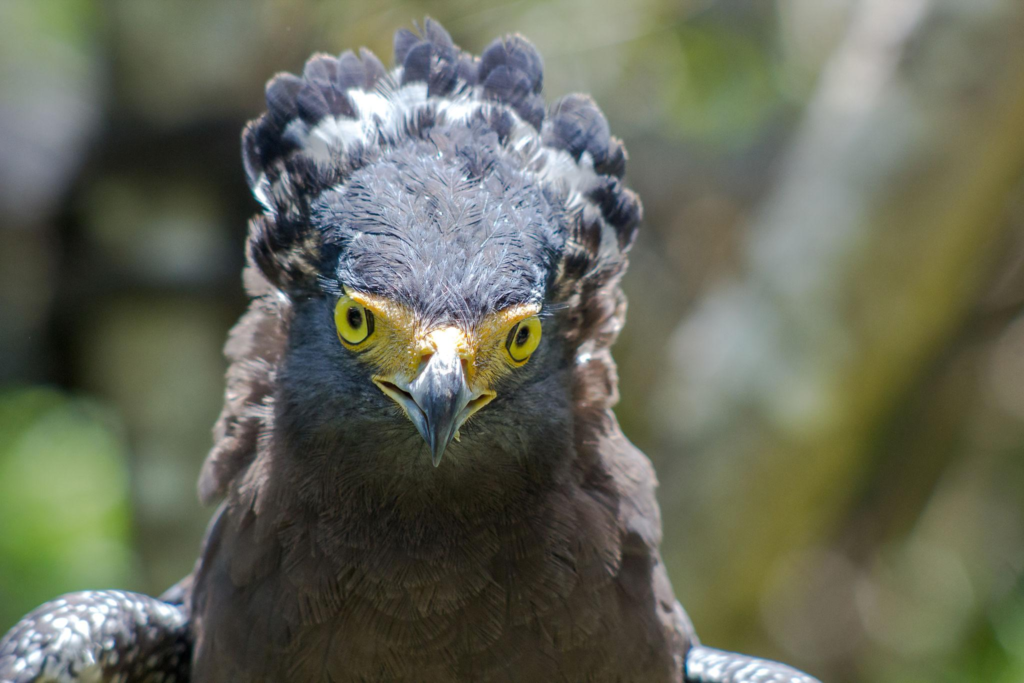
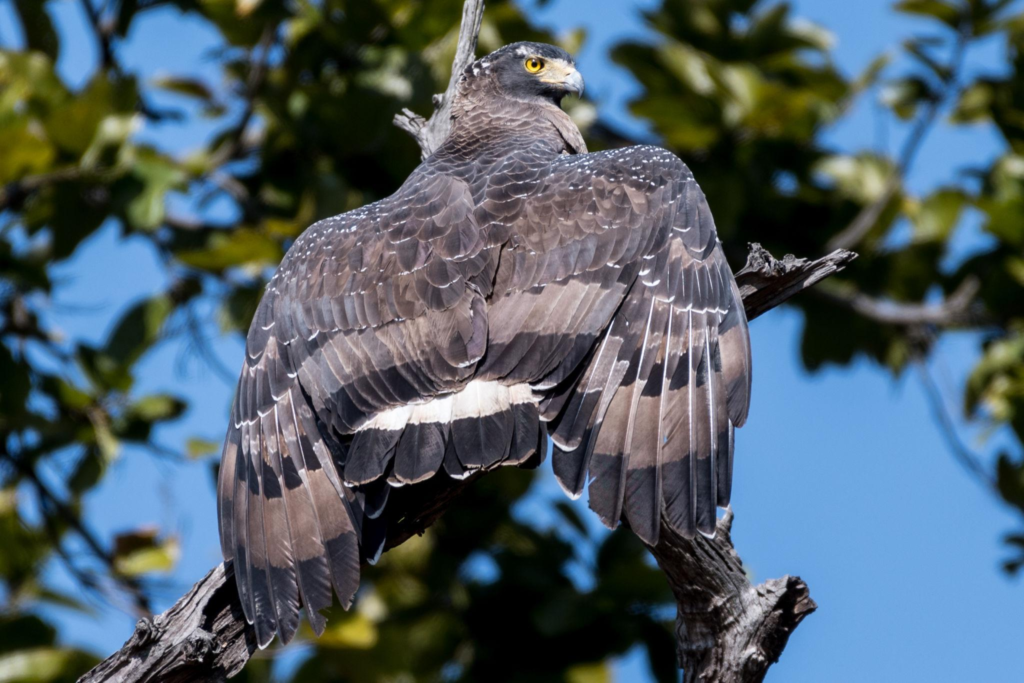
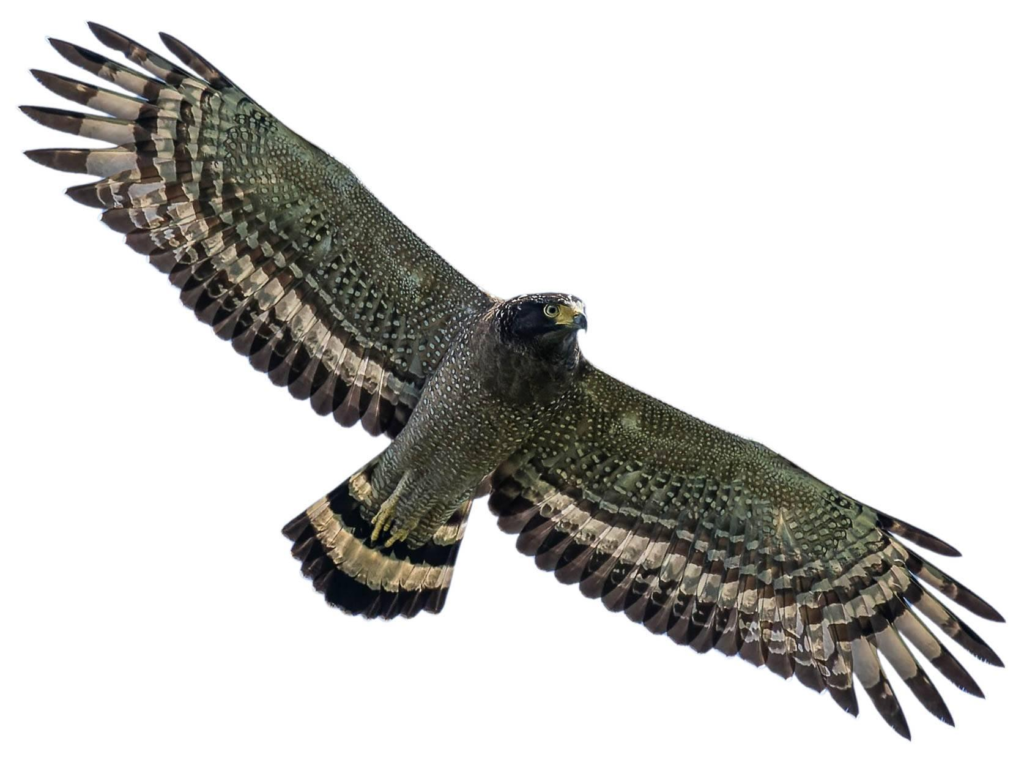
The first feature that attracts attention is its distinctive head. The Crested Serpent Eagle has a prominent, dark crest at the back of its crown, giving the head a somewhat enlarged appearance.
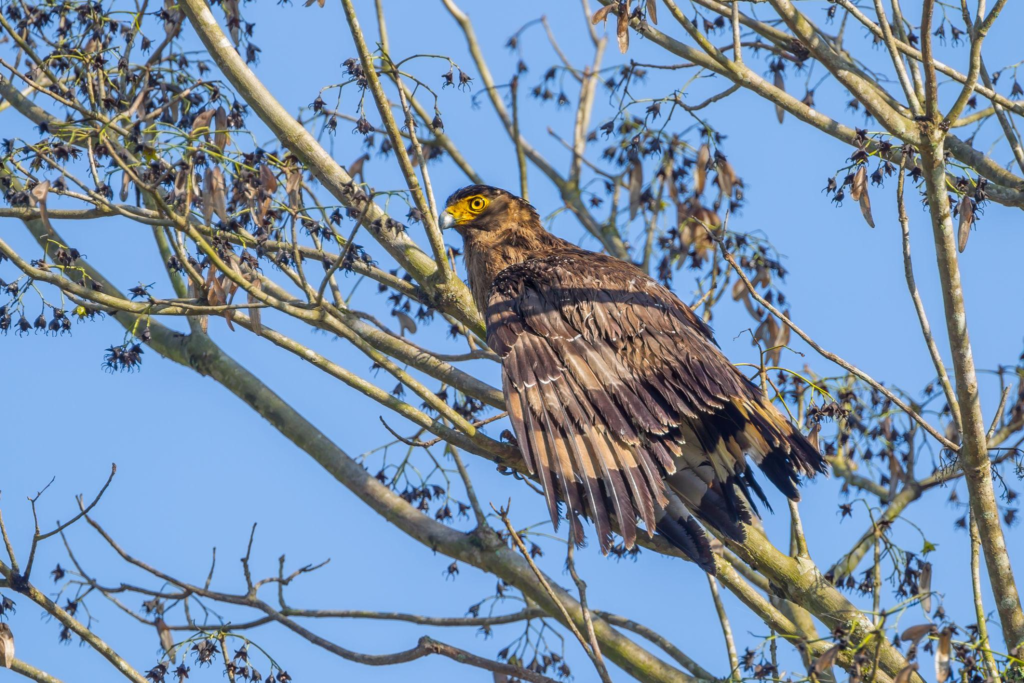
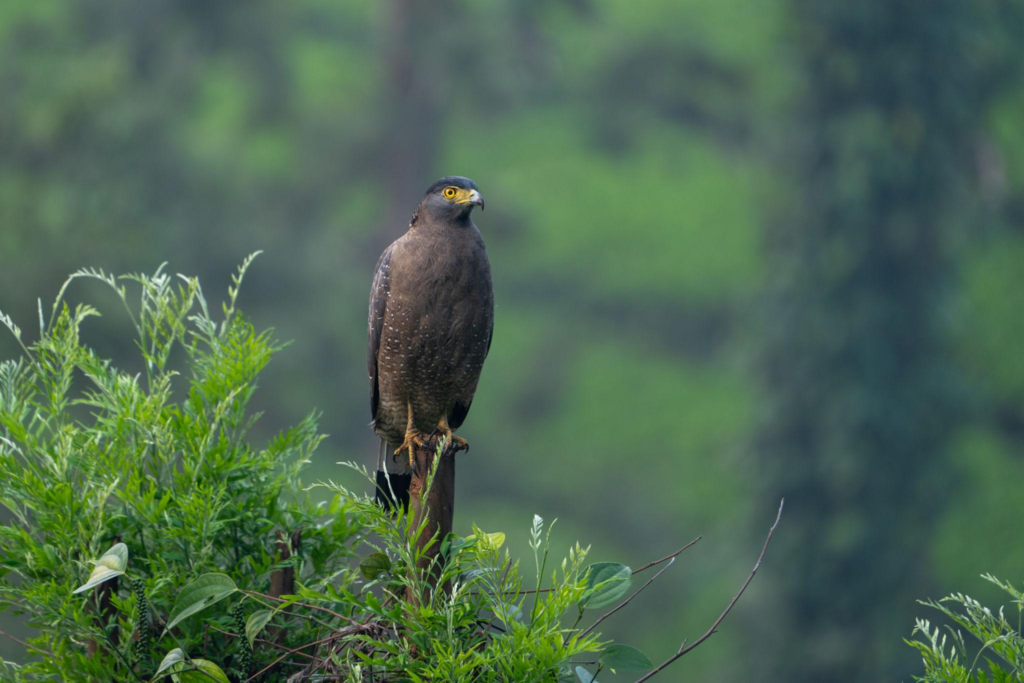
Its overall plumage is predominantly dark brown. The upperparts carry pale spotting, while the underparts show conspicuous whitish spots and markings against a brown background. The facial skin around the eyes and the cere—the fleshy area at the base of the bill—are yellow.
The sexes are broadly similar in appearance, making visual separation between males and females difficult in the field. Juveniles are generally paler, with more extensive whitish plumage and darker streaking.
A combination of its crest, yellow facial skin, spotted underparts and distinctive flight pattern makes identification more reliable than relying on colour alone.
Wings Built for Soaring
The Crested Serpent Eagle has broad, rounded wings that support gliding and soaring. Rather than relying on continuous rapid wingbeats, it can use rising air currents to remain airborne while surveying the landscape.
Its flight silhouette is particularly useful for identification. A broad pale band across the wings and a conspicuous pale band on the tail are important field marks. The dark trailing edges of the wings provide additional contrast.
When viewed from below, the bird’s broad wings and relatively short tail create a compact, powerful silhouette.
This flight style is useful for a predator that spends considerable time searching wooded terrain from above or from elevated perches.
What Does the Crested Serpent Eagle Eat?
See it for yourself
A private journey shaped around you — your group, your pace, your interests. Book a free consultation.
As its name suggests, snakes form an important part of its diet. However, the species is not exclusively dependent on snakes.
Its recorded prey includes:
- Snakes, including venomous species.
- Lizards and other reptiles.
- Frogs and other amphibians.
- Small mammals.
- Occasionally, birds.
It hunts using more than one strategy. An individual may wait on an elevated perch, watching for movement below, or search while soaring above suitable habitat. Once prey is located, its powerful feet and curved talons help secure the animal.
This feeding strategy distinguishes it from fish-specialist raptors such as the Grey-headed Fish Eagle. While both may occupy landscapes containing waterways and wooded vegetation, their principal prey and hunting behaviour differ.
The Yellow Face, Strong Feet and Hunting Precision
The eagle’s yellow facial skin and cere are among its most recognisable features. Its strongly hooked bill is suited to tearing animal prey, while its muscular legs and sharp talons provide the grip necessary to restrain struggling prey.
Its heavily scaled lower legs are another characteristic of this group of snake-hunting raptors. These structures are relevant when dealing with reptiles, although they should not be interpreted as providing complete protection against snake bites.
The bird’s eyesight is important for detecting prey from elevated positions. Its hunting depends on locating movement and selecting an appropriate moment to descend.
Together, these features make the Crested Serpent Eagle an effective predator in wooded environments.
A Solitary Hunter With a Distinctive Call
Crested Serpent Eagles are generally encountered alone or in pairs rather than in large feeding flocks.
Their vocalisations are distinctive. A loud, piercing, often multi-note call may be heard over wooded areas, particularly during display and territorial activity. The call can carry across a considerable distance, sometimes drawing attention to a bird that remains difficult to locate among the vegetation.
The bird may also raise its crest when alarmed or excited. This visible change in posture can make an otherwise understated perched individual appear considerably more imposing.
Courtship and Breeding
Crested Serpent Eagles are generally monogamous. Courtship may involve aerial displays in which pairs soar and call together, sometimes incorporating rolling movements and wing displays.
Nesting takes place in trees. The nest is constructed from sticks and plant material, with smaller twigs and fresh leaves used as lining. Available natural-history accounts describe the species as laying a small clutch, commonly a single egg.
Breeding timing varies geographically. Information from other parts of India should not automatically be applied to the Indian Sundarbans. Although breeding biology is described for the wider species, the available regional inventories cited here do not establish a confirmed local nesting site or breeding season in the Indian Sundarbans.
Human Interaction and the Changing Landscape
As a predator of snakes and other small vertebrates, the Crested Serpent Eagle occupies a position in the terrestrial food web that differs from that of fish-eating birds.
Its continued presence in wooded landscapes depends on suitable habitat, nesting trees and sufficient prey availability.
The wider Sundarbans faces pressures associated with changing environmental conditions, habitat alteration and human activity. Nevertheless, it would be misleading to attribute a particular population decline of this eagle in the Indian Sundarbans to any one of these pressures without species-specific monitoring.
Responsible observation is important. Disturbing a perched bird, approaching a nest or repeatedly flushing an individual for photographs can interfere with normal behaviour.
Where Can the Crested Serpent Eagle Be Observed in the Indian Sundarbans?
The available regional inventories establish its occurrence in the Indian Sundarbans, but they do not provide sufficiently detailed, recent, site-specific observations to identify dependable viewing locations.
Places such as Sajnekhali, Sudhanyakhali, Dobanki, Netidhopani and the forest areas around Gosaba are important reference points within the wider Sundarbans landscape. However, their importance as wildlife observation areas does not establish confirmed records of this particular eagle at each location.
For responsible birdwatching, it is more useful to understand the habitat than to follow an unverified hotspot list. Wooded edges, suitable perching trees and relatively open areas adjoining vegetation are the environments most relevant to its known hunting behaviour.
The distinction matters: a suitable habitat increases ecological plausibility, but does not guarantee the presence of a particular species.
When Is the Crested Serpent Eagle Present?
The IUCN assessment describes the species as non-migratory at the global level. It is generally considered a resident bird across much of its range.
However, the available sources do not establish a detailed seasonal calendar for the Indian Sundarbans.
It would therefore be premature to designate a particular month as the best time to observe this eagle locally. Seasonal changes in visibility, weather, vegetation and bird activity may influence encounters, but these are not equivalent to documented migration patterns.
The Important Truth About Bird Observation
A bird’s absence from a particular observation does not necessarily mean it is absent from the surrounding landscape.
Crested Serpent Eagles can remain perched and relatively inconspicuous, especially when their brown plumage blends with branches and vegetation. Even when present, an individual may spend considerable time outside an observer’s field of view.
Observation depends on several factors:
- Seasonal conditions and weather.
- Visibility and vegetation density.
- Time spent surveying suitable habitat.
- The bird’s feeding and resting behaviour.
- Disturbance and human activity.
- Chance.
A confirmed historical record, a recent photographic observation and a suitable habitat should always be treated as three different categories of evidence.
What Makes the Crested Serpent Eagle of the Sundarbans Unique?
The Crested Serpent Eagle is not an endemic bird of the Sundarbans, nor is there evidence of a separate Sundarbans population or subspecies.
What makes its occurrence interesting is its ecological identity within an ecosystem commonly associated with aquatic predators.
The Sundarbans is internationally recognised for its mangrove forests, tidal rivers and remarkable estuarine biodiversity. Yet its wildlife relationships extend beyond the water.
The Crested Serpent Eagle represents the terrestrial side of this ecological network. Its preference for wooded habitats and its ability to hunt snakes, lizards and other small animals illustrate how the forest environment supports predators that do not depend primarily on fish.
Its documented inclusion in the regional fauna inventories is significant for another reason: it provides evidence that the Indian Sundarbans’ avifauna includes more than the familiar waterbirds and fish-eating raptors.
At the same time, the lack of sufficiently detailed contemporary, site-specific records leaves important questions unanswered. Its current distribution, breeding status and local population trend deserve further ornithological attention.
Myths and Facts About the Crested Serpent Eagle
| Common misconception | What the evidence tells us |
| It eats only snakes. | Snakes are important prey, but it also consumes lizards, amphibians, small mammals and birds |
| It is a fish-eating eagle. | Its principal hunting identity is that of a terrestrial predator |
| Its yellow face is its only identification feature. | The crest, spotted plumage and distinctive flight markings are also important |
| Every Crested Serpent Eagle in the Sundarbans is a resident breeder. | Regional occurrence does not establish local breeding |
| Least Concern means its population is increasing. | Its 2025 global IUCN assessment lists a decreasing population trend |
FAQs
1. Is the Crested Serpent Eagle found in the Indian Sundarbans?
Yes. Spilornis cheela is included in the Department of Sundarban Affairs’ fauna inventory and historical Sundarbans bird checklists.
2. What is the scientific name of the Crested Serpent Eagle?
Its accepted scientific name is Spilornis cheela. It belongs to the family Accipitridae and order Accipitriformes.
3. Is the Crested Serpent Eagle a resident or migratory bird?
It is generally considered non-migratory across its wider range. However, its precise seasonal occurrence in the Indian Sundarbans has not been adequately documented.
4. What does the Crested Serpent Eagle eat?
It primarily hunts snakes and other reptiles, but its diet also includes frogs, small mammals and occasionally birds.
5. How can you identify a Crested Serpent Eagle?
Look for its dark, prominent crest, yellow facial skin, brown plumage with white spotting and broad rounded wings. The pale bands across its wings and tail are particularly useful identification features in flight.
6. Is the Crested Serpent Eagle endangered?
No. It is classified as Least Concern by the IUCN in its 2025 assessment. However, its global population trend is decreasing.
7. Does the Crested Serpent Eagle breed in the Sundarbans?
Breeding is established for the species elsewhere in its range, but the regional sources consulted do not establish a confirmed breeding site in the Indian Sundarbans.
8. Why is it called a Serpent Eagle?
The name refers to its characteristic hunting preference for snakes. However, snakes are not its only food source.
9. How large is a Crested Serpent Eagle?
Depending on geographical population and reference, it measures approximately 50–76 cm in body length, with a wingspan of roughly 109–169 cm.
10. What makes the Crested Serpent Eagle ecologically important?
As a predator of snakes, lizards, amphibians and other small vertebrates, it forms part of the terrestrial food web and contributes to predator–prey relationships in wooded habitats.
The Wild Orbit Perspective
There is something particularly revealing about a predator that belongs to the forest rather than the river.
In the Sundarbans, our attention is naturally drawn towards the waterways, where fish-eagles patrol the sky and kingfishers wait above the tidal creeks. But the wooded landscape holds another world of ecological relationships, where reptiles, amphibians, small mammals and their predators form a different network of life.
The Crested Serpent Eagle belongs to that world.
Its dark crest, yellow face and broad wings make it a distinctive raptor, but its importance extends beyond its appearance. It represents the diversity of hunting strategies that allow wildlife to occupy different ecological spaces within the same mangrove landscape.
There is still much to understand about its contemporary presence in the Indian Sundarbans. Better field documentation, photographic evidence, systematic bird surveys and long-term monitoring could help establish a clearer picture.
For a landscape as complex as the Sundarbans, every documented species contributes another piece to understanding its ecological identity.
And sometimes, the most interesting story in a tidal forest is not unfolding over the water, but somewhere above the trees.
Plan your private Sundarban expedition
A private journey shaped around you — your group, your pace, your interests. Book a free consultation.