 Field guide
The barking deer was once part of the Indian Sundarbans’ terrestrial wildlife. Today, it is considered locally extinct in the Indian Sundarbans, a reminder that even a species capable of surviving in varied forest habitats can disappear when its environment changes beyond its capacity to endure.
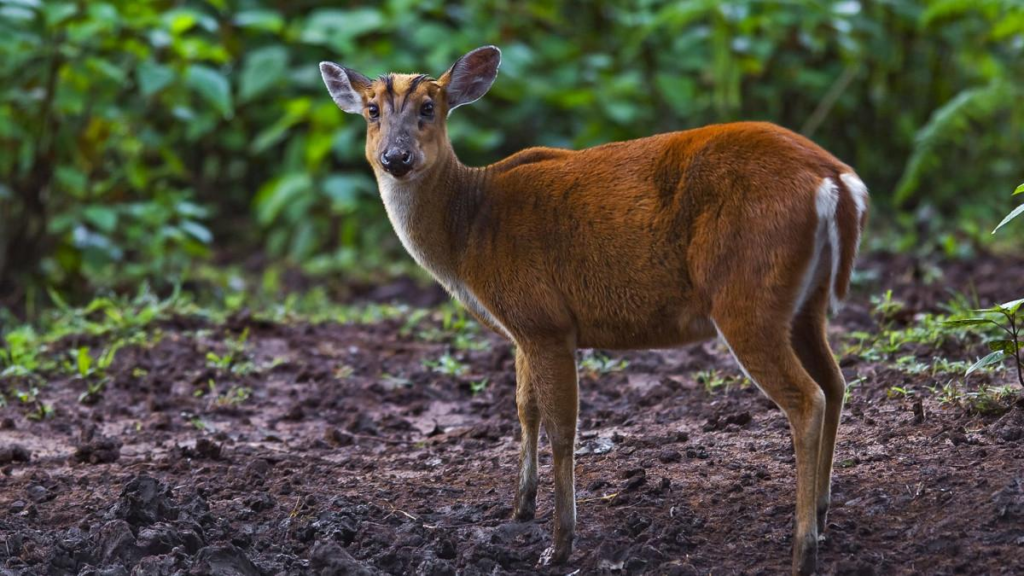
Unlike global extinction, local extinction means that a species has disappeared from a particular geographical area while continuing to survive elsewhere. The barking deer remains part of South Asia’s wildlife, but its historical disappearance from these tidal mangroves represents a significant loss in the ecological history of West Bengal.
The story of this small, elusive deer is not simply about an animal that vanished. It is about changing habitats, the pressure of human activity, and the limits of wildlife survival in a landscape where land, freshwater and salinity are constantly shifting.
Barking Deer At a Glance
| Feature | Details |
| Common name | Barking Deer |
| Other name | Indian Muntjac; Northern Red Muntjac in current taxonomic treatments |
| Scientific name | Muntiacus vaginalis in the current Indian checklist; historical Sundarbans literature commonly uses Muntiacus muntjak |
| Family | Cervidae |
| Order | Artiodactyla |
| Global conservation status | Least Concern in the commonly cited assessment of the muntjac complex; taxonomy and assessments should be matched to the species concept used |
| Status in the Indian Sundarbans | Locally extinct |
| Historical Indian Sundarbans record | Reported from Haliday Island and other islands; historical accounts place its last sighting on Haliday Island in the late 1970s |
| Natural habitat | Forests, woodland edges, scrub and vegetated areas with cover and food |
| Diet | Primarily plant matter, including leaves, shoots, fruits, flowers and grasses |
| Distinctive feature | Short antlers in males, prominent upper canine teeth and a characteristic bark-like alarm call |
| Ecological role | Herbivory, seed consumption and participation in terrestrial food webs |
Scientific Classification And The Taxonomy Question
The barking deer belongs to the deer family, Cervidae. Its classification requires a small but important distinction: older wildlife literature commonly uses Muntiacus muntjak for the barking deer, while more recent taxonomic treatments separate several red muntjac populations into different species.
The Zoological Survey of India’s mammal checklist recognises the Northern Red Muntjac as Muntiacus vaginalis, with a distribution extending through parts of eastern and central India and neighbouring countries. The older name remains widespread in conservation literature and historical accounts of the Sundarbans.
For this article, the historical name is retained when discussing the animal’s disappearance from the Indian Sundarbans, while Muntiacus vaginalis is used when referring to the currently recognised Indian taxon. This distinction matters because conservation records spanning several decades may use different scientific names for animals historically grouped together.
The local-extinction designation applies to the Indian Sundarbans, not to the species throughout its wider range.
The Deer That Once Inhabited The Sundarbans
The Indian Sundarbans is often associated with the Royal Bengal tiger, spotted deer, wild boar, fishing cat and estuarine dolphins. Yet its historical mammal community was more diverse than the animals that remain today.
The barking deer was one of the terrestrial mammals recorded from this landscape. Historical conservation accounts describe it as having occurred on islands including Haliday Island and other islands facing the sea. These records place it among the mammals that disappeared from the Indian Sundarbans as the landscape and its human pressures changed.
The most frequently cited historical marker is the late 1970s, when the barking deer was last reported from Haliday Island. This should be understood as a historical sighting record, not as proof that every part of the Indian Sundarbans was surveyed comprehensively at that time.
A last recorded sighting is not necessarily the exact moment a species becomes extinct in a region. Animals can survive undetected for some time, especially where vegetation is dense and access is difficult. Nevertheless, in the absence of credible contemporary records or evidence of a surviving breeding population, the barking deer is treated as locally extinct in the Indian Sundarbans.
Its disappearance is part of a broader historical pattern. The region has also lost other large terrestrial mammals, including wild buffalo, swamp deer, hog deer and rhinoceroses. The precise dates and circumstances differ by species, but these losses illustrate how the historical composition of Sundarbans wildlife has changed over time.
A Landscape That Changed Around It
The Sundarbans is not a static forest. Its islands are continually reshaped by tidal currents, sediment deposition, erosion and the movement of estuarine channels. Some areas experience prolonged inundation, while the salinity of soils and water varies with location, season, rainfall and freshwater inflow.
For a terrestrial herbivore, these conditions influence the availability of dry ground, edible vegetation, shelter and movement routes. They also determine how easily an animal can move between suitable patches of habitat.
Historical assessments of the Sundarbans’ lost mammals have associated their disappearance with pressures such as agricultural reclamation, habitat degradation, increased salinity and human activity. However, the evidence does not establish a single, precisely measured cause for the barking deer’s disappearance.
It is therefore more accurate to understand its local extinction as part of a wider environmental and historical change than to attribute it to one isolated event.
Why The Barking Deer Belonged To This Ecosystem
Barking deer are forest-dwelling herbivores that feed on a variety of plant materials. In suitable habitats, they browse on young shoots and leaves, consume fallen fruits and take advantage of low-growing vegetation. Their diet and activity influence the movement of plant material through the food web.
They are also prey animals. Across their wider range, muntjacs can be taken by large carnivores, although the exact contribution of barking deer to the historical diet of Sundarbans predators is not established by the sources reviewed.
The distinction is important: the species’ ecological role can be explained from its natural history, but the scale of its former influence on the Indian Sundarbans cannot be quantified without reliable historical population and ecological data.
The loss of a herbivore removes one participant from the interactions linking vegetation, seed consumption, predators and other animals. Even when its former population size is unknown, its disappearance contributes to the loss of ecological diversity.
A Small Deer With Distinctive Features
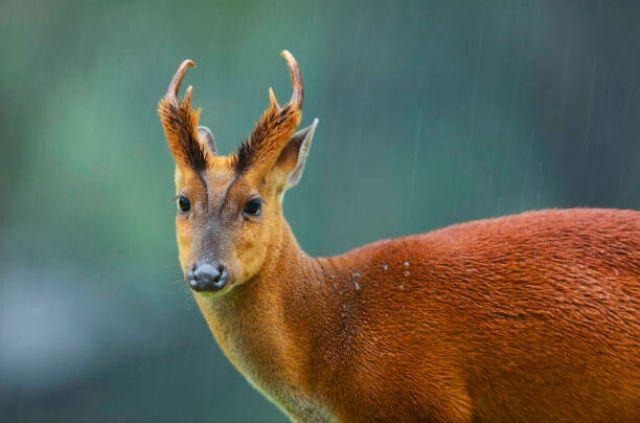
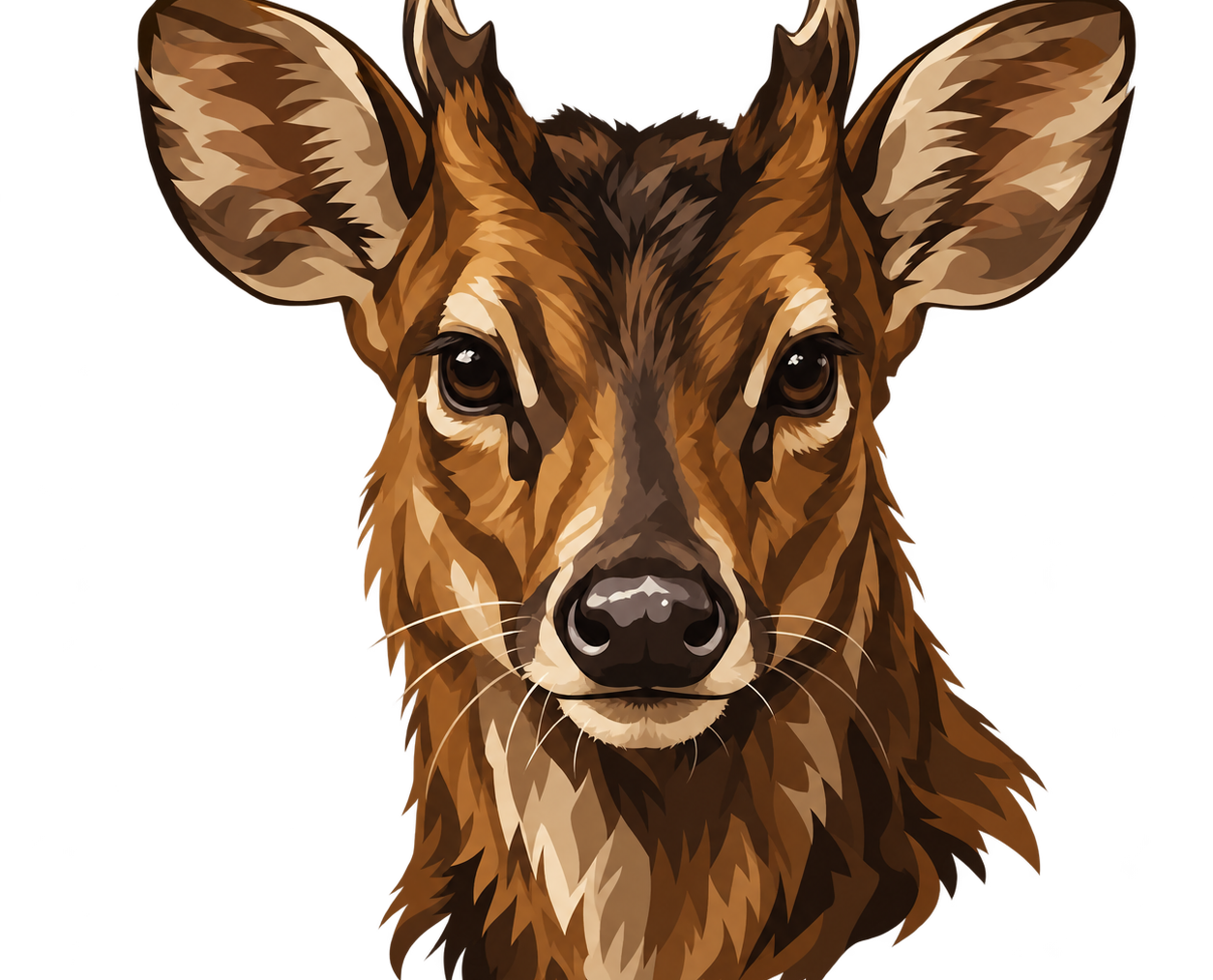
The barking deer is a compact, reddish-brown deer adapted to moving through vegetation where concealment matters more than speed across open ground. Its appearance is modest compared with that of larger deer, but its physical features are distinctive.
The following descriptions refer to the muntjac in its wider range. They are not observations of a surviving population in the Indian Sundarbans.
Body, Coat And Limbs
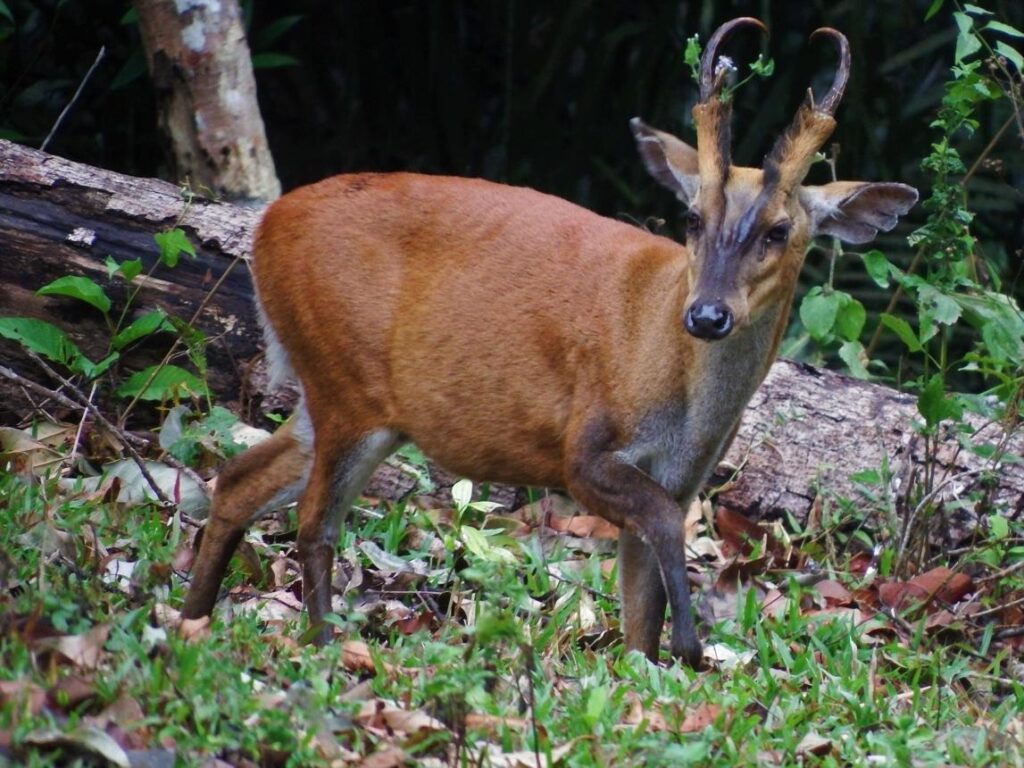
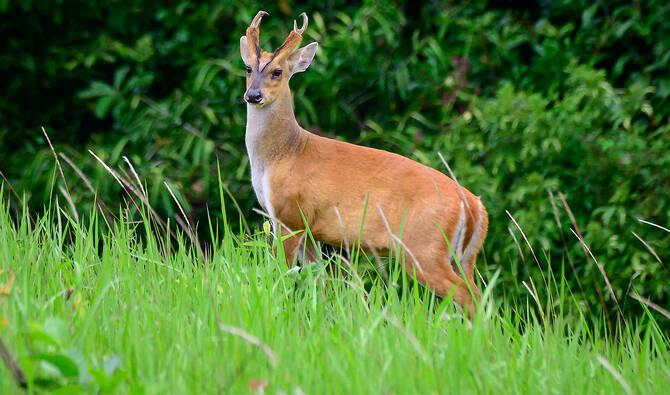
The barking deer has a short, reddish-brown coat, with paler fur on the underside. The coat provides camouflage in shaded woodland, leaf litter and dense vegetation. Its coloration varies with individuals and populations, so a single shade should not be treated as a universal identification feature.
Its compact body and relatively short stature help it negotiate thick understory. Strong limbs allow it to move through tangled vegetation, turn quickly and retreat into cover when disturbed.
Unlike animals adapted primarily to open grassland, the muntjac often depends on a combination of dense cover and nearby feeding areas. It can forage along forest edges while remaining close to places where it can hide.
Antlers And Canine Teeth
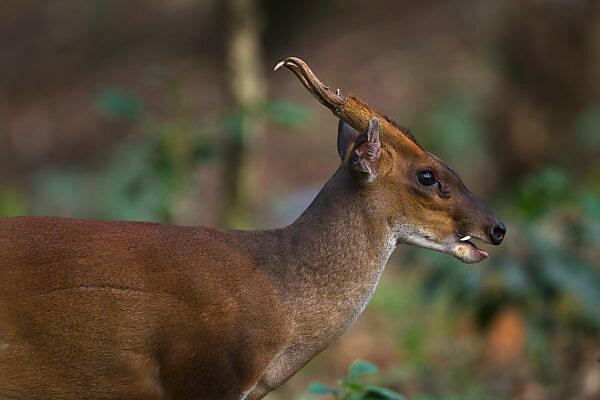
The male barking deer carries a pair of short antlers. These are usually simple in form, with a short brow tine and an unbranched main beam. The antlers grow from elongated bony pedicles, which contribute to the prominent ridges running down the face.
Another striking feature is its elongated upper canine teeth. In males, these can project visibly beyond the lips and play a role in aggressive encounters with other males.
Females do not develop the same antlers as males, although they have bony frontal structures. These differences help distinguish the sexes when an animal is observed clearly.
The combination of small antlers, facial ridges and prominent canines gives the muntjac a distinctive appearance among deer.
Eyes, Ears And Senses
A barking deer depends on detecting danger before a predator gets too close. Its eyes and ears help it monitor its surroundings, while its sense of smell contributes to detecting other animals and interpreting scent marks.
These senses work together in an environment where vegetation can conceal danger. A sudden movement in the understory, an unfamiliar scent or a sound from nearby cover may prompt the deer to freeze, investigate or retreat.
Muntjacs also possess scent-producing glands involved in communication. Scent marking can convey information about an animal’s presence and social status without requiring direct contact.
How It Moves Through Dense Vegetation
The barking deer is a terrestrial mammal. It walks and runs on four slender limbs, using its compact build to move through woodland, scrub and the edges of clearings.
When disturbed, it may rush into thick cover rather than continue into an exposed area. This behaviour can make the animal difficult to observe even in places where it remains relatively common.
The species is not a specialist swimmer adapted to tidal estuaries, and no evidence establishes a distinctive saltwater adaptation in the historical Sundarbans population. It would therefore be inaccurate to portray the barking deer as having evolved special physiological mechanisms for surviving the saline mangrove environment.
Its historical occurrence in parts of the Sundarbans indicates that it was once able to use at least some of the available terrestrial habitats. It does not demonstrate that every mangrove island or tidal forest block provided suitable conditions.
What Does The Barking Deer Eat?
The barking deer is primarily a browser and mixed feeder. Its diet includes several kinds of plant material.
| Food type | Role in its diet |
| Tender leaves and shoots | Provide readily digestible plant material |
| Grasses and herbs | Offer additional vegetation where available |
| Fallen fruits | Supply food when seasonal fruit is accessible |
| Buds and flowers | Provide other sources of plant nutrients |
| Other plant parts | May be consumed depending on habitat and availability |
Muntjacs may also consume some animal matter, such as small animals or eggs, according to natural-history accounts. However, plant material is central to the species’ diet, and it is best described as primarily herbivorous rather than as a specialist predator.
For a deer in a tidal landscape, food availability would depend on the vegetation growing in suitable terrestrial patches. Salinity, inundation and the distribution of plants could influence which areas offered adequate forage.
This is an ecological inference rather than a documented reconstruction of the historical barking deer’s diet in the Indian Sundarbans. No reliable local dietary study was identified in the sources reviewed.
When Is It Most Active?
See it for yourself
A private journey shaped around you — your group, your pace, your interests. Book a free consultation.
Barking deer are often described as solitary and particularly active around dawn and dusk. They may also move and feed at other times, depending on habitat, disturbance and local conditions.
During daylight, an animal may remain concealed in thick vegetation. This habit reduces the likelihood of direct observation and makes reliable population surveys challenging.
The characteristic bark is an alarm vocalisation associated with disturbance or perceived danger. It can be repeated, drawing attention to the presence of a deer even when the animal itself remains hidden. The call gives the species its familiar English name.
For wildlife researchers, vocalisations can provide useful information about animal presence, but a bark alone should not automatically be interpreted as confirmation of a barking deer without appropriate identification.
A Mostly Solitary Forest Dweller
Barking deer are generally solitary, although pairs and females accompanied by young are also encountered. Their social organisation differs from that of herd-forming deer such as the spotted deer, which is a familiar mammal of the Indian Sundarbans today.
Males may defend territories and compete for access to females. Encounters between males can involve displays, chasing and physical aggression, with the antlers and elongated canine teeth playing roles in these interactions.
The animal’s preference for concealment means that its social life often unfolds away from open observation. A deer seen briefly crossing a forest track may reveal little about its home range, breeding status or relationships with neighbouring animals.
Communication Beyond The Bark
The barking deer’s alarm call is its best-known vocal feature, but communication is not limited to sound.
Scent marking is important in muntjac behaviour. Glands around the face and other parts of the body can contribute to chemical communication, while rubbing and marking behaviours may help convey information about territory or social interactions.
Vocalisations may occur in different contexts, including alarm and communication between individuals. The precise meaning of a call depends on the situation; it would be misleading to assign every bark a single, universal meaning.
For an animal living in dense vegetation, scent and sound allow communication even when individuals cannot see one another.
Breeding And The Next Generation
Muntjacs are capable of breeding throughout much of the year, rather than depending on one narrowly defined annual rut. After a gestation period of roughly seven months, females typically give birth to a single fawn.
The young are vulnerable during their earliest days. Concealment among vegetation reduces exposure to potential predators, while the mother remains important to the fawn’s survival and development.
A spotted coat is described in newborn muntjacs. As the animal grows, its appearance changes toward the more uniform reddish-brown coat characteristic of adults.
These reproductive details help explain how muntjac populations can persist in suitable habitats. They do not, however, provide evidence that a population can recover automatically after local extinction. Successful recovery would depend on habitat suitability, the presence of animals from which a population could be established, and the absence or management of the pressures responsible for the original disappearance.
Predators And The Wider Food Web
As a small forest ungulate, the barking deer forms part of the prey base available to carnivores within its wider range. Its behaviour reflects the need to balance feeding with avoiding danger.
The species’ bark can alert other animals to a disturbance, although the extent to which this provides a benefit to other prey species varies with the circumstances.
In the Indian Sundarbans, the Royal Bengal tiger is the dominant terrestrial predator. Spotted deer and wild boar are among its recognised prey. It is reasonable to discuss the barking deer as a potential prey species in a broader ecological context, but the evidence reviewed does not establish how frequently it was preyed upon by Sundarbans tigers historically.
The disappearance of a prey species can change the options available to predators. Nevertheless, the loss of the barking deer should not be presented as the cause of a specific change in tiger behaviour or diet without supporting evidence.
Human Activity And The Loss Of Habitat
Human activity has played an important role in the historical transformation of the Sundarbans. Agriculture, settlement, forest use and changes to island landscapes have altered the relationship between wildlife and suitable habitat.
The World Heritage assessment of the Sundarbans identifies agricultural reclamation and increased soil salinity among the pressures associated with the disappearance of several large mammals. A recent regional account also identifies habitat loss and degradation, alongside hunting or poaching, as possible explanations for the disappearance of the barking deer.
These explanations should be interpreted carefully. The sources do not quantify the relative contribution of each pressure to the barking deer’s extinction in the Indian Sundarbans.
Nor should the history be reduced to a simple conflict between wildlife and local communities. The region’s inhabitants depend on a landscape exposed to cyclones, erosion, changing salinity and livelihood pressures. Understanding conservation requires attention to both ecological processes and human needs.
The most defensible conclusion is that habitat change and human pressure formed part of a wider context in which the barking deer disappeared. A more precise causal account would require additional historical and ecological evidence.
How Scientists Study Barking Deer
Where barking deer populations survive, researchers use several methods to establish presence, understand habitat use and monitor changes over time.
| Method | What it can reveal | Important limitation |
| Camera traps | Photographic records of animals passing through a location | Detection depends on camera placement, timing and animal movement |
| Direct observation | Behaviour, group composition and habitat use | Dense vegetation and avoidance behaviour reduce visibility |
| Tracks and other signs | Possible evidence of movement through an area | Tracks can be difficult to identify reliably |
| Dung analysis | Potential information about diet and species presence | Identification may require specialist examination or genetic methods |
| Acoustic observations | Vocal activity and possible presence | Calls need reliable identification and contextual interpretation |
| Repeated surveys | Changes in detection over time | Failure to detect an animal does not, by itself, prove extinction |
These methods are complementary. A single photograph or report can establish evidence of presence if identification and location are verified, but estimating population size or confirming the absence of a species requires more systematic work.
The Wildlife Institute of India’s published natural-history material describes the muntjac’s physical characteristics, while official wildlife assessments and monitoring programmes provide broader context for studying mammals in forest habitats.
Why Local Extinction Can Be Difficult To Confirm
A secretive mammal can go undetected for long periods. It may use small patches of habitat, avoid people or move primarily during hours when observation is difficult.
For this reason, conservationists distinguish between several kinds of evidence:
- Credible records establish that the species occurred in an area in the past.
- A reliable observation or photograph establishes that it was present at a particular time.
- Accounts that have not yet been independently verified.
- The species is considered no longer present in the area, based on the available evidence and the relevant conservation assessment.
The barking deer fits the historical-presence and local-extinction categories for the Indian Sundarbans in the sources reviewed. Its last reported sighting from Haliday Island in the late 1970s remains an important historical reference.
No recent verified record or evidence of a surviving breeding population was identified in the sources consulted for this article. That is not a claim that every possible habitat has been exhaustively searched; it is a statement about the evidence currently available in the reviewed material.
The Environmental Pressures Behind The Disappearance
The barking deer’s historical disappearance should be understood within the changing ecology of the Indian Sundarbans.
Habitat Loss And Fragmentation
Conversion of natural habitat can reduce the amount of cover and forage available to terrestrial mammals. Fragmentation can also separate suitable habitat patches, making movement between them more difficult.
For a species that uses woodland and dense vegetation, the continuity of suitable terrestrial habitat can be important.
Salinity And Freshwater Influence
Salinity is a defining feature of the Sundarbans, but it is not uniform across the landscape. Freshwater input, rainfall, tidal exchange and the location of estuarine channels all affect local conditions.
Changes in salinity can influence vegetation composition and the distribution of plants that terrestrial herbivores depend on. Historical accounts link increasing soil salinity with the disappearance of several mammals from the region, although the precise effect on the barking deer has not been measured in the sources reviewed.
Erosion, Cyclones And Rising Sea Levels
Cyclones, erosion and sea-level rise create long-term challenges for the Sundarbans. Islands and banks can be reshaped, while tidal flooding affects the availability of dry land.
These processes are important conservation concerns for the ecosystem as a whole. However, it would be speculative to assign a direct, quantified role to any individual climatic event in the barking deer’s disappearance.
Hunting And Other Human Pressures
Historical literature identifies hunting or poaching as a possible contributing factor in the loss of the barking deer from sea-facing islands. Habitat degradation and changes in land use are also cited.
Conservation Priorities For A Lost Species
Because the barking deer is considered locally extinct in the Indian Sundarbans, conservation cannot simply focus on protecting a known local population. The first priority is maintaining credible knowledge of the region’s wildlife and preventing further losses.
| Priority | Conservation relevance |
| Protect remaining natural habitat | Maintains conditions for the native mammals still present |
| Continue systematic wildlife surveys | Helps detect changes in species distribution and identifies unexpected records |
| Preserve historical records | Provides a baseline for understanding the region’s changing mammal community |
| Monitor habitat and salinity | Helps researchers understand changes in vegetation and terrestrial habitat |
| Address illegal hunting | Reduces pressure on vulnerable wildlife where it occurs |
| Work with local communities | Supports conservation approaches that recognise livelihoods and local ecological knowledge |
| Verify unusual sightings | Prevents unconfirmed reports from being mistaken for evidence of a surviving population |
Reintroduction should not be treated as an automatic solution. Any proposal to return barking deer to the Indian Sundarbans would require scientific assessment of historical habitat, present ecological suitability, the causes of the original disappearance, genetic and taxonomic considerations, and the likely consequences for the ecosystem.
Without such an assessment, reintroduction would be premature.
Where Can The Barking Deer Be Observed In The Sundarbans?
There is no established wild population of barking deer to observe in the Indian Sundarbans.
Haliday Island is important as a historical reference because the last reported sighting is associated with that location. It should not be promoted as a current barking deer sighting destination.
Historical references to Bulchery and other sea-facing islands likewise describe former occurrence, not confirmed present-day presence.
Barking deer remain part of the wider wildlife of the Indian subcontinent. Anyone seeking to observe the species in the wild should consult current, reliable records from locations where a population is known to survive rather than relying on old Sundarbans records.
For The Wild Orbit, the distinction is central to responsible wildlife interpretation: a place where an animal once lived is not necessarily a place where it can be seen today.
The Important Truth About Wildlife Sightings
Wildlife observation is inherently unpredictable. Even in a location with a confirmed population, an animal may remain hidden or move through an area outside the period when observers are present.
The absence of a sighting during a survey does not automatically establish absence. Conversely, an unverified report should not be treated as proof that a species has returned.
In the case of the barking deer, the responsible position is to recognise its historical presence and its accepted local-extinction status while remaining open to credible new evidence. Any claim of a rediscovery would require a reliable photograph, a well-documented observation or other evidence independently assessed by qualified researchers.
What Makes The Sundarbans Barking Deer Unique?
The barking deer was not a species found exclusively in the Sundarbans. Its wider distribution includes forest habitats across parts of South and Southeast Asia, and its characteristic features evolved in the context of that broader natural history.
What makes its Sundarbans story distinctive is its relationship with a landscape shaped by tides, salinity, sediment and changing land cover.
Its historical occurrence shows that the region once supported a wider range of terrestrial mammals than the community observed today. Its disappearance also illustrates an important ecological distinction: an animal can survive globally while being lost from a particular region.
There is no reliable evidence that the historical Sundarbans barking deer developed a unique saltwater adaptation, represented a separate Sundarbans subspecies or possessed a special behaviour found nowhere else. Such claims would go beyond the available evidence.
Its significance lies instead in the history it reveals. The loss of this deer is part of the changing story of the Indian Sundarbans, where ecological processes and human pressures have repeatedly reshaped the habitats available to wildlife.
Myths And Facts About The Barking Deer
| Myth | Fact |
| The barking deer is globally extinct. | No. It survives elsewhere in its wider range; it is locally extinct in the Indian Sundarbans. |
| It gets its name from a canine-like appearance. | Its common name comes from its characteristic bark-like alarm call. |
| The species has disappeared everywhere in the Sundarbans region. | The evidence discussed here concerns the Indian Sundarbans. It should not be confused with the separate wildlife status of the Bangladesh Sundarbans. |
| Haliday Island is a current barking deer hotspot. | It is a historical locality associated with the last reported sighting in the late 1970s, not a verified present-day observation site. |
| The deer was specially adapted to drinking saline water. | No such adaptation is established by the sources reviewed. |
| One single cause explains its disappearance. | Historical sources identify habitat change and human pressures, but their individual contributions are not precisely established. |
FAQs
Is The Barking Deer Extinct In The Sundarbans?
The barking deer is considered locally extinct in the Indian Sundarbans. This does not mean it is extinct worldwide; populations survive elsewhere in its wider range.
When Was The Barking Deer Last Seen In The Indian Sundarbans?
Historical accounts place its last reported sighting on Haliday Island in the late 1970s. This is a historical record, not a recent sighting.
What Is The Scientific Name Of The Barking Deer?
Older Sundarbans literature commonly uses Muntiacus muntjak. The current Indian mammal checklist recognises the Northern Red Muntjac as Muntiacus vaginalis, reflecting changes in muntjac taxonomy.
Why Is It Called The Barking Deer?
It is named for its bark-like alarm call, which the animal makes when disturbed or threatened. The call can reveal its presence even when the deer is concealed in vegetation.
What Does The Barking Deer Eat?
It mainly consumes plant material, including leaves, shoots, grasses, herbs, buds and fruits. Its precise diet varies with habitat and food availability.
Why Did The Barking Deer Disappear From The Indian Sundarbans?
Historical sources identify habitat loss and degradation, agricultural reclamation, increasing salinity and hunting or poaching among the possible pressures affecting lost mammals in the region. The exact contribution of each factor to the barking deer’s disappearance is not established.
Can Barking Deer Still Be Seen On Haliday Island?
There is no verified contemporary record establishing a surviving wild population there. Haliday Island is known in this context as a historical locality, not a confirmed current sighting site.
Is The Barking Deer Endangered Worldwide?
The muntjac taxon commonly associated with the barking deer has been assessed as Least Concern in widely cited global conservation references. That global assessment is separate from the species’ local extinction in the Indian Sundarbans. Taxonomic changes mean that the assessment should always be matched to the particular species concept being discussed.
Could The Barking Deer Be Reintroduced Into The Sundarbans?
Potentially, but no reintroduction should be proposed without a detailed scientific assessment of habitat suitability, historical causes of disappearance, genetic considerations and ecological consequences. A former range alone does not establish that reintroduction would be appropriate today.
Why Is The Barking Deer’s Loss Important?
Its disappearance represents a loss of regional biodiversity and part of the Indian Sundarbans’ ecological history. It also reinforces the need to protect habitats and monitor the less conspicuous mammals that remain.
The Wild Orbit Perspective
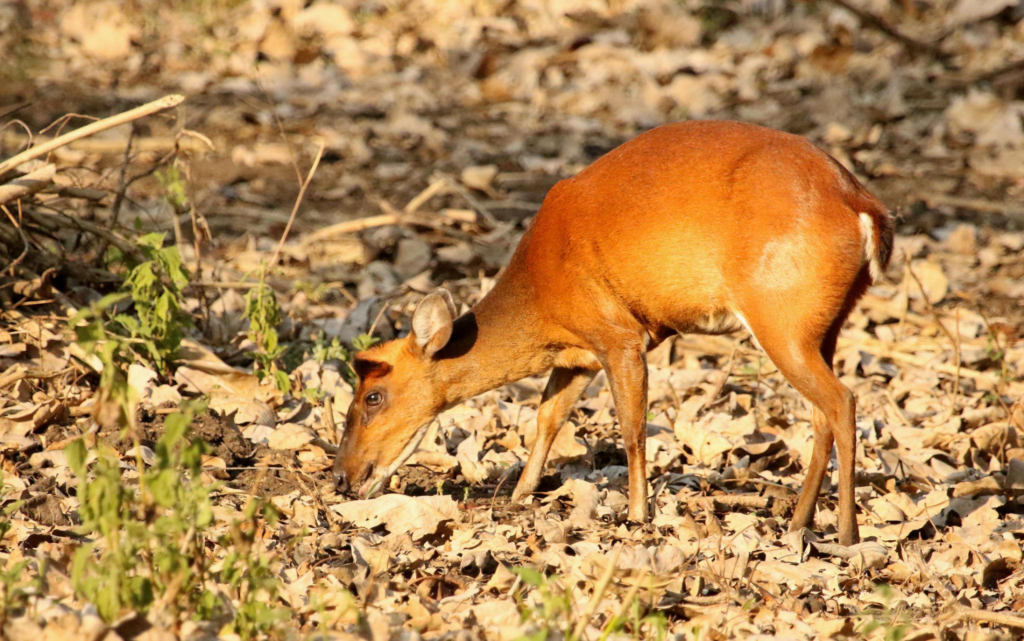
A tidal forest is defined not only by the animals that can still be found within it, but also by the species that have disappeared.
The barking deer once formed part of the Indian Sundarbans’ terrestrial wildlife. Its historical record connects the forest’s past to a present shaped by shifting islands, saline water, changing vegetation and the pressures of human activity.
Its disappearance should not be turned into a dramatic story of a single culprit or a lost animal waiting to be rediscovered. The evidence supports a quieter, more important conclusion: wildlife communities change when the conditions they depend on change, and those changes can be difficult to reverse.
The Sundarbans remains a landscape of remarkable biological value. Protecting its future requires more than conserving its most famous species. It means preserving habitat, monitoring less conspicuous mammals, respecting historical evidence and recognising the ecological relationships that give the forest its character.
The barking deer is no longer an established member of the Indian Sundarbans’ living wildlife. Its place in the region’s natural history nevertheless matters.
A forest’s story is written not only in the footprints it holds today, but also in the silence left by the animals that no longer walk its ground.
Plan your private Sundarban expedition
A private journey shaped around you — your group, your pace, your interests. Book a free consultation.