 Field guide
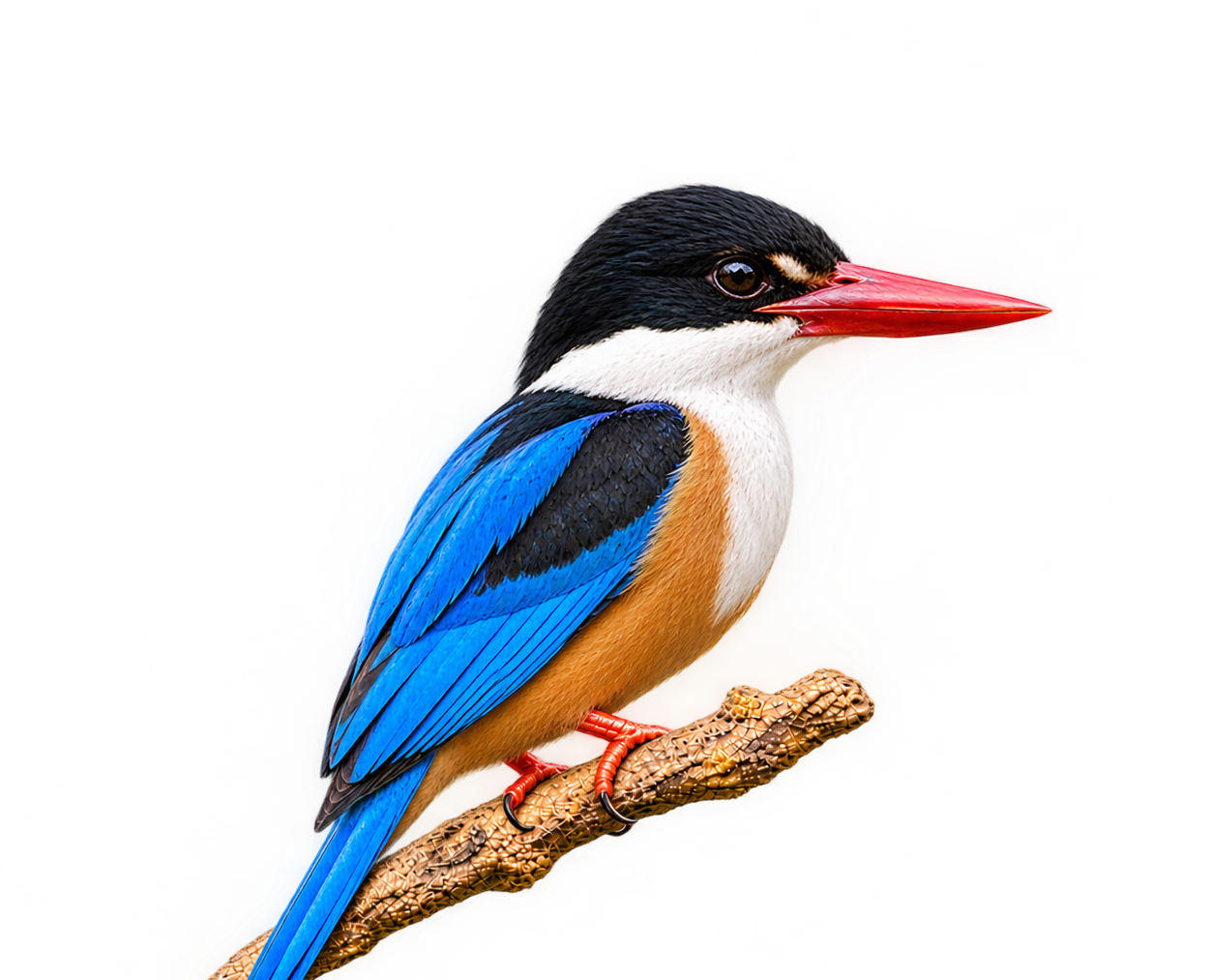
Discover the striking black head, vivid red bill and deep-blue wings of a migratory kingfisher that visits the tidal wetlands of the Indian Sundarbans.
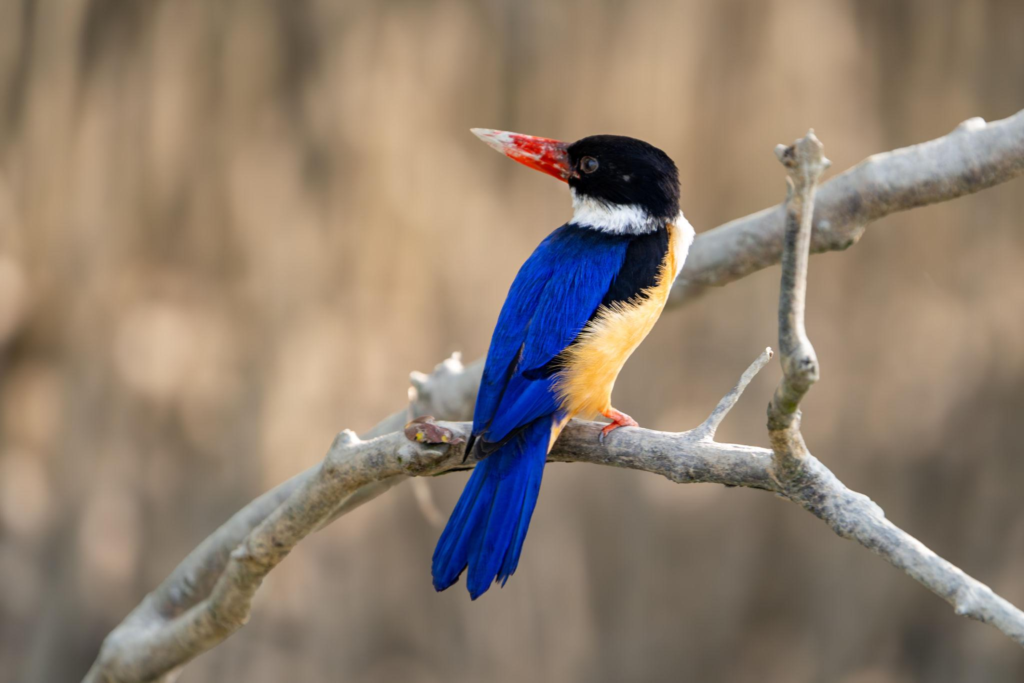
Where mangrove islands meet muddy creeks and estuarine rivers, the Black-capped Kingfisher brings a flash of colour to the winter landscape. Its dark head, bright red bill and blue-black wings stand apart against the muted browns of exposed mudflats and the shifting greens of mangrove vegetation.
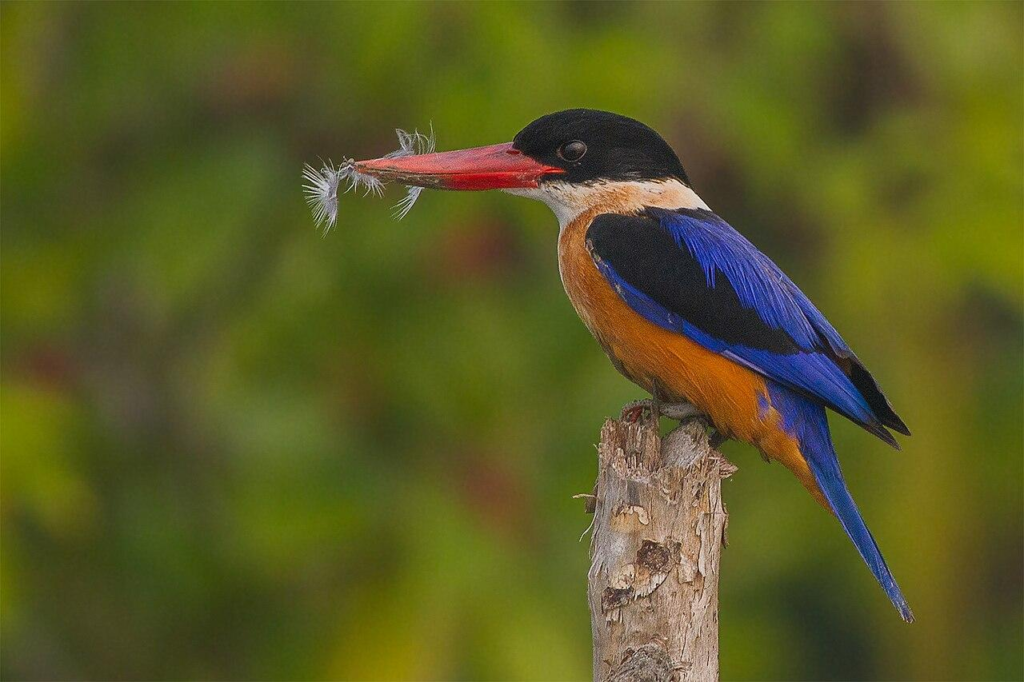
The bird is more than a beautiful presence in a landscape shaped by tides. Its seasonal arrival connects the Indian Sundarbans with a much wider Asian migration system, linking southern wintering grounds with breeding regions farther north. Regional bird records identify it as a winter migrant, although the precise timing and frequency of its occurrence can vary between locations.
For anyone exploring the birdlife of West Bengal’s tidal forests, the Black-capped Kingfisher offers an opportunity to understand how migratory birds use coastal wetlands and why the condition of these habitats matters.
Black-Capped Kingfisher at a Glance
| Feature | Details |
| Common name | Black-capped Kingfisher |
| Scientific name | Halcyon pileata |
| Order | Coraciiformes |
| Family | Alcedinidae |
| Global conservation status | Vulnerable, as reported by the State of India’s Birds |
| Indian status | Classified as a winter migrant in the State of India’s Birds assessment |
| Occurrence in the Indian Sundarbans | Documented as a seasonal visitor in regional bird literature and checklists |
| Typical habitat | Coastal wetlands, mangrove margins, tidal creeks and other suitable waterside habitats |
| Diet | Fish, crustaceans, frogs, lizards and large insects |
| Approximate length | 28–32 cm, including the bill and tail |
| Most recognisable features | Black head, white collar, red bill, blue upperparts and warm rufous underparts |
Taxonomy and Geographic Distribution
The Black-capped Kingfisher belongs to the family Alcedinidae, a group of birds known for their strong bills, keen prey detection and varied feeding strategies. Its scientific name, Halcyon pileata, distinguishes it from other kingfishers with superficially similar colours or habits.
Its broader range extends across parts of East and Southeast Asia and the Indian subcontinent. Northern populations breed in regions including China and Korea, while migratory individuals travel south during the non-breeding season. The species is recorded in India, including West Bengal, but a state-level distribution record should not automatically be interpreted as proof of regular occurrence at every wetland within that state.
Does the Black-Capped Kingfisher Occur in the Indian Sundarbans?
Yes. Regional bird literature and Sundarbans bird checklists document the species as a migratory visitor to the Indian Sundarbans. A 2025 issue of Fantail, the publication of the Birdwatchers’ Society, describes its seasonal presence and feeding behaviour in the region. A separate Sundarbans bird checklist also lists the species as migratory.
These sources support its inclusion in the region’s birdlife. They do not, by themselves, establish a reliable population estimate, a consistent annual arrival date across all islands, or a verified sighting at every well-known watchtower.
Habitat Along the Mangrove Frontier
The Indian Sundarbans is an extensive mosaic of tidal rivers, creeks, mudflats, mangrove islands and human-inhabited margins. For a kingfisher that feeds on animal prey, the edges between water and land can provide opportunities to search for fish, crabs and other small animals.
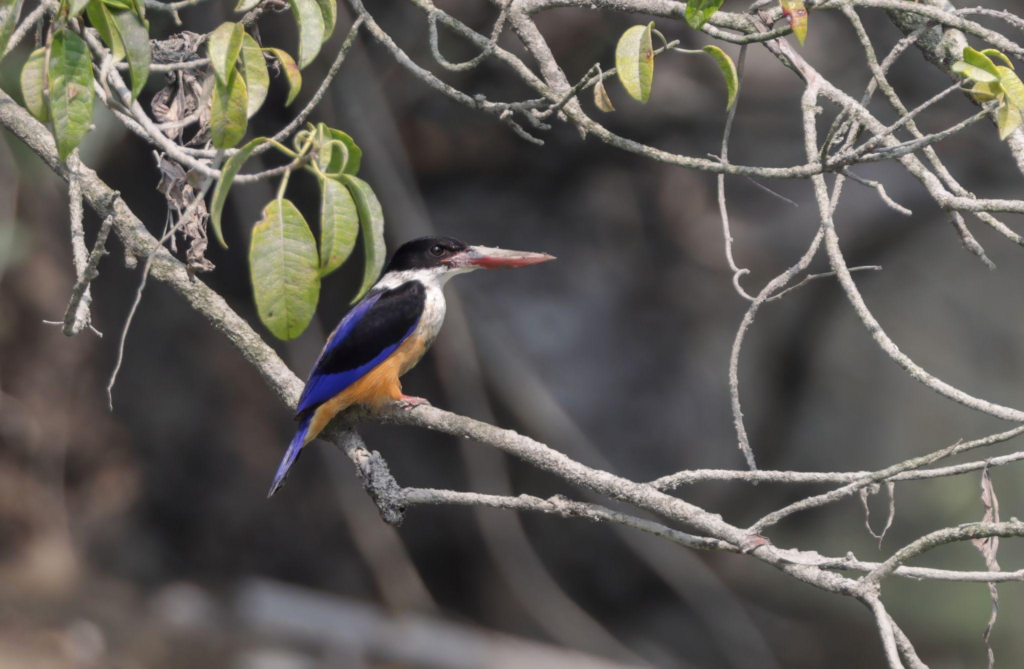
Regional observations describe Black-capped Kingfishers perching close to the ground near mudflats while looking for crabs. This behaviour offers a useful local detail: the bird is not simply a colourful silhouette above open water. It can also use low perches along the tidal margin, where exposed mud and shallow water create feeding opportunities.
However, suitable habitat is not the same as confirmed presence. The bird’s use of a particular creek or island should be established through a documented observation rather than inferred from the appearance of the landscape alone.
How to Identify the Black-Capped Kingfisher
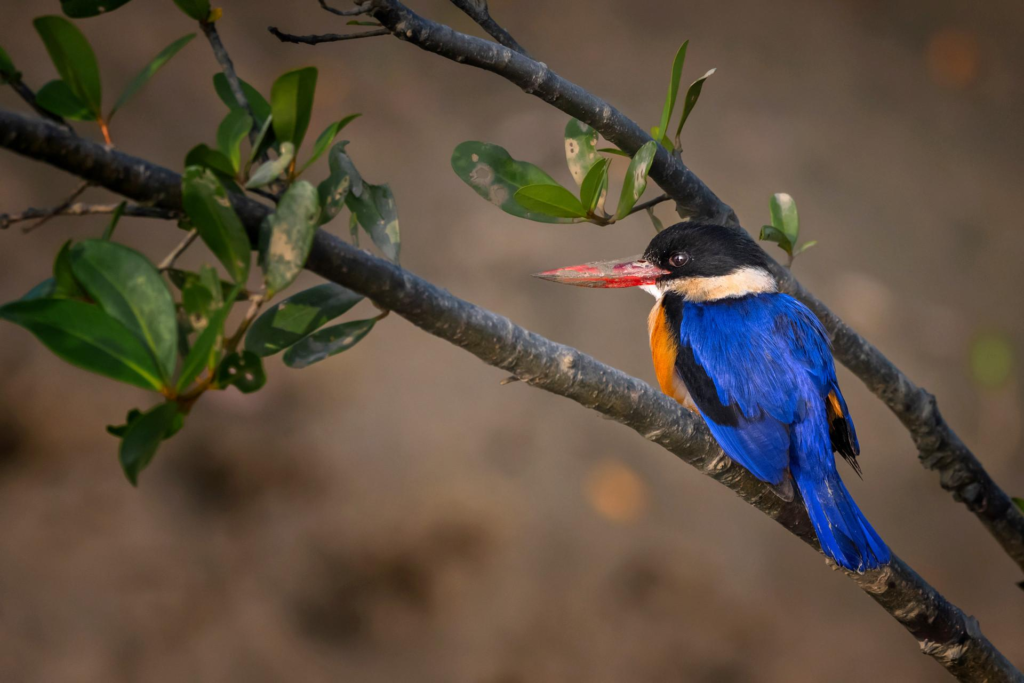
The adult Black-capped Kingfisher is one of the more distinctive kingfishers when seen clearly. Its identification depends on the combination of several features rather than a single colour.
- Black head and crown: The dark head gives the species its common name.
- White collar and throat: A contrasting white area separates the black head from the warmer underparts.
- Bright red bill: The large, red bill is conspicuous even at a distance.
- Deep-blue upperparts: The back and wings appear blue to blue-black, depending on light and viewing angle.
- Rufous underparts: The lower throat and belly show warm orange-brown tones.
- White wing markings: Pale patches can become conspicuous when the bird flies.
Males and females are broadly similar in appearance, while younger birds can have duller plumage and less sharply defined markings. These differences should be considered when identifying birds in photographs or at a distance.
Distinguishing It From Other Sundarbans Kingfishers
The Sundarbans supports several kingfisher species, so colour alone can lead to confusion.
| Species | Useful identification distinction |
| Black-capped Kingfisher | Black head, white collar, red bill and blue upperparts |
| White-throated Kingfisher | Chestnut-brown head and white throat, with blue wings |
| Collared Kingfisher | Blue-green upperparts and a pale collar; overall appearance differs from the Black-capped Kingfisher |
| Brown-winged Kingfisher | Larger, heavier-looking bird with a massive red bill, orange-brown head and dark brown wings |
These comparisons are particularly useful when birds are partially concealed by mangrove foliage or photographed in changing light. The Black-capped Kingfisher’s black head and white collar are important clues, but a responsible identification should consider the entire plumage pattern, body shape and bill.
What It Eats and How It Finds Food
Kingfishers are visually oriented predators, but different species vary in the prey and habitats they exploit. The Black-capped Kingfisher has a varied diet that includes fish, crustaceans, frogs, lizards and large insects. Its diet is therefore broader than its name might suggest.
In the Indian Sundarbans, regional observations specifically describe individuals searching for crabs near exposed mudflats. Low perches can provide a useful vantage point from which to watch the ground and water before making a short flight to capture prey.
Its strong bill is suited to catching and handling animal prey. Nevertheless, it would be misleading to assume that every individual uses the same feeding technique or that every tidal creek provides equally good feeding conditions. Water depth, tide, prey availability, vegetation and disturbance can all influence where a bird chooses to forage.
Flight and Movement
See it for yourself
A private journey shaped around you — your group, your pace, your interests. Book a free consultation.
When perched, the bird’s bright bill and contrasting plumage make it easy to recognise. In flight, the blue upperparts and white wing markings provide additional identification clues.
The tidal landscape creates a constantly changing set of conditions. As water rises, mudflats become submerged; as it falls, feeding surfaces reappear. These changes alter the availability of shallow-water margins and exposed ground, although the precise relationship between tidal stage and Black-capped Kingfisher feeding success in the Indian Sundarbans has not been established by the sources cited here.
Its seasonal movement between northern breeding regions and southern wintering grounds is a broader ecological connection. The bird’s presence in the Sundarbans reflects migration across a much larger geographic area, not an adaptation exclusive to mangrove forests.
A Seasonal Visitor, Not a Permanent Resident
The Black-capped Kingfisher is classified as a winter migrant in India’s State of India’s Birds assessment. This places it among the birds whose seasonal presence connects Indian wetlands with breeding regions farther north.
A regional account published in Fantail describes the species arriving in the Indian Sundarbans around late September and remaining until March. These dates provide a useful indication of the reported local season, not a guarantee that every individual will arrive or depart on the same schedule every year.
Seasonal movements are influenced by conditions across a bird’s range. Weather, food availability and conditions at different stages of migration may influence individual movements, but the available sources do not establish how each factor determines arrival and departure dates specifically in the Indian Sundarbans.
Calls and Communication
Kingfishers use vocal signals in communication, including interactions associated with territories and breeding. However, the sources reviewed for this article do not provide a sufficiently detailed, region-specific account of the Black-capped Kingfisher’s calls in the Indian Sundarbans.
For field identification, it is therefore better to combine visual characteristics with a reliable species-specific sound reference than to rely on an assumed call description. Recordings should also be used carefully: other kingfishers and wetland birds may be calling nearby.
Breeding and Nesting
The Black-capped Kingfisher breeds in parts of its wider Asian range. Species references describe nesting in tunnels excavated in earth banks, a strategy found among several kingfishers.
The evidence cited here does not establish a regular breeding population in the Indian Sundarbans. Its documented winter-migrant status should not be confused with proof of local nesting.
This distinction matters because a bird can be an important seasonal member of an ecosystem without reproducing there. Reliable evidence of breeding would require observations such as repeated territorial behaviour during the breeding period, adults carrying food to a nest, or other appropriately documented nesting activity.
Human Presence Along the Tidal Margins
Fishing settlements, boats and working riverbanks are part of the wider Sundarbans landscape. These areas can overlap with habitats used by birds, although the degree of overlap varies from place to place.
For birdwatchers and photographers, the practical lesson is simple: observe from a respectful distance, avoid chasing a bird between perches, and do not approach suspected nesting sites. Playback of calls should be avoided when it could disturb birds, particularly during breeding or other sensitive periods.
Local fishers and residents may also possess valuable knowledge of seasonal wildlife. Such observations can contribute to understanding bird distribution when they are recorded carefully, with dates, locations and supporting photographs where appropriate.
Conservation Status: Why the Assessment Matters
The Black-capped Kingfisher is listed as Vulnerable in the State of India’s Birds assessment. That is a significant conservation signal, particularly because the species is a seasonal visitor to wetlands across India.
The same assessment reports a rapid decline in its long-term Indian population trend. Its published national trend estimates have also been updated between assessment editions, so figures should always be accompanied by their year and methodology rather than presented as timeless measurements.
A separate checklist for the Bangladesh Sundarbans gives the species a Least Concern assessment under its 2015 regional evaluation. This is not necessarily a contradiction: the geographic scope, assessment date and population being evaluated differ. For an article about the Indian Sundarbans, the current India-focused assessment is more relevant to the country’s conservation context.
Threats and the Importance of Wetland Protection
The national conservation assessment raises concern about the species’ declining trend, but the sources cited here do not establish the relative contribution of individual threats specifically within the Indian Sundarbans.
Several pressures deserve attention as potential areas for further regional research:
- Wetland and shoreline alteration: Changes to feeding margins can affect access to shallow water and exposed ground.
- Disturbance: Repeated close approaches by people or boats may interfere with feeding and resting.
- Changes in prey availability: The abundance and accessibility of fish, crabs and other prey can influence feeding opportunities.
- Pollution and wider environmental change: Their effects on local prey populations and habitat quality require location-specific investigation.
These are relevant ecological concerns, not proof that every pressure is causing a measured decline in this particular population. Demonstrating local impacts requires systematic field observations and suitable ecological data.
Where Can the Black-Capped Kingfisher Be Observed in the Indian Sundarbans?
Regional literature confirms that the Black-capped Kingfisher occurs in the Indian Sundarbans, and a regional account describes it feeding near mudflats. However, the sources cited here do not provide a sufficiently verified, site-by-site record to rank particular watchtowers, islands or creeks as reliable hotspots for this species.
The most useful habitats to examine are suitable tidal margins, creek edges and wetland areas where the bird can perch and search for prey. These are habitat-based suggestions, not claims of confirmed presence at every location.
Sajnekhali, Sudhanyakhali, Dobanki and other recognised birdwatching areas should not automatically be described as confirmed Black-capped Kingfisher locations without supporting site-specific records.
For a useful observation record, note the date, approximate location, habitat, tidal conditions, number of birds and identification features. A photograph can help substantiate the record, provided it does not require approaching or disturbing the bird.
When Is This Bird Present?
The Black-capped Kingfisher is a winter migrant in the Indian Sundarbans. One regional account describes its local presence from approximately late September through March. Actual observations may vary by year and location, so these dates should be treated as a reported seasonal window rather than a fixed schedule.
The best time to look for a particular individual cannot be predicted from season alone. Habitat, tide, weather, movement and observation effort all influence whether a bird is detected.
The Important Truth About Bird Observation
A suitable habitat does not guarantee that a species will be present, and a single sighting does not establish a stable population.
Birdwatching results depend on the time spent searching, the area covered, visibility, weather, tides and the bird’s behaviour. A bird may be present but concealed, feeding elsewhere or moving between habitats.
Likewise, failing to see a Black-capped Kingfisher during one visit does not demonstrate its absence from the wider landscape. Reliable conclusions about distribution require repeated observations over an appropriate period.
What Makes the Sundarbans Black-Capped Kingfisher Unique?
The Black-capped Kingfisher is not a species exclusive to the Sundarbans. Its wider Asian distribution includes habitats beyond mangrove forests. What makes its presence here interesting is the meeting of seasonal migration and a dynamic estuarine environment.
The Indian Sundarbans provides a landscape of changing water levels, exposed mudflats, narrow creeks and vegetated shorelines. Regional observations of the kingfisher searching for crabs along low mudflat perches offer a specific example of how this migratory bird uses the tidal environment.
Its conservation significance extends beyond its vivid plumage. India’s assessment identifies the species as Vulnerable and reports a declining trend, making reliable monitoring important. Understanding where it occurs, when it arrives and which habitats it uses most consistently could help researchers distinguish occasional sightings from regular seasonal use.
The distinctive story, therefore, is not that the Sundarbans has produced a unique kingfisher. It is that this internationally distributed bird forms part of the region’s seasonal wildlife, connecting local tidal wetlands with ecological processes that extend far beyond West Bengal.
Myths and Facts About the Black-Capped Kingfisher
| Myth | Fact |
| All kingfishers feed only on fish. | The Black-capped Kingfisher also eats crustaceans, frogs, lizards and large insects. |
| Every colourful kingfisher is a resident bird. | The Black-capped Kingfisher is a winter migrant in the Indian Sundarbans. |
| A bird recorded in West Bengal must occur at every Sundarbans watchtower. | State-level distribution does not establish presence at a specific site. |
| A bird’s absence during one visit means it is absent from the area. | A single unsuccessful observation cannot establish local absence. |
| The species is exclusive to mangrove forests. | Its wider distribution includes other coastal and wetland habitats. |
FAQs
Is the Black-Capped Kingfisher Found in the Indian Sundarbans?
Yes. Regional bird literature and published Sundarbans checklists document the Black-capped Kingfisher as a migratory visitor to the Indian Sundarbans.
What Is the Scientific Name of the Black-Capped Kingfisher?
Its scientific name is Halcyon pileata. It belongs to the family Alcedinidae and the order Coraciiformes.
How Can You Identify a Black-Capped Kingfisher?
Look for its black head, white collar and throat, bright red bill, blue upperparts and warm rufous underparts. White markings on the wings may also be visible in flight.
Is the Black-Capped Kingfisher a Migratory Bird?
Yes. It is a winter migrant in the Indian Sundarbans. Regional literature reports its presence approximately from late September to March, although timing may vary.
What Does the Black-Capped Kingfisher Eat?
Its diet includes fish, crabs and other crustaceans, frogs, lizards and large insects. Regional observations describe individuals searching for crabs near mudflats.
Is the Black-Capped Kingfisher Endangered?
The State of India’s Birds assessment lists the species as Vulnerable and reports a declining national trend. This conservation assessment is different from the status of a particular local population.
Does the Black-Capped Kingfisher Breed in the Indian Sundarbans?
The sources cited here establish its seasonal occurrence but do not establish regular local breeding. Breeding records from elsewhere in its range should not be treated as proof of nesting in the Indian Sundarbans.
Where Can You See a Black-Capped Kingfisher in the Sundarbans?
Suitable tidal creeks, wetland edges and mudflats are relevant habitats to explore. However, a confirmed sighting at a specific watchtower or island should be supported by a reliable local record; sightings are never guaranteed.
How Is It Different From the White-Throated Kingfisher?
The Black-capped Kingfisher has a black head and white collar, whereas the White-throated Kingfisher has a chestnut-brown head and white throat. Their contrasting head patterns are useful identification clues.
Why Is the Black-Capped Kingfisher Important to the Sundarbans?
It forms part of the region’s seasonal bird community and illustrates the connection between migratory birds and tidal wetlands. Monitoring its occurrence can help improve understanding of the habitats used by winter visitors.
The Wild Orbit Perspective About Black-Capped Kingfisher
The Black-capped Kingfisher reminds us that the Indian Sundarbans is not only a landscape of resident wildlife. It is also part of a wider network of habitats visited by birds travelling across Asia.
Its black crown, red bill and blue wings may be the first details that attract attention. But the deeper story lies in the relationship between seasonal movement, feeding opportunities and the changing tidal margins of the mangrove delta.

Protecting the Sundarbans means understanding these connections as well as the individual species. Every well-documented observation adds a small piece to that understanding, helping build a clearer picture of the wildlife that depends on this remarkable estuarine landscape.
The bird’s winter presence is a reminder that the life of a mangrove wetland extends far beyond its visible boundaries. Its story begins in one landscape, continues across many others, and returns to the tidal edge where land and water are never quite the same twice.
Plan your private Sundarban expedition
A private journey shaped around you — your group, your pace, your interests. Book a free consultation.