 Field guide
The Indian Sundarbans is a landscape shaped by constant change. Tides rise through narrow creeks, silt settles along muddy banks, and mangrove islands are gradually reshaped by erosion and deposition. Today, its remaining large terrestrial mammals include the Royal Bengal tiger, spotted deer and wild boar. But the region’s wildlife history includes animals that have disappeared from its forests.
One of them was the Javan rhinoceros (Rhinoceros sondaicus), a rare Asian rhinoceros that once inhabited the Sundarbans. Its presence is documented in historical natural-history literature, although early records are scarce and sometimes difficult to distinguish from accounts of other rhinoceros species. Historical research indicates that Javan rhinoceroses once occurred in the Sundarbans of both India and Bangladesh, before disappearing from the region during the early twentieth century.
The disappearance of this animal is more than the loss of a remarkable mammal. It represents the disappearance of a large herbivore from an ecosystem whose wildlife communities have been repeatedly altered by hunting, habitat change and human pressure.
The Javan rhinoceros is not extinct worldwide. As of October 2026, the IUCN SSC Asian Rhino Specialist Group reports fewer than 50 individuals remaining, all confined to Ujung Kulon National Park on the western tip of Java, Indonesia. Its global status is Critically Endangered.
For the Indian Sundarbans, however, the story is different: the Javan rhinoceros is a locally extinct mammal, remembered through historical evidence rather than living encounters.
Javan Rhinoceros at a Glance
| Attribute | Details |
| Common name | Javan rhinoceros |
| Scientific name | Rhinoceros sondaicus |
| Family | Rhinocerotidae |
| Order | Perissodactyla |
| Conservation status | Critically Endangered globally |
| Indian Sundarbans status | Locally extinct |
| Current distribution | Ujung Kulon National Park, Java, Indonesia |
| Historical distribution | Parts of South and Southeast Asia |
| Historical Sundarbans presence | Documented in historical accounts |
| Habitat | Lowland tropical forest; formerly present in the Sundarbans |
| Diet | Herbivorous; primarily leaves, shoots, twigs and other vegetation |
| Ecological role | Large herbivore and potential vegetation-shaping species |
| Distinctive features | Grey, folded skin; short single horn, particularly developed in males |
| Main historical pressures | Hunting, habitat loss and human pressure |
| Observation in the Indian Sundarbans | No established surviving wild population |
Scientific Classification and Identity
The Javan rhinoceros belongs to the family Rhinocerotidae, which includes the world’s five living rhinoceros species. It is one of three Asian rhinoceros species, alongside the greater one-horned rhinoceros and the Sumatran rhinoceros.
Its scientific name, Rhinoceros sondaicus, distinguishes it from the greater one-horned rhinoceros (Rhinoceros unicornis). This distinction is important when interpreting historical wildlife records from the Indian subcontinent, where more than one rhinoceros species formerly occurred.
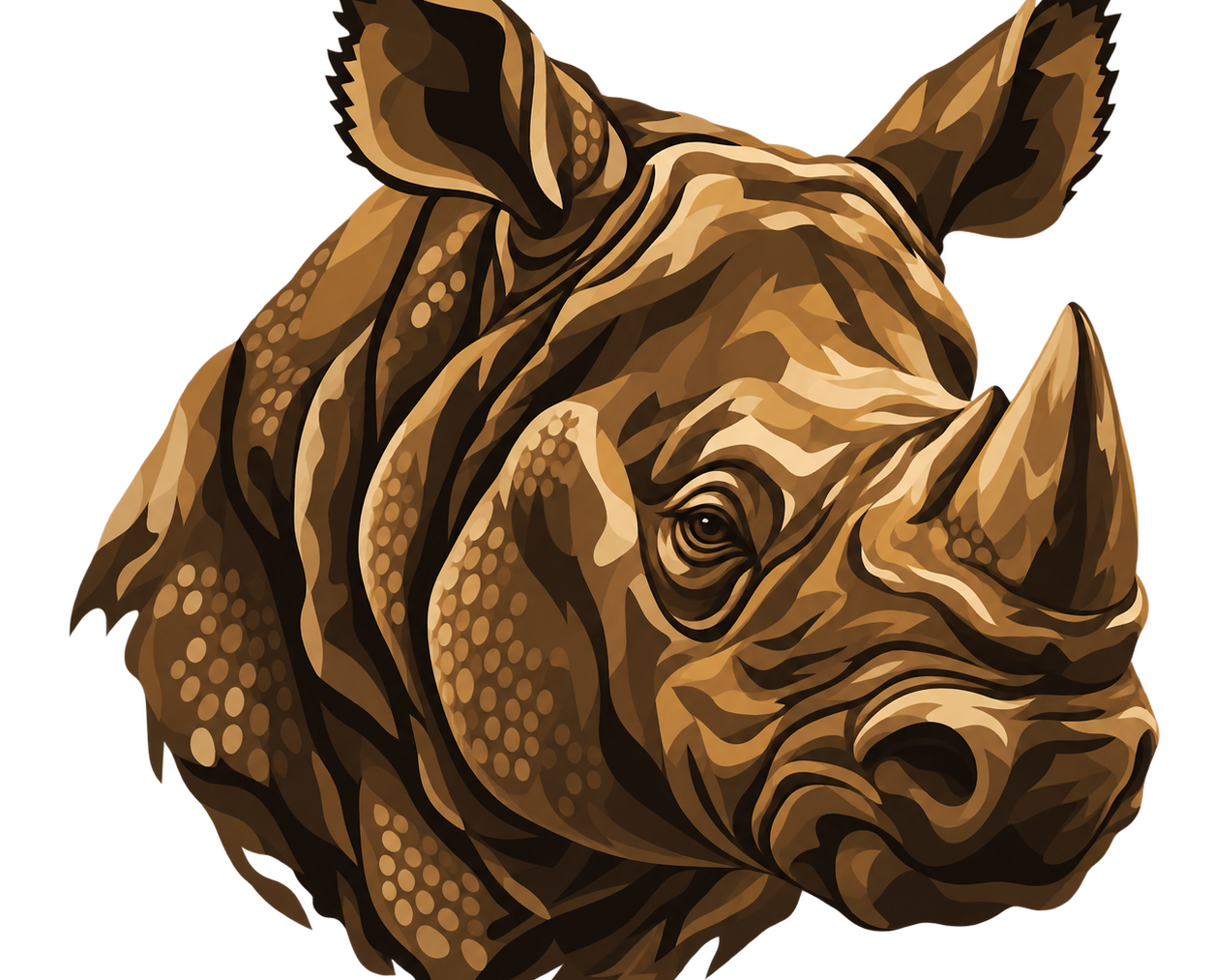
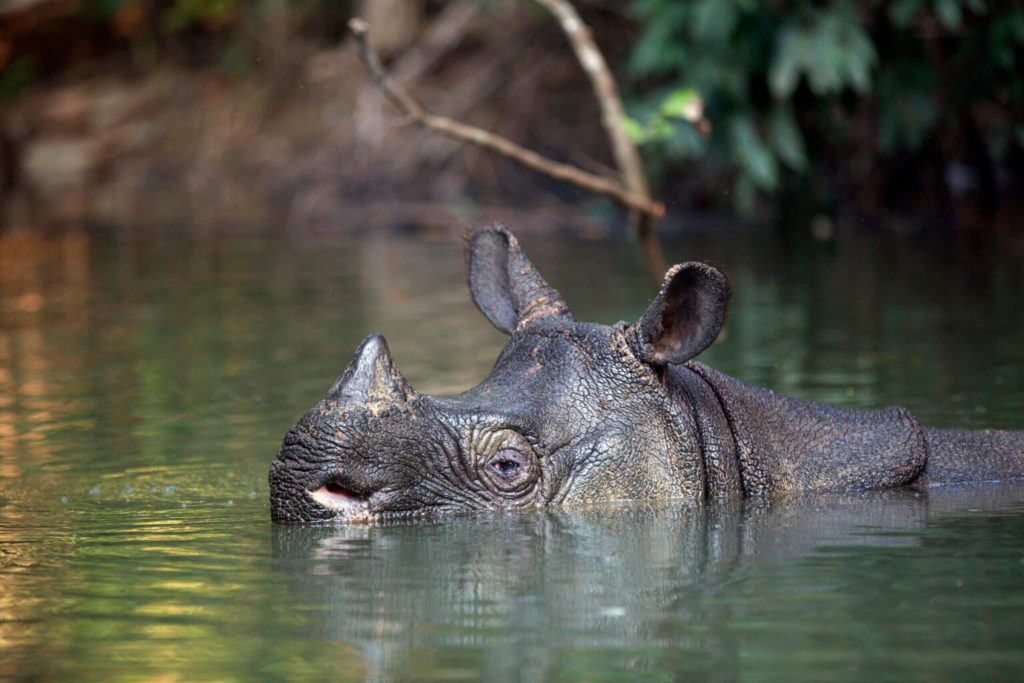
The Javan rhinoceros is relatively compact compared with the greater one-horned rhinoceros. Its grey skin is divided into polygonal segments by fine creases, and its upper lip is pointed and prehensile, allowing it to grasp vegetation. Males generally possess a short, single horn, while females often have a very small horn or none that is clearly visible.
These characteristics help explain why historical identification requires care. Early travellers and naturalists did not always describe animals with the precision expected in modern zoology. In areas where rhinoceros species overlapped, a record that simply mentions a rhinoceros cannot automatically be assigned to the Javan species.
The historical case for the Javan rhinoceros in the Sundarbans is supported by specialist literature, but its exact former distribution and the timing of its final disappearance remain less certain than its present-day status.
The Historical Distribution of the Javan Rhinoceros
The Javan rhinoceros formerly occupied a much larger geographical range than it does today. Its historical distribution extended through parts of mainland Southeast Asia and the Malay region, with records reaching northeastern India and Bangladesh. Over time, populations disappeared across most of this range.
The surviving population is now restricted to western Java. The loss of its mainland populations culminated in the disappearance of the last known Javan rhinoceros in Vietnam in 2010, leaving the Indonesian population as the species’ only remaining wild population.
The Sundarbans formed part of the species’ former northern distribution. Historical research by Kees Rookmaaker notes that Javan rhinoceroses occurred in the Sundarbans of India and Bangladesh and that the species disappeared from this region during the first decades of the twentieth century. The same research cautions that historical accounts from northeastern India are few and often lack sufficient detail.
The evidence therefore supports a clear distinction:
- The Javan rhinoceros was historically present in the Sundarbans.
- It no longer survives there as a known wild population.
- Its worldwide survival depends on the last population in Indonesia.
The Javan Rhinoceros in the Indian Sundarbans
The historical Sundarbans was not identical to the landscape we know today. Its ecological communities developed under changing tidal conditions, shifting river channels, forest succession and increasing human use of surrounding land.
The presence of the Javan rhinoceros indicates that the region once supported a larger terrestrial mammal community than the one surviving in its mangrove forests today. Yet the evidence does not allow a precise reconstruction of the species’ former population size, density or distribution across individual islands.
A historical review of the Indian Sundarbans published through the IUCN Wetlands Programme specifically lists the Javan rhinoceros among the large terrestrial mammals that became extinct in the region. It refers to a historical record in the Imperial Gazette of 1909. This is evidence of historical recognition, not proof that the species survived until 1909 or that this was its final confirmed sighting.
That distinction matters. A last published mention, a last reliable observation and the actual disappearance of a population are three different things.
The most defensible conclusion is that the Javan rhinoceros disappeared from the Sundarbans around the turn of the twentieth century or during the early decades of that century, while the precise date and circumstances of its final disappearance remain uncertain.
Habitat and Relationship With the Mangrove Landscape
The Javan rhinoceros is associated primarily with lowland tropical forest. Its surviving population inhabits the forested landscape of Ujung Kulon National Park, where it browses on woody vegetation, shoots and fallen fruit.
The Indian Sundarbans is a different ecological environment. It consists of tidal mangrove forests, estuarine channels, muddy riverbanks, intertidal flats and islands influenced by freshwater and saline conditions. Many forest areas experience regular tidal inundation, while cyclones and erosion can dramatically alter the landscape.
The historical presence of a rhinoceros in this environment raises an important ecological question: how did a large terrestrial herbivore use a landscape dominated by tides and mangroves?
The available historical evidence does not establish the animal’s precise habitat preferences within the Sundarbans. It would therefore be misleading to claim that it regularly occupied particular creeks, islands or present-day protected forest blocks.
Nor should its former presence be interpreted as proof that it was specially adapted to saline water or tidal flooding. Its survival in the region demonstrates historical occurrence, not a unique physiological adaptation to mangroves.
The more cautious ecological interpretation is that some parts of the former Sundarbans landscape provided conditions in which the species could persist. The exact combination of vegetation, freshwater access, dry ground and seasonal habitat that supported it remains insufficiently documented.
Why the Loss of a Large Herbivore Matters
Large herbivores can influence the structure of vegetation through browsing, trampling and the movement of seeds. Their feeding may create openings in vegetation, change plant recruitment and affect the availability of food or shelter for other organisms. These effects depend on the species, its abundance and the habitat in which it lives.
The Javan rhinoceros is a browser in its present-day forest habitat. It consumes a range of plant material and can influence vegetation through its feeding activities. However, the extent of its former ecological influence in the Indian Sundarbans has not been quantified.
It would be speculative to attribute specific changes in the Sundarbans’ vegetation or wildlife communities directly to the rhinoceros’s disappearance.
Its local extinction nevertheless forms part of a broader pattern: the loss of large mammals reduces the range of ecological interactions operating in a landscape. The consequences may extend beyond the missing species, even when those consequences cannot be reconstructed precisely.
The Javan rhinoceros therefore belongs in the natural history of the Sundarbans not because every detail of its former life is known, but because its disappearance reveals how dramatically the region’s wildlife community has changed.
A Body Built for Browsing
The Javan rhinoceros has a robust body, relatively short legs and thick grey skin marked by folds and polygonal creases. Its appearance can resemble that of the greater one-horned rhinoceros, but it is generally smaller and more lightly built.
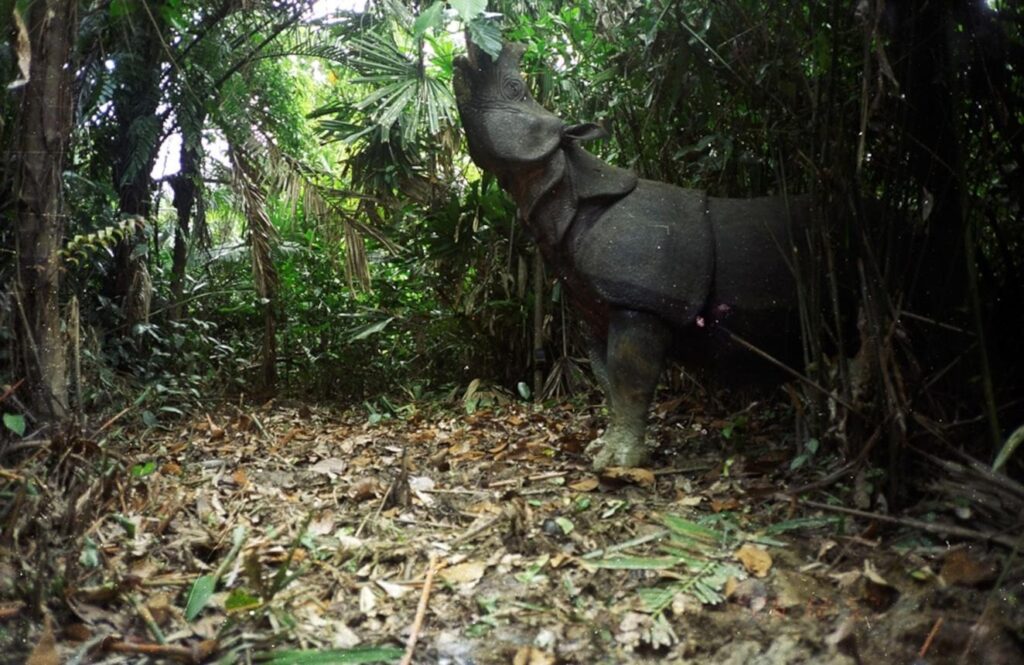
Its most useful feeding feature is the pointed, flexible upper lip. This structure helps the animal grasp and pull vegetation towards its mouth, making it well suited to browsing on woody plants and other forest vegetation.
The short horn is another distinguishing characteristic. In males, it can reach approximately 25 centimetres, although size varies. Females often have a reduced horn or no prominent horn.
The species’ folded skin should not be mistaken for a rigid protective shell. Its appearance reflects the structure of the skin and underlying tissues rather than a literal layer of armour.
How It Moves Through Its Habitat
Javan rhinoceroses are terrestrial mammals adapted to moving through forest vegetation. Their powerful bodies and sturdy legs support movement across uneven ground, while their feeding structures allow them to reach and manipulate plants.
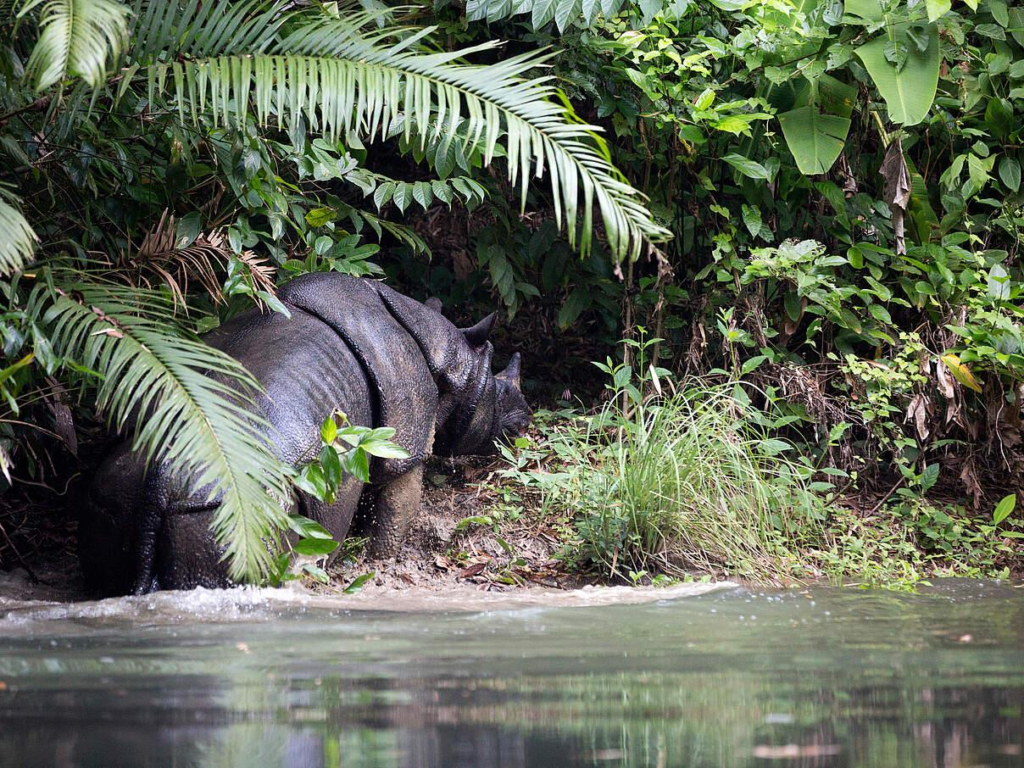
The species also wallows extensively. Wallowing is an important behaviour among rhinoceroses and can help with thermoregulation and skin care. Javan rhinoceroses also visit mineral licks, where they obtain minerals from natural deposits.
These behaviours are documented in the species’ surviving Indonesian habitat. There is insufficient evidence to reconstruct how frequently Javan rhinoceroses wallowed, used mineral-rich sites or moved between habitat patches in the historical Sundarbans.
In particular, it would be incorrect to describe the species as a specialised swimmer capable of navigating the tidal channels of the Sundarbans simply because it was once found there. Its historical presence does not establish the extent of its swimming ability or its response to changing tidal conditions.
What the Javan Rhinoceros Eats
The Javan rhinoceros is herbivorous. In its current forest habitat, its diet includes young shoots, leaves, twigs, saplings and fallen fruit. Research and conservation observations indicate that it feeds on a wide range of plant species.
Its flexible upper lip enables it to grasp vegetation, pull branches within reach and select edible plant parts.
In a tropical forest, browsing can influence which plants are eaten, how vegetation grows and where new shoots are available. These effects can change according to the density of animals, plant composition and seasonal conditions.
The historical diet of the Javan rhinoceros in the Indian Sundarbans has not been established in sufficient detail. It would be inappropriate to list particular Sundarbans mangrove species as confirmed food plants without direct historical or scientific evidence.
Mangrove vegetation is not interchangeable with the tropical forest vegetation used by the surviving population in Java. Any reconstruction of the former diet must account for this difference.
Senses and Behaviour
See it for yourself
A private journey shaped around you — your group, your pace, your interests. Book a free consultation.
Javan rhinoceroses are generally solitary and elusive. Their behaviour is difficult to study because they live in dense forest and are rarely observed directly. Modern research relies heavily on camera traps, tracks, dung and other indirect evidence.
As with other rhinoceroses, smell is an important sensory tool. Scent and physical signs can provide information about other individuals and the use of an area. However, detailed behavioural information from the surviving population should not automatically be treated as a complete account of the species’ historical behaviour in India.
There are no reliable grounds for claiming that the former Sundarbans population behaved differently from the Indonesian population in specific ways. Nor is there sufficient evidence to describe a unique tidal adaptation that evolved in the Sundarbans.
What can be said with confidence is that the species’ biology was shaped by life as a large forest herbivore, while the exact details of its former ecology in the Sundarbans remain poorly documented.
Surviving in a Changing Environment
The modern Sundarbans presents challenges for terrestrial mammals. Tidal inundation, erosion, cyclones, salinity changes and the fragmentation of land can affect the availability and continuity of suitable habitat.
These pressures should not be confused with proven historical causes of the Javan rhinoceros’s disappearance from the region. Although habitat change and human pressure are plausible contributors to the loss of large mammals in the Sundarbans, the precise contribution of each factor to the Javan rhinoceros’s local extinction has not been established.
The species’ global decline has been associated with extensive hunting and habitat loss. Today, the remaining population faces additional risks because it is confined to a single protected area.
Understanding the distinction between known threats and plausible historical explanations is essential. Conservation writing should not turn an incomplete historical record into a confident story unsupported by evidence.
A Solitary Giant
Adult Javan rhinoceroses are generally solitary. Individuals may use overlapping areas, but they do not typically form the large herds associated with some other large herbivores.
Much of the current understanding of their behaviour comes from observations in Ujung Kulon National Park. Researchers use camera traps and indirect signs to understand movement, feeding, reproduction and interactions between individuals.
The social behaviour of the former Sundarbans population is not documented well enough to reconstruct its group structure, home ranges or seasonal movements.
There is no reliable evidence to suggest that Javan rhinoceroses in the historical Sundarbans developed a distinct social system in response to tides or mangrove vegetation.
Breeding and the Next Generation
The Javan rhinoceros has a slow reproductive cycle, a characteristic that makes population recovery difficult when numbers are extremely low.
Gestation is generally estimated at approximately 15–16 months, and females give birth to a single calf. Birth intervals are long, so population growth cannot rapidly compensate for the loss of breeding adults. Some reproductive parameters remain uncertain because the species is difficult to observe directly.
The loss of even a small number of individuals can therefore have serious consequences for a population.
When a species is restricted to one location, its long-term survival depends not only on protecting animals from immediate threats but also on maintaining a viable breeding population, a balanced demographic structure and sufficient genetic diversity.
These concerns are central to current conservation work in Indonesia. They cannot be measured retrospectively for the former Sundarbans population because reliable historical population data are unavailable.
From Historical Coexistence to Local Extinction
The relationship between people and large mammals has changed considerably across South and Southeast Asia. Hunting, the demand for rhinoceros horn, land conversion and growing human pressure have contributed to the decline of rhinoceros populations across their former range.
The Javan rhinoceros was no exception. Its disappearance from much of mainland Asia occurred over a long period rather than through one single event.
For the Indian Sundarbans, the available historical records do not provide a complete account of the people who encountered the species, the frequency of such encounters or the circumstances surrounding its disappearance. It would therefore be misleading to attribute local extinction to one particular community or to describe a single event as the definitive cause.
The Sundarbans has long been a working landscape as well as a wildlife habitat. Fishing, honey collection, agriculture, navigation and settlement are part of its human history. Any account of wildlife loss should recognise this complexity rather than portray local communities as solely responsible for ecological change.
The most defensible explanation is that the Javan rhinoceros disappeared as part of the wider historical contraction of its range, amid human pressure and environmental change. The relative importance of individual factors in the Sundarbans remains uncertain.
The Significance of Historical Wildlife Records
Historical records provide evidence of species that once inhabited places where they can no longer be found. They can also reveal how human descriptions, scientific identification and conservation priorities have changed over time.
For the Javan rhinoceros, early accounts require careful interpretation because historical observers did not always distinguish species precisely. Specialist research has helped clarify the presence of Javan rhinoceroses in northeastern India and the Sundarbans, but gaps remain.
A useful historical record should be assessed according to several questions:
| Research question | Why it matters |
| Was the animal identified to species level? | Prevents confusion with other rhinoceroses |
| Is the location clearly described? | Helps establish whether the record refers to the Indian Sundarbans |
| When was the observation made? | Distinguishes a historical range record from a possible last sighting |
| Was the account published contemporaneously? | Helps assess how directly it reflects the original observation |
| Is the record independently supported? | Reduces the risk of repeating an unverified report |
These principles are especially important when documenting locally extinct mammals. An isolated historical mention can be valuable evidence, but it cannot answer every question about the population’s former life.
What the Loss Means for the Sundarbans
The disappearance of the Javan rhinoceros is one element of a wider loss of large terrestrial mammals from the Sundarbans. Historical ecological literature also records the disappearance of other large mammals, including wild buffalo, hog deer, swamp deer and barking deer.
Each species had its own habitat requirements and ecological relationships. Their disappearances should not be treated as a single event with an identical cause.
Nevertheless, the cumulative loss of large mammals changes the composition of the ecosystem. It reduces the range of herbivore–plant interactions and removes animals that once formed part of the landscape’s food webs.
For the Javan rhinoceros, the local story is now primarily historical. Unlike the tiger or spotted deer, it cannot be encountered as part of a present-day wildlife observation experience in the Indian Sundarbans.
Its importance lies in what its former presence tells us about the region’s ecological history and the consequences of losing large mammals from an already distinctive environment.
Why Is the Javan Rhinoceros Locally Extinct?
The Javan rhinoceros disappeared from the Indian Sundarbans during the early twentieth century or around the turn of that century, according to historical literature. The precise date of its final disappearance is uncertain.
The wider decline of the species is associated with hunting and the loss of suitable habitat. Its former range contracted until the last surviving population became confined to Ujung Kulon National Park in Indonesia.
For the Sundarbans specifically, the evidence does not establish a definitive breakdown of causes. Habitat alteration and human pressure are reasonable parts of the broader historical context, but their individual contributions to the local extinction have not been quantified.
This uncertainty should remain explicit. It is scientifically stronger to distinguish established historical facts from possible explanations than to present a simplified account as proven.
The Global Conservation Crisis
The Javan rhinoceros remains one of the world’s most threatened large mammals.
The IUCN SSC Asian Rhino Specialist Group’s October 2026 information reports fewer than 50 individuals, all in Ujung Kulon National Park. The population is therefore vulnerable to concentrated threats affecting one place, including poaching, disease and natural disasters.
The conservation challenges include:
| Threat | Conservation significance |
| Poaching | Removes individuals from an already very small population |
| Single-site distribution | Leaves the entire species exposed to threats affecting one protected area |
| Low genetic diversity | Can limit long-term population resilience |
| Demographic imbalance | May make successful reproduction more difficult |
| Habitat competition | Can reduce access to suitable food plants |
| Natural disasters | Could affect a substantial proportion of the global population |
| Disease | A disease outbreak could threaten a population with no independent wild refuge |
Protecting the Last Wild Population
Ujung Kulon National Park is the final stronghold of the Javan rhinoceros. Protecting the remaining animals requires sustained monitoring, effective anti-poaching measures and the preservation of suitable habitat.
Camera traps are particularly valuable because they allow researchers to identify animals, document breeding and monitor activity without requiring frequent direct encounters. Tracks and dung can also provide information about movement and habitat use.
Conservation planning must also consider the risks created by having only one wild population. Protecting the existing site is essential, but it cannot completely eliminate the possibility of a catastrophic event affecting the entire species.
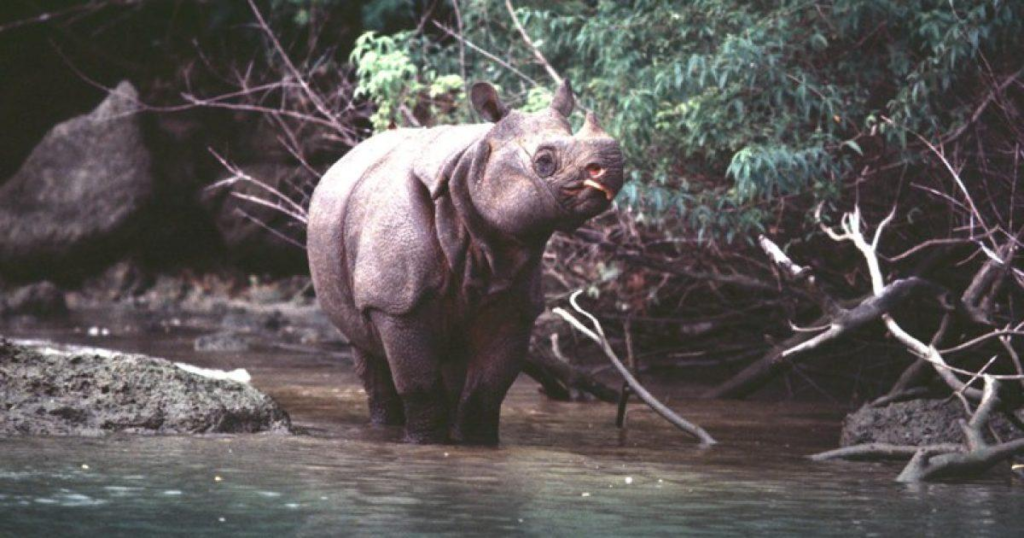
The Asian Rhino Specialist Group identifies establishing a second population as an important conservation priority. Such a programme would require appropriate habitat, careful assessment of risks and long-term management.
The goal is not simply to increase a population count. It is to create conditions in which the species can persist over generations.
What Can the Indian Sundarbans Learn?
The Javan rhinoceros cannot currently be restored to the Indian Sundarbans simply by deciding that its former habitat should be protected. Any future reintroduction would require substantial scientific assessment, and there is no established reintroduction programme for the species in the region.
The immediate lesson is broader: protecting wildlife requires understanding habitat requirements, monitoring populations and recognising the consequences of losing ecological connections before a species disappears.
For the Sundarbans, that means maintaining forest habitat, protecting existing wildlife, improving ecological monitoring and addressing human pressures without overlooking the needs of local communities.
It also means documenting the region’s natural history accurately. Records of former wildlife populations can inform conservation priorities by showing that today’s distribution is not necessarily the limit of a species’ historical range.
Where Can the Javan Rhinoceros Be Observed in the Indian Sundarbans?
It cannot be observed as a wild mammal in the Indian Sundarbans. There is no established surviving population in West Bengal, and no current wildlife observation site in the region can responsibly be promoted as a Javan rhinoceros sighting location.
Historical references to the Sundarbans establish former presence, not current availability. Locations such as Sajnekhali, Sudhanyakhali, Dobanki, Netidhopani and Burirdabri are not verified Javan rhinoceros observation sites.
The only remaining wild population is in Ujung Kulon National Park, Indonesia. Even there, the species is exceptionally elusive, and its conservation status means that wildlife viewing must never take priority over protection.
For visitors exploring the Indian Sundarbans today, the Javan rhinoceros is a subject for natural-history interpretation rather than a species to seek in the forest.
The Important Truth About Wildlife Sightings
Wildlife observation is never guaranteed. Animals can remain concealed even in places where they are known to occur, and the absence of a sighting does not prove that a species is absent.
For a locally extinct species, however, the distinction is more fundamental. The Javan rhinoceros is not simply difficult to find in the Indian Sundarbans; there is no credible evidence of a surviving wild population there.
Presenting it as a possible sighting would create a false expectation and undermine the purpose of a scientifically grounded wildlife guide.
Responsible natural-history writing must distinguish historical occurrence, current presence, suitable habitat and confirmed observation.
What Makes the Javan Rhinoceros of the Sundarbans Unique?
The Javan rhinoceros of the Sundarbans is unique in a historical and ecological sense: it represents a large mammal that once formed part of the region’s wildlife community but no longer survives there.
Its story connects the Indian Sundarbans with a much wider history of rhinoceros decline across Asia. The species once occupied a broad geographical range, but hunting and habitat loss reduced its distribution until only a single wild population remained.
Three aspects make its Sundarbans history especially important.
| Distinctive aspect | Significance |
| Former northern distribution | Historical records place the species in the Sundarbans and northeastern India, far beyond its present range |
| Loss from a tidal ecosystem | Its disappearance forms part of the changing composition of the Sundarbans’ large-mammal community |
| Connection to global extinction risk | The species’ regional disappearance contrasts with its precarious survival in one Indonesian national park |
The available evidence does not establish a unique Sundarbans subspecies or a distinct population adapted specifically to mangroves. Nor does it demonstrate that the animal possessed special physiological adaptations to saline water or tidal flooding.
Its real distinction is the historical connection between a globally threatened rhinoceros and a landscape from which it has disappeared.
The Sundarbans is often discussed through the wildlife that remains. The Javan rhinoceros reminds us that its ecological history also includes animals that are no longer present.
Myths and Facts About the Javan Rhinoceros
| Myth | Fact |
| The Javan rhinoceros is globally extinct. | It survives in Indonesia, although it is Critically Endangered. |
| It can still be spotted in the Indian Sundarbans. | There is no established surviving population in the region. |
| It is the same species as the greater one-horned rhinoceros. | They are separate species with different scientific names. |
| Its historical presence proves that it was adapted to saline tidal water. | Historical occurrence alone does not establish a specialised saltwater adaptation. |
| The exact date of its disappearance from the Sundarbans is known. | Historical records indicate an early twentieth-century disappearance, but the precise final date remains uncertain. |
FAQs
Is the Javan rhinoceros extinct in the Sundarbans?
Yes. The Javan rhinoceros is locally extinct in the Indian Sundarbans. Historical research documents its former presence, but no established wild population remains in the region.
Is the Javan rhinoceros extinct worldwide?
No. It survives in Ujung Kulon National Park in Java, Indonesia. The IUCN SSC Asian Rhino Specialist Group classifies it as Critically Endangered and reports fewer than 50 remaining individuals.
What is the scientific name of the Javan rhinoceros?
Its scientific name is Rhinoceros sondaicus. It belongs to the family Rhinocerotidae and is one of the three living Asian rhinoceros species.
When did the Javan rhinoceros disappear from the Sundarbans?
Historical literature indicates that it disappeared around the turn of the twentieth century or during the early decades of that century. The exact date of its final disappearance is not firmly established.
Why did the Javan rhinoceros disappear from the Indian Sundarbans?
Its disappearance occurred during the wider decline of the species across Asia. Hunting and habitat loss are established threats to the species, but the precise contribution of different factors to its local extinction in the Sundarbans remains uncertain.
What did the Javan rhinoceros eat?
The species is herbivorous and browses on vegetation such as leaves, shoots, twigs, saplings and fallen fruit. Its precise historical diet in the Indian Sundarbans has not been established.
Is the Javan rhinoceros different from the Indian rhinoceros?
Yes. The Javan rhinoceros (Rhinoceros sondaicus) and the greater one-horned or Indian rhinoceros (Rhinoceros unicornis) are distinct species. Their historical ranges overlapped in parts of South Asia.
Can visitors see the Javan rhinoceros in the Sundarbans today?
No. There is no established surviving wild population in the Indian Sundarbans. The remaining wild population is in Indonesia, where the species is exceptionally elusive and conservation protection is paramount.
Why is the Javan rhinoceros important to Sundarbans wildlife history?
It provides evidence of the region’s former large-mammal diversity and illustrates how wildlife distributions can contract over time. Its local extinction is part of the broader history of ecological change in the Sundarbans.
What is being done to protect the Javan rhinoceros?
Conservation efforts in Indonesia include anti-poaching protection, camera-trap monitoring, population assessment and planning for a second population. These measures aim to reduce the risk of losing the species entirely.
The Wild Orbit Perspective
The Javan rhinoceros is a reminder that a landscape’s identity cannot be understood only through the animals that survive today. Its history reaches beyond the muddy banks and mangrove roots of the Indian Sundarbans to a much wider story of ecological change across Asia.
Once, this rhinoceros belonged to the region’s living natural history. Today, its presence survives in historical records, scientific research and the work of those trying to protect the last individuals elsewhere.
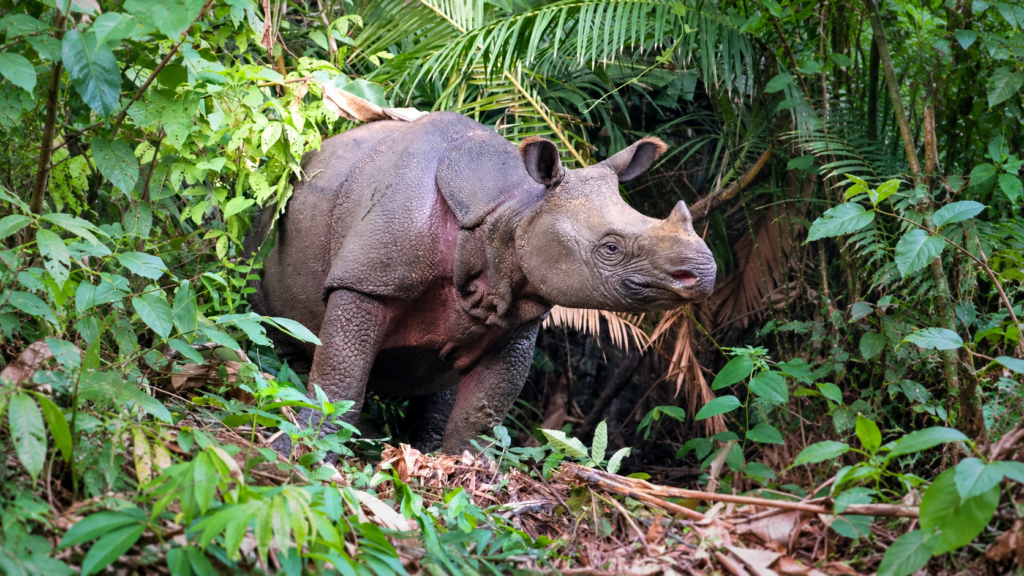
Its disappearance also asks a difficult question: how many ecological relationships are lost before we fully understand their value?
The future of the Javan rhinoceros now depends on protecting the last wild population in Indonesia. In the Sundarbans, its legacy lies in recognising that wildlife conservation is not only about preserving what remains, but also about learning from what has already been lost.
A forest is shaped by the lives it sustains—and its history is also written in the silence left by those that no longer return.
Plan your private Sundarban expedition
A private journey shaped around you — your group, your pace, your interests. Book a free consultation.