Field guide
THE CAT THAT BELONGS TO THE WATER
The Sundarbans is a land where nothing stays exactly where it was.
The tide enters through narrow creeks and winding channels, floods the edges of the mangrove forest, and slowly retreats again. Mudbanks emerge from the water. Pneumatophores rise from the soft ground. Fish move through tidal channels, crabs disappear into their burrows, and the boundary between land and water constantly changes.
Somewhere within this shifting world lives a predator that seems almost designed for it.
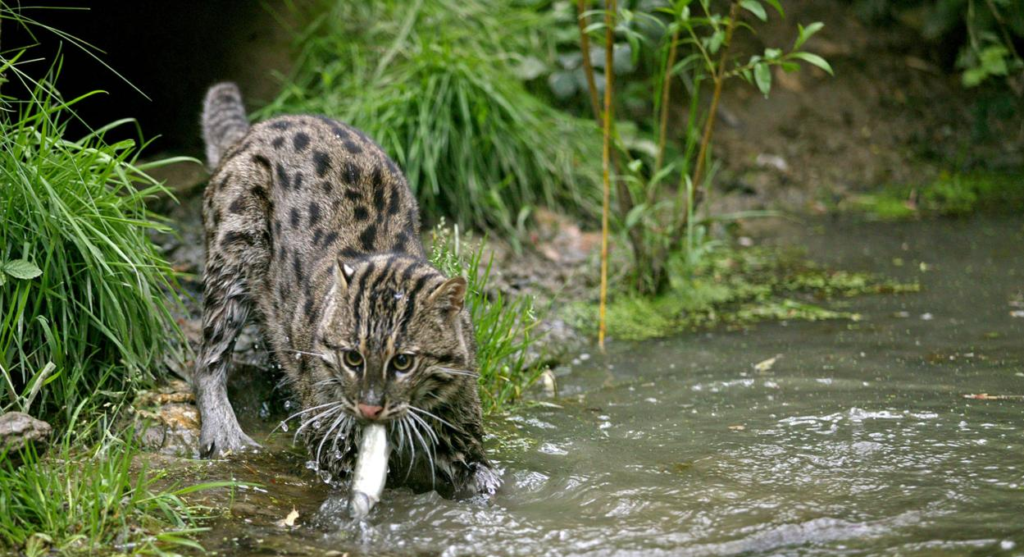
The Fishing Cat — Prionailurus viverrinus.
- It is a wild cat, but not quite like the cats most people imagine.
- It does not depend entirely on dry forest.
- It does not avoid water.
- And it does not merely tolerate getting wet.
It hunts there.
The Fishing Cat is one of Asia’s most distinctive wetland predators, strongly associated with marshes, rivers, swamps, mangroves and other water-rich habitats. Classified as Vulnerable on the IUCN Red List, it has suffered from the widespread destruction and degradation of wetlands across its range.
In India, its story has a particularly strong connection with West Bengal.
The Fishing Cat is the state animal of West Bengal, and the state’s wetlands, floodplains, coastal landscapes and mangrove ecosystems represent some of the most important remaining habitats for the species in the country.
And among those landscapes, the Indian Sundarbans offers one of its most remarkable homes.
Here, the Fishing Cat lives in a world governed by tides.
A Wild Cat Built Around Water
At first glance, the Fishing Cat may look like a fairly typical medium-sized wild cat.
- Its body is compact and muscular.
- Its legs are relatively short.
- Its head is broad.
- Its ears are rounded.
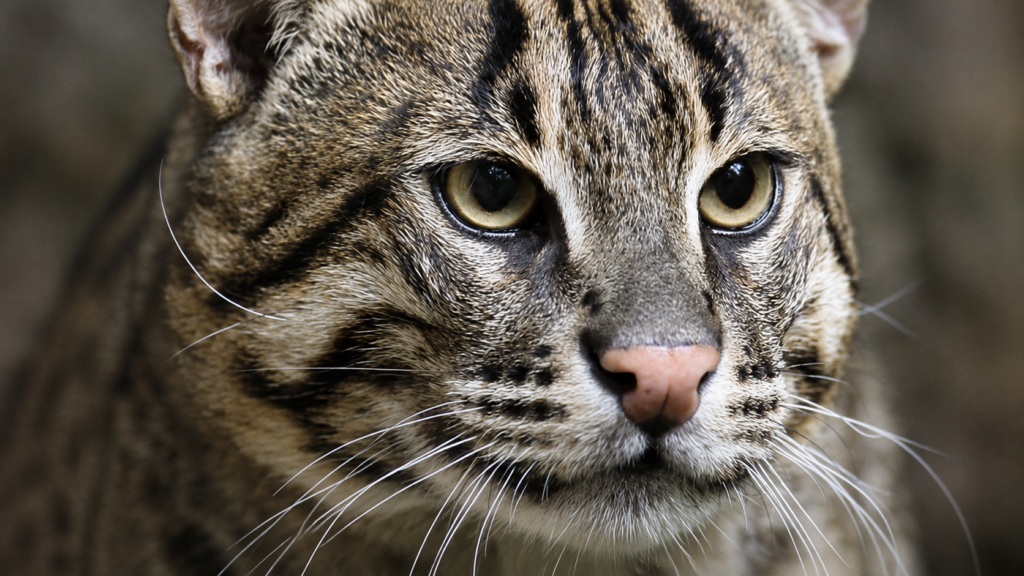
- Its coat is marked by dark spots and stripes over a greyish or olive-brown background.
But look more closely, and its relationship with water begins to reveal itself.
The Fishing Cat has partially webbed feet, an unusual adaptation among felids. Its claws are also incompletely sheathed, remaining somewhat exposed even when retracted.
These are not dramatic transformations into the feet of an aquatic animal.
The Fishing Cat is still unmistakably a cat. But evolution has given it just enough additional equipment to make life around water possible.
- Its feet can help it move through shallow water.
- Its strong body allows it to swim.
- Its paws can seize slippery prey.
And its ability to enter and even dive beneath the water turns an aquatic environment into a hunting ground.
That combination makes the Fishing Cat one of the most fascinating examples of how a terrestrial predator can adapt to a wetland world.
The Name “Fishing Cat” Is Only the Beginning
The name immediately tells us something about the animal.
But it doesn’t tell us everything. Yes, fish are an important part of its diet.
But Fishing Cats are not specialists in the sense of eating nothing but fish.
Depending on where they live and what prey is available, they can also feed on amphibians, reptiles, birds, rodents, crustaceans, molluscs and other small animals.
That flexibility is particularly important in an environment like the Sundarbans.
A tidal wetland is not a supermarket with the same food available every day.
- Water levels change.
- Prey moves.
- Seasons alter availability.
A creek that offers abundant aquatic prey at one time may provide very different opportunities later.
The Fishing Cat responds to this changing environment as an opportunistic predator. Fish may be its signature prey. But the wetland provides a much larger menu.
When a Cat Enters the Water
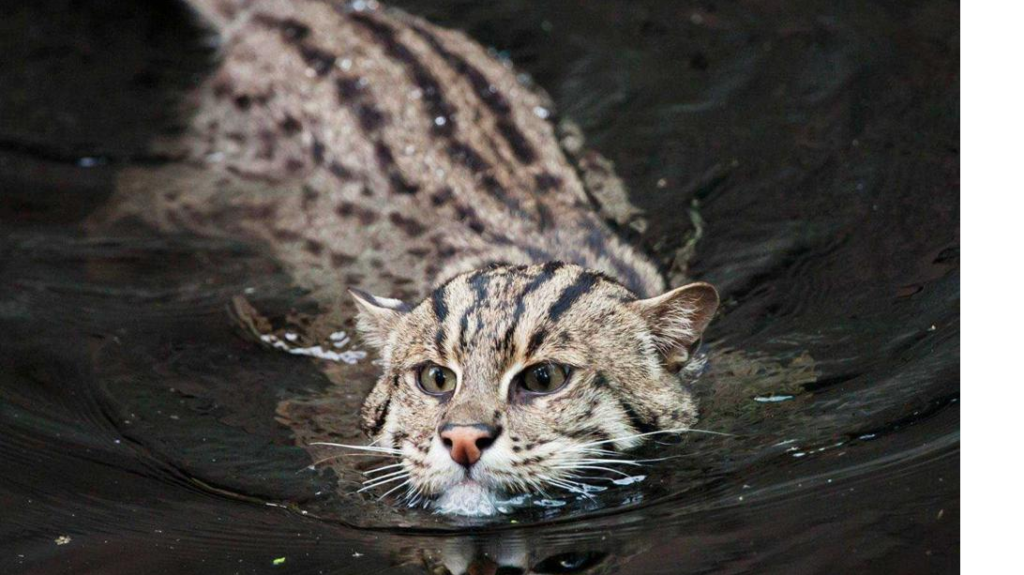
For most people, the most extraordinary image of a Fishing Cat is simple: a cat in water.
It may stand at the edge of a creek, wade through shallow water, strike at prey from the bank, or enter the water itself.
It is a strong swimmer and is capable of diving after aquatic prey.
This behaviour separates the Fishing Cat from the popular image of a typical wild cat.
For a tiger, leopard or jungle cat, water may be crossed, tolerated or occasionally used.
For the Fishing Cat, water can become the place where the hunt happens.
That difference is fundamental.
The animal’s anatomy, behaviour and habitat all point toward the same ecological story: this is a cat whose life is deeply connected to wetlands.
A Secretive Predator of the Mangrove Edge
The Fishing Cat does not have the visual drama of a tiger.
There is no enormous silhouette moving across an open mudbank.
No unmistakable roar travelling through the forest.
Instead, the Fishing Cat is elusive.
- It generally lives alone and is difficult to observe directly.
- It is often active at night or around twilight, although individuals can also be active during the day.
- Its patterned coat helps break up its outline among vegetation, shadows and muddy surroundings.
This makes it perfectly suited to a landscape where visibility is often limited.
- The mangroves are dense.
- The creeks are winding.
- The banks are irregular.
- And the animal itself is cautious.
A Fishing Cat can be present in a wetland without announcing its existence to the people passing nearby.
That secrecy is part of what makes it so fascinating.
In the Sundarbans, the animals that are easiest to notice are not necessarily the animals that matter most.
Some of the ecosystem’s most important inhabitants remain almost invisible.
The Other Cat of the Sundarbans
When people think about cats in the Sundarbans, one animal immediately dominates the imagination: the Royal Bengal Tiger.
The tiger is the great symbol of the mangrove forest. But the Sundarbans does not have only one feline story.
The Fishing Cat occupies a very different ecological space.
The tiger is a large apex predator capable of hunting substantial terrestrial prey.
The Fishing Cat is a smaller, wetland-associated predator whose hunting world extends into shallow water and aquatic habitats.
- One represents the power of the forest.
- The other reveals the importance of the water.
Together, they demonstrate something fundamental about the Sundarbans: an ecosystem is never defined by its most famous species alone.
Behind the tiger’s story is an entire network of smaller predators, prey species, aquatic organisms, birds, reptiles, fish, crustaceans and invertebrates.
The Fishing Cat is one of the predators that connects these worlds.
A Cat Living in a Moving Landscape
There is another reason the Sundarbans Fishing Cat is so remarkable.
Its habitat is not static.
In many landscapes, a predator’s territory can be imagined as a relatively stable patch of forest, grassland or woodland.
The Sundarbans is different. Its waterways are continuously influenced by tides. The same bank may be covered by water and later exposed as mud.
- A narrow creek can change in depth.
- A channel can become more accessible or less accessible.
- The distribution of aquatic prey can change with water movement.
The Fishing Cat therefore lives within a landscape whose physical conditions are constantly being rewritten.
We should not imagine that every Fishing Cat consciously follows a precise tidal timetable for every hunt. The detailed relationship between individual hunting behaviour and tidal cycles requires careful scientific study.
But at the ecosystem level, the relationship is undeniable.
The cat’s hunting world is shaped by moving water.
And that makes the Sundarbans an extraordinary setting for one of Asia’s most water-adapted wild cats.
Why the Fishing Cat Matters?
The Fishing Cat is important not simply because it is rare or unusual.
Its importance comes from what it tells us about the ecosystem around it. A Fishing Cat needs suitable wetland habitat.
- It needs prey.
- It needs vegetation and cover.
- It needs functioning waterways.
And it needs enough ecological connectivity to survive within a landscape increasingly influenced by human activity.
When wetlands disappear, the Fishing Cat loses much more than a place to rest. It loses its hunting ground.
That makes the species an important reminder that protecting wildlife is often inseparable from protecting the habitats that sustain them.
A Fishing Cat cannot survive on a map. It needs a living wetland.
The Fishing Cat of the Indian Sundarbans
West Bengal holds an especially important place in the conservation story of this species.
Recent research has identified the state as a major stronghold for Fishing Cats in India, with the species occurring across several wetland landscapes of southern Bengal.
The Indian Sundarbans form one of these important landscapes.
Dedicated surveys in the Sundarbans Tiger Reserve have documented the species across its forest ranges and attempted to estimate its abundance using camera trapping and related methods.
A 2022 Fishing Cat status assessment by the reserve reported a probable estimate of approximately 385 individuals across its surveyed ranges, based on the methodology used in that assessment.
That number should not be treated as a permanent census.
- Wildlife populations change.
- Survey methods differ.
And the Sundarbans is an enormous, dynamic landscape. But the significance of the survey is clear: the Fishing Cat is an established and important predator of the Sundarbans ecosystem. It is not simply an occasional visitor to the mangroves. It belongs here.
A Different Way of Seeing the Sundarbans
Perhaps that is the best reason to look for the Fishing Cat.
It changes the way we understand the Sundarbans.
- If we look only for tigers, we see the forest as a kingdom of large predators.
- If we look for the Fishing Cat, we begin to notice something else.
We notice the creeks.
- The muddy edges.
- The shallow water.
- The mangrove roots.
- The fish moving beneath the surface.
- The crabs emerging with the tide.
- The hidden movement along the waterline.
We begin to understand that the Sundarbans is not simply a forest interrupted by water. It is a living system created by the relationship between forest and water. And the Fishing Cat is one of the animals that embodies that relationship better than almost any other.
It is a cat that walks the mangrove edge.
- A predator that enters the water.
- A hunter shaped by wetlands.
And in the Indian Sundarbans, it is one of the quietest reminders that some of the wildest stories are not found deep inside the forest.
They begin where the land meets the tide.
A Cat in a World That Never Stays Still
To understand the Fishing Cat of the Sundarbans, we first have to understand the place it calls home.
The Indian Sundarbans is not simply a forest.
It is a constantly moving landscape of mangrove islands, tidal creeks, mudflats, channels, wetlands and intertidal zones, shaped by the continuous movement of water.
- The tide rises.
- The tide falls.
- Water enters the forest through countless channels and later retreats toward the estuary.
- Mudbanks appear and disappear.
- Roots that were surrounded by water become exposed.
- Shallow pools form and change.
And throughout this shifting landscape, life follows the movement of water. For the Fishing Cat, this instability is not a problem to overcome. It is the environment to which it is adapted.
Unlike many wild cats that depend primarily on dry forests, grasslands or scrub, the Fishing Cat is closely associated with wetlands. Across its range, it has been recorded in marshes, swamps, riverbanks, floodplains, streams, mangroves and other water-rich habitats.
The Sundarbans take this wetland relationship into an extraordinary tidal setting. Here, water is not simply present. Water controls the landscape.
Where Land and Water Become One
Walk through the Sundarbans and the distinction between land and water quickly begins to disappear.
A mangrove island may appear solid from a distance. Closer to the edge, the ground becomes soft and muddy.
Beyond it lies a tidal creek. Across the creek is another island. Between the roots are shallow pools and channels.
- Fish move through the waterways.
- Crabs occupy the mud.
- Birds forage along exposed banks.
- Reptiles move between water and land.
And hidden somewhere within this network may be a Fishing Cat.
This is the habitat mosaic that makes the Sundarbans so valuable to the species. The cat does not depend on one particular type of terrain. It can exploit the edges between different habitats.
- The water provides aquatic prey.
- The vegetation provides cover.
- The muddy margins provide access to the water.
And the surrounding forest offers additional opportunities for terrestrial prey. The Fishing Cat therefore occupies an ecological boundary. It lives where several worlds overlap.
A Forest Unlike Any Other
The Sundarbans is dominated by mangrove vegetation specially adapted to saline and waterlogged conditions.
- Trees rise from mud.
- Pneumatophores protrude from the ground.
- Roots create a maze along the waterline.
- The forest is dense in places and open in others.
For the Fishing Cat, this vegetation offers something critical: concealment.
A predator does not always need to be the strongest animal in its environment. Sometimes survival depends on being difficult to detect. The Fishing Cat’s coat, marked by spots and stripes over a greyish or olive-brown background, can help break up its outline among vegetation, shadows and muddy surroundings.
Its relatively compact body is also well suited to moving through dense wetland habitat.
Rather than crossing open terrain in search of prey, it can move through the edges of the landscape with comparatively little exposure. That makes the mangrove fringe more than a boundary. It is part of the Fishing Cat’s hunting environment.
Why the Water’s Edge Matters
For the Fishing Cat, the most valuable part of the Sundarbans may not be deep inside the forest.
It may be the transition zone.
- The place where mud meets water.
- Where vegetation meets a creek.
- Where a shallow channel reaches a bank.
- Where aquatic and terrestrial prey come into close proximity.
These edges are biologically productive.
- Fish move through shallow water.
- Small aquatic animals occupy the margins.
- Crabs emerge from mud.
- Amphibians and reptiles use both land and water.
- Birds visit exposed banks.
- Rodents and other small mammals move through vegetation.
A Fishing Cat can exploit several of these opportunities. This gives the animal an advantage that many purely terrestrial predators do not possess. It can hunt across the boundary.
Where the Cat’s Dinner Begins
The Fishing Cat’s relationship with water becomes even clearer when we look below the surface.
The waterways of the Sundarbans support diverse aquatic communities.
Fish move through tidal creeks. Crustaceans occupy the intertidal zone. Other aquatic organisms form the lower levels of a food web that eventually supports larger predators.
The Fishing Cat sits within this network.
It does not exist independently of the water. Its prey ultimately depends on the productivity of the wetland. This makes the Fishing Cat an excellent example of how an ecosystem connects seemingly unrelated organisms.
- The mangrove trees support the wider ecological system.
- The tidal waters transport nutrients.
- Aquatic organisms use the waterways.
- Small predators consume them.
- Larger predators consume smaller predators.
The Fishing Cat occupies one of the links. Protect the wetland, and you protect the foundation of its hunting world.
More Than Fish
See it for yourself
A private journey shaped around you — your group, your pace, your interests. Book a free consultation.
Although fish give the species its name, the Fishing Cat’s diet is broader.
It can prey on amphibians, reptiles, birds, rodents, crustaceans, molluscs and other small animals.
This is important in the Sundarbans because prey availability can change across space and time.
A cat that depended exclusively on one species would be vulnerable to local fluctuations.
The Fishing Cat is more flexible.
It can shift between aquatic and terrestrial prey depending on opportunity.
That makes it an adaptable predator within a highly variable environment.
Moving Through the Shadows
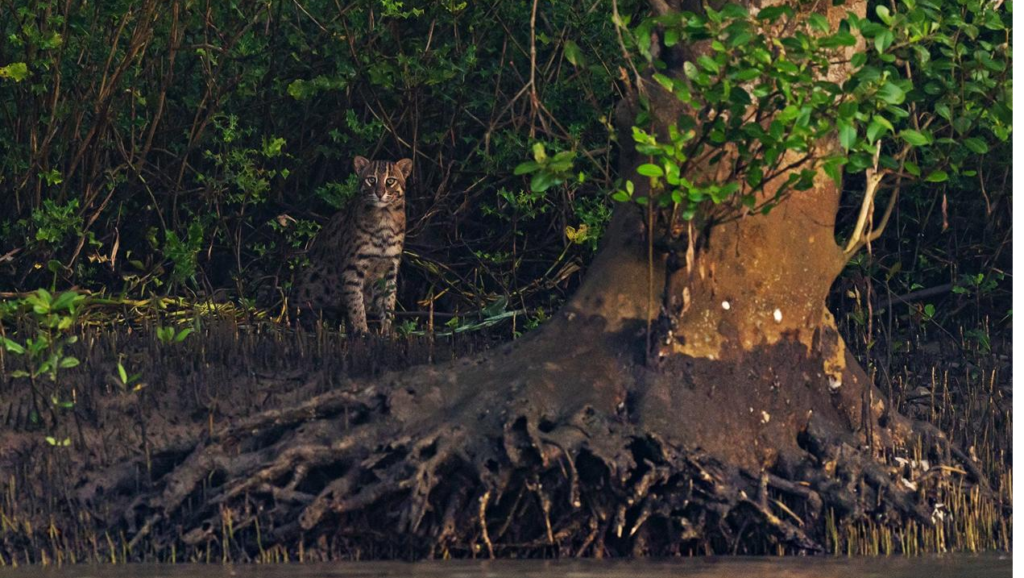
Fishing Cats are generally solitary animals. They do not form large social groups like some mammals.
An individual may move through its territory alone, searching for prey and using vegetation or other sheltered locations for cover.
This solitary lifestyle makes direct observation difficult.
A Fishing Cat can be present in an area without revealing itself. In the Sundarbans, this problem becomes even greater.
- The habitat is vast.
- The vegetation can be dense.
- The terrain is broken by water.
- Visibility is often restricted.
And many potentially suitable areas cannot be easily accessed by people. This is one reason camera traps have become so important in Fishing Cat research. A camera positioned along a trail, bank or other suitable location can record an animal that a field observer might never encounter.
Nocturnal, But Not Invisible to Daylight
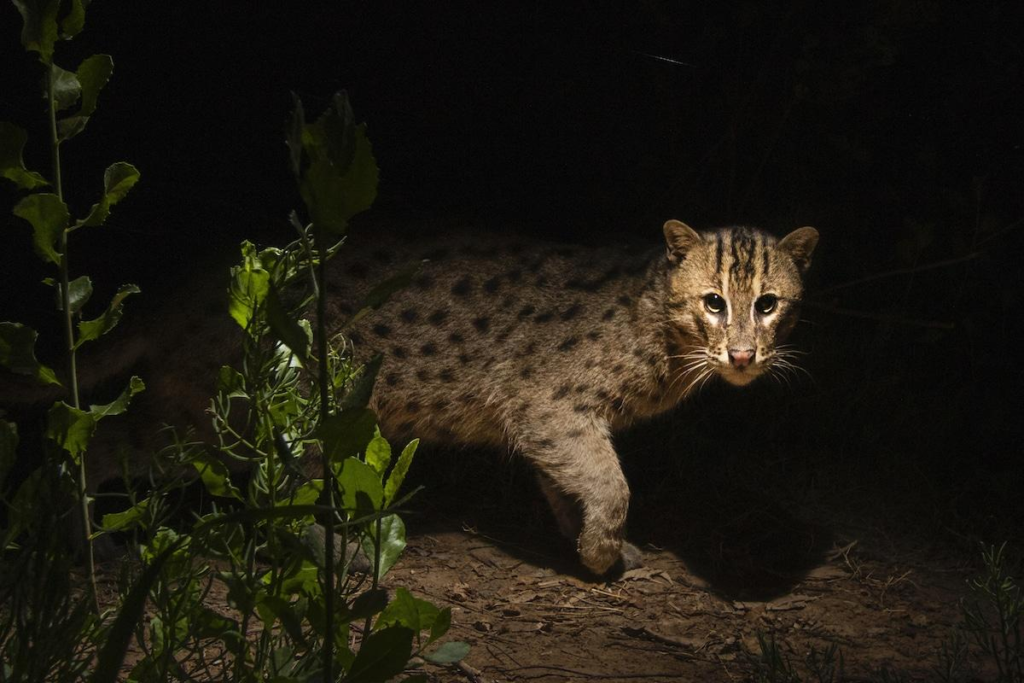
Fishing Cats are often described as nocturnal. And they can be highly active after dark. But their behaviour is not restricted to nighttime. Camera-trapping studies have recorded daytime activity as well.
This flexibility makes sense. A predator living in a changing wetland environment cannot afford to follow a rigid schedule. Prey availability, human disturbance, weather and local conditions can all influence activity.
So while night may offer the Fishing Cat greater security and opportunities for hunting, daylight activity is also possible.
The important point is not to imagine the animal as permanently hidden in darkness. It is better understood as a secretive predator capable of adjusting its activity to its surroundings.
A Cat in a Fragmented Landscape
The geography of the Sundarbans creates another unusual challenge.
The landscape is divided into islands and waterways.
- Creeks separate areas of habitat.
- Channels create natural barriers.
The same geography that provides abundant wetland habitat can also make movement complicated.
For a terrestrial animal with limited swimming ability, water can become a serious obstacle.
The Fishing Cat is different.
Its strong swimming ability allows it to enter water and cross waterways. This does not mean that every channel is equally easy or safe to cross. Tidal currents, depth, predators and weather can all create risks.
But the Fishing Cat’s aquatic ability gives it an unusual advantage in an island landscape. The water that divides its habitat can also become part of the habitat.
A Wildlife Landscape Beyond the Tourist Trail
The Sundarbans is often experienced from boats. Visitors travel through creeks searching for wildlife.
- They watch the banks.
- They scan the forest.
- They hope for a glimpse of a tiger, crocodile, deer or bird.
But much of the Sundarbans remains hidden. The Fishing Cat represents that hidden side.
- It may be moving along a creek while a boat passes nearby.
- It may be hunting after sunset when human activity has declined.
- It may cross a muddy margin without leaving an obvious trace.
Its presence can be detected only by a camera trap, tracks, signs or an exceptionally fortunate observation. This makes the Fishing Cat a perfect example of why wildlife exploration is not simply about seeing animals. It is about understanding where they live, how they move and what the landscape means to them.
An Important Landscape for Fishing Cats
The importance of the Sundarbans to Fishing Cats is supported by dedicated research. The Sundarbans Tiger Reserve conducted a Fishing Cat status assessment using camera trapping across multiple ranges to investigate the species’ distribution and abundance.
Its 2022 assessment produced a probable estimate of approximately 385 Fishing Cats across the surveyed ranges, using the methodology described in the report.
That number should be interpreted carefully.
It is not a permanent population count. It is a survey-based estimate from a particular study and period. Wild populations change, and different survey techniques can produce different estimates.
But the assessment provides strong evidence of the species’ importance within the reserve. The Fishing Cat is not an accidental inhabitant of the Sundarbans. It is part of the ecosystem’s natural predator community.
The Fishing Cat Needs More Than a Protected Area
There is another important lesson from Fishing Cat research in West Bengal. The species is capable of surviving in landscapes outside formal protected areas.
Recent studies have recorded Fishing Cats in wetlands influenced by agriculture, aquaculture, settlements and other human activities. That adaptability is encouraging. But it also creates risk.
When a wild predator lives close to people, opportunities for conflict increase.
- Fish farms can become attractive feeding grounds.
- Domestic animals can become prey.
- Roads can cut across habitat.
People may not realise that a small, secretive cat is using the surrounding wetlands. And when conflict occurs, the animal can pay the price. This is why Fishing Cat conservation cannot stop at the boundary of a reserve.
What Happens When the Water Changes?
The Fishing Cat provides a useful way to think about wetland conservation.
- Imagine the water becoming polluted. Fish populations decline.
- Imagine wetlands being converted. Hunting grounds disappear.
- Imagine waterways becoming fragmented. Movement becomes more difficult.
- Imagine mangrove vegetation being degraded. Cover and ecological productivity decline.
The Fishing Cat experiences these changes directly. This is why the species is more than an interesting animal. Its presence can represent the continued existence of a functioning wetland ecosystem. A healthy Fishing Cat habitat requires much more than a patch of trees.
It requires water, prey, cover and ecological connectivity.
A Cat Between Two Worlds
Perhaps the most accurate way to understand the Sundarbans Fishing Cat is to see it as a predator between worlds.
- It can move through vegetation.
- It can travel across mud.
- It can enter water.
- It can hunt aquatic prey.
- It can take terrestrial prey.
- It occupies neither a purely terrestrial nor purely aquatic niche.
Instead, it exploits the space between them.
And that space is exactly what defines the Sundarbans.
- The forest meets the creek.
- The creek meets the mudflat.
- The mudflat meets the tide.
- Freshwater influence meets saline water.
- Terrestrial life meets aquatic life.
And somewhere within these transitions moves a cat that has evolved to take advantage of them.
THE WILD ORBIT PERSPECTIVE
The Sundarbans is often described as a mangrove forest. But the Fishing Cat teaches us to look at it differently.
It is a wetland landscape first—one in which forests, creeks, mudflats, fish, crabs, birds, reptiles and mammals are bound together by water. The Fishing Cat is one of the species that makes this relationship visible.
- Follow its story and you are led to the creek.
- Follow the creek and you find the tide.
- Follow the tide and you discover the aquatic food web.
And follow that food web back toward the mangroves, and you begin to understand how the entire ecosystem is connected.
The Fishing Cat may be one of the Sundarbans’ least visible predators. But its life reveals something profound: In the Sundarbans, water is not the boundary of the forest. Water is the force that creates it.
When a Cat Goes Fishing
There are few sights in the natural world as unexpected as a cat entering water with a purpose.
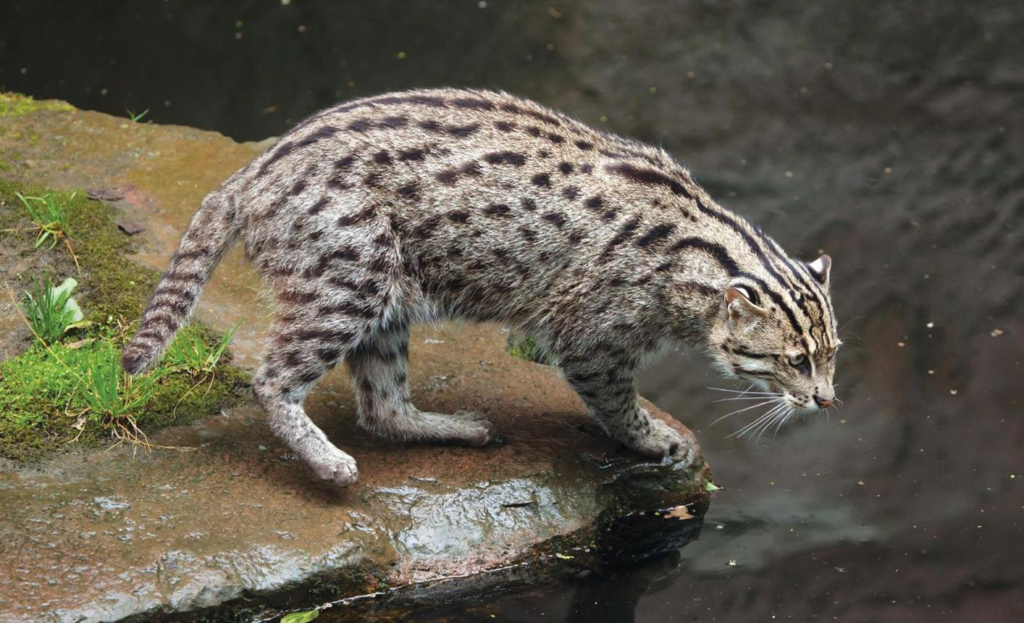
A Fishing Cat may approach a creek quietly, lower its body close to the edge and focus on the movement beneath the surface.
Then, in an instant, the paw moves. And if the timing is right, a fish is pulled from the water. This is what makes the Fishing Cat so extraordinary.
- For most wild cats, water is something to cross.
- For the Fishing Cat, water can be where the hunt begins.
The species is a strong swimmer and is capable of diving after aquatic prey. Its partially webbed feet, powerful body and unusual claw structure give it a combination of adaptations that help it function effectively around water.
But its hunting ability is not simply about anatomy. It is about behaviour. The Fishing Cat has learned to exploit a world that most terrestrial predators cannot fully access. And in the Indian Sundarbans, that world is shaped by tides.
Watching Before Striking
Fishing is not a matter of randomly hitting the water. The Fishing Cat is a predator.
- It watches.
- It listens.
- It waits for an opportunity.
At the edge of shallow water, an individual may remain motionless while observing movement beneath or near the surface.
- Its body remains controlled.
- Its attention is concentrated.
Then the strike can come with remarkable speed. This combination of stillness and sudden movement is common to many feline predators. The difference is where the Fishing Cat applies it.
- A tiger may wait behind vegetation for a deer.
- A leopard may ambush a mammal from cover.
A Fishing Cat can use the same fundamental predator strategy at the edge of water.
The Paw That Becomes a Fishing Tool
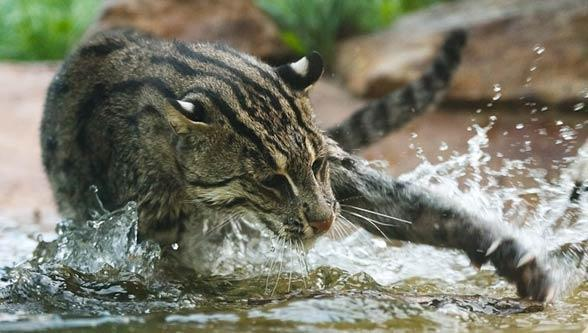
One of the most fascinating aspects of Fishing Cat behaviour is the use of its forepaws. Instead of relying entirely on its mouth to catch prey, the cat can use its paws to strike, scoop and pin aquatic animals.
Fish are difficult prey.
They move quickly. Their bodies are slippery. And water makes precise distance judgment more challenging.
The Fishing Cat’s paws therefore become highly important hunting instruments. The cat can reach into shallow water, strike at prey and attempt to secure it before it escapes. The claws provide additional grip.
And the partially webbed feet assist with movement through the wet environment. It is still the same basic feline paw. But in the Fishing Cat, it has become a tool for exploiting aquatic prey.
A Cat That Enters Its Hunting Ground
The Fishing Cat does not always remain on dry land while hunting.
- It can wade into shallow water.
- It can swim.
- And it can dive after prey.
This ability changes the relationship between predator and habitat. For a terrestrial predator, entering water can increase vulnerability.
- Movement becomes harder.
- The body becomes wet.
- Escape routes become limited.
For the Fishing Cat, these disadvantages are reduced by evolution.
- Its body is adapted to wetland life.
- Its swimming ability allows it to pursue prey beyond the shoreline.
- Its dense coat helps it cope with wet conditions.
And its partially webbed feet contribute to aquatic movement. The result is a predator capable of using a hunting environment that many other cats cannot exploit with the same efficiency.
Is the Fishing Cat Really “Fishing”?
Perhaps the most famous behaviour associated with the species is its interaction with the water’s surface.
Fishing Cats have been observed tapping or disturbing the surface with their paws.
The behaviour has been interpreted as potentially attracting fish by creating disturbances that may resemble the movement of insects or other organisms on the water.
It is an intriguing behaviour.
But it is important not to turn it into a cartoon version of the animal.
The Fishing Cat is not literally using a fishing rod. And not every Fishing Cat necessarily uses this behaviour every time it hunts.
- Its hunting strategy is flexible.
- It may wait.
- It may strike from the edge.
- It may enter shallow water.
- It may pursue prey.
- It may dive.
The surface disturbance is one fascinating tool within a much larger behavioural repertoire. And that makes it even more interesting.
The Fishing Cat does not have one fishing technique. It has an entire toolkit for exploiting water.
A Flexible Predator in an Unpredictable Wetland
The name “Fishing Cat” can create the impression that fish are its only food. They are not. The species is capable of hunting a wide range of prey. Its diet can include:
- Fish
- Frogs and other amphibians
- Crabs and other crustaceans
- Molluscs
- Rodents
- Birds
- Reptiles
- Other small wetland animals
This flexibility is especially valuable in the Sundarbans. The availability of prey changes across habitats and seasons.
- A shallow creek may be productive at one time.
- A muddy margin may provide opportunities later.
- Birds may become available along exposed banks.
- Crabs may emerge from their burrows.
- Small mammals may move through vegetation.
The Fishing Cat can exploit these different opportunities. It is therefore better understood as a wetland generalist predator with a remarkable specialization for aquatic prey, rather than simply a fish-eating cat.
The Sundarbans Provides More Than Water
The Fishing Cat’s hunting world is not restricted to the water itself. The muddy margins of tidal creeks can be equally important. As the tide changes, exposed surfaces may reveal crabs, amphibians and other potential prey. Vegetation along the bank can harbour rodents and birds.
The cat can move between these environments. This ability to hunt at the interface between water and land is one of its greatest ecological advantages. It does not have to choose between the two.
It can use both.
Hunting in a Landscape That Changes
The Sundarbans present a unique challenge for any predator. The landscape changes with the tide.
- Water enters.
- Water retreats.
- Channels change in depth.
- Mudbanks appear and disappear.
Aquatic animals move with the changing conditions. For the Fishing Cat, this means its hunting environment is constantly being reorganised. The cat cannot control the tide.
It has to operate within it. This does not mean that Fishing Cats have been proven to follow a simple rule such as “hunt only at low tide” or “hunt only at high tide.”
Such claims would oversimplify a complex animal. Instead, the important point is ecological: the cat hunts inside a food web whose structure is influenced by tidal movement. That is a very different environment from an inland pond or static freshwater wetland.
Built Like a Cat, Modified by the Wetlands
The Fishing Cat has not evolved into an entirely different kind of animal. Its basic body plan remains feline. But several characteristics work together to make it highly effective in wet environments.
Strong, compact body
Its muscular build helps it move through water and tackle slippery prey.
Relatively short legs
These give it a low, stable body profile when moving through shallow wetland environments.
Partially webbed hind feet
The webbing assists aquatic movement and is one of the species’ most distinctive adaptations.
Incompletely sheathed claws
The claws remain partially exposed and can help with traction and prey handling.
Dense coat
Its coat provides protection and insulation in a frequently wet environment.
Shorter tail
Its relatively short tail distinguishes it from several other similarly sized cats and contributes to its compact appearance.
None of these characteristics alone explains the Fishing Cat. Together, they tell a story. The entire animal is shaped around a life close to water.
When the Wetlands Become Quiet
After sunset, the Sundarbans change.
- Human activity decreases.
- The forest becomes darker.
- The temperature can fall.
Many aquatic and terrestrial animals continue moving through the landscape.
For a secretive predator, darkness can provide additional opportunities. Fishing Cats are often active at night, particularly during periods of low human disturbance. But they are not strictly nocturnal.
Camera-trap studies have documented daytime activity as well. This flexibility is important. A predator should respond to its environment rather than obey a rigid clock.
The Fishing Cat can use darkness when it offers an advantage while remaining capable of activity during daylight.
A Small Predator With a Large Ecological Connection
The Fishing Cat’s hunting behaviour reveals the structure of the Sundarbans food web. Start with a fish.
- The fish depends on the aquatic ecosystem.
- The aquatic ecosystem depends on water movement, nutrients and habitat.
- The mangroves contribute to the wider productivity of the landscape.
The Fishing Cat captures the fish.
The cat then becomes part of the larger ecological system. This is why predators matter even when they are not at the top of the food chain. They regulate prey populations. They move energy through ecosystems.
And their presence can tell us whether suitable habitat remains. The Fishing Cat is therefore not simply another animal living in the mangroves. It is one of the links connecting the aquatic and terrestrial sides of the Sundarbans.
When the Hunter Becomes the Hunted
The Fishing Cat is a predator. But it is not invulnerable.
Young individuals are especially vulnerable to larger predators and other threats. Adults face risks from habitat degradation, human conflict and other pressures. And the very habitat that makes the Fishing Cat successful can also expose it to danger.
- A wetland can be converted.
- A creek can be altered.
- A road can divide habitat.
- A fish farm can create conflict.
- A fragmented landscape can isolate populations.
The ability to hunt in water cannot protect an animal from the disappearance of the water itself.
Why the Hunting Story Matters?
The Fishing Cat’s hunting behaviour is more than a collection of unusual facts. It explains why the species exists where it does.
- Why wetlands matter.
- Why tidal creeks matter.
- Why healthy prey populations matter.
And why protecting the species means protecting an entire ecosystem.
A Fishing Cat cannot survive simply because a few fish remain.
- It needs functioning habitat.
- It needs cover.
- It needs access to water.
- It needs prey.
And it needs enough space to move through the landscape. Its hunting behaviour therefore becomes a conservation story. Protect the hunt, and you protect the habitat that makes the hunt possible.
The Sundarbans Difference
The Fishing Cat is remarkable wherever it occurs. But the Indian Sundarbans adds something extraordinary to its story. Here, the cat does not hunt beside a static freshwater wetland.
- It hunts within an estuarine, tidal, mangrove ecosystem.
- Its potential prey moves through waterways influenced by the tide.
- Its habitat is divided by creeks and channels.
- Its cover is provided by mangrove vegetation.
- Its hunting ground can be submerged and exposed repeatedly.
And its territory exists within one of the world’s most dynamic coastal ecosystems. This is what makes the Sundarbans Fishing Cat story so compelling. It is not simply a story about a cat that catches fish. It is a story about a predator that has learned to live at the boundary between two worlds.
Land and water.
When Water Is Home, Habitat Loss Means More
For many terrestrial animals, habitat loss means losing trees, grassland or shelter. For the Fishing Cat, the problem is more complicated. Its habitat is a combination of: water + vegetation + prey + muddy margins + ecological connectivity.
Remove any major part of that equation and the quality of the habitat can decline. A wetland may still appear to exist on a satellite image.
But if the water is polluted, prey depleted, vegetation removed or waterways fragmented, it may no longer function as a suitable Fishing Cat landscape. This is why conservation cannot be reduced to simply protecting an area on a map. The ecosystem has to remain alive.
A Stronghold With a Warning
West Bengal occupies a particularly important place in the Fishing Cat’s conservation story. Recent research has described the state as a major stronghold for the species in India, with confirmed populations occurring across a variety of wetland landscapes in southern Bengal.
This is encouraging.
But the same research also highlights an important warning. Much of the Fishing Cat’s potential habitat lies outside formally protected areas. A 2024 study of southern West Bengal identified Fishing Cats across numerous wetland landscapes and found that the majority of modelled suitable habitat occurred outside protected areas.
This means that the species’ survival cannot depend entirely on wildlife reserves. It also depends on how people manage the wetlands around them.
When a Natural Hunter Meets Aquaculture
The Fishing Cat’s ability to catch fish becomes a problem when its hunting ground overlaps with commercial fish production.
Aquaculture ponds can provide an attractive concentration of prey. From the perspective of the cat, the opportunity is obvious. From the perspective of a farmer whose livelihood depends on the fish, the situation can be very different.
A Fishing Cat may be viewed as a competitor or pest. Conflict can lead to persecution. This creates one of conservation’s most difficult challenges: the animal is behaving exactly as evolution designed it to behave.
It is the human landscape that has changed around it. Effective conservation therefore requires more than telling people to tolerate wildlife.
It requires practical solutions that allow local communities to protect their livelihoods while reducing harm to the animal.
A Different Kind of Threat
Roads create another danger.
A road may appear small compared with the enormous scale of the Sundarbans and southern Bengal.
But for a small nocturnal mammal moving between wetlands, a road can become a deadly barrier.
Fishing Cats may cross roads while moving between habitat patches or searching for food.
- At night, visibility is reduced.
- Vehicles move quickly.
- A single crossing can become fatal.
Recent research in southern West Bengal has identified road mortality as one of the threats facing Fishing Cats.
This is an important reminder that wildlife conservation is not always about spectacular threats.
Sometimes survival depends on something as ordinary as a road crossing.
A Future Written in Water
The Sundarbans faces another challenge that extends beyond any single species. Climate change and sea-level rise are expected to place increasing pressure on low-lying coastal ecosystems. The Sundarbans is especially vulnerable because it exists at the meeting point of river, land and sea.
- Changing rainfall patterns.
- Increasing temperatures.
- Extreme weather.
- Sea-level rise.
- Coastal erosion.
- Changes in salinity.
These processes can alter the structure and productivity of the ecosystem. For the Fishing Cat, the consequences may not always be immediate. But changes in the wetland can eventually affect prey, vegetation, habitat availability and movement. The species therefore becomes part of a much larger climate story.
Protecting the Predator Means Protecting the Food Web
It is tempting to think of conservation as protecting the animal itself. But predators are only as secure as the ecosystems supporting them.
A Fishing Cat cannot survive without prey.
- If fish populations decline severely, the cat loses one of its major food resources.
- If wetlands become degraded, amphibians and crustaceans can also decline.
- If vegetation is removed, terrestrial prey and cover may change.
The Fishing Cat’s survival therefore depends on an entire network of species. This is why habitat conservation is so powerful. Protecting the food web protects the predator.
Why Science Matters
The Fishing Cat is notoriously difficult to study.
- It is elusive.
- It is mostly solitary.
- It often moves at night.
- Its habitat can be difficult to access.
And in the Sundarbans, waterways can make direct observation especially challenging. This is why modern conservation relies heavily on technologies such as camera trapping. A camera trap can remain active for days or weeks.
- It can record an animal moving through an area without disturbing it.
- It can reveal patterns that human observers would otherwise miss.
And repeated surveys can help researchers understand distribution, activity and population trends. The Sundarban Tiger Reserve’s Fishing Cat assessment is an important example of this approach.
The State Animal of West Bengal
The Fishing Cat holds a special distinction. It is the state animal of West Bengal. That makes its conservation story particularly significant. The species represents more than one protected landscape.
- It represents the state’s wetlands.
- Its rivers.
- Its marshes.
- Its floodplains.
- Its coastal ecosystems.
And its extraordinary biodiversity.
For a state whose identity is so closely connected with water, the Fishing Cat is an appropriate symbol. It is a wild cat that has made water part of its life.
Why Do the Sundarbans Matter to its Future?
The Sundarbans may be one of the places where the Fishing Cat’s relationship with wetlands can continue at a large ecological scale. The landscape offers extensive mangrove habitat.
- It contains a complex network of tidal waterways.
- It supports abundant aquatic and terrestrial biodiversity.
And substantial areas remain protected from intensive development. But protection cannot be taken for granted. The Sundarbans is a dynamic ecosystem.
Its future depends on maintaining the natural processes that sustain it.
If the mangroves remain healthy, waterways remain functional and prey communities remain productive, Fishing Cats have a better chance of surviving.
If those foundations weaken, the consequences eventually reach the predator.
What Makes the Sundarbans Fishing Cat So Extraordinary?
The Fishing Cat is unusual anywhere it lives. But in the Indian Sundarbans, its story becomes even more remarkable. This is not simply a small wild cat that happens to eat fish.
It is a predator shaped by wetlands, equipped for water, and living within one of the most dynamic tidal landscapes on Earth.
- Its paws tell part of the story.
- Its swimming ability tells another.
- Its hunting behaviour reveals more.
But the deepest story is written in its relationship with the Sundarbans itself.
- A cat that can enter water.
- A predator that can hunt aquatic prey.
- A mammal that can move through a landscape divided by tidal creeks.
- And a species whose survival depends on the continued health of wetlands.
That combination makes the Fishing Cat one of the most fascinating animals of the Sundarbans.
1. A CAT THAT ACTUALLY HUNTS IN WATER
Most people instinctively associate cats with dry ground. The Fishing Cat challenges that image. It is a strong swimmer and is capable of diving after aquatic prey. It can enter shallow water to pursue fish and other aquatic animals, sometimes using its paws to strike or scoop prey.
This is not simply a cat that occasionally gets wet. Water is part of its hunting environment. That distinction is important.
- A tiger may cross a river.
- A leopard may swim when necessary.
- A Fishing Cat can make water part of its normal predatory strategy.
That is one of the clearest examples of its uniqueness.
2. PARTIALLY WEBBED FEET
One of the Fishing Cat’s most famous adaptations is found at the end of its legs. Its feet are partially webbed. The webbing does not transform the cat into an aquatic animal. Instead, it provides an additional advantage when moving through water.
This is a remarkable example of evolutionary adaptation.
The Fishing Cat retained the basic anatomy of a feline paw while gaining a small but meaningful modification for life around wetlands. Its feet can help it move through shallow water while its claws remain useful for gripping prey. It did not evolve away from being a cat. It evolved to become a better cat for wetlands.
3. ITS CLAWS ARE DIFFERENT TOO
The Fishing Cat also has an unusual claw structure. Its claws are incompletely sheathed and remain partially exposed when retracted. This characteristic can help with traction and prey handling.
For an animal hunting slippery fish in wet environments, grip matters. Imagine trying to hold a fish with wet paws.
- One movement.
- One twist.
- And the prey is gone.
The Fishing Cat’s combination of paw structure, claws and muscular body gives it an advantage when dealing with this difficult prey. The adaptation is subtle. But together with its webbed feet and swimming ability, it becomes part of a larger pattern. The animal is built around the water.
4. IT CAN SWIM AND DIVE
The Fishing Cat’s aquatic ability extends beyond wading. It can swim and dive after prey. This allows it to exploit a hunting environment that many terrestrial predators cannot use effectively. Underwater, the rules change. The prey moves in three dimensions.
The surface reflects light. Water reduces visibility. And the predator must control its own movement while pursuing prey. The Fishing Cat is capable of entering that environment and hunting within it.
That does not make it an aquatic mammal. It remains a terrestrial cat. But it is a terrestrial predator with an unusually strong aquatic hunting ability. For a cat, that is extraordinary.
5. A DENSE COAT FOR A WET LIFE
Water creates another challenge. Getting wet can reduce body heat and make movement more difficult. The Fishing Cat’s dense coat helps provide protection in its frequently wet environment. Its layered fur helps reduce water penetration and provides insulation.
Again, the adaptation is not dramatic. There is no thick layer of blubber. No specialised flippers. No fully waterproof body.
Instead, the Fishing Cat has evolved a combination of features that allows it to function effectively in wetland habitats. This is a recurring theme in its biology. It is not an aquatic animal pretending to be a cat. It is a cat modified by evolution for life around water.
6. A CAT WITH A SHORTER, POWERFUL BUILD
The Fishing Cat has a distinctive physical appearance. It is stocky and muscular, with relatively short legs and a comparatively short tail. Its body gives it a powerful appearance for its size.
This compact structure is useful in a habitat where a predator may need to move through vegetation, mud and shallow water rather than sprint across open ground. The Fishing Cat is not built like a cheetah. It does not need to chase prey over long distances. Its hunting strategy is based more on: stealth + patience + positioning + sudden attack.
That strategy works particularly well around the edges of wetlands.
7. IT CAN FISH WITH ITS PAWS
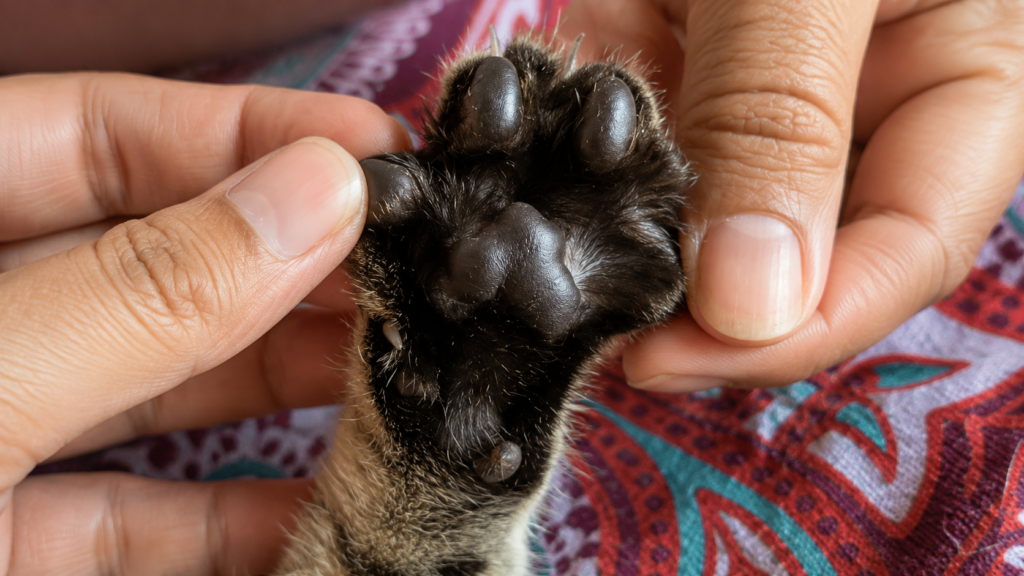
This may be the most visually fascinating behaviour of the species. The Fishing Cat can use its paws to catch aquatic prey. Instead of relying only on its jaws, it can strike at fish from the edge of the water or scoop prey from shallow water.
The paw becomes a hunting instrument. This is particularly useful because fish are slippery and fast. The Fishing Cat must react quickly.
- One movement.
- One strike.
- One opportunity.
And when it succeeds, the aquatic world has supplied the predator with its meal.
8. IT MAY DISTURB THE WATER TO ATTRACT PREY
Fishing Cats have been observed tapping or disturbing the surface of water with their paws. This behaviour is often described as a fishing technique.
One hypothesis is that the disturbance can resemble the movement of insects or other organisms on the surface and potentially attract fish.
It is a fascinating behaviour. But it should not be exaggerated. Not every Fishing Cat necessarily uses this technique, and it is only one component of a broader hunting repertoire.
The more interesting point is that the species is capable of manipulating its environment during hunting.
It does not simply wait for prey to appear. It can interact with the water itself.
9. IT DOES NOT LIVE ON FISH ALONE
The name Fishing Cat can create an overly narrow picture of the animal. Its diet is considerably broader. Depending on habitat and prey availability, Fishing Cats can consume:
- Fish
- Amphibians
- Crabs and other crustaceans
- Molluscs
- Rodents
- Birds
- Reptiles
- Other small animals
This flexibility is particularly valuable in the Sundarbans. The tidal environment is constantly changing. Prey availability changes with season, habitat and water conditions. A predator capable of switching between aquatic and terrestrial prey has greater flexibility.
The Fishing Cat is therefore not simply a fish specialist. It is a wetland predator with an exceptional ability to exploit aquatic prey.
10. IT CAN MOVE BETWEEN LAND AND WATER
This is one of the most important things to understand about the species. The Fishing Cat does not belong exclusively to land. And it does not belong exclusively to water.
It lives between them. It can move through vegetation.
- Walk across muddy ground.
- Wade into shallow water.
- Swim through a creek.
And potentially dive after prey.
That gives it access to several ecological zones within a single landscape. In the Sundarbans, this is especially valuable. The landscape itself is divided into land and water.
- For many terrestrial animals, that division is a barrier.
- For the Fishing Cat, it can be an opportunity.
11. THE SUNDARBANS FISHING CAT LIVES IN A TIDAL WORLD
This is where the story becomes specifically Sundarbans. The Fishing Cat does not simply live beside a river or freshwater pond. It inhabits a landscape of: mangroves + tidal creeks + mudflats + estuarine waters + wetlands.
- The water level changes.
- The shoreline shifts.
- Mudbanks emerge and disappear.
- Channels change.
- Aquatic prey moves through the system.
The Fishing Cat therefore lives in a landscape that is physically dynamic. Its hunting world is constantly being rewritten by the tide. That does not mean the cat follows a rigid tidal schedule.
Rather, it lives within an ecosystem whose productivity and physical structure are strongly influenced by tidal movement. This is what makes the Sundarbans version of the Fishing Cat story so special.
12. IT LIVES WHERE MANGROVES MEET WATER
The Fishing Cat’s habitat relationship gives us another distinctive Sundarbans connection. It can use wetland edges where mangrove vegetation meets water. These areas provide several resources simultaneously.
- Cover from vegetation.
- Access to aquatic prey.
- Mud for movement.
- Terrestrial prey nearby.
And escape routes through dense habitat. This makes the mangrove-water interface especially important. The Fishing Cat is therefore not simply a resident of the forest. It is a resident of the forest-water boundary.
13. THE WATER THAT SEPARATES ISLANDS CAN ALSO CONNECT THEM
The Sundarbans is an archipelago of islands separated by waterways. For many terrestrial animals, water creates fragmentation. But the Fishing Cat’s swimming ability gives it an unusual advantage.
Water can become a route of movement. A channel that separates two areas of habitat may not always be an impassable barrier. The cat can enter the water and cross.
This does not mean every waterway is safe or easy to cross. Tidal currents, depth and other hazards can create serious risks. But compared with many terrestrial predators, the Fishing Cat has an additional movement capability. In the Sundarbans, the water can divide habitat—and also connect it.
14. IT SHARES THE SUNDARBANS WITH THE ROYAL BENGAL TIGER
There are two very different feline stories in the Sundarbans. One is famous. The other is largely hidden. The Royal Bengal Tiger is the iconic apex predator of the mangrove forest. The Fishing Cat is a smaller predator strongly associated with wetlands and aquatic prey.
They share the same extraordinary landscape. But they use it differently.
- The tiger represents the power of the terrestrial predator.
- The Fishing Cat represents the adaptability of the wetland predator.
One dominates the popular imagination. The other quietly reveals how much of the Sundarbans exists beyond the tiger’s story.
15. IT IS THE STATE ANIMAL OF WEST BENGAL
The Fishing Cat has another distinction that makes its story especially relevant to The Wild Orbit. It is the state animal of West Bengal. That is significant because West Bengal contains some of India’s most important Fishing Cat habitats.
Its wetlands stretch across river systems, floodplains, coastal areas and the Sundarbans. The Fishing Cat therefore represents a much larger ecological identity. It is a symbol of the state’s relationship with wetlands. And in the Sundarbans, that relationship becomes visible at its most dramatic.
16. WEST BENGAL IS A MAJOR STRONGHOLD
Recent research has identified West Bengal as a major stronghold for Fishing Cats in India. The species has been documented across numerous wetland landscapes in southern Bengal, including areas outside protected forests.
This is both encouraging and challenging. Encouraging because the species still occupies a significant landscape. Challenging because much of that habitat exists in areas where wildlife must coexist with people.
The Fishing Cat’s future in India will therefore depend heavily on what happens to the wetlands of West Bengal.
17. THE SUNDARBANS SUPPORTS AN IMPORTANT POPULATION
The Fishing Cat has been documented within the Sundarbans Tiger Reserve through dedicated surveys.
A 2022 status assessment by the reserve reported a probable estimate of approximately 385 individuals across the surveyed ranges, using its camera-trapping and ocular-estimation methodology.
That number should not be interpreted as an exact current census. It is a study-specific estimate.
- Populations change.
- Survey methods improve.
- And the landscape itself is constantly changing.
But the finding is important because it demonstrates that the Fishing Cat represents a significant component of the reserve’s wildlife. The Sundarbans is therefore not simply a location where Fishing Cats occur.
It is an important landscape for their conservation.
18. ITS SURVIVAL DEPENDS ON A HEALTHY WETLAND
Perhaps the most important uniqueness of the Fishing Cat is not something visible on its body. It is its dependence on an entire ecosystem.
- The cat needs water.
- The water supports fish.
- The wetland supports crustaceans, amphibians, birds and other prey.
Mangroves provide structure and cover. The wider ecosystem maintains productivity. The Fishing Cat connects these elements through predation. That makes its survival closely connected to the health of the wetland itself.
- When wetlands disappear, Fishing Cats lose their hunting grounds.
- When prey declines, the cat loses food.
- When habitat becomes fragmented, movement becomes harder.
- When human conflict increases, mortality can rise.
The Fishing Cat therefore acts as a reminder: saving the animal means saving the ecosystem around it.
19. A PREDATOR THAT CAN BECOME INVISIBLE
The tiger announces the presence of the Sundarbans. The Fishing Cat often does the opposite.
- It disappears.
- Its patterned coat blends into vegetation.
- Its solitary behaviour reduces encounters.
- Its activity is often concentrated around low-light periods.
- Its habitat is difficult to access.
And the waterways create countless places to hide. This makes the Fishing Cat one of those animals that can be abundant enough to matter ecologically while remaining almost invisible to people.
A visitor may travel through its habitat without ever seeing one. That does not mean the animal is absent. It may simply be better at remaining unseen.
20. THE FISHING CAT IS A STORY ABOUT EVOLUTION
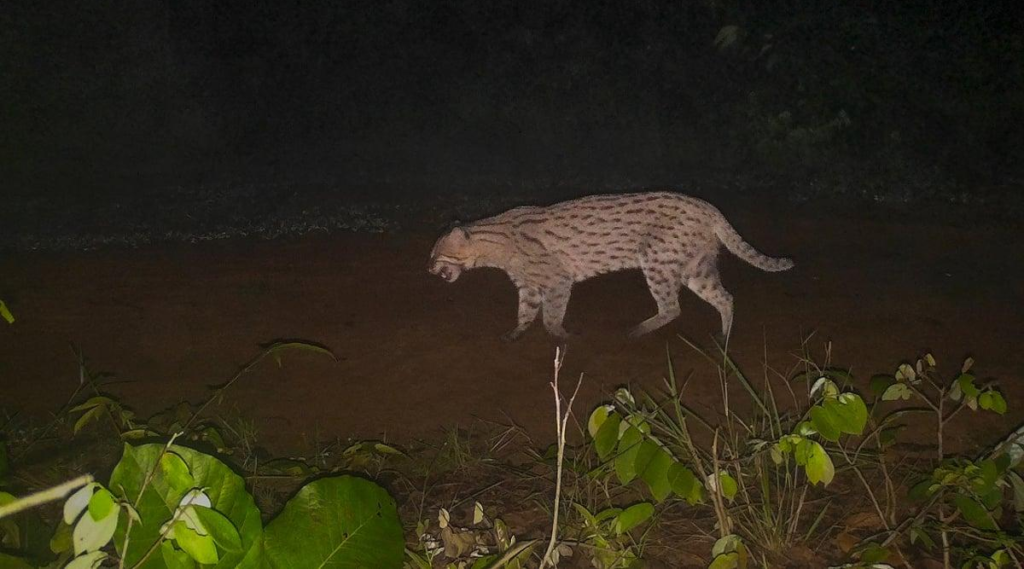
Perhaps the greatest uniqueness of the species is the evolutionary story behind all these traits. Consider what had to happen. A cat moved into wetland environments. Water became an increasingly important source of prey.
- Individuals that could move efficiently through shallow water had an advantage.
- Individuals capable of catching aquatic prey had an advantage.
Features that improved traction, swimming and hunting became useful. Over generations, these characteristics became part of the species. The result is not a fully aquatic cat. It is something more interesting.
A terrestrial predator that evolved enough aquatic ability to make wetlands its hunting ground.
The Sundarbans Fishing Cat: The Ultimate Uniqueness
Now bring all the pieces together.
- A wild cat with partially webbed feet.
- A predator capable of swimming and diving.
- A hunter that can catch fish with its paws.
- An animal that may disturb the water while hunting.
- A flexible predator that can eat aquatic and terrestrial prey.
- A solitary and secretive species.
- A cat whose habitat is strongly associated with wetlands.
- A West Bengal state animal.
- A species of major conservation importance in southern Bengal.
And, in the Sundarbans, a predator living inside an estuarine mangrove system governed by tides. That combination is extraordinary. The Sundarbans does not simply provide another place for the Fishing Cat to live.
It provides a landscape that amplifies everything that makes the species special. Here, the animal’s relationship with water becomes inseparable from the landscape itself.
The Cat That Belongs to the Tidal Edge
The Fishing Cat is often introduced with a simple description: “A wild cat that eats fish.” But that description is far too small for the animal. It is a cat that has learned to hunt in water.
- A predator that can cross the boundary between land and creek.
- A species whose feet carry aquatic adaptations.
- A hunter capable of diving after prey.
- A creature whose existence is tied to wetlands.
And in the Indian Sundarbans, it is an inhabitant of a landscape where the tide itself helps shape the world in which it hunts. That is the real story. Not simply the story of a cat. But the story of evolution meeting water.
THE WILD ORBIT’S FINAL INSIGHT
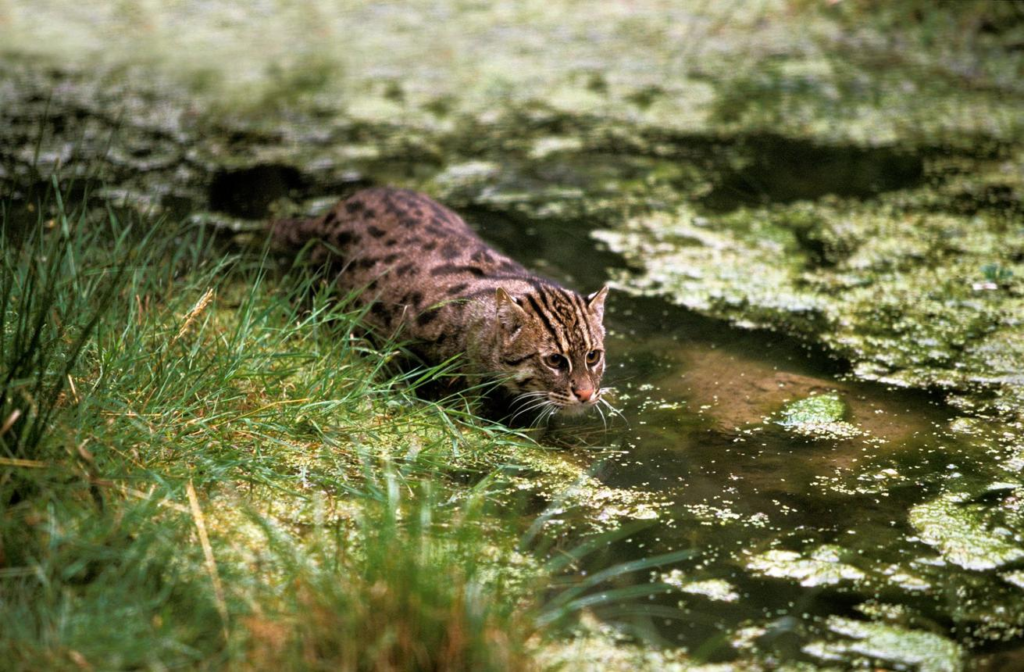
The Fishing Cat does not need to be the largest animal in the Sundarbans to be extraordinary.
- It does not need the roar of a tiger.
- It does not need the size of a crocodile.
- It does not need to dominate the landscape.
Its power lies in adaptation.
- In a world of mud and mangroves, it learned to move through water.
- In a world of slippery prey, it learned to hunt with its paws.
- In a landscape divided by tidal channels, it learned to swim.
And in an ecosystem that changes with every tide, it learned to survive at the edge of two worlds.
The tiger may rule the mangrove forest. But at the water’s edge, another cat has mastered a different kingdom. The Fishing Cat.
And in the Sundarbans, where every tide redraws the boundary between land and water, its story becomes one of the clearest expressions of adaptation in the entire ecosystem.
Plan your private Sundarban expedition
A private journey shaped around you — your group, your pace, your interests. Book a free consultation.