 Field guide
A small, adaptable wild cat found across wetlands, grasslands and scrub.
At first glance, the Jungle Cat (Felis chaus) can look deceptively familiar. Its plain sandy-grey coat, long legs and relatively short tail lack the dramatic markings associated with many other wild cats. Yet this unassuming appearance belongs to one of South Asia’s most adaptable small felids.
In the Indian Sundarbans, the Jungle Cat occupies a particularly interesting place among the region’s lesser cats. Recent camera-trap surveys have confirmed Jungle Cats alongside Fishing Cats and Leopard Cats in the Indian Sundarbans, demonstrating that the mangrove landscape supports more than the better-known Fishing Cat.
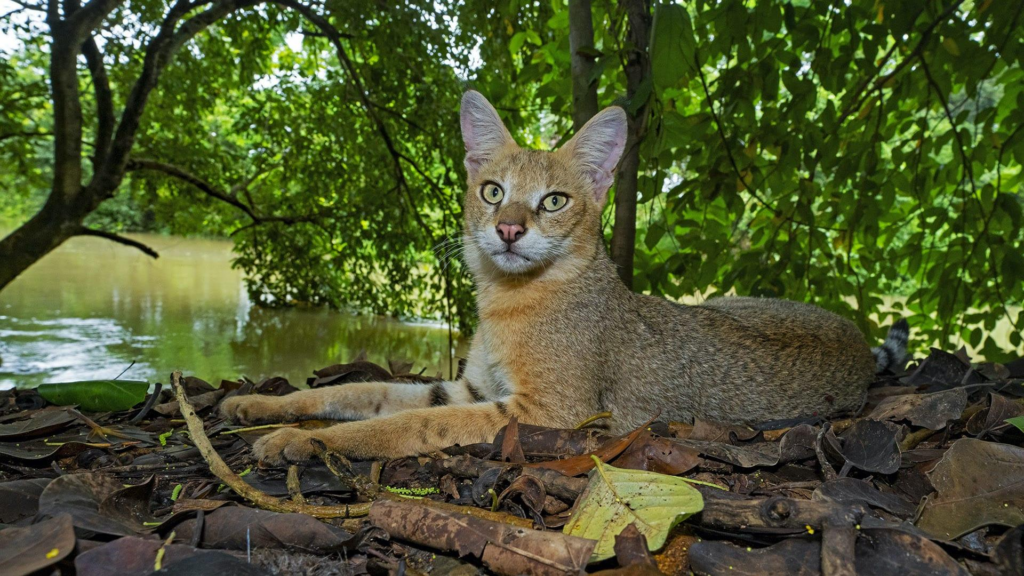
But calling the Jungle Cat a “mangrove cat” would oversimplify its ecology. Across its wider Indian range, the species is associated with wetlands, grasslands, scrub, agricultural landscapes and open or moderately vegetated habitats. A 2026 nationwide study found that Jungle Cats were more strongly associated with warm landscapes with moderate vegetation cover and low to moderate human and livestock disturbance, while dense forests were generally less suitable.
In the Sundarbans, therefore, its story is not simply about surviving inside dense mangrove forest. It is a story about a flexible predator moving through a landscape where forest, water, mudflats, grass, settlements and reclaimed land meet.
Jungle Cat At a Glance
- Common Name: Jungle Cat
- Scientific Name: Felis chaus
- Family: Felidae
- Order: Carnivora
- Type: Small wild cat
- Global IUCN Status: Least Concern
- Population Trend: Decreasing
- Indian Legal Protection: Schedule II under India’s Wildlife Protection Act, according to recent Indian research
- Primary Diet: Small mammals, especially rodents
- Other Prey: Birds, reptiles, amphibians, fish and insects
- Typical Character: Solitary and predominantly terrestrial
- Indian Sundarbans: Recorded by camera traps alongside other lesser cats
What Does a Jungle Cat Look Like?
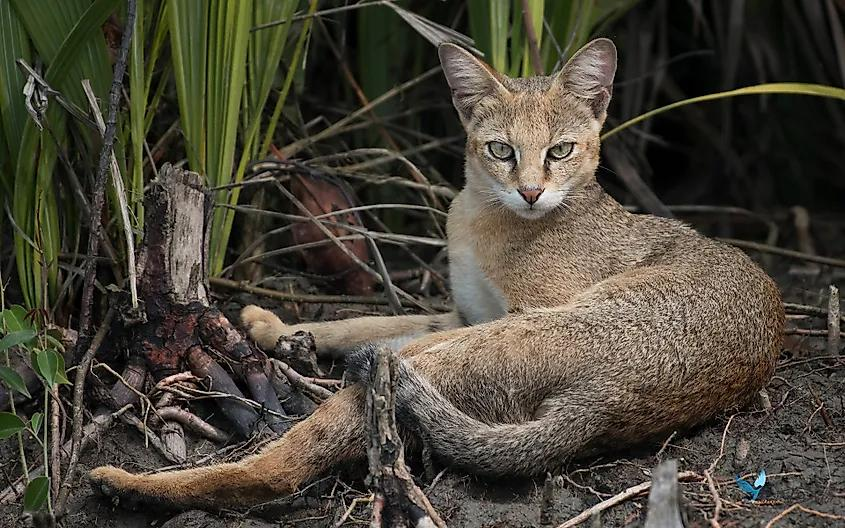
The Jungle Cat is a medium-sized wild cat with a relatively long-legged, lean appearance. Its body is generally sandy, tawny, greyish or brownish, with comparatively little of the bold spotting or striping seen in many other small felids.
Its most distinctive feature is often its ears.
The ears are relatively large and rounded, with characteristic dark tips. This gives the animal a somewhat different profile from the domestic cat and helps make an otherwise plain-looking animal easier to identify.
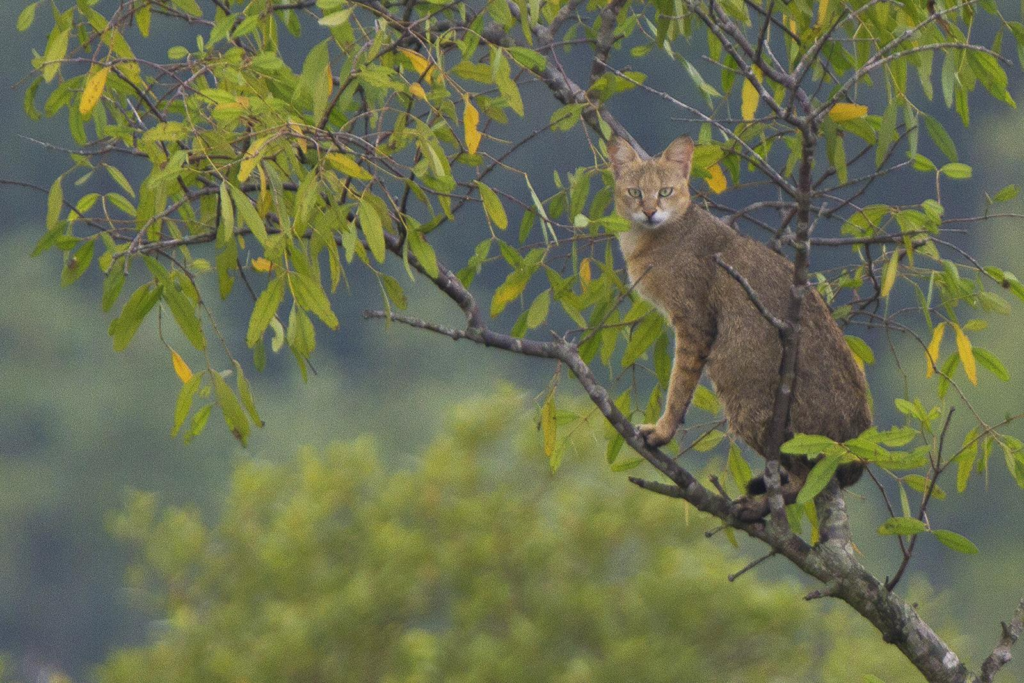
The tail is comparatively short for a cat of its size, usually ending in a darker tip. The legs are long and the body is built for moving through open vegetation, grass and wetland margins rather than climbing trees as a primary strategy.
There is also considerable variation in body size across its geographic range. Adult males are generally larger than females.
The overall impression is not of a heavily built predator. It is a cat designed for movement, concealment and sudden pursuit.
Where Does the Jungle Cat Live?
The name can be misleading.
The Jungle Cat does not require dense jungle.
Across its broad distribution, it occurs in a surprisingly wide variety of landscapes. These include wetlands, river margins, reed beds, grasslands, scrub, agricultural areas, dry forests and other habitats with sufficient cover and prey.
This ecological flexibility is one reason the species has maintained a broad distribution across parts of Asia and the Middle East.
Recent research across India provides an important refinement. Rather than simply preferring “wild” landscapes, Jungle Cats were most likely to occur in warm environments with moderate vegetation cover and relatively low to moderate levels of human and livestock disturbance. Dense forests and highly transformed habitats were less favourable.
This distinction matters in the Sundarbans.
The Jungle Cat in the Indian Sundarbans
The Indian Sundarbans contains a community of lesser cats that exists beneath the ecological shadow of the Royal Bengal Tiger.
The Jungle Cat is one of them.
Recent camera-trap surveys conducted in the Indian Sundarbans have recorded Jungle Cats together with Fishing Cats and Leopard Cats. These records demonstrate that the species remains part of the contemporary small-carnivore community of the Sundarbans.
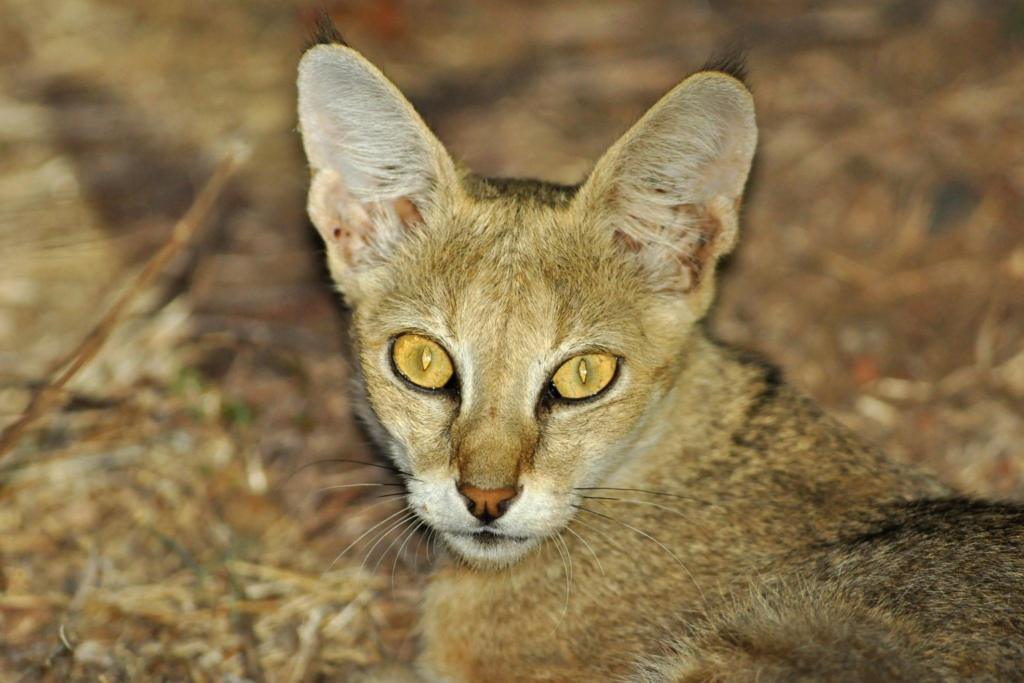
Earlier documentation also recorded the Jungle Cat from reclaimed areas associated with the Sundarbans, showing that its relationship with this landscape has not been restricted to the most intact mangrove forest. UNESCO’s periodic conservation report for Sundarbans National Park listed the Common Jungle Cat among mammals recorded from reclaimed areas.
This is ecologically significant.
The Indian Sundarbans is not a uniform wilderness. It is a mosaic of tidal forests, waterways, mudflats, agricultural land, villages, embankments and human-modified landscapes. A species capable of using more open and transitional habitats can therefore occupy ecological spaces that are different from those used by more specialized forest or wetland predators.
At the same time, the available evidence does not justify describing the Jungle Cat as abundant throughout the Sundarbans. The species is less conspicuous than the tiger, and its population status within the Sundarbans remains much less thoroughly studied.
That uncertainty should remain part of the story.
Landscape and Habitat
Imagine the Sundarbans away from the dramatic image of a wall of mangroves.
At the edge of a settlement, grasses move above a muddy embankment. Beyond them, a narrow creek carries brown, sediment-rich tidal water. A patch of scrub breaks the line of vegetation, while cultivated fields occupy slightly higher ground.
These transitional spaces can be important to small carnivores.
The Jungle Cat generally favours habitats where cover and prey occur together. Wetlands, reed beds, tall grass and riverside vegetation can provide both concealment and hunting opportunities. It is also capable of using agricultural landscapes and areas modified by people.
This makes habitat structure more important than the simple label of “forest”.
For a Jungle Cat, a landscape with sufficient vegetation cover, prey availability and relatively low disturbance may be more valuable than a landscape that merely appears wild.
Rivers and Water Systems
Water is an important ecological component of Jungle Cat habitat, but this should not be confused with the highly aquatic adaptations of the Fishing Cat.
Jungle Cats frequently occur close to wetlands and water bodies because these environments can support abundant prey and dense vegetation.
In the Sundarbans, the relationship becomes more complex because virtually every terrestrial habitat is influenced by tides.
Creeks and rivers constantly reshape the boundaries between land and water. Mudbanks appear and disappear, vegetation is exposed or submerged, and the availability of prey changes with tidal conditions.
For a terrestrial small predator, this produces a shifting hunting landscape.
The Jungle Cat’s presence in such a system therefore reflects behavioural flexibility rather than dependence on the water itself.
How Does the Jungle Cat Hunt?
The Jungle Cat is primarily a predator of relatively small animals.
Rodents form an important component of its diet. Research from India has demonstrated the significance of rodents to the energy intake of Jungle Cats, with small mammals playing a particularly important role in the diets of felids studied in semi-arid landscapes.
But the Jungle Cat is not restricted to rodents.
Its prey can include:
- Small mammals
- Birds
- Frogs and other amphibians
- Lizards
- Snakes
- Fish
- Insects
The exact composition of its diet changes according to habitat and prey availability.
This makes the Jungle Cat an important small predator within the food web.
In agricultural landscapes, that role can become especially visible because rodents may be abundant around crops and human settlements. The same ecological relationship that makes the cat valuable as a predator can, however, bring it into conflict with people when poultry or other domestic animals are taken.
A Predator of Small Prey
A Jungle Cat does not need to bring down large prey to influence its ecosystem.
A field of grass may contain rodents. A wetland edge may hold frogs. Reed beds can conceal birds, while shallow water may provide fish.
The cat moves between these opportunities.
Its hunting strategy is generally based on stealth and sudden attack rather than prolonged pursuit. Its long legs help it move through vegetation and open terrain, while its hearing and vision help locate small prey.
The result is a predator whose ecological influence can be disproportionate to its size.
Research in India has repeatedly highlighted the importance of small mammals in Jungle Cat diets, reinforcing its role as a predator of abundant small prey.
Behaviour
Jungle Cats are generally solitary outside the breeding period.
Individuals use scent marking and other forms of communication to maintain social spacing and communicate reproductive status. Vocalisations include meows, purrs, growls, hisses and other calls, although the meaning of many vocalisations remains insufficiently studied.
They can be active during both daylight and darkness, although activity patterns vary according to location, season and environmental conditions.
Studies of Jungle Cats in India have found substantial nocturnal activity, particularly when compared with some sympatric carnivores.
This flexibility may be particularly useful in human-influenced landscapes, where avoiding periods of intense human activity can reduce encounters.
Jungle Cat and the Other Sundarbans Cats
The Indian Sundarbans supports several small felids, but they do not all occupy exactly the same ecological niche.
- The Fishing Cat is strongly associated with wetlands and is particularly adapted to hunting in aquatic environments.
- The Leopard Cat is a smaller spotted forest cat capable of using a range of habitats.
- The Jungle Cat, by contrast, is generally more closely associated with open habitats, wetlands, grass and scrub than with dense forest.
This separation of habitat and food resources can reduce direct competition between closely related predators.
The presence of all three species in the Indian Sundarbans makes the region especially valuable for understanding how small carnivores coexist within a highly dynamic landscape. Recent camera-trap work has documented all three felids in the Sundarbans.
Reproduction and Kittens
Jungle Cats are generally solitary animals, but reproduction temporarily changes this pattern.
Breeding seasons vary geographically. Gestation is approximately two months, and litters commonly contain several kittens. Sources report litter sizes of roughly three to six kittens and a gestation period of about 63–66 days.
The mother plays the central role in raising the young.
Kittens develop hunting abilities relatively early, gradually moving from dependence towards independence as they grow. Available behavioural information indicates that young Jungle Cats may become independent at around eight to nine months.
For a species whose survival depends heavily on small prey and suitable cover, the survival of young animals is closely tied to the quality and continuity of habitat.
Why Is the Jungle Cat Important?
It is easy to overlook a predator that weighs far less than a tiger.
But ecosystems are not maintained only by their largest animals.
The Jungle Cat occupies the role of a small terrestrial carnivore, consuming rodents and other small vertebrates. Through predation, it participates in regulating populations of animals lower in the food web.
Its presence can also tell us something about habitat.
A landscape capable of supporting a Jungle Cat needs sufficient prey, cover and ecological connectivity. Its occurrence is therefore part of the wider picture of biodiversity beyond flagship species.
In the Sundarbans, where conservation attention naturally centres on tigers, crocodiles and other iconic wildlife, lesser cats remind us that ecological richness exists at many scales.
Conservation Status
The Jungle Cat is currently classified as Least Concern on the IUCN Red List. However, Least Concern does not mean that every population is secure or that local declines are unimportant. The IUCN assessment identifies habitat loss and other human pressures as significant concerns, while the 2026 India-wide study highlights fragmentation, infrastructure, road mortality and other emerging pressures.
The 2026 national assessment is particularly important because it shows that a species can remain geographically widespread while still facing increasing pressure at local and landscape scales.
For the Jungle Cat, conservation therefore cannot rely exclusively on large protected forests.
Open habitats, grasslands, wetlands, scrublands and agricultural mosaics can all matter.
Threats to the Jungle Cat
Habitat Loss and Fragmentation
The conversion of open habitats, agricultural landscapes and scrubland can remove suitable Jungle Cat habitat.
Infrastructure can fragment remaining habitat into smaller, isolated areas, making movement between populations more difficult.
Road Mortality
See it for yourself
A private journey shaped around you — your group, your pace, your interests. Book a free consultation.
Roads create a direct mortality risk, particularly where wildlife habitat intersects with expanding infrastructure. Recent Indian research identifies road mortality as an increasing concern for the species.
Human-Wildlife Conflict
Jungle Cats may occasionally prey on poultry and other domestic animals. Where this happens, the animal can be perceived as a pest and become vulnerable to persecution.
Habitat Conversion
The IUCN identifies industrialisation, urbanisation and conversion of low-intensity agricultural and scrub habitats as important threats, particularly in South Asia.
Domestic Cat Interactions
Hybridisation with domestic cats has been proposed as a potential threat, although its population-level significance remains uncertain and requires further research. It should therefore be treated as a potential, rather than established, major threat.
The Jungle Cat and the Sundarbans’ Human Landscape
One of the most important lessons from the Jungle Cat is that wildlife conservation does not always mean separating nature from people.
The species can use human-modified landscapes, but that flexibility has limits.
As settlements expand, roads multiply and natural vegetation becomes increasingly fragmented, the spaces between suitable habitats can become harder to cross. At the same time, encounters around poultry and other domestic animals can create conflict.
The conservation challenge is therefore not simply to protect forest.
It is to maintain a functioning landscape.
For the Jungle Cat, that may include wetlands, grass, scrub, agricultural margins and vegetated corridors alongside protected habitats.
Conservation Significance in the Indian Sundarbans
The Jungle Cat deserves attention precisely because it is easy to miss.
It does not have the tiger’s cultural visibility. It does not possess the Fishing Cat’s obvious association with water. Its coat does not offer the striking pattern of the Leopard Cat.
Yet camera-trap evidence confirms that it remains part of the Sundarbans’ lesser-cat community.
The next step is better understanding.
The 2026 nationwide assessment notes that Jungle Cat monitoring has often relied on incidental records and by-catch from camera-trap surveys designed primarily for larger carnivores. Because Jungle Cats lack individually distinctive coat patterns like tigers and leopards, estimating abundance through conventional capture-recapture approaches is also difficult.
This leaves an important research opportunity in the Sundarbans.
More focused studies could help establish how Jungle Cats use different habitat types, how they respond to tides and seasonal changes, how they interact with other small carnivores and how human activity affects their distribution.
The Wild Orbit’s Interesting Facts About the Jungle Cat
- It is not actually a specialist forest cat.
Despite its common name, Jungle Cats often use grasslands, wetlands, scrub and agricultural landscapes. - Its ears are one of its easiest identifying features.
The relatively large ears with dark tips give it a distinctive silhouette. - Rodents are important prey.
Studies in India have shown that rodents can provide a substantial share of the Jungle Cat’s energy intake. - It can live surprisingly close to people.
The species has demonstrated an ability to use agricultural and human-modified landscapes, although increasing disturbance and habitat fragmentation create risks. - It is one of the lesser cats of the Indian Sundarbans.
Recent camera-trap surveys have recorded Jungle Cats together with Fishing Cats and Leopard Cats. - Its global status is Least Concern, but populations can still face local threats.
- The species is protected in India.
Recent Indian research identifies the Jungle Cat as a Schedule II species under the Wildlife Protection Act.
FAQs
Is the Jungle Cat found in the Sundarbans?
Yes. Jungle Cats have been recorded in the Indian Sundarbans, including through recent camera-trap surveys that also documented Fishing Cats and Leopard Cats.
Is the Jungle Cat a mangrove specialist?
No. The Jungle Cat is ecologically flexible and occurs across wetlands, grasslands, scrub, agricultural landscapes and other habitats. Its presence in the Sundarbans should not be interpreted as evidence that it is dependent on dense mangrove forest.
What does a Jungle Cat eat?
Rodents are particularly important, but the species can also consume birds, reptiles, amphibians, fish and insects.
Is the Jungle Cat dangerous to humans?
The Jungle Cat is a small, generally solitary wild predator and is not regarded as a significant threat to people. Like other wild animals, it should be observed from a safe distance and never cornered or handled.
What is the conservation status of the Jungle Cat?
The species is currently listed as Least Concern globally by the IUCN, although its population trend is recorded as decreasing and several regional threats are increasing.
How is the Jungle Cat different from the Fishing Cat?
The Fishing Cat is more strongly adapted to wetland and aquatic hunting, whereas the Jungle Cat generally uses a wider range of open, grassy, scrub and wetland habitats. Both occur in the Indian Sundarbans.
How is the Jungle Cat different from the Leopard Cat?
The Leopard Cat is usually smaller and distinctly spotted, while the Jungle Cat has a relatively plain sandy-grey coat, long legs, a short tail and prominent ears.
The Jungle Cat’s Place in the Sundarbans
The Jungle Cat does not announce itself.
There is no dramatic roar, no unmistakable pattern and no reputation that draws crowds towards it. In many landscapes, it survives at the edge of attention—moving through grass, wetlands, scrub and cultivated margins while searching for the small animals that sustain it.
In the Indian Sundarbans, its presence adds another layer to an ecosystem already famous for its tigers and tidal forests.
But its story is also a reminder that the Sundarbans should not be understood only through its most spectacular wildlife.
A landscape is healthy not merely because its largest predator survives. It is healthy when the smaller predators, prey species, wetlands, vegetation and ecological connections that support them continue to function together.
The Jungle Cat is one of those quieter threads.
And sometimes, understanding the wild begins by noticing what is easiest to overlook.
Plan your private Sundarban expedition
A private journey shaped around you — your group, your pace, your interests. Book a free consultation.