Field guide
The Ancient Predator of the Tidal Forest
There are places in the Sundarbans where the forest seems to disappear into water.
At high tide, a creek rises beneath the mangrove canopy. Mudbanks narrow. Roots vanish beneath a moving sheet of brown, silt-laden water. Fish move through the submerged channels, crabs retreat into their burrows, and the boundary between land and river becomes almost impossible to define.
Then, on a falling tide, a shape may appear on the exposed mud.
It may look like a fallen log at first.
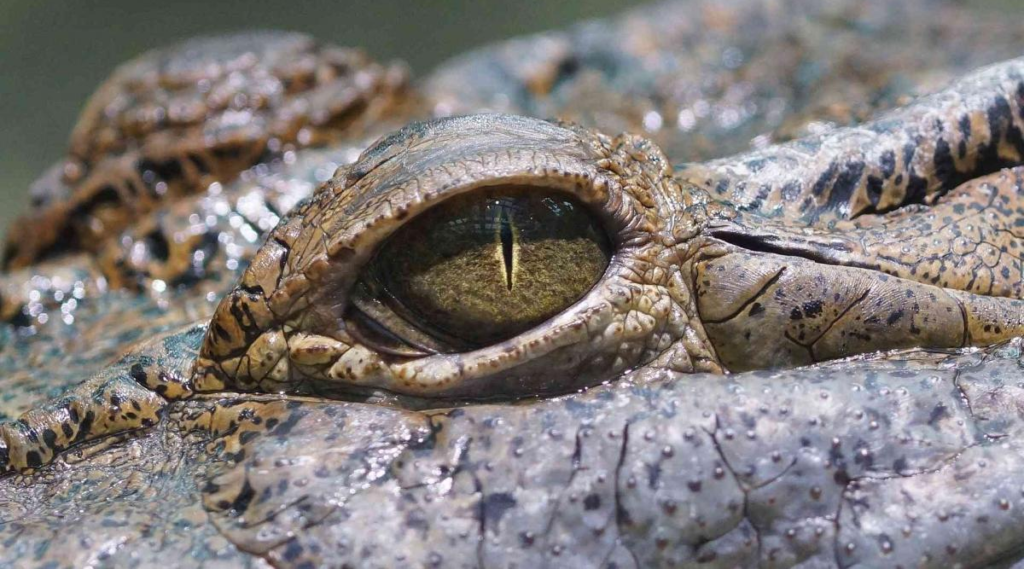
But the eyes are open.
The broad head is almost motionless. Only the water around the nostrils moves. The animal is not waiting for the forest to become quiet. It is waiting for the right opportunity.
This is the saltwater crocodile, Crocodylus porosus—the largest living crocodilian and one of the most formidable predators of the Indo-Pacific. In India, it survives in only a few coastal strongholds, including the mangrove waterways of the Sundarbans. The Wildlife Institute of India describes the Indian Sundarbans population as smaller than the major population at Odisha’s Bhitarkanika, while also recording the species throughout suitable mangrove and coastal habitats in the Andaman and Nicobar Islands.
But the most interesting story is not simply that a giant crocodile lives in a mangrove forest.
It is that the animal is perfectly suited to a landscape where almost nothing stays still.
The Sundarbans are shaped twice a day by tides, continually altered by sediment, rainfall, erosion, cyclones and changing salinity. Its rivers and creeks are not merely waterways. They are the animal’s roads, hunting grounds, boundaries and refuges.
For the saltwater crocodile, this is a world of moving water, shifting mud and extraordinary biological opportunity.
And in the Indian Sundarbans, its story is also a conservation story—one that has moved from historical depletion and intensive protection towards cautious recovery, while new challenges are emerging around nesting habitat and the changing delta.
A Crocodile Built for the Edge of Land and Sea
The saltwater crocodile belongs to the family Crocodylidae and the genus Crocodylus. Its scientific name is Crocodylus porosus, formally described by Johann Gottlob Schneider in 1801. It is also known as the estuarine crocodile or, informally, the “saltie.”
The name “saltwater crocodile” can create the wrong impression.
This is not simply a marine crocodile.
The species uses an extraordinary range of wetland environments, including tidal rivers, estuaries, swamps, coastal waters and non-tidal freshwater sections of rivers. Individuals can travel through marine environments between river systems, and long-distance movements across coastal waters have been documented.
That flexibility is important in understanding its relationship with the Sundarbans.
The Sundarbans itself refuses to fit neatly into categories. It is neither entirely land nor entirely water. It is an intertidal landscape in which rivers, creeks, mudflats, islands and mangrove forests constantly interact.
The saltwater crocodile belongs to this transition zone.
Its body reflects that lifestyle.
An adult crocodile has a heavily armoured body, a powerful tail, strong limbs and an elongated head equipped with formidable jaws. The eyes, ears and nostrils sit high on the head, allowing much of the animal to remain submerged while these sensory organs stay above the surface.
That simple arrangement transforms the animal into an ambush specialist.
A crocodile does not need to chase everything it eats.
It can disappear.
In a tidal creek, disappearing is an advantage.
The World’s Largest Living Crocodilian
C. porosus* is the largest living crocodilian species. Large males can exceed six metres in exceptional cases and may weigh more than a tonne, although such giants are not representative of the average animal encountered in the wild. Females remain substantially smaller.
Size changes the ecological role of a crocodile.
A very large individual is capable of taking a broad range of prey, from fish and birds to mammals, while also scavenging. The species is therefore not restricted to one narrow food source.
But size comes with another consequence.
A large predator needs space.
It needs waterways capable of supporting its body, access to prey, suitable places for thermoregulation and, critically, safe habitat in which reproduction can occur.
This is why simply knowing that crocodiles are present in the Sundarbans tells us very little.
The more important question is whether the landscape can continue to provide the different habitats required throughout the crocodile’s life.
A Predator That Does Not Need to Look Busy
One of the most misleading things about crocodiles is their apparent inactivity.
A crocodile lying motionless beside a tidal channel can appear almost lifeless.
Biologically, it may be doing exactly what it needs to do.
Crocodilians are ectothermic. Their body temperature is strongly influenced by the environment, so basking and other forms of thermoregulation are important parts of their daily behaviour. In the Sundarbans, the difference between sunlit mud and shaded water is therefore not merely visual. It can influence where a crocodile spends its time.
The 2024–25 Sundarbans assessment found that crocodiles showed associations with particular creek widths and winter basking temperatures, illustrating how physical habitat conditions influence their distribution.
The crocodile’s stillness is therefore not emptiness. It is economy. Energy is conserved. The animal allows the environment to do much of the work.
- The tide brings prey.
- The muddy bank provides a basking platform.
- The creek provides concealment.
And the crocodile waits.
A Landscape Designed By the Tide
The Indian Sundarbans is the southernmost portion of the vast Ganges-Brahmaputra delta and forms an intricate landscape of mangrove islands, tidal rivers, creeks, mudbanks and estuarine channels. Within the Sundarbans Tiger Reserve, the protected landscape covers about 2,584.89 square kilometres, including Sundarban National Park, Sajnekhali Wildlife Sanctuary and reserve forest areas.
Water is everywhere.
But not all water is the same.
Freshwater influence, tidal exchange, rainfall, evaporation and connection with the Bay of Bengal create gradients in salinity and water conditions across the delta.
For a saltwater crocodile, this variability is not necessarily a problem.
It is part of the habitat.
The species is capable of living across saline and freshwater environments, and its global distribution reflects this adaptability.
In the Sundarbans, however, the important point is not simply that the crocodile “can tolerate salt.”
The animal must interact with a complete tidal system.
- A creek may be narrow at one point and much wider farther downstream.
- A mudbank may be exposed for several hours and submerged later the same day.
- A forested island may provide nesting habitat, while a neighbouring channel provides access to prey.
The crocodile’s world is therefore three-dimensional and constantly changing.
Where Crocodiles Occur
Evidence from Indian Sundarbans surveys shows that saltwater crocodiles are not distributed uniformly across the landscape.
The 2022 assessment recorded their presence in Sajnekhali, the National Park East and West ranges and other parts of the Sundarbans Biosphere Reserve. It also documented use of inland water channels, with occupancy recorded across approximately 866 square kilometres of aquatic habitat.
A more recent assessment provides an even more detailed picture.
During the 2024–25 population and habitat study, survey teams covered approximately 1,168 kilometres of transects across the Sundarbans Biosphere Reserve. The study recorded 213 direct sightings and estimated the population at between 220 and 242 individuals.
The assessment reported associations with high-tide creek widths of roughly 10–130 metres, with a median around 90 metres, and a preferred salinity range of approximately 10–23 parts per thousand in the surveyed winter conditions. These figures should be understood as findings from that particular assessment, not as universal habitat requirements for every saltwater crocodile everywhere.
That distinction matters.
- Wildlife does not live according to a single number.
- A creek width is not a commandment.
- Salinity is not a switch that suddenly turns habitat on or off.
Instead, these measurements help researchers understand the combinations of environmental conditions associated with crocodile presence.
The Crocodile and the Tidal Creek
A Sundarbans creek is more than a channel of water.
It is a conveyor belt of life.
- Fish enter and leave with changing tides.
- Crabs occupy the muddy margins.
- Birds exploit exposed flats.
- Smaller animals move between forest and water.
For an opportunistic predator, such a system can be extraordinarily productive.
The crocodile can position itself along a bank or within shallow water and exploit animals that enter the channel. Its ambush strategy means that the predator does not need to spend enormous amounts of energy pursuing every potential meal.
This is particularly valuable in an ecosystem where visibility is often poor.
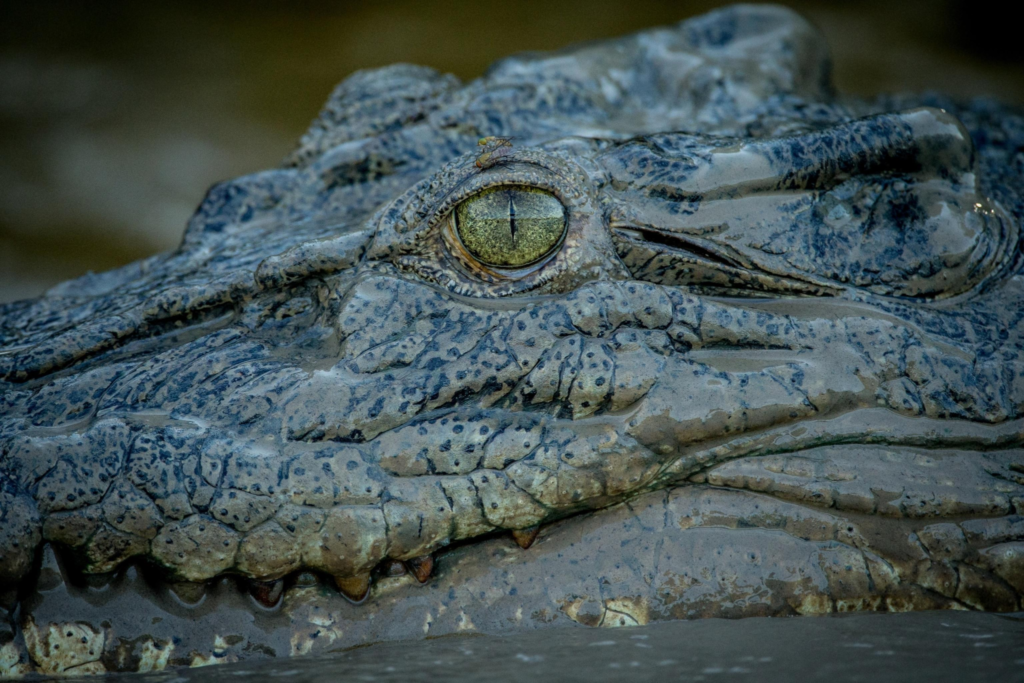
Sundarbans water is frequently opaque with suspended sediment. Roots, banks and shadows create visual complexity. The animal’s dark, textured body can become surprisingly difficult to distinguish from its surroundings.
The forest itself becomes part of the camouflage.
Islands, Banks and the Problem of Nesting Space
- For an adult crocodile, a large waterway can provide movement and hunting opportunities.
- For a nesting female, the requirements are different.
Reproduction introduces another dimension to the conservation story.
Saltwater crocodiles construct nests on land, and successful nesting depends on suitable sites with appropriate conditions for eggs to develop. Across the species’ range, nesting can be affected by flooding, temperature, predators and human disturbance. Historical research has documented substantial nest losses from flooding in some populations.
In the Sundarbans, the problem is intensified by geography.
- Land is limited.
- The islands are dynamic.
- Banks erode.
- Water levels change.
And people occupy parts of the wider delta.
The 2025 Sundarbans assessment highlighted a particularly important warning: crocodile rescues from human-dominated areas have been concentrated around May and June, coinciding with the nesting period, and many rescued animals were females.
Researchers interpreted this pattern as evidence that suitable nesting habitat on forested islands may be becoming scarce, potentially pushing nesting females towards fringe and human-dominated islands.
This is one of the clearest examples of why a species cannot be understood simply by counting adults.
A landscape can contain crocodiles and still be losing the habitat necessary for the next generation.
The Art of the Ambush
A saltwater crocodile does not need to behave like a pursuit predator.
Its hunting strategy is built around patience.
The crocodile places itself where prey are likely to pass and waits.
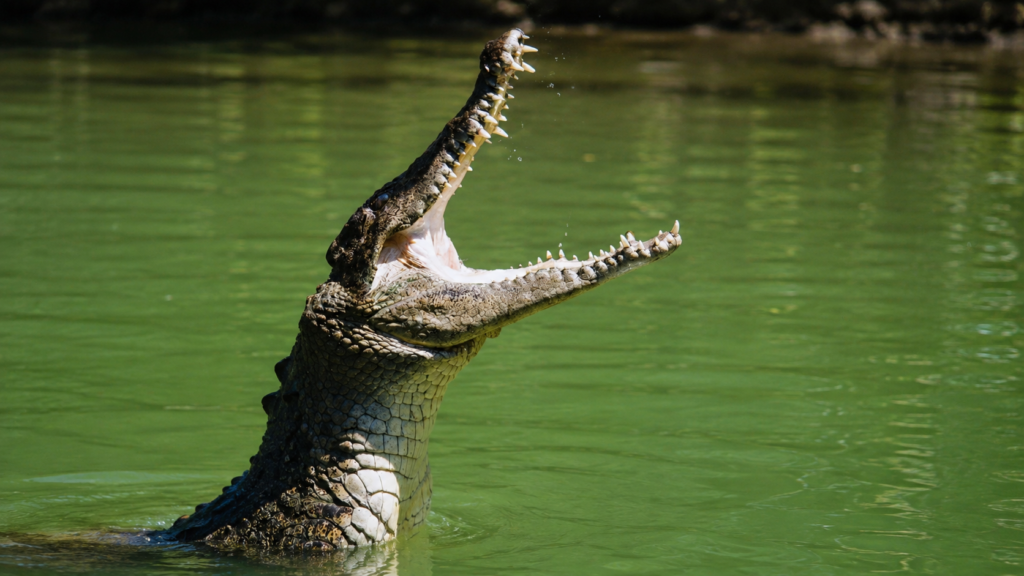
Only a fraction of the animal may be visible above water. When the opportunity arrives, the attack can be extraordinarily fast compared with the stillness that preceded it.
The jaws provide the initial capture mechanism, while the muscular body and tail supply power in the water.
For smaller prey, the outcome may be immediate.
For larger prey, crocodiles can use water as an additional weapon, dragging animals into deeper water and exploiting their own aquatic advantage.
The species has a broad diet that includes fish, birds and mammals, with dietary composition changing according to location, season, body size and prey availability.
This flexibility is one reason the crocodile fits so effectively into dynamic estuarine ecosystems.
Not Just a Hunter
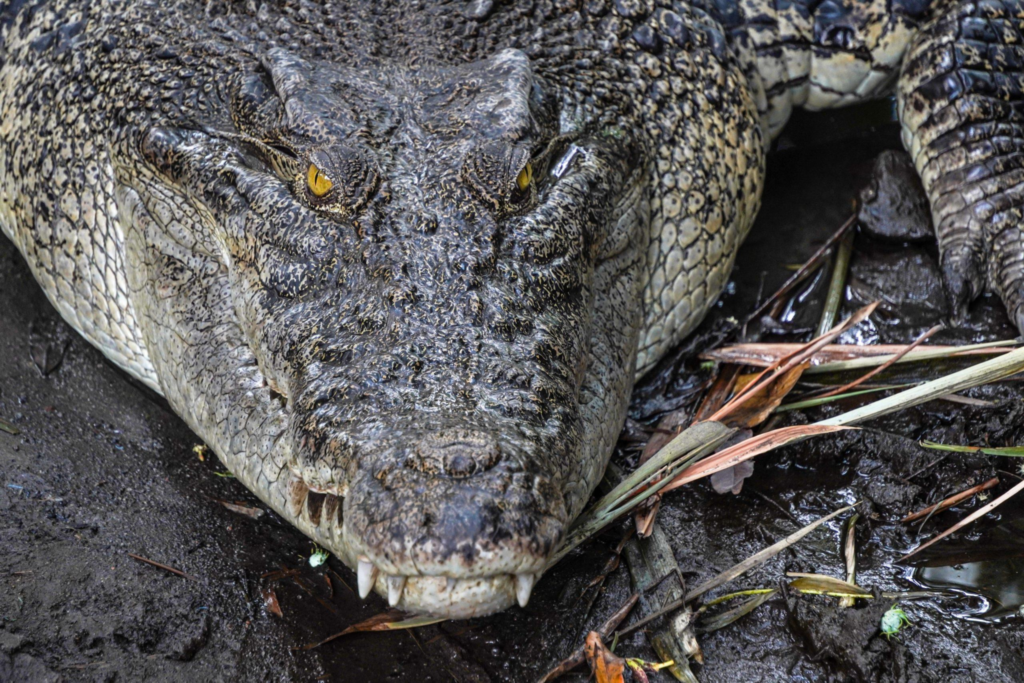
It is tempting to describe a large crocodile only as an apex predator.
That description is useful—but incomplete.
Saltwater crocodiles are opportunistic feeders and can also consume carrion. In an estuarine environment where fish, mammals and other animals die naturally or become stranded, scavenging can become an important ecological function.
The crocodile therefore participates in the system not only by killing prey but also by processing available animal biomass.
This matters because predators are part of nutrient pathways.
Energy captured by fish, birds and mammals eventually moves through the food web. A large aquatic predator sits near the upper end of that pathway.
The crocodile is not separate from the Sundarbans food web.
It is one of its largest expressions.
Tides As An Ecological Clock
- For a terrestrial observer, the tide can seem like scenery.
- For a crocodile, it can be a schedule.
The changing water level alters access to channels, mudbanks and prey. It changes where the animal can move and where it can remain concealed.
This is one reason crocodile behaviour in the Sundarbans should not be separated from hydrology.
The animal’s environment is not a static habitat. It is a moving habitat.
- A mudbank at low tide becomes underwater terrain at high tide.
- A narrow channel can become a broad waterway.
- A concealed bank can become exposed.
The crocodile responds to these changes through movement, thermoregulation, feeding and refuge use.
Thermoregulation: When the Sun Becomes Part of the Biology
Cold-blooded is an old-fashioned expression that often creates confusion.
Crocodiles are ectotherms: they obtain much of their body heat from external sources.
That means a crocodile can use sunlight as a biological resource.
On a cooler morning, an individual may position itself where solar radiation can raise body temperature. Later, it may retreat into water or shade as conditions become warmer.
The 2025 Sundarbans assessment recorded basking temperatures around 20–30°C during winter observations. Again, these are field observations associated with the surveyed population and season, rather than a universal “ideal temperature” for the species.
Seen from a distance, a basking crocodile looks inactive.
In reality, it is managing its physiology.
A Body Engineered for Water
See it for yourself
A private journey shaped around you — your group, your pace, your interests. Book a free consultation.
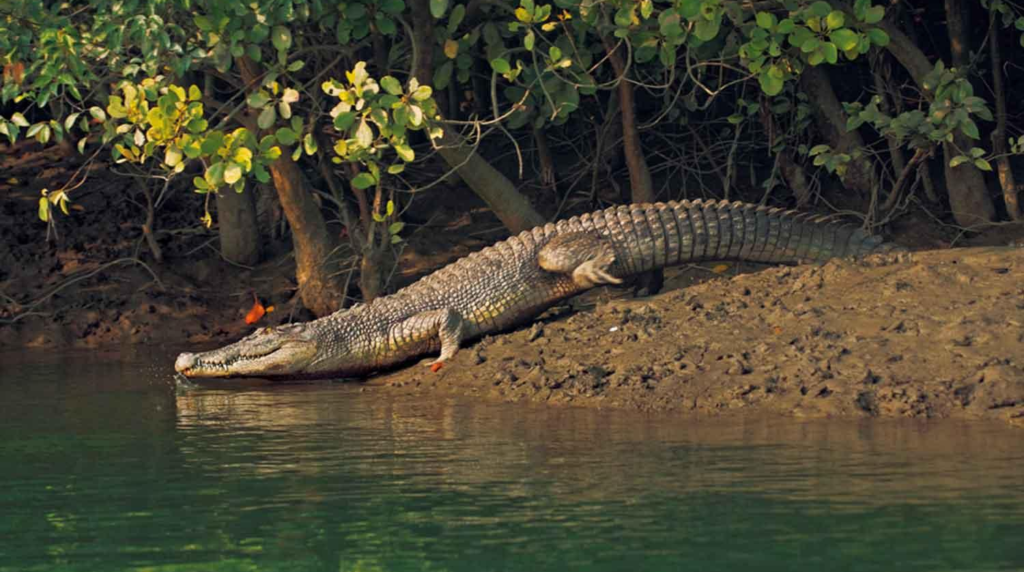
The saltwater crocodile’s anatomy reveals the same relationship.
- Its tail provides powerful propulsion.
- Its limbs can help with steering and movement in shallow water.
- Its eyes and nostrils positioned near the top of the head allow the animal to maintain sensory contact with the surface while much of the body remains submerged.
The skin is reinforced with scales and bony structures that provide protection.
The jaws are built for gripping rather than chewing in the mammalian sense. Crocodiles generally swallow food in pieces or whole, depending on prey size, rather than processing it with grinding teeth.
Its famous teeth are continuously replaced throughout life, another characteristic of crocodilian biology that helps maintain a functional feeding apparatus.
The result is not a creature designed for speed alone.
It is designed for efficiency.
Reproduction and the Next Generation
Reproduction is where the vulnerability of a large predator becomes visible.
The female lays eggs in a nest constructed on land. Clutch sizes can vary, and historical work across the species’ range has recorded clutches containing dozens of eggs. Incubation is typically around several months, with temperature and environmental conditions influencing development.
The female’s relationship with the nest is particularly important.
Crocodilians are unusual among reptiles in the degree of parental care some species provide. Saltwater crocodile females can guard nesting areas and respond to hatchling calls. They may help young emerge from the nest and assist them in reaching water.
But producing eggs is only the beginning.
A hatchling must survive flooding, predators, environmental extremes and competition.
And in the Sundarbans, it must also begin life in a landscape where the line between suitable habitat and human-used habitat can be extremely close.
That makes the increase in hatchling sightings reported in the 2025 assessment particularly noteworthy.
The latest survey recorded 23 hatchlings among the direct sightings, compared with only two reported during the preceding assessment. The researchers described the increase as encouraging, while also recommending continued monitoring to understand population trends and nesting sites.
One survey is not proof that the population is permanently secure.
But it is an important signal.
Least Concern Does Not Mean No Concern
Globally, the saltwater crocodile is currently classified as Least Concern on the IUCN Red List. The most recent assessment was published in 2021, based on an assessment conducted in 2019. The global population was considered secure largely because strong populations remain in countries including Australia and Papua New Guinea, alongside recovery in several other regions.
That global status needs context.
The IUCN itself uses the saltwater crocodile as an example of a species that can be Least Concern globally while having lost populations or becoming ecologically depleted across substantial parts of its former range.
Conservation status is therefore not a guarantee of local security.
A species can be globally widespread while a particular regional population remains vulnerable.
The Indian Sundarbans illustrates that distinction well.
From Depletion to Recovery
Historical exploitation severely affected crocodile populations across their range.
In the Sundarbans, commercial hunting and persecution contributed to major depletion in earlier decades. The Government of West Bengal’s coastal habitat documentation notes that crocodile populations suffered serious depletion historically and that fishing activities can still create mortality risks, including drowning in nets.
Protection changed the trajectory.
The Bhagabatpur Crocodile Project, established in West Bengal in 1976, became an important component of crocodile conservation in the region. Captive breeding and release programmes were undertaken alongside legal protection and habitat conservation.
The IUCN’s species assessment recorded that more than 450 C. porosus had been bred at the West Bengal Forest Department’s Sundarbans facility and released into the wild by March 2012.
Conservation is rarely one intervention.
It is usually a chain.
- Protection reduces deliberate killing.
- Breeding programmes can supplement populations.
- Habitat protection preserves feeding and nesting areas.
- Monitoring reveals whether numbers are changing.
- Community engagement can reduce conflict.
Together, these measures can allow a population to recover.
A Population Showing Encouraging Signals
The latest Indian Sundarbans assessment provides a useful example.
The 2024–25 survey estimated between 220 and 242 saltwater crocodiles in the Sundarbans Biosphere Reserve, compared with an estimated 204–234 in the previous assessment. The 2025 survey produced 213 direct sightings and covered approximately 1,168 kilometres of transects.
The researchers themselves caution that the estimate represents a population trend rather than an exact headcount.
That distinction should always accompany the numbers.
Wild crocodiles are difficult to count.
- They are partly submerged.
- They move.
- Visibility changes with tide and weather.
Some animals are missed.
Others may be encountered repeatedly.
Therefore, the value of the survey lies not simply in the number 220–242, but in the ability to compare standardized observations over time.
The increasing number of observed adults, juveniles and hatchlings is encouraging.
It does not eliminate the need for conservation.
Human-Crocodile Conflict
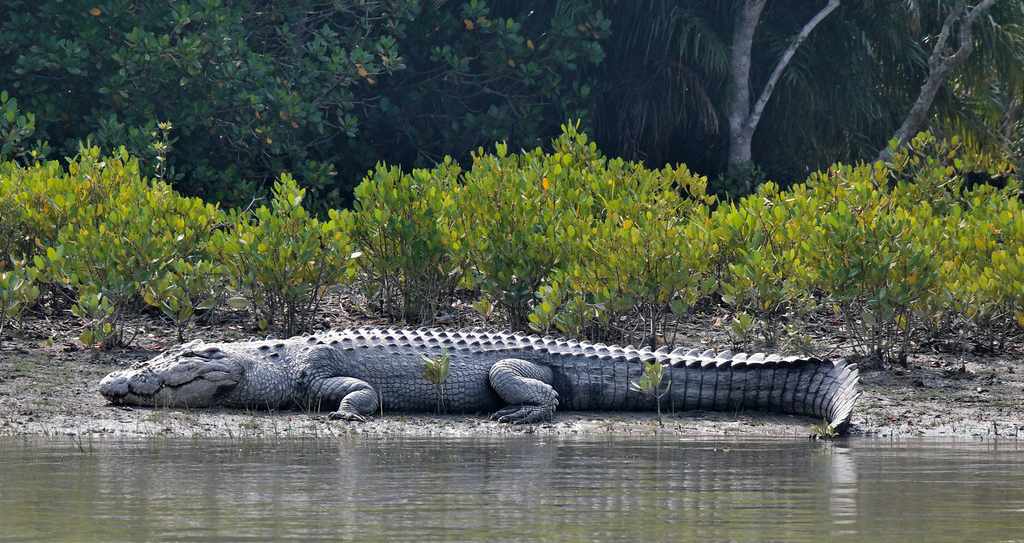
The Sundarbans is unusual because a major predator shares a water-dependent landscape with communities whose livelihoods may also depend on those same waterways.
- Fishers enter creeks.
- People collect crabs.
- Prawn-seed collection has historically been an important livelihood activity.
- Boats travel through channels.
The crocodile sees the water as habitat. People see it as livelihood space. That overlap can become dangerous.
A crocodile does not understand a human boundary.
Nor does a person working in a tidal creek necessarily have the luxury of choosing an empty waterway.
Human-crocodile conflict is therefore not simply a story of “dangerous animals attacking people.”
It is an ecological and social problem created where two species use the same landscape for different reasons.
Historical studies and contemporary reporting have documented crocodile attacks in the Sundarbans, particularly around water-based livelihood activities. Recent conservation reporting has also highlighted the continuing human-crocodile interface as crocodile numbers recover.
A successful conservation programme can paradoxically increase this challenge.
As crocodile numbers recover, encounters can become more likely.
Conservation must therefore include human safety and community participation, not simply protection of the animal.
The Changing Nesting Landscape
Perhaps the most important emerging concern is not the disappearance of adult crocodiles.
It is the availability of places where females can safely reproduce.
The 2025 assessment identified a pattern of crocodile rescues from human habitation during the nesting period, with many rescued animals being females. Researchers suggested that scarcity of suitable nesting habitat on forested islands may be pushing nesting crocodiles toward fringe and human-dominated areas.
This is precisely the kind of conservation issue that a simple population number can conceal.
If adults are alive but nesting habitat is progressively lost, the future population may eventually reflect that loss.
The problem is made more complicated by the physical instability of the delta.
Sea-level rise, erosion, changing salinity and warming conditions may interact with existing pressures. A 2025 government-linked report highlighted possible climate-related influences on suitable nesting habitat, including rising sea level, warming estuarine water and increasing salinity.
These factors should not be treated as a single proven causal chain for every nesting site.
The scientific task is to determine exactly how each variable affects nesting success.
But the warning is important.
The Sundarbans is changing.
And the crocodile’s future depends on whether its habitat changes faster than the species can adapt.
Why Conserving the Crocodile Protects More Than the Crocodile
Large predators occupy disproportionate ecological importance.
Their presence indicates that the ecosystem still supports substantial prey resources, aquatic connectivity and relatively intact habitat.
The saltwater crocodile is therefore more than a large reptile occupying a creek.
It is part of the biological integrity of the estuarine system.
- Protecting its waterways means protecting fish habitat.
- Protecting nesting banks means protecting parts of the island landscape.
- Reducing destructive fishing interactions can benefit multiple aquatic species.
- Maintaining healthy mangrove systems helps stabilize the wider ecological framework on which both wildlife and human communities depend.
The crocodile is not the entire Sundarbans. But its survival is tied to many of the processes that make the Sundarbans function.
What Makes the Saltwater Crocodile Extraordinary?
The saltwater crocodile is impressive because it is large.
But size is only the beginning.
Its real distinction lies in the combination of anatomy, behaviour, environmental tolerance and ecological flexibility that allows one animal to operate across a landscape where freshwater meets the sea and solid ground can disappear beneath the tide.
1. It is the Largest Living Crocodilian
What: Crocodylus porosus is the largest living crocodilian.
How: Its body can reach exceptional lengths, with males capable of exceeding six metres and weighing more than a tonne.
Why it matters: Extreme size gives the species access to prey unavailable to smaller predators and places the adult animal near the top of the aquatic food web.
2. It is Not Restricted to “Salt Water”
What: Despite its common name, the species can use both saline and freshwater environments.
How: It is physiologically and behaviourally capable of moving between different wetland environments, including tidal rivers, estuaries, coastal waters and inland waterways.
Why it matters: This flexibility is particularly valuable in the Sundarbans, where salinity and water conditions change across space and time.
3. It Can Cross Marine Environments
What: Saltwater crocodiles are capable of substantial movements through coastal and marine waters.
How: They can use currents and open water to move between river systems and coastal habitats.
Why it matters: The ability to move through marine environments helps explain the species’ broad geographic distribution and its ability to occupy fragmented coastal landscapes.
4. Its Hunting Strategy is Based on Patience
What: The species is a powerful ambush predator.
How: It remains concealed or nearly motionless and attacks when prey comes within range.
Why it matters: In turbid tidal waterways, camouflage and patience can be more efficient than prolonged pursuit.
5. Its Body Turns Water into an Advantage
What: The crocodile is exceptionally effective in aquatic environments.
How: Its powerful tail supplies propulsion, while the streamlined body and elevated sensory organs allow it to move and wait in water while maintaining awareness of the surface.
Why it matters: The same waterways that make the Sundarbans difficult for humans to navigate provide the crocodile with concealment and mobility.
6. It Can Use Thermoregulation Strategically
What: Crocodiles actively manage body temperature through environmental conditions.
How: They move between sun, shade and water according to thermal needs.
Why it matters: In a tidal landscape, mudbanks and exposed shores become physiological resources, not merely places to rest.
7. Females Provide Parental Care
What: Saltwater crocodile reproduction involves more than simply laying eggs.
How: Females can guard nests and assist hatchlings during emergence, with documented maternal responses to hatchling calls.
Why it matters: In a world where reptiles are often imagined as abandoning their young, crocodilians reveal a more complex form of parental investment.
8. Its Ecological Role Extends Beyond Active Hunting
What: Saltwater crocodiles can also scavenge.
How: They consume available animal matter, including carrion, when opportunities arise.
Why it matters: Their ecological influence therefore includes both predation and the processing of animal biomass within aquatic systems.
9. Its Global Recovery Has Been Uneven
What: The species is globally classified as Least Concern, but its conservation history is not uniformly positive.
How: Strong populations in several countries coexist with regional depletion or extirpation elsewhere.
Why it matters: A global status can hide local conservation problems. The Indian Sundarbans must therefore be monitored as its own population and landscape rather than treated as an automatic beneficiary of global abundance.
10. It is Becoming a Measurable Conservation Success in the Indian Sundarbans
What: Recent surveys indicate an encouraging population trend.
How: The 2024–25 assessment estimated 220–242 crocodiles and recorded 213 direct sightings, including adults, juveniles and hatchlings.
Why it matters: The result suggests that decades of legal protection, habitat conservation and management have produced meaningful recovery signals—but continued monitoring remains essential.
11. Hatchlings Provide a Particularly Important Signal
What: Young crocodiles were detected in greater numbers during the latest assessment.
How: The 2025 survey recorded 23 hatchlings among its direct sightings, compared with two during the preceding assessment.
Why it matters: Seeing more young animals suggests that reproduction is occurring successfully enough to become detectable, although a single survey cannot establish a long-term demographic trend.
12. The Sundarbans Create a Unique Ecological Challenge
What: The crocodile lives in a landscape where land, freshwater and saltwater are continually rearranged by tides.
How: It uses channels, banks and islands within a dynamic estuarine system.
Why it matters: Its survival depends not on one fixed habitat type, but on a functioning network of aquatic and terrestrial environments.
That is perhaps the most important lesson. The extraordinary thing about the saltwater crocodile is not simply that it can survive in salt water. It is that it has evolved to exploit the uncertainty of the coast.
What Makes the Sundarbans Saltwater Crocodile Story Distinctive?
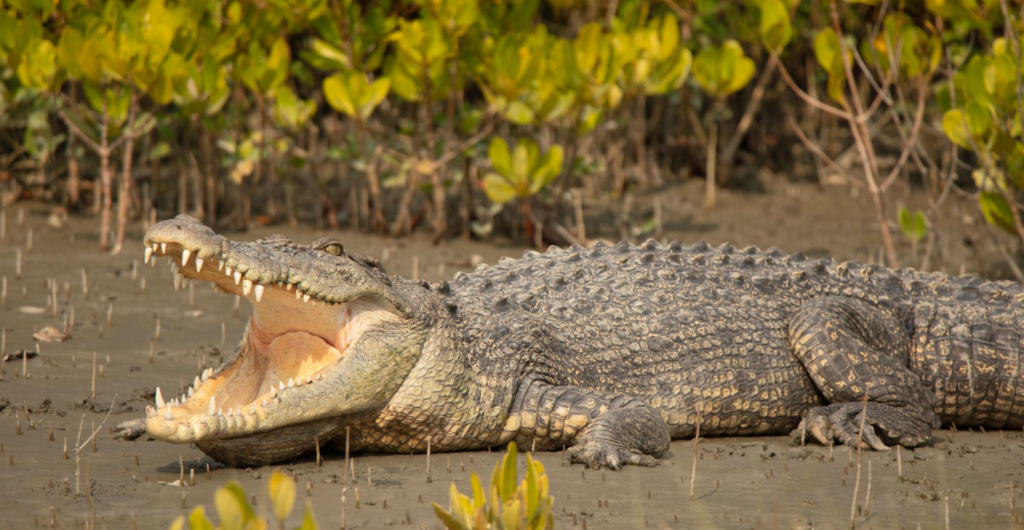
The Indian Sundarbans does not appear to host a formally recognized subspecies or a scientifically established “Sundarbans crocodile” distinct from Crocodylus porosus elsewhere.
That distinction is important.
The uniqueness of the Sundarbans population should not be manufactured through claims of special genetics or exclusive adaptations without evidence.
Its significance comes from ecology.
A Crocodile Living Inside a Tidal Mosaic
The species occupies waterways that are constantly reshaped by tides.
The 2022 assessment documented crocodile use of inland channels and approximately 866 square kilometres of occupied aquatic habitat, demonstrating that the Indian population is not confined to the obvious outer coastline.
A Population Surviving Inside a Human-used Delta
The crocodile’s habitat overlaps with a landscape where communities depend on fishing, crab collection and other water-based livelihoods.
That makes conservation unusually complex.
The goal cannot simply be “more crocodiles.”
It must be: healthy crocodile populations + healthy wetlands + safer human-wildlife coexistence.
A Population Recovering While Its Habitat Remains Dynamic
The 2025 estimate of 220–242 animals is encouraging, but the same assessment raised concerns about shrinking suitable nesting areas and crocodiles moving towards human-dominated islands during nesting season.
That combination makes the Indian Sundarbans particularly important. Recovery is happening.
But recovery is happening inside a changing landscape.
A Species Whose Conservation History is Tied to West Bengal
The long-running conservation effort associated with Bhagabatpur demonstrates that regional conservation can alter the trajectory of a large predator.
The crocodile’s story in West Bengal is therefore not simply one of decline.
It is also a story of protection, captive breeding, release, monitoring and gradual recovery.
The Wild Orbit’s Quick Facts About Saltwater Crocodile Sundarbans
Common Name: Saltwater Crocodile / Estuarine Crocodile
Scientific Name: Crocodylus porosus
Family: Crocodylidae
Order: Crocodylia
Global IUCN Status: Least Concern
Indian Legal Protection: Schedule I under India’s Wildlife (Protection) Act, as amended in 2022
CITES: Appendix I in most range countries, with specified exceptions
Indian Distribution: Sundarbans, Bhitarkanika and coastal areas of the Andaman and Nicobar Islands
Indian Sundarbans 2025 Estimate: Approximately 220–242 individuals in the Sundarban Biosphere Reserve
2025 Direct Sightings: 213
Major Habitat: Estuaries, tidal rivers, creeks, mangroves, wetlands and coastal waters
Diet: Fish, birds, mammals, reptiles and other available animal prey; scavenging also occurs
Ecological Role: Large aquatic predator and scavenger
Key Adaptations: Powerful tail, ambush hunting, aquatic specialization, environmental thermoregulation and tolerance of variable salinity
Sundarbans Significance: One of the region’s largest aquatic predators and an important part of the mangrove food web
The global IUCN classification is based on the 2021 assessment, while the Indian Sundarbans population figure comes from the 2024–25 West Bengal Forest Department assessment and should not be confused with a global population estimate.
FAQs
Where are saltwater crocodiles found in the Indian Sundarbans?
They occur in suitable aquatic habitats across parts of the Indian Sundarbans, including Sajnekhali and the East and West ranges of the National Park. The 2022 assessment also recorded use of inland water channels and estimated occupancy across approximately 866 square kilometres of aquatic habitat.
How many saltwater crocodiles are in the Indian Sundarbans?
The 2024–25 West Bengal Forest Department assessment estimated approximately 220–242 saltwater crocodiles in the Sundarbans Biosphere Reserve. This is an assessment of population size and trend rather than an exact headcount.
What do saltwater crocodiles eat?
Their diet is broad and varies with size and habitat. Fish, birds and mammals can form part of the diet, and the species is also capable of scavenging.
Are saltwater crocodiles endangered?
Globally, Crocodylus porosus is currently classified as Least Concern by the IUCN. However, this global status does not mean every regional population is secure. Some historical populations have disappeared or remain severely depleted, making local monitoring and conservation important.
Why are saltwater crocodiles important to the Sundarbans?
They are among the largest predators in the Sundarbans’ aquatic food web. Their presence reflects the availability of suitable waterways and prey, while their protection is connected to maintaining healthy wetland and mangrove habitat.
Why are crocodiles sometimes found near human settlements?
Recent Sundarbans research suggests that nesting females may be moving towards fringe and human-dominated islands as suitable nesting areas within forested islands become scarce. This creates increased opportunities for human-crocodile encounters, particularly during nesting season.
Can saltwater crocodiles live in freshwater?
Yes. Despite their name, saltwater crocodiles can inhabit freshwater as well as brackish and saline environments. Their broader ecological range includes tidal and non-tidal rivers, wetlands and coastal habitats.
Why is the increase in hatchling sightings significant?
Hatchlings are difficult to detect in the vast and complex Sundarbans. The 2025 assessment recorded 23 hatchlings among direct sightings, compared with two during the previous assessment. This is encouraging evidence of recruitment, although longer-term monitoring is required before drawing firm conclusions about population recovery.
The Wild Orbit Perspective
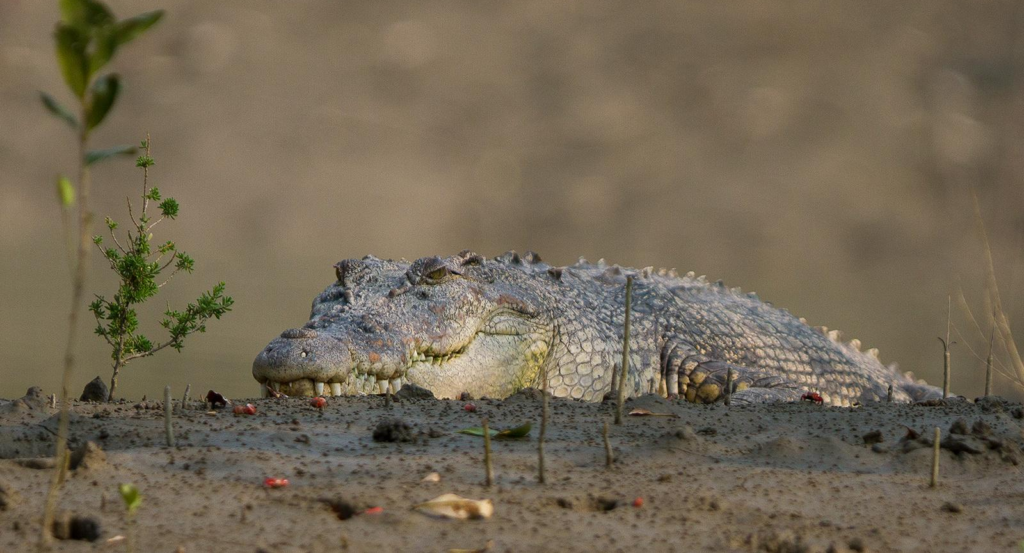
In the Sundarbans, the saltwater crocodile is easy to misunderstand.
It can look like a relic. A prehistoric shape left behind in a landscape of mud and mangroves. But that is only part of the story.
This is not an animal surviving despite the Sundarbans.
- It is an animal whose biology makes sense because of the Sundarbans.
- Its patience makes sense in tidal creeks.
- Its ability to move through saline and freshwater environments makes sense in an estuary.
- Its ambush strategy makes sense in opaque, sediment-rich water.
- Its need for exposed banks makes sense in a landscape where sunlight becomes part of an ectotherm’s physiology.
And its conservation challenges make sense in a delta where wildlife habitat and human livelihood can occupy the same narrow strips of land and water.
The latest population assessment offers a reason for cautious optimism. More crocodiles are being detected, including more hatchlings, after decades of protection and conservation work.
But the story does not end with a rising number.
A crocodile population is only as secure as the landscape that allows it to feed, move, reproduce and raise the next generation.
The Sundarbans is changing.
- Its islands erode.
- Its channels shift.
- Its salinity varies.
- Its storms can redraw coastlines.
And people continue to depend on its waters.
That makes the saltwater crocodile more than a symbol of wilderness.
It becomes a test.
Can a great predator survive in a landscape where nature and human necessity meet so closely?
The answer will depend on whether the Sundarbans retain enough healthy waterways, nesting grounds, prey and protected space for the crocodile to remain what it has been for millennia: a patient giant at the boundary between land and sea.
When the tide rises again, the mudbank disappears.
The forest darkens over the channel. And somewhere beneath the brown water, the crocodile goes with the tide.
Not ancient.
Not untouchable.
But still wild.
And still part of the living Sundarbans.
Plan your private Sundarban expedition
A private journey shaped around you — your group, your pace, your interests. Book a free consultation.