Field guide
The Shikra is not the largest raptor in the Indian Sundarbans, nor is it the most conspicuous. Yet, among the smaller birds of prey, few possess its combination of speed, agility and hunting precision.
Often discovered perched quietly on a branch before making a sudden, calculated movement, the Shikra is a small woodland hawk belonging to the family Accipitridae. Its presence adds another dimension to the avian diversity of the Indian Sundarbans, where tidal forests, village vegetation, agricultural landscapes and human settlements create a varied ecological environment.
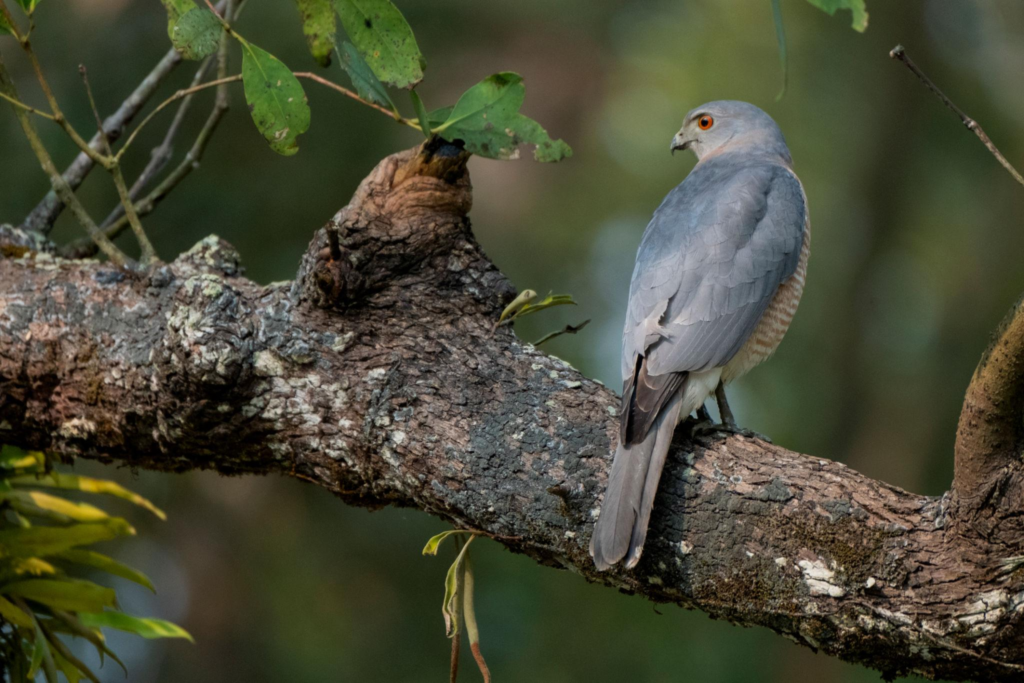
Unlike fish-eating raptors that depend on open waterways, the Shikra is primarily a hunter of terrestrial and arboreal prey. It uses trees, vegetation and open spaces as hunting grounds, making the less frequently noticed terrestrial habitats of the Sundarbans important to its ecological story.
Although the Shikra is widely distributed across the Indian subcontinent, its presence in the Indian Sundarbans is supported by regional faunal documentation. The Fauna of Conservation Areas publication of the West Bengal Department of Sundarban Affairs includes the species in its bird inventory. The available documentation, however, does not establish its present abundance or identify specific locations with consistently recorded sightings.
Shikra at a Glance
| Field | Information |
| Common Name | Shikra |
| Scientific Name | Accipiter badius |
| Alternative Taxonomy | Tachyspiza badia in the Clements 2025 checklist |
| Order | Accipitriformes |
| Family | Accipitridae |
| Conservation Status | Least Concern (IUCN global assessment) |
| Indian Legal Status | Schedule I under the Wildlife (Protection) Act, as reported by State of India’s Birds |
| Indian Sundarbans Occurrence | Included in regional fauna documentation |
| Seasonal Status | Resident in West Bengal |
| Habitat | Open woodland, tree-lined landscapes, agricultural areas and settlements |
| Diet | Small birds, rodents, lizards and other small animals |
| Body Length | Approximately 26–30 cm |
| Ecological Role | Small terrestrial and arboreal predator |
Distribution and Occurrence in the Indian Sundarbans
The Shikra has an extensive distribution across the Indian subcontinent and neighbouring regions of Asia and Africa. Within India, it is a widespread resident, occurring across different landscapes rather than being restricted to a particular forest type.
Its preference for open woodland, cultivated areas, scattered trees and vegetated settlements makes it capable of occupying landscapes that are considerably modified by human activity.
In the Indian Sundarbans, the official Fauna of Conservation Areas inventory provides regional documentary support for its occurrence. The West Bengal checklist compiled by Manna and colleagues also includes the Shikra among the state’s recorded bird species.
An important distinction must nevertheless be made: a record within the wider Indian Sundarbans does not establish that the species occurs regularly throughout every forest block or island. Nor does it establish a breeding population in a particular locality.
The Shikra’s regional distribution is therefore best understood through the wider habitat mosaic, including wooded village surroundings, agricultural land, settlement vegetation and forest edges.
Habitat and Ecological Importance
The Shikra does not depend exclusively on dense forests. In fact, its preference for relatively open and tree-rich habitats helps explain its distribution across varied landscapes.
In the Sundarbans, suitable habitat may occur around village tree cover, cultivated land, groves, vegetated embankments and forest margins. These environments offer potential perching opportunities and access to the small animals on which the hawk feeds.
As a predator, the Shikra participates in the regulation of small vertebrate populations. Its diet includes rodents, lizards and small birds, although the importance of individual prey groups varies according to local availability.
Its ecological relevance is particularly interesting because it represents a terrestrial hunting guild within a landscape that is often discussed primarily through its aquatic and mangrove-associated wildlife.
How to Identify the Shikra
The Shikra is a compact hawk with a relatively small head, short rounded wings and a long, narrow tail.
At a distance, it may appear as an ordinary greyish bird perched among tree branches. A closer observation reveals a distinctive combination of plumage characteristics that helps separate it from other small raptors.
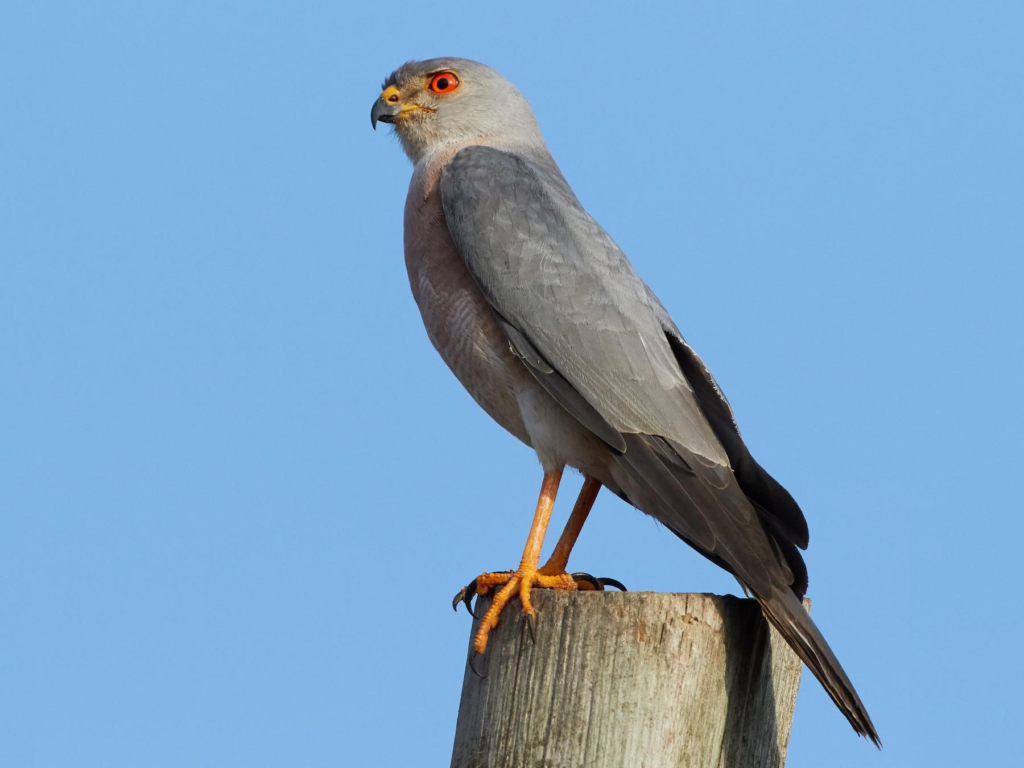
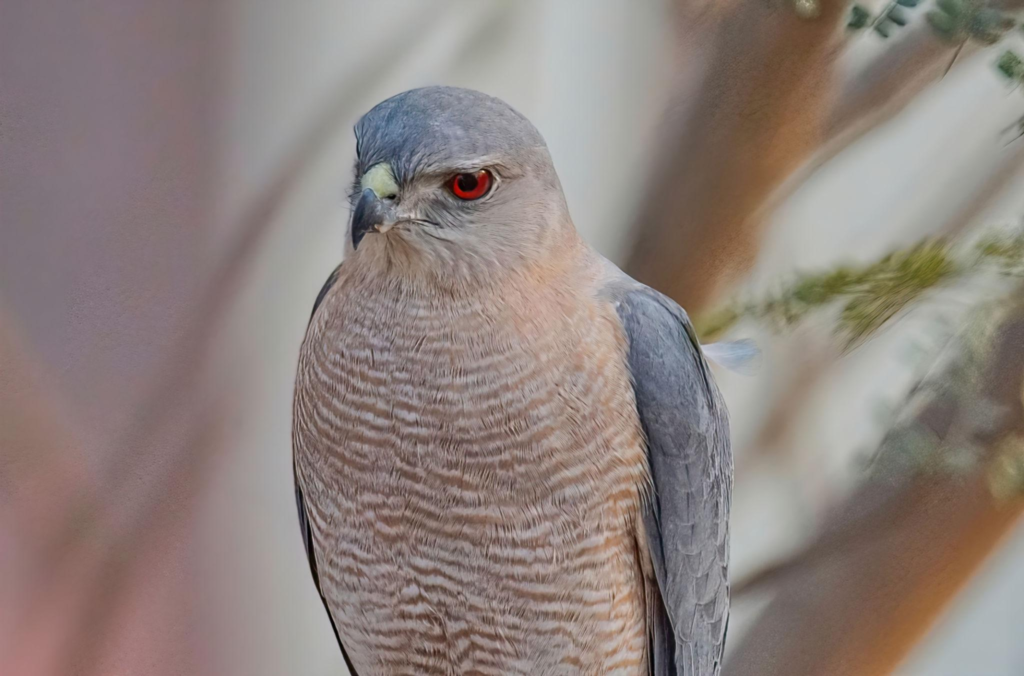
Adult males generally have bluish-grey upperparts and whitish underparts marked with fine reddish-brown barring. Their eyes are characteristically reddish, while the legs and feet are yellow.
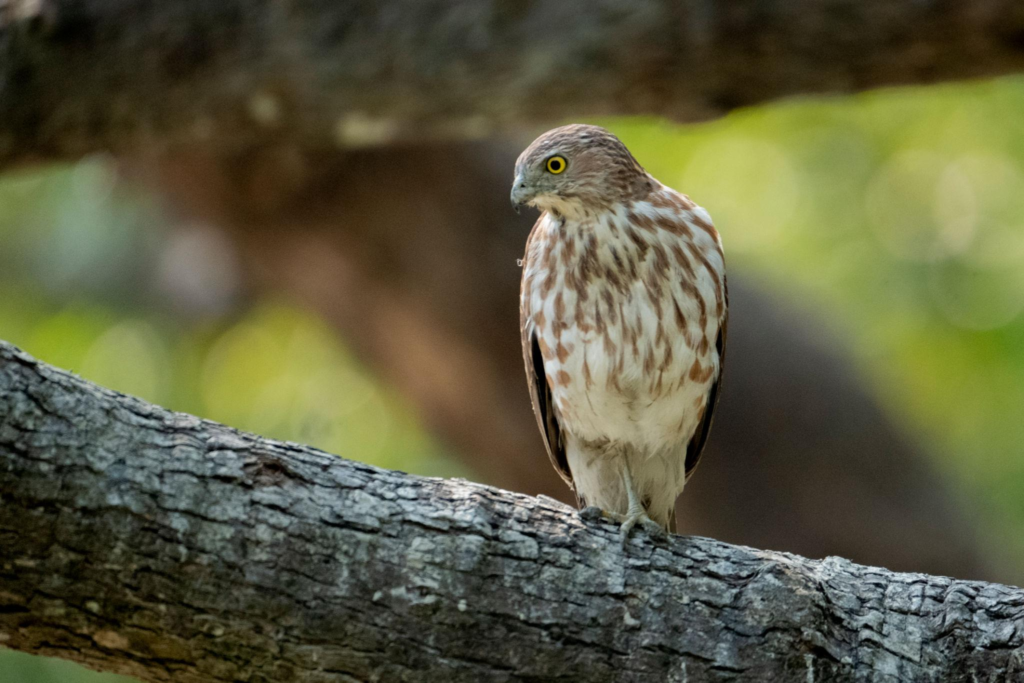
Females are slightly larger and generally browner above, with more pronounced barring beneath. Their irises tend to be yellowish or orange rather than the stronger red associated with adult males.
Juveniles differ considerably from adults. They generally have brown upperparts and streaked underparts rather than the clean, finely barred appearance of mature birds.
Plumage and Distinctive Field Marks
Several features are particularly useful when identifying the Shikra:
- Upperparts: Adult males show bluish-grey coloration, while females are generally browner.
- Underparts: Pale whitish underparts with fine horizontal rufous barring in adults.
- Eyes: Red in adult males and generally yellowish-orange in females.
- Legs: Yellow, relatively slender legs with sharp claws.
- Tail: Long and narrow, helping distinguish its compact hawk-like silhouette.
- Wings: Short, rounded wings characteristic of woodland-hunting Accipiter hawks.
The Shikra can be confused with other small hawks, particularly the Besra (Accipiter virgatus). Both possess compact bodies, rounded wings and relatively long tails.
Reliable identification should therefore consider the combination of body proportions, plumage, underpart markings, eye colour and geographical context rather than relying on a single characteristic.
A Body Designed for Precision
The Shikra’s anatomy reflects its hunting strategy.
Its short, rounded wings allow rapid changes in direction, particularly when navigating between trees and vegetation. Its relatively long tail provides additional control during manoeuvres.
The hooked beak is designed for tearing prey, while its strong feet and curved talons help secure small animals during capture.
Unlike large soaring eagles, the Shikra does not depend on extended periods of gliding over open landscapes. Its hunting behaviour is more closely associated with short, controlled movements from concealed or elevated perches.
These characteristics are typical of small woodland hawks, allowing them to pursue prey in environments where larger raptors may find manoeuvring difficult.
What Does the Shikra Eat?
The Shikra is a carnivorous predator with a varied diet.
Its documented prey includes:
- Small birds.
- Mice and other small rodents.
- Squirrels.
- Lizards.
- Small snakes.
- Other suitably sized small animals.
It generally hunts from a perch, observing its surroundings before making a rapid approach towards potential prey.
Its ability to exploit different prey groups is one reason for its success across woodland, agricultural and settlement environments.
In the Sundarbans, the availability of small vertebrates around tree-rich village landscapes may offer suitable foraging opportunities. However, the precise composition of its local diet has not been established through species-specific regional studies identified for this article.
Flight and Hunting Behaviour
See it for yourself
A private journey shaped around you — your group, your pace, your interests. Book a free consultation.
The Shikra’s flight is generally characterised by a sequence of quick wingbeats followed by short glides.
Its relatively rounded wings and long tail are particularly useful when moving through tree-lined environments.
When hunting, it may remain motionless on a perch for extended periods before suddenly accelerating towards prey. The transition from stillness to movement can be remarkably quick.
This combination of patience and sudden acceleration is central to the Shikra’s hunting strategy.
Unlike the Brahminy Kite, which is frequently seen searching for food over waterways, or the White-bellied Sea Eagle, which surveys extensive river channels, the Shikra operates on a smaller and more immediate hunting scale.
A Solitary Hunter
The Shikra is generally encountered singly or in pairs.
It is not a flock-forming raptor, although pairs may remain associated during the breeding period. Its hunting behaviour is primarily individual, relying on observation, concealment and sudden movement.
Its presence can sometimes become noticeable through the alarm responses of smaller birds. Such reactions are not unusual around predatory birds, as potential prey species may respond to the appearance or movement of a hunting raptor.
Calls and Communication
The Shikra has a distinctive vocal repertoire.
Its commonly described call consists of repeated, high-pitched notes, often represented as a two-part pee-wee sound. Shorter, sharper calls may also be heard during flight or interactions.
Calls are particularly relevant during breeding and territorial behaviour, when communication helps maintain contact between individuals.
For birdwatchers, recognising its vocalisations can be useful because a Shikra may remain partially concealed within foliage.
Breeding and Nesting
In India, the Shikra generally breeds during the warmer months, with March to June commonly reported as its breeding period.
It constructs a relatively small platform nest using twigs, usually placed in a tree. The structure is often lined with softer grass or similar material.
Both members of the pair participate in nest-building activities.
The typical clutch consists of three to four eggs. Published species accounts describe pale bluish-grey eggs with darker markings.
The female undertakes much of the incubation, while the male contributes to the breeding effort, particularly through provisioning.
These details describe the species’ general Indian breeding biology. They should not be interpreted as confirmation of a locally documented breeding population in the Indian Sundarbans.
Its Relationship with Human Settlements
One of the interesting characteristics of the Shikra is its ability to occupy landscapes influenced by human activity.
Unlike certain forest-dependent raptors, it can make use of scattered trees, cultivated land and vegetation around settlements.
This ecological flexibility may be relevant to the Sundarbans, where villages and agricultural landscapes form part of the larger environment surrounding the protected mangrove forests.
The presence of the Shikra in such landscapes also demonstrates that raptor conservation is not exclusively about protecting large, uninterrupted forests. Maintaining suitable vegetation and healthy populations of small prey animals across the wider landscape can also matter.
Conservation Status of the Shikra
The Shikra is globally classified as Least Concern.
Its extensive distribution and ability to occupy different habitat types contribute to its relatively favourable global conservation assessment.
However, Least Concern does not mean that the species is free from conservation pressures.
The State of India’s Birds assessment identifies the Shikra as a resident species in West Bengal and classifies it as a low-priority species in its assessment framework. Its 2025 update also reports a West Bengal long-term trend estimate of 28.14%, alongside an inconclusive current annual trend. These estimates should be interpreted within the assessment’s methodology and confidence intervals rather than treated as a direct population census.
The same assessment reports Schedule I protection under India’s Wildlife (Protection) Act.
Conservation Challenges
Although the Shikra is adaptable, several environmental pressures may affect its habitat and food availability.
Loss of tree cover: Removal of mature trees and vegetation can reduce nesting and perching opportunities.
Habitat alteration: Changes in agricultural and settlement landscapes may affect the availability of suitable hunting grounds.
Prey availability: Changes in small vertebrate populations can influence the availability of food.
Human disturbance: Excessive disturbance around active nests can interfere with breeding activities.
Environmental contamination: Pesticide exposure and other forms of pollution may affect food webs and wildlife health, although their specific impact on Shikra populations in the Indian Sundarbans requires further investigation.
For the Sundarbans, these concerns should be understood as potential habitat and ecological pressures, not as demonstrated causes of a local population decline.
Where Can the Shikra Be Observed in the Indian Sundarbans?
The Shikra’s habitat preferences suggest that tree-rich landscapes outside dense mangrove interiors are particularly relevant when considering possible observation opportunities.
Potentially suitable environments include:
- Village landscapes with mature trees.
- Agricultural fields bordered by vegetation.
- Open woodland and forest edges.
- Tree-lined settlement surroundings.
- Areas with scattered vegetation and suitable prey availability.
The regional fauna inventory confirms its inclusion in the Indian Sundarbans’ documented bird fauna. However, the sources consulted do not establish a reliable, recent, site-specific sighting pattern for locations such as Sajnekhali, Sudhanyakhali, Dobanki, Bonnie Camp or Burirdabri.
These places should therefore not be advertised as confirmed Shikra hotspots without additional records.
For serious birdwatchers, documenting the date, location, habitat, identification characteristics and photographic evidence of an encounter would help improve the understanding of the species’ local distribution.
When Is the Shikra Present?
The Shikra is considered a resident species in West Bengal.
Unlike winter-visiting waterbirds that arrive in the Sundarbans from more northerly regions, the Shikra is not primarily associated with seasonal winter migration in this region.
Its occurrence should therefore not be restricted to the winter birdwatching season.
Nevertheless, actual encounters depend on habitat conditions, weather, visibility, activity patterns and observation effort. A resident species may remain undetected even in suitable habitat.
The Important Truth About Bird Observation
Wildlife observation is never a guaranteed exercise.
A bird may occupy a landscape without being visible to an observer. Dense foliage, movement between trees, weather conditions and natural hunting behaviour can all influence detectability.
For a small raptor such as the Shikra, the difference between being present and being observed can be particularly significant.
Its relatively inconspicuous appearance when perched makes careful scanning of tree canopies and exposed branches more useful than relying exclusively on open-water observation.
The absence of a sighting should never be interpreted as proof that the species is absent from the surrounding landscape.
What Makes the Shikra of the Sundarbans Unique?
The Shikra is not an endemic bird of the Sundarbans, nor does available evidence establish a distinct Sundarbans population or a specialised mangrove adaptation.
Its significance lies elsewhere.
The Indian Sundarbans is often understood through its spectacular aquatic wildlife, mangrove forests, estuarine channels and large predators. Yet the wider ecological landscape also includes terrestrial habitats where smaller predators operate beyond the immediate boundaries of tidal waterways.
The Shikra represents this less conspicuous dimension of the region’s biodiversity.
Its preference for open woodland, scattered trees and settlement vegetation connects it with the landscapes inhabited and cultivated by local communities. It occupies an ecological space different from that of fish eagles and other water-associated raptors.
This relationship is important because the Sundarbans is not simply a forest surrounded by water. It is a complex landscape where natural habitats, human settlements, agricultural areas and tidal ecosystems exist alongside one another.
Understanding the Shikra means recognising that the biodiversity of the Sundarbans extends beyond its famous mangrove waterways.
Myths and Facts About the Shikra
| Common Misconception | The Fact |
| The Shikra is a fish-eating raptor. | It primarily hunts small terrestrial and arboreal animals. |
| Only large raptors are important predators. | Small hawks such as the Shikra also occupy important predator roles. |
| The Shikra lives exclusively in forests. | It also uses agricultural landscapes and settlement vegetation. |
| The Shikra is a winter migrant in West Bengal. | It is classified as a resident species in the state. |
| Every Shikra sighting indicates a breeding pair. | Presence does not establish local breeding activity. |
FAQs
1. Is the Shikra found in the Indian Sundarbans?
Yes. The Shikra is included in the West Bengal Department of Sundarban Affairs’ Fauna of Conservation Areas bird inventory. However, detailed recent site-specific records remain limited in the sources consulted.
2. What is the scientific name of the Shikra?
Its traditionally used scientific name is Accipiter badius. The Clements 2025 checklist uses the revised combination Tachyspiza badia.
3. Is the Shikra a resident bird of the Sundarbans?
It is classified as a resident species in West Bengal. It is not primarily a winter migrant in this region.
4. What does the Shikra eat?
Its diet includes small birds, rodents, squirrels, lizards, small snakes and other small animals.
5. How can you identify a Shikra?
Look for its compact body, short rounded wings, long narrow tail and pale underparts with fine reddish-brown barring. Adult males generally have reddish eyes and bluish-grey upperparts.
6. Is the male Shikra different from the female?
Yes. Adult males are generally smaller, with bluish-grey upperparts and reddish eyes. Females are slightly larger, browner above and generally have yellowish-orange eyes.
7. Does the Shikra breed in the Sundarbans?
Its breeding biology is documented in India, generally between March and June. However, the sources consulted do not establish specific breeding records within the Indian Sundarbans.
8. What is the conservation status of the Shikra?
The Shikra is classified as Least Concern globally. It is also reported under Schedule I of India’s Wildlife (Protection) Act in the State of India’s Birds assessment.
9. Is the Shikra a mangrove-dependent bird?
No. It is adaptable and generally associated with open woodland, agricultural landscapes and tree-rich environments rather than depending exclusively on mangrove forests.
10. Is the Shikra difficult to observe?
It can be overlooked because of its relatively small size and tendency to remain perched among foliage. Careful observation of tree canopies, exposed branches and woodland edges can improve the chances of detection.
The Wild Orbit Perspective
The wilderness of the Sundarbans is not defined only by what happens along its great rivers or beneath the tangled roots of its mangrove forests.
It also exists in the quieter spaces between settlements, in the trees bordering agricultural fields and in the patches of vegetation that connect one habitat to another.
The Shikra belongs to this less celebrated world.
It is a reminder that the ecological character of a landscape cannot be understood through its most famous inhabitants alone. Small predators, inconspicuous birds and species that share space with people are equally important to understanding the wider natural environment.
For The Wild Orbit, exploring the Sundarbans means looking beyond the obvious, recognising its lesser-known wildlife and appreciating the ecological relationships that make this tidal landscape extraordinary.
Sometimes, the most revealing stories of the wilderness belong to the smallest hunters.
Plan your private Sundarban expedition
A private journey shaped around you — your group, your pace, your interests. Book a free consultation.