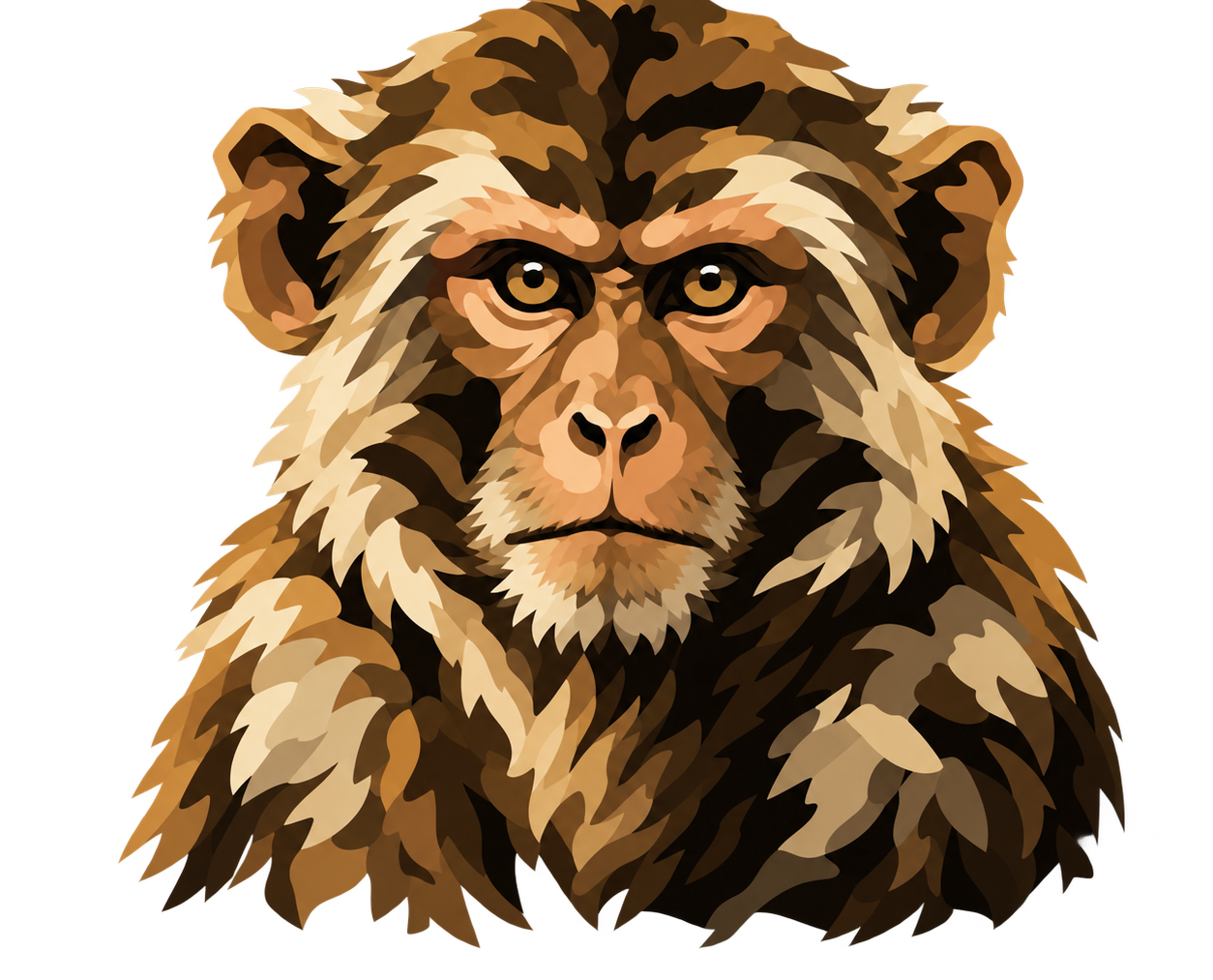
 Field guide
The Monkey That Learned to Live With the Tide.
At first glance, the Rhesus Macaque may seem almost out of place in the Sundarbans.
It is not a specialist mangrove mammal in the way a fishing cat is adapted to wetlands, nor does it possess the obvious aquatic identity of a dolphin. Yet among the tangled roots, tidal creeks and muddy islands of the Indian Sundarbans, Macaca mulatta has established a distinctive life of its own.
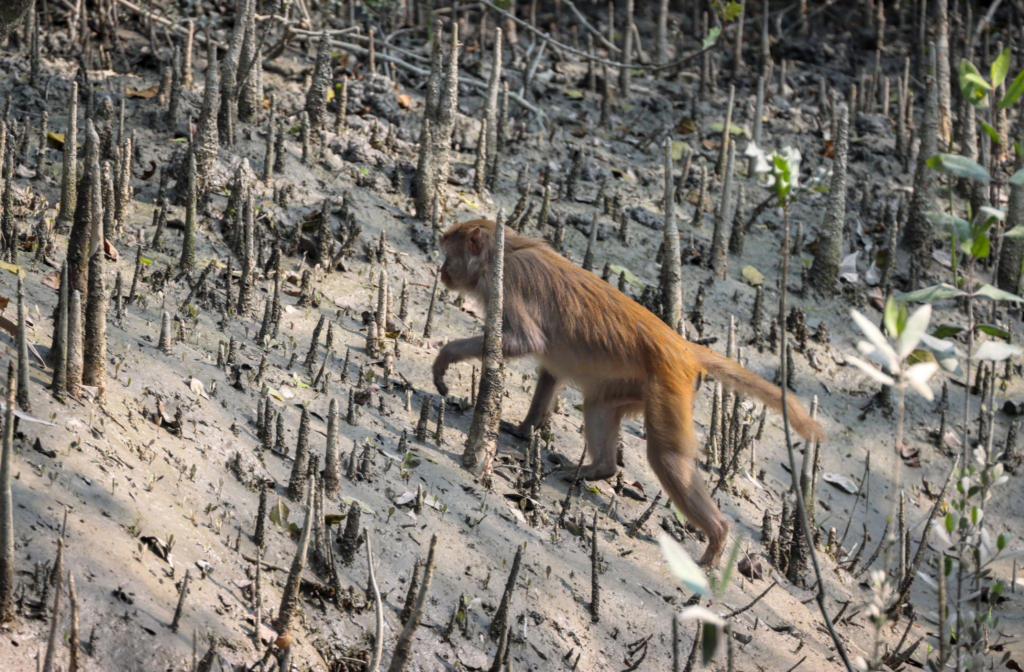
The Rhesus Macaque is a highly adaptable Old World monkey, found across a remarkably broad range of habitats in South and Southeast Asia. In the Sundarbans, however, its flexibility is tested by an environment that changes twice each day. Forest floors disappear beneath tidal water. Creeks widen and narrow. Mudbanks are exposed and submerged. Food availability shifts with the seasons, tides and vegetation.
And the monkey adjusts.
In the Indian Sundarbans, documented research has recorded Rhesus Macaques feeding on mangrove leaves and fruits, molluscs and crabs. A field observation published in the Journal of Threatened Taxa also documented an adult male catching and eating a live fish from the bank of an estuarine channel, followed by two other troop members attempting the same behaviour. It is a small observation, but it reveals something important about this primate: its survival is closely tied to behavioural flexibility.
The Rhesus Macaque is also part of the larger food web of the mangrove forest. Wildlife Institute of India material on the Sundarban Tiger Reserve identifies it among the principal prey species of the Bengal tiger, alongside spotted deer and wild boar.
So the Rhesus Macaque is not simply another monkey living in a forest.
In the Sundarbans, it is a primate shaped by a tidal landscape and a species that connects vegetation, shoreline resources, predators and the wider mangrove food web.
THE MAMMAL OF THE TIDAL FOREST
Meet the Rhesus Macaque
The Rhesus Macaque, Macaca mulatta, belongs to the family Cercopithecidae, the Old World monkeys.
It is a medium-sized primate with a compact body, brown to grey-brown coat, pinkish to reddish facial skin and a comparatively short tail. Adults show clear sexual dimorphism, with males generally larger and heavier than females.
Across its broad geographic range, the species occupies an unusually wide variety of environments. It can live in forests, woodland, agricultural landscapes and human-modified habitats. This ecological flexibility is one reason the Rhesus Macaque has become one of the most widely distributed primates in Asia.
The Indian Sundarbans presents a very different challenge from many of the landscapes in which the species is commonly encountered.
Here, land is fragmented by tidal water.
There is no permanent forest floor everywhere. A channel that is open water at high tide may reveal a muddy edge later. Roots rise from saturated soil. Mangrove vegetation grows in saline and brackish conditions. Islands are continually influenced by erosion, sediment deposition and tidal movement.
Yet Rhesus Macaques occur within this environment and have been recorded from the reserved forests of the Sundarbans. UNESCO’s documentation of Sundarbans National Park lists the species among the major mammals recorded from the reserved forests.
More recent landscape-level assessments have also recorded Rhesus Macaque presence across parts of the Indian Sundarbans. The 2022 Sundarbans landscape assessment reported presence particularly in the Sajnekhali and Basirhat ranges, with additional records from parts of the National Park East and West ranges. It estimated the occupied area at approximately 930 km² within the assessed Sundarbans landscape.
These records matter because they show that the Rhesus Macaque is not an incidental visitor.
It is a component of the Sundarbans mammal community.
Rhesus Macaque At a Glance
- Common Name: Rhesus Macaque
- Scientific Name: Macaca mulatta
- Family: Cercopithecidae
- Order: Primates
- Conservation Status: Least Concern globally
- Indian Sundarbans: Recorded within the Sundarban forest landscape
- Habitat: Forests, mangrove habitats and human-modified environments across its wider range
- Diet: Broadly omnivorous; plants form an important component, with animal foods also taken
- Social Structure: Multi-male, multi-female social groups
- Activity: Primarily diurnal
- Typical Adult Size: Approximately 45–64 cm body length, excluding the tail; males are generally larger
- Distinctive Adaptation: Exceptional dietary and habitat flexibility
- Sundarbans Significance: A resident primate, documented food-web component and prey species of the Bengal tiger
A Primate’s Place in a Mangrove World
The presence of a monkey in a tidal mangrove forest tells us something about the adaptability of the ecosystem’s inhabitants.
Mangrove forests are often described through their trees, mudflats, fish, crocodiles, deer, tigers and birds. But the Rhesus Macaque demonstrates another dimension of the system: terrestrial mammals can exploit an environment that is neither entirely terrestrial nor entirely aquatic.
The forest provides food in the form of leaves, fruits and other plant material. The intertidal zone adds access to animal foods such as crabs and molluscs. The edges of creeks create opportunities that would not exist in a conventional inland forest.
The species therefore occupies a flexible ecological position.
Its relationship with the mangrove environment is not based on one extraordinary anatomical adaptation. It is based more on behavioural flexibility: where it searches for food, what it eats, how it moves through vegetation and how it responds to the changing availability of resources.
That distinction is important.
The Rhesus Macaque has not evolved into a specialised mangrove monkey. Instead, it is a highly adaptable primate making use of the opportunities provided by the mangrove landscape.
BUILT FOR LIFE IN THE SUNDARBANS
A Body Made for Trees, Ground and Forest Edge
The Rhesus Macaque has a relatively compact body, strong limbs and hands capable of grasping branches and manipulating food.
Its body length is generally around 45–64 cm, with the tail adding roughly another 19–32 cm. Males are usually heavier than females. The coat is generally grizzled brown or grey-brown, while the face and exposed skin around the hindquarters have a characteristic pinkish-red appearance.
In the wider range of the species, Rhesus Macaques use both arboreal and terrestrial environments.
The Sundarbans adds another layer.
The ground is often wet, soft and muddy. Vegetation can be dense. Roots and pneumatophores interrupt movement. Tidal water can cut across otherwise continuous-looking habitat.
Historical observations from the Sundarbans suggest that forest-dwelling Rhesus Macaques may spend considerably more time in trees than populations living in less forested or more human-dominated environments. Research from the Sundarbans has specifically described the species as predominantly terrestrial across its wider range while noting that monkeys in the tidal swamp forests rarely descended from trees.
This is one of the more interesting aspects of the Sundarbans population.
A species capable of moving comfortably on the ground can nevertheless make greater use of elevated vegetation when the forest floor becomes difficult, wet or exposed.
The canopy becomes more than a feeding platform.
It becomes refuge, movement space and a way of staying above a landscape that is repeatedly reshaped by water.
How the Rhesus Macaque Moves Through the Mangroves
Movement in the Sundarbans is rarely just a matter of walking from one point to another.
A macaque moving through mangrove vegetation has to negotiate branches, uneven surfaces, mud, exposed roots and channels. It may move between trees, descend to lower levels and approach the edge of water when food opportunities appear.
The species is capable of both arboreal and terrestrial movement, and its flexible locomotion helps explain its success across such a broad range of habitats.
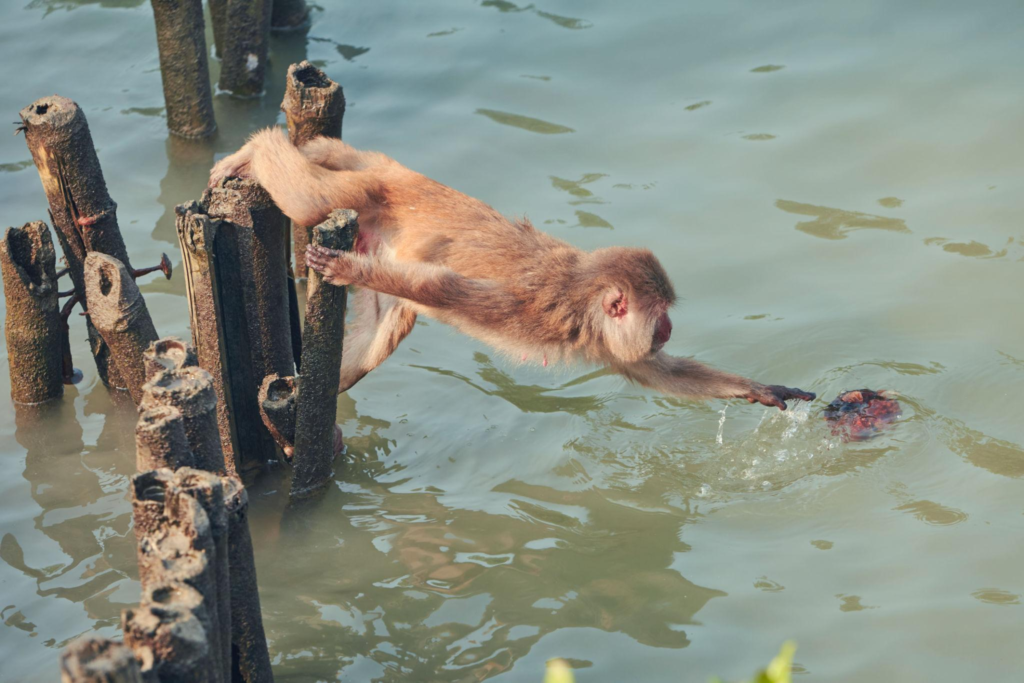
Swimming ability has also been documented for Rhesus Macaques generally, an important capability in a landscape crossed by rivers and tidal channels.
That does not mean a macaque will casually cross every channel it encounters.
The Sundarbans remains a landscape of real physical risk. Water movement, depth, current, predators and the availability of secure landing points all influence how an animal uses the intertidal environment.
The important point is that water is not necessarily an absolute barrier.
For a mammal living among islands, creeks and tidal channels, that flexibility can influence access to food and habitat.
The Diet of a Mangrove Opportunist
Few features of the Rhesus Macaque are more important to understanding its Sundarbans identity than its diet.
Across its range, the species is an adaptable feeder. Plant foods can include fruits, seeds, leaves, flowers, buds, shoots, stems, roots and other plant material. Animal foods are also consumed, including insects and various aquatic or shoreline organisms.
In the Sundarbans, researchers have documented feeding on mangrove leaves and fruits, molluscs and crabs.
That already makes the species unusual among the larger terrestrial mammals of the mangrove forest.
But there is another documented behaviour.
In February 2011, researchers observed an adult male Rhesus Macaque walking to the bank of estuarine water, catching a live fish and eating it. Other troop members watched the behaviour, and two subsequently attempted to catch fish themselves. The observation was published in 2012 as a note in the Journal of Threatened Taxa.
This should not be turned into a claim that fishing is the normal diet of Sundarbans Rhesus Macaques.
The evidence does not support that.
What it does demonstrate is the species’ capacity to exploit an unusual food resource when the opportunity exists.
That distinction is important.
A single documented behaviour can reveal ecological flexibility without proving that it is a dominant or universal behaviour.
The Fish at the Forest Edge
Imagine the boundary between mangrove and water.
A creek pushes against a muddy bank. Roots hold the sediment together. The water is moving, carrying small aquatic animals through a constantly changing environment.
For a macaque, this boundary represents something different from the forest canopy.
It is a food interface.
The documented fish-catching observation provides a rare glimpse into how the Rhesus Macaque can cross ecological boundaries in search of food. The monkey was not transformed into an aquatic hunter. Instead, it used a moment of opportunity at the edge of the estuary.
That is perhaps the better way to understand the species in the Sundarbans.
It is an opportunist.
Its success comes not from specialising in one food source, but from being able to use several.
What the Senses Tell the Monkey
The Rhesus Macaque relies heavily on vision and other senses to navigate a complex social and physical environment.
In a social group, communication includes vocalisations, facial expressions, body posture and physical contact. Grooming is an important social behaviour, while dominance relationships influence interactions between group members.
In the Sundarbans, visual awareness also has obvious ecological value.
- Branches can become pathways.
- Water can become a barrier.
A movement in the vegetation may signal another troop member, a potential food source or danger.
And in a landscape where the Bengal tiger is part of the ecosystem, awareness of predators is not an abstract advantage.
The Rhesus Macaque occupies a position in which social awareness and environmental awareness overlap.
LIFE, BEHAVIOUR & HUMAN CONNECTION
A Society Built Around Relationships
Rhesus Macaques are highly social primates.
Their groups generally contain multiple adult males and females together with juveniles and infants. Female relationships are especially important because females typically remain within their natal social groups, while males commonly disperse as they mature. Social relationships are structured by dominance hierarchies, and maternal relationships have an important role in the organisation of macaque societies.
For a monkey living in the Sundarbans, the group is more than a collection of individuals.
It is an information network.
Young animals learn where food can be found, how to move through the habitat and how to respond to other members of the group. Adults coordinate their activities through a mixture of vocal, visual and tactile communication.
The social life of the Rhesus Macaque is therefore inseparable from its survival.
A mangrove forest is difficult to read.
A troop reads it together.
Grooming, Rank and Social Bonds
See it for yourself
A private journey shaped around you — your group, your pace, your interests. Book a free consultation.
Grooming is one of the most familiar social behaviours among macaques, but its significance goes beyond cleaning the coat.
Physical contact helps maintain relationships and can reinforce social bonds.
Rhesus Macaque society is hierarchical, and dominance affects access to social and reproductive opportunities. Female social relationships are strongly influenced by matrilineal connections, with maternal relatives often forming important social units.
This produces a complex social structure.
A young macaque is not simply growing physically.
It is learning a social system.
It learns who is dominant, who is tolerant, when to approach another animal and when to withdraw.
For juveniles, the troop is effectively a living classroom.
Communication in the Tidal Forest
The Rhesus Macaque communicates through vocalisations, facial expressions, gestures, body postures and touch.
Some calls are associated with alarm, social tension or maintaining contact between members of a group. Visual signals can communicate arousal or aggression, while grooming and other physical interactions help reinforce social relationships.
In a dense mangrove forest, sound can be particularly useful.
Vegetation can block direct lines of sight. A troop may be spread across several trees or different levels of vegetation. A vocal signal can carry information without requiring every animal to remain within visual contact.
The mangrove landscape is therefore not silent to the macaques.
It is filled with information.
Raising the Next Generation
Female Rhesus Macaques generally give birth to a single infant after a gestation period of around 165 days. Young remain closely dependent on their mothers during early development and are carried, protected, groomed and nursed by them.
Infancy is a prolonged learning period.
The young animal must learn how to climb, how to feed, how to interpret social signals and how to navigate the dangers of its environment.
In the Sundarbans, those lessons have an additional ecological dimension.
A juvenile growing up among mangroves must eventually understand a landscape where the location of water, food and safe movement can change with the tide.
The skills required are not written into a map.
They are learned through experience.
The Rhesus Macaque and the Bengal Tiger
The Rhesus Macaque occupies an uncomfortable position in the Sundarbans food web.
It is a predator of smaller organisms and a consumer of plant material.
But it can also become prey.
Wildlife Institute of India information on the Sundarban Tiger Reserve identifies the Rhesus Macaque as one of the principal prey species of the Bengal tiger. Scientific work on tiger ecology in the Sundarbans likewise lists the macaque among the region’s principal prey species.
This relationship adds another reason why arboreal behaviour can matter.
The macaque may use trees and elevated vegetation to move, feed or avoid danger. Yet the tiger is itself capable of moving through water and across islands, making the boundaries between safe and unsafe habitat less predictable than they might appear.
The result is a predator-prey relationship shaped by the unusual geography of the Sundarbans.
There is no simple line between land and water.
Both predator and prey must navigate it.
When Monkeys Meet People
The Rhesus Macaque is one of the world’s most adaptable primates, and this adaptability has brought it into close association with people in many parts of its range.
Human-Rhesus Macaque conflict is widespread in India, particularly in human-dominated landscapes where macaques can exploit crops, food waste and intentionally provided food. Research on the species has also shown how human feeding can alter behaviour and increase competition within groups.
The Sundarbans requires a more careful interpretation.
Forest-dwelling macaques and macaques living around human settlements should not automatically be treated as the same ecological situation.
The Indian Sundarbans contains both protected forest and densely inhabited fringe landscapes. The species can therefore encounter people in different contexts.
Where macaques approach settlements, crop fields or human food sources, the interaction may become problematic for both sides.
But the presence of a monkey near a village does not by itself tell the whole story.
Food availability, habitat structure, human behaviour and local land use all influence the relationship.
Conservation discussions should therefore avoid blaming communities that live beside wildlife.
The objective is coexistence informed by ecology.
CONSERVATION, OBSERVATION AND THE FUTURE
A Species That Is Secure Globally, But Still Ecologically Important
The Rhesus Macaque is currently assessed as Least Concern at the global level.
That status reflects the species’ broad distribution and overall resilience.
It does not mean that every population is equally secure, nor that local habitat changes are irrelevant.
For the Indian Sundarbans, the more important question is not simply whether the species is globally threatened.
It is what happens to the ecological system in which the macaque lives.
The Sundarbans is exposed to erosion, cyclones, tidal flooding, changing salinity, habitat alteration and increasing pressure along the forest–settlement boundary. These processes affect mangrove vegetation and the wider food web.
The effect on Rhesus Macaques can be indirect.
- Changes in vegetation can alter food availability.
- Erosion can remove sections of forest.
- Cyclones can damage trees and reshape habitat.
Changes in human land use can alter access to food and increase contact between wildlife and people.
These are ecological pathways rather than claims that any single environmental change is currently causing a quantified decline in the Indian Sundarbans Rhesus Macaque population.
The distinction matters.
How Rhesus Macaques Can Be Monitored
Monitoring a primate population requires more than occasional sightings.
Field researchers can record direct observations, group locations, troop composition, habitat use and signs of presence. In a complex landscape such as the Sundarbans, systematic surveys are particularly important because visibility is often restricted by dense vegetation and water.
Recent Sundarbans landscape assessments have used spatial sampling to document species distribution, while broader primate research uses direct behavioural observation and demographic studies.
For the Rhesus Macaque, monitoring can provide information about:
- distribution across forest ranges
- group composition
- habitat use
- seasonal movement
- interaction with human settlements
- food-resource use
- predator relationships
- changes in occupied habitat
The 2022 Sundarbans assessment provides particularly useful evidence that the species remains distributed across substantial portions of the Indian Sundarbans, with presence concentrated in particular ranges and patches rather than uniformly throughout the landscape.
That is a more useful conservation picture than simply saying that the monkey is “common.”
WHERE CAN THE RHESUS MACAQUE BE OBSERVED IN THE SUNDARBANS?
The Rhesus Macaque has been documented in several parts of the Indian Sundarbans.
The strongest recent landscape-level evidence identifies Sajnekhali and Basirhat ranges as areas where presence was recorded predominantly, with additional records from parts of the National Park East and West ranges.
Older ecological work has also documented Rhesus Macaques around Sudhanyakhali, while historical studies describe their occurrence within the wider Sundarban Tiger Reserve.
These locations should be understood as documented areas of presence or suitable observation landscape—not guaranteed sighting points.
The behaviour of a wild troop changes with food availability, season, water levels, disturbance and movement patterns.
A visitor may travel through suitable habitat and never see a monkey.
That is not evidence that the species is absent.
THE IMPORTANT TRUTH ABOUT WILDLIFE SIGHTINGS
The Sundarbans does not operate like a wildlife enclosure.
There are no guaranteed animal encounters.
A Rhesus Macaque troop may remain high within mangrove vegetation, move deeper into the forest, remain hidden by foliage or simply be elsewhere when a boat passes.
Even documented observation areas cannot promise a sighting.
This uncertainty is part of genuine wildlife exploration.
The objective is not to force an encounter.
It is to enter the habitat carefully enough that, if the forest reveals something, the observation remains natural.
For a species such as the Rhesus Macaque, patience can be more valuable than proximity.
WHAT MAKES THE SUNDARBANS RHESUS MACAQUE UNIQUE?
The Rhesus Macaque is not unique to the Sundarbans.
What is distinctive is the ecological setting in which the species lives.
Here, a highly adaptable Asian primate occupies one of the world’s great tidal mangrove landscapes.
Its diet includes mangrove vegetation and shoreline animal foods. Its ability to use trees is particularly relevant in a forest where the ground can be flooded. Its flexible feeding behaviour has included a documented instance of fish capture at an estuarine bank. And it occupies a place in a food web that includes one of the world’s most unusual tiger populations.
The species’ relationship with the Sundarbans is therefore defined less by a single extraordinary adaptation than by flexibility.
- It can climb.
- It can move across the ground.
- It can exploit plant foods.
- It can take animal foods.
- It can live in complex social groups.
And it can use a landscape that continually changes beneath it.
That may be its most important Sundarbans adaptation of all.
MYTHS AND FACTS ABOUT THE RHESUS MACAQUE
Myth: Rhesus Macaques are mainly fruit-eating monkeys.
Fact: Fruit can be important, but the species is highly flexible. In the Sundarbans, documented foods include mangrove leaves, fruits, molluscs and crabs, and fish-catching has also been recorded.
Myth: A Rhesus Macaque seen near water must be swimming across a river.
Fact: The species is capable of swimming, but simply approaching a tidal bank does not establish that it intends to cross the channel. Behaviour depends on the immediate circumstances.
Myth: Rhesus Macaques are always terrestrial.
Fact: They can move on the ground but also make substantial use of trees. Sundarbans observations have particularly highlighted their use of arboreal habitat.
Myth: A Least Concern species does not need conservation attention.
Fact: Global conservation status does not eliminate local ecological concerns. Habitat change, human-wildlife interactions and changes to the wider Sundarbans ecosystem remain relevant to local management.
FAQs
What is the scientific name of the Rhesus Macaque?
The scientific name is Macaca mulatta. It belongs to the family Cercopithecidae, the Old World monkeys.
Is the Rhesus Macaque found in the Sundarbans?
Yes. The species is documented in the Indian Sundarbans and is listed among the major mammals recorded from the reserved forests. Recent landscape assessments have recorded it particularly in Sajnekhali and Basirhat ranges and in parts of the National Park East and West ranges.
What does the Rhesus Macaque eat in the Sundarbans?
Documented foods include mangrove leaves, fruits, molluscs and crabs. A scientific observation also recorded an adult male catching and eating a live fish from an estuarine bank.
Is the Rhesus Macaque endangered?
Globally, the Rhesus Macaque is classified as Least Concern. Local populations can nevertheless face habitat and human-wildlife pressures.
Is the Rhesus Macaque arboreal or terrestrial?
It is capable of both terrestrial and arboreal movement. In the Sundarbans, historical observations indicate substantial use of trees by forest-dwelling groups.
Do Rhesus Macaques live in groups?
Yes. They are highly social primates that generally live in multi-male, multi-female groups with juveniles and infants.
Can Rhesus Macaques swim?
The species is capable of swimming. In a landscape divided by tidal channels, this ability can potentially help individuals negotiate water barriers, although actual movement depends on local conditions.
Is the Rhesus Macaque prey for the Bengal tiger?
Yes. The Rhesus Macaque is recognised as one of the principal prey species of the Bengal tiger in the Sundarbans.
Where can Rhesus Macaques be observed in the Indian Sundarbans?
Recent records identify Sajnekhali and Basirhat ranges, along with parts of National Park East and West, as documented areas of presence. Sudhanyakhali also appears in earlier observational literature. These should not be treated as guaranteed sighting locations.
Why is the Rhesus Macaque important to the Sundarbans?
It is part of the mangrove food web, consumes a wide range of resources, can contribute to seed dispersal, forms part of the prey base for the Bengal tiger and demonstrates how adaptable terrestrial mammals use a tidal ecosystem.
THE WILD ORBIT PERSPECTIVE
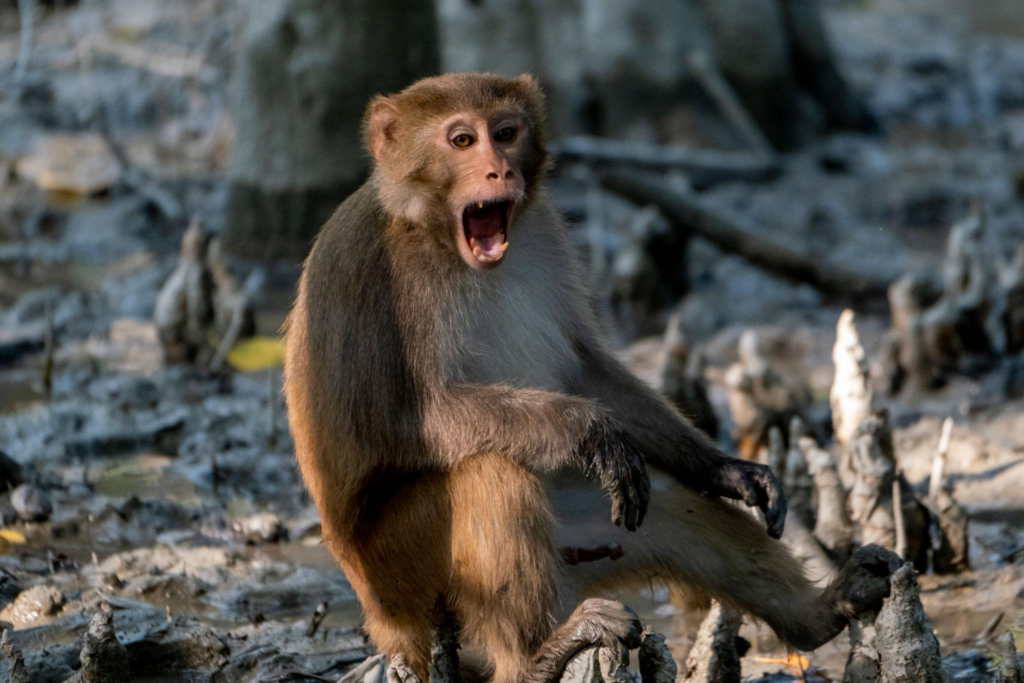
The Rhesus Macaque does not announce the Sundarbans in the way a tiger does.
There is no dramatic silhouette on a riverbank.
No unmistakable roar travelling across a creek.
Instead, there may be movement above the mangrove floor—a branch shifting, a face appearing between leaves, a troop disappearing deeper into vegetation.
But look closer and the species tells a remarkable story.
It is a monkey living in a forest that is never completely still.
- The tide changes the ground.
- The river changes the edge.
- Mangrove trees provide food and shelter.
- Crabs, molluscs and fish offer opportunities beyond the canopy.
- Predators impose another layer of pressure.
And people live alongside the same landscape.
The Rhesus Macaque survives not because the Sundarbans has been made comfortable for it, but because the species is capable of responding to complexity.
Its story is therefore not simply about a monkey.
It is about adaptability.
It is about how an animal can occupy the spaces between forest and water, canopy and mudbank, wilderness and human settlement.
In the Sundarbans, survival is rarely about controlling the landscape.
It is about learning to live with its movement.
And somewhere above the tidal forest floor, the Rhesus Macaque is still doing exactly that.
Plan your private Sundarban expedition
A private journey shaped around you — your group, your pace, your interests. Book a free consultation.