 Field guide
The Wild Water Buffalo once belonged to the larger mammal community of the Sundarbans, when the northern reaches of this vast delta contained more extensive grasslands, freshwater swamps and floodplain vegetation. Today, the species is absent from the Indian Sundarbans. Historical accounts and wildlife research place its disappearance in the late nineteenth century, making it an important example of the large herbivores that the changing delta has lost.
This article distinguishes the buffalo’s global conservation status from its local extinction in the Sundarbans. It also separates documented historical evidence from ecological interpretation, without implying that the animal can still be encountered in the mangrove forests of West Bengal.
Wild Water Buffalo At a Glance
| Attribute | Details |
| Common name | Wild Water Buffalo, Asian Wild Buffalo |
| Scientific name | Bubalus arnee |
| Family | Bovidae |
| Order | Artiodactyla |
| Conservation status globally | Endangered on the IUCN Red List |
| Status in the Indian Sundarbans | Locally extinct |
| Status in West Bengal | Listed as extinct in the state’s mammal checklist |
| Natural habitat | Wetlands, floodplains, marshes, grasslands and forest–grassland mosaics |
| Diet | Primarily grasses and other vegetation |
| Ecological role | Large herbivore, grazer and browser |
| Distribution today | Fragmented populations in parts of South and Southeast Asia; distribution varies by country |
| Typical size | Large bovine; adult males may reach approximately 1.8 m at the shoulder |
| Lifespan | Published species accounts report up to about 25 years in the wild, but this is not a Sundarbans-specific estimate |
| Distinctive feature | Massive, outward-sweeping horns |
| Sundarbans significance | A documented component of the region’s former large-mammal fauna |
A Giant That No Longer Walks the Sundarbans
The historical Sundarbans was not simply the mangrove wilderness seen today. Before the expansion of settlements and agricultural land transformed large parts of the delta, its northern margins included a more varied landscape of marshes, grasslands, wooded floodplains and wetlands. These habitats supported large herbivores that have since disappeared from the region.
The Wild Water Buffalo was one of them.
Historical accounts identify the wild buffalo as a former inhabitant of the Sundarbans, and research on the region’s lost mammals records its disappearance during the nineteenth century. A scientific review of West Bengal’s mammals likewise identifies the species as extinct in the state.
The disappearance matters because large herbivores are more than impressive animals. Through grazing, browsing, trampling and nutrient cycling, they influence the vegetation and physical structure of the environments they occupy. Losing them can alter ecological relationships that have developed over long periods.
For the Sundarbans, however, the buffalo’s story must be reconstructed carefully. There are historical descriptions and records of physical remains, but no contemporary wild population to observe. Its life in the former delta can be understood through historical evidence and scientific knowledge of the species elsewhere in Asia—not through invented scenes of buffalo herds roaming present-day mangrove creeks.
Scientific Classification and Identity
The Wild Water Buffalo belongs to the family Bovidae, the same broad family that includes cattle, antelopes, sheep and goats. Its scientific name is Bubalus arnee. It is a wild bovine, distinct from the familiar domestic water buffalo that has been raised by people across Asia for centuries.
Historical wildlife literature sometimes uses the name Bubalus bubalis when discussing wild buffaloes. This reflects older taxonomic conventions and the long-standing difficulty of distinguishing wild buffaloes from domestic and feral forms in some populations. For a modern species profile, Bubalus arnee is the appropriate name for the Asian Wild Water Buffalo.
The distinction is important in conservation. A domestic buffalo living outside a farm is not automatically a genetically wild animal, and a free-ranging population may require careful investigation before its status can be established. The historical presence of wild buffaloes in the Sundarbans should not be confused with the presence of domestic livestock in settlements around the delta.
Global Conservation Status and Local Extinction
The Wild Water Buffalo is classified as Endangered globally by the IUCN. Its surviving populations are fragmented and face threats that include habitat loss, hunting, competition or interbreeding with domestic buffaloes, disease and the risks associated with small, isolated populations.
Its status in the Sundarbans is different. Here, the species is locally extinct: the regional population has disappeared, although the species survives elsewhere.
This distinction matters because extinction is not always a single global event. A species can survive across parts of its former range while vanishing completely from a particular state, landscape or ecosystem. The Sundarbans has experienced this process with several large mammals, including the Wild Water Buffalo.
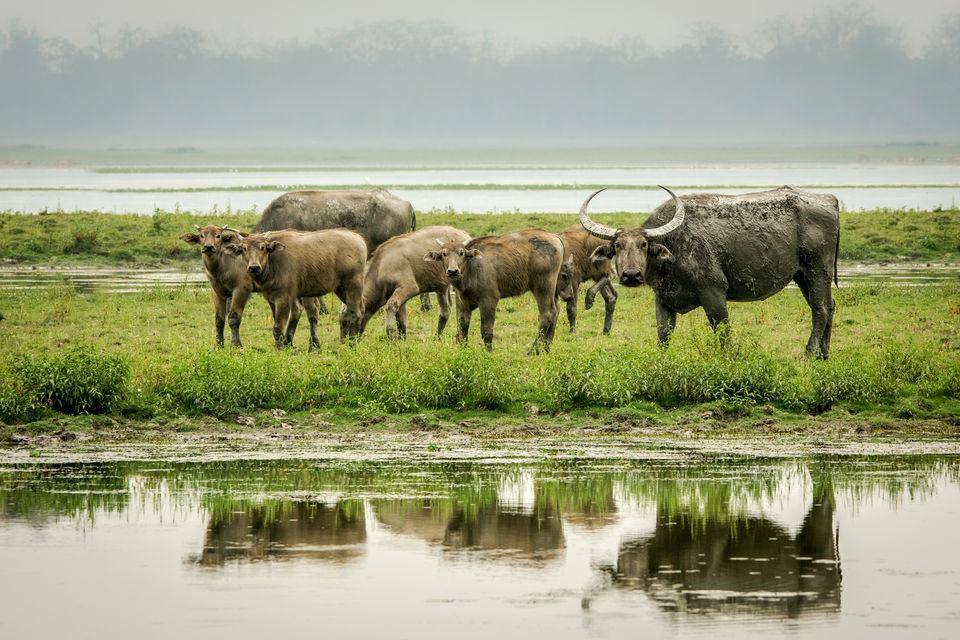
West Bengal’s updated mammal checklist records the buffalo as extinct in the state and describes its former occurrence in northern districts as well as the Sundarbans. The Sundarbans Tiger Reserve’s conservation planning documents also discuss the buffalo among the region’s extinct wildlife.
Where the Wild Water Buffalo Once Lived
The historical distribution of the Wild Water Buffalo extended across a much wider area of South and Southeast Asia than it occupies today. In the Indian subcontinent, its former range included lowland wetlands, grasslands, riverine environments and floodplains.
In West Bengal, historical records associate the species with parts of North Bengal, including areas around Jalpaiguri and Cooch Behar, as well as the Sundarbans. These regions did not all provide identical habitats. The northern plains offered different ecological conditions from the tidal delta, and the species’ historical presence across them should not be interpreted as evidence that it occupied every habitat type equally.
In the Sundarbans, the buffalo was associated with a landscape that was historically more extensive towards the north. The former delta contained grasslands and freshwater-influenced wetlands alongside wooded areas. These open and semi-open habitats would have provided grazing opportunities unavailable in the same form across much of today’s tidal mangrove forest.
The Sundarbans Before the Buffalo Disappeared
The modern Indian Sundarbans is a complex estuarine environment shaped by river flow, tidal movement, sediment deposition, erosion and salinity. Yet its present-day landscape does not perfectly represent the conditions that existed several centuries ago.
Research reviewing the loss of large herbivores from the Sundarbans describes the disappearance of northern grasslands, swamps and floodplain vegetation as part of the wider transformation of the region. Historical literature also points to hunting as an important cause of wildlife depletion. The available evidence suggests that habitat conversion and hunting contributed to the loss of large mammals, although the precise contribution of each factor to the buffalo’s extinction cannot be calculated reliably from the surviving records.
The distinction between the historical and modern landscape is central to understanding this animal. The buffalo did not need a landscape made entirely of dense mangrove trees. Like other large grazing bovines, it depended on suitable forage and access to water. Where freshwater wetlands and grass-rich openings existed alongside woodland, the combination could provide essential resources.
As these habitats contracted or changed, the ecological conditions that supported large herbivores also changed. The buffalo’s disappearance was therefore not simply the loss of a single species. It was part of a broader transformation in the large-mammal community of the delta.
Habitat and Its Relationship With Mangrove Ecology
The Wild Water Buffalo is strongly associated with wetlands and landscapes containing water, grazing vegetation and access to shelter. Studies of surviving populations in India document its use of grassland openings, forested areas and water bodies, although habitat selection varies with the local landscape.
The Sundarbans presents an important ecological distinction. Mangrove forests are dominated by salt-tolerant trees and shrubs, while the buffalo’s traditional feeding ecology relies heavily on grasses and other vegetation. The two systems can meet along forest edges, open patches and freshwater-influenced areas, but they are not interchangeable.
The animal’s former presence in the delta is best understood in relation to the broader mosaic of habitats that once surrounded the mangrove forest. It would be misleading to portray the species as a specialist adapted to feeding among exposed mangrove roots or drinking from highly saline tidal creeks. No reliable evidence establishes such specializations for the Sundarbans population.
Why the Buffalo Mattered to the Ecosystem
Large herbivores influence ecosystems through their daily feeding and movement. They remove plant material, redistribute nutrients through dung, create trails and sometimes open pathways through vegetation. Their grazing can influence which plant species dominate particular areas.
In suitable wetland and grassland habitats, Wild Water Buffaloes can contribute to maintaining a dynamic relationship between grasses, other plants, water and the animals that depend on them. Their feeding patterns may also influence how vegetation regenerates and how other herbivores use shared habitat. These ecological functions are grounded in the species’ biology, but their exact historical effects in the Sundarbans have not been quantified.
The buffalo’s loss also illustrates an important principle: conserving a forest does not automatically restore every component of its former wildlife community. A landscape may retain its identity as a mangrove ecosystem while losing animals that once depended on its wider wetland and grassland mosaic.
A Powerful Body Built for a Large Herbivore
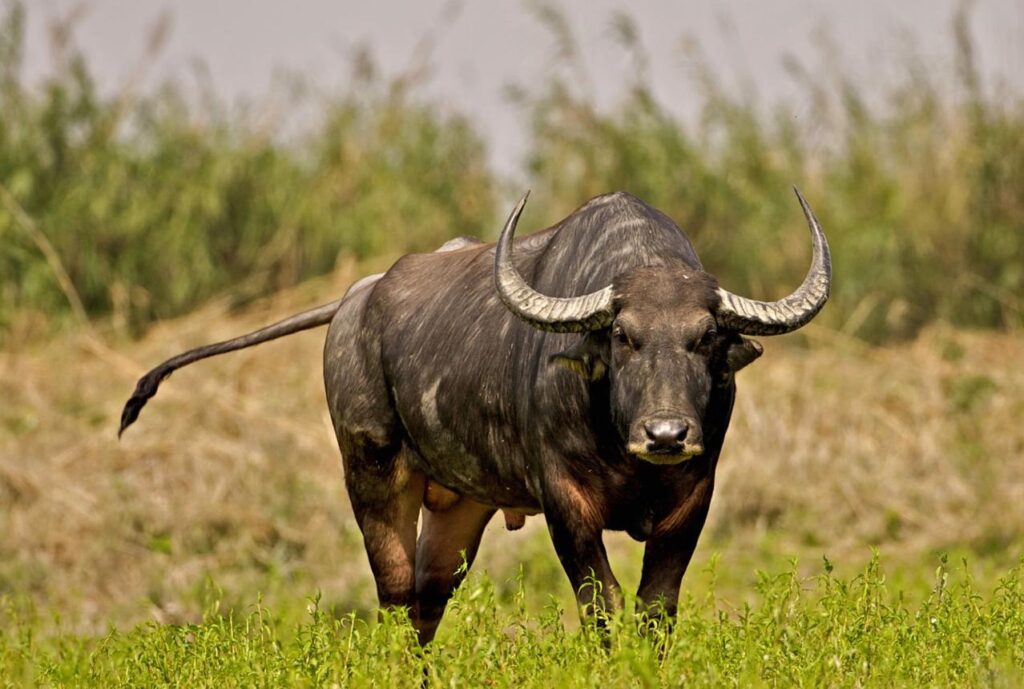
The Wild Water Buffalo is among the largest living wild bovines. Adult males can reach approximately 1.8 metres at the shoulder and weigh hundreds of kilograms. Wildlife Trust of India’s species account gives a broad weight range of approximately 600–1,000 kilograms, although body size varies with sex, age and population. These figures describe the species generally, not historical animals measured in the Sundarbans.
Its body is deep and muscular, supported by strong limbs and broad, cloven hooves. This build enables it to move through wet ground and support its considerable weight. Its physical form reflects the demands of a large grazing mammal, rather than the specialised climbing or narrow-footed movement of animals adapted to steep terrain.
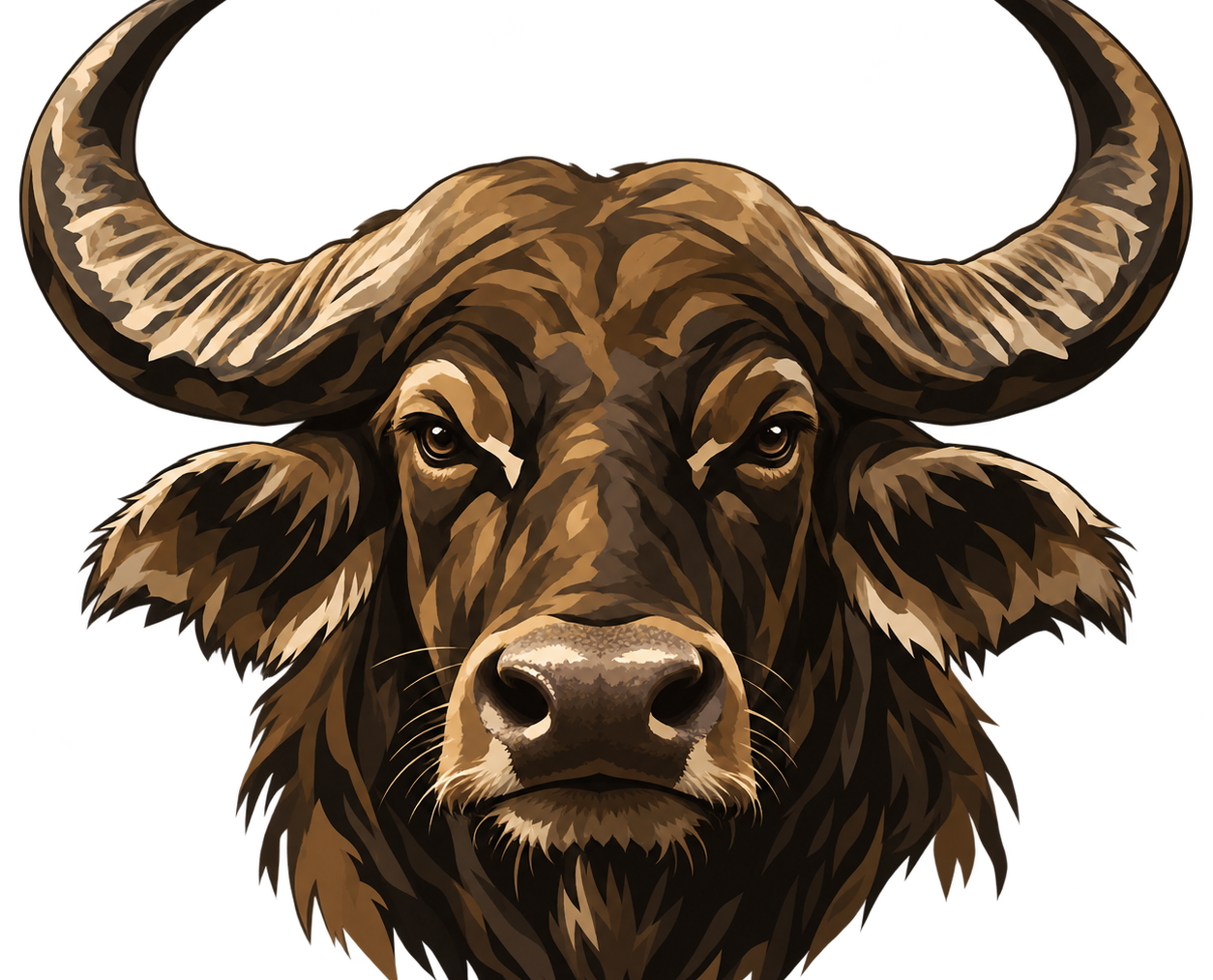
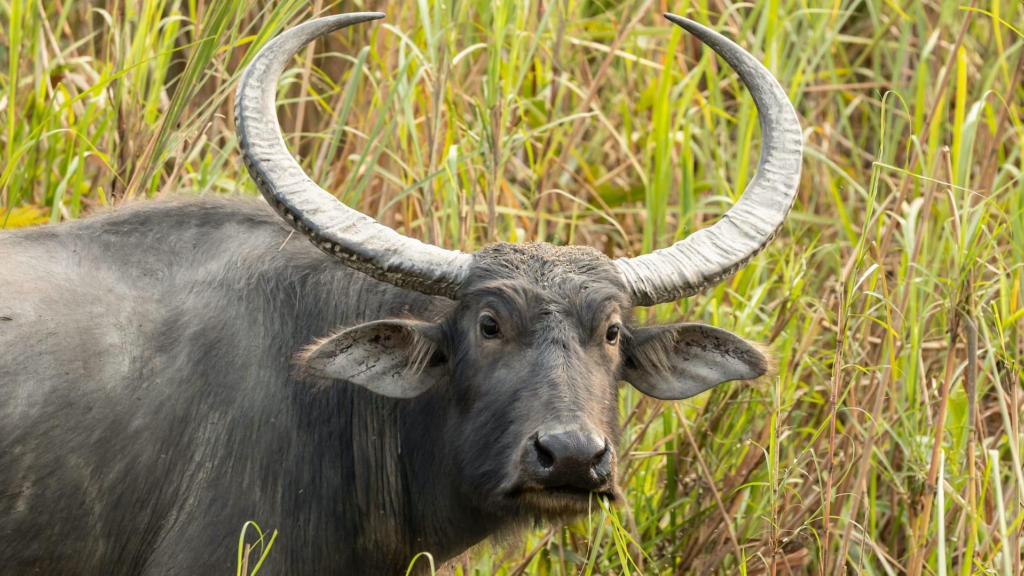
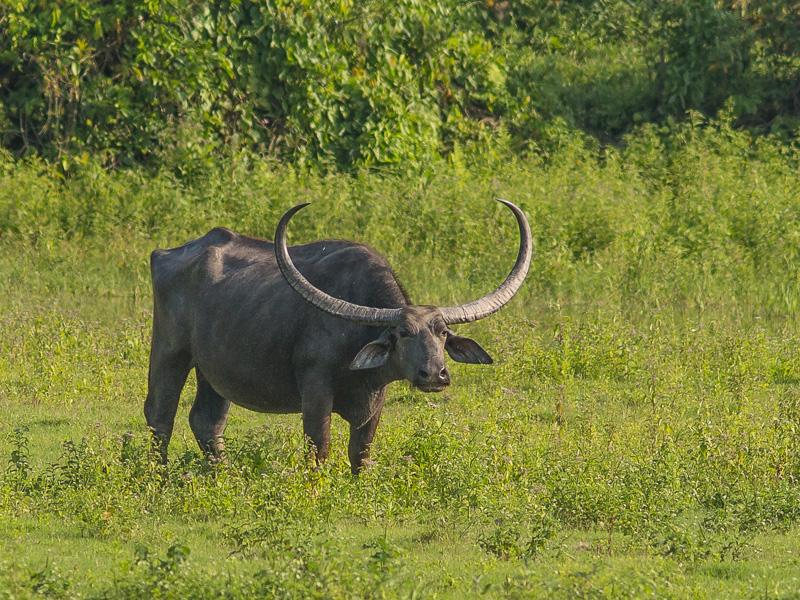
The head is broad and powerful. Adult males develop particularly impressive horns, which sweep outward and curve backwards. These horns are among the most recognisable features of the species and can be very large. They serve as defensive structures and are also involved in displays and confrontations between animals.
The buffalo’s physical strength should not be confused with aggression in every encounter. Like other large herbivores, it may avoid disturbance when possible, but an animal that feels threatened can be dangerous because of its size, speed and horns.
The Horns That Define the Wild Buffalo
The horns of the Wild Water Buffalo are not merely a visual characteristic. They are permanent structures that grow from the skull and provide an effective means of defence.
Their broad, sweeping shape distinguishes the wild form from many domestic buffaloes, although horn shape varies among individuals and domestic breeds. Horns are also useful in species identification, but they should not be used alone to determine whether an animal is genetically wild.
In populations that survive today, horn size and body shape can help trained observers distinguish individuals. The Wildlife Trust of India documents the use of natural features such as horns, body stature and hoofmarks in field monitoring.
For the historical Sundarbans population, there are no reliable measurements that establish a unique regional horn shape or a distinct physical form. Claims that the former delta buffalo possessed special horns or body features adapted specifically to mangrove life would go beyond the available evidence.
Hooves, Movement and Wet Ground
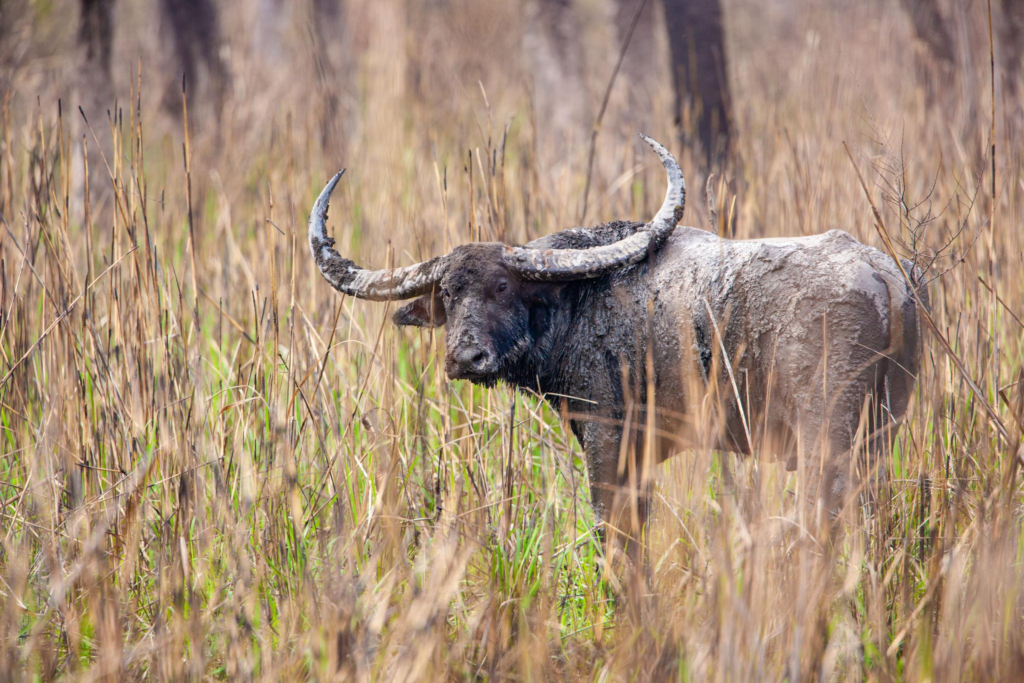
A large bovine must distribute its weight while moving over soft ground. The Wild Water Buffalo’s broad, split hooves help it travel across muddy and marshy terrain. Its limbs and overall build support movement through the wetlands and floodplains that characterise much of its natural habitat.
This does not mean that the animal could move effortlessly over every surface. Deep mud, steep banks, dense vegetation and unstable ground can still present obstacles. Movement depends on the condition of the terrain, the animal’s size and the availability of suitable routes.
In the historical Sundarbans, these traits would have been relevant in wet grasslands, swamp margins and floodplain environments. They should not be interpreted as evidence of a specialised ability to navigate the narrowest tidal creeks or dense mangrove root systems.
Coat, Senses and Physical Protection
See it for yourself
A private journey shaped around you — your group, your pace, your interests. Book a free consultation.
The Wild Water Buffalo generally has a dark grey to blackish coat, with variation according to age, sex, individual condition and population. Its dark appearance contrasts with the lighter vegetation and wetland surfaces found in some of its habitats.
Its eyes, ears and sense of smell help it detect environmental changes, locate food and respond to potential danger. As with other large mammals, these senses operate together rather than as independent tools. Movement, posture, sounds and the behaviour of nearby animals can all provide information about the surroundings.
There is no good evidence that the Sundarbans buffalo developed a uniquely specialised sensory system for the tidal forest. Its adaptations should be understood as those of the species as a whole unless region-specific research demonstrates otherwise.
The buffalo’s hide and muscular body provide physical protection, but neither makes it invulnerable. Injuries, parasites, disease, food shortages and environmental stress can affect individuals and populations.
What the Wild Water Buffalo Eats
The Wild Water Buffalo is primarily a herbivore. Grasses form a major part of its diet, while other vegetation may become important when the availability or quality of grass changes. Research on wild buffaloes in central India records dietary flexibility, including increased browsing during the dry season.
This flexibility is valuable in habitats where the abundance of plants changes seasonally. A buffalo may graze in open patches, feed along wetland margins or browse on available vegetation depending on local conditions.
However, the precise diet of the historical Sundarbans population has not been established through modern dietary analysis. It would be inappropriate to list particular Sundarbans mangrove species as confirmed food plants without evidence.
The ecological importance of the buffalo’s feeding behaviour lies in its ability to consume substantial quantities of vegetation and redistribute nutrients through movement and dung. In landscapes where suitable grasslands exist, these processes can affect plant growth and the distribution of nutrients.
Water, Heat and the Wetland Environment
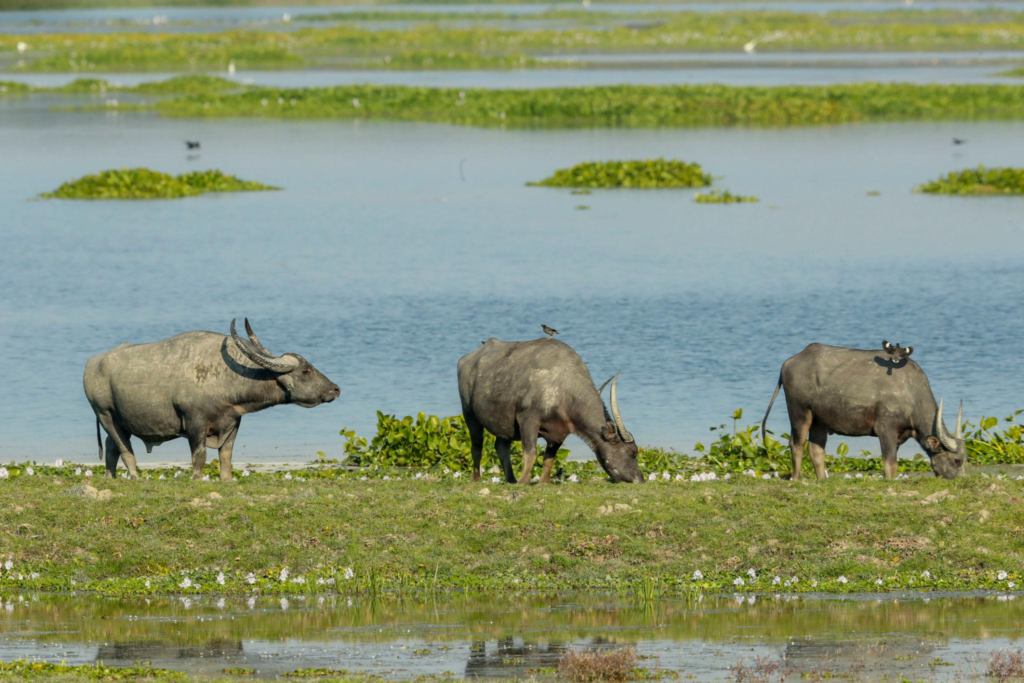
Wild Water Buffaloes are closely associated with water and wet habitats. Water availability supports their daily needs, while wetland environments can offer access to forage and opportunities to cool the body in hot conditions. Their relationship with water is one of the defining characteristics of the species.
Yet the presence of water does not mean every water source is equally suitable. The quality of water, surrounding vegetation, disturbance and seasonal availability all influence habitat value.
This is especially relevant when considering the Sundarbans, where freshwater influence and salinity vary across the landscape. The estuary contains water that changes with tides and the mixing of river water with seawater. There is no reliable evidence that the Wild Water Buffalo of the Sundarbans possessed a special ability to tolerate highly saline water or depended on drinking from tidal channels.
Its historical association with the delta is better explained by the wider availability of suitable wetland and grassland habitat than by any unverified saltwater adaptation.
How It Moves Through Its Habitat
Wild Water Buffaloes are capable swimmers, and water can be both a resource and a route through their environment. Their movement patterns are shaped by food availability, water, habitat structure, disturbance and the needs of the herd.
In suitable landscapes, individuals may move between feeding areas, resting places and water bodies. Such movements help them respond to seasonal changes in vegetation and access to resources.
It is tempting to imagine a herd swimming between mangrove islands in the historical Sundarbans. Although the species’ swimming ability is established, the exact routes, frequency of swimming and movement patterns of the former Sundarbans population are not documented well enough to reconstruct such scenes as fact.
The most scientifically responsible account is therefore a measured one: the buffalo was a large, water-associated herbivore that once occupied the wider delta, but the details of how it moved through the former Sundarbans remain uncertain.
Herds, Social Behaviour and Solitary Males
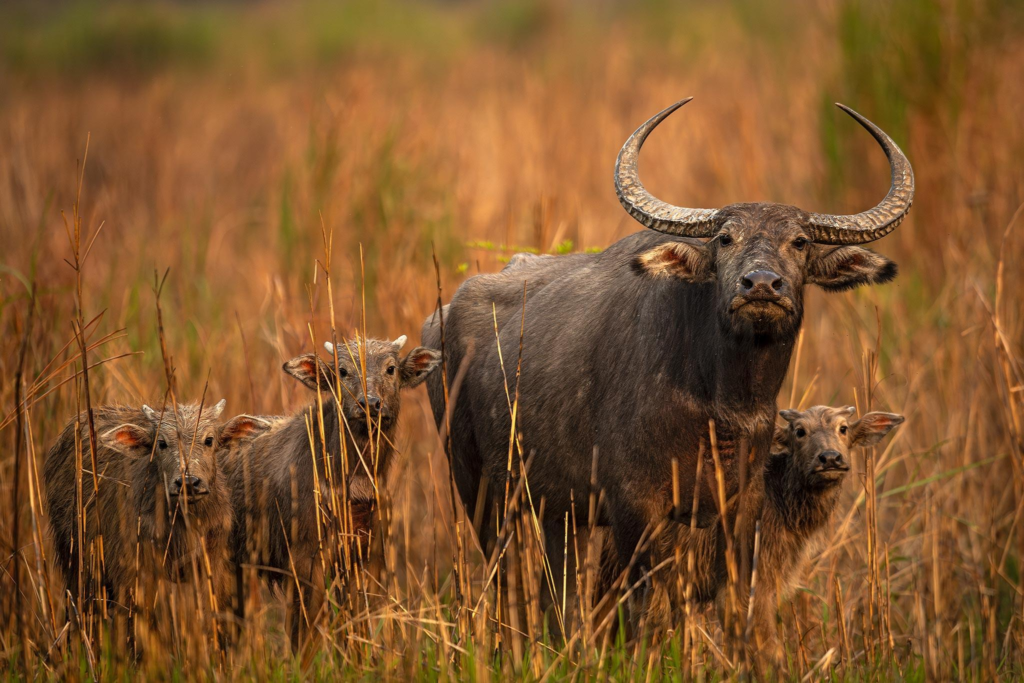
Wild Water Buffaloes are social animals, although their group structure changes with age, sex, season and local conditions. Herds commonly include females and their young, along with younger males. Mature males may spend more time alone or form smaller groups outside the main breeding period.
Group living can offer several advantages. Individuals can respond collectively to disturbance, and young animals remain close to adults during vulnerable stages of life. Herds may also move together between feeding and resting areas, although their exact movements depend on the habitat.
The social structure of the former Sundarbans population has not been documented in sufficient detail to determine herd size, group composition or seasonal patterns. General knowledge of the species helps explain how it may have lived, but it cannot establish the precise behaviour of animals that disappeared more than a century ago.
Communication and Displays
Like other bovines, Wild Water Buffaloes communicate through a combination of vocalisations, body posture, movement and physical displays. Sounds can help maintain contact between individuals, while posture and the position of the head may communicate alertness, dominance or threat.
The horns are especially important during confrontations between males. Their size and strength can make physical encounters dangerous, so displays and changes in posture may be significant parts of social interaction.
However, there is no detailed acoustic or behavioural study of the historical Sundarbans population. Specific claims about its calls, territorial boundaries or unique communication habits would be speculative.
Breeding and the Next Generation
Wild Water Buffalo reproduction varies across its range. Published accounts describe differences in breeding season, and some report an extended mating period rather than one uniform annual window. The Wildlife Trust of India’s species account notes that regional differences and conflicting observations complicate attempts to define a single breeding pattern for all populations.
After mating, the female carries the developing calf for an extended gestation period. Species accounts report a period broadly around 300–340 days, with variation between sources and populations. Calves depend on maternal care during early life, gradually developing the strength and feeding skills needed to live independently.
For the former Sundarbans population, the exact timing of births, calf survival rates and reproductive success are not known. It would be misleading to present modern estimates from another region as historical statistics for West Bengal.
Reproduction is nevertheless central to understanding the species’ conservation needs today. Where wild populations become small and fragmented, the loss of breeding females can have serious consequences. Limited opportunities to reproduce, genetic problems and other demographic pressures can make recovery difficult even when habitat remains available.
Predators, Competition and the Food Web
A fully grown Wild Water Buffalo is a formidable animal, but large herbivores remain part of the food web. Predation risk depends on the animal’s age, physical condition, habitat and the predators present. Young calves are generally more vulnerable than healthy adults.
In the wider Indian landscape, the tiger can prey on buffaloes, although confronting a large adult buffalo can be dangerous. This relationship is relevant to understanding large-mammal ecology, but it should not be used to invent particular hunting events in the historical Sundarbans.
Competition can also influence buffalo populations. Domestic livestock may use the same grazing areas, while changes in vegetation can reduce access to suitable forage. In contemporary conservation landscapes, competition with livestock, habitat degradation and the risk of disease transmission are among the issues that require management.
For the historical delta, the relative importance of predators and competing herbivores is not sufficiently documented to reconstruct the full food web around the buffalo. Its disappearance also means that any former ecological relationship involving the species can no longer be observed directly in the Indian Sundarbans.
The Historical Relationship Between People and Buffaloes
The Wild Water Buffalo once lived in a delta that was also used by human communities. Historical accounts of the wider Sundarbans describe a landscape where people, wildlife, waterways and forest resources overlapped. Hunting was one factor associated with the depletion of large mammals in the region.
The surviving record does not provide a complete picture of how every community interacted with wild buffaloes. It is therefore important not to assign a uniform cultural meaning to the animal or claim that a particular local tradition was widespread without reliable documentation.
Large herbivores can create both opportunities and challenges for people. They may provide food through hunting, while their size and strength can also pose risks during close encounters. Where their habitat overlaps with cultivation, crop damage can become a source of tension. Such effects are documented for wild buffaloes in some contemporary landscapes, but the extent and character of these interactions in the former Sundarbans are less certain.
A balanced account recognises that people were part of the historical landscape without assuming that every interaction was hostile. The disappearance of the buffalo should not be reduced to a simple story of local communities versus wildlife. Hunting, changes in land use, the loss of suitable habitat and broader historical pressures all belong in the discussion.
How the Buffalo Disappeared From the Sundarbans
The disappearance of the Wild Water Buffalo is best understood in the context of wider ecological change rather than as a single event with one established cause.
Historical wildlife records describe the species as present in the Sundarbans during the nineteenth century. The Sundarban Tiger Reserve’s conservation planning material states that wild buffaloes occurred in the region until around 1885 and had disappeared by the end of that century. A separate historical account cited in regional literature refers to a buffalo reportedly shot in the Sundarbans in 1890. These records indicate a late-nineteenth-century disappearance, although they do not establish the exact date on which the last individual died.
Several pressures are relevant to this history.
- Historical accounts describe intensive hunting of large mammals in the Sundarbans and neighbouring areas. This is a documented pressure, although the number of buffaloes killed and its precise contribution to their disappearance are unknown.
- The former northern delta contained grasslands, swamps and floodplain vegetation that later declined or were converted as human land use expanded.
- Alterations to the distribution and character of wetlands would have changed the availability of suitable feeding and resting areas.
- Once numbers fell, the remaining animals would have been increasingly vulnerable to further losses, although population estimates for the historical Sundarbans are unavailable.
The regional research literature identifies hunting and habitat loss as important factors in the disappearance of large herbivores from the Sundarbans, while also acknowledging gaps in the historical evidence.
It is not possible to assign reliable percentages to these causes or determine how much each contributed to the final disappearance. The evidence supports a broad explanation, not a precise reconstruction.
Physical Evidence of a Lost Mammal
The disappearance of an animal does not erase every trace of its former presence. Historical descriptions, old hunting accounts and preserved bones can provide evidence that a species once lived in a particular landscape.
The Wild Water Buffalo is one example. The Sundarban Tiger Reserve’s conservation planning material records buffalo bones recovered from Netidhopani in the reserve and identified by the Zoological Survey of India. It also discusses historical evidence for the animal’s presence in the region.
The reserve document refers to bone recovery from Netidhopani in 2001, while other regional accounts mention buffalo remains found during pond excavation around 1980. These are separate historical references and should not be treated as a single discovery without checking the original records.
Bone identification is important because it can help confirm the former occurrence of a species even when direct sightings have ceased. However, the discovery of remains does not establish how many animals lived nearby, the exact date of death or the size of the historical population.
For the Wild Water Buffalo, the evidence is sufficient to support its former presence and subsequent disappearance. It is not sufficient to produce a detailed population history.
How Scientists Study Extinct Local Populations
When a mammal has disappeared from a region, researchers must rely on different forms of evidence from those used to monitor a living population.
| Method | What it can establish | Limitation |
| Historical records | Former distribution, reported encounters and approximate disappearance periods | Accounts may be incomplete or imprecise |
| Museum specimens and bones | Evidence of past presence and, where diagnostic, species identity | A specimen does not reveal the size of the former population |
| Archaeological investigation | Remains associated with particular deposits or historical contexts | Dating and identification require suitable evidence |
| Archived photographs or hunting records | Visual or written confirmation of historical occurrence | Records may be scarce or lack precise locations |
| Habitat reconstruction | Whether historical environmental conditions were potentially suitable | Suitable habitat does not prove that the species occupied it |
| Modern field surveys | Whether a species is detected in surveyed areas today | Non-detection alone cannot prove absence |
These methods are complementary. A strong historical conclusion emerges when different types of evidence support the same interpretation.
In the case of the Sundarbans buffalo, historical accounts, the state mammal checklist and the reserve’s conservation documents agree that the species no longer occurs as a wild population in the region.
Is the Wild Water Buffalo Still Found in the Sundarbans?
No confirmed wild population of the Wild Water Buffalo remains in the Indian Sundarbans. The species is locally extinct in the region and is listed as extinct in West Bengal’s mammal checklist.
This status should be distinguished from the species’ global conservation status. Wild Water Buffaloes continue to survive in parts of Asia, with particularly important populations in India. The global species is Endangered, not globally extinct.
The historical references to Netidhopani and other parts of the delta are evidence of former presence, not modern wildlife observation sites. They should not be promoted as places where visitors can expect to see wild buffaloes today.
There is also no scientific basis for giving a present-day sighting probability for this species in the Indian Sundarbans. A locally extinct animal cannot be treated as a rare but regularly observable member of the current wildlife community.
What Makes the Sundarbans Wild Water Buffalo Unique?
The distinctive feature of the Sundarbans Wild Water Buffalo is not a proven local adaptation or a genetically separate form. It is the species’ place in the historical ecology of the delta—and the fact that it has disappeared from this landscape.
Several aspects make its story significant.
| Feature | Sundarbans-specific significance |
| Former distribution | Historical records place the buffalo in the wider Sundarbans region during the nineteenth century |
| Habitat relationship | Its occurrence reflects the former importance of wetlands, grasslands and freshwater-influenced landscapes beyond today’s dominant mangrove environment |
| Historical disappearance | Regional records place its disappearance by the end of the nineteenth century |
| Physical evidence | Buffalo remains identified in regional records help support its former presence |
| Ecological loss | Its disappearance represents the loss of a large herbivore and the ecological interactions associated with it |
| Conservation lesson | Protecting the remaining habitat is important, but recovering a locally extinct species would require much more than simply retaining forest cover |
The buffalo should not be described as a mangrove specialist without evidence. Nor is there a verified basis for claiming that the Sundarbans once supported a genetically distinct buffalo subspecies. The region’s significance lies in its historical role as part of the animal’s former range.
The larger lesson is that ecosystems are shaped by the animals that live in them as well as by their vegetation and physical geography. The loss of a large herbivore changes the community of species that remains, even if the landscape still appears wild.
Conservation Challenges and the Possibility of Recovery
The Wild Water Buffalo faces conservation challenges even in areas where it survives. The Wildlife Trust of India’s recovery report describes threats including habitat degradation, hunting, competition with domestic livestock and the vulnerability of small populations. It also documents efforts to improve habitat, strengthen protection and support population recovery in central India.
These contemporary efforts offer important lessons, but they should not be mistaken for a reintroduction programme in the Sundarbans.
A possible return to the Indian Sundarbans would require a dedicated scientific assessment. Researchers would need to establish whether suitable habitat could support the species, whether the ecological conditions of the former range remain adequate, and how a reintroduced population might interact with existing wildlife and people.
Such an assessment would also have to consider the availability of suitable grasslands and freshwater resources, disease risks, genetic management, human–wildlife interactions and the long-term costs of monitoring and protection.
No verified reintroduction plan for the Wild Water Buffalo in the Indian Sundarbans is established by the sources reviewed for this article. Reintroduction should therefore be treated as a hypothetical conservation question, not an announced future project.
Climate Change and the Changing Delta
The Sundarbans faces environmental pressures associated with sea-level rise, coastal erosion, cyclones, changing salinity and the shifting distribution of land and water. These processes affect the long-term condition of mangrove islands and surrounding wetlands.
For the Wild Water Buffalo, the relevance is primarily historical and ecological. The species is already locally extinct, so contemporary climate pressures cannot be described as the direct cause of its disappearance in the nineteenth century. The historical record instead points to a combination of hunting, habitat transformation and the wider loss of suitable environments.
If restoration or reintroduction were ever considered, changing environmental conditions would need to be included in the assessment. Habitat that appears suitable today might not remain suitable over the long term, particularly in a delta where erosion, sediment movement and salinity influence the distribution of wetlands.
Conservation planning must therefore look beyond the amount of forest remaining. It must consider whether the ecological functions required by a species can be maintained into the future.
Where Can This Mammal Be Observed in the Sundarbans?
The Wild Water Buffalo cannot currently be recommended as a wildlife observation target in the Indian Sundarbans.
Historical records connect the species with the wider delta, and the discovery of remains at Netidhopani provides evidence of its former presence. These locations are relevant to the region’s natural history, not to contemporary buffalo sightings.
For wildlife enthusiasts exploring the Sundarbans today, the appropriate approach is to learn about the mammals that still inhabit the region, including spotted deer, wild boar, rhesus macaques, fishing cats and other documented species. The buffalo belongs in a different category: a historically significant mammal that is no longer part of the living wildlife community of the Indian Sundarbans.
The Important Truth About Wildlife Sightings
Wildlife observation is unpredictable. Even in a species’ established habitat, an animal may remain hidden, move away from frequently visited areas or be active at a time when people are not present.
In the case of a locally extinct species, the distinction is even more important. The absence of recent sightings is not simply a matter of poor luck or difficult observation. In the Sundarbans, the available evidence supports the conclusion that the Wild Water Buffalo no longer maintains a wild population.
Accurate wildlife communication means making this distinction clear. A historical record should not be presented as a recent sighting, a fossil or bone discovery should not be described as proof of a surviving population, and a suitable habitat should not be confused with a confirmed animal presence.
For The Wild Orbit, responsible exploration includes understanding what is present, what is uncertain and what has been lost.
Myths and Facts About the Wild Water Buffalo
| Myth | Fact |
| Wild Water Buffaloes still roam the Indian Sundarbans. | Historical records document their former presence, but the species is locally extinct in the region. |
| Wild buffaloes and domestic water buffaloes are the same in every respect. | The wild species is recognised as Bubalus arnee. Domestic and feral animals require careful distinction. |
| The buffalo disappeared because of one single event. | Historical research points to multiple pressures, particularly hunting and habitat transformation, without establishing a precise breakdown of causes. |
| The Wild Water Buffalo is extinct worldwide. | The species survives in parts of Asia and is classified as Endangered globally. |
| Its former presence proves that it was specially adapted to saline mangrove water. | No reliable evidence establishes a specialised saltwater adaptation in the former Sundarbans population. |
FAQs
Is the Wild Water Buffalo extinct in the Sundarbans?
Yes. The Wild Water Buffalo (Bubalus arnee) is locally extinct in the Indian Sundarbans. Historical records place its disappearance in the late nineteenth century.
What is the scientific name of the Wild Water Buffalo?
Its scientific name is Bubalus arnee. It belongs to the family Bovidae and is also known as the Asian Wild Buffalo.
When did the Wild Water Buffalo disappear from the Sundarbans?
Regional historical accounts place its former presence until approximately 1885 and describe it as extinct by the end of the nineteenth century. A report of a buffalo being shot in 1890 is also cited in regional literature, so the exact date of the last animal’s disappearance remains uncertain.
Why did the Wild Water Buffalo disappear from the Sundarbans?
Historical research identifies hunting and habitat loss as important contributing factors. The contraction of grasslands, swamps and floodplain habitats also affected the wider community of large herbivores. The precise contribution of each factor is not known.
Is the Wild Water Buffalo endangered globally?
Yes. The IUCN classifies the species as Endangered. Although it has disappeared from the Sundarbans, wild populations continue to survive in parts of Asia.
Where did the Wild Water Buffalo live in the Sundarbans?
Historical sources place it in the wider Sundarbans region, which formerly included more extensive wetlands, grasslands and floodplain vegetation. Netidhopani is among the places associated with historical physical evidence of the species.
What did the Wild Water Buffalo eat?
It was primarily a herbivore, feeding mainly on grasses and other vegetation. The exact diet of the historical Sundarbans population has not been established.
Can tourists see Wild Water Buffaloes in the Sundarbans today?
No confirmed wild population remains in the Indian Sundarbans. Historical sites associated with the species should not be advertised as current sighting locations.
Could the Wild Water Buffalo be reintroduced to the Sundarbans?
A reintroduction would require extensive scientific assessment of habitat suitability, freshwater resources, disease, genetics, ecological impacts and human–wildlife interactions. No verified reintroduction programme for the Indian Sundarbans is established by the sources reviewed here.
Why is the Wild Water Buffalo important to Sundarbans history?
It represents a lost component of the delta’s former large-mammal community. Its disappearance illustrates how hunting and changes in habitat can permanently alter the wildlife composition of an ecosystem.
The Wild Orbit Perspective
The Sundarbans is often understood through the animals that remain: the Royal Bengal Tiger moving through the forest, spotted deer feeding along clearings, macaques travelling through the canopy and dolphins surfacing in the estuarine channels.
But the natural history of a landscape is also written in the absence of animals.
The Wild Water Buffalo once belonged to the broader ecological world of the Sundarbans. Its story connects the delta’s former grasslands and freshwater wetlands with the transformation of a landscape increasingly shaped by human settlement, hunting and changing habitat.
We cannot reconstruct every detail of its life here. We do not know the exact size of its historical population, the full extent of its movements or the precise moment when the last animal disappeared. Scientific responsibility means acknowledging those gaps rather than filling them with an imagined past.
What the evidence does establish is significant: a large wild herbivore once inhabited this region, and it no longer does.
The story is a reminder that conservation is not only about protecting what survives. It is also about understanding what has been lost, recognising the ecological processes behind that loss and making informed decisions about the wildlife that remains.
The tides continue to reshape the Sundarbans. The mangroves continue to grow, shed leaves and hold the sediment of the delta. Yet the return of each tide does not bring every lost species back.
A wilderness is measured not only by the life it shelters today, but also by the history it teaches us to protect.
Plan your private Sundarban expedition
A private journey shaped around you — your group, your pace, your interests. Book a free consultation.