 Field guide
In the Indian Sundarbans, where tidal creeks wind between mangrove islands and darkness settles over muddy forest edges, some of the most interesting mammals are rarely seen by daylight. Among them is the Small Indian Civet, a secretive, largely nocturnal carnivore whose patterned coat and quiet movements help it remain unnoticed in a landscape shared by wildlife and people.
Smaller than the Large Indian Civet, this adaptable member of the civet family occupies a wide range of habitats across South and Southeast Asia. In the Indian Sundarbans of West Bengal, its documented presence in reclaimed areas adds another dimension to our understanding of the region’s mammal community. Yet much about its local distribution, behaviour and ecology remains insufficiently studied.
Understanding the Small Indian Civet means looking beyond the animal itself. It means examining the relationship between small carnivores, the habitats along forest margins, the changing rhythms of the tidal landscape and the human settlements that form part of the wider Sundarbans environment.
Meet the Small Indian Civet
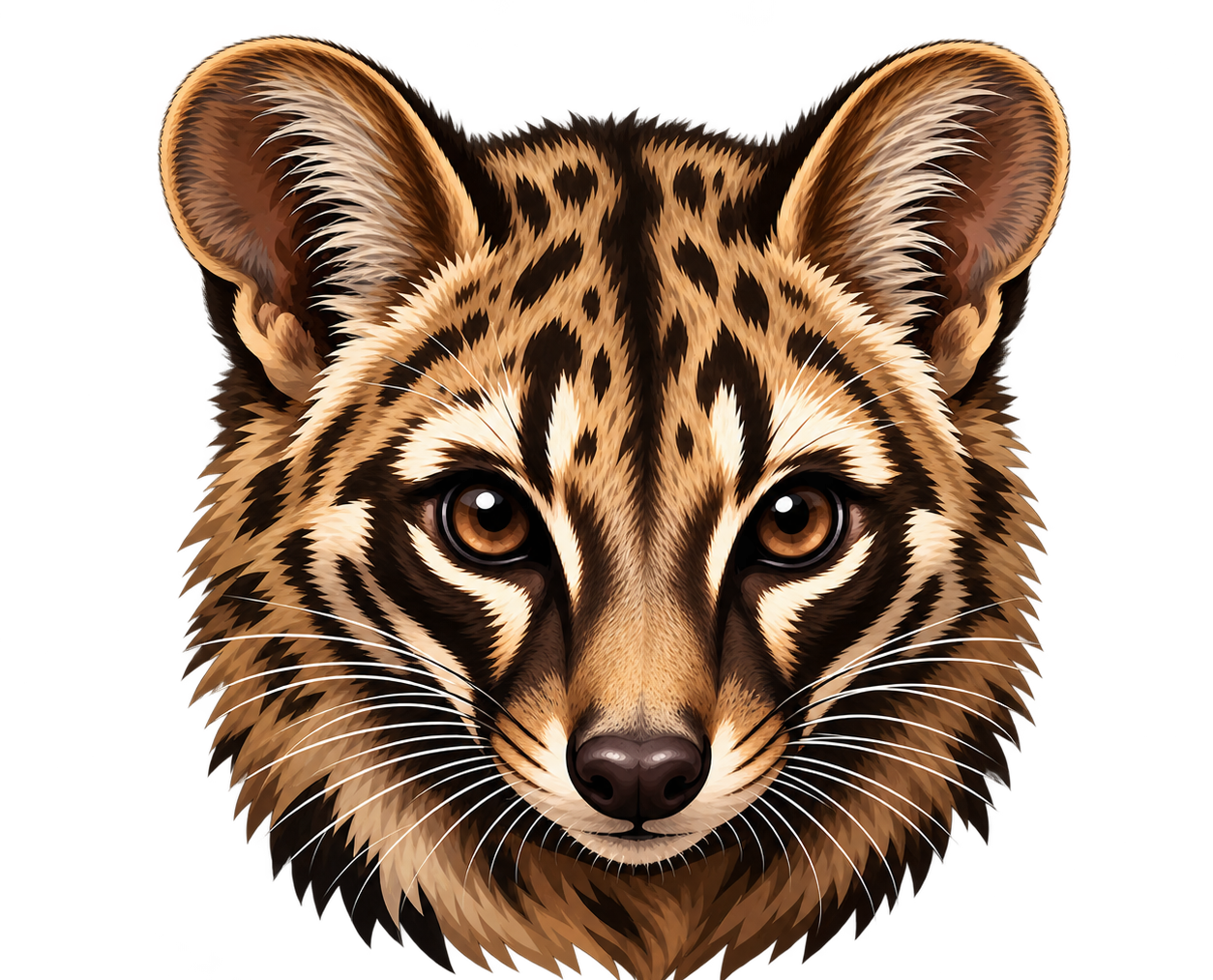
The Small Indian Civet (Viverricula indica) is a small, ground-dwelling mammal belonging to the family Viverridae. Although its pointed face, compact body and long, patterned tail can give it a cat-like appearance, it is not a member of the cat family. Civets belong to a separate branch of the order Carnivora and possess their own distinctive evolutionary history.
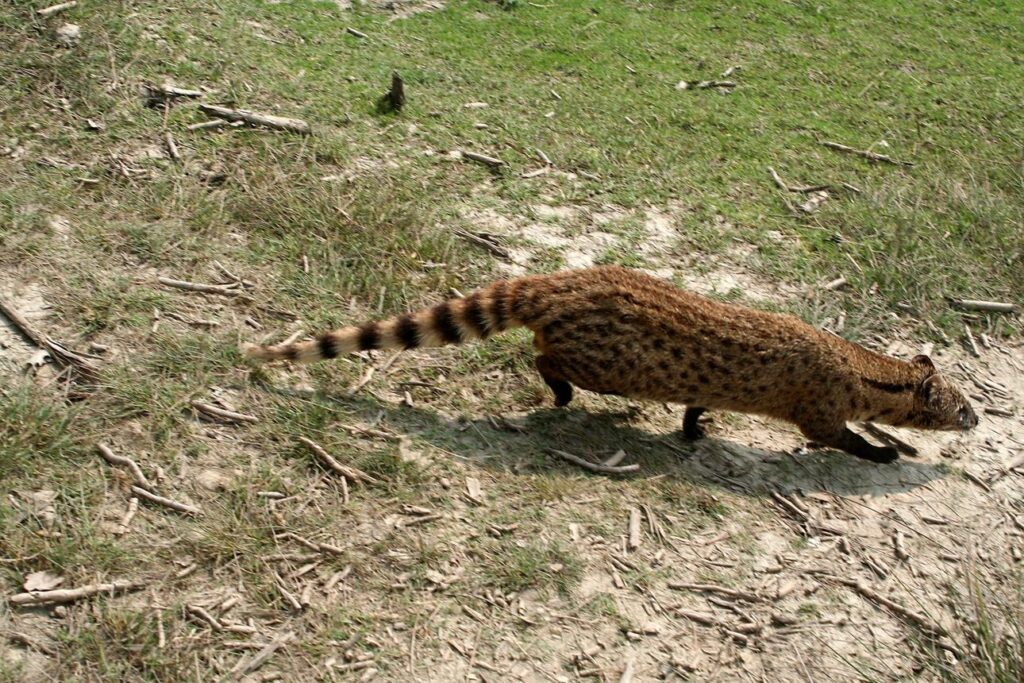
The species is recognised by its greyish-brown to tawny coat, rows of dark spots along the flanks, elongated markings across the back and conspicuous dark-and-pale rings on the tail. Its relatively small size distinguishes it from the larger civets found across parts of the Indian subcontinent.
Unlike large mammals that may leave conspicuous tracks or become familiar sights in wildlife destinations, the Small Indian Civet often lives beyond the attention of casual observers. It generally avoids unnecessary exposure, spends much of its active time after dark and can move through vegetation without attracting notice.
Its ecological flexibility has allowed it to occupy varied landscapes, including scrub, grassland, forest edges, cultivated areas and environments close to human habitation. That adaptability is particularly relevant when examining its place in the Indian Sundarbans, where wildlife habitats extend beyond the interiors of protected mangrove forests.
The species is not simply a miniature version of the Large Indian Civet. Its body proportions, coat pattern, behaviour and habitat associations give it a distinct identity.
Small Indian Civet At a Glance
- Common name: Small Indian Civet
- Scientific name: Viverricula indica
- Family: Viverridae
- Order: Carnivora
- Conservation status: Least Concern globally, according to the IUCN Red List assessment published in 2015.
- Geographic distribution: South and Southeast Asia, including India and Bangladesh.
- Habitat: Scrub, grassland, forest margins, suitable woodland and modified landscapes.
- Diet: Small vertebrates, insects and other invertebrates, with fruit and carrion also reported.
- Activity pattern: Primarily nocturnal.
- Lifestyle: Generally solitary and predominantly terrestrial, with climbing ability.
- Typical body weight: Approximately 2–4 kg in commonly cited species accounts.
- Distinctive features: Spotted flanks, longitudinal dorsal markings, dark legs and a ringed tail.
- Sundarbans significance: Listed in the Sundarban Tiger Reserve’s management documentation among mammals recorded from reclaimed areas.
Scientific Classification and Identity
The scientific name Viverricula indica places the species in the genus Viverricula, within the family Viverridae.
The family includes several other civets and related mammals, including the Large Indian Civet (Viverra zibetha) and the Common Palm Civet (Paradoxurus hermaphroditus). Despite sharing the family name, these species differ in their physical characteristics, habitat preferences and ecological behaviour.
The Small Indian Civet is distinguished particularly by its relatively compact body and the absence of the prominent dorsal crest associated with the Large Indian Civet. Its smaller, spotted appearance and ringed tail are useful identification features, although coat colour and marking intensity can vary between individuals.
Scientific identification is important in the Sundarbans because different small and medium-sized carnivores may occupy overlapping habitats. A civet seen near a settlement, for example, should not automatically be identified as a Small Indian Civet simply because it is nocturnal or has a long tail.
Reliable identification depends on a combination of body size, facial appearance, coat markings, tail pattern and, where possible, photographs or other verifiable evidence.
Where Does the Small Indian Civet Live?
The Small Indian Civet has a broad natural distribution across South and Southeast Asia. In India, the Zoological Survey of India’s national mammal checklist records it across suitable habitats throughout much of the country, excluding the high Himalayas in Jammu and Kashmir.
Its presence across different climatic and ecological regions reflects a capacity to use a variety of terrestrial habitats. It is associated with scrub, tall grass, woodland margins, riverine vegetation and modified environments where food and secure resting places are available.
However, a broad geographic range does not mean that the species occupies every habitat equally. Research summarised in the IUCN assessment indicates that records from the interiors of closed-canopy evergreen forests are relatively uncommon compared with records from open or modified habitats and forest edges.
This distinction matters when interpreting its presence in the Sundarbans. The region is internationally recognised for its extensive mangrove ecosystem, but the broader landscape also includes reclaimed agricultural land, settlements, vegetated embankments and other terrestrial habitats.
The Small Indian Civet’s occurrence in such environments may be as important to understanding its regional ecology as its relationship with forested areas.
The Small Indian Civet in the Indian Sundarbans
The Indian Sundarbans is a dynamic estuarine landscape in which rivers, creeks, mudbanks, mangroves and human settlements form a connected but uneven mosaic of habitats. Not every mammal recorded in the region depends exclusively on the dense mangrove forest.
The Sundarban Tiger Reserve’s management documentation lists the Small Indian Civet among mammals recorded from reclaimed areas. This is a meaningful regional reference because it supports the species’ inclusion in an account of the Indian Sundarbans, rather than relying solely on its wider distribution across India.
Nevertheless, the evidence must be interpreted carefully. A listing in a management document establishes a regional record, but it does not by itself demonstrate that the species is common throughout the reserve, regularly observed in the mangrove interior or present at any particular visitor destination.
Reclaimed areas can contain agricultural fields, scrub, vegetation along boundaries, human settlements and patches of cover. Such environments may provide small mammals, insects, fallen fruit and places in which a civet can rest during daylight. These are plausible ecological opportunities, not proof that every such habitat supports the species.
The distinction between the reserve’s forested areas and reclaimed landscapes is essential. Without more detailed local studies, the Small Indian Civet’s abundance, precise distribution and habitat preferences within the Indian Sundarbans remain uncertain.
Why Does This Civet Matter in a Mangrove Landscape?
The Small Indian Civet is primarily a terrestrial mammal, not a specialised mangrove predator. Its ecological importance in the Sundarbans is therefore best understood through the habitats and food resources it uses, rather than through unverified claims of unique saltwater adaptations.
Mangrove ecosystems are influenced by tidal flooding, sediment movement, salinity and freshwater inputs. The terrestrial habitats around them experience additional influences from farming, settlement, vegetation management and seasonal weather.
Where suitable conditions exist, a small carnivore such as the Small Indian Civet can connect different parts of this landscape through its feeding activity. It consumes animal prey and may also take fruit and carrion, potentially participating in both predation and the removal of organic material.
Its precise contribution to the Sundarbans food web has not been quantified in the evidence reviewed for this article. It would therefore be misleading to assign it a specific ecological function or claim that it controls the local rodent population.
What can be said is that the presence of a small, adaptable carnivore adds to the region’s terrestrial mammal diversity. Its continued presence also raises important questions about how wildlife persists in landscapes where protected forest, reclaimed land and human activity occur close together.
A Body Marked for Concealment
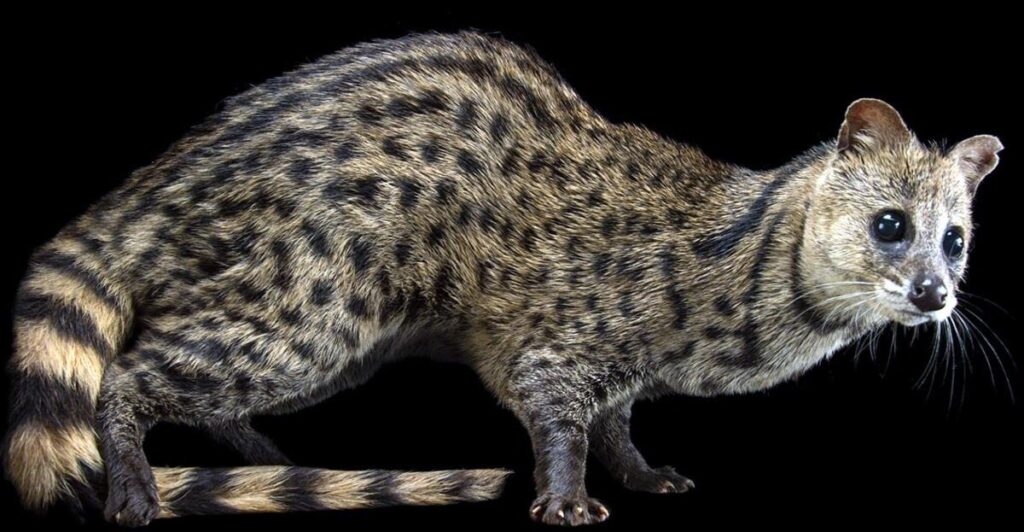
The Small Indian Civet’s appearance combines a low-slung body, relatively elongated legs, a pointed muzzle and a long tail. Its fur varies from greyish brown to sandy or tawny brown, with dark spots on the sides and elongated markings across the back.
The coat pattern is among its most recognisable characteristics. Dark spots on the flanks may align into longitudinal rows, while markings along the spine become more connected. The tail carries alternating dark and pale rings that remain conspicuous when the animal is viewed clearly.
In suitable surroundings, this pattern may help break up the outline of the animal against uneven vegetation and shadow. It is reasonable to regard the coat as a potential aid to concealment, although its effectiveness has not been specifically measured in Sundarbans conditions.
For a mammal that relies heavily on remaining unnoticed, physical appearance is only part of the story. Timing, careful movement and the availability of cover are equally important.
Size, Limbs and Movement
The Small Indian Civet is modest in size compared with many other carnivorous mammals of the region. Commonly reported adult weights fall around 2–4 kg, although actual measurements vary among individuals and sources.
Its relatively elongated body and legs allow it to travel across the ground and move through low vegetation. Unlike strongly specialised arboreal mammals, it spends most of its time on the ground, but it can climb when circumstances require it.
This combination of terrestrial movement and climbing ability gives the species some flexibility when navigating scrub, tangled vegetation and the margins of wooded habitats.
In the Sundarbans, the distinction between firm ground and tidal ground is particularly important. A civet moving through a reclaimed field or vegetated embankment faces different conditions from one moving along a soft, waterlogged creek edge. The species’ general terrestrial abilities should not be mistaken for evidence of a specialised capacity to cross deep mud, swim tidal channels or forage in flooded mangrove forest.
No reliable evidence reviewed here establishes a distinctive swimming adaptation in the Small Indian Civet of the Indian Sundarbans.
Paws, Claws and the Ground Beneath It
The Small Indian Civet has four limbs with darkly coloured feet. Its feet and claws support terrestrial movement and climbing, while its body structure allows it to navigate ground-level cover.
In the wider Sundarbans landscape, ground conditions can change substantially with rainfall and tides. Dry or compacted earth, leaf litter, grass, loose soil and wet mud each influence how a terrestrial animal can move.
It is tempting to assume that any mammal found in the Sundarbans must possess specialised adaptations for muddy terrain. That would be an unjustified conclusion. The Small Indian Civet’s known anatomy supports its classification as a primarily terrestrial, partly arboreal mammal; it does not establish specialised webbing, unusual salt tolerance or other mangrove-specific adaptations.
The species’ persistence in suitable habitats is more plausibly understood through a combination of general mobility, flexible feeding behaviour, cover and access to resting sites.
Its claws can also assist with climbing and may contribute to digging behaviour. Civets have been reported to use burrows and other sheltered spaces, although the extent to which Small Indian Civets excavate their own refuges varies with the available evidence and habitat.
The Ringed Tail: More Than a Distinctive Feature
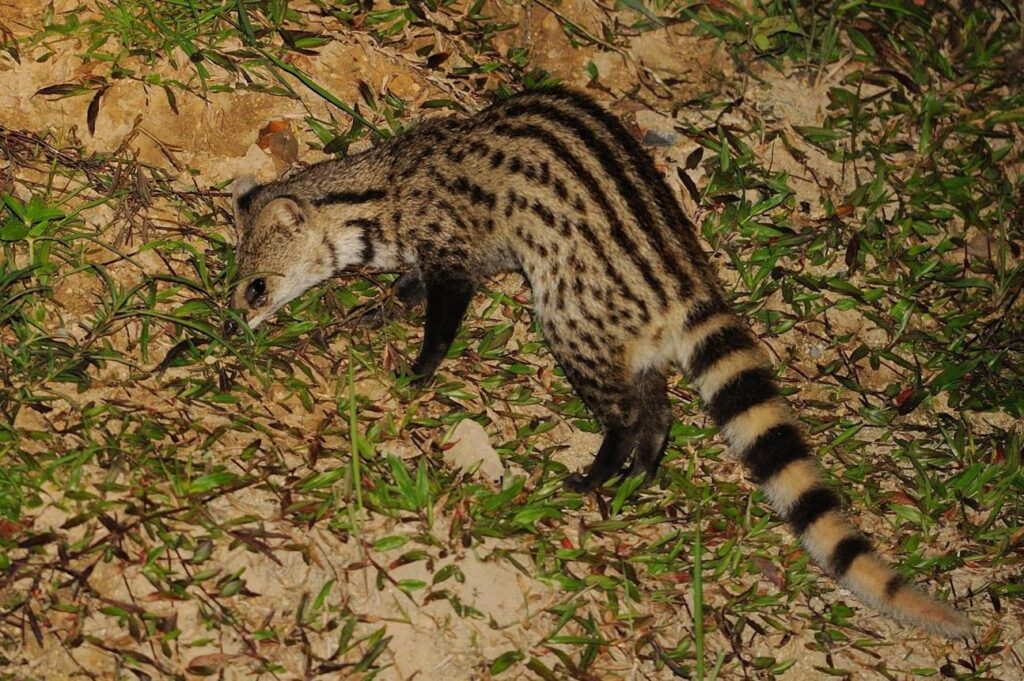
The long, ringed tail is one of the most striking features of the Small Indian Civet. It contributes to the animal’s overall silhouette and provides a useful field identification characteristic.
The tail is not unique to this species among civets, so it should not be used in isolation when distinguishing one species from another. The body markings, relative size and facial features are also important.
In wildlife photography, the tail may be the clearest feature visible when an animal disappears into vegetation. A sequence of images showing the back, flank and tail can therefore be more useful for identification than a single blurred photograph of the face.
Its precise functions beyond those generally associated with a mammalian tail should not be overstated. There is insufficient evidence here to assign the Small Indian Civet’s rings a specialised signalling or camouflage function unique to the Sundarbans.
The Senses Behind Survival
The Small Indian Civet lives largely after dark, when visual conditions are reduced and the detection of food, other animals and potential danger depends on several senses working together.
Its pointed muzzle, whiskers, eyes and ears form part of the sensory equipment expected of a small terrestrial carnivore. Smell is especially relevant to civets because scent plays an important role in their communication.
Whiskers can help an animal gather tactile information about objects close to its face. Hearing can assist with detecting movement, while vision supports navigation and the recognition of nearby objects. However, detailed comparative measurements of the Small Indian Civet’s sensory performance in mangrove environments were not identified in the sources reviewed.
Its sense of smell has a further role in social behaviour. Civets possess specialised scent-producing glands, and scent marking is associated with communication and territorial activity. These chemical signals may convey information about an individual’s presence and reproductive condition.
For a mostly solitary mammal that does not necessarily encounter other members of its species frequently, scent can provide information without requiring direct contact.
What Does the Small Indian Civet Eat?
The Small Indian Civet is an opportunistic feeder whose diet includes a variety of animal and plant resources.
Its food may include:
- Rodents and other small mammals.
- Small birds and eggs.
- Frogs and other amphibians.
- Lizards and other small reptiles.
- Insects and other invertebrates.
- Fallen fruit and other available plant material.
- Carrion where accessible.
The relative importance of these food items varies across its broad distribution and is not established specifically for the Indian Sundarbans. Species accounts describe it as primarily carnivorous or broadly omnivorous, reflecting the range of foods it can consume.
This flexibility is important for an animal living in habitats that may differ in food availability throughout the year.
In a terrestrial setting, rodents and insects may be accessible beneath vegetation or around agricultural land. Fruit may be available in season, while eggs, small vertebrates or carrion can provide occasional food sources. These examples describe potential feeding opportunities rather than a verified Sundarbans-specific diet.
The civet’s feeding habits should not be confused with those of the Fishing Cat or otters. Those mammals are strongly associated with wetland prey and aquatic environments in ways that are not established for the Small Indian Civet.
Hunting and Foraging After Dark
The Small Indian Civet generally searches for food at night. Its feeding strategy is based on locating and capturing accessible prey rather than relying on the pursuit of large animals.
Rodents and other small vertebrates can form important components of its diet. Invertebrates, fruit and carrion broaden the range of resources it can exploit.
Its foraging behaviour is likely to vary with local food availability, cover and disturbance. A civet in an agricultural landscape may encounter a different set of feeding opportunities from one living near scrub or woodland.
In the Sundarbans, it is reasonable to investigate whether reclaimed fields, settlement margins and vegetated boundaries provide feeding habitat, but such use should not be presented as a confirmed behavioural pattern without local observations.
Nor should the animal automatically be described as a beneficial pest controller. Although it eats rodents, the degree to which it reduces rodent populations in any particular location is unknown.
Its ecological role is more complex than a single service: it is a predator, an opportunistic consumer and one participant in a wider network of species interactions.
When Is the Small Indian Civet Most Active?
The Small Indian Civet is primarily nocturnal. Daylight hours are generally associated with resting in sheltered locations, while much of its foraging and movement occurs after dark. Occasional daytime activity has been reported, particularly in less disturbed environments.
Resting places may include burrows, hollow logs, dense vegetation and other protected spaces. In landscapes influenced by people, suitable cavities or sheltered structures may also be used.
Night-time activity can reduce direct encounters with people and some daytime competitors, although nocturnality should not be interpreted as a guarantee of safety.
For researchers, this activity pattern creates a practical challenge. A species can be present in a landscape yet remain difficult to detect during ordinary daytime surveys. Direct observations may be rare even where other evidence indicates its presence.
This is one reason why carefully designed camera-trap surveys and verified photographic records can be valuable for understanding small, elusive mammals.
Surviving a Landscape That Never Stays Still
The Sundarbans is shaped by the movement of tides, sediment deposition, erosion, rainfall and freshwater flows. Yet the Small Indian Civet should not be described as a specialist adapted to every aspect of this changing environment.
Its relationship with the region is more nuanced. Its broad habitat tolerance may allow it to persist in suitable terrestrial environments around the mangrove ecosystem, including areas that differ from the tidal forest itself.
The species’ ability to use varied food sources and sheltered resting places offers a plausible explanation for its wider adaptability. Whether particular populations can persist under specific levels of salinity, flooding or habitat fragmentation requires local evidence.
The key distinction is between adaptability and specialisation. The Small Indian Civet is adaptable across a range of landscapes; there is not enough evidence to claim that it possesses unique physiological adaptations for drinking saline water or surviving prolonged tidal inundation.
Its place in the Sundarbans is therefore best understood through the interaction of generalist ecology and the availability of suitable habitat.
A Solitary Life in a Shared Landscape
The Small Indian Civet is generally solitary. Unlike mammals that depend on herds or stable social groups, it usually moves and forages alone, with closer association between individuals occurring around reproduction.
Solitary behaviour does not mean that individuals live entirely independently of one another. Their ranges may overlap, and scent marking can help communicate presence without direct confrontation.
For a nocturnal animal that may travel through vegetation after dark, avoiding unnecessary encounters can be advantageous. It may also reduce competition over immediate food resources, although the precise relationship between territoriality and food availability has not been established for the Sundarbans population.
There is little basis for assigning this species a particular group size or social structure in the Indian Sundarbans. Its general behaviour is documented across its wider range, but local patterns may differ according to habitat, disturbance and resource availability.
Scent Marking and Chemical Communication
See it for yourself
A private journey shaped around you — your group, your pace, your interests. Book a free consultation.
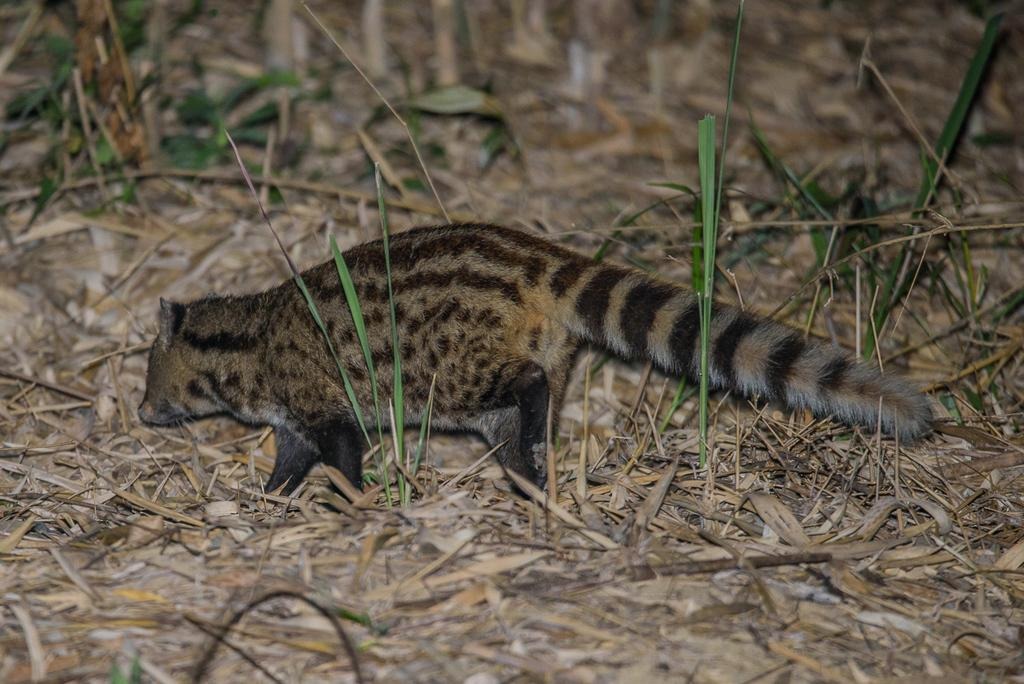
Civets possess specialised scent-producing glands, and chemical communication is an important part of their behaviour. Small Indian Civets have been reported to mark objects and parts of their surroundings with glandular secretions.
Scent marking can help communicate an animal’s presence to others of its species. Depending on the context, chemical signals may carry information associated with territorial use or reproduction.
This form of communication is especially relevant to animals that are active at different times or avoid direct contact. A scent mark can remain after its maker has moved away, allowing another individual to encounter the signal later.
However, the exact meaning of particular scent marks, their duration under humid conditions and their distribution across the Indian Sundarbans have not been established in the evidence reviewed.
It would therefore be misleading to claim that researchers can determine a civet’s territory or reproductive status simply by finding a particular scent mark in the field.
Vocalisation and Behavioural Signals
The Small Indian Civet’s behaviour is not communicated through scent alone. Like other mammals, it can use body posture, movement and vocal signals in particular circumstances.
Nevertheless, detailed studies of its wild vocal repertoire are limited compared with research on better-studied mammals. Reports of specific sounds and mating behaviour should be interpreted in the context in which they were observed, especially when based on captive animals.
For the Indian Sundarbans, there is insufficient evidence to describe a distinct local vocal repertoire or to associate particular calls with specific forest blocks.
Researchers studying the species should record vocalisations only when they can confidently distinguish the source and context. An unidentified night-time sound should not automatically be attributed to a civet.
This restraint matters in a landscape where frogs, birds, insects and several mammal species can be active around the same time.
Breeding, Birth and the Early Life of a Civet
Small Indian Civets reproduce sexually and give birth to live young. Published species accounts report litters of approximately two to five offspring, although litter size and reproductive timing can vary.
The available information on breeding is uneven. Some observations come from captive animals, while regional accounts provide information on young seen at different times of the year. These records do not necessarily describe the precise reproductive cycle of wild animals in the Indian Sundarbans.
Consequently, no particular month should be presented as the definitive breeding season for the Sundarbans population without local evidence.
A female needs a sufficiently sheltered location in which to give birth and protect her young. Burrows, cavities and dense cover are reported resting or sheltering environments for the species, but a particular den type has not been established for this regional population.
The early life of a Small Indian Civet is also less thoroughly documented than that of some larger mammals. Information on juvenile development, survival rates and dispersal in the wild remains limited.
Parental Care and Growing Independence
As with other small carnivores, a young civet depends on its mother during its early development. The female provides milk and is understood to play the principal role in raising the litter.
Young animals must eventually develop the skills needed to locate food, recognise danger and move independently through their surroundings. The exact timing of these stages in wild Small Indian Civets is not sufficiently established to provide a reliable Sundarbans-specific schedule.
There is also no sound basis for estimating how many young survive to adulthood in the Indian Sundarbans. Such estimates would require field studies that follow individuals over time or use other appropriate population-monitoring methods.
This gap in knowledge is important. A species may be widely distributed and classified as globally Least Concern while still having poorly understood local population dynamics.
Understanding reproduction and juvenile survival would help clarify how the species responds to habitat change and other pressures in the region.
Predators, Competitors and the Wider Food Web
As a relatively small carnivore, the Small Indian Civet can itself become prey for larger predators under some circumstances. The precise predators that take it, and the frequency of such events in the Indian Sundarbans, are not established by the evidence reviewed here.
It may also compete with other mammals for certain food resources. Species that consume rodents, insects, eggs or other small animals can have overlapping diets, although overlap does not necessarily mean direct competition is severe.
The Sundarbans supports a diverse mammal community, including the Fishing Cat, jackals, mongooses and larger carnivores. Their ecological requirements differ, and the presence of multiple carnivores does not imply that they all hunt the same prey in the same habitats.
For the Small Indian Civet, the most defensible food-web interpretation is that it participates in a network of predation and resource use. Its exact interactions with other carnivores in the Indian Sundarbans remain a subject for further research.
The Small Indian Civet and Local Communities
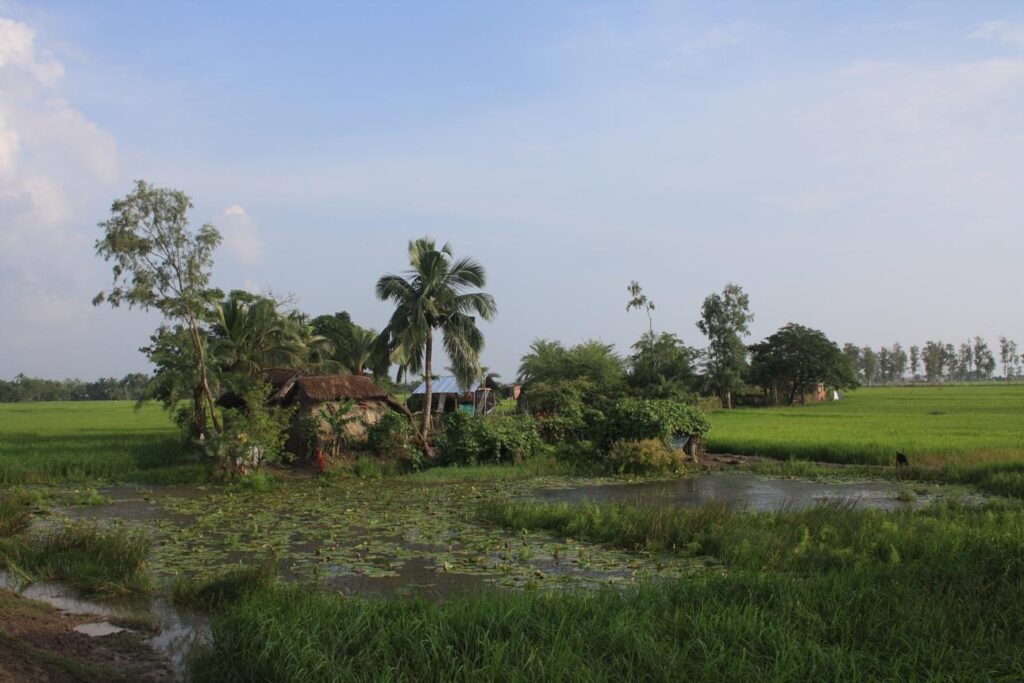
The boundary between wildlife habitat and human-used land is a defining feature of many parts of the Indian Sundarbans. Reclaimed areas contain settlements, agriculture, vegetation and transport routes, creating conditions that differ from those inside protected mangrove forest.
The Small Indian Civet’s documented presence in reclaimed areas makes its relationship with these landscapes relevant. Across its wider range, the species has been recorded near human habitation and can use modified environments when suitable resources and shelter are available.
This does not mean that every encounter represents a conflict. A civet passing through vegetation, feeding on insects or taking shelter may go unnoticed. Interactions become more complicated when wildlife enters buildings, accesses poultry or is mistaken for another animal.
Reports of civets taking poultry or other accessible food exist in the wider species literature, but the frequency and significance of such incidents in the Indian Sundarbans are not established here.
A balanced approach recognises both wildlife ecology and local livelihoods. Poultry, stored food, household waste and sheltered structures can attract opportunistic animals, while people may reasonably be concerned about livestock losses or unfamiliar wildlife around homes.
Where encounters occur, practical measures include securing poultry at night, storing food and waste appropriately, avoiding attempts to handle the animal and seeking guidance from the relevant forest authorities when necessary.
The objective should be to reduce avoidable encounters without portraying local communities as inherently hostile to wildlife.
Why Small Carnivores Are Easy to Overlook
Large mammals often dominate public discussions of wildlife in the Sundarbans. The Royal Bengal Tiger understandably attracts attention, while deer, Fishing Cats, crocodiles and dolphins are also familiar subjects of wildlife interpretation.
Small nocturnal mammals can be harder to study because they are less conspicuous, move through dense ground-level cover and may be active when researchers and visitors are absent.
The Small Indian Civet illustrates this challenge. A verified record may establish its presence without revealing how many animals live in the area, how far they travel or how frequently they use a particular habitat.
Its ecology should therefore be investigated with methods appropriate to a small, elusive carnivore rather than inferred from occasional sightings alone.
Understanding such species also broadens the way the Sundarbans is understood. The region is not defined solely by its most celebrated predators or its aquatic wildlife. Its ecological character also depends on the less visible animals moving through terrestrial habitats, forest margins and reclaimed landscapes.
Conservation Status: Least Concern Does Not Mean No Concern
The Small Indian Civet is classified as Least Concern (LC) in the IUCN Red List assessment published in 2015. The assessment describes the species as widespread and common in parts of its range, with a stable overall population trend at the time of assessment.
This global classification indicates that the species was not considered to meet the criteria for a threatened category at that assessment. It does not mean that every population is stable, that all habitats remain intact or that local declines cannot occur.
The assessment is also dated, so it should not be mistaken for a newly completed evaluation of the species’ status in 2026.
The Zoological Survey of India’s 2024 national mammal checklist lists the Small Indian Civet as Least Concern under its cited IUCN status and records it under Schedule I of India’s amended Wildlife (Protection) Act framework. It also lists the species in CITES Appendix III.
These are different legal and conservation frameworks: IUCN status describes global extinction risk, Indian wildlife legislation establishes domestic legal protection, and CITES concerns international trade. They should not be treated as interchangeable measures.
For conservation work in the Indian Sundarbans, the relevant questions include whether suitable terrestrial habitats are being retained, how wildlife uses reclaimed landscapes, and whether local pressures affect the species’ survival.
Threats to the Small Indian Civet
The Small Indian Civet’s adaptability may allow it to persist in a range of modified environments, but this does not make it immune to human pressures.
Potential threats across its wider distribution include habitat loss, direct killing, hunting and other human-related pressures. Their relative importance varies geographically, and the sources reviewed do not establish a ranked list of threats for the Indian Sundarbans population.
Several issues deserve attention in the region.
Habitat alteration: Changes to scrub, field margins, vegetation and other terrestrial habitats may affect the availability of cover, prey and resting places.
Human–wildlife encounters: Civets entering poultry enclosures or buildings can be perceived as pests. Such encounters may result in injury or killing, although the local frequency of this problem is unknown.
Roads and transport: Where roads intersect habitat, small mammals may be exposed to vehicle collisions. This is a plausible general risk, not a quantified threat for Small Indian Civets in the Indian Sundarbans.
Disturbance and fragmentation: Changes that divide suitable habitat into smaller patches may affect movement and access to resources. The extent of this effect on the local population requires investigation.
Information gaps: Limited local data make it difficult to determine population trends, identify important habitat patches or measure the effects of specific threats.
The last point is especially important. Conservation decisions become more effective when they are informed by evidence about the species’ actual distribution and ecological needs rather than assumptions based on its broad range.
Climate Change and a Changing Estuary
The Indian Sundarbans faces environmental pressures associated with sea-level rise, erosion, cyclones, changing freshwater inputs and shifting salinity patterns. These processes affect habitats, settlements and livelihoods across the region.
For the Small Indian Civet, the implications are not yet clearly established.
A terrestrial mammal using reclaimed areas and vegetation around settlements may be affected when land is lost, cover is removed or the distribution of prey and shelter changes. However, the extent to which these factors influence the species locally has not been quantified in the sources reviewed.
It would be equally misleading to assume that its adaptability guarantees resilience or that every change in salinity directly threatens it.
The most useful approach is to examine changes in the terrestrial habitats that the species actually uses. Repeated surveys could investigate whether civet detections change as vegetation, land use and habitat connectivity change over time.
Such work would also help separate the effects of climate-related processes from those of direct habitat modification and human activity.
How Is the Small Indian Civet Monitored?
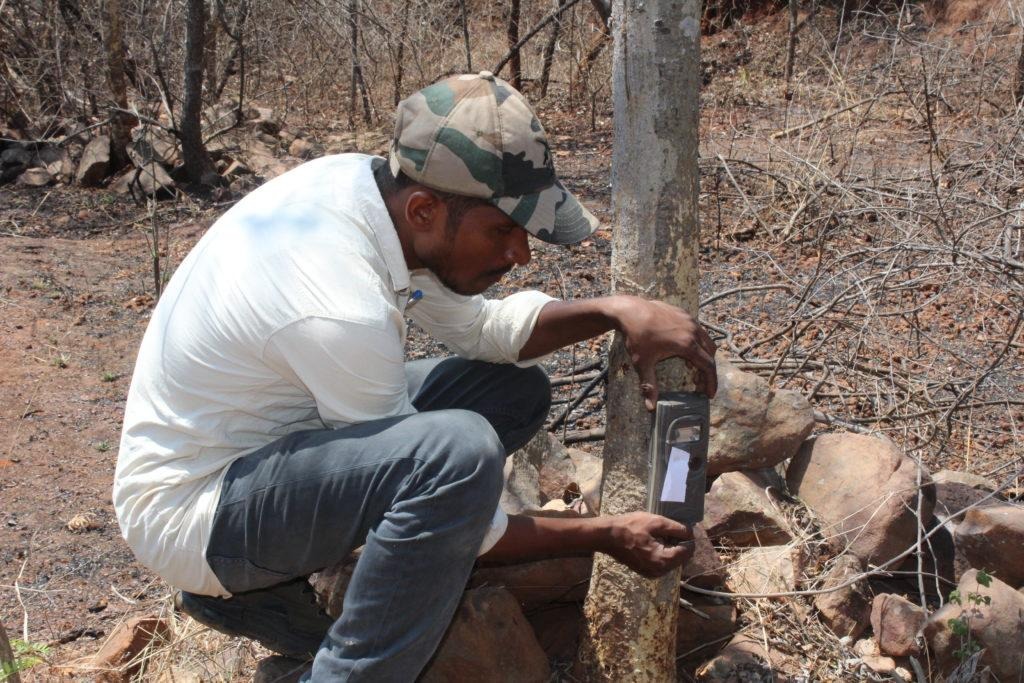
Because the Small Indian Civet is elusive and primarily nocturnal, camera traps can be useful for investigating its presence and activity.
A camera trap uses a motion- or heat-sensitive trigger to photograph animals moving through a selected location. If positioned carefully, it can record animals that would be difficult to observe directly during the day.
For a study in the Indian Sundarbans, cameras might be deployed along suitable vegetated boundaries, terrestrial pathways or other habitat features selected by researchers. Placement should be based on a clear survey design rather than an assumption that any particular tourist destination is a civet hotspot.
A photograph can confirm presence when the animal is identifiable, but a single image does not establish population size or long-term habitat preference.
Repeated surveys provide more useful information. Researchers can record the date and time of detections, identify individual animals where markings permit, compare habitat types and assess how frequently the species is detected under different conditions.
Other evidence may include verified direct observations, tracks and scat. These signs must be interpreted cautiously because tracks may be obscured by mud or tides, while scat identification can be difficult when several carnivores use the same area.
For stronger conclusions, field records should be combined with consistent methods, appropriate effort and expert verification.
What Can Camera Traps Tell Us?
Camera traps can help answer several important questions:
- Is the Small Indian Civet present in a particular habitat?
- At what times of night is it recorded?
- Does its detection frequency differ between habitat types?
- Are individuals using the same paths repeatedly?
- Does recorded activity change between survey periods?
- Is the species detected alongside other terrestrial mammals?
These questions are particularly relevant to the reclaimed landscapes surrounding the Sundarbans’ mangrove ecosystems.
However, detection frequency is not automatically equivalent to abundance. A camera may record an animal repeatedly because it frequently crosses a particular path, while another animal may remain undetected because it moves elsewhere.
Estimating population size or density requires methods appropriate to the study question, sufficient data and careful statistical interpretation.
The most valuable outcome of monitoring may therefore be a clearer understanding of habitat use and changes in the species’ recorded presence, rather than an unsupported estimate of how many civets live in the region.
Where Can the Small Indian Civet Be Observed in the Sundarbans?
The Small Indian Civet is included in Sundarban Tiger Reserve management documentation among mammals recorded from reclaimed areas. This is the most directly relevant regional reference identified for this article.
Its broader habitat associations suggest that suitable terrestrial environments with vegetation, food resources and sheltered resting sites may be worth investigating. Yet this does not justify naming specific islands, watchtowers or tourist routes as reliable sighting locations.
There is insufficient verified evidence here to identify a regular observation zone for the Small Indian Civet at Sajnekhali, Sudhanyakhali, Dobanki, Netidhopani, Burirdabri or Bonnie Camp.
These locations should not be promoted as civet hotspots without supporting records.
For naturalists and researchers, the appropriate priority is to consult current reserve information and use verified wildlife records to identify suitable survey areas. For visitors, the species is best regarded as an elusive mammal whose presence may be confirmed through research or occasional chance encounters, not as an animal that can be reliably seen during a standard expedition.
The Important Truth About Wildlife Sightings
Wildlife observation is unpredictable. A species can be present in a landscape without appearing during a particular visit, and the absence of a sighting does not demonstrate the absence of the animal.
For nocturnal mammals such as the Small Indian Civet, daytime visibility is especially limited. A responsible wildlife experience recognises these limitations and values ecological understanding alongside direct encounters.
Protecting the Habitats That Support Small Carnivores
Conservation of the Small Indian Civet in the Indian Sundarbans begins with understanding the habitats it uses. Protecting mangrove forests remains fundamental to the wider ecosystem, but terrestrial vegetation and suitable habitats outside dense mangroves also deserve attention when they support native wildlife.
Potential conservation priorities include:
- Retaining suitable vegetation and cover around terrestrial habitat patches.
- Maintaining connectivity between appropriate habitat areas wherever feasible.
- Reducing avoidable killing of small carnivores around settlements.
- Improving the secure storage of poultry, food and household waste.
- Recording verified wildlife encounters and photographic evidence.
- Incorporating small mammals into broader biodiversity monitoring.
- Supporting research into habitat use, local distribution and population trends.
These measures should be adapted to local conditions and supported by field evidence. They are not a substitute for species-specific research, but they provide a practical starting point for reducing avoidable pressures.
The Small Indian Civet also demonstrates why conservation cannot focus exclusively on animals that are large, charismatic or easy to count. A landscape’s biodiversity depends on many species whose ecological relationships are not immediately visible.
What Makes the Small Indian Civet of the Sundarbans Unique?
The Small Indian Civet is not known to represent a distinct Sundarbans subspecies, nor is there sufficient evidence to claim that the regional animals possess unique physiological adaptations to tidal mangroves.
Its significance lies instead in the relationship between a widely distributed, adaptable carnivore and the diverse terrestrial habitats surrounding one of the world’s most distinctive estuarine ecosystems.
Its documented presence extends the Sundarbans mammal story beyond the mangrove interior. The Sundarban Tiger Reserve’s management documentation records the species among mammals found in reclaimed areas. This provides a regional basis for studying its relationship with terrestrial habitats that coexist with the tidal forest.
Its ecology highlights the importance of habitat mosaics. Scrub, vegetated boundaries and other suitable terrestrial environments can have ecological value alongside the more widely recognised mangrove forests. The extent to which each habitat supports the civet locally remains a question for research.
Its adaptability makes it an interesting subject for human–wildlife studies. Across its broader range, the species can occur near human settlements. Understanding how it uses modified landscapes in the Indian Sundarbans could help explain how small carnivores persist where human activity and wildlife habitat intersect.
Its relative invisibility creates a conservation challenge. A nocturnal animal can remain poorly understood even in a region that receives considerable wildlife attention. Its presence may be established long before researchers understand its population, movement patterns or response to habitat change.
The Small Indian Civet’s Sundarbans story is therefore not one of a remarkable saltwater specialist. It is a story of an adaptable terrestrial mammal living within a complex landscape, with its precise local ecology still awaiting fuller documentation.
Myths and Facts About the Small Indian Civet
Myth: The Small Indian Civet is a type of wild cat.
Fact: It belongs to the family Viverridae, not the cat family Felidae.
Myth: Every civet in the Sundarbans is a Small Indian Civet.
Fact: Several civet and civet-like mammals occur across South Asia. Identification should rely on physical characteristics and reliable evidence.
Myth: Its presence in the Sundarbans proves that it is common throughout the mangrove forest.
Fact: A documented regional record establishes presence, not abundance or uniform distribution. The Indian Sundarbans record cited here concerns reclaimed areas.
Myth: A Least Concern classification means the species needs no conservation attention.
Fact: Global conservation status does not rule out local threats or knowledge gaps.
Myth: Every wildlife expedition can offer a sighting.
Fact: The Small Indian Civet is largely nocturnal and elusive. Sightings are unpredictable and should never be guaranteed.
FAQs
1. What is the scientific name of the Small Indian Civet?
The scientific name is Viverricula indica. It belongs to the family Viverridae, a group of mammals that includes civets and related species.
2. Is the Small Indian Civet found in the Sundarbans?
Yes. The Small Indian Civet is listed among mammals recorded from reclaimed areas in Sundarban Tiger Reserve management documentation. This confirms a regional record but does not establish its abundance throughout the mangrove forest.
3. Is the Small Indian Civet endangered?
The species was classified as Least Concern in the IUCN Red List assessment published in 2015. This global classification does not rule out local threats or the need for further research.
4. What does the Small Indian Civet eat?
Its diet includes rodents, small birds, amphibians, reptiles, insects and other invertebrates. Fruit and carrion are also reported. The precise composition of its diet in the Indian Sundarbans has not been established.
5. Is the Small Indian Civet nocturnal?
Yes. It is primarily nocturnal, generally foraging after dark and resting in sheltered places during the day. Occasional daytime activity has been reported in some environments.
6. How can you identify a Small Indian Civet?
Look for its relatively small body, pointed muzzle, greyish-brown or tawny coat, dark spots on the flanks, longitudinal dorsal markings and ringed tail. Reliable identification should consider several characteristics together.
7. Is the Small Indian Civet different from the Large Indian Civet?
Yes. The Small Indian Civet is smaller and has a different coat pattern and body profile. The Large Indian Civet (Viverra zibetha) is a separate species with a more substantial build and a prominent dorsal crest.
8. Does the Small Indian Civet live inside mangrove forests?
Its occurrence in the wider Indian Sundarbans is documented, but the available regional reference specifically lists it among mammals recorded from reclaimed areas. Its distribution and frequency of use within dense mangrove forest require further verification.
9. Can visitors easily see a Small Indian Civet during a Sundarbans expedition?
No reliable sighting guarantee can be made. The animal is largely nocturnal, and the evidence reviewed does not establish particular visitor locations as dependable sighting hotspots.
10. What threatens the Small Indian Civet?
Potential pressures across its wider range include habitat alteration, hunting and human-related mortality. The relative importance of these threats to the Indian Sundarbans population remains insufficiently documented.
The Wild Orbit Perspective
The Sundarbans is often understood through its most recognisable wildlife: the Royal Bengal Tiger moving through mangrove shadows, deer feeding along forest margins, or dolphins surfacing in tidal rivers.
But the ecosystem’s story is larger than its most celebrated animals.
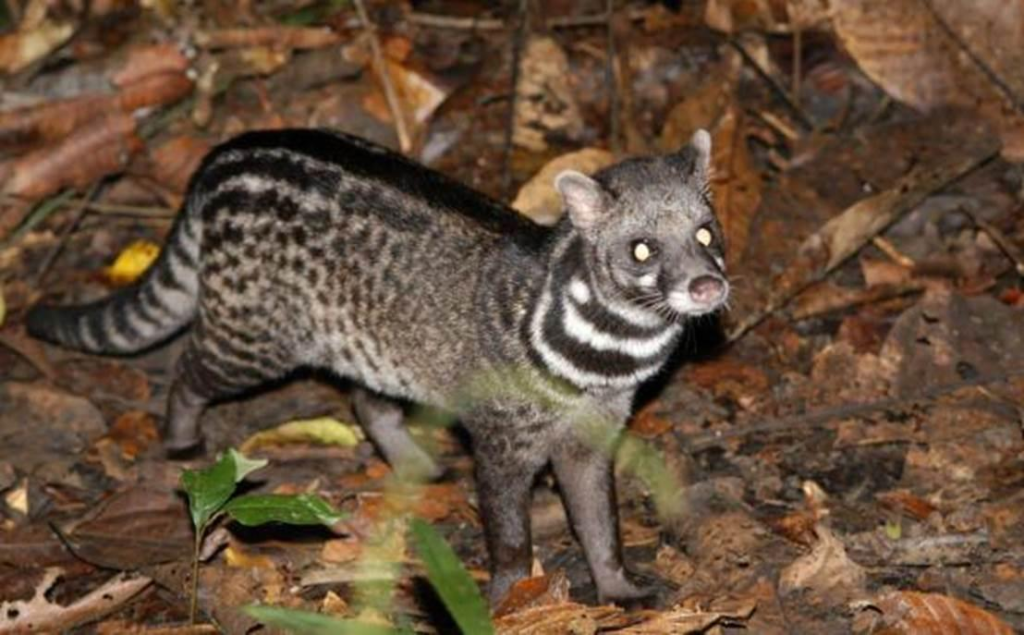
The Small Indian Civet belongs to another part of that story. It is a small carnivore whose life unfolds largely beyond ordinary observation, whose presence has been documented in the wider Sundarbans landscape, and whose relationship with reclaimed habitats remains an opportunity for further study.
Its existence reminds us that conservation is not only about protecting individual species. It is also about understanding the connections between animals, vegetation, food resources, land use and the communities living alongside wildlife.
The tides reshape the waterways. Erosion changes the edges of islands. Human activity transforms parts of the terrestrial landscape. Within these changes, small mammals respond in ways that may be difficult to observe but are still worth understanding.
For the Small Indian Civet, the next step is not to invent a more dramatic story. It is to build a more complete one through careful field research, verified records and a better understanding of the habitats that sustain it.
The quietest animals can reveal important questions about a landscape. Sometimes, protecting the wild begins with learning to notice what we rarely see.
Plan your private Sundarban expedition
A private journey shaped around you — your group, your pace, your interests. Book a free consultation.