 Field guide
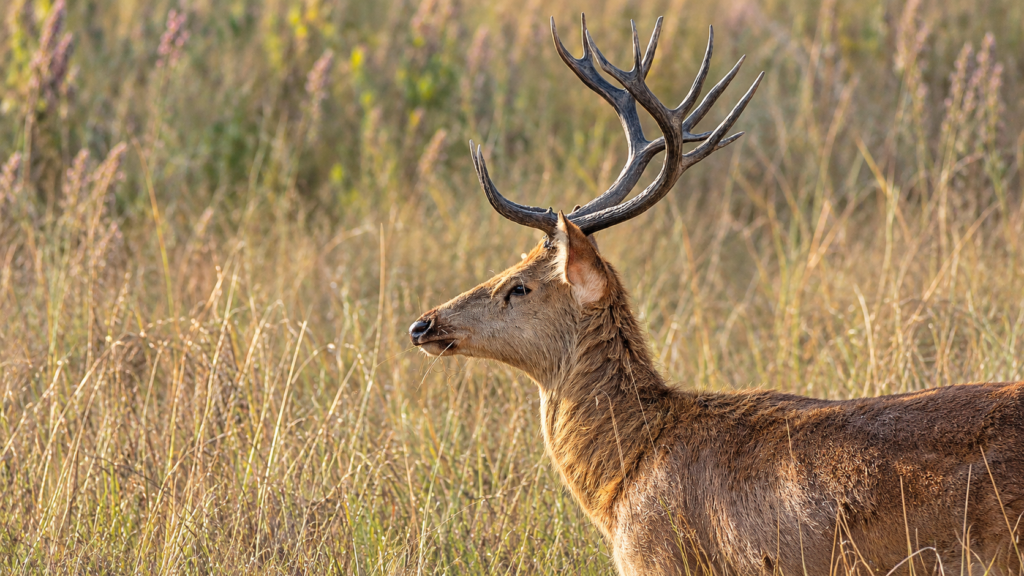
The Swamp Deer (Rucervus duvaucelii), popularly known as the Barasingha, is a large deer of the Indian subcontinent that once inhabited the wider Bengal region, including the Sundarbans. Today, it is locally extinct in the Indian Sundarbans, representing a significant loss from the region’s historical mammal community. Historical wildlife records and scientific studies identify the species as having disappeared from this landscape during the early twentieth century.
Its disappearance is especially revealing because the Sundarbans is not simply a mangrove forest. It is a dynamic estuarine landscape shaped by tides, freshwater availability, sediment movement, and changing vegetation. The Barasingha’s history highlights an important ecological distinction: an animal may once have inhabited a region without being adapted to every habitat found within it.
Swamp Deer / Barasingha At a Glance
| Feature | Details |
| Common Name | Swamp Deer / Barasingha |
| Scientific Name | Rucervus duvaucelii |
| Family | Cervidae |
| Order | Artiodactyla |
| Conservation Status | Vulnerable globally, according to the IUCN Red List |
| Status in the Indian Sundarbans | Locally extinct |
| Natural Distribution | Restricted populations in northern and central India and southwestern Nepal |
| Preferred Habitat | Swampy grasslands, floodplains, wetlands and associated open habitats |
| Diet | Herbivorous; grasses and other vegetation |
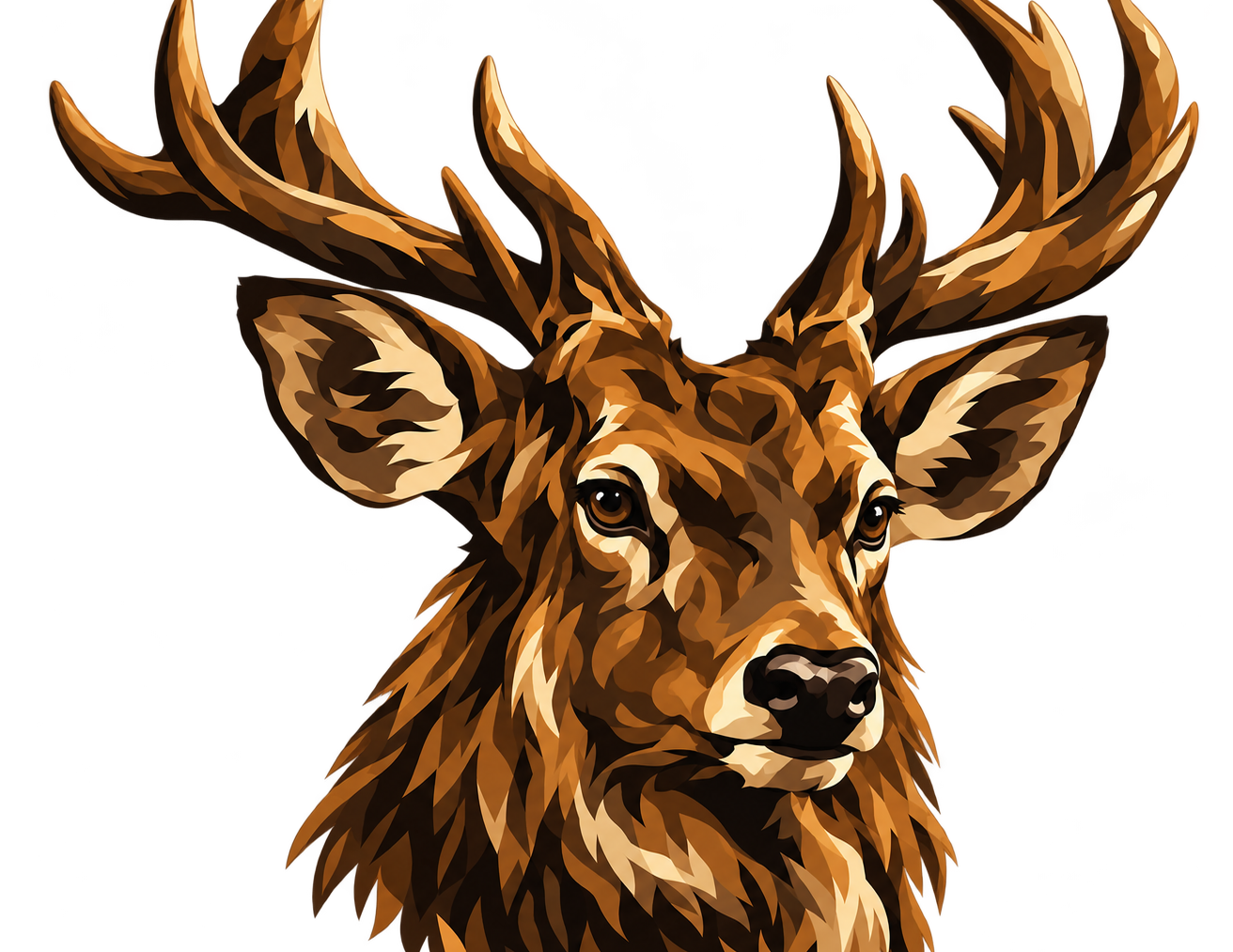
| Distinctive Feature | Large branching antlers in adult males |
| Ecological Role | Large herbivore involved in vegetation dynamics and food-web relationships |
Scientific Identity and Classification
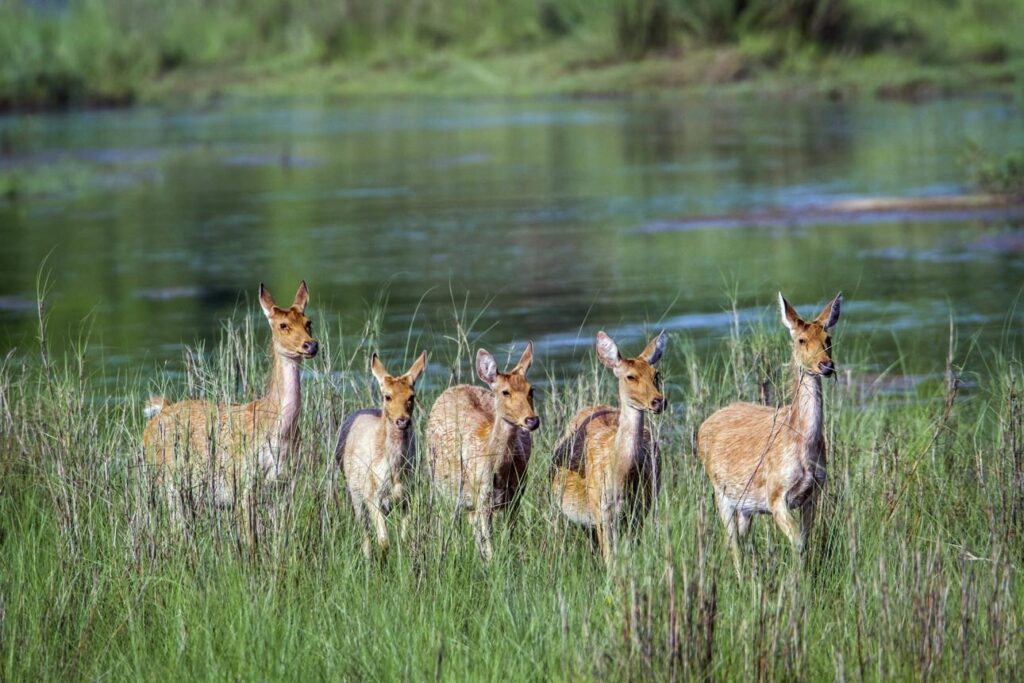
The Swamp Deer is a member of the deer family, Cervidae, and belongs to the genus Rucervus. Its scientific name is Rucervus duvaucelii, although older scientific and regional publications also use Cervus duvaucelii. The common name Barasingha refers to the impressive antlers of adult males, which may carry numerous points. The name is traditionally associated with twelve-tined antlers, but the number varies between individuals.
What Does Locally Extinct Mean?
The term locally extinct means that a species has disappeared from a particular geographical area while continuing to survive elsewhere. It does not mean the animal has become extinct worldwide.
This distinction is essential when discussing the Swamp Deer of the Sundarbans. The Barasingha remains a living species, but historical records indicate that it no longer forms part of the wild mammal community of the Indian Sundarbans. Its global conservation status and its regional disappearance describe two different things: the first concerns the survival of the species across its range; the second concerns the loss of a species from a specific ecosystem.
The distinction also prevents a common misunderstanding. A species can be globally classified as Vulnerable while being completely absent from a particular state, district or protected landscape.
The Historical Range of the Barasingha
Before its range contracted, the Swamp Deer occupied a much broader area of the Indian subcontinent. Historical natural-history accounts recorded it across extensive lowland habitats, from the western parts of the subcontinent towards Assam in the east. Its distribution included suitable grasslands and wetlands across the Indo-Gangetic plains and adjoining lowlands.
The species was not always confined to the protected areas where it survives today. Its historical distribution reflected a landscape in which large expanses of grassland, marsh, floodplain and wetland vegetation remained connected.
As these habitats were converted, fragmented or altered, populations became isolated. Hunting and human pressures added to the decline. The result was a dramatic contraction of the Barasingha’s historical range during the twentieth century.
In Bengal, the species formerly occurred across several lowland regions. A scientific checklist of West Bengal’s mammals, published in 2019 by Jayanta Kumar Mallick, records the Swamp Deer as extinct from several parts of the state, including the Sundarbans. The checklist also records its disappearance from areas such as Jalpaiguri and Alipurduar, illustrating that its historical decline extended beyond the delta.
The Swamp Deer in the Indian Sundarbans
Historical accounts establish that Barasingha once occurred in the Sundarbans. The Wildlife Institute of India’s digital repository contains a wildlife-science dissertation on Swamp Deer habitat in the Pilibhit landscape that summarizes the species’ historical distribution and explicitly notes that it was once abundant in the Sundarbans. The dissertation attributes this historical range to earlier natural-history literature, including Blanford’s nineteenth-century account.
A separate scientific study of mammal fauna in the Sundarban Tiger Reserve lists the Swamp Deer among the mammals that disappeared from the study area, with its presence continuing into the earlier part of the twentieth century. A government-linked forestry development report also identifies the Swamp Deer among the mammals lost from the Sundarban Tiger Reserve over the preceding century.
However, historical occurrence should not be confused with a precise modern population record. The available sources establish former presence and subsequent disappearance, but they do not provide a reliable, year-by-year population series for the Sundarbans. Nor do they establish a single, universally accepted date for the final wild individual.
The most defensible conclusion is therefore straightforward: the Swamp Deer is historically documented in the Sundarbans but is now locally extinct there.
A Deer of Wet Grasslands, Not Simply a Deer of Swamps
The name Swamp Deer can give the impression that the animal could live in any wet environment. In reality, its habitat requirements are more specific.
Barasingha is associated with extensive grasslands, marshes and floodplains where suitable herbaceous vegetation is available. Some populations use open woodland or forest edges, but grassland and swamp habitat remain central to the species’ ecology.
This matters in the Sundarbans, where the word wetland encompasses several distinct environments. A tidal creek, a mudflat, a mangrove forest and a freshwater-influenced grassy marsh are not ecologically interchangeable.
The Sundarbans is a mosaic of islands, estuarine channels, tidal mudbanks, mangrove vegetation and human-inhabited areas. Its hydrology changes with tides, while salinity varies across locations and seasons. These characteristics shape which plants grow in different habitats and which herbivores can use them.
It would therefore be misleading to suggest that the Barasingha disappeared simply because the Sundarbans became too wet, too saline or too densely wooded. The historical sources establish its disappearance, but the evidence reviewed here does not isolate one environmental change as the definitive cause.
The important ecological lesson is that the availability of water alone does not create suitable deer habitat. Vegetation structure, forage quality, seasonal flooding, disturbance and the continuity of appropriate habitat all matter.
Why Its Disappearance Matters
Large herbivores influence the ecosystems in which they live. By feeding on plants, moving between feeding areas and depositing dung, they contribute to vegetation dynamics and nutrient cycling. They also form part of the food web that supports large carnivores. Research on Swamp Deer habitat emphasizes the role of large herbivores in vegetation structure, regeneration and predator–prey relationships.
The Barasingha’s disappearance from the Sundarbans removed one large grazing herbivore from the region’s historical mammal community. It is reasonable to regard this as a loss of ecological diversity, although the available sources do not quantify the specific ecosystem changes attributable to its disappearance.
The species’ history also reminds us that today’s wildlife community is not necessarily a complete reflection of a region’s natural past. A landscape may retain its name, its rivers and much of its characteristic vegetation while losing animals that once lived there.
For the Sundarbans, conservation is therefore about more than protecting the species that remain. Historical records help reveal which ecological relationships have already been lost and why habitat protection must consider the needs of entire communities of wildlife.
A Powerful Body Built for Grazing
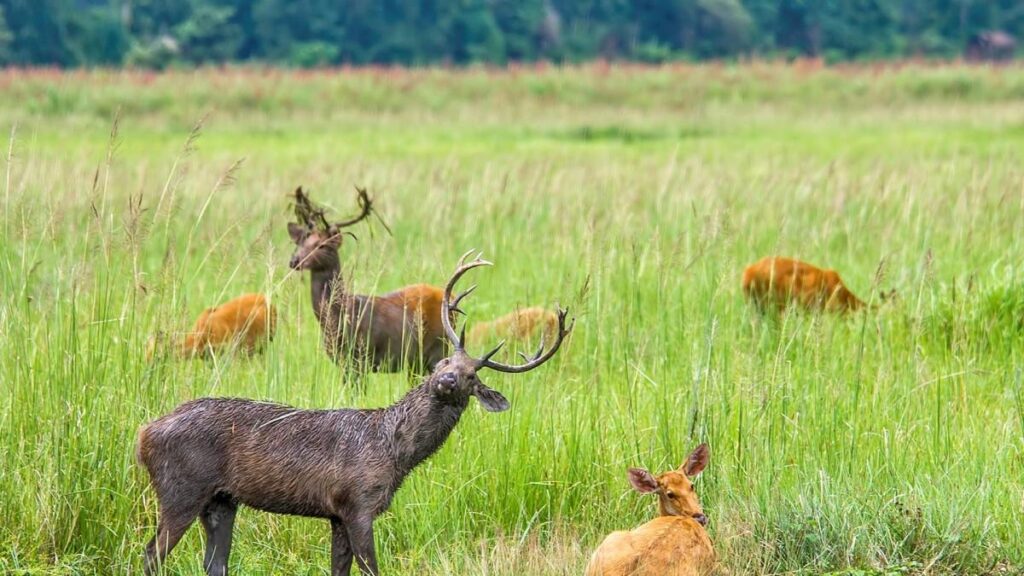
The Barasingha is a large deer with long limbs, a relatively elongated head and a body adapted to moving and feeding in open vegetation. Its overall appearance reflects its life as a substantial herbivore rather than a small, highly specialized forest deer.
Its physical characteristics are best understood in relation to the habitats where the species survives today. Unlike a mammal that depends on climbing or squeezing through dense mangrove roots, the Barasingha primarily uses terrestrial feeding grounds with sufficient space to walk, graze and move between patches of vegetation.
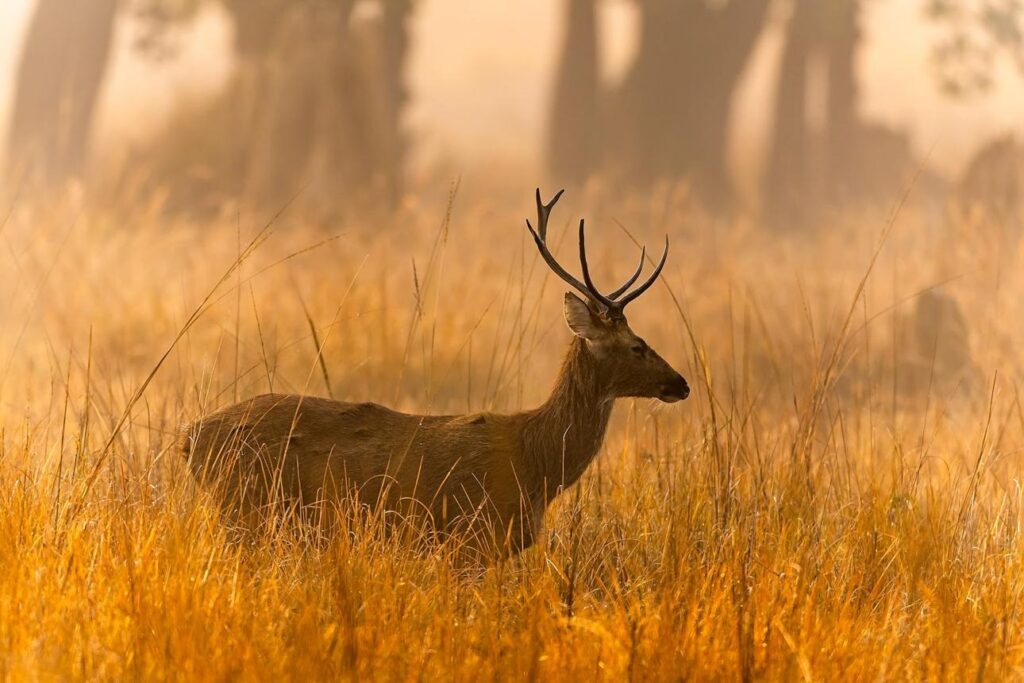
The species’ historical occurrence in Bengal does not establish that it possessed special adaptations for navigating the tidal mangrove forest. There is no adequate evidence in the sources reviewed here to describe it as a mangrove specialist.
The Coat and Seasonal Appearance
The Swamp Deer’s coat is generally brown, with variations in shade according to age, sex, season and individual. The appearance of the animal may contrast strongly with the fresh green of a grassland during the growing season or with dry vegetation later in the year.
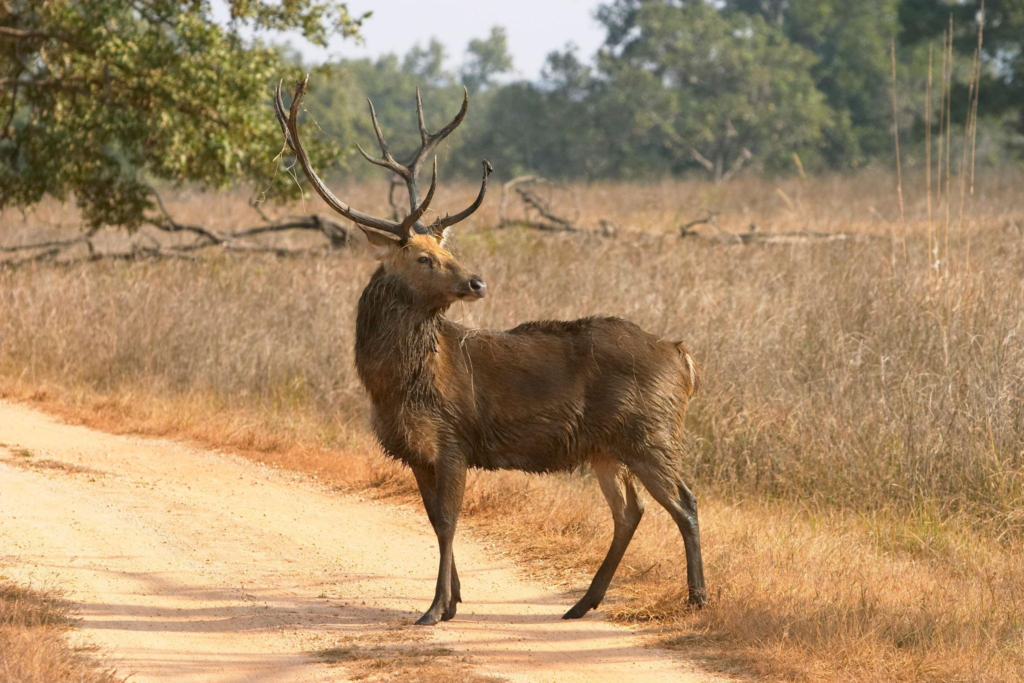
As with many deer, the antlers of adult males are a particularly conspicuous feature. Their branching form helps distinguish the Barasingha from several other Indian deer species, although antler shape and point count vary. The name Barasingha should not be interpreted as a guarantee that every mature male has exactly twelve antler points.
Coat colour and antler development are useful descriptive features for identifying the animal in its living range. They cannot, however, tell us exactly how individual Barasingha once behaved in the Sundarbans.
Antlers and the Adult Male
The antlers are among the most recognizable characteristics of the Barasingha. They grow from the skull, are shed and regrown, and develop into branching structures in mature males.
The name Barasingha is commonly explained through the association with twelve-pointed antlers. In practice, the number of tines can differ. The antlers are a species-identification feature, not evidence that every male follows the same growth pattern.
Because antlers are conspicuous, they can make the species easier to recognize in photographs. But identifying a deer from antlers alone is not always sufficient: viewing angle, age, incomplete growth and image quality can complicate identification.
Feet, Movement and Wet Ground
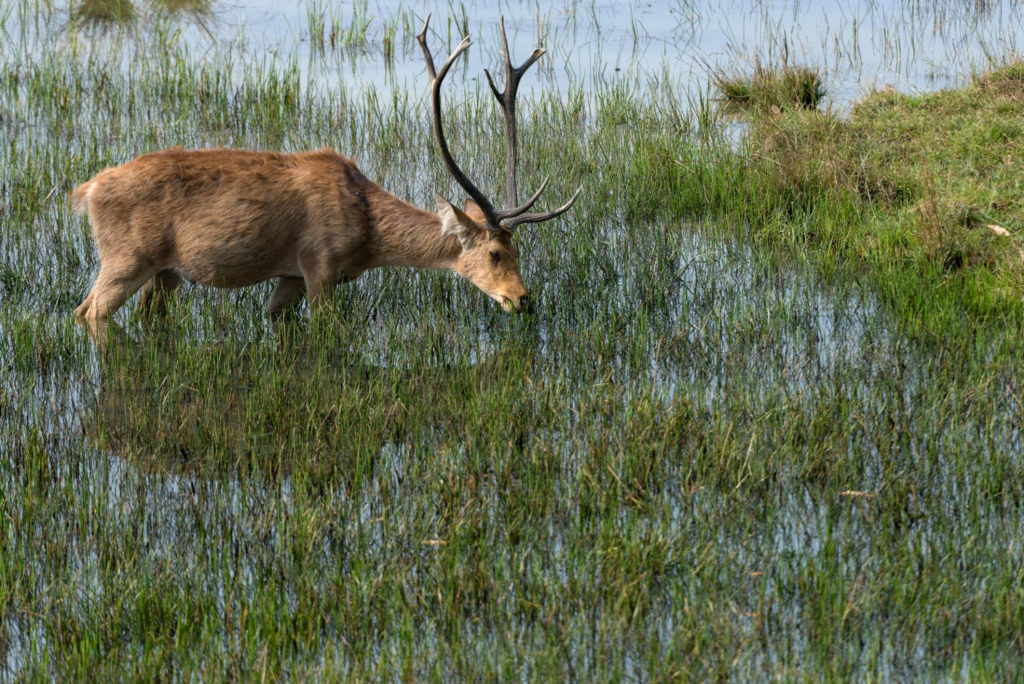
Swamp Deer move on four hoofed legs. Their movement allows them to feed across grassland, marsh and floodplain habitats, including areas that are seasonally wet.
The common name reflects the species’ association with swampy environments, but it should not be taken to mean that Barasingha are aquatic mammals or that they spend their lives in deep water. Their ecology centres on feeding and moving through vegetation in wetland landscapes.
It would also be scientifically unsound to assume that they could move efficiently across every type of Sundarbans terrain. Deep tidal creeks, exposed mudbanks, dense mangrove roots and seasonally flooded grasslands impose very different physical conditions. There is insufficient evidence to specify how Barasingha would have negotiated each of these environments in the historical Sundarbans.
The Senses Behind Survival
Like other deer, the Barasingha relies on sensory information to locate food and respond to potential danger. Vision, hearing and smell are important parts of its general behavioural repertoire.
However, the sources consulted for this article do not provide sufficiently detailed, population-specific evidence to quantify the relative importance of each sense or to describe special sensory adaptations to mangrove conditions.
The appropriate interpretation is that the Barasingha has the ordinary sensory equipment of a terrestrial deer living in environments where it must find forage and remain alert to threats. More specific claims about its sensory performance in the Sundarbans would require direct evidence.
What Does the Swamp Deer Eat?
See it for yourself
A private journey shaped around you — your group, your pace, your interests. Book a free consultation.
The Barasingha is a herbivore whose diet includes grasses and other vegetation. Its dependence on grassland and wetland plants is one of the central features of its ecology. Suitable forage must be available across the seasons, and habitat quality depends not merely on the presence of water but on the vegetation growing around it.
This dependence helps explain why the species is associated with open marshes and grasslands rather than being regarded as a generalist able to thrive in any forest.
In the Sundarbans, the distinction would have been important. Mangrove vegetation differs from the grass-rich feeding grounds used by Barasingha in its present-day range. The delta also contains different degrees of freshwater influence and salinity, which shape the plants available in individual locations.
No verified source reviewed here provides a detailed historical dietary record for Barasingha in the Sundarbans. It would therefore be inappropriate to list particular mangrove plants as confirmed food sources for the former local population.
Surviving Seasonal Changes
The Swamp Deer’s preferred habitat is not static. Flooding, vegetation growth and changes in water availability influence the condition of grasslands and wetlands. A suitable habitat must provide enough food and sufficient space for the deer to use it throughout changing environmental conditions.
Research in northern Indian habitats illustrates the importance of examining the distribution and composition of grassland vegetation when assessing Swamp Deer habitat. Such research also demonstrates that the mere presence of open ground does not automatically make a location suitable for the species.
This offers a useful comparison with the Sundarbans, where tidal processes constantly reshape the relationship between water, soil and vegetation. Yet the comparison has limits: the current evidence does not demonstrate that a particular tidal or salinity-related change directly caused the Barasingha’s disappearance from the delta.
Why It Was Not a Mangrove Specialist
The Barasingha’s historical presence in the Sundarbans should not lead to the conclusion that it was uniquely adapted to mangrove forests.
The species’ established ecology points instead towards wet grasslands, marshes and floodplains. A historical record from the Sundarbans shows that it occurred in the region, but it does not establish that the deer depended on dense mangrove interiors or that it could thrive across all the delta’s habitat types.
This distinction is particularly important for wildlife interpretation. A forest’s historical species list is not a catalogue of animals equally suited to every habitat within its boundaries. It records an ecological relationship that existed in a particular landscape at a particular time.
The Barasingha’s story is therefore not one of a mangrove specialist that lost its unique mangrove adaptation. It is the story of a wetland and grassland deer that once formed part of the wider Sundarbans fauna and subsequently disappeared from it.
A Deer That Lives in Groups
Swamp Deer commonly form groups, with herd composition varying according to season, breeding activity and local conditions. Females and young may gather together, while adult males can show different patterns of association outside the breeding season.
Group living is relevant to the ecology of an open-habitat herbivore. Several animals feeding in the same landscape may benefit from collective vigilance, although group size and behaviour vary with the habitat and circumstances.
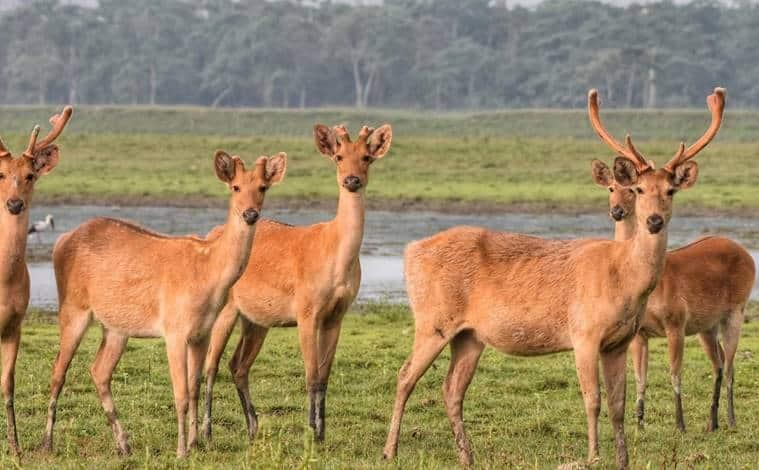
These general patterns are known from the species’ living range. They should not be presented as directly observed behaviour in the historical Sundarbans, where modern field observations of a surviving population are not available.
Breeding and the Next Generation
The continuation of a Barasingha population depends on successful breeding, the survival of young and access to suitable habitat. Like other deer, Swamp Deer reproduce sexually, and adult males develop antlers that are associated with their mature appearance and breeding biology.
Breeding patterns may differ between populations and environmental settings. The evidence gathered for this article does not justify assigning precise breeding dates, gestation figures or local birth rates to the former Sundarbans population.
For conservation purposes, the broader principle is that a habitat must support the complete life cycle of a species. Protecting a patch of vegetation is not sufficient if the surrounding landscape cannot provide adequate food, refuge and room for the population to persist.
Predators and the Food Web
The Swamp Deer is a large herbivore and forms part of the prey base for large carnivores in suitable parts of its present-day range. Its ecological importance extends beyond its relationship with predators: grazing and browsing can influence plant communities, while movement and dung deposition contribute to nutrient cycling.
The Bengal tiger is a major predator in the Sundarbans, but the former presence of Barasingha in the delta should not be used to invent a specific historical predator–prey relationship. The available sources confirm that both species belong to the region’s broader wildlife history; they do not provide direct evidence sufficient to reconstruct how frequently tigers preyed on Barasingha in the historical Sundarbans.
That distinction matters because ecological plausibility is not the same as documented observation.
The Historical Relationship With People
The Barasingha’s wider decline has been associated with hunting, habitat loss and increasing pressure on the landscapes it needs. Scientific literature also identifies conflict with people as a challenge for the species, particularly where human land use overlaps with its habitat.
As grasslands and wetlands are converted for agriculture, settlement or other uses, suitable habitat can shrink and become fragmented. A population that once occupied a connected landscape may eventually survive only in isolated patches.
These pressures provide a broad context for understanding the Barasingha’s historical disappearance from Bengal. However, it would be an overstatement to attribute its local extinction in the Sundarbans to one specific activity, community or historical event without stronger region-specific evidence.
The delta’s ecological history is complex. Changes in land use, the availability of freshwater-influenced habitats, hunting pressure and the transformation of natural vegetation may all be relevant subjects for investigation, but their precise contribution to the disappearance of Barasingha has not been established by the sources reviewed here.
What the Loss Means for Local Wildlife History
The disappearance of the Swamp Deer illustrates how a region’s mammal community can change over time. Species that were once present may vanish from the landscape, leaving future generations familiar only with their names in books, scientific checklists and historical records.
For the Sundarbans, this historical record is particularly important because the region is often understood primarily through its most recognizable wildlife: the Royal Bengal Tiger, estuarine crocodile, fishing cat, spotted deer and aquatic mammals.
The Barasingha reminds us that the region’s former mammal diversity was broader than the wildlife visitors are likely to encounter today. Its story belongs to the natural history of the delta even though the animal is no longer part of its living fauna.
Why Did the Swamp Deer Disappear From the Sundarbans?
The disappearance of Barasingha from the Sundarbans occurred within a wider pattern of historical range contraction. Research on the species identifies hunting and habitat loss among its major threats, alongside pressures associated with human activities and the limited availability of suitable habitat.
Several ecological factors help explain why habitat loss can be especially serious for a species associated with grasslands and wetlands.
| Pressure | Ecological significance |
| Hunting | Can remove individuals faster than a small or declining population can replace them |
| Conversion of wetlands and grasslands | Reduces the area available for feeding, breeding and shelter |
| Habitat fragmentation | Separates suitable patches and can isolate populations |
| Changes in vegetation | Can reduce the availability or quality of preferred forage |
| Human pressure | Can disturb habitat and increase competition for land and natural resources |
These are recognized threats to Swamp Deer conservation generally. They should not be mistaken for a proven ranking of causes in the Sundarbans specifically. The historical sources establish the species’ disappearance, but they do not provide enough evidence to determine the relative contribution of each pressure to the local extinction.
The Role of Habitat Change
The Sundarbans has undergone extensive changes through the interaction of natural estuarine processes and human land use. Tidal flooding, sediment deposition, river-course changes and the distribution of saline and freshwater-influenced environments help determine which habitats persist.
For a grassland-dependent herbivore, the availability of suitable feeding grounds is crucial. A landscape may remain rich in mangroves and aquatic wildlife while no longer supporting the open, plant-rich habitats that a particular terrestrial mammal requires.
This is a general ecological explanation rather than proof of the precise mechanism behind Barasingha’s disappearance. The available historical records do not establish a complete sequence showing which habitat changes occurred first, how the deer population responded, or when its final refuge disappeared.
A rigorous account must leave that uncertainty visible instead of filling it with an attractive but unverified narrative.
Climate Change, Sea-Level Rise and the Limits of Attribution
Climate change, sea-level rise, changing salinity and erosion are important conservation concerns for the wider Sundarbans. These processes can influence vegetation, freshwater availability and the long-term distribution of habitats.
However, the evidence reviewed for this article does not establish climate change or modern sea-level rise as the direct cause of the Barasingha’s historical local extinction. Its disappearance was documented within a broader period of wildlife decline and habitat transformation, and the exact contribution of individual drivers remains insufficiently resolved.
The distinction is important. A conservation article should identify current environmental risks without retroactively attributing an older extinction to a modern threat unless the evidence supports that conclusion.
How Scientists Monitor Swamp Deer Today
Monitoring surviving Barasingha populations requires information about both the animals and the habitats on which they depend.
Methods used in wildlife research can include direct observations, systematic surveys, recording animal signs and mapping vegetation. Camera traps may supplement other approaches where their placement and the target habitat make them useful. Grassland studies also assess vegetation composition and the distribution of suitable habitat patches.
| Monitoring method | What it can establish |
| Direct sightings | Presence, group composition and observable behaviour |
| Track and sign surveys | Evidence of animal use, where signs can be reliably identified |
| Camera traps | Photographic confirmation and repeated detection at monitored sites |
| Vegetation surveys | The structure and composition of potential feeding habitat |
| Repeated population surveys | Changes in distribution and population estimates when appropriate methods are used |
These are general methods relevant to Swamp Deer research. They should not be interpreted as a claim that every method has been used to monitor a surviving Barasingha population in the Sundarbans.
Because the species is locally extinct there, present-day monitoring in the delta cannot be described as routine population monitoring of a resident wild population. Any claim of a new occurrence would require credible verification.
Where Can the Swamp Deer Be Observed in the Sundarbans?
The Swamp Deer cannot currently be recommended as a wild-sighting species in the Indian Sundarbans. Historical records establish its former presence, but the scientific sources reviewed here classify it as locally extinct in the region.
Areas such as Sajnekhali, Sudhanyakhali, Dobanki, Netidhopani and Burirdabri are associated with wildlife observation in the Sundarbans, but their recognition as wildlife-viewing locations does not establish the presence of Barasingha. Listing these places as likely Swamp Deer hotspots would therefore be misleading.
In India, the species survives in selected northern and central landscapes, including protected areas with suitable grassland and wetland habitats. Dudhwa National Park is an important stronghold of the northern Swamp Deer, while Kanha National Park is associated with the central, hard-ground form. The eastern subspecies occurs in parts of Assam.
These locations belong to the species’ present-day conservation geography, not to the Indian Sundarbans.
The Important Truth About Wildlife Sightings
Wildlife observation is unpredictable, and a failure to see an animal does not prove that it is absent from a landscape. Animals may remain concealed, move beyond an observer’s field of view or use habitats that are difficult to access.
However, this principle must not be misapplied to a species that is documented as locally extinct. The absence of a Barasingha sighting during a Sundarbans expedition is not simply an example of ordinary wildlife unpredictability; it is consistent with the established historical record of local disappearance.
A credible claim of a present-day sighting would need verification through evidence such as diagnostic photographs, reliable field documentation or independent confirmation by qualified wildlife researchers or forest authorities.
This is especially important in a region where conservation storytelling should be built on evidence rather than the promise of unusual sightings.
Conservation Beyond the Sundarbans
The Barasingha’s future depends on protecting the habitats where it survives. The species remains globally classified as Vulnerable, and conservation work focuses on maintaining viable populations and the grassland and wetland environments they require.
Effective conservation includes protecting suitable habitat, managing vegetation, reducing illegal hunting and monitoring populations. In landscapes where populations have become isolated, habitat connectivity and careful planning can also matter.
India’s legal protection for the species is an important part of this framework. The national conservation literature consulted here identifies the Swamp Deer as a Schedule I species under the Wildlife (Protection) Act, 1972, and as listed in Appendix I of CITES.
Nevertheless, legal protection alone cannot restore a species to every part of its historical range. Recovery depends on ecological suitability, the availability of viable source populations, long-term habitat protection and a scientifically justified conservation plan.
Could the Barasingha Return to the Sundarbans?
A return to the Sundarbans should not be presented as an existing conservation plan or an inevitable outcome.
Any proposal to reintroduce Barasingha would require detailed assessment of its former habitat, present ecological conditions, the availability of appropriate grassland and wetland mosaics, and the possible effects on existing wildlife and human communities.
A scientifically sound feasibility study would also need to establish whether the landscape could support a viable population over the long term. The fact that a species lived in a region historically is not, by itself, sufficient justification for bringing it back.
The sources reviewed here do not establish an approved Barasingha reintroduction programme for the Indian Sundarbans. It is therefore more responsible to treat the possibility as a hypothetical conservation question than to suggest that a return is planned.
What Makes the Sundarbans Swamp Deer Unique?
The Barasingha of the Sundarbans is distinctive not because a special mangrove-adapted population is known to have evolved there, but because the species forms part of the region’s historical wildlife record.
Its former presence connects the delta to a broader history of lowland grasslands, marshes and wetlands across the Indian subcontinent. Its subsequent disappearance shows that a region’s wildlife community can change substantially even when the landscape continues to support many other species.
Three points are especially important:
- Scientific literature records the Swamp Deer as formerly present in the Sundarbans.
- Its established association with grasslands and marshes demonstrates why wet environments should not all be treated as ecologically interchangeable.
- The loss of a species from one region can be permanent at the local scale even while the species survives elsewhere.
The Barasingha’s story also reveals the limits of historical evidence. We know that the deer once inhabited the Sundarbans and that it disappeared during the early twentieth century. We do not have sufficient evidence to reconstruct every stage of its decline or identify one definitive cause.
Acknowledging these gaps does not weaken the story. It distinguishes a reliable natural-history account from speculation.
Myths and Facts About the Swamp Deer
| Myth | Fact |
| The Barasingha is extinct worldwide. | It survives in parts of India and Nepal and is globally classified as Vulnerable. |
| Every male Barasingha has exactly twelve antler points. | Antler tine counts vary; the common name does not guarantee an exact count. |
| Any swamp is suitable habitat. | The species depends strongly on suitable grassland, marsh and wetland vegetation. |
| The Barasingha can still be seen in the Sundarbans if visitors are lucky. | It is documented as locally extinct in the Indian Sundarbans; routine wild sightings should not be expected. |
| The exact cause of its disappearance from the Sundarbans is known. | Historical sources establish its disappearance, but the precise contribution of individual causes remains uncertain. |
FAQs
Is the Swamp Deer extinct in the Sundarbans?
Yes. The Swamp Deer, or Barasingha, is locally extinct in the Indian Sundarbans, although it continues to survive in parts of India and Nepal.
What is the scientific name of the Barasingha?
Its accepted scientific name is Rucervus duvaucelii. Older publications may use Cervus duvaucelii.
When did the Swamp Deer disappear from the Sundarbans?
Scientific accounts indicate that it survived in the region into the earlier part of the twentieth century. The sources reviewed do not establish a definitive date for the last individual.
Why did the Barasingha disappear from the Sundarbans?
Its disappearance occurred amid a wider historical decline associated with hunting and habitat loss. However, the precise contribution of each factor to its local extinction has not been conclusively established.
Is the Swamp Deer endangered worldwide?
The species is classified as Vulnerable on the IUCN Red List. This global assessment is separate from its locally extinct status in the Sundarbans.
What does the Barasingha eat?
It is a herbivore that feeds on grasses and other vegetation. Suitable grasslands, marshes and wetland habitats are important for its survival.
Why is it called Barasingha?
The name is traditionally associated with the numerous points on the antlers of adult males. Despite the common association with twelve points, actual tine counts vary.
Can tourists see Swamp Deer in the Sundarbans?
No wild sightings should be expected in the Indian Sundarbans because the species is documented as locally extinct there. Its surviving populations occur in other parts of the Indian subcontinent.
Could Swamp Deer be reintroduced to the Sundarbans?
Reintroduction would require scientific assessment of habitat suitability, ecological impacts and long-term population viability. The sources reviewed do not establish an approved reintroduction programme for the Indian Sundarbans.
Why is the Swamp Deer important to the history of the Sundarbans?
It demonstrates that the delta’s historical wildlife community was different from the one present today. Its disappearance highlights the importance of preserving habitat diversity and documenting changes in the region’s mammal fauna.
The Wild Orbit Perspective
The Sundarbans is a living landscape of tidal rivers, muddy banks, mangrove roots and islands continually shaped by water. Its wildlife is often understood through the animals that remain visible today, but its natural history also includes species that no longer inhabit the delta.
The Swamp Deer is one of those absences. It once belonged to the wider wildlife community of the Sundarbans, yet it is now remembered through scientific records rather than encounters in the forest.
Its story calls for a broader understanding of conservation. Protecting the living mangroves is essential, but so is understanding the habitats, ecological relationships and historical changes that determine which species can survive in a landscape.
The Barasingha remains part of India’s wildlife heritage. Its disappearance from the Sundarbans is a reminder that the survival of a species elsewhere cannot replace the ecological history lost when it vanishes from a place.
Sometimes, the most important wildlife story in a forest is the story of an animal that is no longer there.
Plan your private Sundarban expedition
A private journey shaped around you — your group, your pace, your interests. Book a free consultation.