
 Field guide
A flash of electric blue crosses the green edge of a mangrove island. A moment later, a large bird settles on an exposed branch, its chocolate-brown head contrasting sharply with a white throat and an oversized red bill. It is the White-throated Kingfisher, one of the most recognisable kingfishers of the Indian subcontinent.
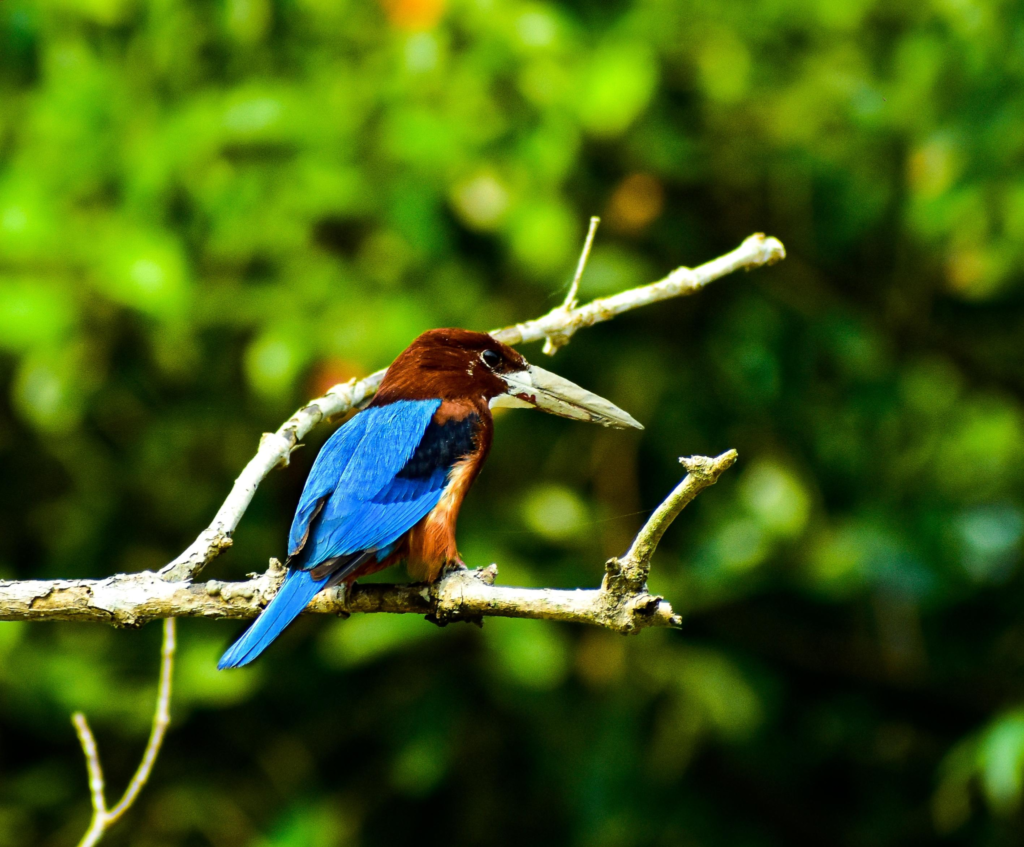
Unlike several of its relatives, this bird does not depend entirely on rivers and wetlands. It can hunt over agricultural fields, open woodland, village gardens, ponds and coastal landscapes. In the Indian Sundarbans, this adaptability allows it to occupy the wider landscape surrounding the mangrove forests, including human settlements and vegetated riverbanks.
The White-throated Kingfisher is not simply a bird of water. It is a versatile predator whose feeding behaviour connects aquatic and terrestrial habitats.
Species Identity and Classification
The White-throated Kingfisher (Halcyon smyrnensis) belongs to the order Coraciiformes and family Alcedinidae. It is also known as the White-breasted Kingfisher.
Its scientific name was established by Carl Linnaeus in 1758. The species occurs across a broad geographical range extending from parts of West Asia through the Indian subcontinent and Southeast Asia.
White-throated Kingfisher at a Glance
| Field | Information |
| Common name | White-throated Kingfisher |
| Alternative name | White-breasted Kingfisher |
| Scientific name | Halcyon smyrnensis |
| Order | Coraciiformes |
| Family | Alcedinidae |
| Conservation status | Least Concern (IUCN) |
| Indian Sundarbans occurrence | Documented in regional bird checklists |
| Seasonal status | Generally resident; local seasonal movements are insufficiently documented |
| Habitat | Mangrove edges, wetlands, open country, gardens and agricultural landscapes |
| Diet | Fish, insects, crustaceans, amphibians, reptiles and small vertebrates |
| Approximate length | 26–28 cm |
| Distinctive features | Chocolate-brown head, white throat, turquoise-blue wings and red bill |
| Ecological role | Generalist predator |
Conservation Status and Global Distribution
The White-throated Kingfisher is classified as Least Concern on the IUCN Red List. Its broad distribution and ability to use different habitat types contribute to its relatively favourable global conservation position.
However, Least Concern does not mean that every local population is free from environmental pressure. Habitat degradation, pollution and changes in the quality of feeding and nesting environments can still affect individual populations. The global assessment should not be interpreted as a dedicated assessment of the species in the Indian Sundarbans.
Is the White-throated Kingfisher Found in the Indian Sundarbans?
Yes. Its presence in the Indian Sundarbans is documented in regional bird inventories.
The Sundarban Tiger Reserve’s Tiger Conservation Plan includes the White-throated Kingfisher in its checklist of birds of the Sundarban Biosphere Reserve. It also appears in the checklist published in the report of the First Sundarban Bird Festival in 2023.
These records establish its regional occurrence, but they should not be confused with a detailed population survey or proof of breeding at a particular location.

The bird’s habitat preferences help explain its presence. It is comfortable around open landscapes, freshwater ponds, drainage channels, vegetated banks and mangrove edges. It does not require continuous, dense mangrove cover.
Within the Sundarbans, the broader mosaic of settlements, agricultural land, waterways and forest margins provides different opportunities for feeding and perching.
Habitat and Ecological Context
The White-throated Kingfisher is unusually flexible for a bird commonly associated with aquatic environments.
Its habitat may include:
- Open riverbanks and vegetated creek margins.
- Ponds, canals and freshwater wetlands.
- Agricultural fields and village landscapes.
- Trees and exposed branches near water.
- Mangrove edges and open clearings.
- Gardens and roadside vegetation.
The species generally avoids extensive, densely enclosed forest, favouring places where it can locate prey from a visible perch. Its use of mangrove edges is therefore different from that of specialised forest kingfishers that depend more closely on tidal creeks and mangrove interiors.
Its Ecological Importance
As a generalist predator, the White-throated Kingfisher feeds on organisms from several parts of the food web.
Its prey includes insects, crustaceans, fish, amphibians and reptiles. This varied diet places it at the intersection of terrestrial and aquatic food systems.
Its presence also illustrates an important ecological principle: the biodiversity of the Sundarbans is not confined to its protected mangrove forests. The surrounding landscape, including agricultural fields, village ponds and vegetated banks, contributes to the wider habitat network.
How to Identify the White-throated Kingfisher
The White-throated Kingfisher is one of the easier kingfishers to recognise once its characteristic colour combination is understood.
An adult has a large reddish-orange bill, a deep chocolate-brown head and underparts, a bright white throat and breast, and brilliant blue to turquoise upperparts.
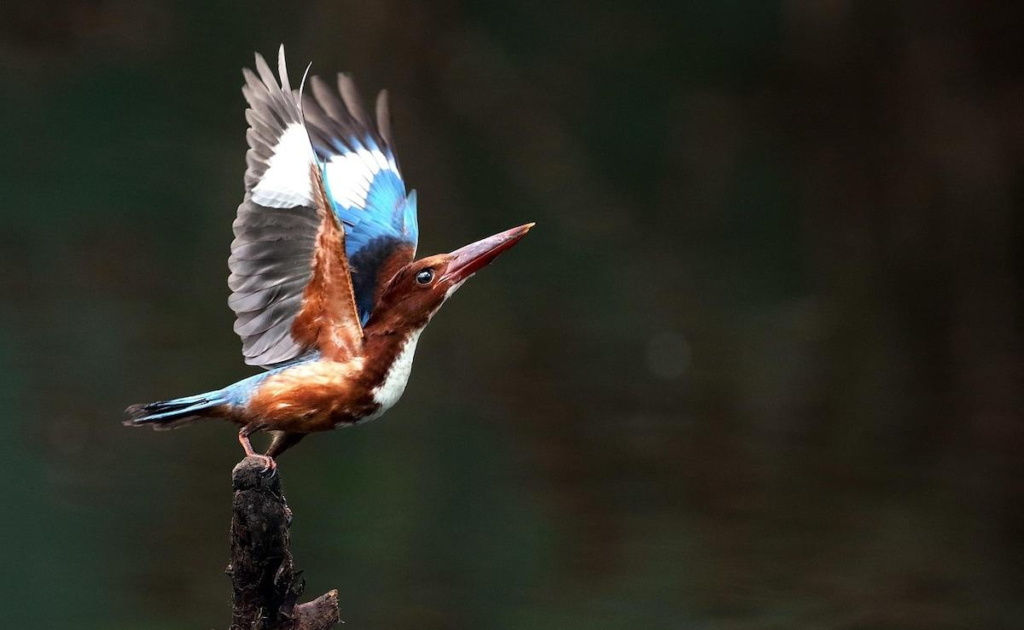
Its red legs complement the bill, while the wings reveal conspicuous white patches when the bird takes flight.
At approximately 26–28 cm in length, it is considerably larger and more robust than the Common Kingfisher. Its broad head and heavy bill give it a powerful appearance.
Plumage and Distinctive Field Marks
The bird’s appearance can be understood through four principal colour regions:
- Head and underparts: Deep chocolate brown, extending across the head, neck, shoulders and much of the belly.
- Throat and breast: A striking white area that gives the species its common name.
- Wings and tail: Brilliant turquoise-blue to blue-green, especially visible in good natural light.
- Bill and legs: Strong reddish-orange to red.
Male and female birds are very similar in appearance, making field identification by sex difficult. Juveniles are generally duller than adults. Their bills are less brightly coloured, and their breast feathers may show fine darker markings.
The Beak: A Tool for More Than Catching Fish
The large, pointed bill is one of the species’ most important hunting tools.
Although the bird belongs to the kingfisher family, its feeding strategy extends well beyond catching fish. It can seize insects, small crabs, lizards, frogs and other suitable prey.
Its bill allows it to grasp prey firmly and manipulate food before swallowing. When prey is too large or difficult to swallow immediately, the bird may strike it repeatedly against its perch.
This behaviour is particularly useful when handling hard-bodied insects and small vertebrates.
What Does the White-throated Kingfisher Eat?
See it for yourself
A private journey shaped around you — your group, your pace, your interests. Book a free consultation.
The White-throated Kingfisher is a carnivorous generalist. Its diet varies according to habitat, prey availability and opportunity.
| Food category | Examples |
| Fish | Small fish |
| Insects | Grasshoppers, beetles, crickets and dragonflies |
| Crustaceans | Crabs |
| Amphibians | Frogs and other small amphibians |
| Reptiles | Small lizards and snakes |
| Other vertebrates | Small rodents and occasionally birds |
In the Sundarbans, its potential feeding opportunities are not restricted to fish-bearing tidal channels. The surrounding terrestrial environment provides additional prey.
This is an important distinction between the White-throated Kingfisher and more specialised fish-eating kingfishers.
How It Hunts and Captures Prey
The bird typically hunts from an exposed perch, scanning the surrounding ground or water for movement.
Once prey is detected, it launches into a short, direct flight and captures the target. It may return to its perch before consuming the prey.
Unlike the Common Kingfisher, which is strongly associated with plunge-diving for small fish, the White-throated Kingfisher frequently captures prey from land or shallow water.
It is not a deep-diving specialist. Its feeding versatility allows it to exploit different environments without depending on one particular source of food.
Flight and Movement
Its flight is rapid and direct, with short, rounded wings producing quick wingbeats.
When airborne, the bright blue upperwing and prominent white patches make the bird particularly noticeable.
It often uses exposed branches, poles, wires and other elevated structures as observation points. These perches provide a useful view of the ground and nearby water.
In open landscapes, its combination of conspicuous plumage and relatively direct flight makes it easier to notice than many smaller, more secretive birds.
A Solitary Hunter With Territorial Behaviour
White-throated Kingfishers are generally encountered alone or in pairs rather than in large feeding flocks.
Individuals may maintain feeding territories, using familiar perches to watch for prey. During the breeding period, pairs cooperate in defending and raising their young.
Their preference for open hunting positions makes their behaviour relatively visible, particularly in settlements and agricultural landscapes.
Calls and Communication
The White-throated Kingfisher is not a particularly quiet member of the bird community.
Its vocalisations include loud, repetitive, chattering calls. One familiar call is a rapid series of harsh notes that may sound almost like laughter.
It often calls while perched or in flight. Vocal activity can become particularly noticeable during territorial interactions and the breeding season.
The calls are useful for field identification, especially when the bird is partially concealed by foliage.
Breeding and Nesting Behaviour
White-throated Kingfishers generally breed in pairs. Unlike many birds that build exposed nests among branches, they usually excavate a nesting tunnel in an earthen bank.
The tunnel leads to a wider nesting chamber, where the eggs are laid.
Suitable nesting sites may include the banks of streams, ponds, rivers and other earthen embankments. Nesting can also occur in certain other suitable cavities.
Eggs and Parental Care
Clutch size generally ranges from four to seven eggs, with five or six commonly reported.
Both parents participate in incubation and caring for the young. Newly hatched chicks are altricial, meaning they are dependent on their parents for food, warmth and protection.
The parents continue supplying food as the chicks develop, eventually leading to fledging.
Although the general breeding biology of the species is documented, detailed information about nesting success and breeding-site distribution specifically within the Indian Sundarbans is not established by the regional checklists consulted for this article.
When Does the White-throated Kingfisher Breed?
Across India, the principal breeding period is generally reported between March and July, although breeding dates can vary geographically and with local conditions.
The IUCN species account also documents breeding records across a wider April–July period in India.
These are broader Indian breeding patterns, not verified dates for individual nesting sites in the Indian Sundarbans.
Is the White-throated Kingfisher Migratory?
The White-throated Kingfisher is generally regarded as a resident species across much of its range.
The IUCN assessment classifies its movement pattern as non-migratory, although the species literature recognises that some populations can make partial, relatively short-distance movements.
There is insufficient regional evidence here to establish a distinct migration calendar or predictable seasonal arrival and departure dates for the Indian Sundarbans. It is therefore more accurate to describe it as a generally resident bird than to assign it a specific local migratory pattern.
Its Relationship With Human Settlements
One reason this kingfisher is relatively adaptable is its willingness to use modified landscapes.
Village ponds, agricultural fields, roadside trees and open spaces can all provide feeding opportunities or suitable perches.
This makes the species an interesting representative of the wildlife found beyond the core mangrove forest.
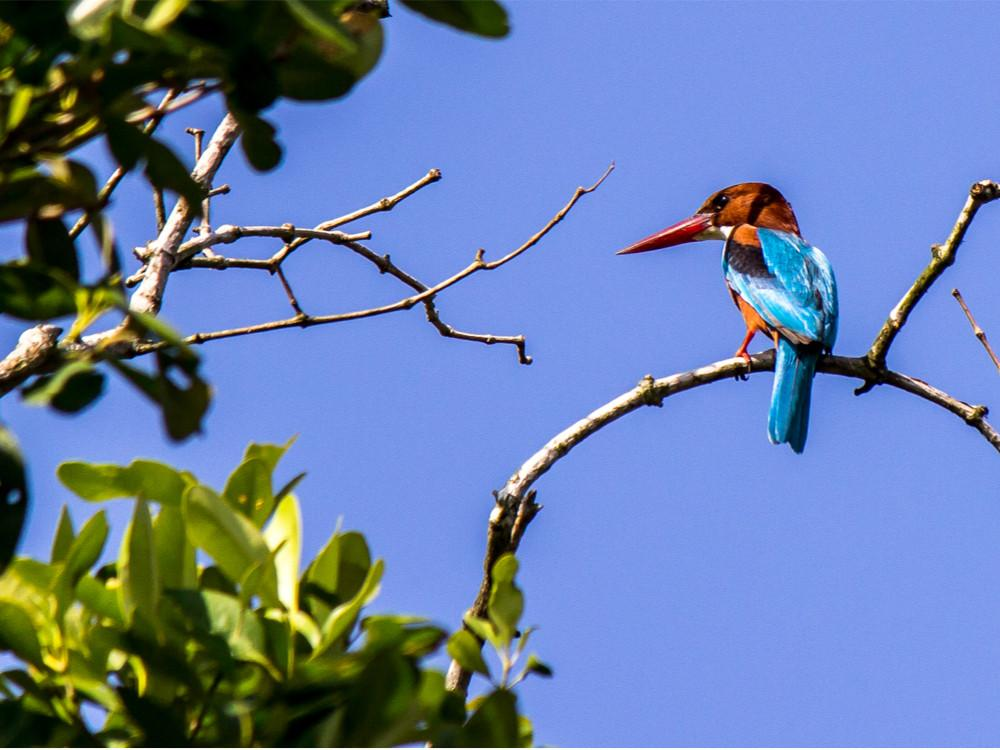
Its presence around settlements also demonstrates why conservation planning should consider the wider ecological landscape rather than focusing exclusively on forest interiors.
However, the available regional sources do not establish a specific pattern of conflict between this species and Sundarbans communities.
Conservation Challenges and Habitat Protection
The White-throated Kingfisher is not currently considered globally threatened. Nevertheless, its long-term presence depends on maintaining suitable feeding, perching and nesting environments.
Several environmental pressures deserve attention:
Wetland degradation: The deterioration of ponds, canals and other freshwater habitats can reduce feeding opportunities.
Pollution: Contamination of aquatic environments can affect prey availability and the wider food chain.
Loss of nesting banks: Alterations to earthen embankments and natural riverbanks can reduce suitable nesting opportunities.
Habitat modification: Removing trees, clearing vegetation and reducing open green spaces can affect the availability of hunting perches.
These are relevant ecological considerations based on the species’ documented habitat requirements. They should not be interpreted as evidence that each pressure has been measured or established as a major population-level threat in the Indian Sundarbans.
Where Can the White-throated Kingfisher Be Observed in the Indian Sundarbans?
The species is included in the Sundarban Tiger Reserve’s regional bird inventory and the First Sundarban Bird Festival checklist.
However, these sources do not provide a sufficiently detailed, species-specific distribution map to establish particular observation hotspots.
For responsible observation, the following habitat types are worth understanding:
| Habitat | Ecological relevance |
| Village ponds | Potential feeding habitat where fish and aquatic prey are available |
| Agricultural landscapes | Open hunting grounds for insects and small vertebrates |
| Vegetated riverbanks | Potential perching and feeding environments |
| Mangrove edges | Suitable habitat where open perches and accessible prey occur |
| Settlement greenery | Trees, wires and exposed structures provide observation points |
These are habitat-based observation possibilities, not verified species-specific hotspots or guaranteed sighting locations.
When Is the Best Time to Observe This Bird?
The White-throated Kingfisher is generally resident, so it is not necessary to depend on a particular migratory season to encounter the species.
Its visibility may vary according to weather, light, feeding activity and habitat conditions.
Early morning and late afternoon can offer favourable natural light for wildlife photography, although these should not be interpreted as scientifically established peak activity periods for the Indian Sundarbans population.
A useful observation strategy is to scan exposed branches, poles, wires and vegetation bordering open ground or water.
The Important Truth About Bird Observation
Wildlife observation is never a guarantee.
A bird may be present in an area without being visible to an observer. It may be resting, feeding away from an accessible viewpoint or temporarily using another part of its territory.
Tidal conditions, weather, vegetation, disturbance and observation effort can all influence the likelihood of encountering a bird.
There is also an important difference between habitat suitability, species presence and population abundance.
A suitable riverbank does not prove that a White-throated Kingfisher occupies it. Similarly, a single observation does not establish a permanent population.
Responsible birdwatching requires patience, accurate identification and respect for wildlife.
What Makes the Sundarbans White-throated Kingfisher Unique?
The White-throated Kingfisher is not a species exclusive to the Sundarbans. It occurs across a much wider geographical region, from West Asia to Southeast Asia.
Its distinctive relationship with the Indian Sundarbans lies instead in its ecological flexibility.
The Sundarbans is often imagined through its specialised mangrove wildlife: the Royal Bengal Tiger, estuarine crocodile, mudskippers, fishing cats and mangrove-dependent birds.
But the wider ecosystem contains another layer of biodiversity that extends beyond dense mangrove vegetation.
The White-throated Kingfisher represents this broader ecological community.
It can use open spaces, freshwater environments, agricultural landscapes and mangrove margins. Its feeding behaviour connects insects, fish, crustaceans, amphibians and small vertebrates across different habitat types.
This makes it an interesting species through which to understand the relationship between the protected mangrove landscape and the human-influenced environments surrounding it.
Its presence also reminds us that the ecological identity of the Sundarbans cannot be understood through its forest alone.
Myths and Facts About the White-throated Kingfisher
| Common misconception | The scientific explanation |
| Every kingfisher eats only fish. | White-throated Kingfishers consume a diverse range of prey, including insects, crabs, frogs and reptiles. |
| Kingfishers must live beside water. | This species frequently occupies terrestrial habitats far from water. |
| The White-throated Kingfisher is a deep-diving bird. | It generally hunts from perches and is not a deep-diving specialist. |
| All kingfishers migrate seasonally. | The White-throated Kingfisher is generally resident, although some populations may undertake short-distance movements. |
| Male and female birds have completely different colours. | Adult males and females are broadly similar in appearance. |
FAQs
1. What is the scientific name of the White-throated Kingfisher?
Its scientific name is Halcyon smyrnensis. It belongs to the order Coraciiformes and family Alcedinidae.
2. Is the White-throated Kingfisher found in the Indian Sundarbans?
Yes. It is documented in the Sundarban Tiger Reserve’s bird checklist and the First Sundarban Bird Festival checklist.
3. How can you identify a White-throated Kingfisher?
Look for its chocolate-brown head and underparts, bright white throat, turquoise-blue wings and tail, and large reddish-orange bill.
4. What does the White-throated Kingfisher eat?
Its diet includes fish, insects, crabs, frogs, lizards, small snakes and occasionally small birds and mammals.
5. Does the White-throated Kingfisher live only near water?
No. It also occupies agricultural fields, gardens, open woodland, roadside vegetation and other terrestrial habitats.
6. Is the White-throated Kingfisher migratory?
It is generally a resident species. Some populations may undertake short-distance movements, but a distinct seasonal migration pattern has not been established for the Indian Sundarbans.
7. What is the breeding season of the White-throated Kingfisher in India?
Its principal breeding period is generally March to July, although regional variation occurs. Specific breeding dates for the Indian Sundarbans require further documentation.
8. Where does the White-throated Kingfisher build its nest?
It generally excavates a tunnel in an earthen bank, leading to a nesting chamber where the eggs are laid.
9. What is the conservation status of the White-throated Kingfisher?
It is classified as Least Concern on the IUCN Red List. This is a global assessment rather than a specific assessment of its Sundarbans population.
10. What makes the White-throated Kingfisher different from other kingfishers?
Its most distinctive ecological characteristic is its broad feeding behaviour. Unlike more specialised fish-eating kingfishers, it regularly hunts terrestrial prey as well as aquatic organisms.
The Wild Orbit Perspective
The White-throated Kingfisher is a reminder that the extraordinary biodiversity of the Indian Sundarbans does not always announce itself through rare or elusive wildlife.
Sometimes, it appears in the simplest of places: a branch overlooking a muddy creek, a tree beside an agricultural field or an exposed perch near a village pond.
Its brilliant blue wings, white throat and powerful red bill make it instantly recognisable. Yet its real ecological interest lies in something less obvious: its ability to move between aquatic and terrestrial food systems.

Understanding the Sundarbans means looking beyond the famous species and exploring the relationships that sustain its wider landscape.
Every bird, whether specialised for the mangrove interior or adaptable enough to live alongside human settlements, contributes another piece to the ecological story of this extraordinary delta.
And sometimes, understanding a wilderness begins with paying attention to the bird sitting quietly on a branch.
Plan your private Sundarban expedition
A private journey shaped around you — your group, your pace, your interests. Book a free consultation.