 Field guide
The Spotted Small Cat of the Indian Sundarbans.
After dark, the Sundarbans becomes a different landscape.
The channels continue to move with the tide, mudbanks disappear beneath rising water, and the forest edges become difficult to read. In this shifting world, some of the delta’s smallest predators begin to move.
Among them is the Leopard Cat (Prionailurus bengalensis), a small wild cat with a spotted coat, long legs and a remarkably adaptable nature. It is far smaller than the Royal Bengal Tiger and much less conspicuous than the Fishing Cat, yet it occupies an important place among the Sundarbans’ lesser carnivores.
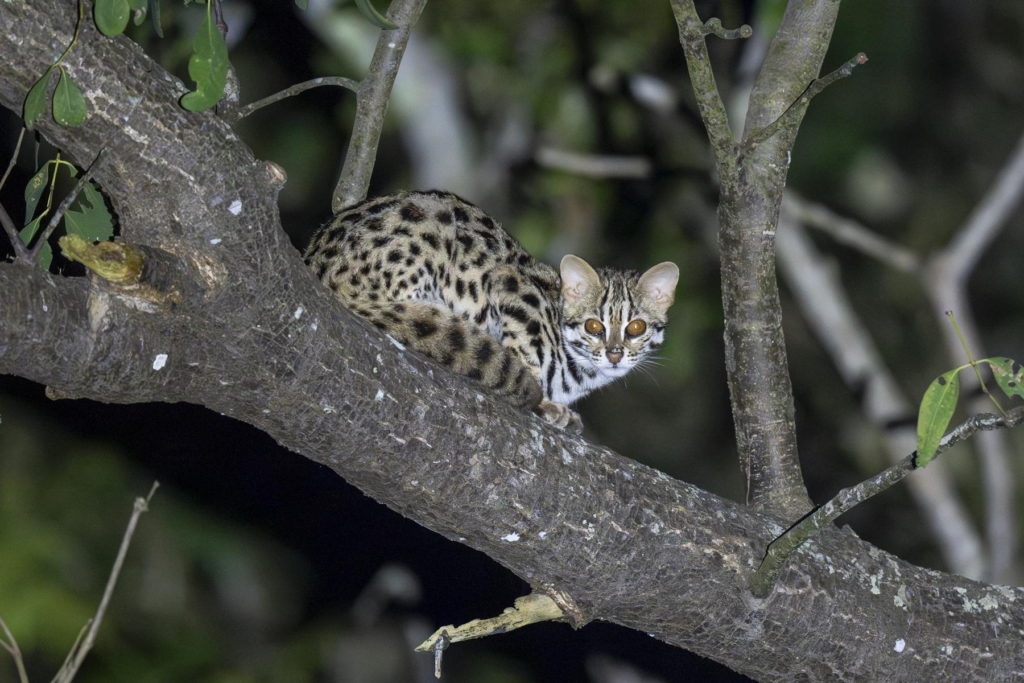
The Leopard Cat is primarily a nocturnal hunter. Solitary and elusive, it moves through vegetation and forest edges in search of small prey, relying on stealth rather than size.
In the Indian Sundarbans, recent camera-trap research has provided an even more intriguing glimpse of the species. Alongside the normally coloured Leopard Cat, researchers have documented melanistic individuals—a darker colour form—in the Sundarban Biosphere Reserve.
For an animal so rarely seen by people, the camera trap is revealing a surprisingly complex story.
Leopard Cat At a Glance
- Common Name: Leopard Cat
- Scientific Name: Prionailurus bengalensis
- Family: Felidae
- Order: Carnivora
- Size: Approximately domestic-cat sized, although considerably longer-legged and more slender
- Weight: Commonly around 3–7 kg, with variation across its geographic range
- Activity: Mainly nocturnal, with activity extending around dusk and dawn
- Social behaviour: Generally solitary
- Diet: Small mammals, birds, reptiles, amphibians and other small vertebrates
- Distribution: South, Southeast and East Asia
- Indian Sundarbans: Confirmed by camera-trap records
- Global conservation status: Least Concern
- Protection in India: Schedule I under the Wildlife (Protection) Act
- Notable Sundarbans record: Melanistic Leopard Cats documented photographically in the Indian Sundarbans
What Does a Leopard Cat Look Like?
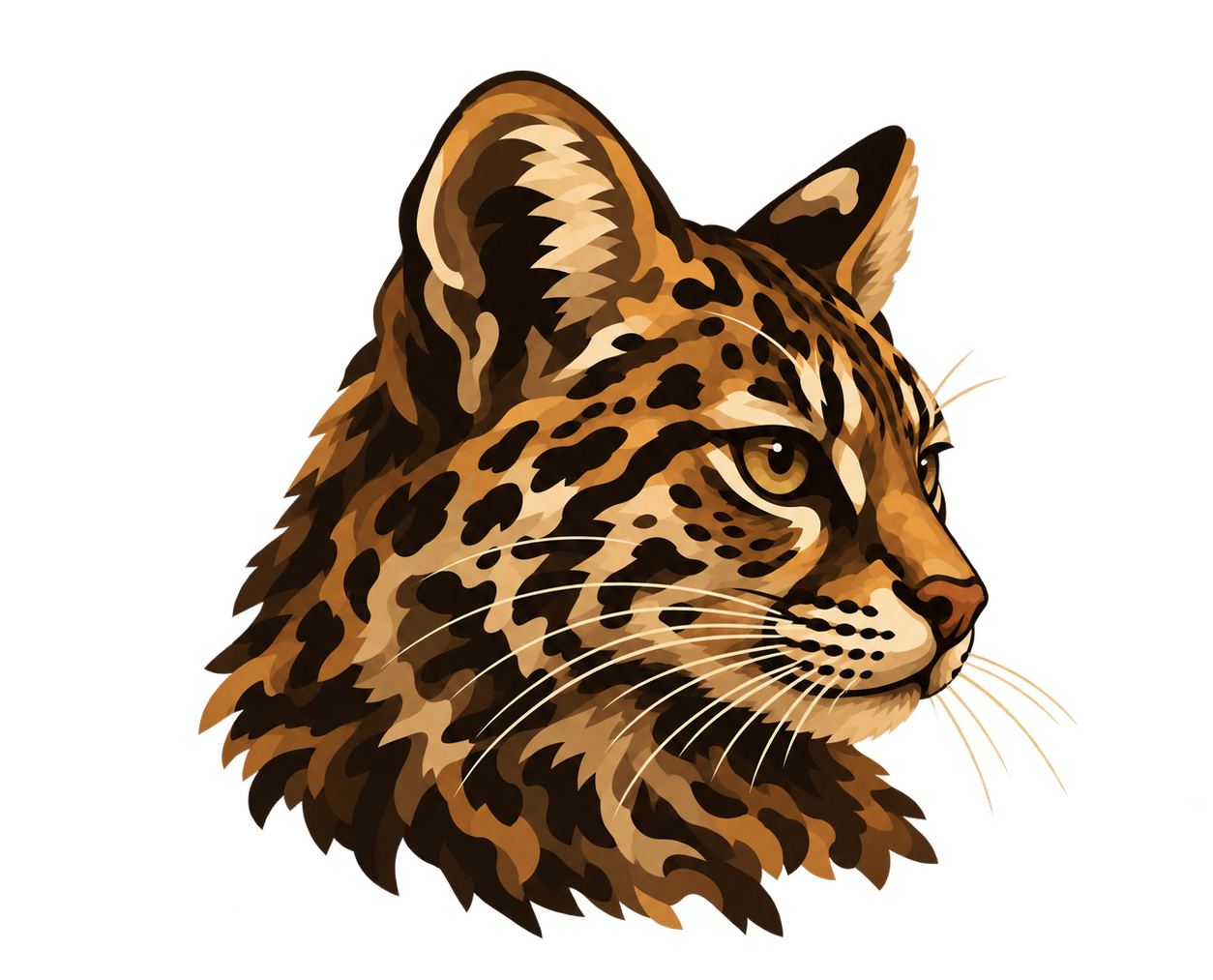
At first glance, the Leopard Cat can resemble a miniature leopard.
The resemblance comes from its spotted coat rather than from its size. Its body is generally tawny, yellowish-brown or buff, with dark spots covering the upper parts and limbs. The pattern can vary considerably between individuals and populations.
Its head is relatively small, with a short, narrow muzzle and rounded ears. The backs of the ears are dark and carry a conspicuous pale or white spot. Dark facial markings run between the eyes and towards the ears, giving the face a distinctive appearance.
The legs are relatively long compared with those of a domestic cat, giving the animal a light, agile build. Its tail is spotted and may show indistinct rings towards the darker tip.
The result is a cat built less for confrontation than for movement: compact, quiet and difficult to detect.
Unlike the leopard, whose coat is dominated by rosettes, the Leopard Cat’s body markings are primarily solid spots and blotches.
That distinction matters in the field.
A small spotted cat disappearing through vegetation in the Sundarbans is not automatically a young leopard or another large cat. Size, body proportions, facial markings, tail pattern and coat structure are important when identifying the species.
A Cat Built for the Forest Edge
The Leopard Cat is not restricted to one narrow habitat type.
Across its broad Asian distribution, it has demonstrated an ability to occupy forests, scrub, grassland, plantations and other modified landscapes. Research from different parts of its range also shows that it can use habitats close to water and adjust its movements according to the availability of prey and cover.
This adaptability is particularly important when thinking about the Sundarbans.
The Indian Sundarbans is not a conventional terrestrial forest. It is a tidal delta where land and water are constantly interacting. Forest patches are separated by creeks, channels and rivers, while salinity, flooding and sediment movement influence the conditions on the ground.
A small terrestrial predator living here must therefore operate within a landscape that changes from one tide to the next.
The Leopard Cat’s relatively small body may actually be an advantage in such an environment. It can move through dense vegetation, use narrow passages and hunt prey that are unavailable to larger carnivores.
But the species’ presence should not be interpreted as evidence that every part of the Sundarbans provides equal habitat.
The available evidence confirms its occurrence in the Indian Sundarbans, but detailed information about its population size, territory structure and habitat preferences specifically within the Indian mangrove landscape remains comparatively limited.
That distinction is important.
The presence of a species is not the same as having a complete understanding of its ecology.
The Leopard Cat in the Indian Sundarbans
The Leopard Cat is one of several small felids sharing the Indian Sundarbans with the much larger Royal Bengal Tiger.
The Wildlife Institute of India has identified the Leopard Cat among the small carnivores inhabiting the Sundarbans. More recent camera-trap work has provided direct photographic evidence of the species within the Indian Sundarbans.
The latest development is especially significant.
During camera trapping conducted between November 2024 and January 2025, researchers recorded Leopard Cats alongside Fishing Cats and Jungle Cats. The survey also produced the first photographic documentation of a melanistic Leopard Cat in the Sundarban Biosphere Reserve.
The photographs came from six locations within the Dhulibhasani, Herobhanga and Ajmalmari compartments of the Raidighi Range in South 24 Parganas.
The records were not concentrated in a single isolated location. Herobhanga was approximately 250 metres from the inhabited mainland, while Ajmalmari and Dhulibhasani were approximately 8 km and 11 km away, respectively.
This distribution suggests that the melanistic form is not necessarily confined to one tiny part of the landscape.
It also demonstrates something fundamental about the Sundarbans: much of its wildlife remains easier to detect through technology than through direct observation.
A camera trap can stand beside a forest path or within a mangrove landscape for days and nights without disturbing the animal. Eventually, a passing Leopard Cat leaves behind a few seconds of evidence—enough to confirm that it was there.
A Darker Leopard Cat
Melanism is one of the most striking aspects of the recent Sundarbans records.
A melanistic Leopard Cat has a much darker appearance than the more familiar spotted form. In the Indian Sundarbans, camera traps captured this darker form during the 2024–25 survey.
The discovery is scientifically valuable not simply because the animal looks unusual.
It expands what researchers know about the visible variation of Leopard Cats living in the Sundarbans.
The photographs were recorded at night, between approximately 19:00 and 03:00, consistent with the species’ predominantly nocturnal behaviour.
Importantly, the available publication describes this as the first photographic documentation of melanistic Leopard Cats in the Sundarban Biosphere Reserve. It does not establish how common melanism is in the broader Indian Sundarbans population.
That remains a question for future research.
More camera trapping may reveal whether the dark form is extremely rare, locally concentrated, or more widely distributed than previously recognized.
For now, it is best understood as a newly documented part of the Leopard Cat’s story in the Indian Sundarbans.
When the Forest Goes Quiet
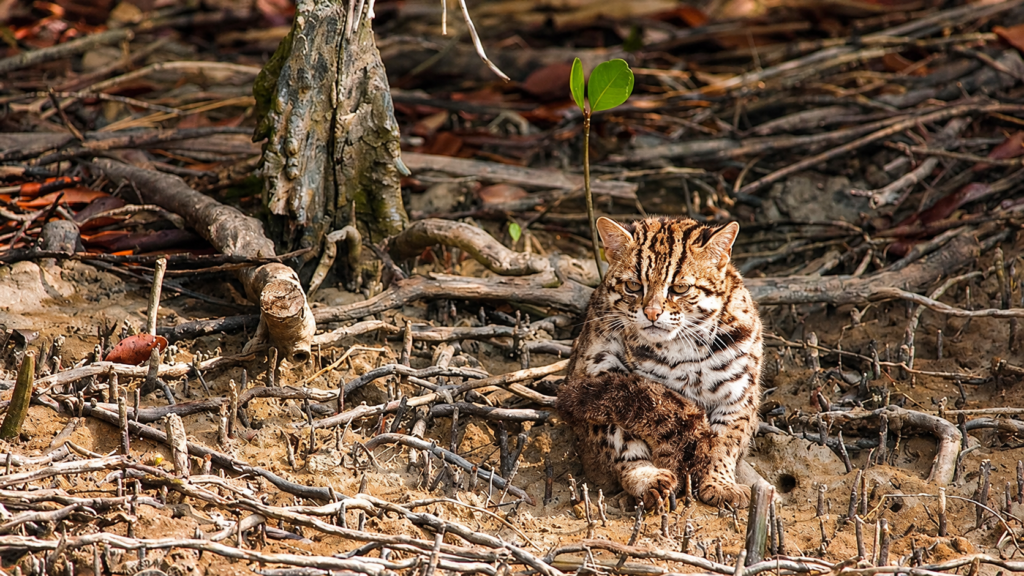
The Leopard Cat is principally a night-active animal.
Across studies of the species, activity commonly increases around dusk and continues through the night, although the precise rhythm can vary between habitats and populations.
This makes ecological sense.
Small predators moving through landscapes occupied by larger carnivores and people benefit from remaining inconspicuous. Darkness provides cover, while nocturnal prey such as rodents become active.
In the Sundarbans, the timing of activity also places the Leopard Cat inside the delta’s most visually difficult hours.
At night, the distinction between solid ground, shadow and vegetation becomes less obvious. Tidal creeks disappear into darkness, while roots, trunks and branches form an intricate network of cover.
A Leopard Cat does not need to dominate this environment.
It only needs to move through it without being noticed.
What Does the Leopard Cat Eat?
The Leopard Cat is a small predator with a broad diet.
Its prey can include rodents and other small mammals, birds, frogs, lizards and other small vertebrates. Studies from different parts of Asia have repeatedly shown the importance of small terrestrial prey, particularly rodents, while the exact composition of the diet varies with habitat and prey availability.
This flexibility is valuable in a changing landscape.
In the Sundarbans, food resources are influenced by tides, vegetation, season and the distribution of other animals. A predator that can switch between different small prey is less dependent on a single food source.
Research from the Sundarbans region of Bangladesh has also documented Leopard Cat feeding ecology through analysis of scat and field evidence, demonstrating the importance of birds and other small prey in the diet.
However, diet data from the Bangladeshi Sundarbans should not automatically be presented as an exact description of the Indian Sundarbans population.
The two landscapes form part of the same larger mangrove ecosystem, but local prey availability and habitat conditions can differ.
That is another reason why further field research in the Indian Sundarbans matters.
A Predator at the Smallest Scale
Large predators attract attention because their ecological effects are easy to imagine.
A tiger kills a deer.
A crocodile waits beside a creek.
But ecological systems also depend on predators operating at a much smaller scale.
The Leopard Cat hunts rodents, birds, amphibians, reptiles and other small animals. Through this role, it participates in the regulation of small-vertebrate populations and transfers energy through the food web.
It is a mesopredator—a predator occupying a level below the largest apex predators.
Its ecological importance should therefore not be measured by the size of the animal.
In a mangrove ecosystem, thousands of small interactions occur beyond human observation. The Leopard Cat is one participant in that network.
Solitary by Nature
Leopard Cats are generally solitary.
Adults usually move and hunt alone, coming together primarily for reproduction. Their relatively secretive behaviour contributes to the difficulty of studying them.
This is one reason camera trapping has become so valuable.
A large animal moving along a forest edge may be noticed by people, photographed by visitors or recorded through tracks. A small nocturnal cat can pass through the same landscape almost invisibly.
The camera does not need the animal to reveal itself.
It simply waits.
In the Indian Sundarbans, this approach has already produced new information about the species, including evidence that would have been extremely difficult to obtain through conventional observation.
Breeding and Young
Leopard Cat reproduction has been studied across its Asian range, although detailed breeding information specific to the Indian Sundarbans remains limited.
Gestation is generally around two months, and litters commonly contain two or three kittens. Young are born small and dependent on their mother before gradually becoming capable of independent movement and feeding.
The mother provides the essential early protection and food.
For a solitary small carnivore, this period is particularly important. Young Leopard Cats must eventually learn how to move through vegetation, locate prey and avoid danger without the protection of an adult.
The exact timing of breeding in the Indian Sundarbans should not be assumed from studies conducted elsewhere in Asia.
Seasonality can differ geographically, and there is currently insufficient Sundarbans-specific evidence to describe a precise local breeding calendar with confidence
Leopard Cat and the Other Sundarbans Cats
The Leopard Cat shares its environment with other small felids, but the species should not be confused with them.
Leopard Cat
Smaller, slender-bodied and distinctly spotted, generally nocturnal and capable of using a variety of forest and scrub habitats.
Fishing Cat
Larger and more strongly associated with wetlands, tidal creeks and aquatic environments. Its body is more heavily built, and its ecology is closely tied to wetland prey.
Jungle Cat
Generally larger and more plain-coloured, with a different body shape and habitat association. It is often associated with grassland, reedbeds, scrub and habitats around human settlements.
Royal Bengal Tiger
A completely different scale of predator. The tiger is vastly larger and occupies the apex of the Sundarbans terrestrial food web.
The coexistence of these cats illustrates how a single landscape can contain several predators occupying different ecological niches.
The Leopard Cat’s Relationship with Water
The Leopard Cat is primarily a terrestrial hunter, but it is not a species that should be imagined as completely disconnected from water.
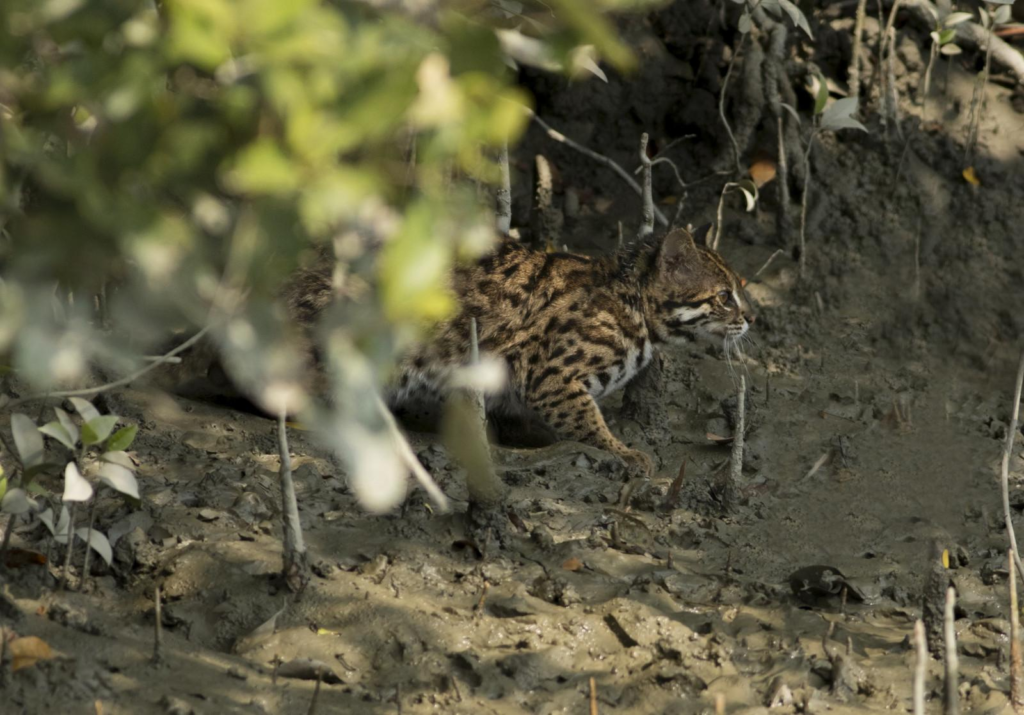
Across its range, the species occurs in habitats associated with rivers, wetlands and forested waterways, and it is capable of swimming.
For the Sundarbans, this distinction is important.
The Leopard Cat does not need to become an aquatic predator to survive in a wetland landscape. Instead, it can exploit the narrow interface between land and water, where vegetation, prey and cover meet.
This is very different from the Fishing Cat, whose ecological association with wetlands is considerably stronger.
The two species demonstrate that living in a water-dominated landscape does not require identical adaptations.
Conservation Status
Globally, the Mainland Leopard Cat is currently classified as Least Concern on the IUCN Red List.
That designation does not mean the species faces no threats.
The Leopard Cat has a very large geographic range and remains relatively widespread, but habitat loss, hunting, trade and human-related mortality affect populations in different parts of Asia.
Its adaptability has helped the species persist in landscapes that have been substantially modified by people.
The situation in the Sundarbans needs to be understood through the character of the ecosystem itself.
Mangrove loss, fragmentation, changes in land use, increasing human pressure and broader environmental changes can influence the habitats used by small carnivores. For species that depend on secure cover and adequate prey, changes at the landscape level can have consequences even when the animals remain difficult to detect.
The Leopard Cat is also legally protected in India.
It is included in Schedule I of the Wildlife (Protection) Act, 1972, placing it among India’s highest levels of statutory wildlife protection.
Protection on paper, however, is only one part of conservation.
Understanding where the species occurs, how it moves through the mangrove landscape, what it eats and how populations respond to environmental change is equally important.
What Makes the Leopard Cat of the Sundarbans Interesting?
The Leopard Cat is not unique to the Sundarbans. It is a widespread Asian small cat.
What makes its presence here interesting is the way this adaptable predator exists within one of the world’s most dynamic tidal landscapes.
The Sundarbans forces terrestrial wildlife to live with conditions that are unusual even by forest standards.
- Land is fragmented by water.
- Vegetation grows under saline influence.
- Tides reshape access to the ground.
And large portions of the landscape are difficult for people to enter and observe.
Yet the Leopard Cat persists.
Recent camera-trap work has now added another layer to that story: the documentation of melanistic Leopard Cats in the Indian Sundarbans.
This is not simply a curious colour variation.
It is evidence that the species still contains ecological and biological stories that have not yet been fully documented.
Why the Leopard Cat Matters to the Sundarbans
Wildlife conservation is often built around the animals that people already know.
- The tiger is famous.
- The crocodile is feared.
- The Fishing Cat attracts attention because of its association with water.
The Leopard Cat is different.
- It is small.
- It is nocturnal.
- It is solitary.
And it rarely announces its presence.
Yet its existence reminds us that the Sundarbans is not defined by a handful of iconic species. It is a living network of predators, prey, plants, microorganisms and ecological processes operating at many different scales.
Protecting that network means protecting animals that are easy to see and those that almost never are.
The Leopard Cat belongs to the second group.
Its story is largely written in footprints, camera-trap frames and fleeting encounters.
FAQs
Is the Leopard Cat found in the Indian Sundarbans?
Yes. Leopard Cats have been documented in the Indian Sundarbans through camera-trap surveys. Recent research has also documented melanistic individuals in the Sundarban Biosphere Reserve.
Is the Leopard Cat the same as a leopard?
See it for yourself
A private journey shaped around you — your group, your pace, your interests. Book a free consultation.
No. They are different species. The Leopard Cat is a small wild cat roughly comparable in size to a domestic cat, while the leopard is a much larger member of the genus Panthera.
Is the Leopard Cat nocturnal?
Yes. The species is predominantly nocturnal, although activity patterns can vary according to habitat and local conditions.
What does a Leopard Cat eat?
Its diet includes small mammals, birds, amphibians, reptiles and other small vertebrates. Rodents can be particularly important prey.
Is the Leopard Cat dangerous to humans?
Leopard Cats are small, elusive wild cats and generally avoid people. They should nevertheless be treated as wild animals and never approached, cornered or handled.
How rare is the Leopard Cat in the Sundarbans?
There is not enough published evidence to give a reliable population estimate specifically for the Indian Sundarbans. Camera-trap records confirm its presence, but the species’ precise abundance and distribution require further research.
What is a melanistic Leopard Cat?
A melanistic Leopard Cat is a darker-coloured form of the species. Camera traps recently documented melanistic individuals in the Indian Sundarbans for the first time photographically.
What is the conservation status of the Leopard Cat?
The Mainland Leopard Cat is classified as Least Concern globally by the IUCN. In India, it receives the highest level of protection under Schedule I of the Wildlife (Protection) Act.
The Quiet Presence of the Leopard Cat
The Leopard Cat does not command the Sundarbans.
It does not roar across the forest or leave a trail that everyone notices.
Instead, it moves quietly through the darkness.
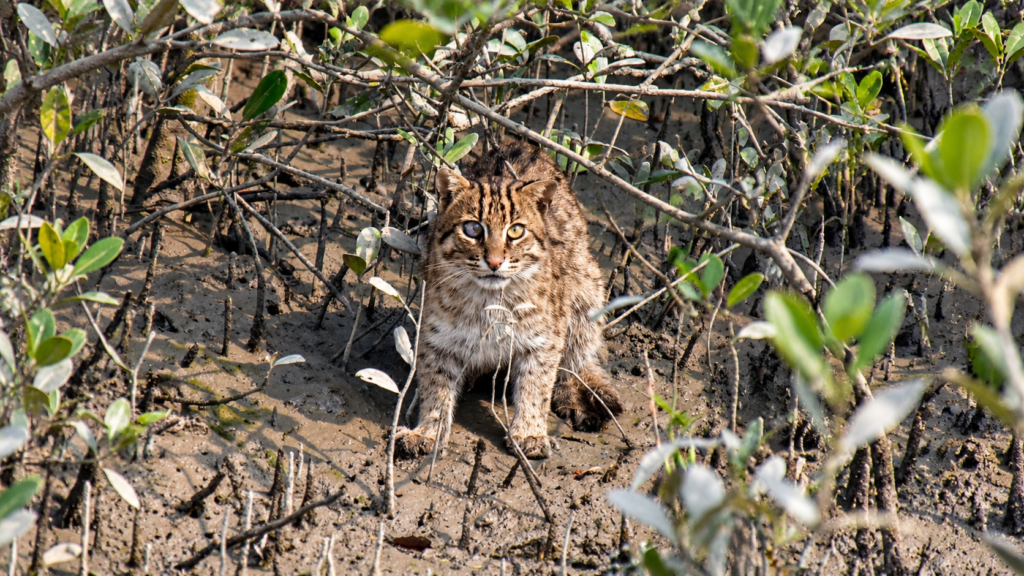
Somewhere beyond the last visible channel, a small spotted cat may be following the edge of a mangrove thicket, searching for movement in the leaf litter. A rodent shifts beneath the vegetation. A bird settles for the night. The tide continues to rise beyond the trees.
For a few seconds, an infrared camera may capture the animal passing through the frame.
Then it disappears again.
That is the nature of the Leopard Cat in the Sundarbans: present, elusive and still only partly understood.
And perhaps that is precisely why it deserves closer attention. Because every new camera-trap image does more than record a small wild cat.
It reveals another piece of the living Sundarbans.