 Field guide
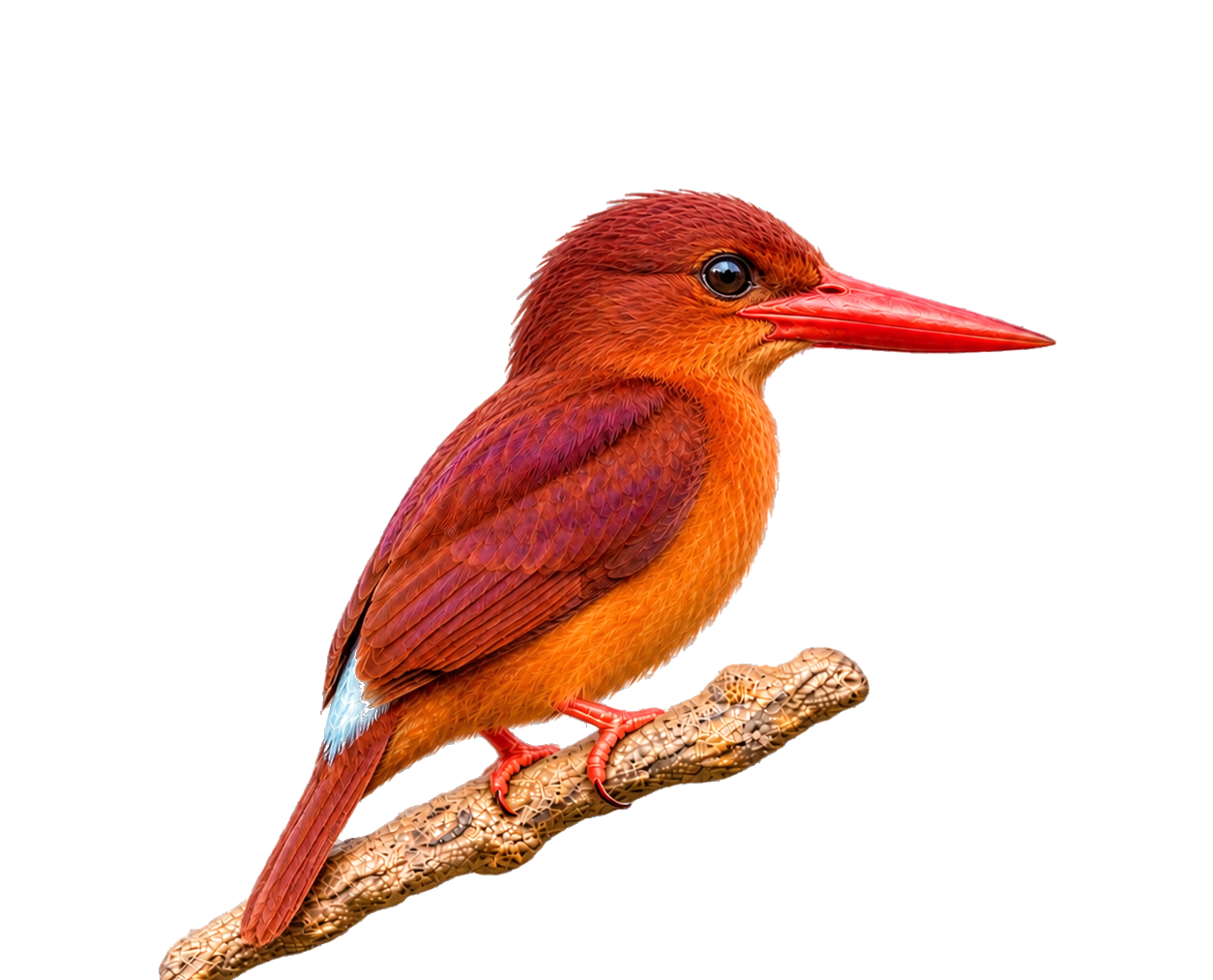
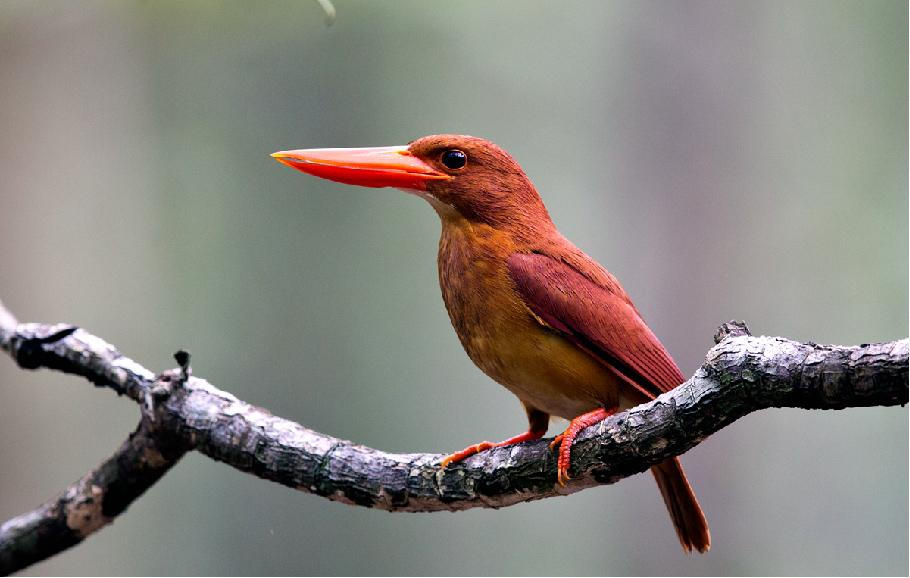
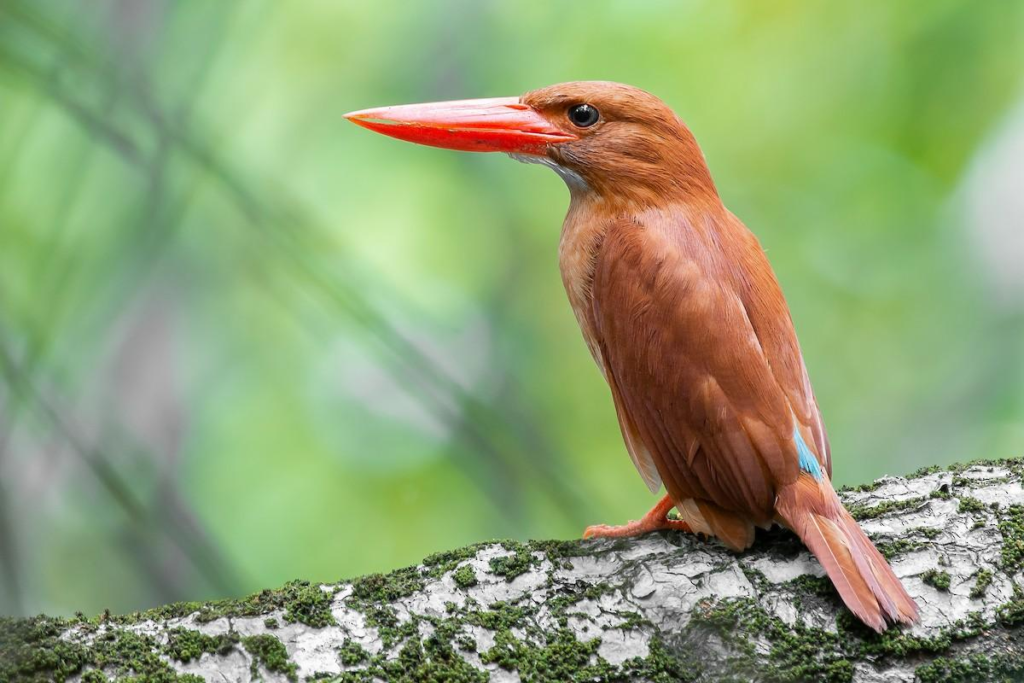
The Ruddy Kingfisher is a medium-sized kingfisher belonging to the family Alcedinidae. Its scientific name is Halcyon coromanda, and it is recognised by its predominantly reddish-chestnut plumage, substantial bright red bill and contrasting pale bluish-white rump.
At approximately 25–27 centimetres in length, it is considerably larger than the small river kingfishers commonly encountered along open waterways.
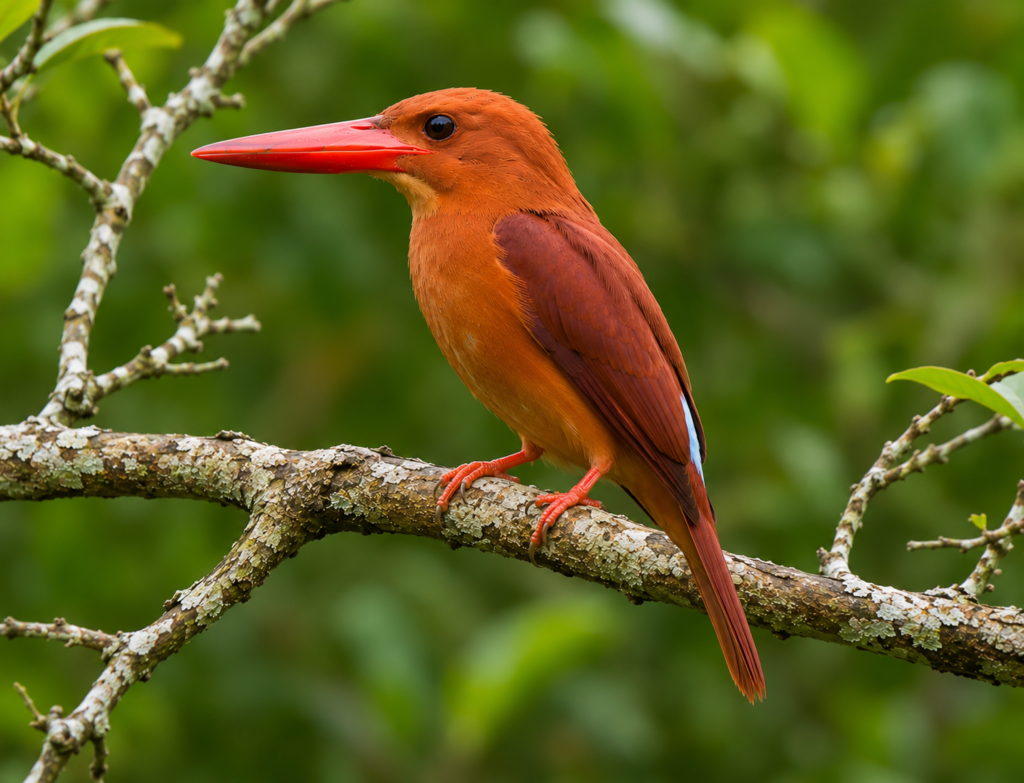
Its appearance is unusual among Indian kingfishers. Rather than displaying the brilliant turquoise or electric-blue upperparts associated with several familiar species, the Ruddy Kingfisher carries a predominantly warm, earthy colour palette.
It is also a relatively secretive bird. It generally keeps to wooded environments, where its chestnut plumage can blend into the shaded surroundings.
For birdwatchers exploring the Indian Sundarbans, recognising this species requires attention not only to colour but also to its distinctive rump, bill and overall body structure.
Ruddy Kingfisher at a Glance
| Field | Information |
| Common Name | Ruddy Kingfisher |
| Scientific Name | Halcyon coromanda |
| Order | Coraciiformes |
| Family | Alcedinidae |
| Genus | Halcyon |
| Global Conservation Status | Least Concern (IUCN, 2025) |
| Indian Legal Protection | Schedule II, Wildlife (Protection) Act |
| Occurrence in West Bengal | Documented in regional ornithological literature |
| Sundarbans Association | Recognised in historical regional literature |
| Seasonal Status in India | Resident and summer migrant, according to State of India’s Birds |
| Preferred Habitat | Evergreen woodland, freshwater and brackish swamps, mangroves |
| Approximate Length | 25–27 cm |
| Diet | Fish, crustaceans, insects and other small animals |
| Distinctive Features | Chestnut plumage, red bill and pale bluish-white rump |
Taxonomy and Scientific Classification
The Ruddy Kingfisher belongs to the order Coraciiformes, which includes kingfishers, bee-eaters and rollers.
Its family, Alcedinidae, contains several familiar Indian kingfishers, including the White-throated Kingfisher, Black-capped Kingfisher and Collared Kingfisher.
The accepted scientific name is Halcyon coromanda, originally described by John Latham in 1790.
The species has several geographical subspecies distributed across eastern and southeastern Asia. The nominate form, H. c. coromanda, occurs across parts of the eastern Himalayan region and northeastern Indian subcontinent.
Distribution: From Eastern India to Southeast Asia
The Ruddy Kingfisher has a broad geographical distribution extending across eastern and southeastern Asia.
Its range includes:
- Northeastern India
- Eastern Himalayan foothills
- Bangladesh
- Myanmar
- China
- Japan and the Korean Peninsula
- Parts of Southeast Asia
- Several islands of the Indonesian and Philippine archipelagos
Within India, it is particularly associated with the northeastern region, although ornithological field guides also document its occurrence in West Bengal and the Andaman Islands.
The Birds of the Indian Subcontinent field guide by Ranjit Manakadan, J. C. Daniel and Nikhil Bhopale records the species in West Bengal and identifies mangrove swamps among its habitats.
An older regional ornithological account also explicitly includes the Sundarbans in its distribution.
These references establish a historical and regional association, although they should not be interpreted as evidence of a continuously distributed or regularly observed population throughout the Indian Sundarbans.
Habitat: Where the Ruddy Kingfisher Belongs
The Ruddy Kingfisher is primarily associated with forested environments containing suitable feeding opportunities.
Its preferred habitats include:
- Dense tropical and subtropical evergreen forests
- Shaded forest streams
- Freshwater pools
- Freshwater and brackish swamps
- Mangrove forests
- Wooded wetlands and forest edges
Its association with mangroves makes the species particularly interesting in the context of the Sundarbans.
However, not every mangrove environment provides equally suitable habitat. The species’ preference for wooded, relatively secluded environments suggests that vegetation structure and available prey may be important factors.
The Indian Sundarbans contains an intricate network of tidal rivers, creeks, mangrove islands and freshwater-influenced landscapes. These environments create a complex habitat mosaic in which different kingfisher species exploit different ecological opportunities.
The Ruddy Kingfisher’s presence in this wider landscape is therefore best understood through its woodland and wetland requirements rather than assuming that it occupies every tidal creek.
Is the Ruddy Kingfisher a Resident or Migratory Bird?
The answer requires geographical context.
The State of India’s Birds identifies the Ruddy Kingfisher’s migratory status in India as Resident and Summer Migrant.
This classification reflects the species’ varied movements across its Indian distribution.
Northern populations can undertake seasonal movements, while some populations in warmer parts of its range remain resident.
However, this national classification does not establish the exact seasonal status of the species in the Indian Sundarbans.
There is insufficient publicly established regional evidence to confidently classify its Sundarbans population as a permanent resident, regular summer visitor or seasonal migrant.
This distinction is important because a species’ overall migration behaviour cannot automatically be applied to every geographical region within its range.
How to Identify the Ruddy Kingfisher
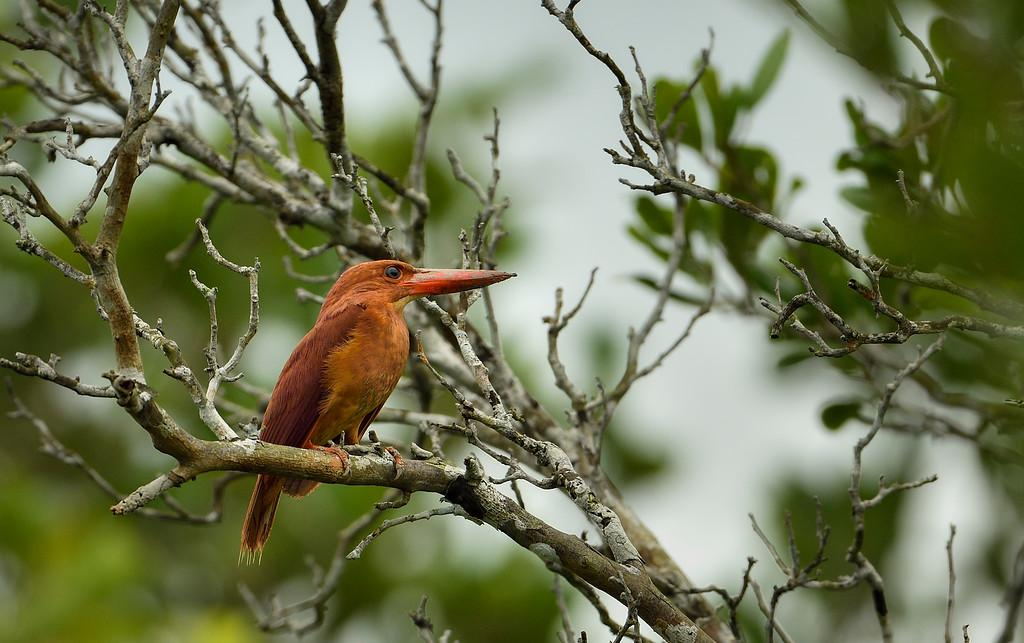
The Ruddy Kingfisher possesses several distinctive identification features that make it recognisable once properly observed.
Its most noticeable characteristic is its predominantly cinnamon-chestnut appearance.
Unlike many other kingfishers, its body does not depend on extensive bright-blue plumage for visual distinction.
The following features are particularly useful:
Head and upperparts
The head, neck and mantle are predominantly rufous-chestnut to cinnamon. Depending on lighting, the upperparts can show a subtle violet or purplish sheen.
Underparts
The breast and belly are generally warm rufous, maintaining the overall reddish appearance.
Rump
The lower back and rump possess a contrasting pale bluish-white patch. This feature becomes especially noticeable when the bird takes flight.
Bill
The bill is large, strong and bright red. Its substantial structure is characteristic of the species.
Legs and feet
These are also reddish, complementing the bill.
Eyes
The eyes are dark, providing contrast against the warm-coloured head.
The sexes are generally similar in appearance, making identification primarily dependent on plumage and structural characteristics rather than obvious differences between males and females.
Plumage and Distinctive Field Marks
The Ruddy Kingfisher’s plumage is among its most recognisable characteristics.
Its chestnut coloration creates a relatively uniform appearance, although subtle variations occur across different body regions.
The upperparts are generally richer and darker, while the underparts appear somewhat lighter and more orange-rufous.
The pale rump is particularly important because it provides a strong identification feature when the bird moves between perches.
Juveniles differ from adults. Their upperparts tend to be browner, and their underparts can show fine dark barring. Their rump may also appear bluer.
These differences should be considered when identifying immature individuals.
A Powerful Bill and a Hunting Strategy
The Ruddy Kingfisher’s substantial red bill is an important part of its feeding anatomy. Like other kingfishers, it uses its bill to seize and manipulate prey. However, it is not exclusively dependent on catching fish.
Its diet includes:
- Small fish
- Crustaceans
- Crabs
- Aquatic insects
- Beetles and other terrestrial insects
- Frogs and other small amphibians
The precise dietary composition can vary according to habitat and prey availability.
This varied diet allows the species to exploit more than one feeding opportunity within forested wetlands.
It is important not to assume that every Ruddy Kingfisher observed near water is necessarily fishing. The species can also forage for terrestrial and aquatic invertebrates.
Flight and Movement
See it for yourself
A private journey shaped around you — your group, your pace, your interests. Book a free consultation.
The Ruddy Kingfisher is generally an elusive bird that spends considerable time within vegetation.
It commonly moves between secluded perches, using its flight to travel through wooded environments.
One of its most distinctive flight characteristics is the contrasting pale rump, which becomes visible against the darker chestnut body.
This provides a useful identification opportunity when the bird is seen briefly crossing an opening.
Its shy nature and preference for secluded habitat can make visual observation difficult, even in areas where suitable habitat exists.
What It Eats and How It Finds Food
The Ruddy Kingfisher uses perching and short hunting movements to locate prey.
Its diet is not restricted to fish, distinguishing its ecological requirements from those of strictly fish-dependent aquatic predators.
Small fish and crustaceans provide opportunities in wetland environments, while insects and other small animals can be taken in forested surroundings.
Research conducted on a Japanese population of the species has also documented the importance of frogs and fish in food delivered to nestlings.
However, those findings relate to a different geographical population and should not be treated as a direct description of the species’ diet in the Indian Sundarbans.
For the Sundarbans, detailed local dietary studies remain an important research opportunity.
A Secretive Life Among Trees
The Ruddy Kingfisher is generally solitary or encountered in pairs.
It is not a typical flock-forming kingfisher and is often described as shy and secretive. Its behaviour is closely associated with secluded wooded habitats.
Unlike the White-throated Kingfisher, which frequently occupies exposed electrical wires, fences, branches and other prominent perches around settlements, the Ruddy Kingfisher is more closely associated with forested environments.
This difference in habitat preference can be useful when identifying kingfishers during birdwatching.
Calls and Vocal Communication
The Ruddy Kingfisher produces distinctive vocalisations that can help reveal its presence even when the bird remains hidden.
Its calls are generally described as high-pitched, descending whistles.
Some field guides describe a repeated piping or trilling quality to its vocal communication.
For birdwatchers, listening carefully can be particularly useful in dense vegetation, where the bird’s chestnut plumage may be difficult to distinguish against shaded branches.
However, calls should not be used in isolation for confirming a local record without considering other identification evidence.
Breeding and Nesting Behaviour
The Ruddy Kingfisher is a cavity-nesting bird.
Like several other woodland kingfishers, it uses excavated nesting chambers and tunnels rather than constructing an exposed cup-shaped nest on a branch.
Historical species accounts describe nesting tunnels excavated into suitable earthen banks, particularly in forest environments.
The breeding biology of the species has also been studied in Japan, where researchers documented parental involvement in nest excavation, incubation and feeding of chicks.
Breeding information varies across geographical populations, and breeding observations from Japan or other parts of Asia should not automatically be applied to the Indian Sundarbans.
At present, a sufficiently detailed and verifiable account of local nesting activity in the Indian Sundarbans is not established in the sources consulted for this article.
Consequently, its occurrence in the region should not be interpreted as proof of local breeding.
Interactions With the Sundarbans Ecosystem
The Ruddy Kingfisher occupies an ecological position within the food web as a predator of smaller animals.
By feeding on insects, crustaceans, fish and amphibians, it participates in the movement of energy through forest and wetland food webs.
Its varied diet also illustrates the ecological connections between terrestrial vegetation and aquatic environments.
In a landscape such as the Sundarbans, where forest margins meet tidal waterways and wetlands, these connections are particularly important.
Nevertheless, the exact contribution of the Ruddy Kingfisher to local prey regulation or ecosystem processes has not been quantified through species-specific research in the Indian Sundarbans.
Human Interaction and Disturbance
The species’ preference for secluded environments makes habitat condition an important consideration.
Vegetation clearance, disturbance around wooded wetlands and degradation of suitable forest habitat can potentially affect the availability of feeding and nesting environments.
For birdwatchers and wildlife photographers, responsible observation is essential.
Avoid approaching suspected nesting sites, disturbing secluded perches or using repeated playback to attract individuals.
A bird that remains hidden is not necessarily absent. Sometimes, the most meaningful observation is simply recognising the habitat that supports it.
Conservation Status of the Ruddy Kingfisher
The species is globally classified as Least Concern. However, its assessed population trend is decreasing.
The Ruddy Kingfisher is classified as Least Concern on the IUCN Red List. This classification indicates that the species does not currently meet the global criteria for a threatened category.
However, Least Concern should not be interpreted as an absence of conservation concerns. The 2025 assessment identifies a decreasing global population trend.
The State of India’s Birds also identifies the species as a moderate conservation priority, with insufficient data for establishing its long-term and current annual population trends. In India, the species is listed under Schedule II of the Wildlife (Protection) Act.
Conservation Challenges
The Ruddy Kingfisher depends on suitable forest and wetland environments. Potential conservation concerns include:
Habitat degradation: The loss or deterioration of wooded wetlands can reduce suitable feeding and nesting environments.
Forest disturbance: Excessive disturbance around secluded forest habitats can affect the availability of suitable nesting and feeding areas.
Wetland degradation: Changes in water quality and prey availability can influence the ecological conditions supporting the species.
Climate change: Changes in rainfall, temperature and wetland hydrology may influence habitat suitability. However, the specific consequences for Ruddy Kingfisher populations in the Indian Sundarbans remain insufficiently studied.
Conservation planning should therefore consider the wider forest and wetland landscape rather than focusing exclusively on the bird itself.
Where Can the Ruddy Kingfisher Be Observed in the Indian Sundarbans?
The Ruddy Kingfisher is associated with the wider Sundarbans region in historical ornithological literature.
The Birds of the Indian Subcontinent field guide documents the species in West Bengal and includes mangrove swamps among its habitats. An older regional account also identifies the Sundarbans within its distribution.
However, the available references do not establish a reliable, contemporary, site-specific list of locations within the Indian Sundarbans where the species can regularly be observed.
For this reason, it would be scientifically inappropriate to identify Sajnekhali, Sudhanyakhali, Dobanki, Bonnie Camp or other individual locations as confirmed Ruddy Kingfisher hotspots without verifiable records.
Wooded wetland environments may provide suitable habitat, but habitat suitability alone does not establish the bird’s presence.
For serious birdwatchers, dated and independently verifiable observations are particularly valuable in improving the understanding of this species’ regional distribution.
When Is the Ruddy Kingfisher Present?
The species has a mixed resident and summer-migrant classification in the Indian context, according to the State of India’s Birds.
However, its precise seasonal occurrence in the Indian Sundarbans remains insufficiently documented.
It is therefore not possible to provide a scientifically defensible month-by-month observation calendar for the region.
More systematic observations across different seasons would help establish whether the species occurs regularly, arrives seasonally or appears only occasionally in particular parts of the landscape.
The Important Truth About Bird Observation
Birdwatching is influenced by several interconnected factors.
Tide, weather, vegetation, season, feeding activity and the time spent surveying an area can all influence whether a bird is detected.
The Ruddy Kingfisher’s secretive behaviour makes this particularly relevant.
A suitable habitat does not guarantee a sighting, and a lack of sightings does not necessarily establish absence.
Similarly, a single observation cannot demonstrate a resident population or regular seasonal occurrence.
Reliable bird records should ideally include:
- Date and geographical location
- Clear photographic or acoustic evidence, where possible
- Diagnostic identification features
- Habitat description
- Observer and verification details
These observations can contribute to a more accurate understanding of the species’ distribution in the Indian Sundarbans.
What Makes the Ruddy Kingfisher of the Sundarbans Unique?
The Ruddy Kingfisher is not an endemic species of the Sundarbans, nor is there evidence that the regional population possesses a separate biological identity.
Its significance lies in its association with the wider forest and wetland environments of eastern India.
The Sundarbans is generally recognised for its mangrove specialists, particularly species that depend heavily on tidal waterways and intertidal habitats.
The Ruddy Kingfisher represents a somewhat different ecological relationship.
Its association with wooded wetlands, secluded vegetation, streams and swamp forests highlights the importance of habitat diversity within the larger mangrove landscape.
It also reminds us that the biodiversity of the Sundarbans cannot be understood through its most familiar or frequently photographed species alone.
Some birds are conspicuous along open waterways. Others remain concealed within vegetation, revealing themselves only briefly.
The Ruddy Kingfisher belongs to this latter group.
Its documented regional association is meaningful, but the precise nature of its contemporary distribution within the Indian Sundarbans remains an area where further field documentation is needed.
Myths and Facts About the Ruddy Kingfisher
| Common Misconception | Scientific Understanding |
| The Ruddy Kingfisher feeds exclusively on fish. | Its diet also includes insects, crustaceans and amphibians. |
| Every Ruddy Kingfisher is migratory. | The species includes resident and seasonally moving populations. |
| Its red plumage makes it easy to observe. | It is a secretive bird associated with secluded wooded habitats. |
| It is endemic to the Sundarbans. | It has a much wider distribution across eastern and southeastern Asia. |
| Its presence in mangroves means it occupies every mangrove island. | Habitat suitability and confirmed occurrence are different things. |
| Least Concern means its population is increasing. | The IUCN’s 2025 assessment identifies a decreasing global population trend. |
FAQs
1. What is the scientific name of the Ruddy Kingfisher?
The scientific name is Halcyon coromanda. It belongs to the order Coraciiformes and family Alcedinidae.
2. Is the Ruddy Kingfisher found in the Indian Sundarbans?
Historical ornithological literature includes the Sundarbans in its distribution, and regional field guides document the species in West Bengal. However, contemporary site-specific occurrence requires further documentation.
3. How can you identify a Ruddy Kingfisher?
Look for its cinnamon-chestnut plumage, bright red bill and reddish feet. Its contrasting pale bluish-white rump is particularly noticeable during flight.
4. Is the Ruddy Kingfisher a migratory bird?
The species includes both resident and migratory populations. The State of India’s Birds classifies its Indian status as Resident and Summer Migrant. Its exact seasonal status in the Indian Sundarbans remains uncertain.
5. What does the Ruddy Kingfisher eat?
It feeds on fish, crustaceans, crabs, insects and small amphibians. Its diet varies according to habitat and prey availability.
6. Is the Ruddy Kingfisher a rare bird?
It is a relatively secretive species, and its distribution is not equally well documented throughout its range. Its local abundance in the Indian Sundarbans has not been reliably established.
7. Does the Ruddy Kingfisher breed in the Sundarbans?
Its breeding biology is documented in other parts of its range. However, the available evidence consulted here does not establish confirmed local breeding in the Indian Sundarbans.
8. What is the conservation status of the Ruddy Kingfisher?
It is classified as Least Concern on the IUCN Red List, with a decreasing global population trend in the 2025 assessment.
9. How is the Ruddy Kingfisher different from the White-throated Kingfisher?
The Ruddy Kingfisher has predominantly chestnut-red plumage and a pale rump. The White-throated Kingfisher has brilliant turquoise-blue upperparts, a chocolate-brown head and a distinctive white throat and breast.
10. Is the Ruddy Kingfisher endemic to India?
No. It occurs across a much wider geographical range covering eastern and southeastern Asia.
The Wild Orbit Perspective
The Sundarbans is often understood through its most celebrated wildlife: the Royal Bengal Tiger, estuarine crocodile, spotted deer and the remarkable diversity of its kingfishers.
But the ecological character of this landscape is also shaped by birds that are rarely seen and sometimes poorly documented.
The Ruddy Kingfisher is one such bird.
Its chestnut plumage, bright red bill and pale rump distinguish it from many of the more familiar kingfishers of the region. Yet its real importance extends beyond identification.
It represents the relationship between forest vegetation, freshwater influence, wetland environments and the wider ecological network of the Indian Sundarbans.
For The Wild Orbit, documenting such species is part of understanding the Sundarbans as a living ecosystem rather than simply a destination for wildlife sightings.
There is still much to learn about the Ruddy Kingfisher’s regional distribution, movements and breeding ecology. Every responsibly documented observation can contribute to that understanding.
Sometimes, the most interesting stories of the Sundarbans are not about the wildlife that appears before us, but about the species whose presence reminds us how much of this extraordinary landscape remains to be understood.
Plan your private Sundarban expedition
A private journey shaped around you — your group, your pace, your interests. Book a free consultation.